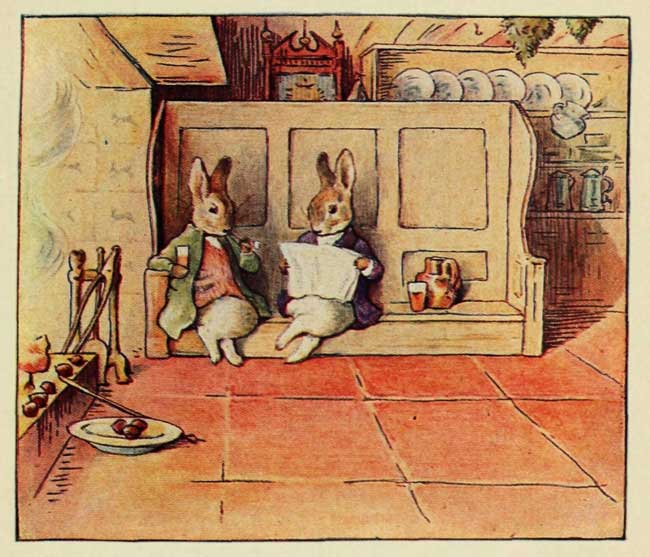
Two Rabbits, One Reading, One Smoking and Drinking — Beatrix Potter

illus-0007-1

Happy Days — Samuel Beckett (2000 Filmed Production)

Sayonara Nippon — Katsuhiro Otomo

tumblr_lfeha28HxI1qdx1cuo1_r1_1280

(Via).

Errors on Walt Whitman // Jorge Luis Borges

whitman

Rabbit — Henri Rousseau

“Sound and Fury” — O. Henry

“Sound and Fury” by O. Henry

PERSONS OF THE DRAMA

Mr. Penne An Author
Miss Lore An Amanuensis

Scene—Workroom of Mr. Penne’s popular novel factory.
Mr. Penne—Good morning, Miss Lore. Glad to see you so prompt. We should finish that June installment for the Epoch to-day. Leverett is crowding me for it. Are you quite ready? We will resume where we left off yesterday. (Dictates.) “Kate, with a sigh, rose from his knees, and—”

Miss Lore—Excuse me; you mean “rose from her knees,” instead of “his,” don’t you?

Mr. Penne—Er—no—”his,” if you please. It is the love scene in the garden. (Dictates.) “Rose from his knees where, blushing with youth’s bewitching coyness, she had rested for a moment after Cortland had declared his love. The hour was one of supreme and tender joy. When Kate—scene that Cortland never—”

Miss Lore—Excuse me; but wouldn’t it be more grammatical to say “when Kate saw,” instead of “seen”?

Mr. Penne—The context will explain. (Dictates.) “When Kate—scene that Cortland never forgot—came tripping across the lawn it seemed to him the fairest sight that earth had ever offered to his gaze.”

Miss Lore—Oh!

Mr. Penne (dictates)—”Kate had abandoned herself to the joy of her new-found love so completely, that no shadow of her former grief was cast upon it. Cortland, with his arm firmly entwined about her waist, knew nothing of her sighs—”

Miss Lore—Goodness! If he couldn’t tell her size with his arm around—

Mr. Penne (frowning)—”Of her sighs and tears of the previous night.”

Miss Lore—Oh!

Mr. Penne (dictates)—”To Cortland the chief charm of this girl was her look of innocence and unworldiness. Never had nun—”

Miss Lore—How about changing that to “never had any?”

Mr. Penne (emphatically)—”Never had nun in cloistered cell a face more sweet and pure.”

Miss Lore—Oh!

Mr. Penne (dictates)—”But now Kate must hasten back to the house lest her absence be discovered. After a fond farewell she turned and sped lightly away. Cortland’s gaze followed her. He watched her rise—”

Miss Lore—Excuse me, Mr. Penne; but how could he watch her eyes while her back was turned toward him?

Mr. Penne (with extreme politeness)—Possibly you would gather my meaning more intelligently if you would wait for the conclusion of the sentence. (Dictates.) “Watched her rise as gracefully as a fawn as she mounted the eastern terrace.”

Miss Lore—Oh!

Mr. Penne (dictates)—”And yet Cortland’s position was so far above that of this rustic maiden that he dreaded to consider the social upheaval that would ensue should he marry her. In no uncertain tones the traditional voices of his caste and world cried out loudly to him to let her go. What should follow—”

Miss Lore (looking up with a start)—I’m sure I can’t say, Mr. Penne. Unless (with a giggle) you would want to add “Gallegher.”

Mr. Penne (coldly)—Pardon me. I was not seeking to impose upon you the task of a collaborator. Kindly consider the question a part of the text.

Miss Lore—Oh!

Mr. Penne (dictates)—”On one side was love and Kate; on the other side his heritage of social position and family pride. Would love win? Love, that the poets tell us will last forever! (Perceives that Miss Lore looks fatigued, and looks at his watch.) That’s a good long stretch. Perhaps we’d better knock off a bit.”

(Miss Lore does not reply.)

Mr. Penne—I said, Miss Lore, we’ve been at it quite a long time— wouldn’t you like to knock off for a while?

Miss Lore—Oh! Were you addressing me before? I put what you said down. I thought it belonged in the story. It seemed to fit in all right. Oh, no; I’m not tired.

Mr. Penne—Very well, then, we will continue. (Dictates.) “In spite of these qualms and doubts, Cortland was a happy man. That night at the club he silently toasted Kate’s bright eyes in a bumper of the rarest vintage. Afterward he set out for a stroll with, as Kate on—”

Miss Lore—Excuse me, Mr. Penne, for venturing a suggestion; but don’t you think you might state that in a less coarse manner?

Mr. Penne (astounded)—Wh-wh—I’m afraid I fail to understand you.

Miss Lore—His condition. Why not say he was “full” or “intoxicated”? It would sound much more elegant than the way you express it.

Mr. Penne (still darkly wandering)—Will you kindly point out, Miss Lore, where I have intimated that Cortland was “full,” if you prefer that word?

Miss Lore (calmly consulting her stenographic notes)—It is right here, word for word. (Reads.) “Afterward he set out for a stroll with a skate on.”

Mr. Penne (with peculiar emphasis)—Ah! And now will you kindly take down the expurgated phrase? (Dictates.) “Afterward he set out for a stroll with, as Kate on one occasion had fancifully told him, her spirit leaning upon his arm.”

Miss Lore—Oh!

Mr. Penne (dictates)—Chapter thirty-four. Heading—”What Kate Found in the Garden.” “That fragrant summer morning brought gracious tasks to all. The bees were at the honeysuckle blossoms on the porch. Kate, singing a little song, was training the riotous branches of her favorite woodbine. The sun, himself, had rows—”

Miss Lore—Shall I say “had risen”?

Mr. Penne (very slowly and with desperate deliberation)—”The—sun—himself—had—rows—of—blushing—pinks—and—hollyhocks—and—hyacinths—waiting—that—he—might—dry—their—dew-drenched—cups.”

Miss Lore—Oh!

Mr. Penne (dictates)—”The earliest trolley, scattering the birds from its pathway like some marauding cat, brought Cortland over from Oldport. He had forgotten his fair—”

Miss Lore—Hm! Wonder how he got the conductor to—

Mr. Penne (very loudly)—”Forgotten his fair and roseate visions of the night in the practical light of the sober morn.”

Miss Lore—Oh!

Mr. Penne (dictates)—”He greeted her with his usual smile and manner. ‘See the waves,’ he cried, pointing to the heaving waters of the sea, ‘ever wooing and returning to the rockbound shore.'” “‘Ready to break,’ Kate said, with—”

Miss Lore—My! One evening he has his arm around her, and the next morning he’s ready to break her head! Just like a man!

Mr. Penne (with suspicious calmness)—There are times, Miss Lore, when a man becomes so far exasperated that even a woman—But suppose we finish the sentence. (Dictates.) “‘Ready to break,’ Kate said, with the thrilling look of a soul-awakened woman, ‘into foam and spray, destroying themselves upon the shore they love so well.”

Miss Lore—Oh!

Mr. Penne (dictates)—”Cortland, in Kate’s presence heard faintly the voice of caution. Thirty years had not cooled his ardor. It was in his power to bestow great gifts upon this girl. He still retained the beliefs that he had at twenty.” (To Miss Lore, wearily) I think that will be enough for the present.

Miss Lore (wisely)—Well, if he had the twenty that he believed he had, it might buy her a rather nice one.

Mr. Penne (faintly)—The last sentence was my own. We will discontinue for the day, Miss Lore.

Miss Lore—Shall I come again to-morrow?

Mr. Penne (helpless under the spell)—If you will be so good.

(Exit Miss Lore.)


The Reading Girl — Theodore Roussel

The Reading Girl 1886-7 by Théodore Roussel 1847-1926

Field with Two Rabbits — Vincent van Gogh

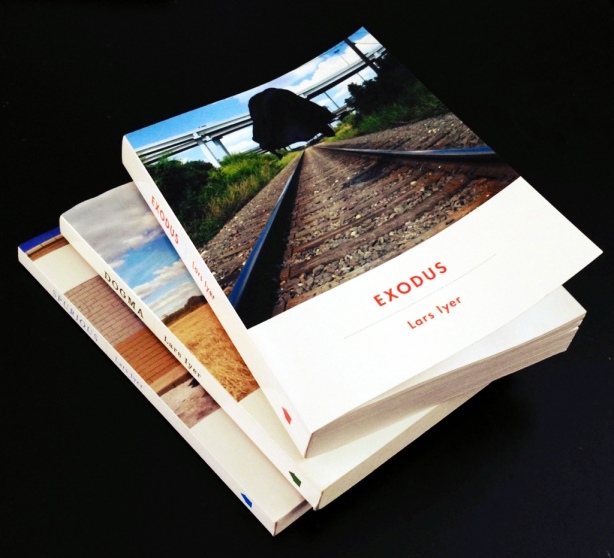
A Riff on Lars Iyer’s Novel Exodus

l

I. Trilogy

Exodus is the third entry in a trilogy that Lars Iyer began with Spurious and Dogma.

What happens in Exodus?

Not much (but also maybe everything—like all sorts of philosophical investigations and intellectual adventure and despair and potential revolution and symbolic death, etc.).

If you’ve read Spurious and Dogma you’d expect this.

There is a quest though in Exodus, a quest that feels more visceral, more real, cuts closer to the bone than in the first two entries.

What is this quest?

Do our heroes W. and Lars vanquish despair? Figure out Kafka?

Do they save humanity (or at least the humanities department)?

Do they finally cast the One Ring into Mount Doom?

(They go on a lecture tour).

II. Quest

What is the connection between Kierkegaard and capitalism?: that’s our question, W. says. What does Kierkegaard tell us about the despair of capitalism?

And

‘The true and only virtue is to hate ourselves’, W. says, reading from his notebook.

And, perhaps more specifically

Of course, they’re going to close all humanities courses in British universities, W. says . . . They’re simply going to marketise education, W. says. They’re simply going to turn the university over to the free market. They’re going to submit philosophy to the forces of capitalism . . .

And

Imagine it! Two plastic cups of Plymouth Gin might usher in the reign of peace, W. says.

And

There are no jobs in philosophy — everyone knows that. No jobs in academia!

And etc.

III. The Call to Adventure

This is our last tour, W. says. He feels that strongly. Something’s going to happen. Something’s about to happen. . . Why does he feel such a sense of dread?

IV. The Road of Trials

Gin, Deleuze, Kafka, Kierkegaard, gin, Blade Runner, Guy Debord, postgraduate students, linguistic stupidity, anxiety over what Alan Badiou is doing right this very minute, gin, Gandhi, Marx, the blogosphere (so-called), Bartleby, Moses, God, logical-mathematical stupidity, the Talmud, gin, bodily-kinesthetic stupidity, cheap food, the Thames, Oxford, Rosenzweig, interpersonal stupidity, gin, Bela Tarr, Manchester, Wikipedia, gin, intrapersonal stupidity, Beckett, Gombrowicz, Middlesex, Weil, naturalistic stupidity, Abraham and Isaac, Old Europe, sports science students, moral stupidity, Solomon Maimon, gin, Plato (turning in his grave), public houses, existential stupidity, Kant, a friend from Taiwan, a plenary speaker, sartorial stupidity, gin, Krasznahorkai, blowing a great horn to have the horde come running (like that guy in Anchorman), a Dostoevskian innocence or a Grossmanian selflessness, religious stupidity, Master/Blaster as a metaphor for the mind-brain problem, Canadian laughter in the glittering light (etc.), Essex Postgraduates, gin, gin, gin, job security, painting-and-decorating stupidity, hangovers, posh people eating lunch in the sun, settling for cans of Stella from the trolley, philosophy of walking, gin, romantic stupidity, gin, culinary stupidity, gin, stupidity stupidity.

Revolution!

V. The Magic Flight

Alcohol makes people speak, that’s its greatness, W. says. It makes them religious, political, even as it shows them the impossibility of religion and the impossibility of politics. Drinking carries you through despair, W. says. Through it, and out beyond it, if you are prepared to keep drinking right all through the night.

VI. Apotheosis

W. dreams of the profound slumber from which we would rise reborn, ready for the morning, ready for work. He dreams of the great day that would follow our night of rest, and of the great ideas that would flash above us like diurnal stars.

How is it still alive in him, the belief that he might wake into genius?, W says. How is it that he still believes, despite everything, that he is a man of thought?

VII. Freedom to Live

Thought is the hangman, our hangman, W. says. Thought has its nooses ready just for us.

VIII. Cult Fiction

Judgment, evaluation, criticism: Exodus—the Spurious Trilogy, if that’s what we’ll call it—has reserved its own special place in the world of cult fiction. These novels (if they are in fact novels) perform their own deconstruction. They delineate metacognition. They frustrate. They are simultaneously sad and funny, and even a little bit scary, at least if you earn your bread by academicizin’.

They frustrate. Wait, do I repeat myself? Very well then, I repeat myself.

These novels dissect the problems of philosophy against the backdrop of late capitalism, but part of this dissection is also the covering up of the dissection: the fear, the failure, the despair, the doom. (Hence the anesthesia, the gin). So that the novels seem to be a series of references, contours, quirks, loops of dialog, declamations, insults . . . That the novels take their own central subject as the failure to mean, to communicate—and then perform these failures: deferral, delay, intellectual suspense. And that these suspensions replace the furniture and sets of the traditional novel, etc. Maybe I’m failing to mean. I’ve anesthetized myself a bit, I do admit.

I get it. I mean, that’s maybe what I mean, or hope to mean to say about these novels: That meaning is hard, that saying meaning doing thinking is hard; that thinking afteragainstbeyond other thinkers is hard, painful, produces despair, dread, etc. Maybe that’s why I like these novels. Because I think that maybe I get them even as I doubt that I do get them.

IX. An Idea

Publisher Melville House might consider putting all three of these books into one epic volume.

X. A Question

Do the eagles ever show up to fly W. and Lars out of Mordor?

Cage III — Free Show (Infinite Jest)

Cage III — Free Show. B.S. Latrodectus Mactans Productions/Infernatron Animation Concepts, Canada. Cosgrove Watt, P. A. Heaven, Everard Maynell, Pam Heath; partial animation; 35 mm.; 65 minutes; black and white; sound.

The figure of Death (Heath) presides over the front entrance of a carnival sideshow whose spectators watch performers undergo unspeakable degradations so grotesquely compelling that the spectators’ eyes become larger and larger until the spectators themselves are transformed into gigantic eyeballs in chairs, while on the other side of the sideshow tent the figure of Life (Heaven) uses a megaphone to invite fairgoers to an exhibition in which, if the fairgoers consent to undergo unspeakable degradations, they can witness ordinary persons gradually turn into gigantic eyeballs.

INTERLACE TELENT FEATURE CARTRIDGE #357-65-65

From David Foster Wallace’s novel Infinite Jest.

Palm Sunday — Ferdinand Georg Waldmüller

“Porcelain and Pink” — F. Scott Fitzgerald

“Porcelain and Pink” by F. Scott Fitzgerald

A room in the down-stairs of a summer cottage. High around the wall runs an art frieze of a fisherman with a pile of nets at his feet and a ship on a crimson ocean, a fisherman with a pile of nets at his feet and a ship on a crimson ocean, a fisherman with a pile of nets at his feet and so on. In one place on the frieze there is an overlapping—here we have half a fisherman with half a pile of nets at his foot, crowded damply against half a ship on half a crimson ocean. The frieze is not in the plot, but frankly it fascinates me. I could continue indefinitely, but I am distracted by one of the two objects in the room—a blue porcelain bath-tub. It has character, this bath-tub. It is not one of the new racing bodies, but is small with a high tonneau and looks as if it were going to jump; discouraged, however, by the shortness of its legs, it has submitted to its environment and to its coat of sky-blue paint. But it grumpily refuses to allow any patron completely to stretch his legs—which brings us neatly to the second object in the room:

It is a girl—clearly an appendage to the bath-tub, only her head and throat—beautiful girls have throats instead of necks—and a suggestion of shoulder appearing above the side. For the first ten minutes of the play the audience is engrossed in wondering if she really is playing the game fairly and hasn’t any clothes on or whether it is being cheated and she is dressed.

The girl’s name is JULIE MARVIS. From the proud way she sits up in the bath-tub we deduce that she is not very tall and that she carries herself well. When she smiles, her upper tip rolls a little and reminds you of an Easter Bunny, She is within whispering distance of twenty years old.

One thing more—above and to the right of the bath-tub is a window. It is narrow and has a wide sill; it lets in much sunshine, but effectually prevents any one who looks in from seeing the bath-tub. You begin to suspect the plot?

We open, conventionally enough, with a song, but, as the startled gasp of the audience quite drowns out the first half, we will give only the last of it:

JULIE: (In an airy sophrano—enthusiastico)

   When Caesar did the Chicago
He was a graceful child,
Those sacred chickens
Just raised the dickens
The Vestal Virgins went wild.
Whenever the Nervii got nervy
He gave them an awful razz
They shook is their shoes
With the Consular blues
The Imperial Roman Jazz

(During the wild applause that follows JULIE modestly moves her arms and makes waves on the surface of the water—at least we suppose she does. Then the door on the left opens and LOIS MARVIS enters, dressed but carrying garments and towels. LOIS is a year older than JULIE and is nearly her double in face and voice, but in her clothes and expression are the marks of the conservative. Yes, you’ve guessed it. Mistaken identity is the old rusty pivot upon which the plot turns.)

LOIS: (Starting) Oh, ‘scuse me. I didn’t know you were here.

JULIE: Oh, hello. I’m giving a little concert—

LOIS: (Interrupting) Why didn’t you lock the door?

JULIE: Didn’t I?

LOIS: Of course you didn’t. Do you think I just walked through it?

JULIE: I thought you picked the lock, dearest. Continue reading ““Porcelain and Pink” — F. Scott Fitzgerald”

A Pupil of Green Girl’s School, Reading — Annie Margaret Bradley

Copyright Reading Museum Service / Supplied by The Public Catalogue Foundation

Microcosmos (Full Film)


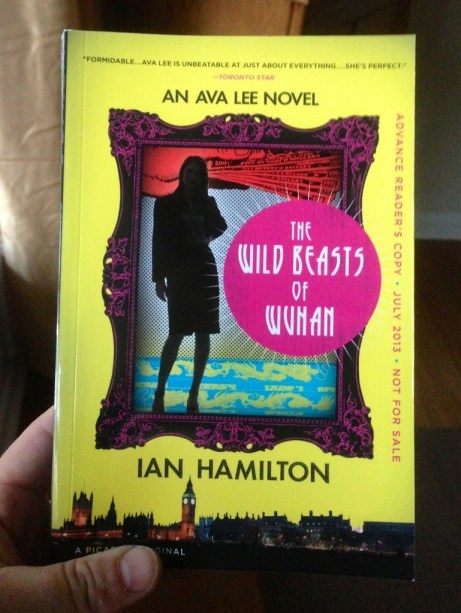
The Wild Beasts of Wuhan (Book Acquired, 3.21.2013)

20130322-135238.jpg

It took me a few minutes to figure out the title of Ian Hamilton’s latest Ava Lee novel, The Wild Beasts of Wuhan—something about the font I guess. The book is out this June from Picador. Blurb from Hamilton’s site:

In The Wild Beasts of Wuhan, Uncle and Ava are summoned by Wong Changxing, “The Emperor of Hubei” and one of the most powerful men in China, when he discovers that the Fauvist paintings he recently acquired are in fact forgeries.

Ava uncovers a ring of fraudulent art dealers and follows their twisted trail to Denmark, the Faroe Islands, Dublin, London, and New York. But the job is further complicated by Wong’s second wife, the cunning and seductive May Ling, who threatens to interfere in Ava’s investigation.

Will Ava find the perpetrators and get the Wongs’ money back? Or will May Ling get to them first…


Jorge Luis Borges Uses Zeno’s Paradox to Describe Kafka’s Literature

I once premeditated making a study of Kafka’s precursors. At first I had considered him to be as singular as the phoenix of rhetorical praise; after frequenting his pages a bit, I came to think I could recognize his voice, or his practices, in texts from diverse literatures and periods. I shall record a few of these here, in chronological order.

The first is Zeno’s paradox against movement. A moving object at A (declares Aristotle) cannot reach point B, because it must first cover half the distance between two points, and before that, half of the half, and before that, half of the half of the half, and so on to infinity; the form of this illustrious problem is, exactly, that of “The Castle”, and the moving object and the arrow and Achilles are the first Kafkian characters in literature.

Read the rest of “Kafka and His Precursors” by Jorge Luis Borges here.

Misshelved

20130323-123116.jpg