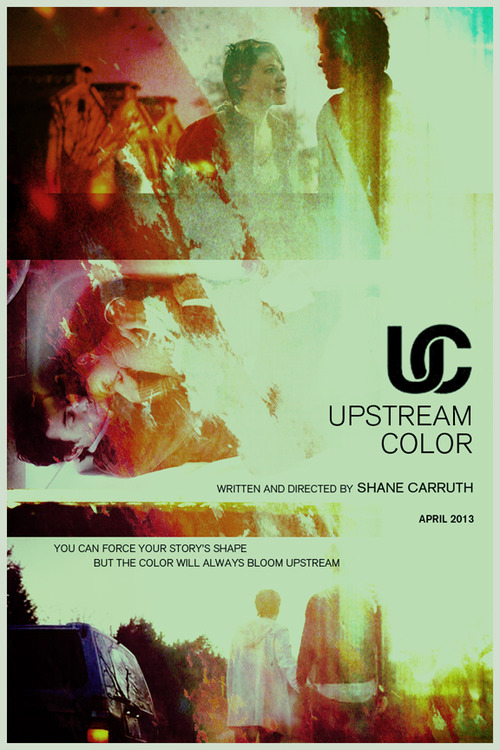
1. I managed to avoid reading anything about Shane Carruth’s new film Upstream Color before I saw it.
I just knew that this was the guy who did Primer, this was his new film, and I wanted to see it because Primer was so strange and engaging.
2. Two immediate responses after viewing Upstream Color:
i). The desire to see Upstream Color again and
ii). The desire to read what other people thought about Upstream Color.
3. (My wife and I, reading the credits, pausing the credits, reassessing the film against the backdrop of the credits, arguing about the film, discussing the film, etc.).
4. I think it’s better that if you have any interest at all in Upstream Color that you just see it cold [update/warning: the comments section of this post is full of spoilers]. But I know that 100 minutes is an investment of time, so maybe you’d like some kind of précis or at least description. So, a loose attempt, which surely will devolve into fragments and references:
Upstream Color is a sci-film, sort of.
Or maybe its a mystery film about ethics and biology.
Maybe a nature film, sort of.
Henry David Thoreau’s Walden.
Worms—parasites.
Theft.
Pigs.
Shades of Philip K. Dick, David Cronenberg, Terence Malick, but also something utterly original.
Mind control.
Trauma.
Ambient music.
Orchids.
Sampling nature.
Memory.
Swimming.
Drowning.
Creation: knitting, paper chains, music, seeds, life, children, etc.
A film that can and should be described as poetic.
It’s a love story, too.
5. It occurs to me that there’s a trailer for the film. I haven’t seen it yet. Should we watch it?
6. Does that do it for you? I don’t know how to do this anymore. Recommend things. I don’t know, the trailer makes the film perhaps look more pretentious than it is. It isn’t pretentious. It isn’t even confusing—just perplexing, haunting, troubling.
7. (Wanted: Quinoa Valley Record Co., complete discography).
8. My take on Upstream Color, spoiler-free, supporting-detail-free:
The film is about agency, about drive, about how the characters (and, implicitly, us, we, the audience, who identify with the characters on the screen) may be driven by something beyond us, something controlling us like a parasite (internal) or from afar like a ventriloquist (external). That even when we do assert agency the effect, the fallout, the shape lays beyond us, upstream.
9. (This morning, my wife telling me about her dream, a nightmare that our young daughter had ingested hallucinogenic mushrooms, clearly a response to the film).
10. I haven’t done a good job of really saying anything about the film. So, lazily:
I think Caleb Crain provides a perceptive and persuasive reading of the film in his essay “The Thoreau Poison.” He reads the film through the American transcendentalists, particularly Thoreau, of course, but also Emerson and Hawthorne.
There’s also a piece at Slate by Forrest Wickman that perhaps over-explicates but nonetheless offers perspective, including elements of Carruth’s own take.
11. (I will avoid Carruth’s explanation of the film until I’ve seen it a second time. Maybe I’ll avoid his explanation forever).
12. A take on Upstream Color that I don’t quite buy into (the take is my own): The film perhaps invites us to find metaphysical entities in two of its secondary characters, both of whom exert influence (creative and destructive) over the primary characters. Something something godlike, something something devillike.
I like that the film offers this simple duality and then crushes it, shows something far more complicated, suggests a cycle far more strange.
13. (White orchid. Blue orchid. Yellow orchid).
14. Upstream Color features minimal dialogue and nothing approaching traditional exposition, but we still learn about its characters, come to feel for them, feel their desires and traumas. The film is cerebral and philosophical, but it’s also emotional, offering an aesthetic that sublimely overwhelms the viewer.
15. Carruth wrote, produced, directed, scored, photographed, cast and starred in Upstream Color. (I’m sure he did a lot of other stuff too). He also distributed the film himself. The entire filmmaking process was untouched by the Hollywood system. There’s so much hope for film as an art form in this knowledge.
16. Parting thoughts: See Upstream Color. Resist imposing whatever film grammar you usually bring with you to the movies. Resist the temptation to see the film as a puzzle to figure out. See Upstream Color.
What are fairy stories for? Freud gave an answer – they were related to daydreams and wish-fulfilment fantasies, in which the questing self meets helpers and enemies, and in which the ending is always happy. He wondered if myths were the “secular dreams of youthful humanity” but distinguished myths from fairy tales by claiming that myth is “related to disaster”. It can also be argued that myth is related to the human need to know what was before, and what will be after the individual life, the living society. Myths are concerned with origins, the fear of death, and the hope for the overcoming of death in another world. The universe of Asgard and Valhalla, of Olympus and Hades, is not the fairy-tale unreal world with its visiting suns and moons, castles and undifferentiated forests. We don’t put it together in our imaginations in the same way. There is neither explanation nor teaching in the true wonder tale.
Other things which are not essentially part of true fairy tales are character, psychological causation, and real morality. Princesses are virtually interchangeable – they are either kind and modest and housewifely, or vain and stupid and inconsiderate. They are called “princesses” but peasants and merchants’ daughters have the same limited and recognisable natures. Simpletons and gallant princes have the same chance of solving riddles, obtaining magic feathers, or keys, the same insect or fishy helpers. Lazy girls are caught out by boasts that they can spin flax into gold, and are helped by strange brownies, or dwarves, or other creatures. The best single description I know of the world of the fairy tale is that of Max Lüthi who describes it as an abstract world, full of discrete, interchangeable people, objects and incidents, all of which are isolated and are nevertheless interconnected, in a kind of web or network of two-dimensional meaning. Everything in the tales appears to happen entirely by chance – and this has the strange effect of making it appear that nothing happens by chance, that everything is fated.
We were stationed in the little town of N—-. The life of an officer in the army is well known. In the morning, drill and the riding-school; dinner with the Colonel or at a Jewish restaurant; in the evening, punch and cards. In N—- there was not one open house, not a single marriageable girl. We used to meet in each other’s rooms, where, except our uniforms, we never saw anything.
One civilian only was admitted into our society. He was about thirty-five years of age, and therefore we looked upon him as an old fellow. His experience gave him great advantage over us, and his habitual taciturnity, stern disposition and caustic tongue produced a deep impression upon our young minds. Some mystery surrounded his existence; he had the appearance of a Russian, although his name was a foreign one. He had formerly served in the Hussars, and with distinction. Nobody knew the cause that had induced him to retire from the service and settle in a wretched little village, where he lived poorly and, at the same time, extravagantly. He always went on foot, and constantly wore a shabby black overcoat, but the officers of our regiment were ever welcome at his table. His dinners, it is true, never consisted of more than two or three dishes, prepared by a retired soldier, but the champagne flowed like water. Nobody knew what his circumstances were, or what his income was, and nobody dared to question him about them. He had a collection of books, consisting chiefly of works on military matters and a few novels. He willingly lent them to us to read, and never asked for them back; on the other hand, he never returned to the owner the books that were lent to him. His principal amusement was shooting with a pistol. The walls of his room were riddled with bullets, and were as full of holes as a honey-comb. A rich collection of pistols was the only luxury in the humble cottage where he lived. The skill which he had acquired with his favourite weapon was simply incredible; and if he had offered to shoot a pear off somebody’s forage-cap, not a man in our regiment would have hesitated to place the object upon his head.
Our conversation often turned upon duels. Silvio — so I will call him — never joined in it. When asked if he had ever fought, he drily replied he had; but he entered into no particulars, and it was evident that such questions were not to his liking. We came to the conclusion that he had upon his conscience the memory of some unhappy victim of his terrible skill. Moreover, it never entered into the head of any of us to suspect him of anything like cowardice. There are persons whose mere look is sufficient to repel such a suspicion. But an unexpected incident occurred which astounded us all.
One day, about ten of our officers dined with Silvio. They drank as usual, that is to say, a great deal. After dinner we asked our host to hold the bank for a game at faro. For a long time he refused, for he hardly ever played, but at last he ordered cards to be brought, placed half a hundred ducats upon the table, and sat down to deal. We took our places round him, and the play began. It was Silvio’s custom to preserve a complete silence when playing. He never disputed, and never entered into explanations. If the punter made a mistake in calculating, he immediately paid him the difference or noted down the surplus. We were acquainted with this habit of his, and we always allowed him to have his own way; but among us on this occasion was an officer who had only recently been transferred to our regiment. During the course of the game, this officer absently scored one point too many. Silvio took the chalk and noted down the correct account according to his usual custom. The officer, thinking that he had made a mistake, began to enter into explanations. Silvio continued dealing in silence. The officer, losing patience, took the brush and rubbed out what he considered was wrong. Silvio took the chalk and corrected the score again. The officer, heated with wine, play, and the laughter of his comrades, considered himself grossly insulted, and in his rage he seized a brass candlestick from the table, and hurled it at Silvio, who barely succeeded in avoiding the missile. We were filled with consternation. Silvio rose, white with rage, and with gleaming eyes, said:

 Biblioklept