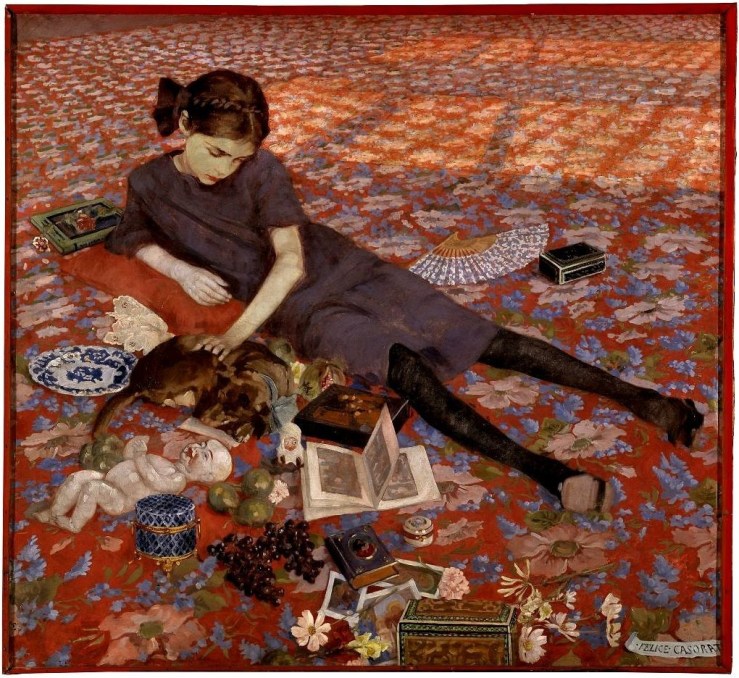
Girl On a Red Carpet — Felice Casorati

girl

Beach House, Live at the Interface in 2010

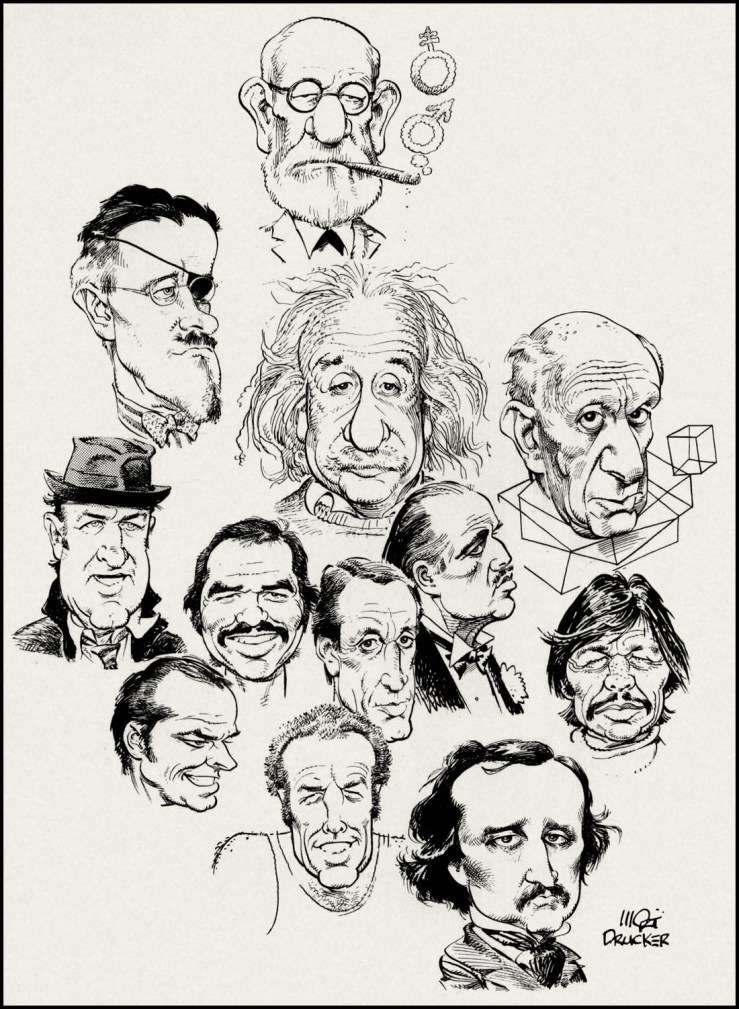
Mort Drucker Portraits of Freud, Joyce, Poe, Einstein, Charles Bronson, Etc.

mort drucker

Interrogation II — Leon Golub

golub

Recording the humiliation with a camera, with the perpetrators, a stupid grin on their faces, included in the picture, side by side with the twisted naked bodies of their prisoners, is an integral part of the process…The very positions and costumes of the prisoners suggest a theatrical staging, a kind of tableau vivant, which cannot but bring to mind the whole spectrum of American performance art and ‘theatre of cruelty’ the photos of Mapplethorpe, the weird scenes in David Lynch, to name but two” — Slavoj Žižek on Abu Ghraib (Violence)

A Ballad of the Captains — Harry Clarke

0068 The Year's At The Spring - Harry Clarke - A Ballad of the Captains 2

(Via/more).

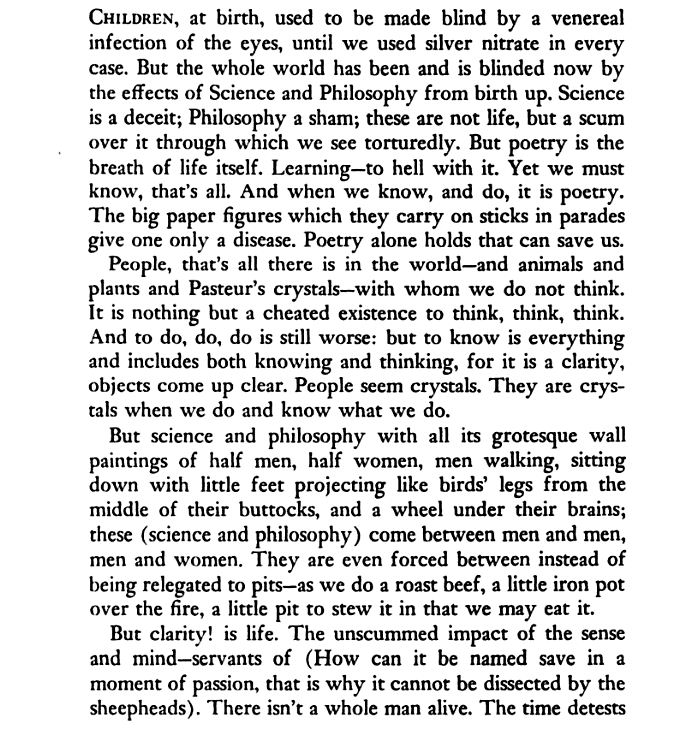
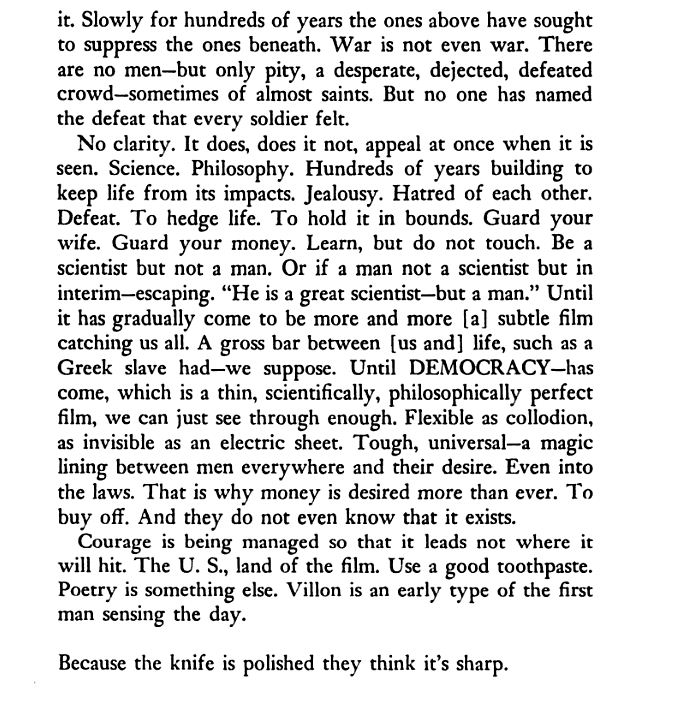
“Science and Philosophy” — William Carlos Williams

1

            2

“Science and Philosophy” by William Carlos Williams is collected in The Embodiment of Knowledge (New Directions).

Huxley vs. Orwell: The Webcomic

Stuart McMillen’s webcomic adapts (and updates) Postman’s famous book-length essay, Amusing Ourselves to Death, which argues that Aldous Huxley’s vision of the future in Brave New World was ultimately more accurate than the one proposed by George Orwell in 1984. (Via).

“The Bible as Poetry” — Walt Whitman

“The Bible as Poetry” by Walt Whitman

I suppose one cannot at this day say anything new, from a literary point of view, about those autochthonic bequests of Asia—the Hebrew Bible, the mighty Hindu epics, and a hundred lesser but typical works; (not now definitely including the Iliad—though that work was certainly of Asiatic genesis, as Homer himself was—considerations which seem curiously ignored.) But will there ever be a time or place—ever a student, however modern, of the grand art, to whom those compositions will not afford profounder lessons than all else of their kind in the garnerage of the past? Could there be any more opportune suggestion, to the current popular writer and reader of verse, what the office of poet was in primeval times—and is yet capable of being, anew, adjusted entirely to the modern?

All the poems of Orientalism, with the Old and New Testaments at the centre, tend to deep and wide, (I don’t know but the deepest and widest,) psychological development—with little, or nothing at all, of the mere esthetic, the principal verse-requirement of our day. Very late, but unerringly, comes to every capable student the perception that it is not in beauty, it is not in art, it is not even in science, that the profoundest laws of the case have their eternal sway and outcropping.

In his discourse on “Hebrew Poets” De Sola Mendes said: “The fundamental feature of Judaism, of the Hebrew nationality, was religion; its poetry was naturally religious. Its subjects, God and Providence, the covenants with Israel, God in Nature, and as reveal’d, God the Creator and Governor, Nature in her majesty and beauty, inspired hymns and odes to Nature’s God. And then the checker’d history of the nation furnish’d allusions, illustrations, and subjects for epic display—the glory of the sanctuary, the offerings, the splendid ritual, the Holy City, and lov’d Palestine with its pleasant valleys and wild tracts.” Dr. Mendes said “that rhyming was not a characteristic of Hebrew poetry at all. Metre was not a necessary mark of poetry. Great poets discarded it; the early Jewish poets knew it not.” Compared with the famed epics of Greece, and lesser ones since, the spinal supports of the Bible are simple and meagre. All its history, biography, narratives, &c., are as beads, strung on and indicating the eternal thread of the Deific purpose and power. Yet with only deepest faith for impetus, and such Deific purpose for palpable or impalpable theme, it often transcends the masterpieces of Hellas, and all masterpieces.

The metaphors daring beyond account, the lawless soul, extravagant by our standards, the glow of love and friendship, the fervent kiss—nothing in argument or logic, but unsurpass’d in proverbs, in religious ecstasy, in suggestions of common mortality and death, man’s great equalizers—the spirit everything, the ceremonies and forms of the churches nothing, faith limitless, its immense sensuousness immensely spiritual—an incredible, all-inclusive non-worldliness and dew-scented illiteracy (the antipodes of our Nineteenth Century business absorption and morbid refinement)—no hair-splitting doubts, no sickly sulking and sniffling, no “Hamlet,” no “Adonais,” no “Thanatopsis,” no “In Memoriam.”

The culminated proof of the poetry of a country is the quality of its personnel, which, in any race, can never be really superior without superior poems. The finest blending of individuality with universality (in my opinion nothing out of the galaxies of the “Iliad,” or Shakspere’s heroes, or from the Tennysonian “Idylls,” so lofty, devoted and starlike,) typified in the songs of those old Asiatic lands. Men and women as great columnar trees. Nowhere else the abnegation of self towering in such quaint sublimity; nowhere else the simplest human emotions conquering the gods of heaven, and fate itself. (The episode, for instance, toward the close of the “Mahabharata”—the journey of the wife Savitri with the god of death, Yama,

“One terrible to see—blood-red his garb,

His body huge and dark, bloodshot his eyes,

Which flamed like suns beneath his turban cloth,

Arm’d was he with a noose,”

who carries off the soul of the dead husband, the wife tenaciously following, and—by the resistless charm of perfect poetic recitation!—eventually redeeming her captive mate.)

I remember how enthusiastically William H. Seward, in his last days, once expatiated on these themes, from his travels in Turkey, Egypt, and Asia Minor, finding the oldest Biblical narratives exactly illustrated there to-day with apparently no break or change along three thousand years—the veil’d women, the costumes, the gravity and simplicity, all the manners just the same. The veteran Trelawney said he found the only real nobleman of the world in a good average specimen of the mid-aged or elderly Oriental. In the East the grand figure, always leading, is the old man, majestic, with flowing beard, paternal, &c. In Europe and America, it is, as we know, the young fellow—in novels, a handsome and interesting hero, more or less juvenile—in operas, a tenor with blooming cheeks, black mustache, superficial animation, and perhaps good lungs, but no more depth than skim-milk. But reading folks probably get their information of those Bible areas and current peoples, as depicted in print by English and French cads, the most shallow, impudent, supercilious brood on earth.

I have said nothing yet of the cumulus of associations (perfectly legitimate parts of its influence, and finally in many respects the dominant parts,) of the Bible as a poetic entity, and of every portion of it. Not the old edifice only—the congeries also of events and struggles and surroundings, of which it has been the scene and motive—even the horrors, dreads, deaths. How many ages and generations have brooded and wept and agonized over this book! What untellable joys and ecstasies—what support to martyrs at the stake—from it. (No really great song can ever attain full purport till long after the death of its singer—till it has accrued and incorporated the many passions, many joys and sorrows, it has itself arous’d.) To what myriads has it been the shore and rock of safety—the refuge from driving tempest and wreck! Translated in all languages, how it has united this diverse world! Of civilized lands to-day, whose of our retrospects has it not interwoven and link’d and permeated? Not only does it bring us what is clasp’d within its covers; nay, that is the least of what it brings. Of its thousands, there is not a verse, not a word, but is thick-studded with human emotions, successions of fathers and sons, mothers and daughters, of our own antecedents, inseparable from that background of us, on which, phantasmal as it is, all that we are to-day inevitably depends—our ancestry, our past.

Strange, but true, that the principal factor in cohering the nations, eras and paradoxes of the globe, by giving them a common platform of two or three great ideas, a commonalty of origin, and projecting kosmic brotherhood, the dream of all hope, all time—that the long trains gestations, attempts and failures, resulting in the New World, and in modern solidarity and politics—are to be identified and resolv’d back into a collection of old poetic lore, which, more than any one thing else, has been the axis of civilization and history through thousands of years—and except for which this America of ours, with its polity and essentials, could not now be existing.

No true bard will ever contravene the Bible. If the time ever comes when iconoclasm does its extremest in one direction against the Books of the Bible in its present form, the collection must still survive in another, and dominate just as much as hitherto, or more than hitherto, through its divine and primal poetic structure. To me, that is the living and definite element-principle of the work, evolving everything else. Then the continuity; the oldest and newest Asiatic utterance and character, and all between, holding together, like the apparition of the sky, and coming to us the same. Even to our Nineteenth Century here are the fountain heads of song.
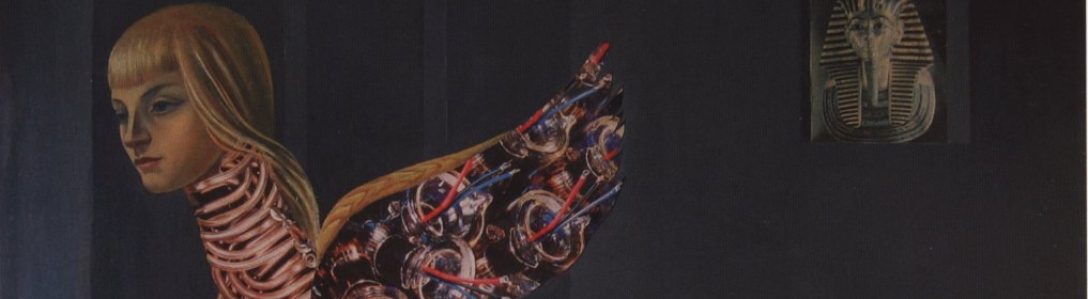
 

Untitled — Bridget Tichenor

el_maravilloso_surrealismo_de_bridget_tichenor_3948_641x427

The Draughtsman’s Contract — Peter Greenaway

The Resurrectionist (Book Acquired, 6.04.2013)

20130607-155808.jpg

20130607-155816.jpg

Matthew Guinn’s The Resurrectionist showed up in the mail a few days ago. Haven’t really had time to get into it, but the premise seems promising, and Guinn’s Southern lit bona fides also intrigue me.

Publisher W.W. Norton’s blurb:

A young doctor wrestles with the legacy of a slave “resurrectionist” owned by his South Carolina medical school.

“Dog days and the fresh bodies are arriving once again.” So begins the fall term at South Carolina Medical College, where Dr. Jacob Thacker is on probation for Xanax abuse. His interim career—working public relations for the dean—takes an unnerving detour into the past when the bones of African American slaves, over a century old, are unearthed on campus. Out of the college’s dark past, these bones threaten to rise and condemn the present.

In the middle of the nineteenth century, Dr. Frederick Augustus Johnston, one of the school’s founders, had purchased a slave for his unusual knife skills. This slave, Nemo (“no man”) would become an unacknowledged member of the surgical faculty by day—and by night, a “resurrectionist,” responsible for procuring bodies for medical study. An unforgettable character, by turns apparently insouciant, tormented, and brilliant, and seen by some as almost supernatural, Nemo will seize his self-respect in ways no reader can anticipate.

With exceptional storytelling pacing and skill, Matthew Guinn weaves together past and present to relate a Southern Gothic tale of shocking crimes and exquisite revenge, a riveting and satisfying moral parable of the South.


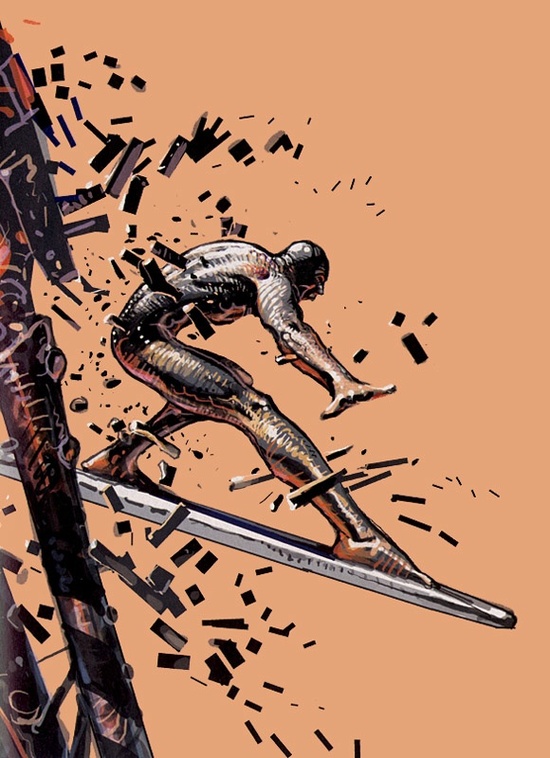
Silver Surfer — Moebius

surfer

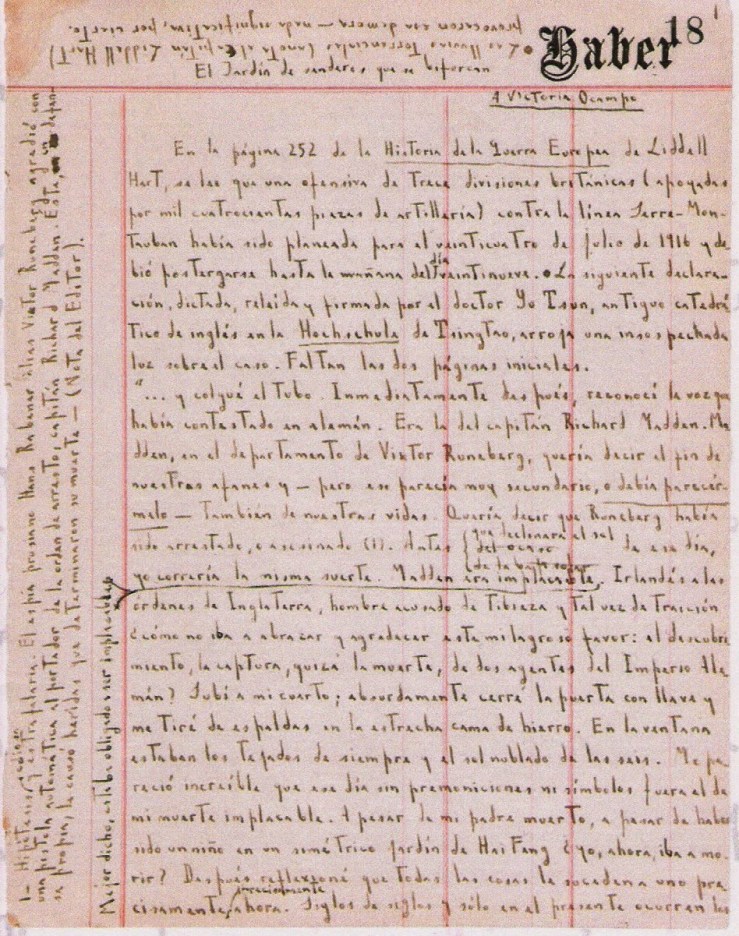
Handwritten Manuscript Page for Jorge Luis Borges’s “The Garden of Forking Paths”

borges manuscript

(Via).

List with No Name #29

  1. V., mostly on a beach in Ko Lanta.
  2. The Road, in the maternity ward after my daughter was born.
  3. Infinite Jest, late at night after I first moved to Tokyo. And then lugging it onto the train.
  4. Un Bel Morir, in the emergency room all night, my mother’s fever so high.
  5. As I Lay Dying, another hospital.
  6. 2666. On a plane leaving San Francisco. And then compulsively every night for a month.
  7. Angels, on a Florida beach.
  8. Cat’s Cradle, on a houseboat, on a river.
  9. The Once and Future King, in the back of a rented car that was zooming across the South Island of NZ, my parents repeatedly imploring me to just look up please.
  10.  Ulysses, on the old gold velour couch I sometimes still miss, on my roommate’s Ritalin, comprehending next to nothing. And then a decade later, with real joy.

Read an Excerpt from Adam Novy’s Work in Progress, The Gore and the Splatter

Hobart has published an excerpt of Adam Novy’s work in progress, The Gore and Splatter. I was a big fan of Adam’s last novel, The Avian Gospels, a dystopian take on terror and gypsies and birds. When I interviewed Adam a few years ago, he told me he was “writing a novel about the life and times of Medusa. It’s called The Gore and the Splatter. Ryan Chang got a bit more info about the novel in his interview with Adam, posted yesterday at Electric Literature:

I’m working on a novel about Perseus and Medusa before they get discovered. The early days of Perseus and Medusa. It takes place partially in mythic Greece and partially the suburb I grew up in. The characters are in the middle of mythic history. One thing about mythology I’ve always been really interested is what the characters know about their place and time in history. There’s this idea that the world is new and folks are creating meaning as they go along. Do they know they’re creating meaning? And what would it be like to be a teenager under those circumstances? Or a parent raising those teenagers, what would it be like?

I’m looking forward to this one. Until then we have the excerpt. Here is an excerpt of the excerpt:

Pentheus’s bedroom: hardly large enough to fit his mattress, a modest trunk of clothes, a wooden torso on a stick that wore his armor while he slept, and an altar to Athena. The floorplanks creaked, the roof leaked water, porous walls keened in wind. He’d let his mother and his nephews have the bedrooms with the windows. The den was also small, and too close to the kitchen for these rooms to be considered separate entities, and this house, such as it was, sat unevenly on pylons of old concrete, for the ground was a decline of dirt and sand on a rambling scrappy hillside, where any rugged vegetables that flourished in the desperate little gardens were scavengered immediately by rabbits.

The bungalow wasn’t quite dysfunctional, merely ugly, small, grotty, and way beyond the prospect of improvement. Still, the sneaky sisters Casey and Arden enjoyed their lives in an unfairly lavish home, and the house where the miraculous atrocity had happened, with the river and the tree, was nigh short of a mansion, if an ugly, nouveau, tasteless one. Perhaps whoever’d lived there had been killed for being vulgar. Pentheus had been working in a lumber yard adjacent to The Turnbull Farm—a huge, efficient version of the farm where Casey and Arden lived—when Mister Reddy heard that he was tall and took him on as his assistant. Your feet are very big, he’d said, you’ll leave a large carbon footprint. Pentheus thought he’d caught his golden opportunity, but all he got to do was walk beside the boss in heavy armor, sweat until he felt that he would rot, follow incoherent orders and let teenage girls humiliate him. And the pay was just as crappy as the lumber yard. Agave, his own mother, was a maid for Mister Turnbull. She was sixty-eight years old, but still she cooked, scrubbed the floor, washed stains from the clothes of messy children whose privilege didn’t exactly translate into manners. Pentheus and Agave paid their rent to Mister Reddy, who was Mister Turnbull’s partner, though Mister Reddy and Mister Turnbull also paid their salaries. Pentheus and his mother were little more than conduits for money as it looped its way inexorably back to whence it came. Jayden, Pentheus’s nephew, had said they were a kind of large intestine, where food was turned to shit and got excreted without their being able to enjoy it. Pentheus sometimes wished the boy was less articulate.

Birthday — Dorothea Tanning

10-Birthday_4

“The Seven Vagabonds” — Nathaniel Hawthorne

“The Seven Vagabonds” — Nathaniel Hawthorne

Rambling on foot in the spring of my life and the summer of the year, I came one afternoon to a point which gave me the choice of three directions. Straight before me the main road extended its dusty length to Boston; on the left a branch went toward the sea, and would have lengthened my journey a trifle of twenty or thirty miles, while by the right-hand path I might have gone over hills and lakes to Canada, visiting in my way the celebrated town of Stamford. On a level spot of grass at the foot of the guide-post appeared an object which, though locomotive on a different principle, reminded me of Gulliver’s portable mansion among the Brobdignags. It was a huge covered wagon—or, more properly, a small house on wheels—with a door on one side and a window shaded by green blinds on the other. Two horses munching provender out of the baskets which muzzled them were fastened near the vehicle. A delectable sound of music proceeded from the interior, and I immediately conjectured that this was some itinerant show halting at the confluence of the roads to intercept such idle travellers as myself. A shower had long been climbing up the western sky, and now hung so blackly over my onward path that it was a point of wisdom to seek shelter here.

“Halloo! Who stands guard here? Is the doorkeeper asleep?” cried I, approaching a ladder of two or three steps which was let down from the wagon.

The music ceased at my summons, and there appeared at the door, not the sort of figure that I had mentally assigned to the wandering showman, but a most respectable old personage whom I was sorry to have addressed in so free a style. He wore a snuff-colored coat and small-clothes, with white top-boots, and exhibited the mild dignity of aspect and manner which may often be noticed in aged schoolmasters, and sometimes in deacons, selectmen or other potentates of that kind. A small piece of silver was my passport within his premises, where I found only one other person, hereafter to be described.

“This is a dull day for business,” said the old gentleman as he ushered me in; “but I merely tarry here to refresh the cattle, being bound for the camp-meeting at Stamford.” Continue reading ““The Seven Vagabonds” — Nathaniel Hawthorne”