The Dream — Ferdinand Hodler

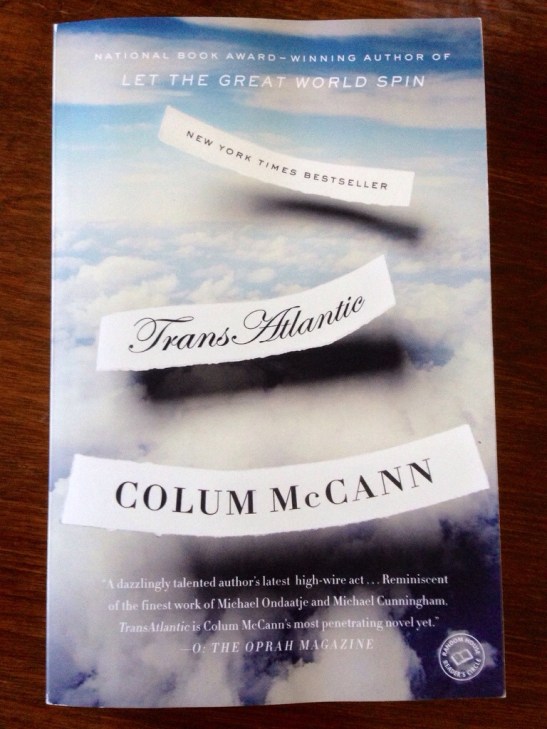
Colum McCann’s TransAtlantic (Book Acquired, 5.01.2014)

20140504-092016.jpg

Colum McCann’s TransAtlantic is new in trade paperback from Picador.

This (longish) blurb is from the author’s website, where you can also download an excerpt of the book and/or listen to audio of McCann reading from TransAtlantic:

In the National Book Award–winning Let the Great World Spin, Colum McCann thrilled readers with a marvelous high-wire act of fiction that The New York Times Book Review called “an emotional tour de force.” Now McCann demonstrates once again why he is one of the most acclaimed and essential authors of his generation with a soaring novel that spans continents, leaps centuries, and unites a cast of deftly rendered characters, both real and imagined.

Newfoundland, 1919. Two aviators—Jack Alcock and Arthur Brown—set course for Ireland as they attempt the first nonstop flight across the Atlantic Ocean, placing their trust in a modified bomber to heal the wounds of the Great War.

Dublin, 1845 and ’46. On an international lecture tour in support of his subversive autobiography, Frederick Douglass finds the Irish people sympathetic to the abolitionist cause—despite the fact that, as famine ravages the countryside, the poor suffer from hardships that are astonishing even to an American slave.

New York, 1998. Leaving behind a young wife and newborn child, Senator George Mitchell departs for Belfast, where it has fallen to him, the son of an Irish-American father and a Lebanese mother, to shepherd Northern Ireland’s notoriously bitter and volatile peace talks to an uncertain conclusion.

These three iconic crossings are connected by a series of remarkable women whose personal stories are caught up in the swells of history. Beginning with Irish housemaid Lily Duggan, who crosses paths with Frederick Douglass, the novel follows her daughter and granddaughter, Emily and Lottie, and culminates in the present-day story of Hannah Carson, in whom all the hopes and failures of previous generations live on. From the loughs of Ireland to the flatlands of Missouri and the windswept coast of Newfoundland, their journeys mirror the progress and shape of history. They each learn that even the most unassuming moments of grace have a way of rippling through time, space, and memory.

The most mature work yet from an incomparable storyteller, TransAtlantic is a profound meditation on identity and history in a wide world that grows somehow smaller and more wondrous with each passing year.

The Connection — Katharina Wulff

Kierkegaard is an ugly hunchback loser

kierkegaardKate Beaton is the best.


“Myth Is a Type of Speech” — Roland Barthes

Myth is a type of speech

Of course, it is not any type: language needs special conditions in order to become myth: we shall see them in a minute. But what must be firmly established at the start is that myth is a system of communication, that it is a message. This allows one to perceive that myth cannot possibly be an object, a concept, or an idea; it is a mode of signification, a form. Later, we shall have to assign to this form historical limits, conditions of use, and reintroduce society into it: we must nevertheless first describe it as a form.

It can be seen that to purport to discriminate among mythical objects according to their substance would be entirely illusory: since myth is a type of speech, everything can be a myth provided it is conveyed by a discourse. Myth is not defined by the object of its message, but by the way in which it utters this message: there are formal limits to myth, there are no ‘substantial’ ones. Everything, then, can be a myth? Yes, I believe this, for the universe is infinitely fertile in suggestions. Every object in the world can pass from a closed, silent existence to an oral state, open to appropriation by society, for there is no law, whether natural or not, which forbids talking about things. A tree is a tree. Yes, of course. But a tree as expressed by Minou Drouet is no longer quite a tree, it is a tree which is decorated, adapted to a certain type of consumption, laden with literary self- indulgence, revolt, images, in short with a type of social usage which is added to pure matter.

Naturally, everything is not expressed at the same time: some objects become the prey of mythical speech for a while, then they disappear, others take their place and attain the status of myth. Are there objects which areinevitably a source of suggestiveness, as Baudelaire suggested about Woman? Certainly not: one can conceive of very ancient myths, but there are no eternal ones; for it is human history which converts reality into speech, and it alone rules the life and the death of mythical language. Ancient or not, mythology can only have an historical foundation, for myth is a type of speech chosen by history: it cannot possibly evolve from the ‘nature’ of things.

Speech of this kind is a message. It is therefore by no means confined to oral speech. It can consist of modes of writing or of representations; not only written discourse, but also photography, cinema, reporting, sport, shows, publicity, all these can serve as a support to mythical speech. Myth can be defined neither by its object nor by its material, for any material can arbitrarily be endowed with meaning: the arrow which is brought in order to signify a challenge is also a kind of speech. True, as far as perception is concerned, writing and pictures, for instance, do not call upon the same type of consciousness; and even with pictures, one can use many kinds of reading: a diagram lends itself to signification more than a drawing, a copy more than an original, and a caricature more than a portrait. But this is the point: we are no longer dealing here with a theoretical mode of representation: we are dealing with this particular image, which is given for this particular signification. Mythical speech is made of a material which has already been worked on so as to make it suitable for communication: it is because all the materials of myth (whether pictorial or written) presuppose a signifying consciousness, that one can reason about them while discounting their substance. This substance is not unimportant: pictures, to be sure, are more imperative than writing, they impose meaning at one stroke, without analyzing or diluting it. But this is no longer a constitutive difference. Pictures become a kind of writing as soon as they are meaningful: like writing, they call for a lexis.

We shall therefore take language, discourse, speech, etc., to mean any significant unit or synthesis, whether verbal or visual: a photograph will be a kind of speech for us in the same way as a newspaper article; even objects will become speech, if they mean something. This generic way of conceiving language is in fact justified by the very history of writing: long before the invention of our alphabet, objects like the Inca quipu, or drawings, as in pictographs, have been accepted as speech. This does not mean that one must treat mythical speech like language; myth in fact belongs to the province of a general science, coextensive with linguistics, which is semiology.
From Mythologies by Roland Barthes. Translated by Annette Lavers.

The Hermit — Gerrit Dou

Prometheus in Chains — Frantisek Kupka

“The representation of reality can be more real than reality itself” (William T. Vollmann)

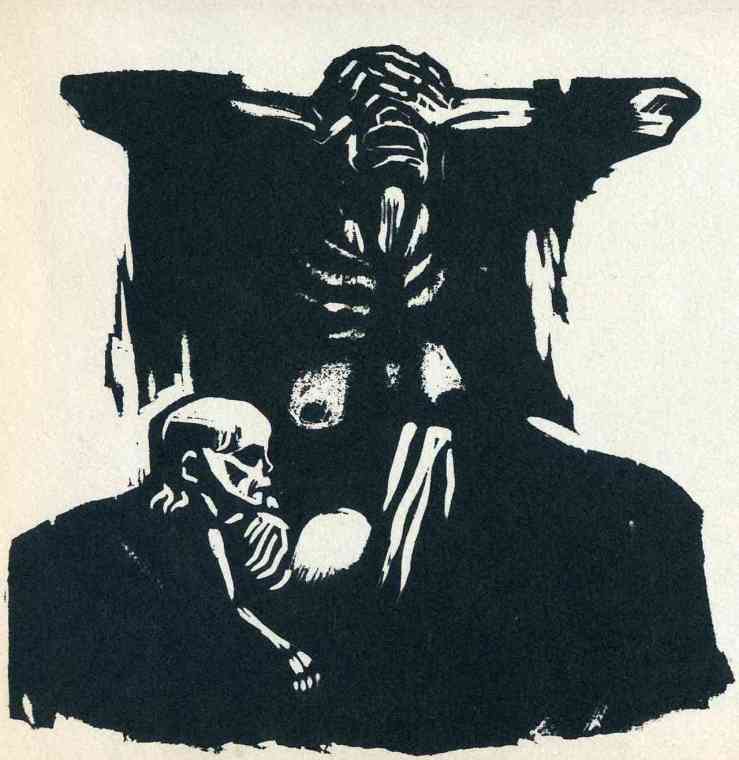
He photographed Lenin’s corpse lying in state, and captured many emotion-laden scenes, but the full power of images first impressed itself upon the young Roman Karmen later on in that same year, 1924, when he passed by an exhibition of German art arranged by Otto Nagel. Amidst the other flotsam hung “The Sacrifice” by Käthe Kollwitz. How can I describe this woodcut? The mother’s black cloak is open to reveal her breasts as she offers up her baby to death.

In the same folio, which was called “War,” Karmen, stunned and riveted, saw “The Parents,” a black woodcut of a man mourning, supporting the hand in which his face is buried upon the back of his wife, who mourns in his lap; this couple comprise a dark mass of mourning, silhouetted against a white background and their outlines printed negatively in white.

These two prints moved him to tears. But when, now scanning the walls almost ferociously in his determination to find every scrap of paper by this artist, he discovered “Hunger,” which would become leaf number two of most versions of her great “Proletariat” folio of 1925, the emotion which overcame him was anger—anger against an order which made people suffer in this way. And how strange it was that he was moved! For he had known hunger himself; and his father had suffered at the hands of the White Guards. This was the moment when he understood that the representation of reality can be more real than reality itself.

From William T. Vollmann’s Europe Central.

The woodcuts here are of course the Kollwitz pieces that inspire young Karmen Roman, who would go on to become one of the most prolific filmmakers of the Soviet era.

hunger


Good Old “Good Old Neon” Essay (Not Actually Old But Actually Very New)

Wallace4

Today, the Los Angeles Review of Books published an insightful essay by Tim Peters about David Foster Wallace’s short story “Good Old Neon.”

“Good Old Neon” is (in my estimation) Wallace’s finest piece of sustained prose, and his most tortured exploration of the tension between authenticity and performance.

Peters’s essay also features a number of photographs from Wallace’s high school yearbook, which are interesting, sure, but they actually fit into the essay.

Breaking into the strands and allusions that feed “Good Old Neon” (including Dostoevsky, Tolstoy, Hawthorne, and Hemingway), Peters’s essay has a riff-like quality (is that why I like it so much?), but there’s also a thesis here, one that I think actually answers alarmist/reactionary “death of the novel”/”end of literature” “think pieces” (how do you like that last clause for phrases in quotation marks?).

Obviously, if you haven’t read “Good Old Neon,” then read “Good Old Neon.

Then check out Peter’s essay. A sample of his analysis:

If you read “Good Old Neon” and then read D. T. Max’s biography of Wallace, Every Love Story Is a Ghost Story (the epigraph of which is a line from “Neon”), you see one example after another of stuff from Wallace’s life that Neal says happened to him. Being raised by people “of high ideals and values, humanists”; making fun of his sister as a kid and pretending like she was obese and jumping out of the way when she passed him in the hallway; having a knack for mathematical logic and logical paradoxes; having “a killer G.P.A.”; playing a varsity sport; being a philanderer with women; being on the professional fast track by the time he was in his 20s; getting into religion and meditation as a way of dealing with his troubles; living in the vicinity of the cornfields of Illinois; committing suicide. At the end of the story, when Neal’s ghost is hovering over Wallace and their high school yearbook, and as the latter is thinking about how impossible it is to try and pass through the exterior image of a person and to enter into the realm of his psyche, you wonder if what’s really going on in this story is something more akin to what happens between Dorian Gray and his picture, or William Wilson and his double, or Dr. Jekyll and Mr. Hyde, or Bruce Banner and the Incredible Hulk, or the two Tyler Durdens in Fight Club, or even between Martin Sheen and his reflection in the mirror in Hearts of Darkness, which is to say, you wonder if what’s going on here is a sort of a spiritual/philosophical death match, a duel between two opposite tendencies that are internal to a psyche but in the world of these stories are teased into two separate but similar-looking characters, into doubles or doppelgängers who both need each other and then perversely also try to destroy each other. And the dialectic that these characters are working out is Apollo v. Dionysus, the superego v. the id, the false self v. the true self, the rational civilized scientific order v. spontaneity and passion and a community of spirit. The drama that makes these stories interesting is that there’s no boring, middling, mediating ego term to calm things down and to make concessions and to prevent the dialectic from exploding. Hence: Dorian Gray stabs himself; William Wilson stabs himself; Mr. Hyde is either going to be executed or to commit suicide; The Hulk goes Smash; Tyler Durden shoots himself; Martin Sheen has a heart attack and has to be flown off the set of Apocalypse Now. And as for “Good Old Neon,” the struggle is between Neal, the golden child, against the “real, more enduring and sentimental” David Wallace who’s looking at their pictures in the high school yearbook. It’s the struggle between a nihilist who’s yet actively making the society function, and a believer who has a desire for solid, non-alienated, human relationships, but who’s quietly, sadly, sitting in a recliner and watching the nihilists run.

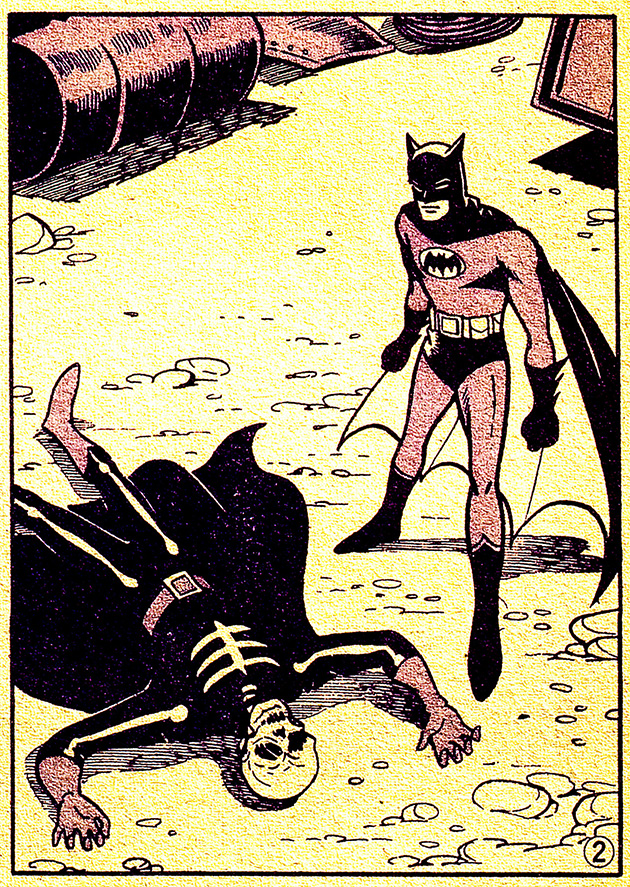
Batman vs. Lord Death Man — Jiro Kuwata

batman

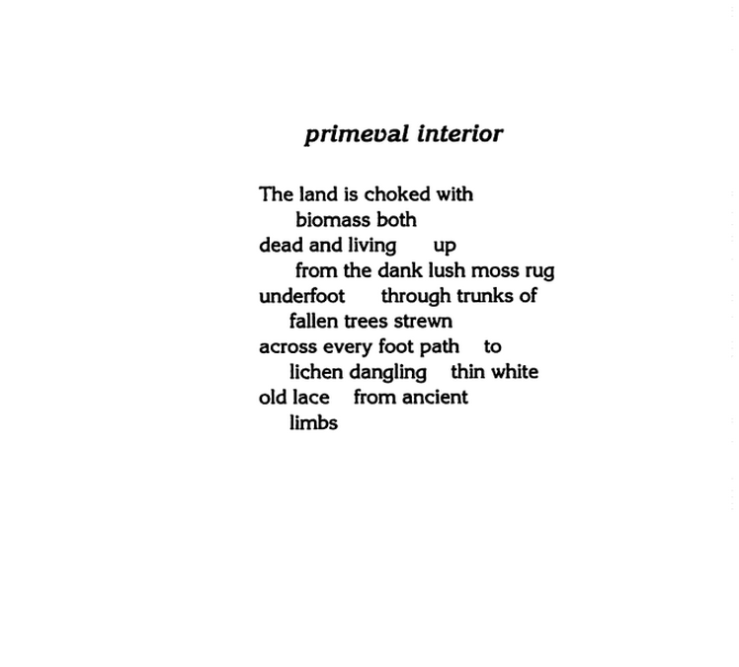
“Primeval Interior” — Tom Clark

tom clark

Woman at the Café — Antonio Donghi

(And Yet Another) Moby-Dick (Book Acquired, 4.18.2014)

20140504-091858.jpg

So I bought yet another copy of Moby-Dick, despite the many several editions already in our home.

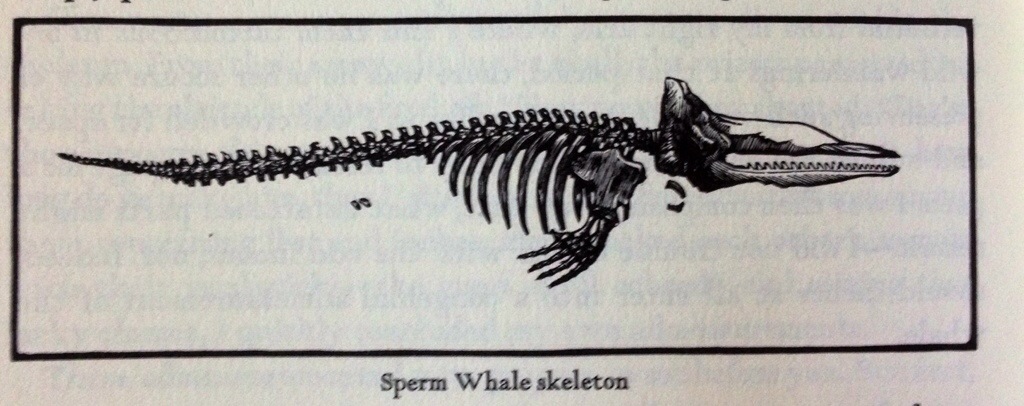
I’d looked for an edition of the Barry Moser illustrated M-D for years—casually, in used book shops—but after a few (ahem) glasses of chardonnay, I bought one for next to nothing on eBay.

Moser’s etchings are superb, of course, and they most often illustrate the technical, scientific, or historical aspects of the novel. Great stuff.

20140504-091909.jpg

20140504-091923.jpg

20140504-091931.jpg

Interior — William Rothenstein

Bridgeman; (c) Museums Sheffield; Supplied by The Public Catalogue Foundation

Departure of the Prodigal Son — Alberto Savinio

I started (yet another) new blog

I started (yet another) new blog—not planning on updating it that much. Check it out (or not).


Unrelated owl by Huang Yongyu: