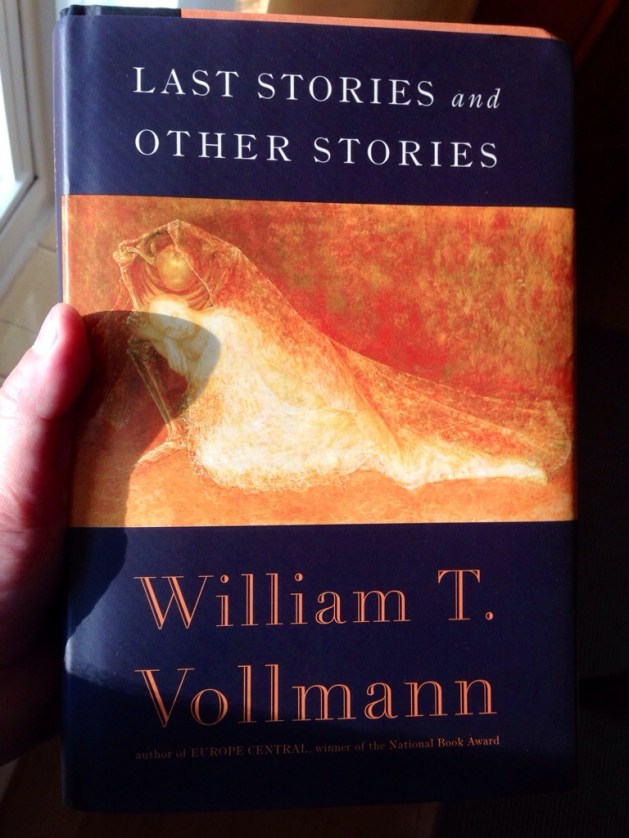
Vollmann’s Last Stories and Other Stories (Book Acquired, 6.09.2014)

20140611-112543-41143694.jpg

William T. Vollmann’s Last Stories and Other Stories is new in hardback from Penguin this July. I’ll have a review then, but for now, publisher’s blurb:

Supernaturally tinged stories from William T. Vollmann, author of the National Book Award winner Europe Central

In this magnificent new work of fiction, his first in nine years, celebrated author William T. Vollmann offers a collection of ghost stories linked by themes of love, death, and the erotic.

A Bohemian farmer’s dead wife returns to him, and their love endures, but at a gruesome price. A geisha prolongs her life by turning into a cherry tree. A journalist, haunted by the half-forgotten killing of a Bosnian couple, watches their story, and his own wartime tragedy, slip away from him. A dying American romances the ghost of his high school sweetheart while a homeless salaryman in Tokyo animates paper cutouts of ancient heroes.

Are ghosts memories, fantasies, or monsters? Is there life in death? Vollmann has always operated in the shadowy borderland between categories, and these eerie tales, however far-flung their settings, all focus on the attempts of the living to avoid, control, or even seduce death. Vollmann’s stories will transport readers to a fantastical world where love and lust make anything possible.

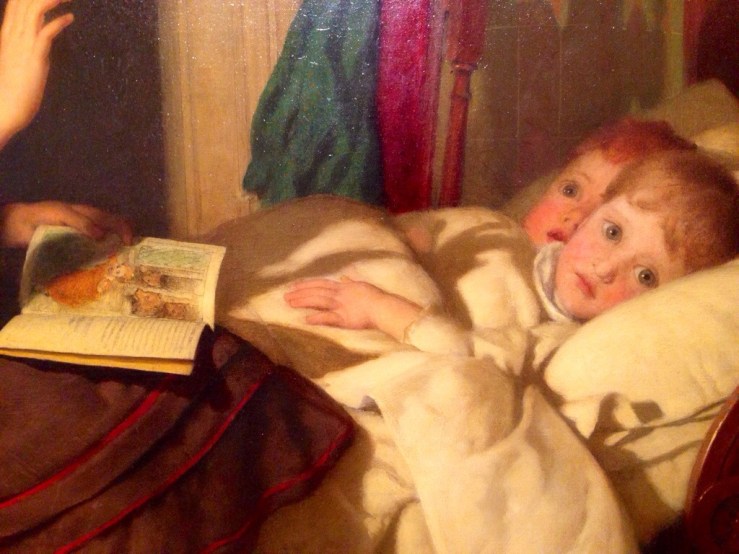
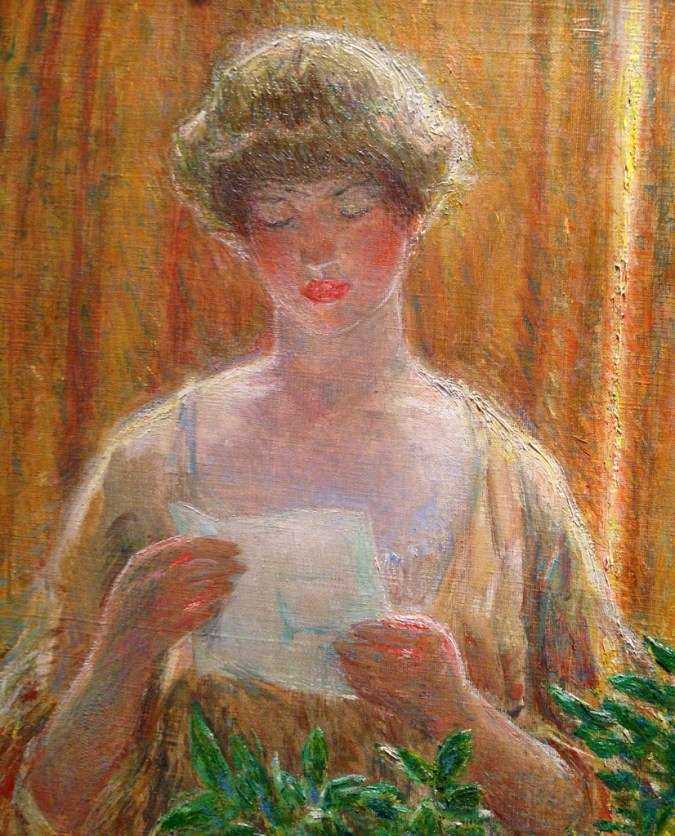
A Bedtime Story (Detail) — Seymour Joseph Guy

20140604-130714-47234184.jpg

The Clearing — Paul Ranson

“Food” — Donald Barthelme

I was preparing a meal for Celeste-a meal of a certain elegance, as when arrivals or other rites of passage are to be celebrated.

First off there were Saltines of the very best quality and of a special crispness, squareness, and flatness, obtained at great personal sacrifice by making representations to the National Biscuit Company through its authorized nuncios in my vicinity. Upon these was spread with a hand lavish and not sitting Todd’s Liver Pate, the same having been robbed from geese and other famous animals and properly adulterated with cereals and other well-chosen extenders and the whole delicately spiced with calcium propionate to retard spoilage. Next there were rare cheese products from Wisconsin wrapped in gold foil in exquisite tints with interesting printings thereon, including some very artful representations of cows, the same being clearly in the best of health and good humor. Next there were dips of all kinds including clam, bacon with horseradish, onion soup with sour cream, and the like, which only my long acquaintance with some very high-up members of the Borden company allowed to grace my table. Next there were Fritos curved and golden to the number of 224 (approx.), or the full contents of the bursting 53c bag. Next there were Frozen Assorted Hors d’Oeuvres of a richness beyond description, these wrested away from an establishment catering only to the nobility, the higher clergy, and certain selected commoners generally agreed to be comers in their particular areas of commonality, calcium propionate added to retard spoilage. In addition there were Mixed Nuts assembled at great expense by the Planters concern from divers strange climes and hanging gardens, each nut delicately dusted with a salt that has no peer. Furthermore there were cough drops of the manufacture of the firm of Smith Fils, brown and savory and served in a bowl once the property of Brann the Iconoclast. Next there were young tender green olives into which ripe red pimentos had been cunningly thrust by underpaid Portuguese, real and true handwork every step of the way. In addition there were pearl onions meticulously separated from their nonstandard fellows by a machine that had caused the Board of Directors of the S&W concern endless sleepless nights and had passed its field trails just in time to contribute to the repast I am describing. Additionally there were gherkins whose just fame needs no further words from me. Following these appeared certain cream cheeses of Philadelphia origin wrapped in costly silver foil, the like of which a pasha could not have afforded in the dear dead days. Following were Mock Ortolans Manques made of the very best soybean aggregate, the like of which could not be found on the most sophisticated tables of Paris, London and Rome. The whole washed down with generous amounts of Tab, a fiery liquor brewed under license by the Coca-Cola Company which will not divulge the age-old secret recipe no matter how one begs and pleads with them but yearly allows a small quantity to circulate to certain connoisseurs and bibbers whose credentials meet the very rigid requirements of the Cellarmaster. All of this stupendous feed being a mere scherzo before the announcement of the main theme, chilidogs.
“What is all this?” asked sweet Celeste, waving her hands in the air. “Where is the food?”
“You do not recognize a meal spiritually prepared,” I said, hurt in the self-love.
“We will be very happy together,” she said. “I cook.”

From Donald Barthelme’s short story “Daumier.”

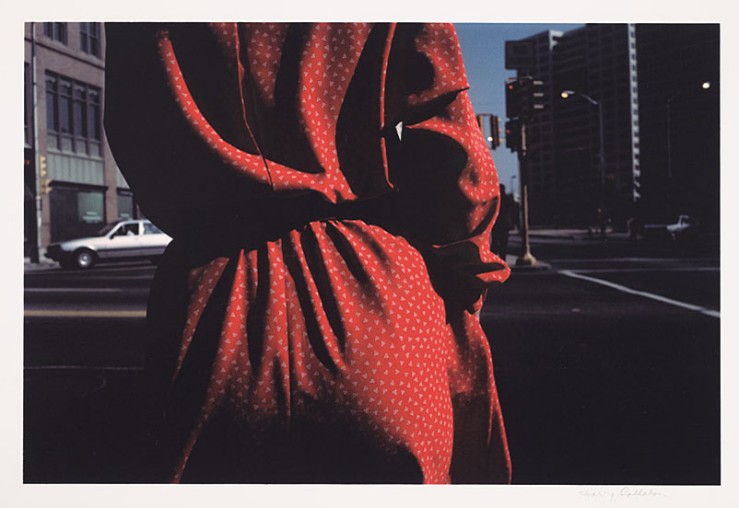
Atlanta — Harry Callahan

02-callahan_sfmoma_lg

Read Barry Hannah’s Short Story “The Spy of Loog Root”

THE OUTCAST NEPHEW was farhearinged. That is a difficult word and concept, but as with farsighted, his ear could not participate with sounds up close, only those far away, up to a quarter mile, a distance of course at which the rest of us townsmen can hear little at all except explosions and aircraft. It seemed to work that if voices were soft enough, faint enough, they could penetrate his tympana. One thought of the sound waves, but how, in his case? I don’t know, but imagine the tenderness of his ears, bent by the incredible bawling of noise he must have sensed up close, so that he ran away, holding both ears in agony, dispossessed of normal human intercourse.

He was one of those exceptional children, ghostly with long blond hair, to whom none of his family out at Loog Root Pass felt kin, except the mother. We never got, because of his affliction, a definite reckoning on his intelligence before he ran off, alone, into the hills.

Read the rest of Barry Hannah’s short story “The Spy of Loog Root” at The Oxford American.

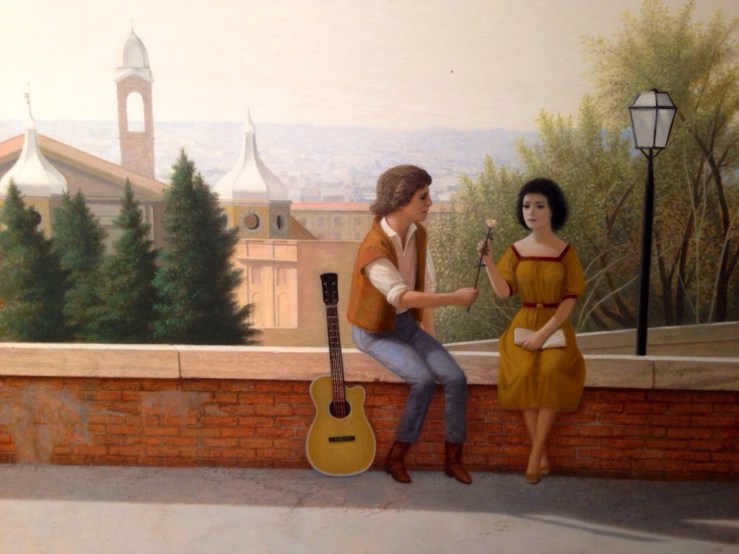
View of Rome — Joseph Jeffers Dodge

20140604-130712-47232460.jpg

Riding Death in My Sleep — Wangechi Mutu

“Go to hell, Roberto” | Roberto Bolaño’s The Unknown University

The Unknown University, Roberto Bolaño’s poetry collection—his complete poems, a bilingual edition, lovely, beautiful, over 800 pages—has been shifted all over my messy house this past month, wedged into ad hoc shelves, even conspicuously, for a time, fatly weighing down another Bolaño text, The Insufferable Gaucho (which I’ve been reading in tandem with/against The Unknown University), swollen and warped with saltwater from the gray Atlantic ocean.

I pecked at The Unknown University discursively, avoiding end notes, taking the rest of the Bolañoverse as my guide or frame or map or background for these poems. I read randomly, trying one poem at a time in no special order, taking crude stabs at the Spanish text on the left hand pages, clumsily matching them against Laura Healy’s fine translation, a poetics that matches the tone and rhythm and cadence and vibe of Bolaño’s other translators, Natasha Wimmer and Chris Andrews.

Then last night, a tale from The Insufferable Gaucho compelled me to read from The Unknown University straightwise, linear, 1-2-3, non-discursively, to take a stab at an orderly trajectory, reading it like a novel in fragments, perhaps.

The book is divided into three parts, each comprised of their own chapters or individual books. Last night I read, or reread, the first half of the first part: The Snow-NovelGuirat de BornelhStreets of BarcelonaIn the Reading Room of Hell.

The examples and citations in this riff come from those books, but I’d suggest that the images, motifs, and themes of these early poems—switchblades, hell, abysses, poets, girls, detectives, assassins, hunchbacks, genitals, sex, madness, blood—resonate throughout the entire volume (and throughout Bolaño’s oeuvre).

Perhaps the most central theme is Bolaño himself; The Unknown University often reads like a diffuse autobiography, with Bolaño’s concern for his own place in literature at the fore.

We see that anxiety in the first poem shared by the editors, a piece from 1990 included in the book’s intro:

Even a decade earlier, Bolaño prophesied that he would be carried to hell, a primal setting of the Bolañoverse. Bolaño’s romantic ancestor Jorge Luis Borges famously imagined Paradise as a kind of library. Bolaño inverts that image:
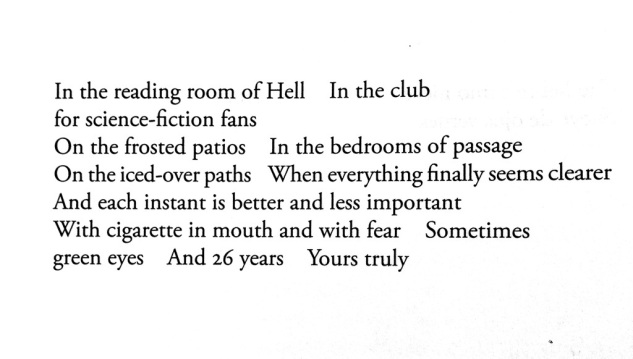
20140609-152831-55711939.jpgIn another poem, Bolaño seems to obliquely address Borges again (“Dear, this isn’t Paradise”), while also name-checking the heroes of that “club / for science-fiction fans” (including some perhaps-unlikely figures):
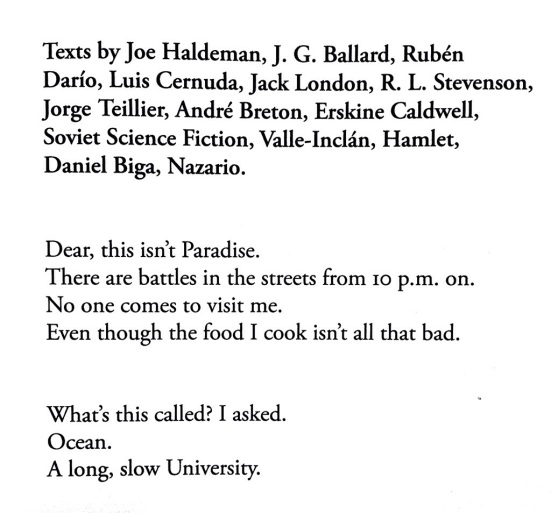
20140609-152831-55711467.jpg“A long, slow University.” Yes.

But how could Bolaño leave his hero Edgar Allan Poe from the curriculum? Oh, never mind. Here he is: 
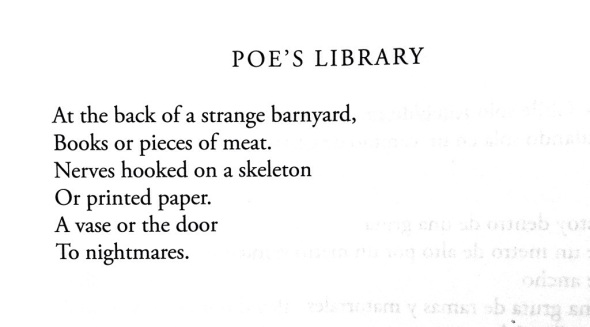
20140609-152830-55710956.jpg

The vase—Pandora’s box, Keats’s urn?—is a central image in these early poems. Dark, beautiful, and transformative, Bolaño seems to posit the vase—an object rendered somewhat mundane in its traditional place as an aesthetic object—as a portal to the abyss:

20140609-152830-55710494.jpg

Elsewhere our poet warns/invites us: “The nightmare begins over there, right there. / Further up, down, everything’s part of the / nightmare. Don’t stick your hand in that urn. Don’t / stick your hand in that hellish vase.” Reading the poem forces us to stick our hand in the vase.

If Bolaño seems occasionally melodramatic in his poems, a thrall to Baudelaire, he’s also keenly aware of it, even this early in his career. A twinning of irony and earnestness characterizes Bolaño’s writing, a savage self-reflexive humor that doesn’t necessarily reveal itself on first reading. When he begins a poem about a lost love, “Go to hell, Roberto, and remember you’ll never stick it in again,” the sentiment is simultaneously tragic and comic, the kind of personal confession that connects to the reader’s own experiences. “To be honest I don’t remember much now,” our narrator confides near the end, before the devastating conclusion, “She loved me forever / She crushed me.”

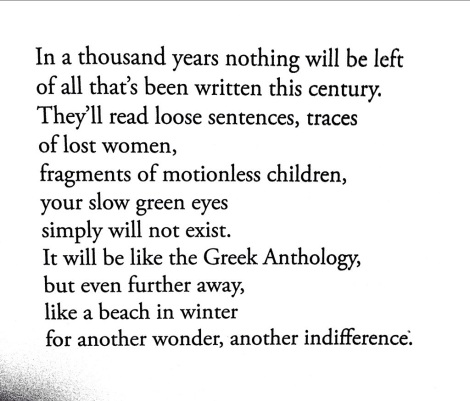
For Bolaño though, what’s perhaps most crushing is the loss of literature:
20140609-161756-58676319.jpg

And yet Bolaño sticks his arm into the vase, walks out over the chasm, dares for his poems to perhaps earn the right to be one of those “loose sentences, traces . . . fragments” that may survive.

In the very early poem “Work,” Bolaño romanticizes his own literary posterity:

Poetry that might champion my shadow in days to come

when I’ll be just a name not the man who wandered

with empty pockets, worked in slaughterhouses

on the old and on the new continent.

I seek credibility not durability for the ballads

I composed in honor of very real girls.

And mercy for my years before 26.

Seems like a reasonable request.

I don’t know if these poems are good or bad or excellent or what. I do know that I loved reading them and that they are of a piece with everything else I’ve read by Bolaño. The best moments recall his best writing, that strange mix of plain, even understated language, set against romantic violence and terrible madness. The poems here don’t distill the best of Bolaño into burning kernels of visceral realism; rather, they feel like the liquid filament of the Bolañoverse. Fantastic.

More to come.

The Unknown University is available now from New Directions.
“WAR IS PEACE” (Orwell Manuscript)

20140609-133942-49182823.jpg

“Literature is a struggle over the nature of reality” (Dmitry Samarov’s Portrait of Richard Wright)

wrightcard3

Check out more of Dmitry Samarov’s greeting cards for the Chicago Literary Hall of Fame.

Mandrill — Oskar Kokoschka

Hope/desperation (Schopenhauer)

Hope is the result of confusing the desire that something should take place with the probability that it will. Perhaps no man is free from this folly of the heart, which deranges the intellect’s correct appreciation of probability to such an extent that, if the chances are a thousand to one against it, yet the event is thought a likely one. Still in spite of this, a sudden misfortune is like a death stroke, whilst a hope that is always disappointed and still never dies, is like death by prolonged torture.

He who has lost all hope has also lost all fear; this is the meaning of the expression “desperate.” It is natural to a man to believe what he wishes to be true, and to believe it because he wishes it, If this characteristic of our nature, at once beneficial and assuaging, is rooted out by many hard blows of fate, and a man comes, conversely, to a condition in which he believes a thing must happen because he does not wish it, and what he wishes to happen can never be, just because he wishes it, this is in reality the state described as “desperation.”

From Arthur Schopenhauer’s “Psychological Observations.” Translated by T. Bailey Saunders.

Miss Ingram (Detail) — Childe Hassam

20140604-130710-47230517.jpg

Forest Fire in Moonlight — Charles Burchfield

forest fire

Capitalism arose and took off its pajamas (Donald Barthelme)

Capitalism arose and took off its pajamas. Another day, another dollar. Each man is valued at what he will bring in the marketplace. Meaning has been drained from work and assigned instead to remuneration. Unemployment obliterates the world of the unemployed individual. Cultural underdevelopment of the worker, as a technique of domination, is found everywhere under late capitalism. Authentic self-domination by individuals is thwarted. The false consciousness created and catered to by mass culture perpetuates ignorance and powerlessness. Strands of raven hair floating on the surface of the Ganges . . . Why can’t they clean up the Ganges? If the wealthy capitalists who operate the Ganges wig factories could be forced to install sieves, at the mouths of their plants . . . And now the sacred Ganges is choked with hair, and the river no longer knows where to put its flow, and the moonlight on the Ganges is swallowed by the hair, and the water darkens. By Vishnu! This is an intolerable situation! Shouldn’t something be done about it?

From Donald Barthelme’s short story “The Rise of Capitalism.”

Eleanor — Harry Callahan

callahan