“All art constantly aspires towards the condition of music”

The Dream of Saffo — Agostino Arrivabene

For me, the word “writing” is the exact opposite of the word “waiting” (Roberto Bolaño)

The truth is, I don’t believe all that much in writing. Starting with my own. Being a writer is pleasant—no, pleasant isn’t the word—it’s an activity that has its share of amusing moments, but I know of other things that are even more amusing, amusing in the same way that literature is for me. Holding up banks, for example. Or directing movies. Or being a gigolo. Or being a child again and playing on a more or less apocalyptic soccer team. Unfortunately, the child grows up, the bank robber is killed, the director runs out of money, the gigolo gets sick and then there’s no other choice but to write. For me, the word “writing” is the exact opposite of the word “waiting.” Instead of waiting, there is writing. Well, I’m probably wrong—it’s possible that writing is another form of waiting, of delaying things. I’d like to think otherwise. But, as I said, I’m probably wrong.

Roberto Bolaño, in a 2001 email interview with Carmen Boullosa. First published in Bomb and then collected in Melville House’s The Last Interview.


Snow — Francine van Hove

francine-van-hove-neiges

The Reverse of a Framed Painting — Cornelis Norbertus Gysbrechts

“The Mockingbird” — Charles Bukowski

IMG_3055

Lovers I — Milan Hrnjazović

Read Barry Hannah’s perfect short story “Even Greenland”

I was sitting radar. Actually doing nothing.

We had been up to seventy-five thousand to give the afternoon some jazz. I guess we were still in Mexico, coming into Mirimar eventually in the F-14. It doesn’t much matter after you’ve seen the curvature of the earth. For a while, nothing much matters at all. We’d had three sunsets already. I guess it’s what you’d call really living the day.

But then, “John,” said I, “this plane’s on fire.”

“I know it,” he said.

John was sort of short and angry about it.

“You thought of last-minute things any?” said I.

“Yeah. I ran out of a couple of things already. But they were cold, like. They didn’t catch the moment. Bad writing,” said John.

“You had the advantage. You’ve been knowing,” said I.

“Yeah. I was going to get a leap on you. I was going to smoke you. Everything you said, it wasn’t going to be good enough,” said he.

“But it’s not like that,” said I. “Is it?”

The wings were turning red. I guess you’d call it red. It was a shade against dark blue that was mystical flamingo, very spaceylike, like living blood. Was the plane bleeding?

“You have a good time in Peru?” said I.

“Not really,” said John. “I got something to tell you. I haven’t had a ‘good time’ in a long time. There’s something between me and a good time since, I don’t know, since I was was twenty-eight or like that. I’ve seen a lot, but you know I haven’t quite seen it. Like somebody’s seen it already. It wasn’t fresh. There were eyes that used it up some.”

“Even high in Mérida?” said I.

“Even,” said John.

“Even Greenland?” said I.

Read the rest of Barry Hannah’s short story “Even Greenland.”

Charles Bukowski on Individuality

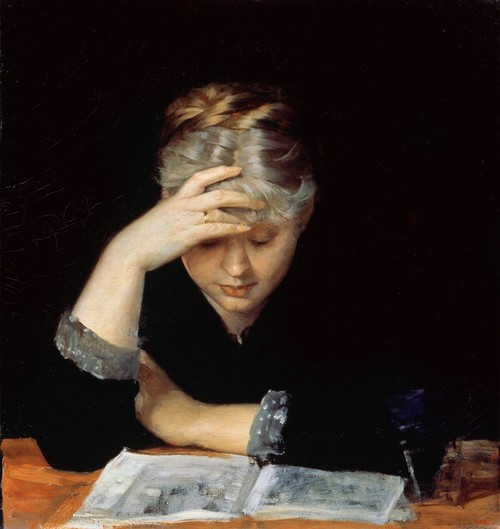
At a Book — Marie Bashkirtseff

at a book

L’Avventura – Michelangelo Antonioni (Full Film)

Syssigy — Leonora Carrington

Syssigy

Reading/Have Read/Should Write About

IMG_3050.JPG

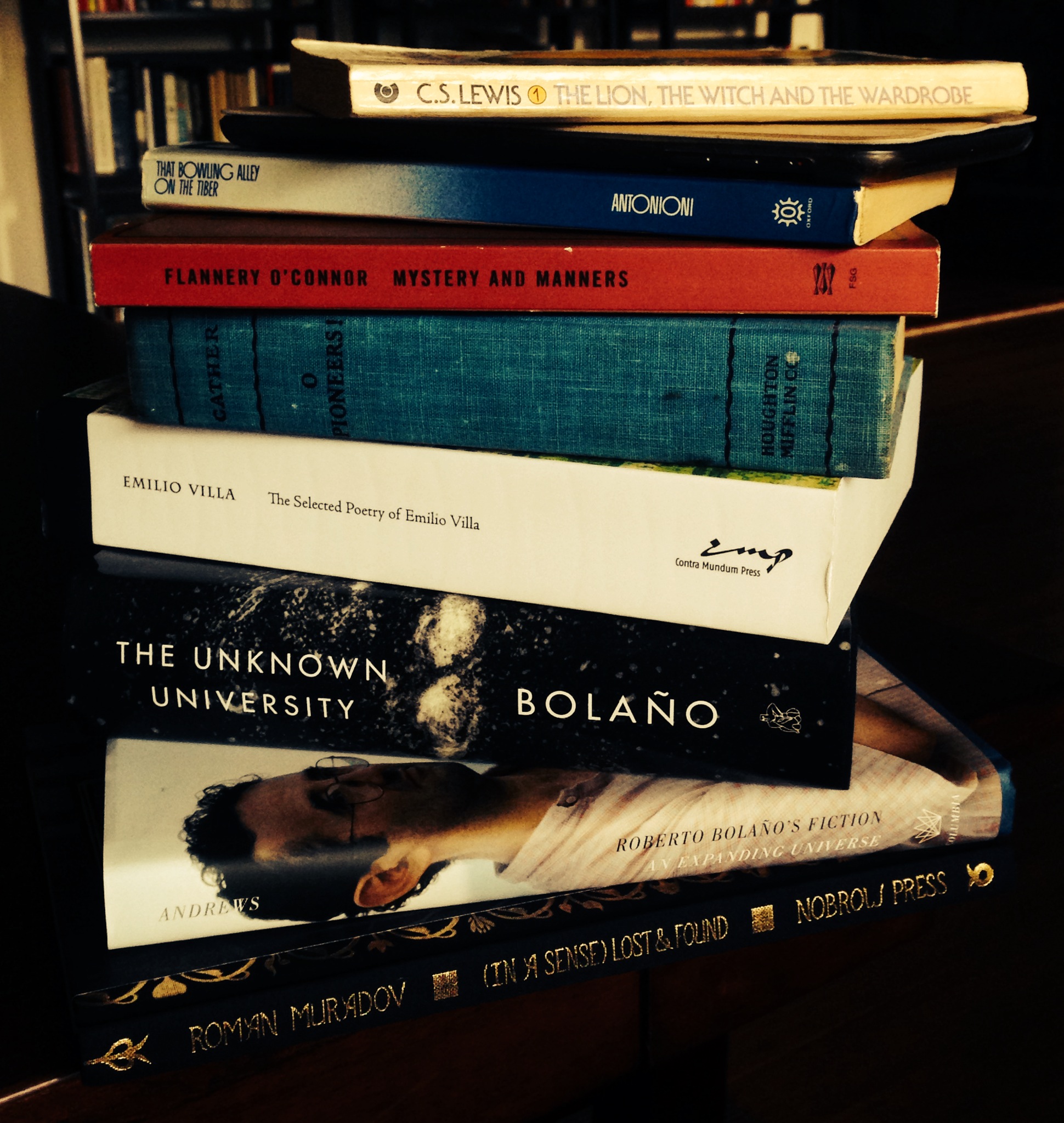
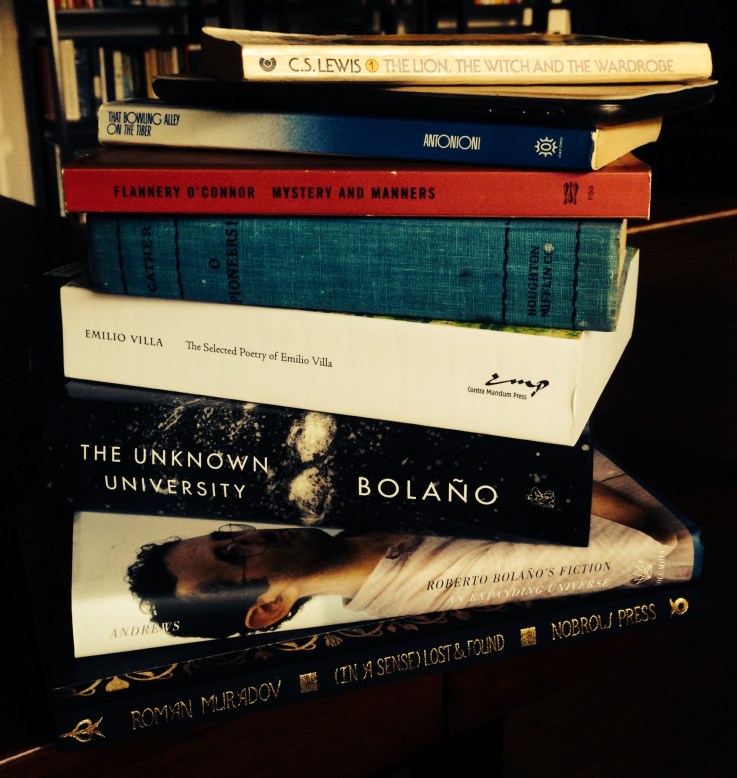
Ran out of time this week before I could write about anything I’ve been reading. So a quick riff, from top to bottom, in the pic above:

The Lion, the Witch, and the Wardrobe, C.S. Lewis

I’ve been reading this at night with my seven-year-old daughter. I’ve read it maybe a thousand times now. Lewis is not the best prose stylist, but he fuses together bits of pagan and Christian myth better than the best.

On the iPad:

The Possibility of an Island, Michel Houellebecq

My least-favorite Houellebecq so far—has some wonderful rants at times, but Houellebecq keeps embedding these terrible pop culture references (following his hero Bret Easton Ellis’s lead?) that usually dull the edge he’s been sharpening. And the narrator’s spite at this point is almost unbearable—reading it makes me feel like Gandalfdore drinking that poisonous potion in Harry Potter and the League of Bad Mentorsjust sucking down venom.

The Golden Notebook, Doris Lessing

Great stuff. A little over two-thirds finished. Wrote about is some here.

Lanark, Alasdair Gray

I might regret that I never wrote a Big Fat Review of Lanark, Gray’s bizarre cult novel. The book is a weird chimera: It starts as a weird sci-fi/fantasy trip—closer to Kafka’s The Castle than genre-conventional fare though, to be clear. Then it shifts into this modernist Künstlerroman that seems to want to be a Scottish answer to Joyce’s Portrait. Then there’s a short story inserted in the middle, a return to the dystopian fantasy (heavy streaks of Logan’s Run and Zardoz and Soylent Green—very ’70s!), and, right before its (purposefully) dissatisfying conclusion, an essay by a version of the author, who defensively critiques his novel for characters and readers alike. Gray wants to have written the Great Scottish Epic. I’m not sure if he did, but Lanark has moments that are better than anything I’ve read all year—even if the end result doesn’t hang together so well.

The Bowling Alley on the Tiber, Michelangelo Antonioni

Sketches and figments that Antonioni never turned into films. Not sure if he intended to.

Mystery and Manners, Flannery O’Connor

Good lord.

O Pioneers!, Willa Cather

There’s a tendency in American fiction to posit the American Dream as a masculine escapist fantasy. This version of the Dream is perhaps best expressed in the last lines of The Adventures of Huckleberry Finn, when Huck declares: “But I reckon I got to light out for the territory ahead of the rest, because Aunt Sally she’s going to adopt me and sivilize me, and I can’t stand it. I been there before.” Always more territory, always more space outside of the (maternal) civilizing body. Cather answers to that version of the Dream in her character Alexandra Bergson, who cultivates the land and claims her own agency through commerce and agriculture.

The Selected Poetry of Emilio Villa, translated by Dominic Siracusa

What a strange and wonderful book! I wrote about it here. Confounding.

The Unknown University, Roberto Bolaño

Okay, so I wrote about the first section in detail here. More or less finished it. Bolaño’s best poems are basically prose (that’s not a knock).

Roberto Bolaño’s Fiction: An Expanding Universe, Chris Andrews

Wrote about it a bit here; will write more when I finish. Makes me want to reread Bolaño (although I almost always want to reread Bolaño).

(In a Sense) Lost & Found, Roman Muradov

The plot of Muradov’s debut graphic novel floats like a dream-fog in surreal, rich art as the ludic dialogue refuses to direct the reader to a stable referent. Great stuff.
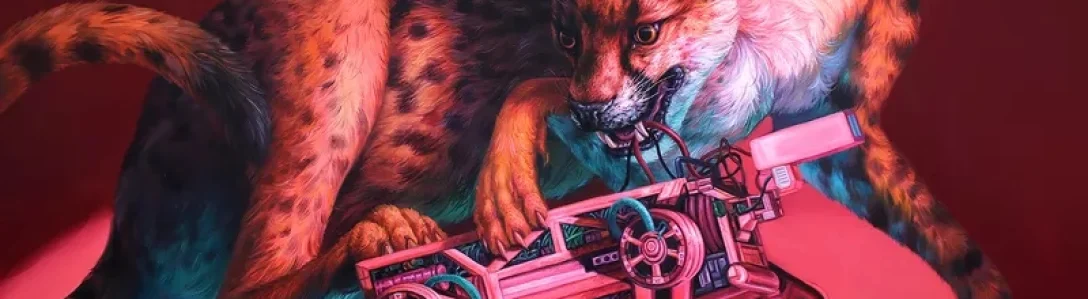
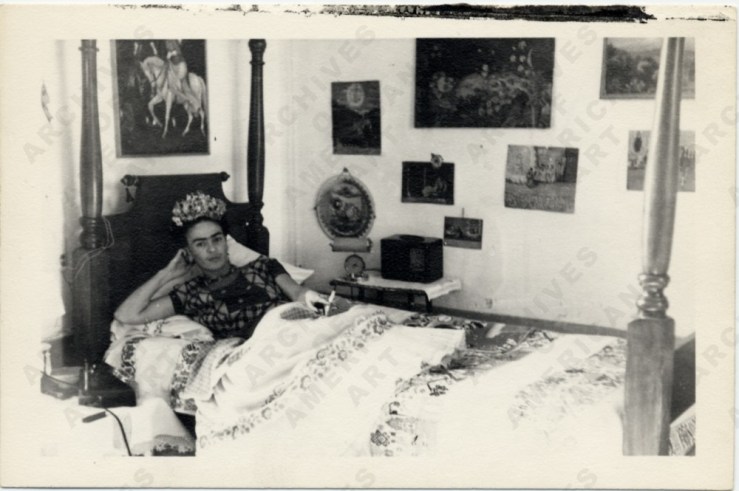
Frida Kahlo reclining on her bed in Coyoacán, Mexico

AAA_daleches_0002

“Titles for Unwritten Articles, Essays, and Stories” — Samuel Butler

“Titles for Unwritten Articles, Essays, and Stories”

from Samuel Butler’s Note-Books

  1. The Art of Quarrelling.
  2. Christian Death-beds.
  3. The Book of Babes and Sucklings.
  4. Literary Struldbrugs.
  5. The Life of the World to Come.
  6. The Limits of Good Faith.
  7. Art, Money and Religion.
  8. The Third Class Excursion Train, or Steam-boat, as the Church of the Future.
  9. The Utter Speculation involved in much of the good advice that is commonly given—as never to sell a reversion, etc.
  10. Tracts for Children, warning them against the virtues of their elders.
  11. Making Ready for Death as a Means of Prolonging Life.  An Essay concerning Human Misunderstanding.  So McCulloch [a fellow art-student at Heatherley’s, a very fine draughtsman] used to say that he drew a great many lines and saved the best of them.  Illusion, mistake, action taken in the dark—these are among the main sources of our progress.
  12. The Elements of Immorality for the Use of Earnest Schoolmasters.
  13. Family Prayers: A series of perfectly plain and sensible ones asking for what people really do want without any kind of humbug.
  14. A Penitential Psalm as David would have written it if he had been reading Herbert Spencer.
  15. A Few Little Crows which I have to pick with various people.
  16. The Scylla of Atheism and the Charybdis of Christianity.
  17. The Battle of the Prigs and Blackguards.
  18. That Good may Come.
  19. The Marriage of Inconvenience.
  20. The Judicious Separation.
  21. Fooling Around.
  22. Higgledy-Piggledy.
  23. The Diseases and Ordinary Causes of Mortality among Friendships.
  24. The finding a lot of old photographs at Herculaneum or Thebes; and they should turn out to be of no interest.
  25. On the points of resemblance and difference between the dropping off of leaves from a tree and the dropping off of guests from a dinner or a concert.
  26. The Sense of Touch: An essay showing that all the senses resolve themselves ultimately into a sense of touch, and that eating is touch carried to the bitter end.  So there is but one sense—touch—and the amœba has it.  When I look upon the foraminifera I look upon myself.
  27. The China Shepherdess with Lamb on public-house chimney-pieces in England as against the Virgin with Child in Italy.
  28. For a Medical pamphlet: Cant as a means of Prolonging Life.
  29. For an Art book: The Complete Pot-boiler; or what to paint and how to paint it, with illustrations reproduced from contemporary exhibitions and explanatory notes.
  30. For a Picture: St. Francis preaching to Silenus.  Fra Angelico and Rubens might collaborate to produce this picture.
  31. The Happy Mistress.  Fifteen mistresses apply for three cooks and the mistress who thought herself nobody is chosen by the beautiful and accomplished cook.
  32. The Complete Drunkard.  He would not give money to sober people, he said they would only eat it and send their children to school with it.
  33. The Contented Porpoise.  It knew it was to be stuffed and set up in a glass case after death, and looked forward to this as to a life of endless happiness.
  34. The Flying Balance.  The ghost of an old cashier haunts a ledger, so that the books always refuse to balance by the sum of, say, £1.15.11.  No matter how many accountants are called in, year after year the same error always turns up; sometimes they think they have it right and it turns out there was a mistake, so the old error reappears.  At last a son and heir is born, and at some festivities the old cashier’s name is mentioned with honour.  This lays his ghost.  Next morning the books are found correct and remain so.
  35. A Dialogue between Isaac and Ishmael on the night that Isaac came down from the mountain with his father.  The rebellious Ishmael tries to stir up Isaac, and that good young man explains the righteousness of the transaction—without much effect.
  36. Bad Habits: on the dropping them gradually, as one leaves off requiring them, on the evolution principle.
  37. A Story about a Freethinking Father who has an illegitimate son which he considers the proper thing; he finds this son taking to immoral ways, e.g. he turns Christian, becomes a clergyman and insists on marrying.
  38. For a Ballad: Two sets of rooms in some alms-houses at Cobham near Gravesend have an inscription stating that they belong to “the Hundred of Hoo in the Isle of Grain.”  These words would make a lovely refrain for a ballad.
  39. A story about a man who suffered from atrophy of the purse, or atrophy of the opinions; but whatever the disease some plausible Latin, or imitation-Latin name must be found for it and also some cure.
  40. A Fairy Story modelled on the Ugly Duckling of Hans Andersen about a bumptious boy whom all the nice boys hated.  He finds out that he was really at last caressed by the Huxleys and Tyndalls as one of themselves.
  41. A Collection of the letters of people who have committed suicide; and also of people who only threaten to do so.  The first may be got abundantly from reports of coroners’ inquests, the second would be harder to come by.
  42. The Structure and Comparative Anatomy of Fads, Fancies and Theories; showing, moreover, that men and women exist only as the organs and tools of the ideas that dominate them; it is the fad that is alone living.
  43. An Astronomical Speculation: Each fixed star has a separate god whose body is his own particular solar system, and these gods know each other, move about among each other as we do, laugh at each other and criticise one another’s work.  Write some of their discourses with and about one another.

Continue reading ““Titles for Unwritten Articles, Essays, and Stories” — Samuel Butler”

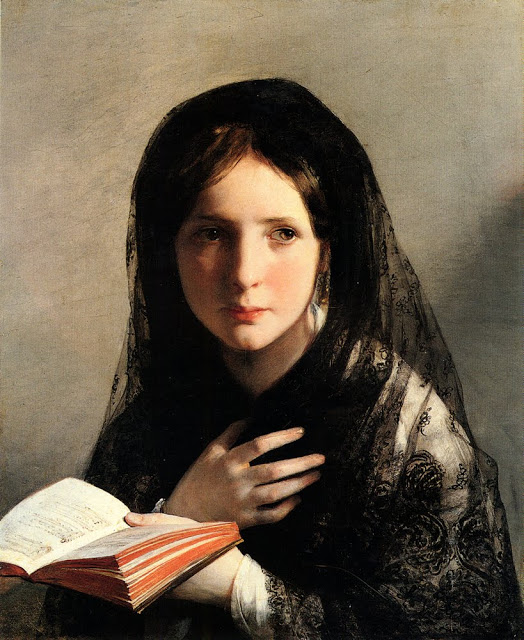
Lost in Dreams — Friedrich von Amerling

2aFriedrich von Amerling (Austrian-born artist, 1803-1887) In Traumen Versunken, 1835.

Meanwhile.

20140719-140243-50563063.jpg