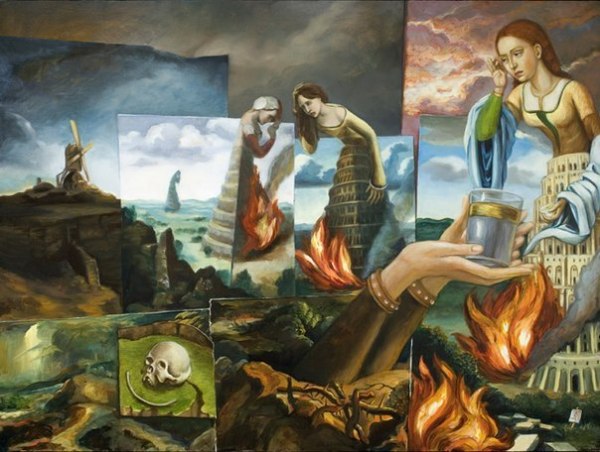
The Manufacturing of Tears — Carrie Ann Baade

VRO69LKBMGU

“This Compost” — Walt Whitman

“This Compost”

by

Walt Whitman

1

Something startles me where I thought I was safest,
I withdraw from the still woods I loved,
I will not go now on the pastures to walk,
I will not strip the clothes from my body to meet my lover the sea,
I will not touch my flesh to the earth as to other flesh to renew me.

O how can it be that the ground itself does not sicken?
How can you be alive you growths of spring?
How can you furnish health you blood of herbs, roots, orchards, grain?
Are they not continually putting distemper’d corpses within you?
Is not every continent work’d over and over with sour dead?

Where have you disposed of their carcasses?
Those drunkards and gluttons of so many generations?
Where have you drawn off all the foul liquid and meat?
I do not see any of it upon you to-day, or perhaps I am deceiv’d,
I will run a furrow with my plough, I will press my spade through the sod and turn it up underneath,
I am sure I shall expose some of the foul meat.

2

Behold this compost! behold it well!
Perhaps every mite has once form’d part of a sick person—yet behold!
The grass of spring covers the prairies,
The bean bursts noiselessly through the mould in the garden,
The delicate spear of the onion pierces upward,
The apple-buds cluster together on the apple-branches,
The resurrection of the wheat appears with pale visage out of its graves,
The tinge awakes over the willow-tree and the mulberry-tree,
The he-birds carol mornings and evenings while the she-birds sit on their nests,
The young of poultry break through the hatch’d eggs,
The new-born of animals appear, the calf is dropt from the cow, the colt from the mare,
Out of its little hill faithfully rise the potato’s dark green leaves,
Out of its hill rises the yellow maize-stalk, the lilacs bloom in the dooryards,
The summer growth is innocent and disdainful above all those strata of sour dead.

What chemistry!
That the winds are really not infectious,
That this is no cheat, this transparent green-wash of the sea which is so amorous after me,
That it is safe to allow it to lick my naked body all over with its tongues,
That it will not endanger me with the fevers that have deposited themselves in it,
That all is clean forever and forever,
That the cool drink from the well tastes so good,
That blackberries are so flavorous and juicy,
That the fruits of the apple-orchard and the orange-orchard, that melons, grapes, peaches, plums, will
none of them poison me,
That when I recline on the grass I do not catch any disease,
Though probably every spear of grass rises out of what was once a catching disease.

Now I am terrified at the Earth, it is that calm and patient,
It grows such sweet things out of such corruptions,
It turns harmless and stainless on its axis, with such endless successions of diseas’d corpses,
It distills such exquisite winds out of such infused fetor,
It renews with such unwitting looks its prodigal, annual, sumptuous crops,
It gives such divine materials to men, and accepts such leavings from them at last.

“The Hungry Stones” — Rabindranath Tagore

“The Hungry Stones”

by

Rabindranath Tagore


My kinsman and myself were returning to Calcutta from our Puja trip when we met the man in a train. From his dress and bearing we took him at first for an up-country Mahomedan, but we were puzzled as we heard him talk. He discoursed upon all subjects so confidently that you might think the Disposer of All Things consulted him at all times in all that He did. Hitherto we had been perfectly happy, as we did not know that secret and unheard-of forces were at work, that the Russians had advanced close to us, that the English had deep and secret policies, that confusion among the native chiefs had come to a head. But our newly-acquired friend said with a sly smile: “There happen more things in heaven and earth, Horatio, than are reported in your newspapers.” As we had never stirred out of our homes before, the demeanour of the man struck us dumb with wonder. Be the topic ever so trivial, he would quote science, or comment on the Vedas, or repeat quatrains from some Persian poet; and as we had no pretence to a knowledge of science or the Vedas or Persian, our admiration for him went on increasing, and my kinsman, a theosophist, was firmly convinced that our fellow-passenger must have been supernaturally inspired by some strange “magnetism” or “occult power,” by an “astral body” or something of that kind. He listened to the tritest saying that fell from the lips of our extraordinary companion with devotional rapture, and secretly took down notes of his conversation. I fancy that the extraordinary man saw this, and was a little pleased with it.

When the train reached the junction, we assembled in the waiting room for the connection. It was then 10 P.M., and as the train, we heard, was likely to be very late, owing to something wrong in the lines, I spread my bed on the table and was about to lie down for a comfortable doze, when the extraordinary person deliberately set about spinning the following yarn. Of course, I could get no sleep that night.

When, owing to a disagreement about some questions of administrative policy, I threw up my post at Junagarh, and entered the service of the Nizam of Hydria, they appointed me at once, as a strong young man, collector of cotton duties at Barich.

Barich is a lovely place. The Susta “chatters over stony ways and babbles on the pebbles,” tripping, like a skilful dancing girl, in through the woods below the lonely hills. A flight of 150 steps rises from the river, and above that flight, on the river’s brim and at the foot of the hills, there stands a solitary marble palace. Around it there is no habitation of man—the village and the cotton mart of Barich being far off. Continue reading ““The Hungry Stones” — Rabindranath Tagore”

Cucumbers — Pierre Dubreuil

“Oscuridad” — Laetitia Sadier

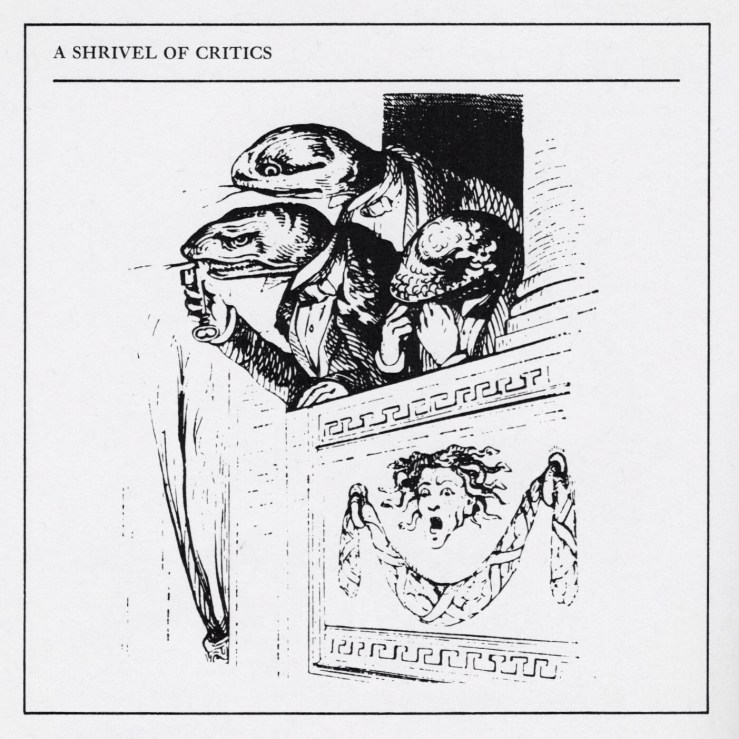
A Shrivel of Critics

IMG_7593

From James Lipton’s An Exaltation of Larks.

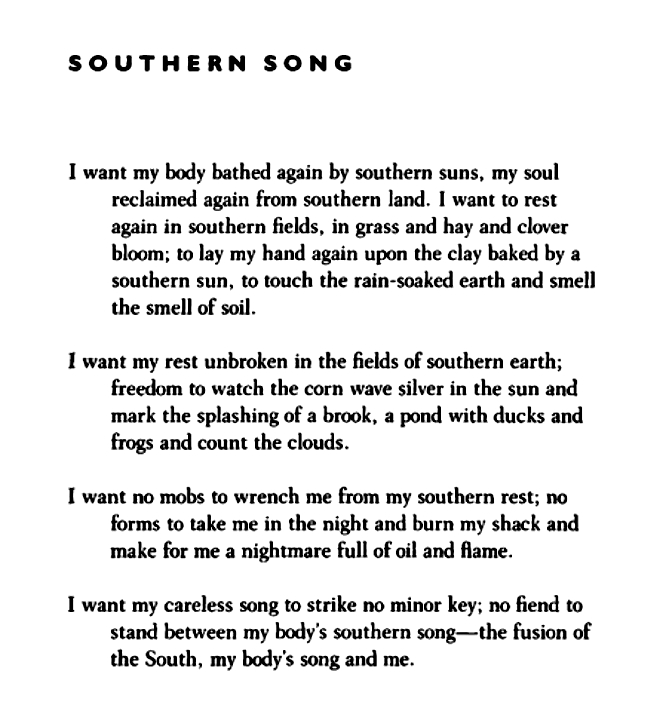
“Southern Song” — Margaret Walker

Screenshot 2015-07-07 at 8

Watch Harry Nilsson and Ringo Starr in Son of Dracula (or don’t, it’s pretty terrible)

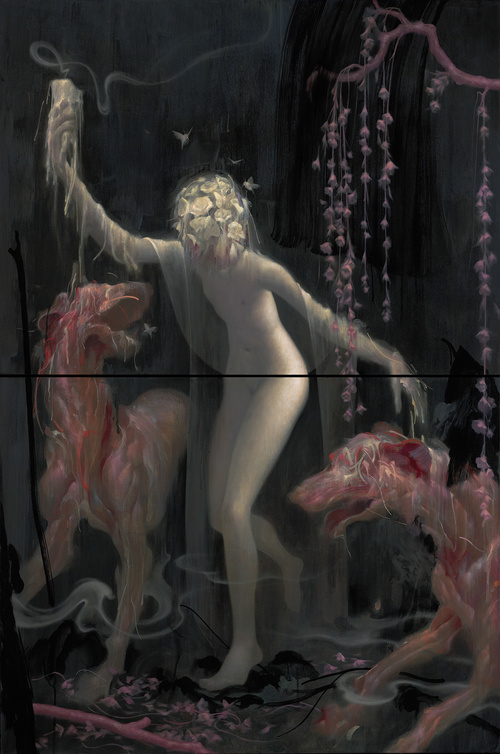
Excavation — James Jean

Excavation_webres

Still Life with Widow’s Veil — Otto Dix

A brief note to readers new to Infinite Jest (and a very incomplete list of motifs in the novel)

David Foster Wallace’s 1996 novel Infinite Jest poses rhetorical, formal, and verbal challenges that will confound many readers new to the text. The abundance of (or excess of) guides and commentaries on the novel can perhaps have the adverse and unintentional consequence of making readers new to Infinite Jest believe that they can’t “get it” without help.  Much of the online analyses and resources for Infinite Jest are created by and targeted to readers who have finished or are rereading the novel. While I’ve read many insightful and enlightening commentaries on the novel over the years (and, in particular, over the past six weeks rereading IJ), my intuition remains that the superabundance of analysis may have the paradoxical effect of actually impeding readers new to the text. With this in mind, I’d suggest that first-time readers need only a dictionary and some patience.

(Still: Two online resources that might be useful are “Several More and Less Helpful Things for the Person Reading Infinite Jest,” which offers a glossary and a few other unobtrusive documents, and Infinite Jest: A Scene-by-Scene Guide,”which is not a guide at all, but rather a brief series of synopses of each scene in the novel, organized by page number and year; my sense is that this guide would be helpful to readers attempting to delineate the novel’s nonlinear chronology—however, I’d advise against peeking ahead).

The big advantage (and pleasure) of rereading Infinite Jest is that the rereader may come to understand the plot anew; IJ is richer and denser the second go around, its themes showing brighter as its formal construction clarifies. The rereader is free to attend to the imagery and motifs of the novel more intensely than a first-time reader, who must suss out a byzantine plot propelled by a plethora of characters. Readers new to IJ may find it helpful to attend from the outset to some of the novel’s repeated images, words, and phrases. Tracking motifs will help to clarify not only the novel’s themes and “messages,” but also its plot. I’ve listed just a few of these motifs below, leaving out the obvious ones like entertainment, drugs, tennis (and, more generally, sports and games), and death. The list is in no way definitive or analytic, nor do I present it as an expert; rather, it’s my hope that this short list might help a reader or two get more out of a first reading.


Heads

Cages

Faces

Maps

Masks

Cycles

Teeth

Waste

Infants

Pain

Deformities

Subjects

Objects

Continue reading “A brief note to readers new to Infinite Jest (and a very incomplete list of motifs in the novel)”

The Fox (Fair Game) — Alexander Pope

Entries under “B” from Captain Grose’s Dictionary of the Vulgar Tongue (1811)

The following definitions are from the “B” section of Captain Grose’s Dictionary of the Vulgar Tongue (1811).

BABES IN THE WOOD. Criminals in the stocks, or pillory.

BABBLE. Confused, unintelligible talk, such as was used at the building the tower of Babel.

BACK BITER. One who slanders another behind his back,
i.e. in his absence. His bosom friends are become his back
biters, said of a lousy man.

BACKED. Dead. He wishes to have the senior, or old
square-toes, backed; he longs to have his father on six
men’s shoulders; that is, carrying to the grave.

BACK UP. His back is up, i.e. he is offended or angry; an expression or idea taken from a cat; that animal, when angry, always raising its back. An allusion also sometimes used to jeer a crooked man; as, So, Sir, I see somebody has offended you, for your back is up.

BACON. He has saved his bacon; he has escaped. He has a good voice to beg bacon; a saying in ridicule of a bad voice.

BACON-FACED. Full-faced.

BACON FED. Fat, greasy.

BACK GAMMON PLAYER. A sodomite.

BACK DOOR (USHER, or GENTLEMAN OF THE). The same.

BAD BARGAIN. One of his majesty’s bad bargains; a worthless soldier, a malingeror. See MALINGEROR.

BADGE. A term used for one burned in the hand. He has got his badge, and piked; he was burned in the hand, and is at liberty. Cant. Continue reading “Entries under “B” from Captain Grose’s Dictionary of the Vulgar Tongue (1811)”

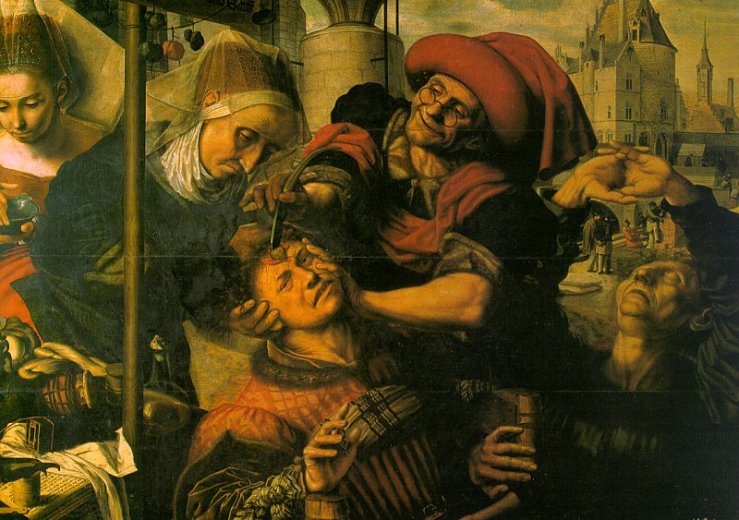
The Surgeon — Jan Sanders van Hemessen

tumblr_lz17lsTFeM1r5569zo1_1280

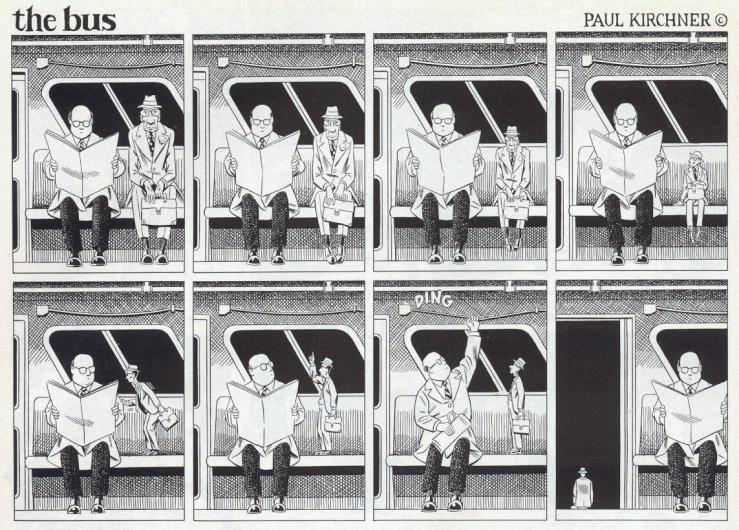
The Bus — Paul Kirchner

KLJcNZy - Imgur

Fireworks — Konstantin Somov