“Greville Fane” — Henry James


“Greville Fane”

by

Henry James

Coming in to dress for dinner, I found a telegram: “Mrs. Stormer dying; can you give us half a column for to-morrow evening?  Let her off easy, but not too easy.”  I was late; I was in a hurry; I had very little time to think, but at a venture I dispatched a reply: “Will do what I can.”  It was not till I had dressed and was rolling away to dinner that, in the hansom, I bethought myself of the difficulty of the condition attached.  The difficulty was not of course in letting her off easy but in qualifying that indulgence.  “I simply won’t qualify it,” I said to myself.  I didn’t admire her, but I liked her, and I had known her so long that I almost felt heartless in sitting down at such an hour to a feast of indifference.  I must have seemed abstracted, for the early years of my acquaintance with her came back to me.  I spoke of her to the lady I had taken down, but the lady I had taken down had never heard of Greville Fane.  I tried my other neighbour, who pronounced her books “too vile.”  I had never thought them very good, but I should let her off easier than that.

I came away early, for the express purpose of driving to ask about her.  The journey took time, for she lived in the north-west district, in the neighbourhood of Primrose Hill.  My apprehension that I should be too late was justified in a fuller sense than I had attached to it—I had only feared that the house would be shut up.  There were lights in the windows, and the temperate tinkle of my bell brought a servant immediately to the door, but poor Mrs. Stormer had passed into a state in which the resonance of no earthly knocker was to be feared.  A lady, in the hall, hovering behind the servant, came forward when she heard my voice.  I recognised Lady Luard, but she had mistaken me for the doctor.

“Excuse my appearing at such an hour,” I said; “it was the first possible moment after I heard.”

“It’s all over,” Lady Luard replied.  “Dearest mamma!”

She stood there under the lamp with her eyes on me; she was very tall, very stiff, very cold, and always looked as if these things, and some others beside, in her dress, her manner and even her name, were an implication that she was very admirable.  I had never been able to follow the argument, but that is a detail.  I expressed briefly and frankly what I felt, while the little mottled maidservant flattened herself against the wall of the narrow passage and tried to look detached without looking indifferent.  It was not a moment to make a visit, and I was on the point of retreating when Lady Luard arrested me with a queer, casual, drawling “Would you—a—would you, perhaps, be writing something?”  I felt for the instant like an interviewer, which I was not.  But I pleaded guilty to this intention, on which she rejoined: “I’m so very glad—but I think my brother would like to see you.”  I detested her brother, but it wasn’t an occasion to act this out; so I suffered myself to be inducted, to my surprise, into a small back room which I immediately recognised as the scene, during the later years, of Mrs. Stormer’s imperturbable industry.  Her table was there, the battered and blotted accessory to innumerable literary lapses, with its contracted space for the arms (she wrote only from the elbow down) and the confusion of scrappy, scribbled sheets which had already become literary remains.  Leolin was also there, smoking a cigarette before the fire and looking impudent even in his grief, sincere as it well might have been. Continue reading ““Greville Fane” — Henry James”

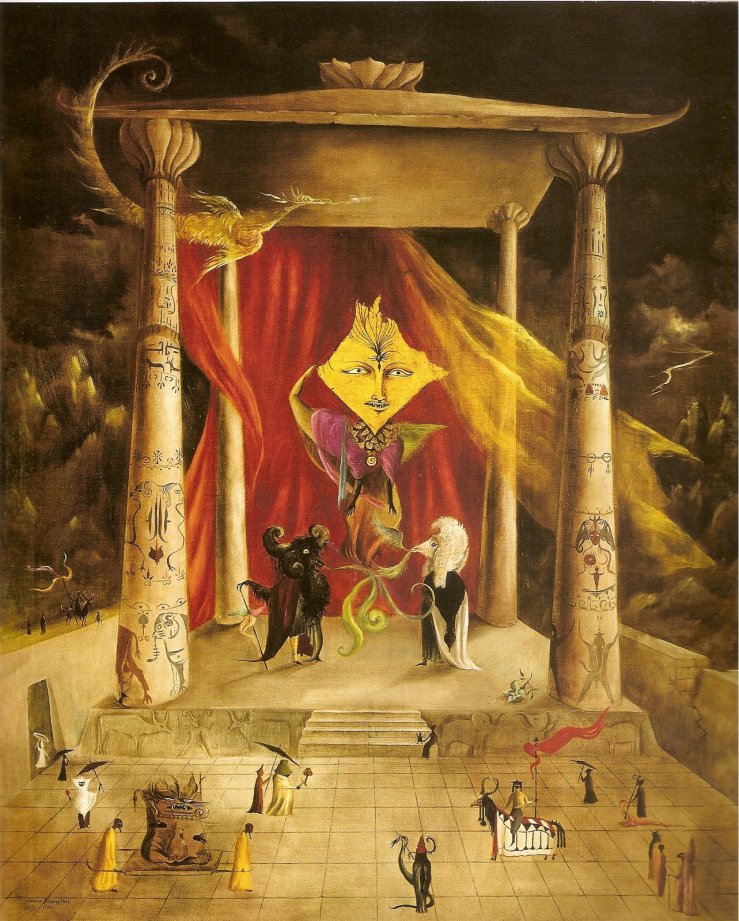
Temple of the World — Leonora Carrington

leonora-carrington_2

Uncle Piacsek in Front of the Black Sideboard — Jozsef Rippl-Ronai

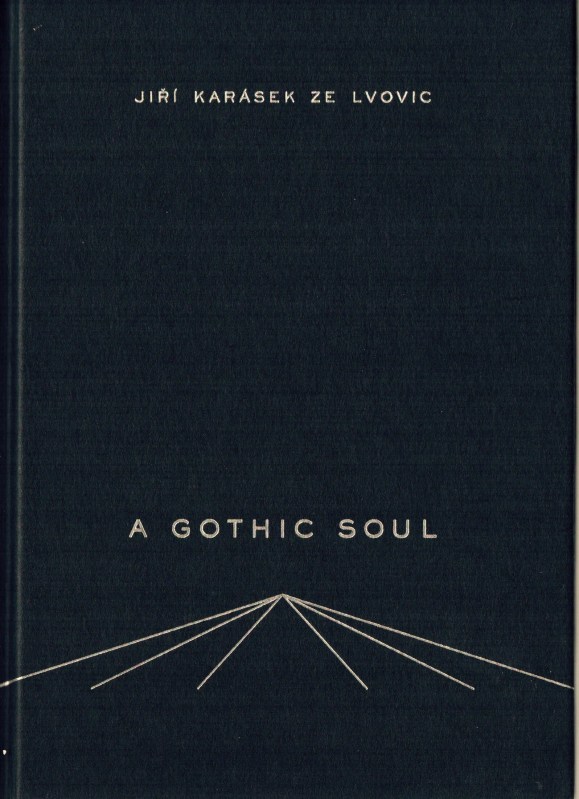
Jiří Karásek ze Lvovic’s A Gothic Soul (Book acquired, 3.30.2015)

image

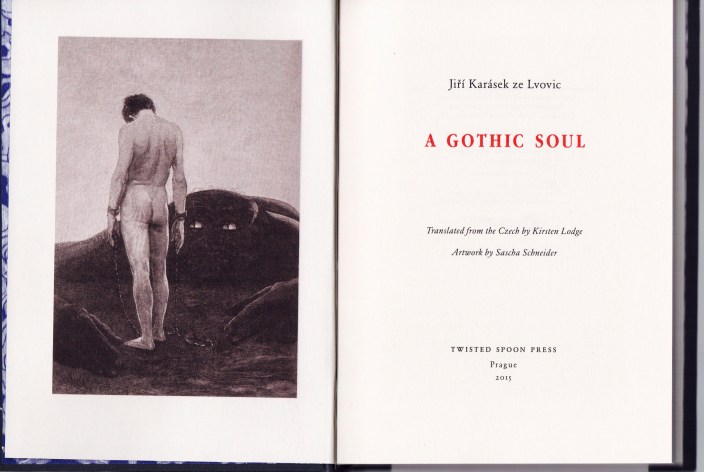
Another beautiful volume from Twisted SpoonA Gothic Soul by Jiří Karásek ze Lvovic, translated from the Czech by Kirsten Lodge, featuring prints by Sascha Schneider.

I dipped my toe in this weekend—strange, brooding stuff. More to come.

image

Twisted Spoon’s blurb:

A Gothic Soul is the most acclaimed work of Czech Decadent prose. Expressing concerns that are unique to the Czech movement while alluding creatively and ironically to Joris-Karl Huysman’s Against Nature, the novella is set in Prague, which is portrayed as a dead city, a city peopled by shades, who, like the protagonist — a nihilist and the “last scion of a noble line” — are only a dim reflection of the city’s medieval splendor. The man lives in a dreamworld, the labyrinth of his soul giving rise to visions. In his quest for meaning, he walks the city, often hallucinating, while pondering questions of religious fervor and loss of faith, the vanity of life, his own sense of social alienation, human identity and its relationship to a “nation,” the miserable situation of the Czechs under Habsburg rule, and Prague’s loss of its soul on the cusp of modernity as old sections, such as much of the squalid Jewish Quarter, are demolished to make way for gaudy new buildings and streets. With a history of madness running in the family and afraid the same fate awaits him, he ultimately retreats into seclusion, preferring the monastic way of life as the epitome of unity and wholeness and a tonic to present-day fragmentation. Yet Karásek eschews the mawkish, opting instead for darker tones that play with the tropes and motifs of Decadence while conflating the same-sex desires of his protagonist, the fatalism and futility of such an existence within the social construct of the day, with concerns for the dual fates of his nation and city.

Given his importance for Czech literature and for European Decadence, very little of Karásek’s work has been translated into English. Kirsten Lodge included translations of his poetry in Solitude, Vanity, Night: An Anthology of Czech Decadent Poetry, and we have made available her translations of some of his shorter prose here and here. This is the first time A Gothic Soul, or any full-length work of Karásek’s prose, has been translated into English.

As birds as well as words (Gertrude Stein on the way Chaucer sounds)

You do remember Chaucer, even if you have not read him you do remember not how it looks but how it sounds, how simply it sounds as it sounds. That is as I say because the words were there. They had not yet to be chosen, they had only has yet to be there just there.

That makes a sound that gently sings that gently sounds but sounds as sounds. It sounds as sounds of course as words but it sounds as sounds. It sounds as sounds that is to say as birds as well as words. And that is because the words are there, they are not chosen as words, they are already there. That is the way Chaucer sounds.

From Gertrude Stein’s lecture “What Is English Literature” (no question mark); collected in Look at Me Now and Here I Am.

Pair of Pheasants — Maruyama Okyo

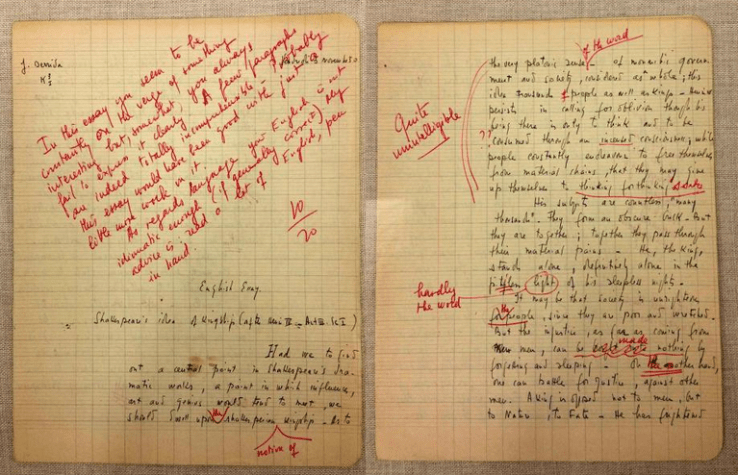
“Quite unintelligible,” remarks Derrida’s English teacher

derrida-shakespeare

(Via, via).

Spring at Barbizon — Jean-Francois Millet

“Someone who has 500 friends, has no friends” — Günter Grass on Facebook

“A Worn Path” — Eudora Welty

“A Worn Path”

by

Eudora Welty

It was December—a bright frozen day in the early morning. Far out in the country there was an old Negro woman with her head tied red rag, coming along a path through the pinewoods. Her name was Phoenix Jackson. She was very old and small and she walked slowly in the dark pine shadows, moving a little from side to side in her steps, with the balanced heaviness and lightness of a pendulum in a grand-father clock. She carried a thin, small cane made from an umbrella, and with this she kept tapping the frozen earth in front of her. This made a grave and persistent noise in the still air, that seemed meditative like the chirping of a solitary little bird.

She wore a dark striped dress reaching down to her shoe tops, and an equally long apron of bleached sugar sacks, with a full pocket: all neat and tidy, but every time she took a step she might have fallen over her shoelaces, which dragged from her unlaced shoes. She looked straight ahead. Her eyes were blue with age. Her skin had a pattern all its own of numberless branching wrinkles and as though a whole little tree stood in the middle of her forehead, but a golden color ran underneath, and the two knobs of her cheeks were illumined by a yellow burning under the dark. Under the red rag her hair came down on her neck in the frailest of ringlets, still black, and with an odor like copper.

Now and then there was a quivering in the thicket. Old Phoenix said, “Out of my way, all you foxes, owls, beetles, jack rabbits, coons and wild animals!. . . Keep out from under these feet, little bob-whites…. Keep the big wild hogs out of my path. Don’t let none of those come running my direction. I got a long way.” Under her small black-freckled hand her cane, limber as a buggy whip, would switch at the brush as if to rouse up any hiding things.

On she went. The woods were deep and still. The sun made the pine needles almost too bright to look at, up where the wind rocked. The cones dropped as light as feathers. Down in the hollow was the mourning dove—it was not too late for him.

The path ran up a hill. “Seem like there is chains about my feet, time I get this far,” she said, in the voice of argument old people keep to use with themselves. “Something always take a hold of me on this hill— pleads I should stay.” Continue reading ““A Worn Path” — Eudora Welty”

No Way Jose — Alan Macdonald

p_nowayjose

Riff on the end/beginning of Gravity’s Rainbow

Well: “A screaming comes across the sky. It has happened before [—]”

□ □ □ □ □ □ □

So. Okay. So I finished Gravity’s Rainbow on Friday night, and reread the opening section (and more than the opening section) on Saturday morning, resisting a compulsion to immediately return to the beginning.

□ □ □ □ □ □ □

So: Okay: Right?

The ending of Gravity’s Rainbow cycles back to the beginning (like Finnegans Wake): Blicero’s rocket, screaming across the sky—yes? no?—to invade the dreams (?) of psychic Pirate Prentice? The book: a loop, a Möbius strip, a film, its reels discombobulated, jostled, scattered

□ □ □ □ □ □ □

“…it’s all theatre,” we learn on the book’s first page (page 3); the book ends in a theater—the Orpheus Theater!—where maybe scattered Slothrop is the leading man, scattered, we find ourselves in him, parts of him—where the audience demands, on the book’s last page: “Start-the-show!”

□ □ □ □ □ □ □

“You’re putting response before stimulus,” Spectro shakes his head at Pointsman, early in “Beyond the Zero,” the first section of Gravity’s Rainbow—does this describe the beginning/end of the novel? (“It has happened before”).

□ □ □ □ □ □ □

Or, a bit earlier even, at the seance, (page 32), Gloaming describes one kind of plot: “…we should get something like a straight line” — but then gives us another kind of plot — “…however we’ve data that suggest the curves for certain —conditions, well they’re actually quite different—schizophrenics for example tend to run a bit flatter in the upper part then progressively steeper—a sort of bow shape … classical paranoiac—” Is this the shape of Gravity’s Rainbow?

□ □ □ □ □ □ □

—but right this moment it’s that final dash that intrigues me—this in a novel full of dashes, this in a novel that name-checks Emily Dickinson, Eternal Empress of Dashes—the fragmented conclusion is full of dashes, lines obliterated by more perfect, straight lines, simultaneously connecting and disconnecting—like the novel’s final line:

“Now everybody—“

□ □ □ □ □ □ □ Continue reading “Riff on the end/beginning of Gravity’s Rainbow”

The Blessed Guillaume de Toulouse Tormented by Demons — Ambroise Frédeau

tumblr_ltprof64JM1r1dpd5o1_1280

“I find this disgusting, but I can’t help myself” (eXistenZ)