If civilization has an opposite, it is war (Ursula K. Le Guin)

Tibe spoke on the radio a good deal. Estraven when in power had never done so, and it was not in the Karhidish vein: their government was not a public performance, normally; it was covert and indirect. Tibe, however, orated. Hearing his voice on the air I saw again the long-toothed smile and the face masked with a net of fine wrinkles. His speeches were long and loud: praises of Karhide, disparagements of Orgoreyn vilifications of “disloyal factions,” discussions of the “integrity of the Kingdom’s borders,” lectures in history and ethics and economics, all in a ranting, canting, emotional tone that went shrill with vituperation or adulation. He talked much about pride of country and love of the parentland, but little about shifgrethor, personal pride or prestige. Had Karhide lost so much prestige in the Sinoth Valley business that the subject could not be brought up? No; for he often talked about the Sinoth Valley. I decided that he was deliberately avoiding talk of shifgrethor because he wished to rouse emotions of a more elemental, uncontrollable kind. He wanted to stir up something which the whole shifgrethor-pattern was a refinement upon, a sublimation of. He wanted his hearers to be frightened and angry. His themes were not pride and love at all, though he used the words perpetually; as he used them they meant self-praise and hate. He talked a great deal about Truth also, for he was, he said, “cutting down beneath the veneer of civilization.”

It is a durable, ubiquitous, specious metaphor, that one about veneer (or paint, or pliofilm, or whatever) hiding the nobler reality beneath. It can conceal a dozen fallacies at once. One of the most dangerous is the implication that civilization, being artificial, is unnatural: that it is the opposite of primitiveness… Of course there is no veneer, the process is one of growth, and primitiveness and civilization are degrees of the same thing. If civilization has an opposite, it is war. Of those two things, you have either one, or the other. Not both. It seemed to me as I listened to Tibe’s dull fierce speeches that what he sought to do by fear and by persuasion was to force his people to change a choice they had made before their history began, the choice between those opposites.

From Ursula Le Guin’s 1969 novel The Left Hand of Darkness. The bold emphases are mine—mea culpa, I couldn’t help it.

On Ursula K. Le Guin’s Hainish novels


img_1190

“Are we not Men?”

— The Island of Dr. Moreau, H.G. Wells (1896)

“A country, a people…Those are strange and very difficult ideas.”

— Four Ways to Forgivenss, Ursula K. Le Guin (1995)

—Each of the novels in Ursula K. Le Guin’s so-called Hainish cycle obliquely addresses Wells’s question by tackling those strange and very difficult ideas of “a country, a people.” The best of these Hainish books do so in a manner that synthesizes high-adventure sci-fi fantasy with dialectical philosophy.

—What am I calling here “the best”? Well—

The Left Hand of Darkness

Planet of Exile/City of Illusions (treat as one novel in two discursive parts)

The Dispossessed

—(How oh how oh how dare I rank The Dispossessed—clearly a masterpiece, nay?—so low on that little list? It’s too dialectical, maybe? Too light on the, uh, high adventure stuff, on the fantasy and romance and sci-fi. Its ideas are too finely wrought, well thought out, expertly cooked (in contrast to the wonderful rawness of Rocannon’s World, for example). None of this is to dis The Dispossessed—it’s probably the best of the Hainish books, and the first one casual readers should attend to. (It was also the first one I read way back when in high school)).

—The novels in Le Guin’s so-called Hainish cycle are

Rocannon’s World (1966)

Planet of Exile (1966)

City of Illusions (1967)

The Left Hand of Darkness (1969)

The Dispossessed (1974)

The Word for World is Forest (1976)

Four Ways to Forgiveness (1995)

The Telling (2000)

—Okay, so I decided to include For Ways to Forgiveness in the above list even though most people wouldn’t call it a “novel” — but its four stories (novellas, really) are interconnected and tell a discrete story of two interconnected planets that are part of the Hainish world. And I pulled a quote from it above. So.

—I read, or reread, Le Guin’s so-called Hainish cycle close to the chronological order proposed by the science fiction writer Ian Watson. I don’t necessarily recommend this order.

—(I keep modifying “Hainish cycle” with “so-called” because the books aren’t really a cycle. Le Guin’s world-building isn’t analogous to Tolkien’s Middle Earth or Faulkner’s Yoknapatawpha County. (Except when her world-building is analogous). But let us return to order).

Le Guin on the subject:

People write me nice letters asking what order they ought to read my science fiction books in — the ones that are called the Hainish or Ekumen cycle or saga or something. The thing is, they aren’t a cycle or a saga. They do not form a coherent history. There are some clear connections among them, yes, but also some extremely murky ones. And some great discontinuities (like, what happened to “mindspeech” after Left Hand of Darkness? Who knows? Ask God, and she may tell you she didn’t believe in it any more.)

OK, so, very roughly, then:

Rocannon’s World, Planet of Exile, City of Illusions: where they fit in the “Hainish cycle” is anybody’s guess, but I’d read them first because they were written first. In them there is a “League of Worlds,” but the Ekumen does not yet exist.

—I agree with the author. Read this trilogy first. Read it as one strange book.

—(Or—again—pressed for time and wanting only the essential, read The Dispossessed and The Left Hand of Darkness—but you already knew that, no?).

Continue reading “On Ursula K. Le Guin’s Hainish novels”

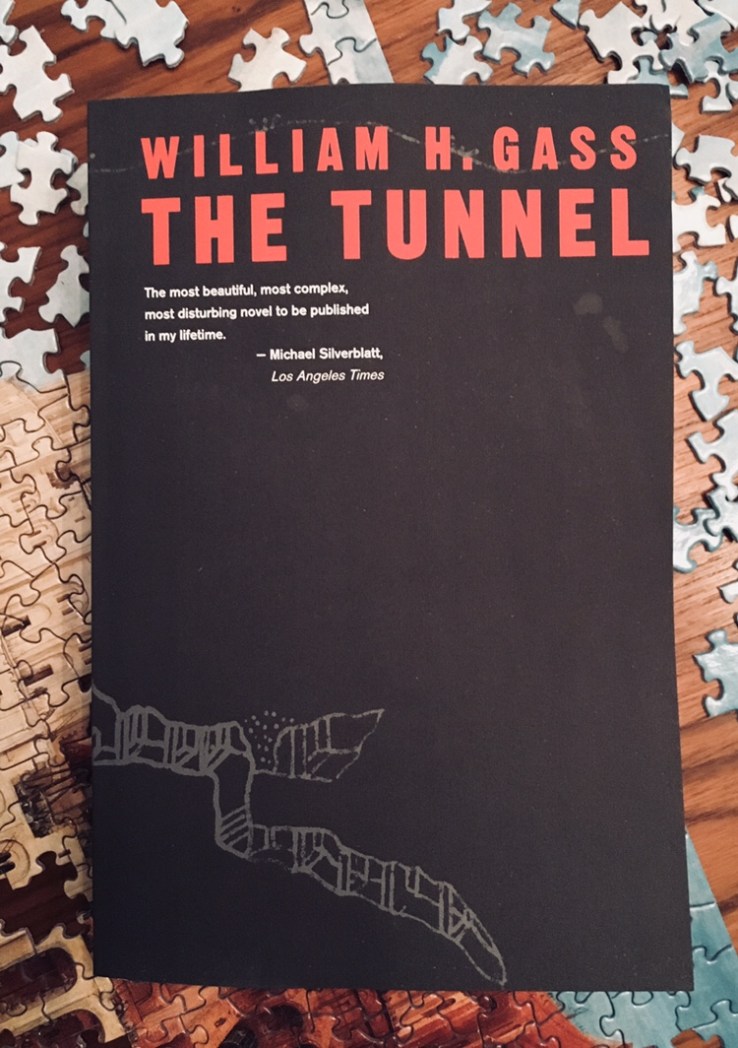
William H. Gass’s The Tunnel (Book acquired, 22 Jan. 2018)

img_8960

The great late great William H. Gass’s very big novel The Tunnel was one of four books I put on my 2018 Good Intentions Reading List that I didn’t previously own. (I did check it out from the library a few years back and download the audiobook—read by Gass himself–but I didn’t make a big dent). I ordered it from my favorite bookstore and it came in yesterday. The Tunnel is one of three Great Big Books I plan to (attempt to) read this year, including Middlemarch and some novel called War & Peace. I’ll probably start The Tunnel first.

Here are two selections from The Tunnel:

img_8962

An Invocation to the Muse

O brood O muse upon my mighty subject like a holy hen upon the nest of night.
O ponder the fascism of the heart.
Sing of disappointments more repeated than the batter of the sea, of lives embittered by resentments so ubiquitous the ocean’s salt seems thinly shaken, of let-downs local as the sofa where I copped my freshman’s feel, of failures as frequent as first love, first nights, last stands; do not warble of arms or adventurous deeds or shepherds playing on their private fifes, or of civil war or monarchies at swords; consider rather the slightly squinkered clerk, the soul which has become as shabby and soiled in its seat as worn-out underwear, a life lit like a lonely room and run like a laddered stocking.
Behold the sagging tit, the drudge-gray mopped-out cunt-corked wife, stale as yesterday’s soapy water or study the shiftless kind, seedy before any bloom, thin and mean as a weed in a walk;
Smell the grease that stands rancid in the pan like a second skin, the pan aslant on some fuel-farting stove, the stone in its corner contributing what it can to the brutal conviviality of close quarters,
Let depression like time-payments weigh you down; feel desperation and despair like dust thick in the rug and the ragged curtains, or carry puppy pee and plate-scrapings, wrapped in the colored pages of the Sunday paper, out to the loose and blowing, dog-jawed heap in the alley;
Spend your money on large cars, loud clothes, sofa-sized paintings, excursions to Hawaii, trinkets, knicknacks, fast food, golf clubs, call girls, slimming salons, booze;
Suffer shouting, heat rash, chilblains, beatings, betrayal, guilt, impotence, jail, jealousy, humiliation, VD, vermin, stink.
Sweat through a St. Louis summer and sing of that.
O muse, I cry, as loudly as I can, while still commanding a constricted scribble, hear me! help me! but my nasty echo answers: one muse for all the caterwauling you have called for! where none was in that low-life line of work before?
It’s true. I’ll need all nine for what I want to do—perhaps brand new—all nine whom Hesiod must have frigged to get his way, for he first spoke their secret names and hauled their history by the snout into his poem. For what I want to do …
Which is what—exactly? to deregulate Descartes like all the rest of the romancers? to philosophize while performing some middle-age adultery? basically enjoying your anxieties like raw lickker when it’s gotten to the belly? I know—you want to make the dull amazing, you want to Heidegger some wholesome thought, darken daytime for the TV, grind the world into a grain of Blake.
O, I deny it! On the contrary! I shall not abuse your gift. I pledge to you, if you should choose me, not to make a mere magician’s more of less, to bottle up a case of pop from a jigger of scotch. I have no wish to wine water or hand out loaves and fishes like tickets on a turkey. It is my ambition to pull a portent—not a rabbit but a raison d’être—from anything—a fish pond, top hat, fortune cookie—you just name it—a prophecy in Spengler’s fanciest manner, a prediction of a forlorn future for the world from—oh, the least thing, so long as it takes a Teutonic tone—a chewed-over, bubble-flat wad of baseball gum, say, now hard and sour in the street, with no suggestion of who the player’s picture was, impersonal despite its season in someone’s spit, like a gold tooth drawn from a Jew’s jaw.
Misfits, creeps, outcasts of every class; these are my constituents—the disappointed people—and if I could bring my fist down hard on the world they would knot together like a muscle, serve me, strike as hard as any knuckle.
Hey Kohler—hey Koh—whistle up a wind. Alone, have I the mouth for it? the sort of wind I want? Imagine me, bold Kohler, calling out for help—and to conclude, not to commence—to end, to bait, to 30, stop, leave off, to hush a bye forever … to untick tock.

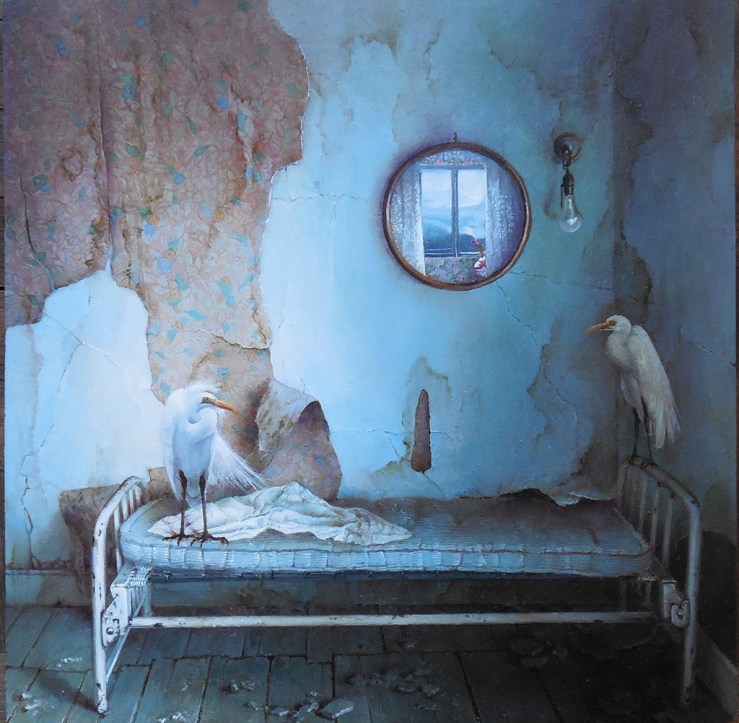
I Wake to Sleep — Dina Brodsky

waketosleepwebsite-1024x1002

I Wake to Sleep by Dina Brodsky (b. 1981)