When Ralph Waldo Emerson informed—or rather, perhaps, warned us—that we are what our mothers made us, we might dismiss it as received opinion and let it go at that, like the broken clock which is right twice a day, like the self-evident answer contained in Freud’s oft-quoted query “What do women want?” when, as nature’s handmaid, she must want what nature wants which is, quite simply, More. But which woman? Whose mother, Emerson’s? A woman so in thrall to religion that we confront another dead end; or Freud’s? or even one’s own, even mine, offering an opportune bit of wisdom to those of us engaged in the creative arts, where paranoia is almost an occupational hazard: “Bill, just try to remember,” she said, “there is much more stupidity than there is malice in the world,” an observation lavish with possibilities recalling Anatole France finding the fool more dangerous than the rogue because “the rogue does at least take a rest sometimes, the fool never.”
This is hardly to see stupidity and malice as mutually exclusive: look at your morning paper, where their combined forces explode exponentially (women and children first) from Bosnia to Belfast, unlike the international “intelligence community” so self-contained in its malice-free exercises that it generally ensnares only its own dubious cast of players. Of further importance is the distinction between stupidity and ignorance, since ignorance is educable, while stupidity’s self-serving mission is the cultivation and exploitation of ignorance, as politicians are keenly aware.
How, then, might Emerson’s mother have seen herself stumbling upon Thomas Carlyle’s vision of her son as a “hoary-headed and toothless baboon”? Or Freud’s, in the gross unlikelihood of her reading the Catholic World’s review of her son’s book Moses and Monotheism as “poorly written, full of repetitions . . . and spoiled by the author’s atheistic bias and his flimsy psychoanalytic fancies”? Goethe’s Wilhelm Meister dismissed as “sheer nonsense” by the Edinburgh Review and, a good century later, the hero of Saul Bellow’s Dangling Man ridiculed as a “pharisaical stinker” in Time magazine, John Barth’s The End of the Road recommended by Kirkus Reviews “for those schooled in the waste matter of the body and the mind,” and William Faulkner’s Absalom, Absalom! shrugged off as the “final blowup of what was once a remarkable, if minor, talent” by The New Yorker magazine where, just forty years later, “a group of avant-garde critics has put forward the idea that books should be made unreadable. This movement has manifest advantages. Being unreadable, the text repels reviewers, critics, anthologists, academic literati, and other parasitical forms of life,” indicting the author of the novel JR wherein “to produce an unreadable text, to sustain this foxy purpose over 726 pages, demands rare powers. Mr. Gaddis has them.” “You’re a fool, a fool!” the distraught mother of Dostoevski’s ill-fated hero Nikolay Stavrogin cries out at the “parasitical forms of life” surrounding her. “You’re all ungrateful fools. Give me my umbrella!”
(“Mothers” is collected in The Rush to Second Place).
He recognizes in all these dislocations, of course, his lonely quest for the impossible mating, the crazy embrace of polarities, as though the distance between the terror and the comedy of the void were somehow erotic—it’s a kind of pornography. No wonder the sailor asked that his eyes be plucked out! He overlays frenzy with freeze frames, the flight of rockets with the staking of the vampire’s heart, Death’s face with thrusting buttocks, cheesecake with chaingangs, and all just to prove to himself over and over again that nothing and everything is true. Slapstick is romance, heroism a dance number. Kisses kill. Back projections are the last adequate measure of freedom and great stars are clocks: no time like the presence. Nothing, like a nun with a switchblade, is happening faster and faster, and cause (that indefinable something) is a happy ending. Or maybe not.
From Robert Coover’s 1987 short story “The Phantom of the Movie Palace.”
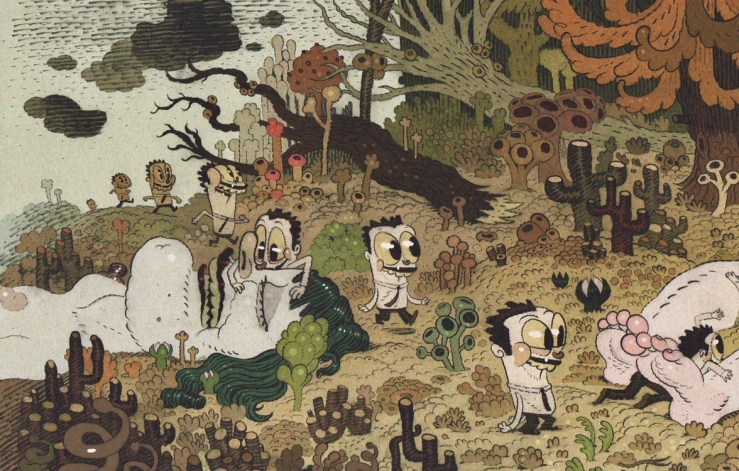
In Mudbite, Dave Cooper conjures a perverse and lurid dreamworld that seethes and wriggles with its own nightmare logic. The erstwhile hero of this world is Eddy Table, an apparent alter-ego for Cooper himself. Mudbite collects two new Eddy Table adventures, “Mud River” and “Bug Bite”, abject fantasias of intense sexual anxiety rendered in Cooper’s compellingly repellent style.
The two tales are bound tête-bêche; after you finish “Bug Bites”, you can flip the book over and read “Mud River.” Or maybe you’ll read the stories in the other order. Mudbite’s playful design invites the reader to participate in ordering the relationship between the stories. Cooper’s inimitable aesthetic unifies the project’s themes of aberrant sexuality and libidinal anxieties.
Antoine Volodine’s collection of loosely-connected stories Writers (2010; English translation by Katina Rogers, Dalkey Archive, 2014) is 108 pages. I have read the first four of the seven stories here—the first 54 pages. This is the first book by Volodine that I have read. Antoine Volodine is in fact a pseudonym, I know, but I don’t know much else about the writer. I’ve been meaning to read him for a few years, after some good folks suggested I do so, but I’ve never come across any of his books in the wild until this weekend. After I finish Writers I will read more about Volodine, but for now I am enjoying (?) how and what this book teaches me about the bigger project Volodine seems to be working towards.
That bigger project evinces in the first story in the collection, “Mathias Olbane,” which centers on the titular character, a writer who tries to hypnotize himself into a suicide attempt. Poor Mathias goes to prison for twenty-six years — “He had assassinated assassins.” Like most of the figures in Writers (so far anyway—you see by the title of this post that I am reporting from half way through, yes?) — like most of the figures in Writers, Mathias is a revolutionary spirit, resisting capitalist power and conformist order through radical violence. Before prison, Mathias wrote two books. The first, An Autumn at the Boyols’ “consisted of eight short texts, inspired by fantasy or the bizarre, composed in a lusterless but impeccable style. Let’s say that it was a collection that maintained a certain kinship with post-exoticism…” The description of the book approximates a description of Writers itself; notably, Volodine identifies his own genre as post-exoticism. Autumn at the Boyols’ doesn’t sell at all, and its sequel, Splendor of the Skiff (which “recounted a police investigation, several episodes of a global revolution, and traumatizing incursions into dream worlds”) somehow fares even worse. Mathias begins a new kind of writing in prison:
…after twenty-six years in captivity, he had forged approximately a hundred thousand words, divided as follows:
sixty thousand first and last names of victims of unhappineess
twenty thousand names of imaginary plants, mushrooms, and herbs
ten thousand names of places, rivers, and localities
and ten thousand various words that do not belong to any language, but have a certain phonetic logic that makes them sound familiar
I love the mix of tones here: Mathias Olbane’s grand work is useless and strange and sad and ultimately unknowable, and Volodine conveys this with both sinister humor and dark pathos. Once released from prison, our hero immediately becomes afflicted with a rare and incurable and painful disease. Hence, the suicide urge. But let’s move on.
The second tale in Writers, “Speech to the Nomads and the Dead,” offers another iteration of post-exotic writing, both in form and content. The story plays out like a weird nightmare. Linda Woo, isolated and going mad in a prison cell, conjures up an audience of burn victims, an obese dead man, Mongolian nomads, and several crows. She delivers a “lesson” to her auditors (a “lesson,” we learn, is one of post-exoticism’s several genres). The lesson is about the post-exotic writers themselves. She names a few of these post-exotic writers (Volodine is addicted to names, especially strange names), and delivers an invective against the modern powers that the post-exotic writers write against:
Post-exoticism’s writers…have in their memory, without exception, the wars and the ethnic and social exterminations that were carried out from one end of the 20th century to the other, they forget none and pardon none, they also keep permanently in mind the savageries and the inequalities that are exacerbated among men…
The above excerpt is a small taste of Woo’s bitter rant, which goes on for long sentence after long sentence (Volodine is addicted to long sentences). Like Mathias Olbane, Linda Woo writes in the face of futility, creating the “post-exotic word,” a word that creates an “absurd magic” that allows the post-exotic writers to “speak the world.”
Linda Woo’s name appears in the next story in Writers, “Begin-ing,” if only in passing. This story belongs to an unnamed writer, yet another prisoner. Wheelchair-bound, he is interrogated and tortured by two insane inmates who have taken over their prison, having killed their captors. The pair, Greta and Bruno Khatchatourian, are thoroughly horrific, spouting abject insanities that evoke Hieronymus Boschs’s hell. They are terrifying, and I had a nightmare the night that I read “Begin-ing.” It’s never quite clear if Greta and Bruno Khatchatourian are themselves post-exotic writers gone mad or just violent lunatics on the brink of total breakdown. In any case, Volodine affords them dialogue that veers close to a kind of horror-poetry. “We can also spew out the apocalypse,” Greta defiantly sneers. They torture the poor writer. Why?
They would like it, in the end, if he came around to their side, whether by admitting that he’s been, for a thousand years, a clandestine leader of dark forces, or by tracing for them a strategy that could lead them to final victory. … They would like above all for him to help them to drive the dark forces out from the asylum, to prepare a list of spies, they want him to rid the world of the last nurses, of Martians, of colonialists, and of capitalists in general.
The poor writer these lunatics torture turns inward to his own formative memories of first writings, of begin-ing, when he created his own worlds/words in ungrammatical misspelled scrawlings, filling notebook after notebook. Volodine unspools these memories in sentences that carry on for pages, mostly centering on the writer’s strange childhood in an abject classroom where he engages in depravities that evoke Pasolini’s Salò. And yet these memories are the writer’s comfort—or at least resistance—to the lunatics’ violence. Volodine’s prose in “Begin-ing” conjures Goya’s various lunatics, witches, demons, and dogs. It’s all very upsetting stuff.
Courtyard with Lunatics, 1794 by Francisco Goya (1746-1828)
After the depravity of “Begin-ings,” the caustic comedy of the next story “Acknowledgements” is a welcome palate cleanser. In this story’s twelve pages (I wish there were more!) Volodine simultaneously ridicules and exults the “Acknowledgements” page that often appends a novel, elevating the commonplace gesture to its own mock-heroic genre. The story begins with the the hero-writer thanking “Marta and Boris Bielouguine, who plucked me from the swamp that I had unhappily fallen into along with the bag containing my manuscript.” The “swamp” here is not a metaphor, but a literal bog the writer nearly drowned in. And the manuscript? A Meeting at the Boyols’, a title that recalls poor Mathias Olbane’s first book An Autumn at the Boyols’. Each paragraph of “Acknowledgments” is its own vignette, a miniature adventure in the form of a thank-you note to certain parties. Most of the vignettes end in sex or death, or an escape from one of the two. “Grad Litrif and his companion Lioudmila” as well as “the head of the Marbachvili archives” (oh the names in this story!) are thanked for allowing the writer
…to access the notebooks of Vulcain Marbachvili, from which I was able, for my story Long Ago to Bed Early, to copy several sentences before the earthquake struck that engulfed the archives. My thanks to these three people, and apologies to the archivist, as I was sadly unable to locate either her name or her body in the rubble.
“Acknowledgments” is littered with such bodies—sometimes victims of disasters and plagues, and elsewhere the bodies of the married or boyfriended women the writer copulates with before escaping into some new strange circumstances (he often thanks the husbands and the boyfriends, and in one inspired moment, thanks a gardener “who one day had the presence of mind to detain Bernardo Balsamian in the orchard while Grigoria and I showered and got dressed again”). He thanks a couple who shows him their collection of 88 stuffed guinea pigs; he thanks “the leader of the Muslim Bang cell” who, during his “incarceration in Yogyakarta…forbid the prisoners on the floor from sodomizing” him; he thanks the “Happy Days” theater troupe who “had the courage” to perform his play Djann’s Awakening three times “before a rigorously empty room.” Most of the acknowledgments connect the writer’s thank-you to a specific book he’s written. I’m tempted to list them all (oh the names!), but just a few—Tomorrow the Otters, Eve of Pandemic, Journal of Pandemonium, Goodbye Clouds, Goodbye Romeo, Mlatelpopec in Paradise, Macbeth in Paradise, Hell in Paradise…Without exaggeration: “Acknowledgements” is one of the funniest stories I’ve ever read.
With its evocations of mad and obscure writers, Volodine’s books strongly reminds me of Roberto Bolaño’s work. And yet reading it is not like reading an attempt to copy another writer—which Volodine is in no way doing—but rather like reading a writer who has filtered much of the same material of the 20th century through himself, and has come to some of the same tonal and thematic viewpoints—Volodine’s labyrinth is dark and weird and sinister and abject, but also slightly zany and terribly funny. More to come.
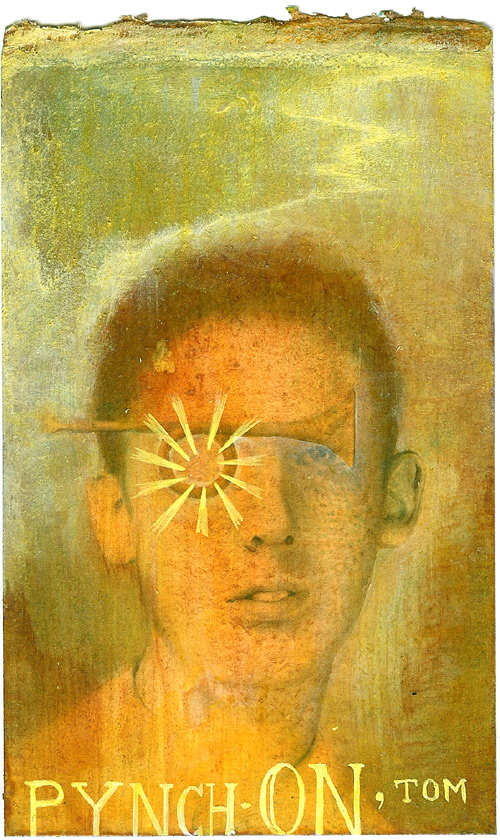
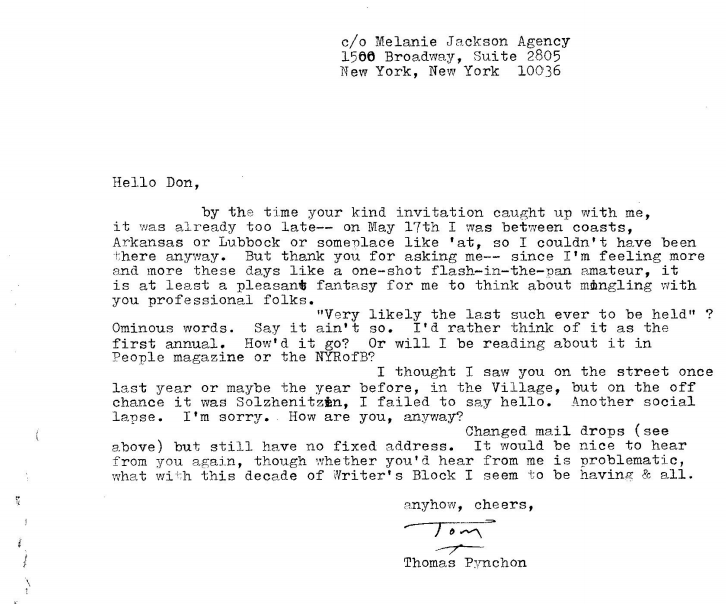
To date, Thomas Ruggles Pynchon (American, b. 1937), has published eight novels and one collection of short stories. These books were published between 1963 and 2013. On this day, Thomas Ruggles Pynchon’s 81st birthday, I present my ranking of his novels. My ranking is completely subjective, essentially incomplete (in that I haven’t read two of Pynchon’s novels all the way through), and thoroughly unnecessary. My ranking should be disregarded, but I do not think it should be treated with any malice. You are most welcome to make your own ranking in the comments section of this post, or perhaps elsewhere online, or on a scrap of your own paper, or in personal remarks to a friend or loved one, etc. I have not included the short story collection Slow Learner (1984) in this ranking because it is not a novel.
Here is the list, ranked from not-greatest to greatest:
8. Bleeding Edge (2013)
I have never made it past the first thirty pages of Bleeding Edge, despite two attempts. I don’t even own it. I will probably read it in ten years and see something there that I didn’t see in 2013 or 2015 but for now, I’m not sure.
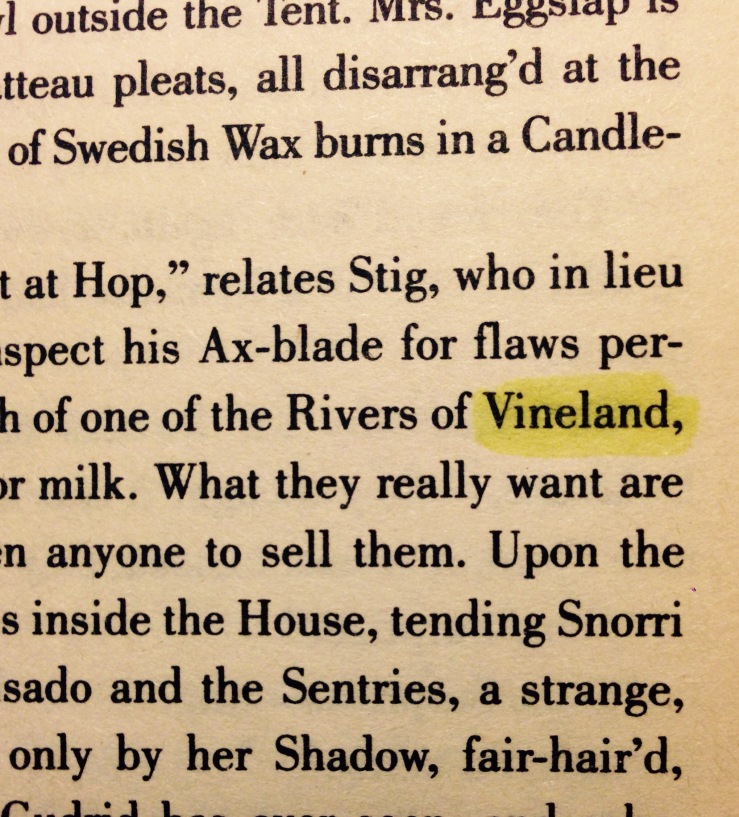
7. Vineland (1990)
Vineland is the other Pynchon novel I haven’t managed to finish. I’ve tried three times, including a semi-serious shot last year where I stalled after the fourth chapter (around 90 pages in). Vineland seems to have a strange status for Pynchon cultists—its a cult novel in an oeuvre of cult novels, I guess. Perhaps Vineland has a sturdier core to it than I can sense, but even though I dig the goofy humor, I haven’t yet found something to grab onto.
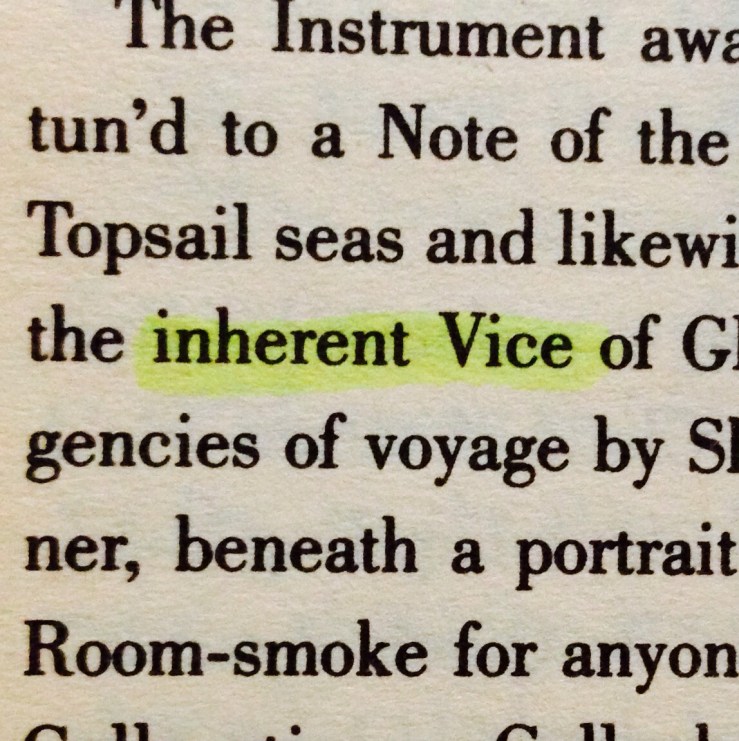
6. Inherent Vice (2009)
I love Inherent Vice. It has a bit of a reputation of being “Pynchon lite,” whatever that means, but I think it’s a much denser book than a first reading might suggest—its shaggy baggy breeziness coheres into something stronger on a second or third read. Inherent Vice is both a diagnosis of the sixties and a prognosis of a future to come.
5. V. (1963)
V. makes a good starting place for anyone new to Pynchon. Even though it’s his first novel, V. already stages Pynchon’s major themes (paranoia, technology, entropy, globalism) in an elastic and discursive narrative style and a zany (and sometimes sinister) tone. These elements continued throughout the next half century in Pynchon’s writing. V. shares a few characters with Gravity’s Rainbow, and in many ways it feels like a dress rehearsal for that bigger, grander, fuller novel—but it reverberates with its own richness. The ninth chapter, the story of of Kurt Mondaugen, is a particularly dark and decadent bit of writing.
4. The Crying of Lot 49 (1966)
The Crying of Lot 49 doesn’t so much convert paranoia into hope as it shows that the two are part and parcel of the same impulse of a consciousness that has to know that it cannot know. Pynchon’s dualities here feel new—paranoia/hope is wrapped into zaniness/horror. He sends us to escape into thelabyrinth. I wrote new in the previous sentence, but Pynchon’s ambiguities resonate with American literature’s dark romantic traditions—Melville, Hawthorne, O’Connor, et al.
3. Against the Day (2006)
Against the Day glides into its sprawl, billowing out into genre trajectories that transcend the boundaries of the plot’s dates (1893-1918). Pynchon’s longest novel to date earns its 1,085-page run, pivoting between comic fantasy, high adventure, flânerie escapade, scientific treatise, and a byzantine global mystery—all weighed down by the ballast of rising modernism. Pynchon merges these styles, both “high” and “low,” into something thoroughly Pynchonian. Despite its length, Against the Day is perhaps Pynchon’s clearest indictment of sinister power, neatly figured in the oligarch Scarsdale Vibe. Just writing about it here makes me want to revisit it again and check in on The Chums of Chance and their marvelous airship The Inconvenience.
2. Mason & Dixon (1997)
Pynchon’s zany/sinister tonal axis, comic bravado, and genre-shifting modes rarely result in what folks narrowly think of as literary realism. His characters can be elastic, cartoonish even—allegorical sometimes (and even grotesque). Mason & Dixon takes two historically real (and historically famous) characters as its subject, and, in a wonderfully hyperbolic 18th-century style, takes the duo on a fantastic journey to measure the world. How does one measure the world though? Pynchon takes on seemingly every subject under the sun in Mason & Dixon, and the novel is very much about the problems and limitations of measuring (and describing, and knowing) itself. But what comes through most strongly in all of Pynchon’s fantasia is the weight of Mason and Dixon’s friendship. It’s the most real thing in a wonderfully unreal novel.
1. Gravity’s Rainbow (1973)
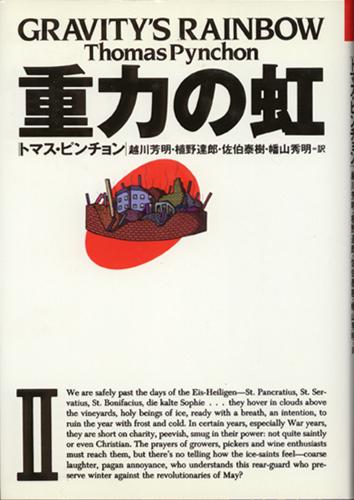
Gravity’s Rainbow is probably the best American postmodern novel ever produced. In any case, I haven’t read another novel that so acutely dissects postwar America. Pynchon extends Eisenhower’s warning of the “military-industrial complex” by adding another element: entertainment. The intuition here surpasses prescience. The problem with Gravity’s Rainbow is that it cannot be read—it has to be reread. Its themes, motifs, and symbols are easy to miss on a first pass through, when you’re likely bugeyed and bewildered. Rereading Gravity’s Rainbow is like reading it for the first time. You have to let the book teach you how to read it. Let it teach you.
Captain Geoffrey “Pirate” Prentice’s bodacious banana breakfast for a bunch of hung over army officers (Gravity’s Rainbow)—
Routine: plug in American blending machine won from some Yank last summer, some poker game, table stakes, B.O.Q. somewhere in the north, never remember now….Chop several bananas into pieces. Make coffee in urn. Get can of milk from cooler. Puree ‘nanas in milk. Lovely. I would coat all the booze-corroded stomachs of England. . . . Bit of marge, still smells all right, melt in the skillet. Peel more bananas, slice lengthwise. Marge sizzling, in go long slices. Light oven whoomp blow us all up someday oh, ha, ha, yes. Peeled whole bananas to go on broiler grill soon as it heats. Find marshmallows. . . .
“You one of those right wing nut outfits?” inquired the diplomatic Metzger. Fallopian twinkled. “They accuse us of being paranoids.” “They?” inquired Metzger, twinkling also. “Us?” asked Oedipa.
“Not quite how it sorts out. Differences among the world religions are in fact rather trivial when compared to the common enemy, the ancient and abiding darkness which all hate, fear, and struggle against without cease”— he made a broad gesture to indicate the limitless taiga all around them— “Shamanism. There isn’t a primitive people anywhere on Earth that can’t be found practicing some form of it. Every state religion, including your own, considers it irrational and pernicious, and has taken steps to eradicate it.”
“What? there’s no ‘state religion’ in the U.S.A., pardner, we’ve got freedom of worship, it’s guaranteed in the Constitution—keeps church and state separate, just so’s we don’t turn into something like England and keep marching off into the brush with bagpipes and Gatling guns, looking for more infidels to wipe out. Nothing personal o’ course.”
“The Cherokee,” replied Prance, “the Apache, the massacre of the Sioux Ghost Dancers at Wounded Knee, every native Red Indian you’ve found, you people have either tried to convert to Christianity or you’ve simply killed.”
“I suggest it was about the fear of medicine men and strange practices, dancing and drug-taking, that allow humans to be in touch with the powerful gods hiding in the landscape, with no need of any official church to mediate it for them. The only drug you’ve ever been comfortable with is alcohol, so you went in and poisoned the tribes with that. Your whole history in America has been one long religious war, secret crusades, disguised under false names. You tried to exterminate African shamanism by kidnapping half the continent into slavery, giving them Christian names, and shoving your peculiar versions of the Bible down their throats, and look what happened.”
“The Civil War? That was economics. Politics.”
“That was the gods you tried to destroy, waiting their hour, taking their revenge. You people really just believe everything you’re taught, don’t you?”
“I’ll be in the bar,” said Reef. Yzles-Bains was in fact one of the few places on the continent of Europe where a sober Anarchist could find a decent Crocodile—equal amounts of rum, absinthe, and the grape spirits known as trois-six—a traditional Anarchist favorite, which Loïc the bartender, a veteran of the Paris Commune, claimed to have been present at the invention of.
1. You may never get to touch the Master, but you can tickle his creatures. 2. The innocence of the creatures is in inverse proportion to the immorality of the Master. 3. If they can get you asking the wrong questions, they don’t have to worry about answers. 4. You hide, they seek. 5. Paranoids are not paranoid because they’re paranoid, but because they keep putting themselves, fucking idiots, deliberately into paranoid situations.
“Somebody quoted Norman Mailer as saying that he wasn’t a better writer because his contemporaries weren’t better…I don’t know whether he really said that or not, but the point I want to make is that no one in Pynchon’s generation can make that statement. If we’re not as good as we should be it’s not because there isn’t a standard. And I think Pynchon, more than any other writer, has set the standard. He’s raised the stakes.”
THE NEXT DAY Reef, Cyprian, and Ratty were out on the Anarchists’ golf course, during a round of Anarchists’ Golf, a craze currently sweeping the civilized world, in which there was no fixed sequence—in fact, no fixed number—of holes, with distances flexible as well, some holes being only putter-distance apart, others uncounted hundreds of yards and requiring a map and compass to locate. Many players had been known to come there at night and dig new ones. Parties were likely to ask, “Do you mind if we don’t play through?” then just go and whack balls at any time and in any direction they liked. Folks were constantly being beaned by approach shots barreling in from unexpected quarters. “This is kind of fun,” Reef said, as an ancient brambled guttie went whizzing by, centimeters from his ear.






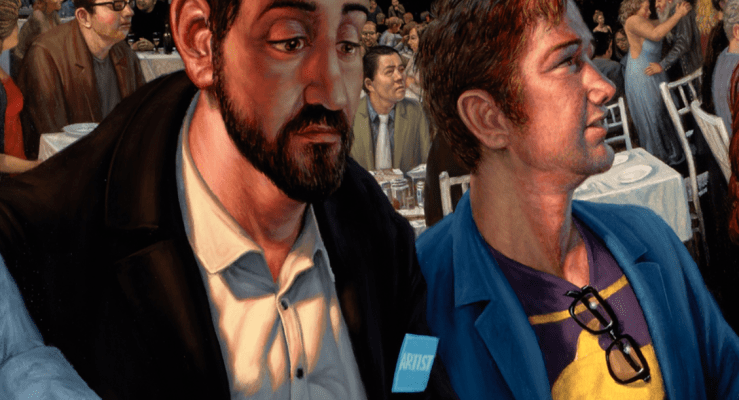

 To date, Thomas Ruggles Pynchon (American, b. 1937), has published eight novels and one collection of short stories. These books were published between 1963 and 2013. On this day, Thomas Ruggles Pynchon’s 81st birthday, I present my ranking of his novels. My ranking is completely subjective, essentially incomplete (in that I haven’t read two of Pynchon’s novels all the way through), and thoroughly unnecessary. My ranking should be disregarded, but I do not think it should be treated with any malice. You are most welcome to make your own ranking in the comments section of this post, or perhaps elsewhere online, or on a scrap of your own paper, or in personal remarks to a friend or loved one, etc. I have not included the short story collection Slow Learner (1984) in this ranking because it is not a novel.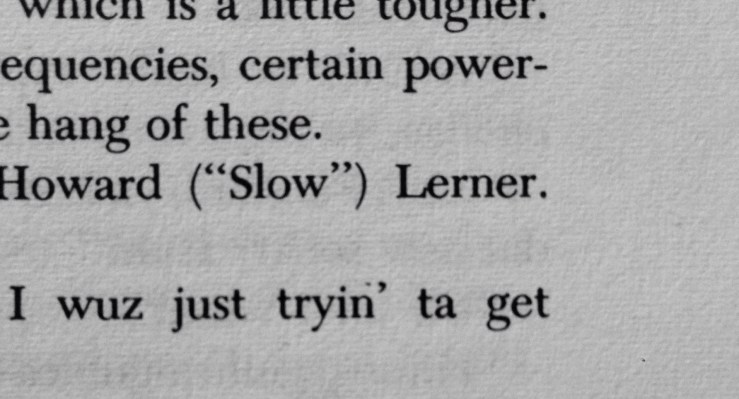






 Biblioklept