“All art constantly aspires towards the condition of music”

Read “Details of a Sunset,” a short story by Vladimir Nabokov

“Details of a Sunset”

by

Vladimir Nabokov


The last streetcar was disappearing in the mirrorlike murk of the street and, along the wire above it, a spark of Bengal light, crackling and quivering, sped into the distance like a blue star.

“Well, might as well just plod along, even though you are pretty drunk, Mark, pretty drunk….”

The spark went out. The roofs glistened in the moonlight, silvery angles broken by oblique black cracks.

Through this mirrory darkness he staggered home: Mark Standfuss, a salesclerk, a demigod, fair-haired Mark, a lucky fellow with a high starched collar. At the back of his neck, above the white line of that collar, his hair ended in a funny, boyish little tag that had escaped the barber’s scissors. That little tag was what made Klara fall in love with him, and she swore that it was true love, that she had quite forgotten the handsome ruined foreigner who last year had rented a room from her mother, Frau Heise.

“And yet, Mark, you’re drunk….”

That evening there had been beer and songs with friends in honor of Mark and russet-haired, pale Klara, and in a week they would be married; then there would be a lifetime of bliss and peace, and of nights with her, the red blaze of her hair spreading all over the pillow, and, in the morning, again her quiet laughter, the green dress, the coolness of her bare arms. Continue reading “Read “Details of a Sunset,” a short story by Vladimir Nabokov”

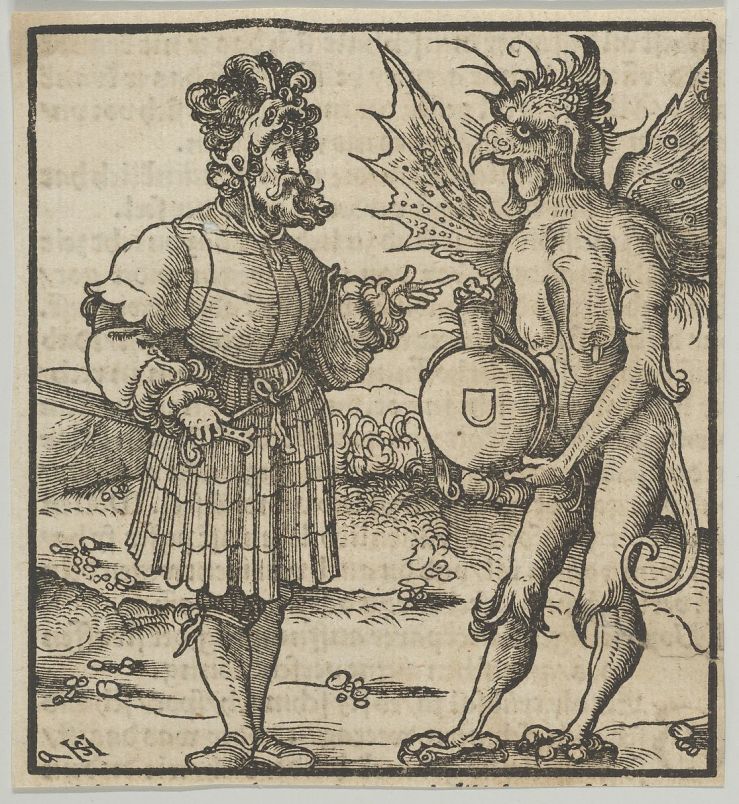
The Devil Offering Poison to a Knight –Hans Schäufelein

59.507.157(6)

The Devil Offering Poison to a Knight, 1517 by Hans Schäufelein (c. 1480–c. 1540)

Nathaniel Hawthorne’s journal entry for July 20th, 1837

July 20th.–A drive yesterday afternoon to a pond in the vicinity of Augusta, about nine miles off, to fish for white perch. Remarkables: the steering of the boat through the crooked, labyrinthine brook, into the open pond,–the man who acted as pilot,–his talking with B—- about politics, the bank, the iron money of “a king who came to reign, in Greece, over a city called Sparta,”–his advice to B—- to come amongst the laborers on the mill-dam, because it stimulated them “to see a man grinning amongst them.” The man took hearty tugs at a bottle of good Scotch whiskey, and became pretty merry. The fish caught were the yellow perch, which are not esteemed for eating; the white perch, a beautiful, silvery, round-backed fish, which bites eagerly, runs about with the line while being pulled up, makes good sport for the angler, and an admirable dish; a great chub; and three horned pouts, which swallow the hook into their lowest entrails. Several dozen fish were taken in an hour or two, and then we returned to the shop where we had left our horse and wagon, the pilot very eccentric behind us. It was a small, dingy shop, dimly lighted by a single inch of candle, faintly disclosing various boxes, barrels standing on end, articles hanging from the ceiling; the proprietor at the counter, whereon appear gin and brandy, respectively contained in a tin pint-measure and an earthenware jug, with two or three tumblers beside them, out of which nearly all the party drank; some coming up to the counter frankly, others lingering in the background, waiting to be pressed, two paying for their own liquor and withdrawing. B—- treated them twice round. The pilot, after drinking his brandy, gave a history of our fishing expedition, and how many and how large fish we caught. B—- making acquaintances and renewing them, and gaining great credit for liberality and free-heartedness,–two or three boys looking on and listening to the talk,–the shopkeeper smiling behind his counter, with the tarnished tin scales beside him,–the inch of candle burning down almost to extinction. So we got into our wagon, with the fish, and drove to Robinson’s tavern, almost five miles off, where we supped and passed the night In the bar-room was a fat old countryman on a journey, and a quack doctor of the vicinity, and an Englishman with a peculiar accent. Seeing B—-‘s jointed and brass-mounted fishing-pole, he took it for a theodolite, and supposed that we had been on a surveying expedition. At supper, which consisted of bread, butter, cheese, cake, doughnuts and gooseberry-pie, we were waited upon by a tall, very tall woman, young and maiden-looking, yet with a strongly outlined and determined face. Afterwards we found her to be the wife of mine host. She poured out our tea, came in when we rang the table-bell to refill our cups, and again retired. While at supper, the fat old traveller was ushered through the room into a contiguous bedroom. My own chamber, apparently the best in the house, had its walls ornamented with a small, gilt-framed, foot-square looking-glass, with a hair-brush hanging beneath it; a record of the deaths of the family written on a black tomb, in an engraving, where a father, mother, and child were represented in a graveyard, weeping over said tomb; the mourners dressed in black, country-cut clothes; the engraving executed in Vermont. There was also a wood engraving of the Declaration of Independence, with fac-similes of the autographs; a portrait of the Empress Josephine, and another of Spring. In the two closets of this chamber were mine hostess’s cloak, best bonnet, and go-to-meeting apparel. There was a good bed, in which I slept tolerably well, and, rising betimes, ate breakfast, consisting of some of our own fish, and then started for Augusta. The fat old traveller had gone off with the harness of our wagon, which the hostler had put on to his horse by mistake. The tavern-keeper gave us his own harness, and started in pursuit of the old man, who was probably aware of the exchange, and well satisfied with it.

Our drive to Augusta, six or seven miles, was very pleasant, a heavy rain having fallen during the night, and laid the oppressive dust of the day before. The road lay parallel with the Kennebec, of which we occasionally had near glimpses. The country swells back from the river in hills and ridges, without any interval of level ground; and there were frequent woods, filling up the valleys or crowning the summits. The land is good, the farms look neat, and the houses comfortable. The latter are generally but of one story, but with large barns; and it was a good sign, that, while we saw no houses unfinished nor out of repair, one man at least had found it expedient to make an addition to his dwelling. At the distance of more than two miles, we had a view of white Augusta, with its steeples, and the State-House, at the farther end of the town. Observable matters along the road were the stage,–all the dust of yesterday brushed off, and no new dust contracted,–full of passengers, inside and out; among them some gentlemanly people and pretty girls, all looking fresh and unsullied, rosy, cheerful, and curious as to the face of the country, the faces of passing travellers, and the incidents of their journey; not yet damped, in the morning sunshine, by long miles of jolting over rough and hilly roads,–to compare this with their appearance at midday, and as they drive into Bangor at dusk; two women dashing along in a wagon, and with a child, rattling pretty speedily down hill;–people looking at us from the open doors and windows;–the children staring from the wayside;–the mowers stopping, for a moment, the sway of their scythes;–the matron of a family, indistinctly seen at some distance within the house her head and shoulders appearing through the window, drawing her handkerchief over her bosom, which had been uncovered to give the baby its breakfast,–the said baby, or its immediate predecessor, sitting at the door, turning round to creep away on all fours;–a man building a flat-bottomed boat by the roadside: he talked with B—- about the Boundary question, and swore fervently in favor of driving the British “into hell’s kitchen” by main force.

Colonel B—-, the engineer of the mill-dam, is now here, after about a fortnight’s absence. He is a plain country squire, with a good figure, but with rather a heavy brow; a rough complexion; a gait stiff, and a general rigidity of manner, something like that of a schoolmaster. He originated in a country town, and is a self-educated man. As he walked down the gravel-path to-day, after dinner, he took up a scythe, which one of the mowers had left on the sward, and began to mow, with quite a scientific swing. On the coming of the mower, he laid it down, perhaps a little ashamed of his amusement. I was interested in this; to see a man, after twenty-five years of scientific occupation, thus trying whether his arms retained their strength and skill for the labors of his youth,–mindful of the day when he wore striped trousers, and toiled in his shirt-sleeves,–and now tasting again, for pastime, this drudgery beneath a fervid sun. He stood awhile, looking at the workmen, and then went to oversee the laborers at the mill-dam.

Nathaniel Hawthorne’s journal entry, 20 July 1837. From American Note-Books.

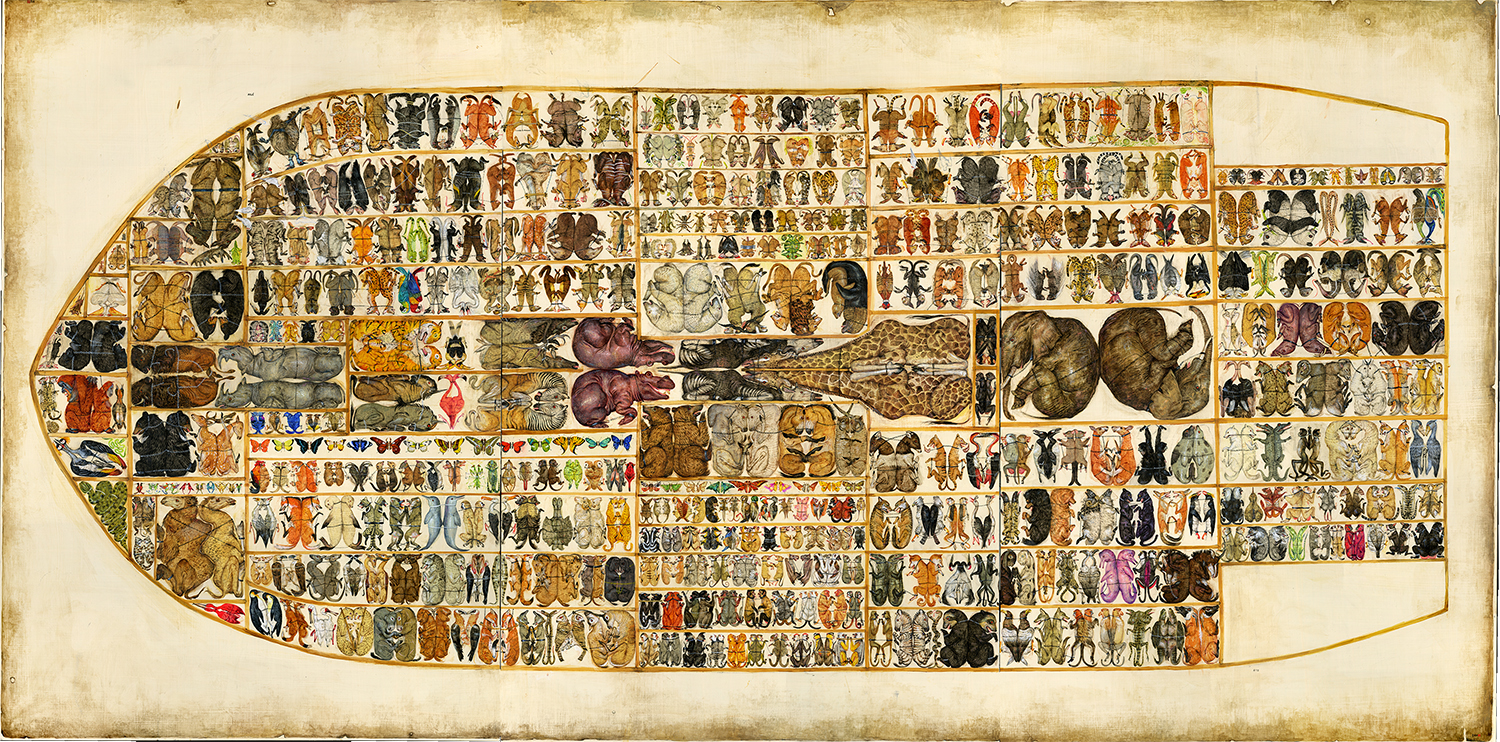
The Ark — Mu Pan

ark1500

The Ark, 2020 by Mu Pan (b. 1976)

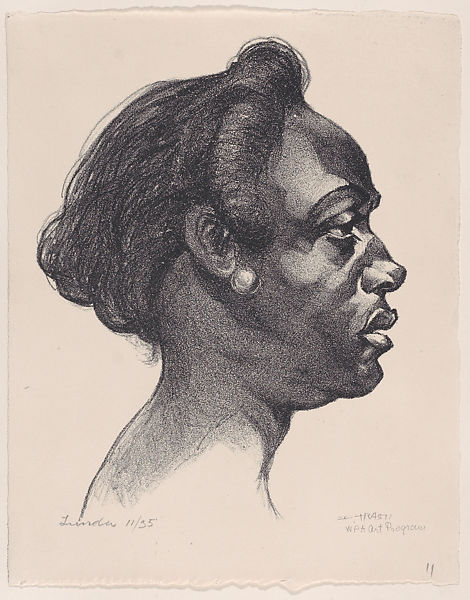
Linda — Dox Thrash

restricted

Linda, c. 1941 by Dox Thrash (1893–1965)

“All art constantly aspires towards the condition of music”

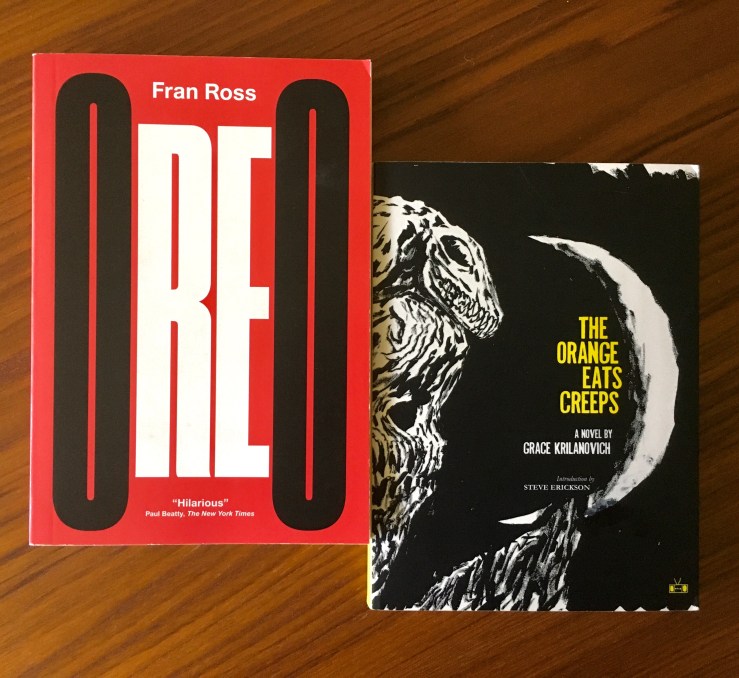
Oreo/Orange (Books acquired, 13 July 2020)

img_5778

I’m like 50 pages from the end of Fran Ross’s 1974  Oreo and I simply don’t understand how this novel is so erased or ignored in most discussions of postmodern classics. (It could be ignorance—mine for sure—or erasure, or sure, structural racism in publishing and literary criticism—I mean, I feel like every list that compels someone to read Thomas Pynchon and Kathy Acker and John Barth and Stanley Elkin and Ishmael Reed and Robert Coover should include Fran Ross, Fran Ross’s novel Oreo, Fran Ross’s only novel Oreo, why is there only one novel by Fran Ross, Oreo? What I’m trying to say is: Why didn’t I read this until now? Although reading it now has felt like a gift of some kind.)

This thing—Oreo, that is—zapped me on like page three or four with this ditty–

Ec1_7BJXkAUYc1q

I mean, c’mon!

I owe Oreo a proper write-up, if I can ever muster such a thing again, which maybe I can’t.

I also picked up, almost entirely at random, Grace Krilanovich’s novel The Orange Eats Creeeps. The spine and title struck me, I saw it was a Two Dollar Radio publication, and when I fished it from the shelf, I read Steve Erickson’s blurb and just went with it. Here’s Two Dollar’s blurb:

A girl with drug-induced ESP and an eerie connection to Patty Reed (a young member of the Donner Party who credited her survival to her relationship with a hidden wooden doll), searches for her disappeared foster sister along “The Highway That Eats People,” stalked by a conflation of Twin Peaks’ “Bob” and the Green River Killer, known as Dactyl.

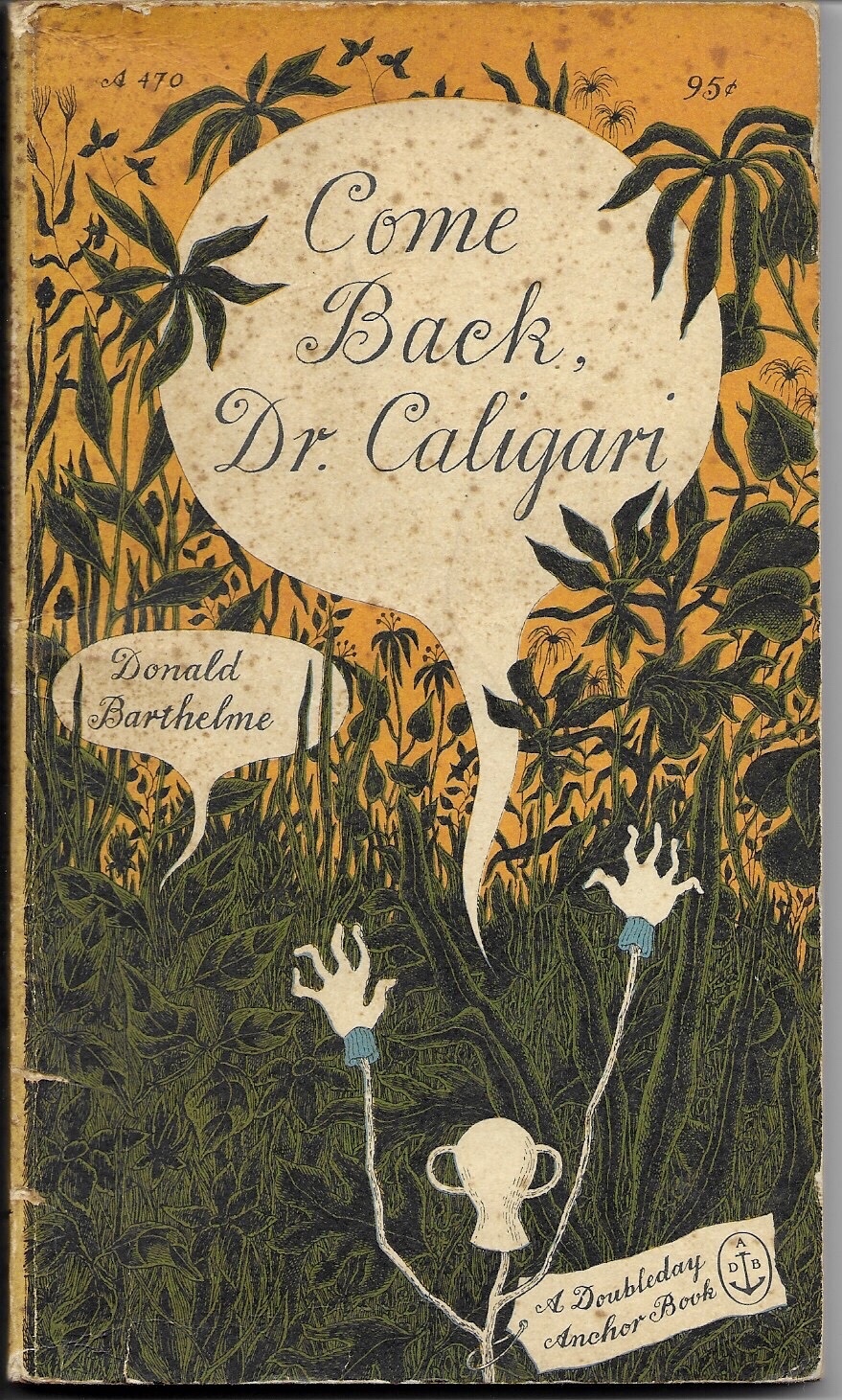
I also found a Donald Barthelme collection with an Edward Gorey cover:

2020-07-16_161411

Five bookmarks

2020-07-18_154118_1-4

Business card for the NC-based artist Hannah Dansie, likely obtained at an arts fair in Asheville, NC, late 2018. Inside Charles Portis’s The Dog of the South, pages 106-07. Did I finish The Dog of the South? Yes I did.

2020-07-18_154118_1-2

An actual bookmark from the indie publisher Two Dollar Radio, obtained in 2020 when I purchased their edition of Rudolph Wurlitzer’s Nog. Inside Rudolph Wurlitzer’s Nog, between the cover and the first page. Did I finish Nog? Yes I did.

2020-07-18_154118_1-3

Entrance ticket for Wat Pho, obtained in Bangkok, Thailand, in the fall of 2002. Found inside Thomas Pynchon’s V., pages 228-29 (the beginning of “Mondaugen’s Story.” Did I finish V.? Yes I did.

2020-07-18_154118_1-1

Postcard from the Greek indie publisher Pilotless Press celebrating Allen Kechagiar’s chapbook The Mundane History of Lockwood HeightsObtained via the publisher in 2012. Inside of Barry Hannah’s Long, Last, Happy, page 254-55. Did I finish The Mundane History of Lockwood Heights? Yes I did.

2020-07-18_154118_1

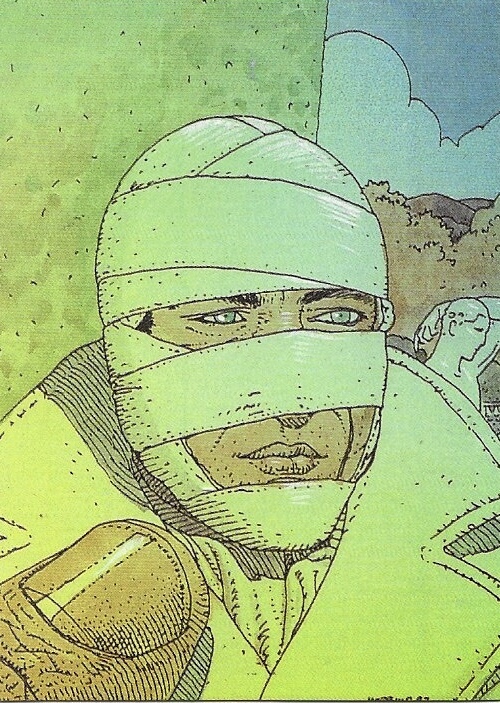
Card #30 (from Airtight Garage) of a set of Moebius collector cards, circa 1993. Obtained in a pack of Moebius Collector Cards purchased from Floating World Comics in Portalnd, Oregon, in July of 2019. Inside Jim Dodge’s Fup, pages 24-25. Did I finish Fup? No I did not.

The Madmen — Agostino Arrivabene

i-folli

The Madmen, 2017 by Agostino Arrivabene (b. 1967)

Three Books

2020-07-16_161411

2020-07-16_161411_1

Come Back, Dr. Caligari by Donald Barthelme. Mass-market paperback from Anchor Books, 1965. Cover art and design by Edward Gorey.

I’d only ever seen the Milton Glaser cover for Barthelme’s first collection of stories, Come Back, Dr. Caligari, and was thrilled to pick up this Gorey Anchor cover the other day. I’d almost picked up the Glaser version years ago, but it wasn’t in great shape, and I was pretty sure that all of the stories in Caligari are contained in Sixty Stories and Forty Stories (I could be wrong). I love the richness of Gorey’s cover.

2020-07-16_161411_2

Nova by Samuel R. Delany. Mass-market paperback from Bantam Books, 1979. Cover art by Eddie Jones (not credited); no designer credited.

I couldn’t make it through Delany’s cult favorite Dhalgren a few years back, but Nova was easier sledding. The book is a riff on Moby-Dick, tarot, monoculture, and the grail quest. It’s jammed with ideas and characters, and if it never quite coheres into something transcendent, it’s a fun quick read (even if the ending, right from the postmodern metatextual playbook is too clever by half).

2020-07-16_161411_3

Mr Pye by Mervyn Peake. Mass-market papberback from Penguin Books, 1982. Cover art by Mervyn Peake; no designer credited.

While Mr Pye isn’t as rich, dense, or abjectly weird as Peake’s Gormenghast trilogy, it is wry and sharp, a strange morality play that made me laugh out loud a few times. (It also has a few shades of Wicker Man to it–but not too much). Good stuff.

Checkmate — Maria Helena Vieira da Silva

2020-07-15_151953_3

Checkmate, 1950 by Maria Helena Vieira da Silva (1908–1992)

Illustration for Poe’s “The Masque of Red Death” — Ivor Abrahams

The Masque of the Red Death 1976 by Ivor Abrahams born 1935

Illustration for Poe’s “The Masque of Red Death,” 1976 by Ivor Abrahams (1935–2015)

“The Masque of Red Death”

by

Edgar Allan Poe


The “Red Death” had long devastated the country. No pestilence had ever been so fatal, or so hideous. Blood was its Avatar and its seal—the redness and the horror of blood. There were sharp pains, and sudden dizziness, and then profuse bleeding at the pores, with dissolution. The scarlet stains upon the body and especially upon the face of the victim, were the pest ban which shut him out from the aid and from the sympathy of his fellow-men. And the whole seizure, progress and termination of the disease, were the incidents of half an hour.

But the Prince Prospero was happy and dauntless and sagacious. When his dominions were half depopulated, he summoned to his presence a thousand hale and light-hearted friends from among the knights and dames of his court, and with these retired to the deep seclusion of one of his castellated abbeys. This was an extensive and magnificent structure, the creation of the prince’s own eccentric yet august taste. A strong and lofty wall girdled it in. This wall had gates of iron. The courtiers, having entered, brought furnaces and massy hammers and welded the bolts. They resolved to leave means neither of ingress nor egress to the sudden impulses of despair or of frenzy from within. The abbey was amply provisioned. With such precautions the courtiers might bid defiance to contagion. The external world could take care of itself. In the meantime it was folly to grieve, or to think. The prince had provided all the appliances of pleasure. There were buffoons, there were improvisatori, there were ballet-dancers, there were musicians, there was Beauty, there was wine. All these and security were within. Without was the “Red Death”.

It was towards the close of the fifth or sixth month of his seclusion, and while the pestilence raged most furiously abroad, that the Prince Prospero entertained his thousand friends at a masked ball of the most unusual magnificence. Continue reading “Illustration for Poe’s “The Masque of Red Death” — Ivor Abrahams”

Under the Sign of the Labyrinth (Book acquired, 7 July 2020)

img_5756

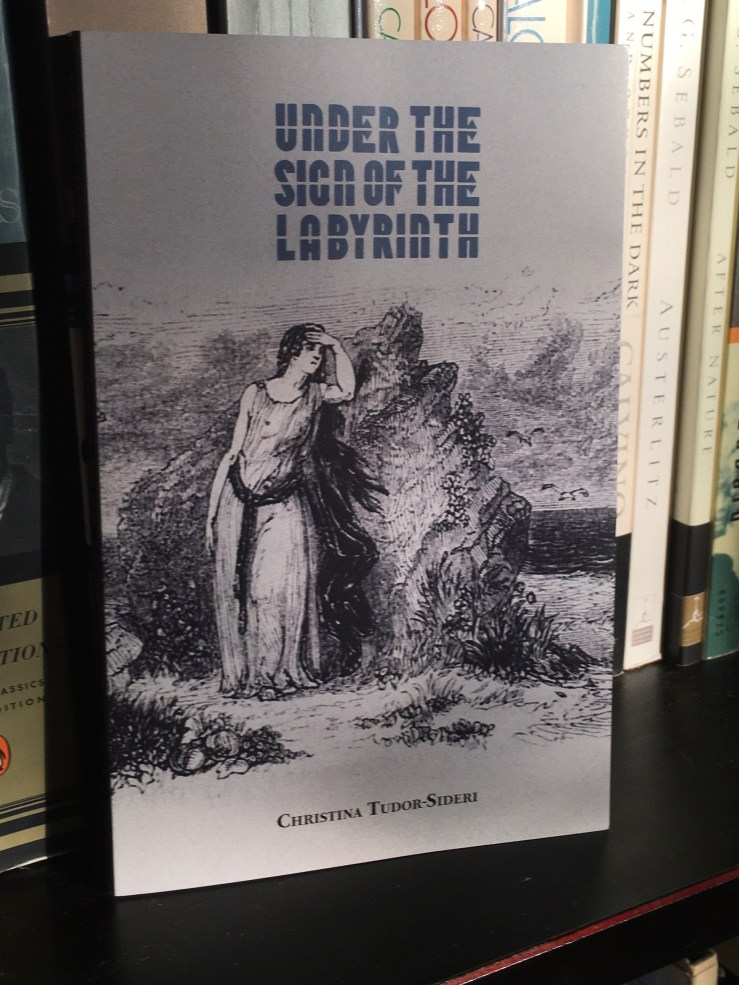
Christina Tudor-Sideri’s Under the Sign of the Labyrinth adds to Sublunary Editions‘ growing catalog of odd and engaging short volumes.

Their blurb:

There is no need to place your hand on a wound to feel it throbbing in pain. There is no need to see its root to know that a tree is dying. I am renouncing history. A film frame has lost its meaning. Vain and cruel, I have become a self that contains all negations to come, I have escaped the universe of time and space—page after page, touch after touch, train after train. I have become the idea of a sea beast moving in the deep. I have become the labyrinth. I am entombed in poetry. In the first stanza, in the last, in the blueness of thirsting ink—in the bruising of eternity. I have become alone. I am alone.”

Buzz off

From Jim Jarmusch’s 1986 film Down By Law (full film below).

Pacific — Alex Colville

alex-colville-pacific

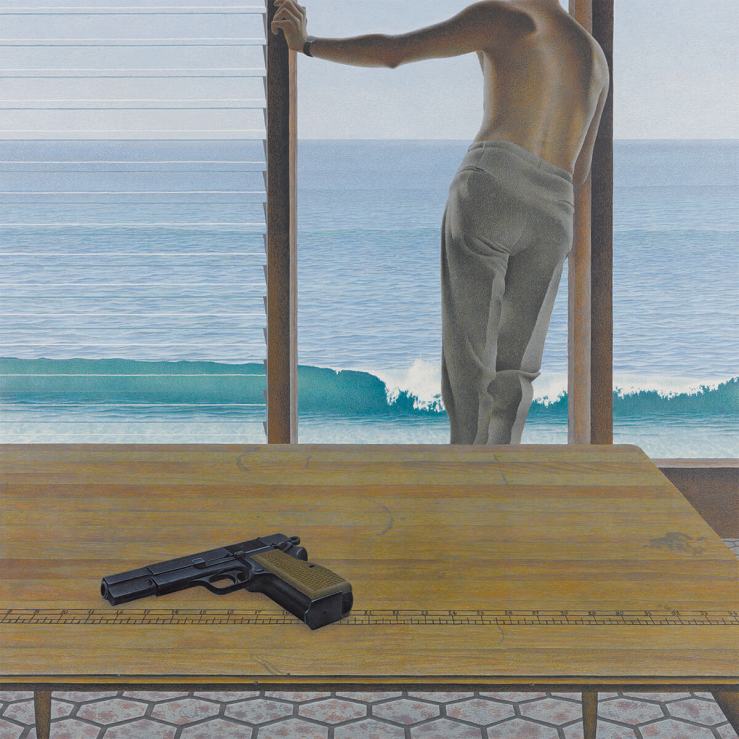
Pacific, 1967 by Alex Colville (1920-2013)

“The Friar’s Dream” — Álvaro Mutis

2020-06-29_174250

From The Mansion; English translation by Beatriz Haugner.