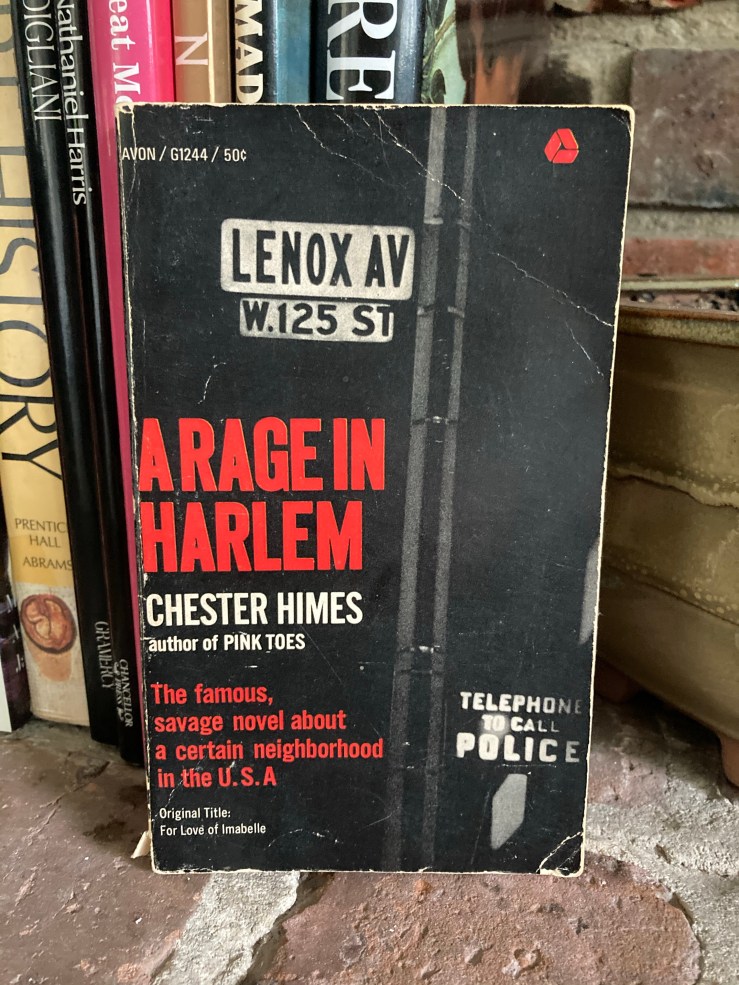
I’d been meaning to read Chester Himes for a while now (on the recommendation of Ishmael Reed, who cites Himes as a major influence), so I picked up a copy of A Rage in Harlem, the first of his Coffin Ed and Grave Digger detective stories. I was expecting hardboiled crime fiction—and sure, there are elements of it here—but Himes’ 1957 novel was far zanier and more ecstatic than I expected. A Rage in Harlem pops along with wild energy, spinning out into strange directions, donning artful disguises, always on the run. Absolutely loved it. Here’s the blurb:
For love of fine, wily Imabelle, hapless Jackson surrenders his life savings to a con man who knows the secret of turning ten-dollar bills into hundreds—and then he steals from his boss, only to lose the stolen money at a craps table. Luckily for him, he can turn to his savvy twin brother, Goldy, who earns a living—disguised as a Sister of Mercy—by selling tickets to Heaven in Harlem. With Goldy on his side, Jackson is ready for payback.
The day the fat woman
In the bright blue bathing suit
Walked into the water and died,
I thought about the human
Condition. Pieces of old fruit
Came in and were left by the tide.
What I thought about the human
Condition was this: old fruit
Comes in and is left, and dries
In the sun. Another fat woman
In a dull green bathing suit
Dives into the water and dies.
The pulmotors glisten. It is noon.
We dry and die in the sun
While the seascape arranges old fruit,
Coming in and the tide, glistening
At noon. A woman, moderately stout,
In a nondescript bathing suit,
Swims to a pier. A tall woman
Steps toward the sea. One thinks about the human
Condition. The tide goes in and goes out.
At the airport-security checkpoint on my way to visit my grandmother, I am asked to drink from my water bottle.
This water bottle?
That’s right. Open it and drink from it.
/
At the airport-security checkpoint on my way to visit my grandmother, I am asked to take off my shoes.
Take off my shoes?
Yes. Both Please.
/
At the airport-security checkpoint on my way to visit my grandmother, I am asked if I have a fever.
A fever? Really?
Yes. Really.
/
My grandmother is in a nursing home. It’s not bad. It doesn’t smell like pee. It doesn’t smell like anything. When I go to see her, as I walk through the hall past the common room and the nurses’ station, old person after old person puts out his or her hand to me. Steven, one says. Ann, another calls. It’s like being in a third-world country, but instead of food or money you are what is wanted, your company. In third-world countries I have felt overwhelmingly American, calcium-rich, privileged, and white. Here, I feel young, lucky, and sad. Sad is one of those words that has given up its life for our country, it’s been a martyr for the American dream, it’s been neutralized, co-opted by our culture to suggest a tinge of discomfort that lasts the time it takes for this and then for that to happen, the time it takes to change a channel. But sadness is real because once it meant something real. It meant dignified, grave; it meant trustworthy; it meant exceptionally bad, deplorable, shameful; it meant massive, weighty, forming a compact body; it meant falling heavily; and it meant of a color: dark. It meant dark in color, to darken. It meant me. I felt sad.
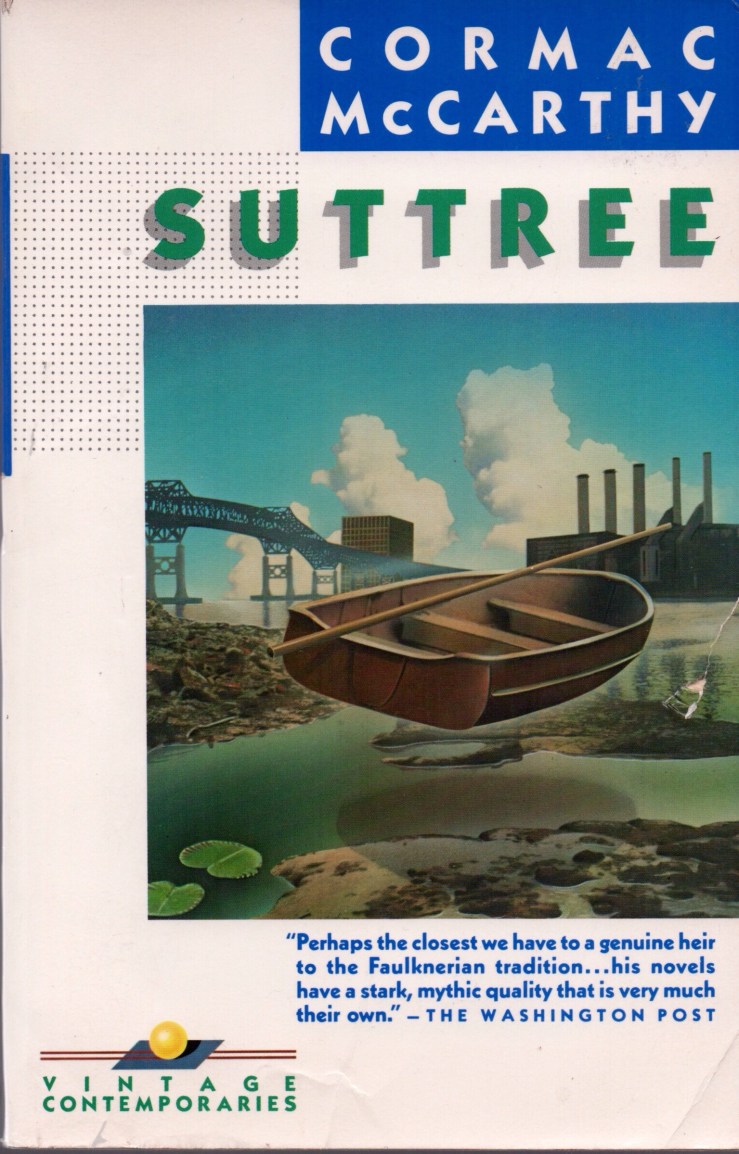
I’ve been a big fan of the Vintage Contemporaries 1980s series for ages now. The books were easily available, cheap and used, in the nineties, and I first read Raymond Carver and Jay McInerney in VC editions, later adding novels by Denis Johnson, Don DeLillo, Jerzy Kosinski to the burgeoning collection. I was thrilled to find a VC copy of Cormac McCarthy’s Suttree years ago; I wasn’t looking for it in particular, but the spine of a Vintage Contemporaries edition is hard to miss in a used bookstore. I picked it up of course, and gave the Vintage International edition I’d read to a friend who’d just finished Blood Meridian. The dark, moody Vintage International covers strongly contrast the bright, vivid VC edition (with a surreal painting by Marc Tauss):
In time, I’d unshelve at least one or two VC editions when browsing a used bookstore, especially if it was an author I’d been meaning to read. I ended up reading and loving Joy Williams’ first collection, Taking Care, that way, as well as Charles Portis’s Norwood (which led to me reading every Portis novel I could get my hands on).
The one I really, really wanted though was the Vintage Contemporaries edition of Barry Hannah’s collection Airships. I must have seen it first–just the spine–in this great write up of VC designs at Talking Covers, and then added it to a mental list of titles to check for. There’s absolutely nothing wrong with the Grove Press copy I have of Airships; indeed, I really dig its photorealistic cover by Hannah’s contemporary Glennray Tutor—but I guess at this point I have to admit I’m collector (of cheap eighties paperbacks).
In his 1978 collection Airships, Barry Hannah sets stories in disparate milieux, from the northern front of the Civil War, to an apocalyptic future, to the Vietnam War, to strange pockets of the late-twentieth century South. Despite the shifts in time and place, Airships is one of those collections of short stories that feels somehow like an elliptical, fragmentary novel. There are the stories that correspond directly to each other — the opener “Water Liars,” for instance, features (presumably, anyway), the same group of old men as “All the Old Harkening Faces at the Rail.” The old men love to crony up, gossip, tell tall tales. An outsider spoils the fun in “Water Liars” by telling a truth more terrible than any lie; in “Harkening,” an old man shows off his new (much younger) bride. These stories are perhaps the simplest in the collection, the homiest, anyway, or at least the most “normal” (whatever that means), yet they are both girded by a strange darkness, both humorous and violent, that informs all of Airships.
Well so and anyway:
Yesterday, browsing my beloved used bookstore, I found, while not really looking for it, the Vintage Contemporaries edition of Airships. I was in the “H” section of General Fiction, looking for something by Chester Himes (which I found, but in the Mysteries section, which I really have never browsed before), and there it was, its spine singing to me from a low shelf. I was happy to note the cover is by Rick Lovell, who’s responsible for my favorite VC editions (along with, obviously, series designer Lorraine Louie). As a sort of cherry on top, my edition has a little gold sticker at the top of the inside cover, proclaiming “Square Books on the Square, Oxford Mississippi.” Hannah taught at Ole Miss for nearly three decades. Square Books is still there.
I was excited with my find and I’m a dork so I tweeted about it. The next tweet I saw in my timeline was this tweet by Christopher DeWeese (retweeted by the writer John Lingan):
In the last email he sent me, David Berman included this fake picture of a new edition of Actual Air in the old Vintage Contemporaries style. Ugh I'm sad. pic.twitter.com/aSHnEGCP2i
David Berman was a poet, musician, and singer (and more) who died almost exactly a year ago. He was kind of a hero of mine, as far as these things go, and as such I never made an attempt to contact him, even when he linked to this blog on his blog, Menthol Mountains. I absolutely love the cover he made—or did he make it? I don’t actually know—but I know that he loved Vintage Contemporaries, that they were important to him. I recall John Lingan tweeting about having to cut some of his discussion about the series with Berman in his fantastic profile of the then-not-late artist. I couldn’t find the tweet, but I reached out to John, and he told me I remembered right; he also told me he recalled seeing a copy of Harold Brodkey’s First Love and Other Sorrows in Berman’s room.
I wonder if Berman and I had the same VC edition of First Love and Other Sorrows? The one with the Rick Lovell cover of butterflies on a sandcastle? Or maybe he had the one with the purple cover? I gave my copy to a good friend years ago, and have never seen one with the Lovell cover since.





![[title not known] by George Jones 1786-1869](https://biblioklept.org/wp-content/uploads/2020/08/a00337_10.jpg?w=739)




 year ago. He was kind of


 Biblioklept