In these chapters, Ishmael (again) describes the business of rendering oil and etcetera from a whale’s corpse. The chapters show again Ishmael’s push-pull narration style, vacillating between the physical/commercial and the metaphysical/philosophical.
Look—I’m gonna quote the hell out of this chapter. Ish and his fellows set to a big ole tub of sperm, by which he means, of course, spermaceti, the vital stuff found in an organ in the sperm whale’s head; the vital stuff that energizes and lights Ishmael’s world. On that self-same sperm:
It had cooled and crystallized to such a degree, that when, with several others, I sat down before a large Constantine’s bath of it, I found it strangely concreted into lumps, here and there rolling about in the liquid part. It was our business to squeeze these lumps back into fluid. A sweet and unctuous duty! No wonder that in old times this sperm was such a favourite cosmetic. Such a clearer! such a sweetener! such a softener! such a delicious molifier! After having my hands in it for only a few minutes, my fingers felt like eels, and began, as it were, to serpentine and spiralise.
The next sentence—a full paragraph—is something else:
As I sat there at my ease, cross-legged on the deck; after the bitter exertion at the windlass; under a blue tranquil sky; the ship under indolent sail, and gliding so serenely along; as I bathed my hands among those soft, gentle globules of infiltrated tissues, woven almost within the hour; as they richly broke to my fingers, and discharged all their opulence, like fully ripe grapes their wine; as I snuffed up that uncontaminated aroma,—literally and truly, like the smell of spring violets; I declare to you, that for the time I lived as in a musky meadow; I forgot all about our horrible oath; in that inexpressible sperm, I washed my hands and my heart of it; I almost began to credit the old Paracelsan superstition that sperm is of rare virtue in allaying the heat of anger; while bathing in that bath, I felt divinely free from all ill-will, or petulance, or malice, of any sort whatsoever.
The sentence above: 161 words, eleven semicolons, fourteen commas, one dash, and of course, one final period. In these words and characters—halts and stops, connections and jumps—Ishmael converts his pain, his “horrible oath,” his drastic hypos, his desire to go about knocking the hats off men, his general misanthropy—he converts all of this into a moment of transcendence.
The moment of transcendence extends into a kind of spermy mindmeld:
Squeeze! squeeze! squeeze! all the morning long; I squeezed that sperm till I myself almost melted into it; I squeezed that sperm till a strange sort of insanity came over me; and I found myself unwittingly squeezing my co-laborers’ hands in it, mistaking their hands for the gentle globules. Such an abounding, affectionate, friendly, loving feeling did this avocation beget; that at last I was continually squeezing their hands, and looking up into their eyes sentimentally; as much as to say,—Oh! my dear fellow beings, why should we longer cherish any social acerbities, or know the slightest ill-humor or envy! Come; let us squeeze hands all round; nay, let us all squeeze ourselves into each other; let us squeeze ourselves universally into the very milk and sperm of kindness.
Here, I think is the the grand thesis of Moby-Dick.
III. But no. That’s not the thesis. That’s the grand ecstatic epiphany of joy, which Ishmael deflates in the next paragraph:
Would that I could keep squeezing that sperm for ever! For now, since by many prolonged, repeated experiences, I have perceived that in all cases man must eventually lower, or at least shift, his conceit of attainable felicity; not placing it anywhere in the intellect or the fancy; but in the wife, the heart, the bed, the table, the saddle, the fireside, the country; now that I have perceived all this, I am ready to squeeze case eternally. In thoughts of the visions of the night, I saw long rows of angels in paradise, each with his hands in a jar of spermaceti.
Locate the epiphany elsewhere than the intellect or the fancy then: wife, bed, saddle, etc.
—Say it, no ideas but in things—, wrote William Carlos Williams not quite a century later.
IV. Ishmael turns from ideas to things. He lists some of the other magic potions in the sperm whale’s body: white-horse, plum pudding, slobgollion, gurry, and nippers.
The chapter ends with Ish describing the process by which a spademan and gaffman cut the whale into pieces. It’s a mechanical, thingy business, one that points back to the reason for Ahab’s revenge quest:
This spade is sharp as hone can make it; the spademan’s feet are shoeless; the thing he stands on will sometimes irresistibly slide away from him, like a sledge. If he cuts off one of his own toes, or one of his assistants’, would you be very much astonished? Toes are scarce among veteran blubber-room men.
Toes are scarce, but perhaps not as vital as legs.
V. Ch. 95, “The Cassock.”
Another short chapter on a long subject. Ishmael describes-but-not-defines “a very strange, enigmatical object . . . lying along lengthwise in the lee scuppers.” His description is an accumulation of negations:
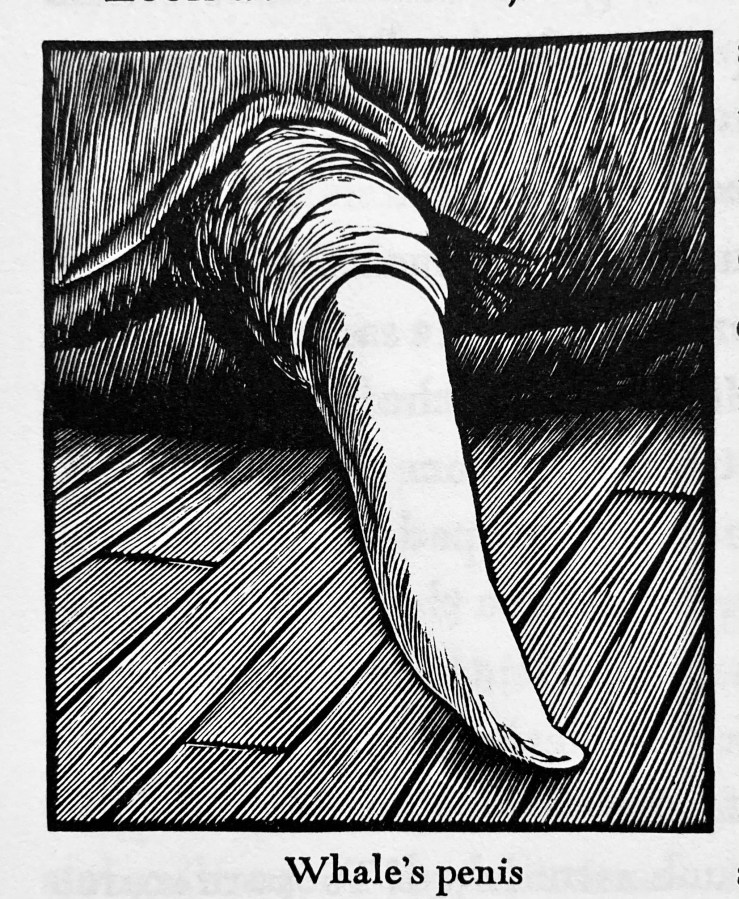
Not the wondrous cistern in the whale’s huge head; not the prodigy of his unhinged lower jaw; not the miracle of his symmetrical tail; none of these would so surprise you, as half a glimpse of that unaccountable cone,—longer than a Kentuckian is tall, nigh a foot in diameter at the base, and jet-black as Yojo, the ebony idol of Queequeg.
And what is that enormous jet black cone? A “grandissimus, as the mariners call it.”
It’s the whale’s dick, natch.
Moby-Dick illustration by Barry Moser
Ishmael compares it to the idol “found in the secret groves of Queen Maachah in Judea” — the Asherah pole — and points out that “King Asa, her son, did depose her, and destroyed the idol, and burnt it for an abomination.”
This is a phallic book full of castrations, cuttings off both figurative and literal.
VI. Ch. 96, “The Try-Works”
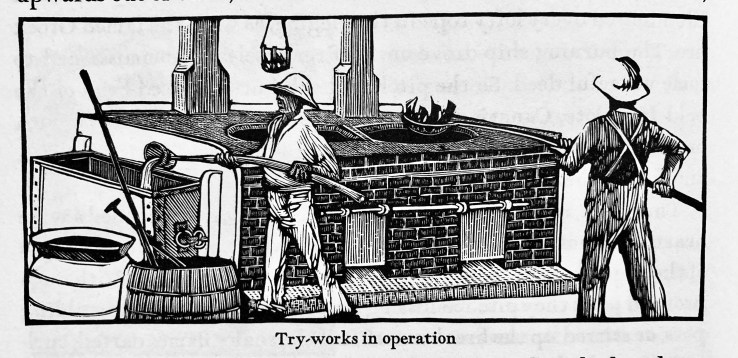
Another chapter initially focused on the practical business of whaling. In this case, we learn about the try-works, where blubber is cooked down to oil. I’ll let Moser’s illustration stand in here:
Moby-Dick illustration by Barry Moser
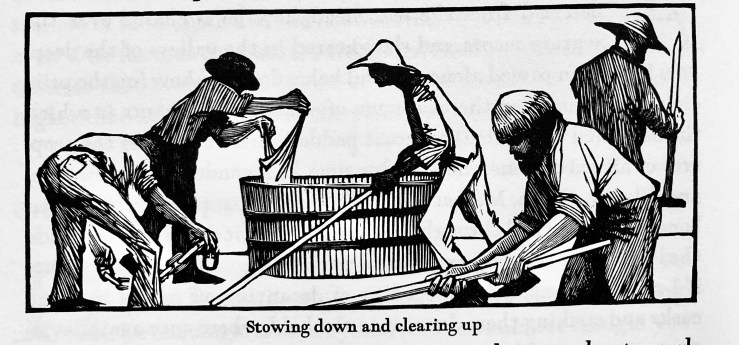
And here:
The chapter ends though in a great metaphysical rush, as Ish goes from things back to ideas:
The truest of all men was the Man of Sorrows, and the truest of all books is Solomon’s, and Ecclesiastes is the fine hammered steel of woe. “All is vanity.” ALL. This wilful world hath not got hold of unchristian Solomon’s wisdom yet. But he who dodges hospitals and jails, and walks fast crossing graveyards, and would rather talk of operas than hell; calls Cowper, Young, Pascal, Rousseau, poor devils all of sick men; and throughout a care-free lifetime swears by Rabelais as passing wise, and therefore jolly;—not that man is fitted to sit down on tomb-stones, and break the green damp mould with unfathomably wondrous Solomon.
The chapter concludes with a puzzling set of metaphors:
There is a wisdom that is woe; but there is a woe that is madness. And there is a Catskill eagle in some souls that can alike dive down into the blackest gorges, and soar out of them again and become invisible in the sunny spaces. And even if he for ever flies within the gorge, that gorge is in the mountains; so that even in his lowest swoop the mountain eagle is still higher than other birds upon the plain, even though they soar.
VII. Ch. 97, “The Lamp.”
In this very short (three-paragraph) chapter, Ishmael notes that whalemen light their lamps from the oil of the animals they hunt.
VIII. Ch. 98, “Stowing Down and Clearing Up.”
A chapter about cleaning up. Ish declares that, “were it not for the tell-tale boats and try-works, you would all but swear you trod some silent merchant vessel, with a most scrupulously neat commander. The unmanufactured sperm oil possesses a singularly cleansing virtue.” In other words, despite all the butchery, blood, and bits involved, there’s something in the whale itself that purifies the decks after a good scrub down.
The chapter ends with Ishmael recognizing the mechanical repetition of his business though—no wonder the Modernists revived Moby-Dick!
Yet this is life. For hardly have we mortals by long toilings extracted from this world’s vast bulk its small but valuable sperm; and then, with weary patience, cleansed ourselves from its defilements, and learned to live here in clean tabernacles of the soul; hardly is this done, when—There she blows!—the ghost is spouted up, and away we sail to fight some other world, and go through young life’s old routine again.
Oh! the metempsychosis! Oh! Pythagoras, that in bright Greece, two thousand years ago, did die, so good, so wise, so mild; I sailed with thee along the Peruvian coast last voyage—and, foolish as I am, taught thee, a green simple boy, how to splice a rope!
I. In this riff, Chapters 91, 92, and 93 of Moby-Dick.
II. Ch. 91, “The Pequod Meets The Rose-bud.”
Stubb stars in this humorous chapter in which The Pequod encounters a French vessel which is towing a pair of “what the fishermen call a blasted whale, that is, a whale that has died unmolested on the sea, and so floated an unappropriated corpse.” The smell from these two dead whales is awful. (Ish claims the odor is “worse than an Assyrian city in the plague, when the living are incompetent to bury the departed.”)
We soon learn the French ship bears an ironic name: “Bouton de Rose,”—Rose-button, or Rose-bud; and…this was the romantic name of this aromatic ship.”
Stubb hails the ship to ask Ahab’s famous question to all the ships The Pequod encounter, but the The Rose-bud has not seen the White Whale. Ahab leaves off, letting Stubb take over the chapter with his cruel comedy:
He now perceived that the Guernsey-man, who had just got into the chains, and was using a cutting-spade, had slung his nose in a sort of bag.
“What’s the matter with your nose, there?” said Stubb. “Broke it?”
“I wish it was broken, or that I didn’t have any nose at all!” answered the Guernsey-man, who did not seem to relish the job he was at very much. “But what are you holding yours for?”
“Oh, nothing! It’s a wax nose; I have to hold it on. Fine day, ain’t it? Air rather gardenny, I should say; throw us a bunch of posies, will ye, Bouton-de-Rose?”
“What in the devil’s name do you want here?” roared the Guernsey-man, flying into a sudden passion.
The Guernsey-man is irritated because his captain knows nothing of whales and refuses to discard the rotten animals, which his crew understand to be worthless. Stubb, however, thinks that one of the whales might be full of ambergris, a valuable substance, and he hatches a cunning plan to get the whale for himself. Stubb enlists the Gurnsey-man’s help in his plan: Stubb will appear as an expert witness on whales to The Rose-bud’s captain (ironically, a former perfumier)–only the captain speaks no English—so the Gurnsey-man will translate. However, the Gurnsey-man will simply say whatever he wants (namely, that they should cut the whales loose).
The scene plays out in comedy that I think still holds up today:
“What shall I say to him first?” said he.
“Why,” said Stubb, eyeing the velvet vest and the watch and seals, “you may as well begin by telling him that he looks a sort of babyish to me, though I don’t pretend to be a judge.”
“He says, Monsieur,” said the Guernsey-man, in French, turning to his captain, “that only yesterday his ship spoke a vessel, whose captain and chief-mate, with six sailors, had all died of a fever caught from a blasted whale they had brought alongside.”
Upon this the captain started, and eagerly desired to know more.
“What now?” said the Guernsey-man to Stubb.
“Why, since he takes it so easy, tell him that now I have eyed him carefully, I’m quite certain that he’s no more fit to command a whale-ship than a St. Jago monkey. In fact, tell him from me he’s a baboon.”
The scene continues in this line, with Stubb repeatedly insulting the captain who remains unaware of his abuse. When the captain offers Stubb a glass of wine to thank him for his advice, he replies thus:
“Thank him heartily; but tell him it’s against my principles to drink with the man I’ve diddled. In fact, tell him I must go.”
“He says, Monsieur, that his principles won’t admit of his drinking; but that if Monsieur wants to live another day to drink, then Monsieur had best drop all four boats, and pull the ship away from these whales, for it’s so calm they won’t drift.”
Stubb makes off with the whale and digs into it with his spade. He hits gold:
“I have it, I have it,” cried Stubb, with delight, striking something in the subterranean regions, “a purse! a purse!”
Dropping his spade, he thrust both hands in, and drew out handfuls of something that looked like ripe Windsor soap, or rich mottled old cheese; very unctuous and savory withal. You might easily dent it with your thumb; it is of a hue between yellow and ash colour. And this, good friends, is ambergris, worth a gold guinea an ounce to any druggist.
III. Stubb is the star of “The Pequod Meets The Rose-bud.” The chapter showcases his wit, and affords him all the best lines—lines a far cry from Ahab’s Shakespearean mode.
But this particular chapter also underlines my suspicion that Stubb is the villain of Moby-Dick. He’s cruel and greedy, duplicitous and hardhearted. He’s the opposite of largehearted Ishmael. Stubb has shown his double-edged comic cruelty earlier in the novel—most notably in the way he bullies his boat’s crew with sweethearted insults, but also in Ch. 64, “Stubb’s Supper,” when he plays cruel fun on Fleece, the Black cook of The Pequod. Stubb’s cruel avarice comes to a head in Ch. 93, “The Castaway.” But let’s first attend to Ch. 92, “Ambergris.”
IV. Ch. 92, “Ambergris.”
“Who would think, then, that such fine ladies and gentlemen should regale themselves with an essence found in the inglorious bowels of a sick whale!” Ishmael ponders near the beginning of this short chapter, which again riffs on a major theme of Moby-Dick; namely, how every thing earthly (and unearthly) finds its definition in its opposition.
V. Ch. 93, “The Castaway.”
Right.
So. Anyway. Per point III—I think I was arguing that Stubb is something of an asshole. He’s a bully, a bad boss, and despite the genial empathy in Ishmael’s voice (Melville’s voice?) that extends to all the horribles of The Pequod, he does not acquit himself well in “The Castaway.”
Ish sets the tragic scene from the outset:
It was but some few days after encountering the Frenchman, that a most significant event befell the most insignificant of the Pequod’s crew; an event most lamentable; and which ended in providing the sometimes madly merry and predestinated craft with a living and ever accompanying prophecy of whatever shattered sequel might prove her own.
In other words: The fate of poor Pip, the Black cabin boy, prefigures the fate of all the crew of the damned Pequod—-
and—
VI. (And, parenthetically—
I’ve been falling asleep to an audiobook of Cormac McCarthy’s novel Blood Meridian, which many many many folks have pointed out follows Moby-Dick, both rhetorically and thematically
(I mean hey, consider those opening lines:
“Call me Ishmael”
“See the child.
)
And anyway, I sort of dip into Blood Meridian in random places, finding concurrent moments, motifs, intersections—
And in the Tarot scene of Blood Meridian, the Judge tells the Black Jackson that “In your fortune lie our fortunes all” — an echo here of the fate of poor Pip.
)
VII. And anyway,
—So, “in the ambergris affair Stubb’s after-oarsman chanced so to sprain his hand, as for a time to become quite maimed; and, temporarily, Pip was put into his place.”
Pip was put into his place.
Pip freaks out and jumps from the boat his first time, a jump that results in the loss of a whale. Sadistic Stubb is stern (and more than racist) in his rebuke:
“Stick to the boat, Pip, or by the Lord, I won’t pick you up if you jump; mind that. We can’t afford to lose whales by the likes of you; a whale would sell for thirty times what you would, Pip, in Alabama. Bear that in mind, and don’t jump any more.” Hereby perhaps Stubb indirectly hinted, that though man loved his fellow, yet man is a money-making animal, which propensity too often interferes with his benevolence.
(Old Ishmael (and Old Melville) — what’s with the verb hinted there?)
And so and well—
But we are all in the hands of the Gods; and Pip jumped again. It was under very similar circumstances to the first performance; but this time he did not breast out the line; and hence, when the whale started to run, Pip was left behind on the sea, like a hurried traveller’s trunk. Alas! Stubb was but too true to his word. It was a beautiful, bounteous, blue day; the spangled sea calm and cool, and flatly stretching away, all round, to the horizon, like gold-beater’s skin hammered out to the extremest. Bobbing up and down in that sea, Pip’s ebon head showed like a head of cloves. No boat-knife was lifted when he fell so rapidly astern. Stubb’s inexorable back was turned upon him; and the whale was winged. In three minutes, a whole mile of shoreless ocean was between Pip and Stubb. Out from the centre of the sea, poor Pip turned his crisp, curling, black head to the sun, another lonely castaway, though the loftiest and the brightest.
Ishmael understands the incredible existential loss of being castaway in the wide waste of the sea:
…the awful lonesomeness is intolerable. The intense concentration of self in the middle of such a heartless immensity, my God! who can tell it?
Poor Pip goes mad. His fate will be the fate of the company proper.
And if Ishmael’s sympathy sympathizes the victim, so too does it sympathize the villain—-
For the rest, blame not Stubb too hardly. The thing is common in that fishery; and in the sequel of the narrative, it will then be seen what like abandonment befell myself.
—and yet that sympathy is an empathetic prefiguring gust of our narrator Ish’s ultimate fate.
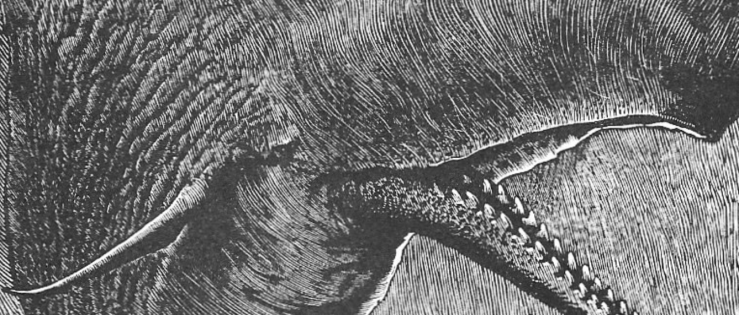
Detail from a Barry Moser illustration to Moby-Dick
I. In this riff: Chapters 88-90 of Moby-Dick.
II. Ch. 88, “Schools and Schoolmasters.”
In this chapter, Ishmael distinguishes between the two types of “schools” of whales—the harem schools, which are comprised of all adult females and one male (Ish calls the harem-lord the “Grand Turk”), and the all-male schools. Ish points out that these Grand Turks aren’t great dads:
…like certain other omnivorous roving lovers that might be named, my Lord Whale has no taste for the nursery, however much for the bower; and so, being a great traveller, he leaves his anonymous babies all over the world; every baby an exotic.
Ish points out that the all-male schools are far more aggressive than the harem schools. Too, the young males are quick to abandon their wounded fellows:
Another point of difference between the male and female schools is still more characteristic of the sexes. Say you strike a Forty-barrel-bull—poor devil! all his comrades quit him. But strike a member of the harem school, and her companions swim around her with every token of concern, sometimes lingering so near her and so long, as themselves to fall a prey.
III. Ch. 89, “Fast-Fish and Loose-Fish.”
In this marvelous chapter, Ishmael begins in a legal mode and ends in a philosophical one. He gives us the (unofficial but self-legislated) code of all whalers:
I. A Fast-Fish belongs to the party fast to it.
II. A Loose-Fish is fair game for anybody who can soonest catch it.
This doctrine we all may know from our playground days, when it took this form: “Finders keepers, Losers weepers.”
Ever the expansive expander, Ish suggests that “these two laws touching Fast-Fish and Loose-Fish, I say, will, on reflection, be found the fundamentals of all human jurisprudence . . . Is it not a saying in every one’s mouth, Possession is half of the law: that is, regardless of how the thing came into possession?”
He then pivots, sympathetically pointing out that for all of “fundamentals of human jurisprudence,” property and the power over property comes down to coercive force:
But often possession is the whole of the law. What are the sinews and souls of Russian serfs and Republican slaves but Fast-Fish, whereof possession is the whole of the law? What to the rapacious landlord is the widow’s last mite but a Fast-Fish? What is yonder undetected villain’s marble mansion with a door-plate for a waif; what is that but a Fast-Fish? What is the ruinous discount which Mordecai, the broker, gets from poor Woebegone, the bankrupt, on a loan to keep Woebegone’s family from starvation; what is that ruinous discount but a Fast-Fish? What is the Archbishop of Savesoul’s income of £100,000 seized from the scant bread and cheese of hundreds of thousands of broken-backed laborers (all sure of heaven without any of Savesoul’s help) what is that globular £100,000 but a Fast-Fish? What are the Duke of Dunder’s hereditary towns and hamlets but Fast-Fish? What to that redoubted harpooneer, John Bull, is poor Ireland, but a Fast-Fish? What to that apostolic lancer, Brother Jonathan, is Texas but a Fast-Fish? And concerning all these, is not Possession the whole of the law?
Laws and mores are but window dressing, pasteboard masks veiling the brutally true untrue truth that Might makes right.
But Ish isn’t done. He points out that, “if the doctrine of Fast-Fish be pretty generally applicable, the kindred doctrine of Loose-Fish is still more widely so,” and then underlines his application with examples of conquest and imperialism:
What was America in 1492 but a Loose-Fish, in which Columbus struck the Spanish standard by way of waifing it for his royal master and mistress? What was Poland to the Czar? What Greece to the Turk? What India to England? What at last will Mexico be to the United States? All Loose-Fish.
Swept away in his oversoul passions, Ishmael moves from historical and political examples to metaphysical territory, eventually suggesting (in another of the novel’s many metatextual moves) that the relationship between reader and author is but another application of the loose-fish/fast-fish doctrine:
What are the Rights of Man and the Liberties of the World but Loose-Fish? What all men’s minds and opinions but Loose-Fish? What is the principle of religious belief in them but a Loose-Fish? What to the ostentatious smuggling verbalists are the thoughts of thinkers but Loose-Fish? What is the great globe itself but a Loose-Fish? And what are you, reader, but a Loose-Fish and a Fast-Fish, too?
IV. Ch. 90, “Heads or Tails.”
Ish begins with what he claims is a order “from the books of the Laws of England: “De balena vero sufficit, si rex habeat caput, et regina caudam.” Bracton, l. 3, c. 3.” He proceeds to tell us that this law stipulates that
…of all whales captured by anybody on the coast of that land, the King, as Honorary Grand Harpooneer, must have the head, and the Queen be respectfully presented with the tail. A division which, in the whale, is much like halving an apple; there is no intermediate remainder.”
I love that last bit in which we are reminded that power will grab all parts of a substance leaving no intermediate remainder for the powerless.
In this chapter, The Pequod passes by “the long islands of Sumatra, Java, Bally, and Timor; which, with many others, form a vast mole, or rampart, lengthwise connecting Asia with Australia,” but never rows boats to a shore: “But how now? in this zoned quest, does Ahab touch no land? does his crew drink air? Surely, he will stop for water. Nay.” The Pequod is fully stocked for this particular revenge mission.
III. Anticipating what will come in this chapter, Ishmael informs us that,
Sperm Whales, instead of almost invariably sailing in small detached companies, as in former times, are now frequently met with in extensive herds, sometimes embracing so great a multitude, that it would almost seem as if numerous nations of them had sworn solemn league and covenant for mutual assistance and protection.
They soon come upon a great host of whales, which, “beheld through a blending atmosphere of bluish haze, showed like the thousand cheerful chimneys of some dense metropolis.”
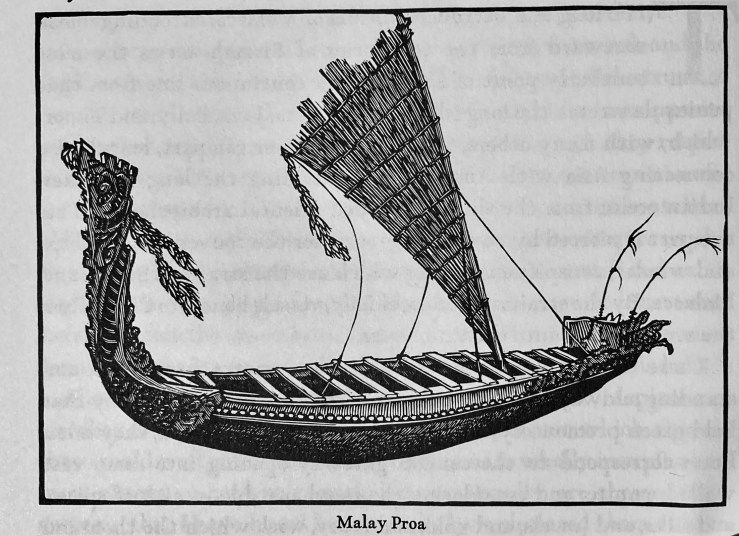
IV. “The Grand Armada” plays out in the mode of one of Melville’s earlier romantic adventure. The stakes are heightened when a pirate ship of Malays (“these rascally Asiatics,” Ishmael sounds with a racist note) pursues The Pequod as The Pequod pursues pods upon pods of whales.
Moby-Dick illustration by Barry Moser
V. Ishmael, ever-large-hearted (despite his many faults), compares the whales to sheep, and then to the over-hunted buffalo of the American West, and then, finally, to humankind:
Had these Leviathans been but a flock of simple sheep, pursued over the pasture by three fierce wolves, they could not possibly have evinced such excessive dismay. But this occasional timidity is characteristic of almost all herding creatures. Though banding together in tens of thousands, the lion-maned buffaloes of the West have fled before a solitary horseman. Witness, too, all human beings, how when herded together in the sheepfold of a theatre’s pit, they will, at the slightest alarm of fire, rush helter-skelter for the outlets, crowding, trampling, jamming, and remorselessly dashing each other to death. Best, therefore, withhold any amazement at the strangely gallied whales before us, for there is no folly of the beasts of the earth which is not infinitely outdone by the madness of men.
The lines shift away from the chapter’s romantic tone, instead underlying the philosophical mode of Moby-Dick.
VI. But that adventurous mode returns—Ishmael’s boat—which is to say, Queequeg’s boat, which is to say, Starbuck’s boat—look, the boat the narrator’s in—a particular boat manages to lance two whales with something called a “drugg”:
All whaleboats carry certain curious contrivances, originally invented by the Nantucket Indians, called druggs. Two thick squares of wood of equal size are stoutly clenched together, so that they cross each other’s grain at right angles; a line of considerable length is then attached to the middle of this block, and the other end of the line being looped, it can in a moment be fastened to a harpoon.
A third drugg is unlucky though, striking a note of danger and foreshadowing the disaster at the novel’s conclusion:
But upon flinging the third, in the act of tossing overboard the clumsy wooden block, it caught under one of the seats of the boat, and in an instant tore it out and carried it away, dropping the oarsman in the boat’s bottom as the seat slid from under him. On both sides the sea came in at the wounded planks, but we stuffed two or three drawers and shirts in, and so stopped the leaks for the time.
VII. The scene shifts again. Queequeg’s “jerking harpoon drew out” (everything in this phallic novel is always jerking and pricking and penetrating) “and the towing whale sideways vanished.” Ishmael’s boat then “glided between two whales into the innermost heart of the shoal, as if from some mountain torrent we had slid into a serene valley lake.”
The scene that unfolds is one of the most tender in all of Moby-Dick. “Here the storms in the roaring glens between the outermost whales, were heard but not felt,” declares Ishmael. Remember, our narrator sets out to sea to assuage his homicidal, suicidal impulses. He still remembers the wolfish world in this moment of respite, but he does not feel it. He feels something else:
…we were now in that enchanted calm which they say lurks at the heart of every commotion. And still in the distracted distance we beheld the tumults of the outer concentric circles, and saw successive pods of whales, eight or ten in each, swiftly going round and round, like multiplied spans of horses in a ring; and so closely shoulder to shoulder, that a Titanic circus-rider might easily have over-arched the middle ones, and so have gone round on their backs.
VIII. The boat is walled in by the whales, but Ishmael is not fearful. The whales about them are gentle — “small tame cows and calves; the women and children of this routed host.”
Ish continues:
…these smaller whales—now and then visiting our becalmed boat from the margin of the lake—evinced a wondrous fearlessness and confidence, or else a still becharmed panic which it was impossible not to marvel at. Like household dogs they came snuffling round us, right up to our gunwales, and touching them; till it almost seemed that some spell had suddenly domesticated them. Queequeg patted their foreheads; Starbuck scratched their backs with his lance; but fearful of the consequences, for the time refrained from darting it.
Violence is suspended here. And again, Starbuck, Queequeg, and Ishmael are coded as riders of conscience wrapped up in Ahab’s bloody quest.
IX. The scene intensifies. Actually, intensifies is entirely the wrong verb here, although, to be clear, the episode develops with a particular intensity—but intense seems to suggest anxiety, which here is suspended (even for the briefest of moments), as Ishmael’s boat encounters a “still stranger world” of calm:
But far beneath this wondrous world upon the surface, another and still stranger world met our eyes as we gazed over the side. For, suspended in those watery vaults, floated the forms of the nursing mothers of the whales, and those that by their enormous girth seemed shortly to become mothers. The lake, as I have hinted, was to a considerable depth exceedingly transparent; and as human infants while suckling will calmly and fixedly gaze away from the breast, as if leading two different lives at the time; and while yet drawing mortal nourishment, be still spiritually feasting upon some unearthly reminiscence;—even so did the young of these whales seem looking up towards us, but not at us, as if we were but a bit of Gulfweed in their new-born sight.
X. Queequeg then explodes, believing a whale darted and fastened with a line to a boat: ““Line! line!…him fast! him fast!—Who line him! Who struck?—Two whale; one big, one little!””
The image is of a different tethering though: Queequeg has mistaken a mother and child for two apparent victims:
Starbuck saw long coils of the umbilical cord of Madame Leviathan, by which the young cub seemed still tethered to its dam. Not seldom in the rapid vicissitudes of the chase, this natural line, with the maternal end loose, becomes entangled with the hempen one, so that the cub is thereby trapped. Some of the subtlest secrets of the seas seemed divulged to us in this enchanted pond. We saw young Leviathan amours in the deep.
And yet even after his lovefest, our sailors, our whalemen, will not be above general slaughter.
XI. The episode, as I’ve stated above, is one of the few in Moby-Dick wherein Ishmael overcomes the intense negative feeling he bears for his own world, and instead merges into a kind of Emersonian over-soul. “The Grand Armada” anticipates the novel’s greatest melding moment, Ch. 94, “A Squeeze of the Hand.” I’ve been quoting too much in this riff, but I can’t help it. Here is Ishmael’s joy:
And thus, though surrounded by circle upon circle of consternations and affrights, did these inscrutable creatures at the centre freely and fearlessly indulge in all peaceful concernments; yea, serenely revelled in dalliance and delight. But even so, amid the tornadoed Atlantic of my being, do I myself still for ever centrally disport in mute calm; and while ponderous planets of unwaning woe revolve round me, deep down and deep inland there I still bathe me in eternal mildness of joy.
And let us end this chapter and this riff with a bath of “eternal mildness of joy,” skipping over any predation its final pages might yield.
S.D. Chrostowska’s collection of short (and often very short) fictions A Cage for Every Child is forthcoming this summer from Sublunary Editions. Here’s their blurb:
A hunter of giant worms is surprised by the sentience of their prey. A flower sprouting in the palm of a hand delivers bad news. In an unknown country, power is transferred in hyper-sensual ways.
Whether fantastic or seemingly mundane, the twenty-four stories united in A Cage for Every Child unfold as uncanny encounters and brief sojourns in parallel worlds. Told in S. D. Chrostowska’s slyly provocative style, each tale questions the stability of our reality and the meaning of our pursuits.
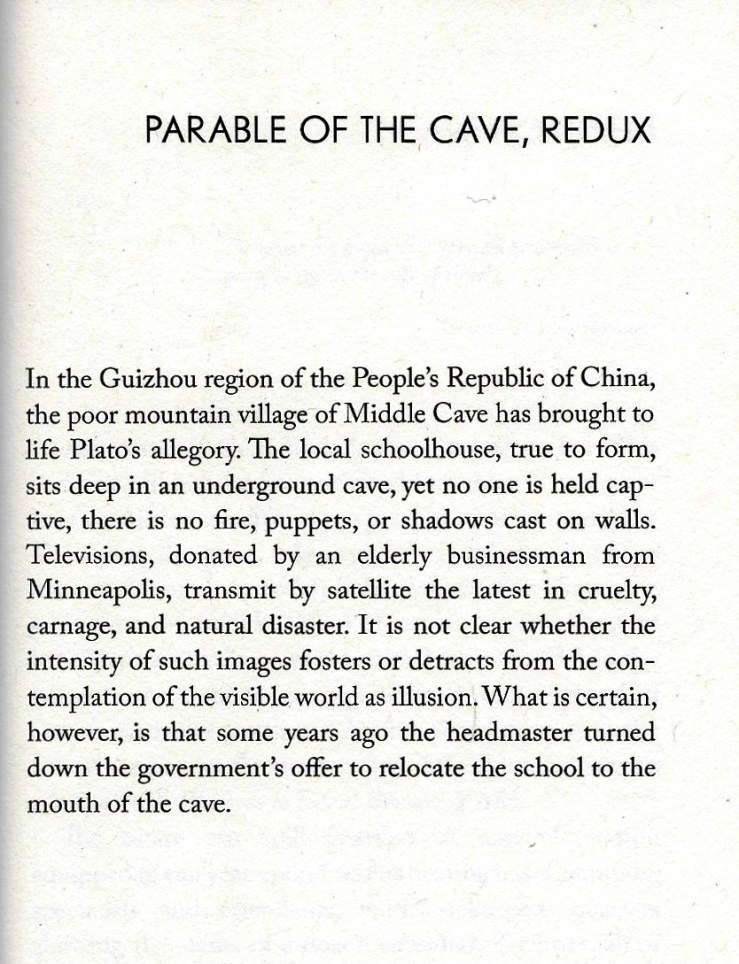
I’ve read a few of the shorter pieces in Cage and am digging it so far. Here’s “Parable of the Cave, Redux”:
Another chapter that starts out horny and ends in death.
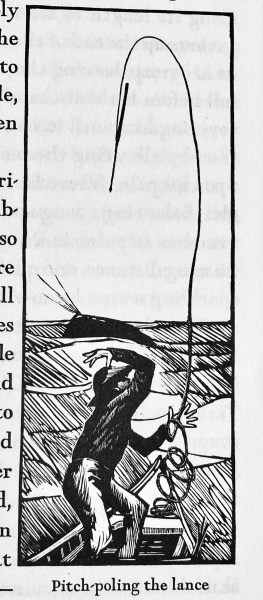
Our Man Ish lets us know that many whalers love to “grease the bottom” of their boats to make them run faster against the water, for “oil is a sliding thing.” Queequeg greases up his boat’s keel, “rubbing in the unctuousness…in obedience to some particular presentiment.” The presentiment presents in yet another whale sighting. Tashtego spears one, but it nevertheless starts to evade the whale boats. The solution? Pitchpoling:
Of all the wondrous devices and dexterities, the sleights of hand and countless subtleties, to which the veteran whaleman is so often forced, none exceed that fine manœuvre with the lance called pitchpoling. Small sword, or broad sword, in all its exercises boasts nothing like it. It is only indispensable with an inveterate running whale; its grand fact and feature is the wonderful distance to which the long lance is accurately darted from a violently rocking, jerking boat, under extreme headway. Steel and wood included, the entire spear is some ten or twelve feet in length; the staff is much slighter than that of the harpoon, and also of a lighter material—pine. It is furnished with a small rope called a warp, of considerable length, by which it can be hauled back to the hand after darting.
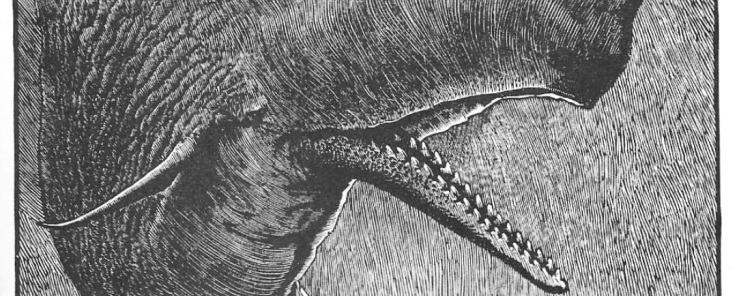
Moby-Dick illustration by Barry Moser
Stubb executes the pitchpole lancing with success, and celebrates his kill in a fit of patriotic bloodlust:
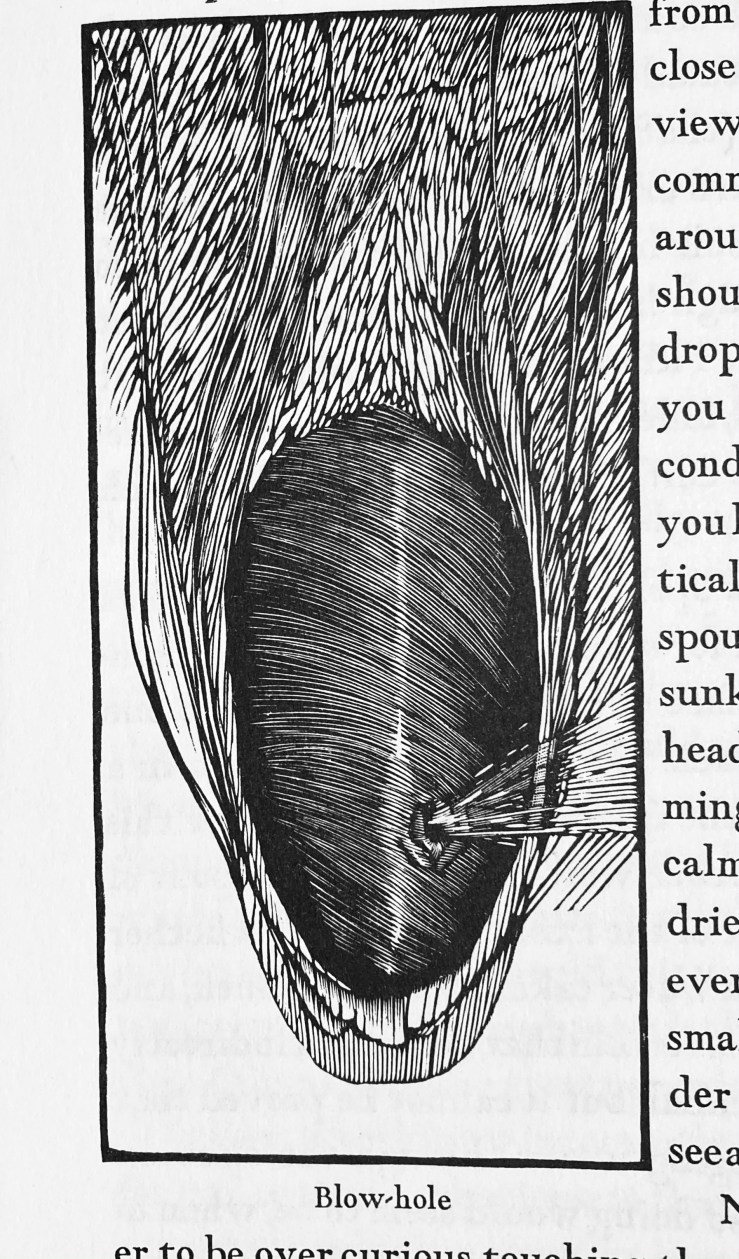
“That drove the spigot out of him!” cried Stubb. “’Tis July’s immortal Fourth; all fountains must run wine today! Would now, it were old Orleans whiskey, or old Ohio, or unspeakable old Monongahela! Then, Tashtego, lad, I’d have ye hold a canakin to the jet, and we’d drink round it! Yea, verily, hearts alive, we’d brew choice punch in the spread of his spout-hole there, and from that live punch-bowl quaff the living stuff.”
Stubb has proven himself a callous soul to this point. He is a jocular anti-Starbuck—and an anti-Ishmael, perhaps—and his suggestion that his crew “quaff the living stuff” from the whale he’s just lanced seems particularly cruel against the sympathetic portrait of whales that Ishmael has sketched over the last few chapters. He’s a figurative bloodsucker here, drawn first as a zany comic, but in a deeper reading, he is the Ugly American.
III. Ch. 85, “The Fountain.”
Here, Ishmael puts on his scientist’s cap again to puzzle out whether the whale spouts water or air.
He begins in an exacting mode, giving us the current date and time in the voyage:
…down to this blessed minute (fifteen and a quarter minutes past one o’clock P.M. of this sixteenth day of December, A.D. 1850), it should still remain a problem, whether these spoutings are, after all, really water, or nothing but vapor—this is surely a noteworthy thing.
(My darling wife’s birthday is December 16, although this has no bearing on this chapter, even if it bears a bit on my riff. In any case, Ishmael gives us a chance to get our temporal bearings here. Unless I’m wrong, the date suggests that The Pequod is almost a year out from its initial departure from Nantucket on Christmas Day of the preceding year.)
IV. “The Fountain” is one of those chapters (of which there are many) that might turn readers off from Moby-Dick—and yet it’s the sort of chapter that underlines the novel’s excellence. Ishmael is on a quest to know an unknowable thing, to describe it, analyze it, evaluate it, synthesize it into his own consciousness, and, perhaps ultimately thereby define it. Ch. 85 sees him at that task: “Still, we can hypothesize, even if we cannot prove and establish. My hypothesis is this: that the spout is nothing but mist.”
As always though, Ishmael’s own prejudices in favor of “the great inherent dignity and sublimity of the Sperm Whale” color any hypotheses he might draw. Indeed, for Ishmael, the sperm whale is a figure of genius:
He is both ponderous and profound. And I am convinced that from the heads of all ponderous profound beings, such as Plato, Pyrrho, the Devil, Jupiter, Dante, and so on, there always goes up a certain semi-visible steam, while in the act of thinking deep thoughts.
Ishmael finds—or, maybe more accurately projects—a fellow thinker of deep thoughts in the great whale. He tells us that
While composing a little treatise on Eternity, I had the curiosity to place a mirror before me; and ere long saw reflected there, a curious involved worming and undulation in the atmosphere over my head. The invariable moisture of my hair, while plunged in deep thought, after six cups of hot tea in my thin shingled attic, of an August noon; this seems an additional argument for the above supposition.
The lines are both ironic, metatextual, but also sincere and sweet. Of course our man Ish might spy a bit of mist in his tiny humid attic—but could it not also be the physical manifestation of his own genius of the metaphysical—his “little treatise on Eternity” (by which paradoxical title I take to mean Moby-Dick).
In the end of the chapter, Ishmael tries to reconcile his physics with is metaphysics:
Doubts of all things earthly, and intuitions of some things heavenly; this combination makes neither believer nor infidel, but makes a man who regards them both with equal eye.
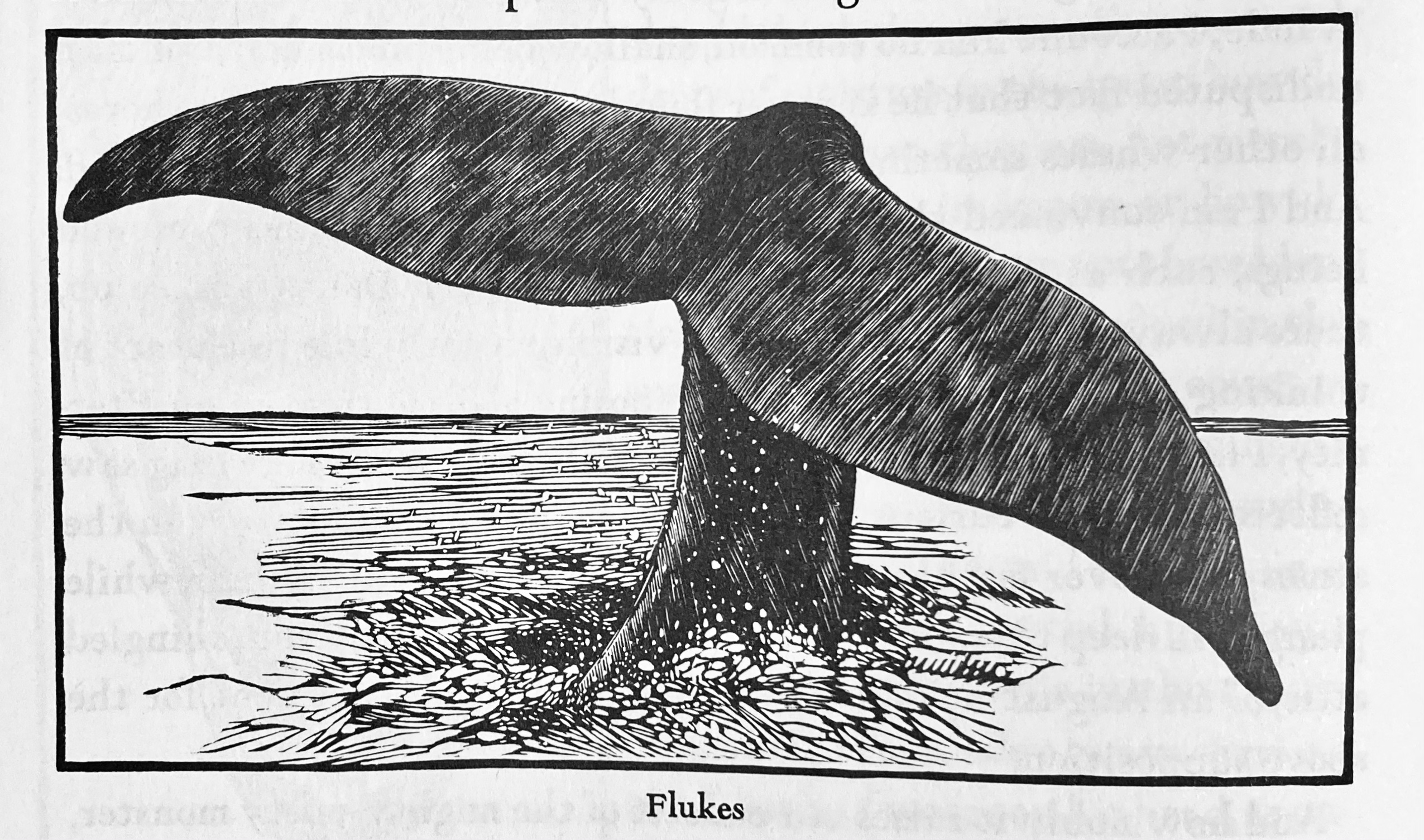
Other poets have warbled the praises of the soft eye of the antelope, and the lovely plumage of the bird that never alights; less celestial, I celebrate a tail.
This chapter sees Ishmael again playing scientist, but also aesthete. His first problem is to figure out just where, exactly, the tail of the whale begins. (In Ch. 90, “Heads or Tails,” he will concede that, in the whale, like the apple, “there is no intermediate remainder” between head or tail—the part that is not head is tail and the part that is not tail is head.)
VI. (Ishmael is more concerned, ultimately, with the power of the tail—and I don’t think Melville is above some punning symbolism here. We are a’whaling and wailing, and tailing and telling tales.)
VII. Every-horny Ishmael is horny (natch) for the whale tail:
Real strength never impairs beauty or harmony, but it often bestows it; and in everything imposingly beautiful, strength has much to do with the magic. Take away the tied tendons that all over seem bursting from the marble in the carved Hercules, and its charm would be gone. As devout Eckerman lifted the linen sheet from the naked corpse of Goethe, he was overwhelmed with the massive chest of the man, that seemed as a Roman triumphal arch. When Angelo paints even God the Father in human form, mark what robustness is there. And whatever they may reveal of the divine love in the Son, the soft, curled, hermaphroditical Italian pictures, in which his idea has been most successfully embodied; these pictures, so destitute as they are of all brawniness, hint nothing of any power, but the mere negative, feminine one of submission and endurance, which on all hands it is conceded, form the peculiar practical virtues of his teachings.
Our boy Ish might be a bit hot and bothered for Michelangelo’s Sistine God!
In this long chapter, the crew of a German whaler called the Jungfrau (virgin), hail The Pequod. The Jungfrau’s captain Derick De Deer begs some whale oil from the Nantucket ship, and Ishmael notes the irony, although he also notes that “what in the Fishery is technically called a clean [ship] (that is, an empty one), [is] well deserving the name of Jungfrau or the Virgin.”
Just as The Pequod shares some oil for Captain De Deer’s lamp, a pod of whales is sighted, and both ships lower boats, entering into competition to lance the largest and slowest of the whales, who swims “many fathoms in the rear…a huge, humped old bull [who] seemed afflicted with the jaundice, or some other infirmity.”
Ishmael notes that it’s possible that this old whale is an outsider to the pod: “Whether this whale belonged to the pod in advance, seemed questionable; for it is not customary for such venerable leviathans to be at all social. Nevertheless, he stuck to their wake…” Stubb points out that the old whale has “lost his tiller,” and the crew soon spot the missing limb.
…the cause of his devious wake in the unnatural stump of his starboard fin. Whether he had lost that fin in battle, or had been born without it, it were hard to say.
We have here another double for mad Ahab.
III. The race between the two crews carries out in a mix of comedy and pathos. The mates of The Pequod, Stubb and Flask, provide comic bravado as they encourage their boats to row harder (“Don’t ye love sperm? There goes three thousand dollars, men!—a bank!—a whole bank!” yaps Flask).
IV. First mate Starbuck and Ishmael offer more empathy and respect for the aged whale. Consider this portrait Ishmael paints:
As the boats now more closely surrounded him, the whole upper part of his form, with much of it that is ordinarily submerged, was plainly revealed. His eyes, or rather the places where his eyes had been, were beheld. As strange misgrown masses gather in the knot-holes of the noblest oaks when prostrate, so from the points which the whale’s eyes had once occupied, now protruded blind bulbs, horribly pitiable to see. But pity there was none. For all his old age, and his one arm, and his blind eyes, he must die the death and be murdered, in order to light the gay bridals and other merry-makings of men, and also to illuminate the solemn churches that preach unconditional inoffensiveness by all to all.
Ishmael’s final sentence here doubly damns aesthetics and religion, suggesting that the “merry-makings of men” are underwritten in blood and murder—no matter if we “preach unconditional inoffensiveness by all to all.”
V. When they dart the beast, its agitated body rolls around, revealing an infected wound:
Still rolling in his blood, at last he partially disclosed a strangely discoloured bunch or protuberance, the size of a bushel, low down on the flank.
“A nice spot,” cried Flask; “just let me prick him there once.”
“Avast!” cried Starbuck, “there’s no need of that!”
But humane Starbuck was too late. At the instant of the dart an ulcerous jet shot from this cruel wound, and goaded by it into more than sufferable anguish, the whale now spouting thick blood, with swift fury blindly darted at the craft, bespattering them and their glorying crews all over with showers of gore, capsizing Flask’s boat and marring the bows. It was his death stroke.
The bloody shower is more foreshadowing. Or maybe it’s just the everyday business of whaling.
VI. When the crew of The Pequod cut into the whale, they find “the entire length of a corroded harpoon…imbedded in his flesh, on the lower part of the bunch before described.” Ishmael notes that finding spears in whales is not wholly unusual, but then gives us a more dramatic detail:
But still more curious was the fact of a lance-head of stone being found in him, not far from the buried iron, the flesh perfectly firm about it. Who had darted that stone lance? And when? It might have been darted by some Nor’ West Indian long before America was discovered.
Ishmael here posits the whale’s primeval primacy.
VII. Ch. 81 converts its bloody business back into comedy at the end. The Jungfrau mistakes a fin-back whale for a sperm whale—but fin-backs are a “species of uncapturable whales, because of its incredible power of swimming.” Ishmael notes that “Derick and all his host were now in valiant chase of this unnearable brute.” He knows what Derick does not know: that the Jungfrau’s ” bold, hopeful chase” is actually a doomed, hopeless case. Ishmael ends with a wry punchline: “Oh! many are the Fin-Backs, and many are the Dericks, my friend.”
VIII. Ch. 82, “The Honor and the Glory of Whaling.”
In this chapter our boy Ish, as always, is horny for whaling.
IX. In another metatextual opening, Ish begins by calling attention to his discursive narrative style: “There are some enterprises in which a careful disorderliness is the true method.” He then proceeds to chronicle the “many great demi-gods and heroes, prophets of all sort” who are part of the whaling fraternity (noting that he is “transported with the reflection” that he belongs, “though but subordinately,” to this grand company).
X. It strikes me now that Ch. 82 is another of Moby-Dick’s stand-alone chapters, and that it would actually make a fine introduction to anyone wanting to dip their toe into its mass. Read it here.
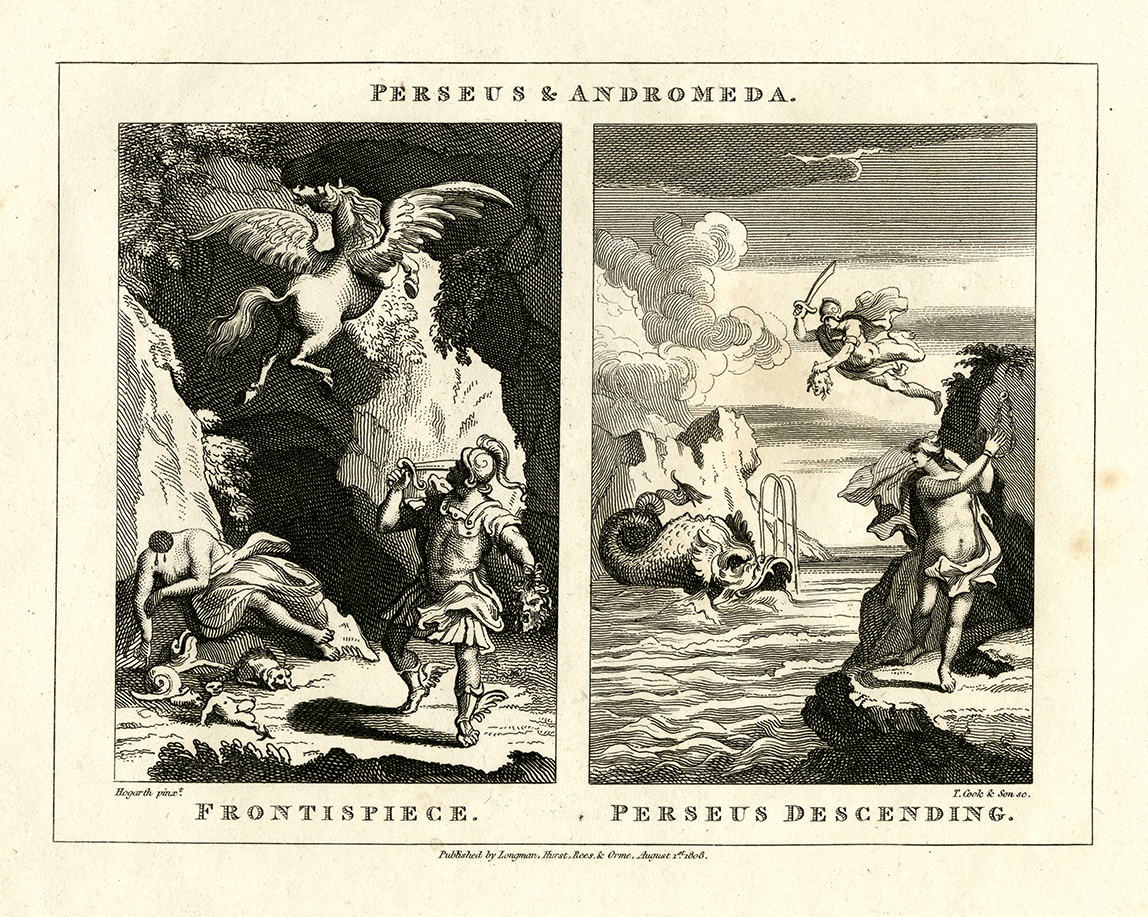
Perseus & Andromeda illustrations by William Hogarth
XI. Anyway—
Ever-largehearted-and-often-bombastic Ishmael lards his chapter with every stripe of whalemen, including:
“The gallant Perseus, a son of Jupiter…the first whaleman…”
St. George of “that famous story of St. George and the Dragon; which dragon I maintain to have been a whale…”
Hercules, “that antique Crockett and Kit Carson—that brawny doer of rejoicing good deeds, [who] was swallowed down and thrown up by a whale…”
Jonah (natch)
and
“Vishnoo [who] became incarnate in a whale, and sounding down in him to the uttermost depths, rescued the sacred volumes.”
“Perseus, St. George, Hercules, Jonah, and Vishnoo! there’s a member-roll for you! What club but the whaleman’s can head off like that?” our jocular boy concludes jocularly.
XII. Ch. 83, “Jonah Historically Regarded.”
Way back in Ch. 9, “The Sermon,” Melville—via Ishmael, via Father Mapple—retold the biblical story of Jonah. Here, that story is squared against the knowledge of whalemen—and one dubious sailor in particular, a certain Sag-Harbor—who remain dubious of “this historical story of Jonah and the whale.” Ishmael points out though that “there were some sceptical Greeks and Romans, who, standing out from the orthodox pagans of their times, equally doubted the story of Hercules and the whale, and Arion and the dolphin; and yet their doubting those traditions did not make those traditions one whit the less facts, for all that.”
Ishmael tries to refute Sag-Harbor and the other Nantuckeers’ arguments against the veracity of Jonah’s voyage in the whale. Ish points out that “a German exegetist supposes that Jonah must have taken refuge in the floating body of a dead whale—even as the French soldiers in the Russian campaign turned their dead horses into tents, and crawled into them.” He also suggests that it’s possible “that when Jonah was thrown overboard from the Joppa ship, he straightway effected his escape to another vessel near by, some vessel with a whale for a figure-head…possibly called The Whale…”
Ultimately though, Ishmael is unable to scientifically explain how Jonah traveled from the coast of Joppa to Ninevah in just three days. He concludes then that, “this very idea of Jonah’s going to Nineveh via the Cape of Good Hope [is] a signal magnification of the general miracle.”










 Biblioklept