Helena — Stefan Zsaitsits

Helena, 2020 by Stefan Zsaitsits (b. 1981)

Suttree steals a police cruiser


Somnolent city, cold and dolorous in the rain, the lights bleeding in the streets. Cutting through the alley off Commerce he saw a man huddled among the trash and he knelt to see about him. The face came up and the eyes closed. An oiled mask in black against the bricks.

Suttree took him by one arm. Ab, he said.

Can you get me home? A voice from the void, dead and flat and divested of every vanity. Suttree raised up one of the great arms and got it across his shoulder and braced his feet to rise. Sweat stood on his forehead. Ab, he said. Come on.

He opened his eyes and looked about. Are they huntin me? he said.

I dont know. Come on.

He lurched to his feet and stood there reeling while Suttree steadied him by one arm. Their shadows cast by the lamp at the end of the alley fell long and narrow to darkness. As they tottered out of the mouth of the alley a prowlcar passed. Ab sagged, swung back and slammed against the building.

Goddamnit Ab. Straighten up now. Ab.

The cruiser had stopped and was backing slowly. The spotlight came on and sliced about and pinned them against the wall.

Go on, Youngblood.

No.

I aint goin.

You’ll be all right in a minute.

With them I aint goin. Go on.

No damnit. Ab. I’ll talk to them.

But the black had begun to come erect with a strength and grace contrived out of absolute nothingness and Suttree said: Ab, and the black said: Go on.

All right, said the officer. What’s this?

I’m just getting him home, said Suttree. He’s all right.

Is that so? He dont look so all right to me. What are you doin with him? He your daddy?

Fuck you, said Ab.

What?

There were two of them now. Suttree could hear the steady guttering of the cruiser’s exhaust in the empty street.

What? said the officer.

The black turned to Suttree. Go on now, he said. Go on while ye can.

Officer this man’s sick, said Suttree.

He’s goin to be sicker, said the cop. He gestured with his nightstick. Get his ass in there.

Bullshit on that, said the other one. Let me call the wagon. That’s that big son of a bitch …

Jones lurched free and swung round the corner of the alley at a dead run. The two cops tore past Suttree and disappeared after him. The flat slap of their shoes died down the alley in a series of diminishing reports and then there was only the rough drone of the idling cruiser at the curb. Suttree stepped to the car, eased himself beneath the wheel and shut the door. He sat there for a moment, then he engaged the gearbox and pulled away.

He drove to Gay Street and turned south and onto the bridge. The radio crackled and a voice said: Car Seven. He turned left at the end of the bridge, past the abandoned roller rink, a rotting wooden arena that leaned like an old silo. He went down Island Home Pike toward the river. The radio fizzled and crackled. Calling any car in area B. Area B. Come in.

We’ve got a report of some kind of disturbance at Commerce and Market.

Suttree drove along the lamplit street. There was no traffic. The lights at Rose’s came up along his left and the lights from the packing company. The radio said: Car Nine. Car Nine. Suttree turned off down an old ferry road, going slowly, the car rocking and bumping over the grou
nd, out across a field, the headlights picking up a pair of rabbits that froze like plaster lawn figures. The dead and lightly coiling back of the river moving beyond the grass. The sparsely lit silhouette of the city above. The headlights failed somewhere out over the water in a gauzy smear. He brought the car to a stop and shifted it into neutral and stepped out into the wet grass. He pulled the hoodlatch under the dash and walked to the front of the cruiser and raised the hood. He came back to the car and sat in the seat and removed his shoelace. He looked out at the river and the city. One of the rabbits began to lope slowly through the light ground mist toward the dark of the trees.

The radio popped. Wagner? What’s the story down there?

Suttree got out and walked around to the front of the car and bent into the motor compartment and pulled back the throttle linkage. The motor rose to a howl and he tied the linkage back with the shoelace, fastening it to the fuel line where it entered the pump. Live flame was licking from the end of the tailpipe. He climbed in and pushed the clutch to the floor and shifted the lever hard up into second in a squawk of gearteeth. The rabbits were both gone. He eased off the seat and stood with one foot on the ground and the other on the clutch. Then he leaped back and slapped the door shut.

For a moment it didnt move. The tires cried in the grass and smoking clods went rifling off through the dark. Then it settled slightly sideways, dished back again, and in a shower of mud and grass moved out across the field. It went low and fast, the headlights rigid and tilting. It tore across the field and ripped through the willows at the river’s edge and went planing out over the water in two great wings of spray that seemed pure white and fanned upward twenty feet into the air. When it came to rest it was far out in the river. The headlights began to wheel about downstream. Then they went out. For a while he could see the dark hump of it in the river and then it slowly subsided and was gone. He squatted in the damp grass and looked out. There was no sound anywhere along the river. After a while he rose and started home.


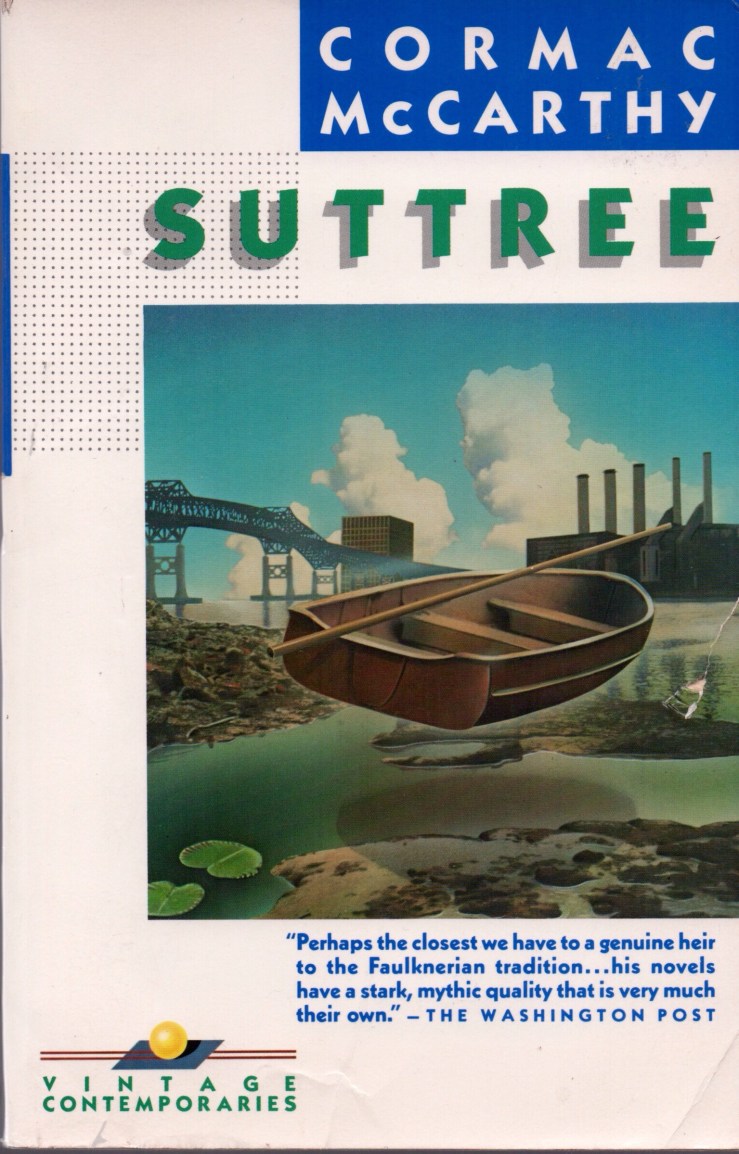
From Cormac McCarthy’s novel Suttree.

A review of Alasdair Gray’s novel Poor Things (and an anticipation of Yorgos Lanthimos’ film adaptation)

I. What I read

I read Alasdair Gray’s 1992 novel Poor Things. It was the second time I’d read the novel. I first read it close to ten years ago, after I read Gray’s superior but more flawed cult novel Lanark (1981).

II. What I remembered from that first reading

The basic contours of the plot; the postmodernist matryoshka-doll structure; the typography; the engravings; the art.

III. Why I reread it

Director Yorgos Lanthimos has adapted Poor Things into a film. The four films I have seen by him (Dogtooth, 2009; The Lobster, 2015; The Killing of a Sacred Deer, 2017; The Favourite, 2018) are formally daring, horrific, hallucinatory, and darkly funny. 

(The final two minutes of The Favourite are absolutely hypnotic.)

I had the good fortune to see all of these films cold, with no awareness of plot or structure, and I have extended this gift to myself again with Lanthimos’ adaptation of Gray’s novel: I have avoided watching any of the trailers for the film or reading any reviews or other bright clippings. I do know the identity of some of the actors involved, but do not know which characters they play. (I assume Emma Stone is Bella.)

Of course, in rereading the source novel, I have perhaps primed myself to a first viewing of Lanthimos’ Poor Things by setting Lanthimos’ vision against its literary and visual antecedent. This might be a way of saying I am not going into his film cold.

IV. About the plot of Alasdair Gray’s Poor Things

Poor Things riffs on Shelley’s Frankenstein. 

It is also a passionate defense for rationality, sexuality, feminism, and humanism. It is set primarily in the nineteenth century and in Glasgow, Scotland, but it is also set elsewhen and elsewhere.

There are three primary characters: Archibald McCandless, Bella Caledonia, and Godwin Baxter. They are depicted rather allegorically on Gray’s wonderful cover for his novel, Archie and Bella cuddled up to God:
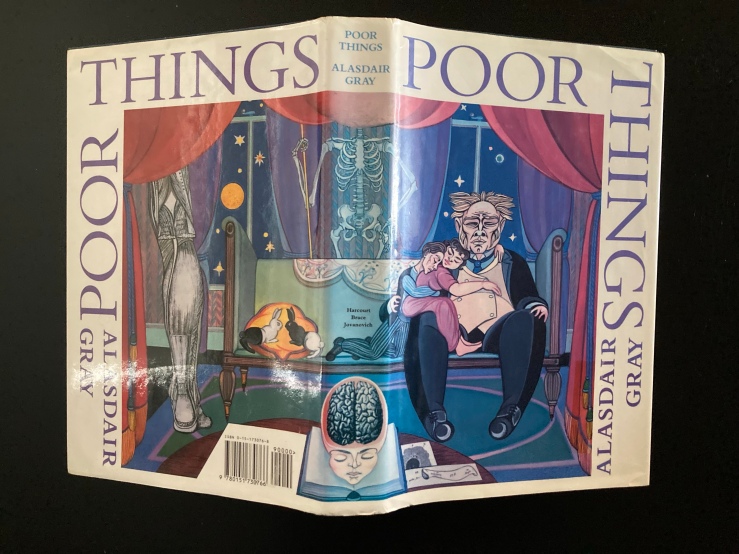
Godwin is not a mad scientist, but he does undertake some radical experiments.

Bella is the chiefest of those experiments. I will not spoil all the details. The narrative hints too that Godwin himself, surgeon son of a famous surgeon, might himself be an experimental creation.

Archibald McCandless, who narrates most of the novel, is of poorer stock than rich Godwin Baxter. A rural bastard with a chip on his shoulder, McCandless finds himself out of sync with his fellow medical students, rich boys all. But he finds a fellow to his liking in weirdo Godwin, through whom he meets Bella. He quickly falls deeply in love with the strange creature.

There are engagements, elopements, entanglements; there are dialectics, debates, debaucheries.
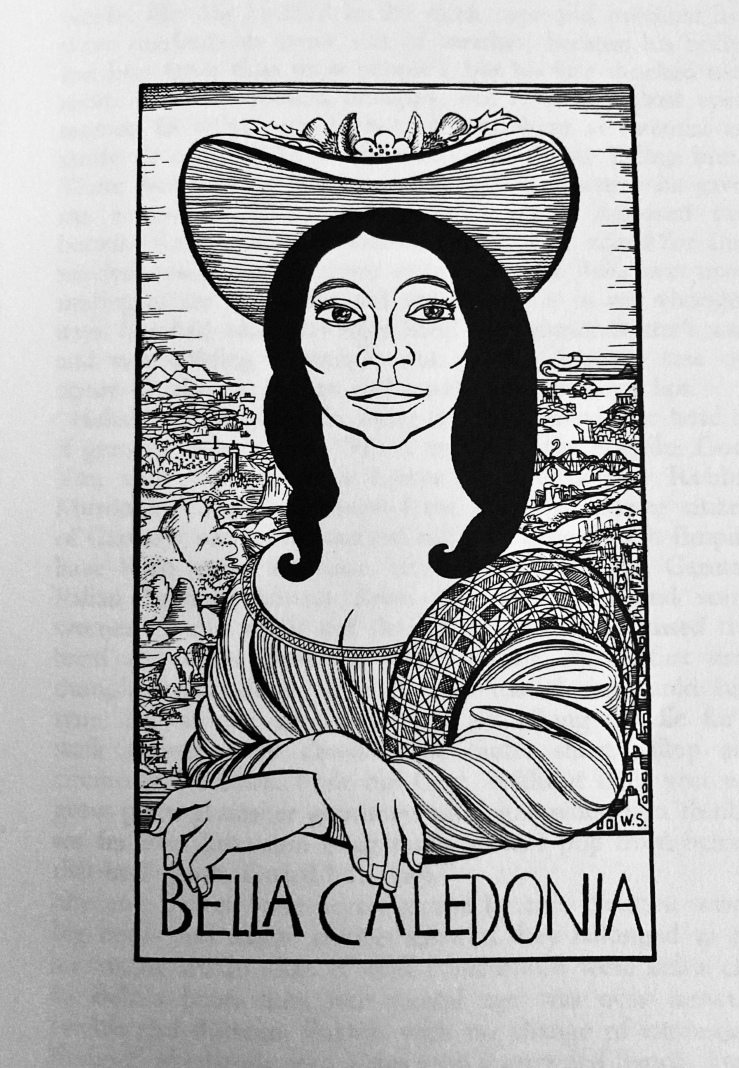
The rest of the plot of Poor Things should not be recounted in too much detail. It draws from Marys Shelley and Wollstonecraft; from Candide and Gray’s Anatomy, from 18th and 19th c. travelogues and Fabian Society tracts.

I should let Bella offer her own (which is to say Gray’s ironic metareflexive) dissection of the novel’s sources. In a letter that appends the narrative proper, she suggests that the “story positively stinks of all that was morbid in that most morbid of centuries, the nineteenth,” cribbing

…episodes and phrases to be found in Hogg’s Suicide’s Grave with additional ghouleries from the works of Mary Shelley and Edgar Allan Poe. What morbid Victorian fantasy has he NOT filched from? I find traces of The Coming Race, Dr. Jekyll and Mr. Hyde, Dracula, Trilby, Rider Haggard’s She, The Case-Book of Sherlock Holmes and, alas, Alice Through the Looking-Glass; a gloomier book than the sunlit Alice in Wonderland. He has even plagiarized work by two very dear friends: G. B. Shaw’s Pygmalion and the scientific romances of Herbert George Wells.

The “he” in the text above is Archibald McCandless (although it is also of course Alasdair Gray).

V. About the structure of Alasdair Gray’s Poor Things

The narrative structure of Gray’s Poor Things is indissoluble from the plot, images, and themes. I have used the word structure in the above; perhaps presentation of events would be better. Nevertheless.

The bulk of the novel consists of a “lost” vanity-press memoir entitled Episodes from the Early Life of Archibald McCandless M.D., Scottish Public Health Officer. This narrative includes the ostensible etchings of one “William Strang” (the illustrations are of course by Gray himself).

Inside McCandless’ Episodes are nested other episodes, purportedly by other authors. First, there’s the letter from Duncan Wedderburn, once a lustful rake, now reduced to lunacy after his entanglement with Bella (his riff on Scotland and The Book of Revelations is a wonderful moment of true crankery).
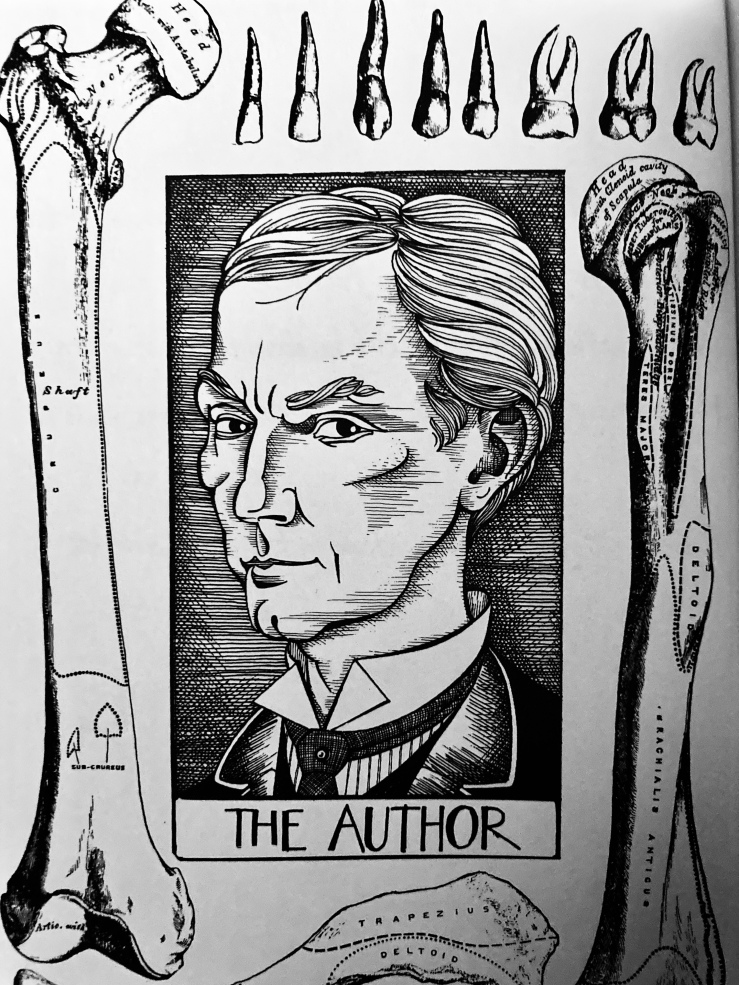
Then, McCandless’s narrative gives way for quite some time to the purported letters of Bella herself, off adventuring away from Father God and Betrothed Archie. These letters are the philosophical backbone of Poor Things; the moral meat of its plot. McCandless then regains his Episodes; it ends with wonderful gothic violence.

But the novel Poor Things continues. We have another letter from Bella, now much advanced in age, herself a famous doctor, having taken up the family trade. Her silly husband Archie is dead and she’s destroyed all but a single copy of his memoir Episodes—the single copy we’ve just read. Her letter is addressed to the possible future heirs who have failed to materialize, and who thus have been spared the scandal of their antecedent’s apparent lunacy. Bella’s letter seeks to undo the gothic fantasies that preceded it, puncturing McCandless’s swollen fancies with surgical rationality while at the same time reasserting the essential feminist qualities of that precursor text. The effect is somewhat deflationary—but the novel is not yet complete!

Gray’s Poor Things is framed by two bookends, both attributed to “Alasdair Gray.”

The initial frame is “Introduction,” in which Gray explains how a friend found McCandless’s Episodes in a pile of documents that were set to be destroyed, read it, and passed it along to Gray. Gray then explains how he edited together the volume we are about to read (he “unfortunately” managed to lose the original volume in the process), cribbing it together along with Bella’s letter and some other visual materials—an assemblage, a lovely literary Frankenstein’s creature.
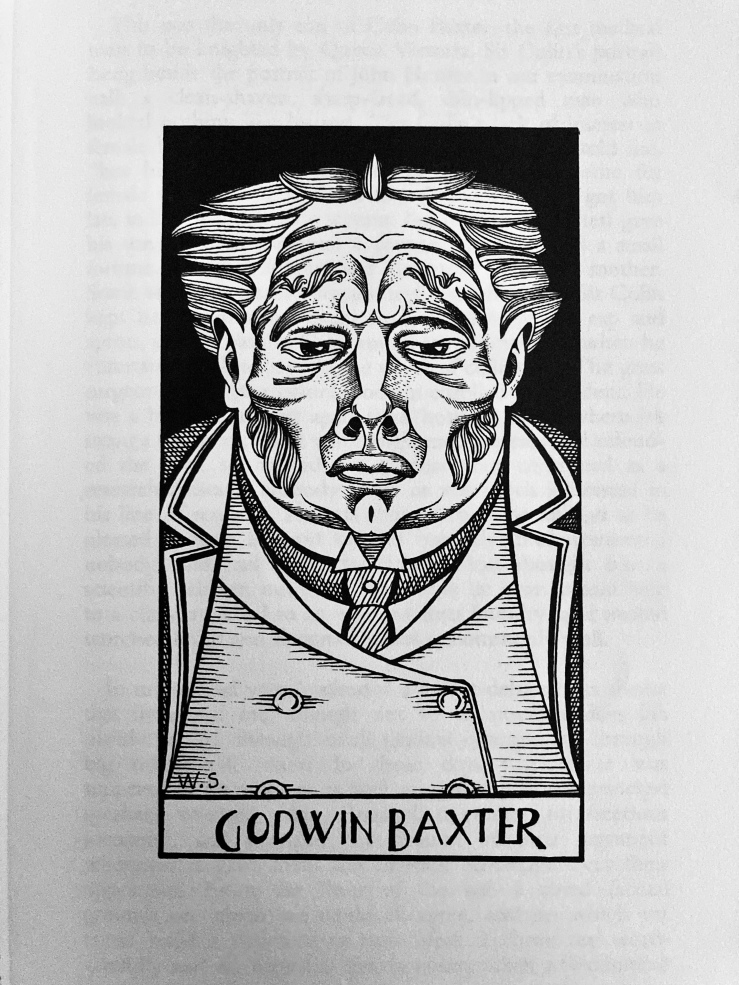
The final bookend is “Notes Critical and Historical.” In this section, Gray simultaneously bolsters and undermines all the narrative material that’s come before it. As one might expect from “historical” end notes, Gray (or “Gray”) lards this section with other narrative materials—anecdotes, citations, bibliographies, and interviews, among other apparent ephemera. And yet this conclusion is hardly ephemeral—indeed, the material Gray includes serves to again puncture the narratives that precede it.

Gray’s bookending gambit pays dividends in the last paragraph of the novel, by which I mean the last paragraph of “Notes Critical and Historical.” Again, I will not spoil the content here, but rather suggest that Gray has covered all his bets. The real fun in the novel is to immediately re-read the beginning: flip the frames around. Maybe fan the book about. Facts and fancies may fall out of it.

VI. An anticipation of Yorgos Lanthimos’ film adaptation of Poor Things

I have no strong emotional investment in the quality of a film adaptation of an Alasdair Gray novel. (I’m far more aesthetically invested in a possible video game adaptation of his cult classic Lanark.)

I don’t mean the previous unparantheticalized sentence to sound dismissive; to be very clear, I don’t think I’d object to any novel I loved being adapted to film or any other medium. The filmmaker might fuck up their own adaption but they could never truly affect the novel itself. At one point I think I’d have been aghast at someone’s attempt to adapt Gravity’s Rainbow or Blood Meridian; I’ve felt bad about film adaptations of Under the Volcano and Moby-Dick, no matter how grand their ambitions.

Now, I just don’t give a fuck. Go for it. Something interesting might happen, but you can’t hurt the text. At best, you’ll end up with a New Thing, which is what I expect and hope from Yorgos Lanthimos’ Poor Things. Who knows?

In rereading Gray’s Poor Things, I thought of what other filmmakers might do with the novel. Guillermo del Toro would fuss over its visuals too much at the expense of characterization. (Maybe Matteo Garrone could reign him in.) Jane Campion could likely channel its gothicism, its wit, its intellect. Peter Greenaway in his prime could have made a brilliant series of tableaux from Gray’s material. Gaspar Noé could explode a few pages of its essence over a few hours without ever getting to its core. Wes Anderson might have skillfully arranged its nested narratives, but perhaps too cleanly, too precisely even. Lars Von Trier might lean into the dirt. I suppose I could go on.

But really, while rereading Poor Things the thought that kept coming back to life was, Hey, how will Lanthimos adapt this to film?

VII. A possible answer to the above question

I hope he’s created his own beautiful monster.

Walton Ford’s illustration for Joy Williams’ story “The Last Generation”

Walton Ford’s illustration for Joy Williams’ story “The Last Generation.” The story appeared in the 1 April 1989 issue of Esquire.

Questions for the quaking ovoid of lamplight | Passage from (and a little riff on) Cormac McCarthy’s novel Suttree

A clear night over south Knoxville. The lights of the bridge bobbed in the river among the small and darkly cobbled isomers of distant constellations. Tilting back in his chair he framed questions for the quaking ovoid of lamplight on the ceiling to pose to him: Supposing there be any soul to listen and you died tonight?

They’d listen to my death.

No final word?

Last words are only words.

You can tell me, paradigm of your own sinister genesis construed by a flame in a glass bell.

I’d say I was not unhappy.

You have nothing.

It may be the last shall be first.

Do you believe that?

No.

What do you believe?

I believe that the last and the first suffer equally. Pari passu.

Equally?

It is not alone in the dark of death that all souls are one soul.

Of what would you repent?

Nothing.

Nothing?

One thing. I spoke with bitterness about my life and I said that I would take my own part against the slander of oblivion and against the monstrous facelessness of it and that I would stand a stone in the very void where all would read my name. Of that vanity I recant all.

From Cormac McCarthy’s novel Suttree.

I first read Suttree around thirteen years ago. I’m not sure how many times I’ve waded into it since then. At least two more times in full, plus another two times on audiobook, via Richard Poe’s marvelous narration. I checked the audiobook out from my library again (via Hoopla, which has about everything Audible has, I reckon) a few weeks ago, and fell asleep to Buddy Suttree’s various McAnally misadventures, often not falling asleep as quickly as I planned to. The novel is incredibly rich and fertile, filled with pockets that seem to reverberate stronger from the past viewed through the strange glass of having read McCarthy’s final novel The Passenger late last year, a capstone novel, a novel of insane sobriety that answers to Suttree’s oversoul drunkenness. The Passenger is perhaps Suttree’s secret sequel. Poe’s Suttree narration dipped into my daytime hours—drives and chores, and then just listening and doing nothing else. I forgot so many things: How fucking funny the novel is (I knew this but forgot it, remembering all its bumbling and baffling tragedies); all the shenanigans Suttree and his boys get into (he, I suspect the deferred narrator of his own manic enterprises, always allows himself a measure of impartiality as a witness). I forgot how many of Suttree’s McAnally pals die. I forgot how sad the novel is. Anyway. I was finishing up some domestic chore—let’s call it squeezing the late fall lemons from the lemon tree into a concentrate to freeze, we’ve given all we can away, and they’ll spoil otherwise; or maybe I was finishing kneading a loaf of bread; or maybe something mundane as folding towels and rags hot from the dryer—anyway, I was finishing some or other chore when this passage floated through my ears, caught a bit of purchase, seemed worth sharing. Read Suttree!

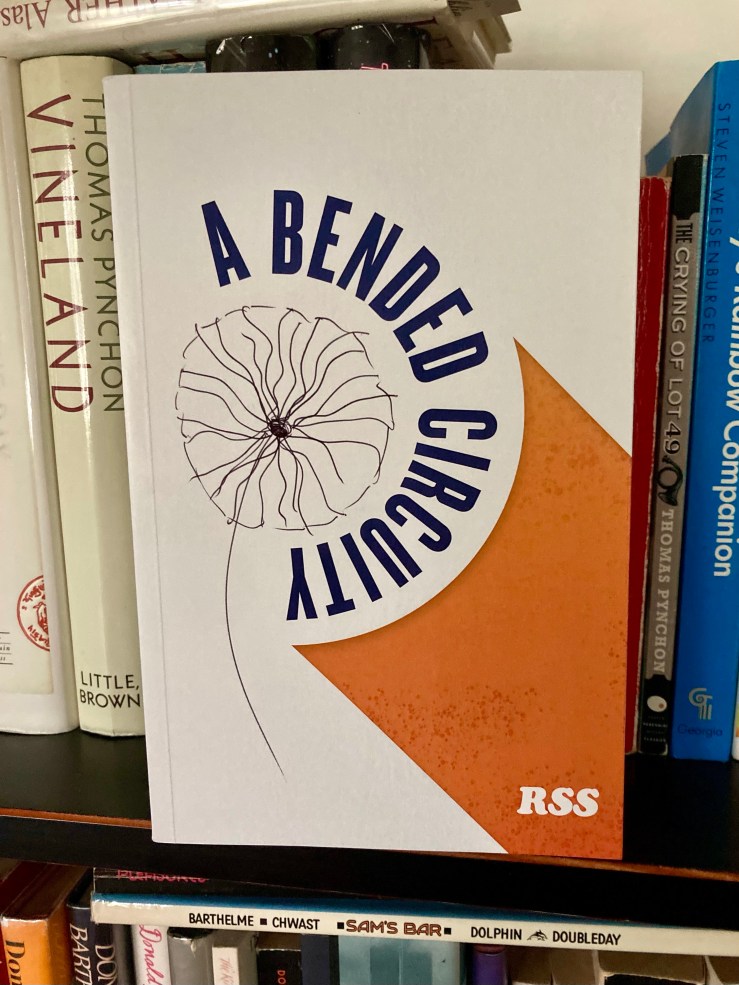
Robert S. Stickley’s A Bended Circuity (Book acquired, 27 Nov. 2023)


After hearing some positive murmurs praising its erudite maximalism and general zaniness, I caved and bought a copy of Robert S. Stickley’s 2020 novel A Bended Circuity. My copy arrived with a ballpoint flower and the front page signed with a scrawled “R S S.” I can’t really find anything about Big Box Publishing, the purported publisher of this edition, but I do know that the copies of the European reprint at Corona Samizdat sold out pretty quickly. (They have a second printing under way).

Here is the copy from the back of my edition:

There are screams in the night. Interlopers are afoot, have taken hold. Wildfires are burning the countryside and the gentry are running for cover. Fortunes are at stake. The South will not sleep.

A Bended Circuity opens on a midsummer’s afternoon with preparations being made for a soirée at the glamorous Hobcaw Barony. But not all goes according to plan. We soon find Charleston abruptly aroused from her slumber by the playful first smites of an unknown enemy waging a heinous prank war.

Calling his confederates to arms, one Bradley Pinçnit — heir to Marigold Manor and writer for revived southern mouthpiece, The Mercury — afternoon with preparations being made for a soirée at the glamorous Hobcaw Barony. But not all goes according to plan. We soon find Charleston abruptly aroused from her slumber by the playful first smites of an unknown enemy waging a heinous prank war.

Calling his confederates to arms, one Bradley Pinçnit — heir to Marigold Manor and writer for revived southern mouthpiece, The Mercury – organizes and helms a “Junto of Condign Men” then drives them to action. Offsetting her husband’s violent movement is Gabuirdine Lee, a housewife struggling to find her voice as the din of war encompasses her.

Ciphered into everything — the new roadways, the scars of the people, the tracts torn through ravaged plantations — there emerges one clear symbol: The Red Radical. Following the hints offered up by this cryptic motif, an army is mustered and pointed toward north so as to seek justice for the pernicious acts being committed upon an old way of life. But the army will first have to get out of its own way if it is to stand a chance of making it out of the South.

Read the W.A.S.T.E. Mailing List review of A Bended Circuity if you like.


It Is December and Already Dark Forces Are Gathering

It Is December and Already Dark Forces Are Gathering — Glen Baxter