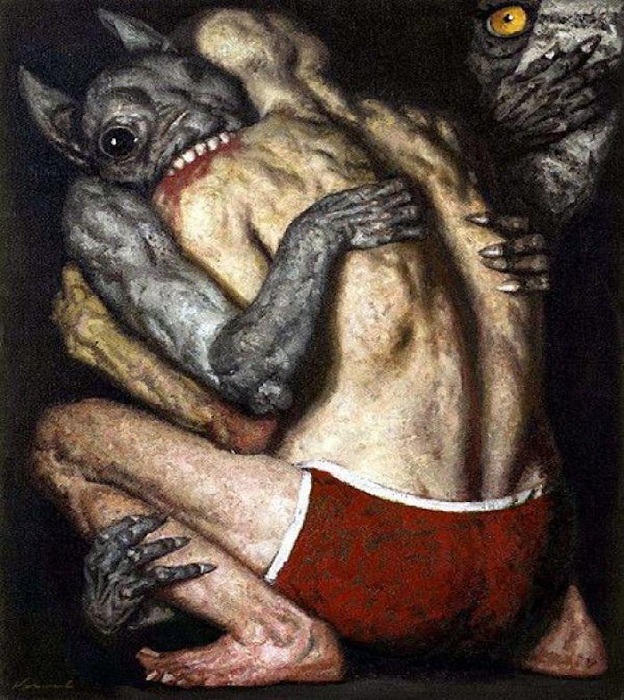
I ordered a copy of his most famous novel, The Woman in the Dunes (translation by E. Dale Saunders), on the recommendation of the bookseller who rang up Secret Rendezvous for me. (We chatted about Ballard and a few other writers and I recommended Martin Bax’s overlooked novel The Hospital Ship.) I picked it up today. The Vintage International edition I got includes wonderful illustrations by Machi Abe, like the one below (unfortunately the art director did not choose to adapt one for the cover):
I also got Beasts Head for Home (translation by Richard F. Calichman), an earlier less-celebrated novel.
I’d been wanting to read Fernanda Melchor’s Hurricane Season (translation by Sophie Hughes), so I ordered it as well. It’s been compared to both 2666 and Faulkner, so I have high expectations. (Flicking through it recalls Krasznahorkai or Sebald or Bernhard—big long paragraphless chunks.)
I also picked up Francie Schwartz’s memoir Body Count, somewhat at random, based on the title and the spine. It was shelved incorrectly (or maybe correctly?) in “General Fiction.” I opened it to see that it was a first edition, 1972, dedicated to Norman Mailer. Unless I’m wrong, it’s one of only two editions, the other being a British hardback copy. Flicking through it, the chapter titles, the mostly-written-in dialogue prose, and the general themes of sex drugs rocknroll interested me enough to look it up while I was in the store. The first google hit was for an Amazon listing pricing the book at over a thousand dollars, so I left with it. The main attraction for this book seems to be a brief affair Schwartz had with Paul McCartney. I read through some of those bits, and they seem juicy enough I guess.
I’ll read either the Melchor or Abe’s The Woman in the Dunes next. (I finished Carol Emshwiller’s novel Mister Boots this morning and loved it. Not sure if I’ll ever get my shit together enough to write a real review again though. Peace.)
Aleksandar Tišma’s Kapo is forthcoming from NYRB in translation by Richard Williams. NYRB’s blurb:
The Book of Blam, The Use of Man, Kapo: In these three unsparing novels the Yugoslav author Aleksandar Tišma anatomized the plight of those who survived the Second World War and the death camps, only to live on in a death-haunted world. Blam simply lucked out—and can hardly face himself in the mirror. By contrast, the teenage friends in The Use of Man are condemned to live on and on while enduring every affliction. Kapo is about Lamian, who made it through Auschwitz by serving his German masters, knowing that at any moment and for any reason his “special status” might be revoked.
But the war is over now. Auschwitz is in the past. Lamian has settled down in the Bosnian town of Banja Luka, where he has a respectable job as a superintendent in the railyard. Everything is normal enough. Then one day in the paper he comes on the name of Helena Lifka, a woman—like him a Yugoslav and a Jew—he raped in the camp. Not long after he sees her, aged and ungainly, Lamian is flooded with guilt and terror.
Kapo, like Tišma’s other great novels, is not simply a document or an act of witness. Tišma’s terrible gift is to see with an artist’s dispassionate clarity how fear, violence, guilt, and desire—whether for life, love, or simple understanding—are inextricably knotted together in the human breast.
Morning and evening Maids heard the goblins cry: “Come buy our orchard fruits, Come buy, come buy: Apples and quinces, Lemons and oranges, Plump unpeck’d cherries, Melons and raspberries, Bloom-down-cheek’d peaches, Swart-headed mulberries, Wild free-born cranberries, Crab-apples, dewberries, Pine-apples, blackberries, Apricots, strawberries;— All ripe together In summer weather,— Morns that pass by, Fair eves that fly; Come buy, come buy: Our grapes fresh from the vine, Pomegranates full and fine, Dates and sharp bullaces, Rare pears and greengages, Damsons and bilberries, Taste them and try: Currants and gooseberries, Bright-fire-like barberries, Figs to fill your mouth, Citrons from the South, Sweet to tongue and sound to eye; Come buy, come buy.”
Their discussion begins with Street Cop but expands much further, touching on postmodernism, realism (“Our Zeitgeist has left us mostly with shards of media as our reality,” says Spiegelman; “When people ask me, I say that I learned my realism from Kafka,” replies Coover”), time and space, the desire for happy endings, and more. But like I said, it begins with Street Cop:
ART SPIEGELMAN: So first: why a street cop?
ROBERT COOVER:Well, I wrote Street Cop in 2019. It emerged, like everything I write, from anxieties about the present. I had written about private eyes, but the dumb street cop was something new. I liked the idea of a guy who would be technologically inept. It’s about a bumbler who began his career as a crook and drug dealer, before accidentally becoming a cop who stumbles his way through a techno-city where the landscape changes daily thanks to 3D printing—blurring past, present and future. His job is to convict suspects rather than solve crimes, but all he wants, really, is to return to the old part of town, a seamy noir-like zone where his urges, and their many flaws, are permissible.
AS:When I first read and signed on to illustrate your story early in 2020’s quarantine, I was grateful to dive into a Dystopia Next Door and escape the one that surrounded us even in the bucolic bunker in the woods we’d retreated to from NYC. Choking on an overdose of toxic news, and compulsively “doom-scrolling”—I really love that phrase—I found the Covid-free air of Street Cop breathable because at least it didn’t have the twin viruses of the Covid pandemic and Trump directly confronting me. Still, the very first picture I drew had Covids in it—it was inevitable that they found their way into the prescient present of the story.
Small Beer Press had a warehouse sale last month, so I ordered two by the late avant-garde sci-fi writer Carol Emshwiller. I ordered Carmen Dog, which is what I take to be her most lauded novel, based on this blurb from Ursula Le Guin:
Carol is the most unappreciated great writer we’ve got. Carmen Dog ought to be a classic in the colleges by now . . . It’s so funny, and it’s so keen.
The pub’s blurb:
The debut title in our Peapod Classics line, Carol Emshwiller’s genre-jumping debut novel is a dangerous, sharp-eyed look at men, women, and the world we live in.
Everything is changing: women are turning into animals, and animals are turning into women. Pooch, a golden setter, is turning into a beautiful woman–although she still has some of her canine traits: she just can’t shuck that loyalty thing–and her former owner has turned into a snapping turtle. When the turtle tries to take a bite of her own baby, Pooch snatches the baby and runs. Meanwhile, there’s a dangerous wolverine on the loose, men are desperately trying to figure out what’s going on, and Pooch discovers what she really wants: to sing Carmen.
I also ordered a story collection, Report to the Men’s Club. Small Beer’s blurb:
What if the world ended on your birthday — and no one came? What if your grandmother was a superhero? What if the orphan you were raising was a top-secret weapon, looked like Godzilla, and loved singing nursery rhymes? What if poet laureates fought to the death, in stadiums?
A day or two before they showed up, I found a copy of Emshwiller’s 2005 novel Mister Boots in the YA section of my local bookshop. I launched into it and I don’t think it necessarily reads as YA-as-genre, but it’s the kind of weird shit I would’ve loved to get a hold of as a sixteen year old. Blurb:
Bobby Lassiter has some important secrets—but it’s not as if anyone’s paying attention. It’s the middle of the Depression, and while Bobby’s mother and older sister knit all day to make money, Bobby explores the California desert around their home. That’s how Bobby finds Boots. He’s under their one half-dead tree, halfdead himself. Right away he’s a secret, too—a secret to be fed and clothed and taken care of, and even more of a secret because of what he can do. Sometimes Boots is a man. Sometimes he’s (really, truly) a horse. He and Bobby both know something about magic—and those who read this book will,
From The Minus Times #29, as republished in The Minus Times Collected.
I made as much of the mix I could—D.C.3’s second record The Good Hex isn’t streaming or even on YouTube. Here is David Berman’s “Nashville Mix” mixtape:
I remember Kitty saying we shared a deep longing for the consolation prize, laughing as we rinsed the stagecoach.
I remember the night we camped out and I heard her whisper “think of me as a place” from her sleeping bag with the centaur print.
I remember being in her father’s basement workshop when we picked up an unknown man sobbing over the shortwave radio
and the night we got so high we convinced ourselves that the road was a hologram projected by the headlight beams.
I remember how she would always get everyone to vote on what we should do next and the time she said “all water is classic water” and shyly turned her face away.
At volleyball games her parents sat in the bleachers like ambassadors from Indiana in all their midwestern schmaltz.
She was destroyed when they were busted for operating a private judicial system within U.S. borders.
Sometimes I’m awakened in the middle of the night by the clatter of a room service cart and I think back on Kitty.
Those summer evenings by the government lake, talking about the paradox of multiple Santas or how it felt to have your heart broken.
I still get a hollow feeling on Labor Day when the summer ends
and I remember how I would always refer to her boyfriends as what’s-his-face, which was wrong of me and I’d like to apologize to those guys right now, wherever they are:
Benedikt had arranged all the shelves in the storeroom a long time ago: you could see right away what was where. Father-in-law had Gogol right next to Chekhov–you could look for a hundred years and you’d never find it. Everything should have its own science, that is, its own system. So you don’t have to fuss around here and there to no good end, instead you can just go and find what you need.
Number eight wasn’t there. Well, maybe he made a mistake and put it in the wrong place … that happens … Here’s The Northern Herald, here’s The Herald of Europe, Russian Wealth, The Urals, Lights of the Urals, Beekeeping … no, not here … Banner, Literary Bashkortostan, New World … he’d read them, Turgenev, he’d read it, Yakub Kolas, read it, Mikhalkov, A Partisan’s Handbook, Petrarch, The Plague, The Plague of Domestic Animals: Fleas and Ticks, Popescu, Popka-the-Fool–Paint It Yourself, Popov, another Popov, Poptsov, The Iliad, Electric Current, he’d read it, Gone With the Wind, Russo-Japanese Poly-technical Dictionary, Sartakov, Sartre, Sholokhov: Humanistic Aspects, Sophocles, Sorting Consumer Refuse, Sovmorflot–60 Years, Stockard, Manufacture of Stockings and Socks, he’d read that one, that one and that one …
Chalk Farm, Chandrabkhangneshapkhandra Lal, vol. 18, Chaucer, John Cheever; The Black Prince, aha, a mistake, that didn’t go there, Chekhov, Chapchakhov, Chakhokhbili in Kar-sian, Chukh-Chukh: For Little People.
Chen-Chen: Tales of the Congo, Cherokee Customs, Chewing Gum Stories, Chingachguk the Giant Serpent, Chipmunks and Other Friendly Rodents, Chkalov, Chrysanthemums of Armenia Part V, Chukotka: A Demographic Review, Chukovsky, Chum– Dwelling of the Peoples of the Far North, Churchill: The Early Years, read it. Kafka, Kama River Steamboats, Kashas Derived from Whole Grain. Dial M for Murder, Murder in Mesopotamia, Murder on the Orient Express, Kirov’s Murder, Laudanum: The Poetic Experience, Lilliputians and Other Little People, Limonov, Lipchitz, Lipid-protein Tissue Metabolism … he’d read it all.
The Red and the Black, Baa Baa Black Sheep, The Blue and the Green, The Adventure of the Blue Carbuncle, The Blue Cup, Island of the Blue Dolphins, The Chocolate Prince, The Crimson Flower .. . that’s a good one … The Crimson Letter, Crimson Sails, Little Red Riding Hood, The Yellow Arrow, The Five Orange Pips, The White Steamboat, White Clothes, White Bim– Black Ear, T. H. White, The Woman in White, The Purple Island, The Black Tower, Black Sea Steamboats: Registry, this is where The Black Prince goes. Now …
The Vampire’s Embrace, The Dragon’s Embrace, The Foreigner’s Embrace, The Fatal Embrace, Passion’s Embrace, Fiery Embraces, The All-Consuming Flame of Passion … The Dagger’s Blow, The Poisoned Dagger, The Poisoned Hat, Poisoned Clothes, With Dagger and Poison, Poisonous Mushrooms of Central Russia, Golden-haired Poisoners, Arsenic and Old Lace, Death of a Salesman, Death Comes for the Archbishop, Death Comes at Midnight, Death Comes at Dawn, The Bloody Dawn. . .
Children of the Arbat, Vanya’s Children, Children of the Underground, Children of the Soviet Land, Kids in Cages, Children on Christ, The Boxcar Children, Nikita’s Childhood.
Marinina, Marinating and Pickling, Marine Artists, Marinetti –the Ideologist of Fascism, Mari-El Grammar: Uses of the Instrumental Case.
Klim Voroshilov, Klim Samgin, Ivan Klima, K. Li, Maximal Load in Concrete Construction: Calculations and Tables (dissertation).
Anais Nin, Nina Sadur, Nineveh: An Archeological Collection. Ninja in a Bloody Coat, Mutant Ninja Turtles Return, Papanin, Make Life from Whom?
Hamlet, Prince of Denmark, Tashkent–City of Bread, Bread –A Common Noun, Urengoi– The Land of Youth, Uruguay– An Ancient Land, Kustanai– The Steppe Country, Scabies–An Illness of Dirty Hands,.
Foot Hygiene on the Road, F. Leghold, Ardent Revolutionaries, The Barefoot Doctors, Flat Feet in Young Children, Claws: New Types, Shoe Polish Manufacture, Grow Up, Friend: What a Young Man Needs to Know about Wet Dreams, Hands Comrade!, Sewing Trousers, The Time of the Quadrupeds, Step Faster!, How the Millipede Made Porridge, Marinating Vegetables at Home, Faulkner, Fiji: Class Struggle, Fyodor’s Woe, Shakh-Reza-Pahlevi, Shakespeare, Shukshin.
Mumu, Nana, Shu-shu: Tales of Lenin, Gagarin: We Remember Yura, Tartar Women’s Costumes, Bubulina–A Popular Greek Heroine, Boborykin, Babaevsky, Chichibabin, Bibigon, Gogol, Dadaists Exhibition Catalogue, Kokoschka, Mimicry in Fish, Vivisection, Tiutiunnik, Chavchavadze, Lake Titicaca, Popocatepetl, Raising Chihuahuas, The Adventures of Tin Tin.
Afraid of guessing, Benedikt went through the treasures with shaking hands; he was no longer thinking about issue number eight. It’s not here, I’ll live. But book after book, journal after journal–he’d already seen this, read this, this, this, this, this … So what did this mean? Had he already read everything? Now what was he going to read? And tomorrow? A year from now?
His mouth went dry and his legs felt weak. He lifted the candle high; its bluish light parted the darkness and danced on the shelves along the books’ covers … maybe, up on the top …
Plato, Plotinus, Platonov, Plaiting and Knitting Jackets, Herman Plisetsky, Maya Plisetskaya, Plevna: A Guide, Playing with Death, Plaints and Songs of the Southern Slavs, Playboy. Plinths: A Guidebook, Planetary Thinking, Plan for Popular Development in the Fifth Five-year Plan. Plebeians of Ancient Rome. Plenary Sessions of the CPSU, The Horn of Plenty in Oil Painting, Pleurisy. Pliushka, Khriapa, and Their Merry Friends. Plying the Arctic Waters. The Pilgrims at Plymouth Rock. He’d read them all.
From The Slynx by Tatyana Tolstaya. English translation by Jamey Gambrell.