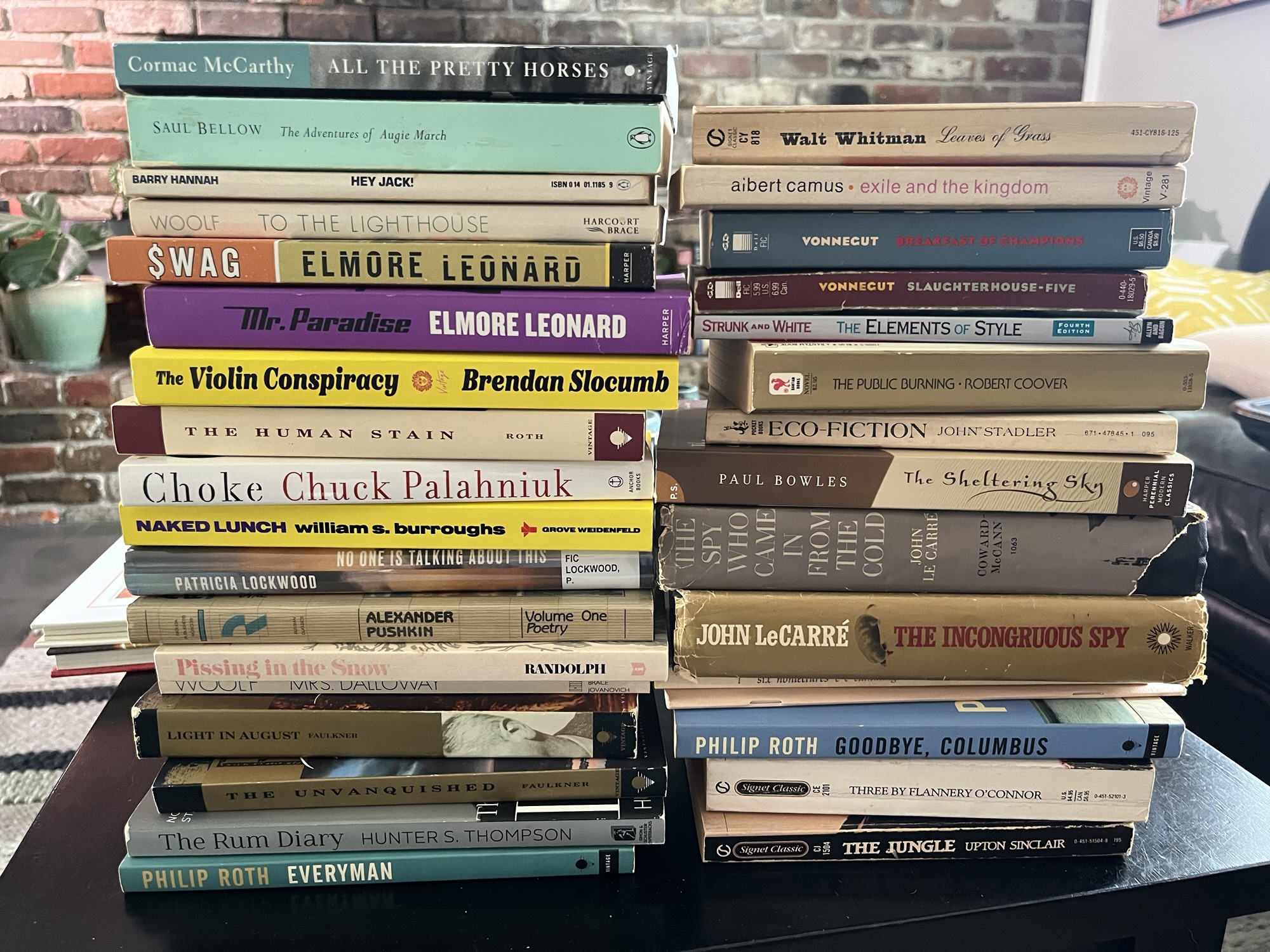
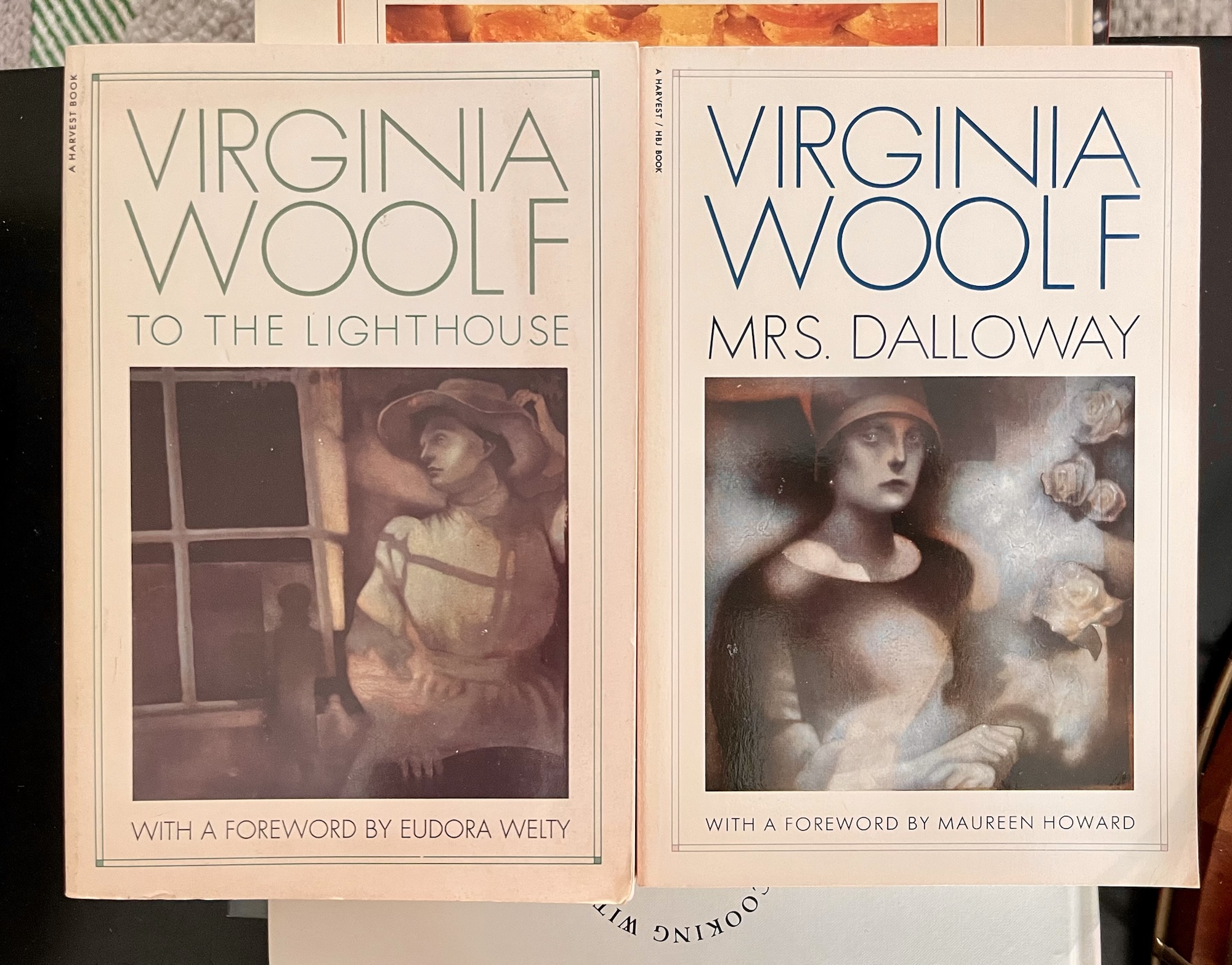
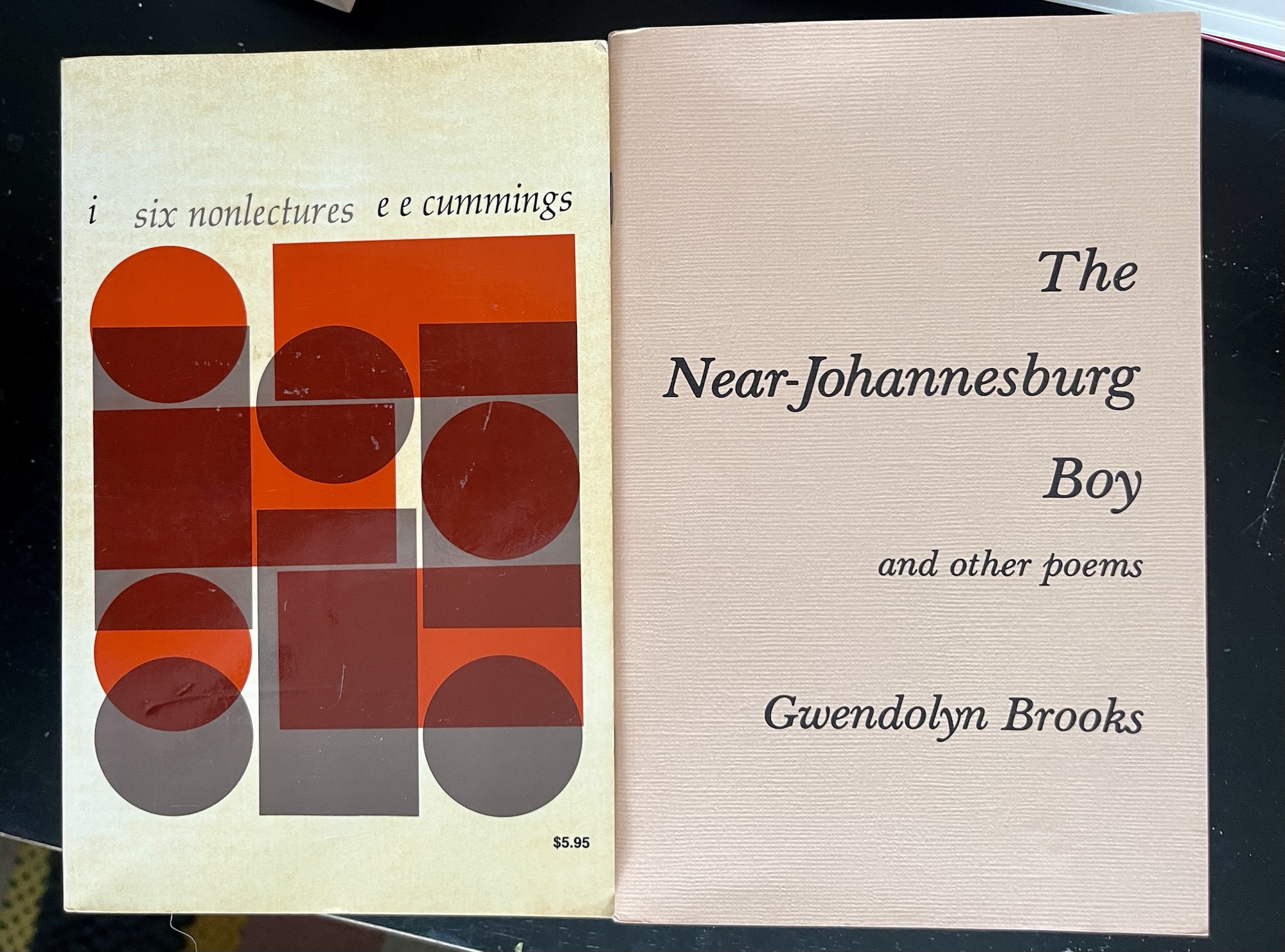
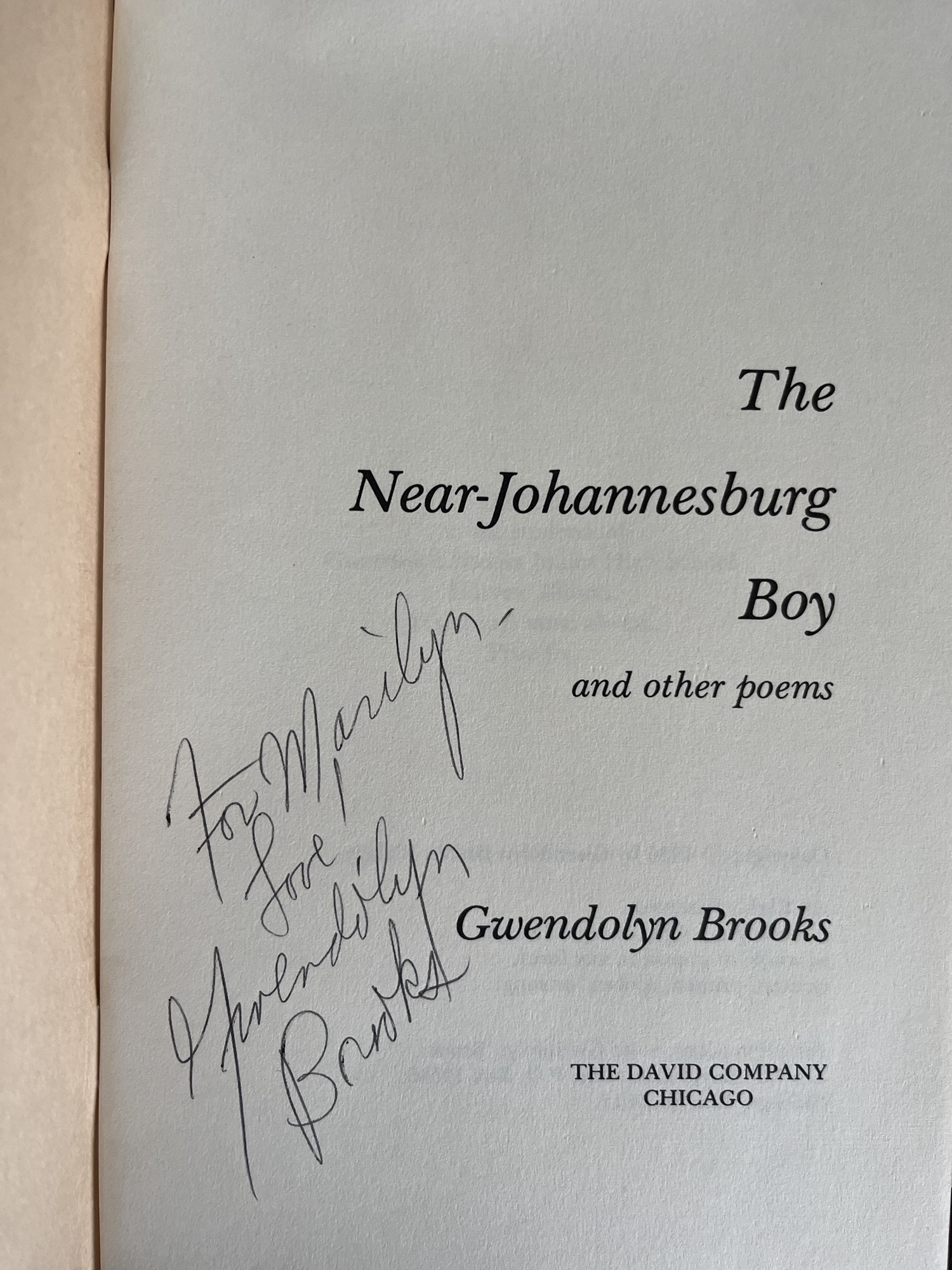
Blog about some recent reading, books acquired, a mini-review of The Hard Quartet live, etc.

I’ve been lucky over the last decade or so that my little college’s spring break almost always coincides with my children’s spring break. We aimed again this year at Georgia, spending a few days in a cabin outside the unfortunately named Whitesburg. Spring had not yet really sprung there yet. There was very little green about, but the hikes along and around Snake Creek through 20th century ruins were pleasant enough, and the kids enjoyed ziplining and aerial obstacle courses. In one of their sessions, I sneaked away to Harvey’s House of Books.

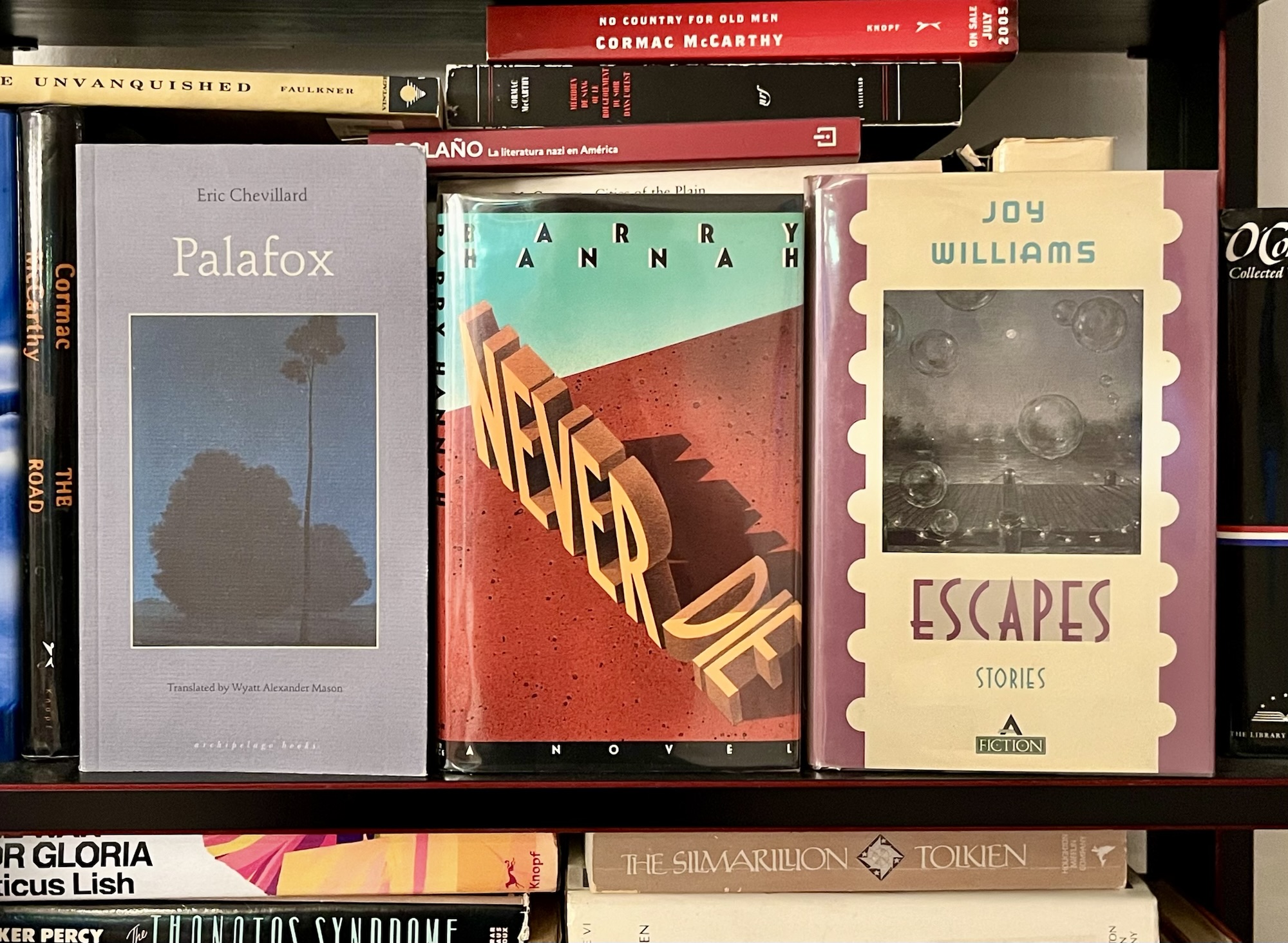
Harvey’s is, as far as I can tell, a Friends of the Library venture run by volunteers. I didn’t expect much, but the fiction section was surprisingly well populated. For around five bucks I picked up Charles Johnson’s Middle Passage, Mario Vargas Llosa’s The Feast of the Goat, and two by Cristina Peri Rossi — The Ship of Fools and Dostoevsky’s Last Night.

I was happy and surprised to find Rossi’s The Ship of Fools (in translation by Psiche Hughes); I’ve had it on a mental list for a few months now. I started it that night and it’s really odd–reminds me a bit of Ann Quin’s stuff, very odd but fun. More thoughts to come.

The Ship of Fools proved a nice antidote to the books I’d brought with me, Paul Valéry’s Monsieur Teste, (in translation by Charlotte Mandell) and a Dino Buzzati collection translated by Lawrence Venuti, called The Bewitched Bourgeois. I’ve enjoyed the Buzzati stories, but piled up there’s a sameness here that cries for interruption. I love Borgesian riffs on “Before the Law” as much as the next nerd, but too many in a row (six, in my case this week) feels, I dunno, like, I get it. But to be clear, I’ve really liked most of The Bewitched Bourgeois. I think it’s better parceled out though. Monsieur Teste on the other hand…look, I don’t know, maybe I misunderstood the book entirely, but I really kinda sorta hated it. Was I supposed to hate the central persona, Mister Teste, who aims for precision in language but comes off as a bore? At least it was short.

While I didn’t have the time in Atlanta to hit multiple bookstores (like in past trips), I made a point to hit up A Capella Books, a well stocked indie joint with a great used collection. I didn’t score anything there, although I was thrilled to see Anders Nilsen’s Tongues prominently featured in the graphic novel section. The book is great — I got a review copy right before we left. Some asshole named Edwin Turner landed a blurb on the back under his hero Charles Burns’s much shorter, pithier, better blurb:

Our spring break culminated Saturday night at the Variety Playhouse in Little Five Points, where we saw the so-called indie supergroup The Hard Quartet play all of their songs. I really dig The Hard Quartet’s self-titled debut, and dragged my wife and son along. (My daughter declined but played taxi driver.) Some interesting looking children were exiting the theater (really more of a club, let’s be honest) as we were entering, assuring the concerned security guard that they’d be right back, they just needed to get some Gatorade at a corner store. These were Sharp Pins, or The Sharp Pins, or Thee Sharp Pins, a Chicago power pop trio fronted by a kid named Kai Slater. They played a tight thirty minute set (including a Byrds cover); young Slater knows how to tuck away middle eight. The band’s youth invigorated the crowd of indie oldheads, and if Sharp Pins were occasionally a little out of tune or a step behind on the count, what came through was a true joy for the pop song. My son went bananas from them, saying something like, I know that they aren’t as good at playing their instruments as the Hard Quartet guys, but I liked their songs more. He bought their album and their t-shirt.

I liked The Hard Quartet’s live show very much — these are some old, or let’s just say older guys — look, pretty much everyone at the show was old, older, etc., except the Sharp Pins, my son, and some other teens there with their folks — these guys, the HQ, are veterans of disorder, coming up in club shows and theaters and big stages and big big stages and so on. They seemed very comfortable in the quasi-theater club. It was a joy to watch and listen to them.

They are, as I mentioned before, a so-called “supergroup.” Stephen Malkmus was the sideman for David Berman in The Silver Jews; Matt Sweeney, a popular YouTube influencer, was a member of another infamous supergroup — David Pajo’s short-lived side project Zwan; Emmett Kelly is a former gang member and circus performer; Jim White is the best drummer I’ve ever seen live (I have no stupid joke here; he is amazing and I listened to Ocean Songs every night for two years in a row when I was 22 and that’s not an exaggeration.)

The Hard Quartet are clearly a “real” band and not anyone’s side project. Sonics live were richer, fuller, more expansive than on disc. Emmett Kelly sang his new song, which, as far as I can tell, is the only update to their setlist in the past year — basically the record played straight through — but they seemed to never remember who was playing bass on which song when. No one used a pick, ever, as far as I could tell. Sweeney broke a string and then claimed he’d never broken a string on stage, ever. (Dubious.) Malkmus said he was thinking about “The Devil Went Down to Georgia,” but, what if it was, like, “The Devil Went Down on George.” Sweeney jokingly referred to Charlie Daniels as Chuck Daniels and at least two Atlanta audience members hissed foolish rejoinders. (Could’ve been those big beers, bald boys!) Jim White is both a gentle percussionist and a rawk gawd drummer. Malkmus’s, Kelly’s, and Sweeney’s singing in unison were some of the finest moments of the night, as in “Rio’s Song” and “Heel Highway.” The band’s weathered implementation of silence and space was also delicious and judicious in numbers like “Six Deaf Rats,” “Action for the Military Boys,” and “Hey.” Skronk and noodling were measured but never mannered. (Or the manners were there but they weren’t bad, unless they were meant to be bad.) Matt Sweeney’s left foot was the boss of the band, the bandleader, the clapper clopping down the count in a leopard print.

The Hard Quartet finished before eleven, having played all their songs. I think we all had a good time.

Jim White
Matt Sweeney
Stephen “SM” Malkmus
Emmett Kelly

Read “Report on Heaven and Hell,” a very short story by Silvina Ocampo

“Report on Heaven and Hell”

by

Silvina Ocampo

translation by Edith Grossman


Heaven and Hell, like the great auction galleries, have heaps of objects accumulated in their passageways, objects that will not surprise anyone because they are the same things usually found in the galleries of this world. But it is not enough to speak only of objects; there are also cities, towns, gardens, mountains, valleys, suns, moons, winds, seas, stars, reflections, temperatures, tastes, perfumes, sounds, for Eternity provides us with every kind of sensation and spectacle.

If it seems to you that the wind roars like a tiger and if in the glance of the heavenly dove you see the eyes of a hyena, if the well-dressed man who crosses the street is wearing shameless tatters, if the prize-winning rose offered to you is a faded rag as drab as a sparrow, if your wife’s face is dulled, raw, and angry-your eyes, and not God, have made them that way.

When you die the demons and the angels (they are equally intent and know that you are sleeping halfway between this world and some other one) will come to your bed in disguise and, stroking your head, will permit you to select the things you preferred during your lifetime. At first, in a kind of sample display, they will show you nutural objects. If they show you the sun, the moon, or the stars, you will see them in a painted crystal ball and you will think that the crystal sphere is the world; if they show you the sea or the mountains, you will see them in a stone and you will think that the stone is the sea and the mountains; if they show you a horse it will be a miniature, but you will think that the horse is real. The angels and the demons will distract your spirit with pictures of flowers, shining fruits, and candies; making you think that you are still a child, they will sit you in a kind of sedan chair, called the queen’s chair or the chair af gold, and they will carry you, their hands intertwined, down those corridors to the center of your life where your preferences dwell.

Be careful. If you select more things from Hell than from Heaven, you may go to Heaven; on the other hand, if you select more things from Heaven than from Hell, you run the risk of going to Hell since your love for celestial things will imply mere greed.

The laws of Heaven and Hell are capricious. Whether you go to one place or the other depends on the most insignificant detail. I know of people who have gone to Hell because of a broken key or a wicker cage and of others who have gone to Heaven because of a sheet of newspaper or a cup of milk.

The Temptation of Saint Anthony (Detail) — Pieter Breughel the Younger

Detail from The Temptation of Saint Anthony, с. 1625 by Pieter Breughel the Younger (1564- 1637/1638)

Posted in Art

Mass-market Mondays | Flann O’Brien’s Stories and Plays

Stories and Plays, collected 1974, Flann O’Brien. Penguin Books (1977). Cover design by Neil Stuart. 208 pages.

From “A Bash in the Tunnel”

James Joyce was an artist. He has said so himself. His was a case of Ars gratia Artist. He declared that he would pursue his artistic mission even if the penalty was as long as eternity itself. This seems to be an affirmation of belief in Hell, therefore of belief in Heaven and God.

“James Joyce was an artist. He said so himself.” | Flann O’Brien’s “A Bash in the Tunnel” (Or, “Was Joyce Mad?” by Hamlet Prince of Denmark)

“A Bash in the Tunnel”

by

Flann O’Brien


James Joyce was an artist. He has said so himself. His was a case of Ars gratia Artist. He declared that he would pursue his artistic mission even if the penalty was as long as eternity itself. This seems to be an affirmation of belief in Hell, therefore of belief in Heaven and God.

A better title of this piece might be: Was Joyce Mad? by Hamlet, Prince of Denmark. Yet there is a reason for the present title.

Some thinkers-all Irish, all Catholic, some unlay—have confessed to discerning a resemblance between Joyce and Satan. True, resemblances there are. Both had other names, the one Stephen Dedalus, the other Lucifer; the latter name, meaning ‘Maker of Light’, was to attract later the ironical gloss ‘Prince of Darkness’! Both started off very well under unfaultable teachers, both were very proud, both had a fall. But they differed on one big, critical issue. Satan never denied the existence of the Almighty; indeed he acknowledged it by challenging merely His primacy. Joyce said there was no God, proving this by uttering various blasphemies and obscenities and not being instantly struck dead.

A man once said to me that he hated blasphemy, but on purely rational grounds. If there is no God, he said, the thing is stupid and unnecessary. If there is, it’s dangerous. Anatole France says this better. He relates how, one morning, a notorious agnostic called on a friend who was a devout Catholic. The devout Catholic was drunk and began to pour forth appalling blasphemies. Pale and shocked, the agnostic rushed from the house. Later, a third party challenged him on this incident.

‘You have been saying for years that there is no God. Why then should you be so frightened at somebody else insulting this God who doesn’t exist?’ ‘I still say there is no God. But that fellow thinks there is. Suppose a thunderbolt was sent down to strike him dead. How did I know I wouldn’t get killed as well? Wasn’t I standing beside him?’ Another blasphemy, perhaps-doubting the Almighty’s aim. Yet it is still true that all true blasphemers must be believers.

What is the position of the artist in Ireland? Just after the editors had asked me to try to assemble material for this issue of Envoy, I went into the Scotch House in Dublin to drink a bottle of stout and do some solitary thinking. Before any considerable thought had formed itself, a man-—then a complete stranger-came, accompanied by his drink, and stood beside me: addressing me by name, he said he was surprised to see a man like myselt drinking in a pub. My pub radar screen showed up the word ‘TOUCHER’. I was instantly on my guard. Continue reading ““James Joyce was an artist. He said so himself.” | Flann O’Brien’s “A Bash in the Tunnel” (Or, “Was Joyce Mad?” by Hamlet Prince of Denmark)”

A run-on sentence on Gabriel García Márquez’s delirious novel The Autumn of the Patriarch

Gabriel García Márquez’s The Autumn of the Patriarch isn’t so much a novel as it is a delirium, a swamp fever, a sun-bleached hallucination stretched across centuries, a beast that coils and uncoils, bloated with its own rot, a thing that does not begin or end but only festers, looping back on itself in great, heaving tides of unpunctuated or undepunctuated or mispunctuated thought, García Márquez dragging us under, drowning us in the mind or minds of the titular dictator, a paranoid consciousness so swollen with its own power that it warps reality itself, a man who reigns forever and is always dying, whose past rewrites itself with every breath, whose power is infinite and yet always slipping, slipping, slipping through his fingers like the stolen sea, parceled off and shipped to Arizona, because why not, because what is truth if not what he declares it to be, because when you have lived for centuries, when your general is served up at a Thyestean feast, when your nation’s children are disappeared to an island, never to return, when the cattle are branded with your mark, when the very hour itself is subject to your whim, then nothing is real, nothing but the fear, the violence, the rape, the predation, the endless grinding machinery of power that must sustain itself, and so we cycle, we spiral, we convulse through six sections, six deaths, six endless iterations of his reign, six grotesque confirmations that absolute power is an ouroboros swallowing its own tail, devouring itself, erasing itself, until nothing is left but the silence of his ruin, the empty palace where his corpse will be found again and again, where his legacy is nothing but absence, and translator Gregory Rabassa—mad saint, linguistic necromancer—renders it all in English without breaking the spell, his translation a relentless incantation that doesn’t just mimic the novel’s crushing, hypnotic cadence but becomes it, suffocating, pressing, forcing you to inhabit the mind of this eternal, rotting god-tyrant, this cosmic mistake, this doomed and doom-dealing beast whose power, no matter how total, will crumble, will fade, will rot, will vanish into nothing, just like everything else.

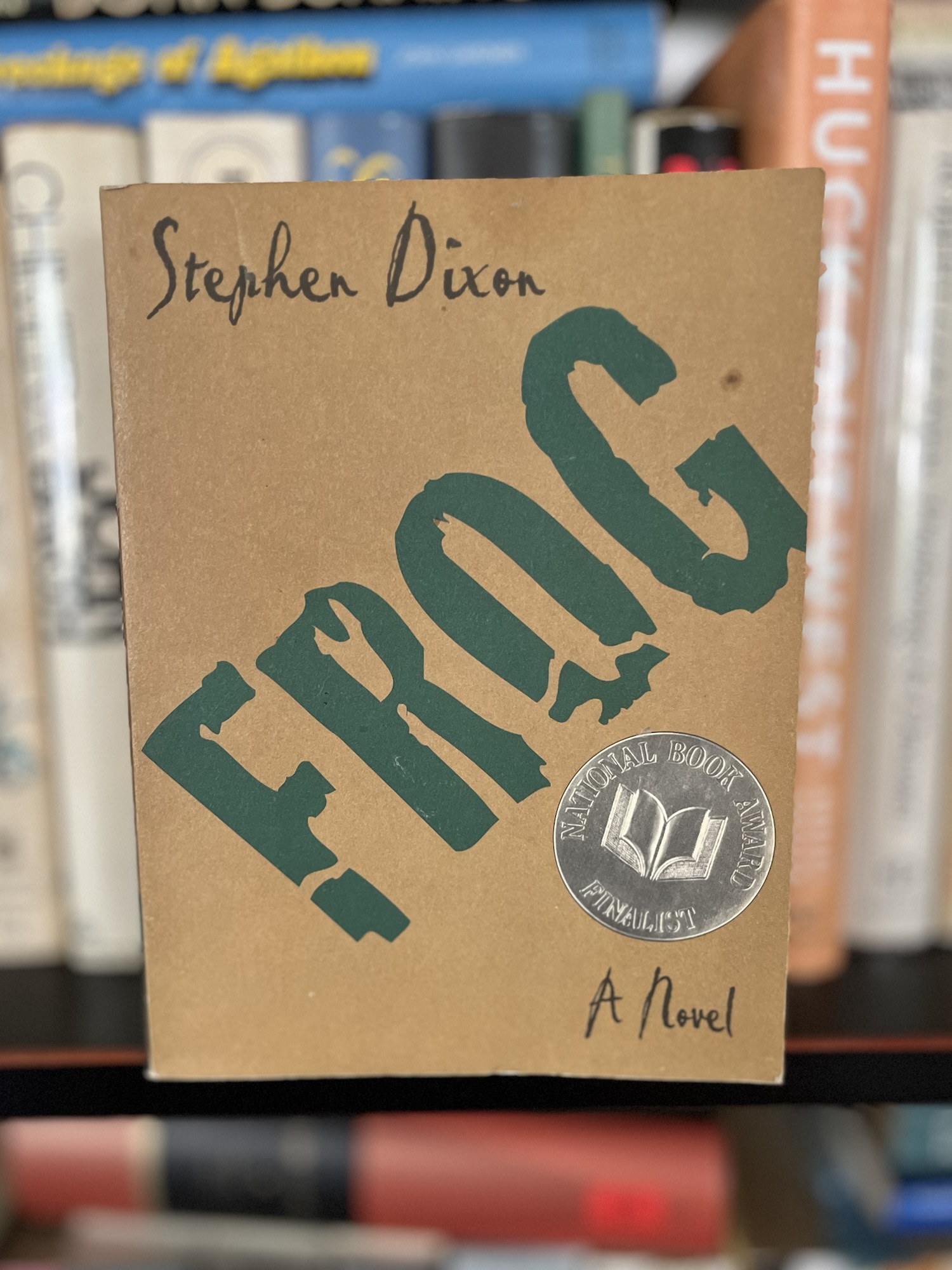
Stephen Dixon’s Frog (Book acquired, 7 March 2025 — thanks Tilford!)

A big thank you to one of my oldest friends, P. Tilford, for sending me a copy of Stephen Dixon’s Frog.

From “Frog in Prague”:

They stand still. “And Kafka?” Howard says.

“Kafka is not buried here.”

“No? Because I thought—what I mean is the lady at my hotel’s tourist information desk—the Intercontinental over there—and also the one who sold me the ticket now, both told me—”

The man’s shaking his head, looks at him straight-faced. It’s up to you, his look says, if you’re going to give me anything for this tour. I won’t ask. I won’t embarrass you if you don’t give me a crown. But I’m not going to stand here all day waiting for it.

“Here, I want to give you something for all this.” He looks in his wallet. Smallest is a fifty note. Even if he got three-to-one on the black market, it’s still too much. He feels the change in his pocket. Only small coins. This guy’s done this routine with plenty of people, that’s for sure, and he’d really like not to give him anything.

Margie Sarsfield’s Beta Vulgaris (Book (and some beet seeds) acquired, 2 Feb. 2025)

I got a review copy of Margie Sarsfield’s debut novel Beta Vulgaris the other week. It came with a little packet of beet seeds.

Publisher Norton’s blurb:

Elise and her boyfriend, Tom, set off for Minnesota, hoping the paycheck from the sugar beet harvest will cover the rent on their Brooklyn apartment. Amidst the grueling work and familiar anxieties about her finances, Elise starts noticing strange things: threatening phone calls, a mysterious rash, and snatches of an ominous voice coming from the beet pile.

When Tom and other coworkers begin to vanish, Elise is left alone to confront the weight of her past, the horrors of her uncertain future, and the menacing but enticing siren song of the beets. Biting, eerie, and confidently told, Beta Vulgaris harnesses a distinct voice and audacious premise to undermine straightforward narratives of class, trauma, consumption, and redemption.

I missed my window to plant beets here in north Florida.

Mass-market Monday | J.G. Ballard’s Hello America

Hello America, 1981, J.G. Ballard. Triad Grenada (1983). Cover illustration by Tim White. 236 pages.

Today’s mass-market Monday selection was inspired by last night’s rewatch of David Cronenberg’s 1975 film Shivers. Shivers’ first fortyish minutes play as one of the more persuasive Ballardian commitments to film—more Ballardian than Cronenberg’s Crash (2016) or Ben Wheatley’s High-Rise (2015). Indeed, Shivers is an aesthetic foster twin to Ballard’s novel High-Rise, born the same year. High-Rise is far superior to Hello America, but I think Hello America is probably better than it comes off in my short review from 2022:

You’d think a novel where President Manson wants to make America great Again would feel more prescient, but Ballard’s so in love here with the sparkle and pop of Pop Art America that he fails to attend to the dirt, grease, and grime that make the machine run. A fun novel, but its contemporary currency is squashed not so much by historical reality as the weight of Ballard’s oeuvre before it.

Megalomaniacs — Bridget Tichenor

The image is a surreal painting depicting a dreamlike landscape with multiple horses in a desert-like environment. In the foreground, two prominent horses are featured, one adorned with a vibrant, multicolored patchwork covering and the other draped in a translucent white fabric that flows behind it resembling a gown. The background reveals a series of undulating hills and mountains under a dramatically clouded sky. To the left, more horses can be seen at a distance, their forms melded into the earth-toned environment, enhancing the painting's mystical atmosphere. The composition is rich in texture and warm colors, with a range of browns, greens, and blues creating depth and movement.

Megalomaniacs, 1967 by Bridget Tichenor (1917-1990)

Vincenzo Latronico’s Perfection (Book acquired, late Feb. 2025)

Vincenzo Latronico’s Perfection, in translation by Sophie Hughes, is new from NYRB. Their blurb–

Anna and Tom, an expat couple, have fashioned a dream life for themselves in Berlin. They are young digital “creatives” exploring the excitements of the city, freelancers without too many constraints, who spend their free time cultivating house plants and their images online. At first, they reasonably deduce that they’ve turned their passion for aesthetics into a viable, even enviable career, but the years go by, and Anna and Tom grow bored. As their friends move back home or move on, so their own work and sex life—and the life of Berlin itself—begin to lose their luster. An attempt to put their politics into action fizzles in embarrassed self-doubt. Edging closer to forty, they try living as digital nomads only to discover that, wherever they go, “the brand of oat milk in their flat whites was the same.”

Perfection—Vincenzo Latronico’s first book to be translated into English—is a scathing novel about contemporary existence, a tale of two people gradually waking up to find themselves in various traps, wondering how it all came to be. Was it a lack of foresight, or were they just born too late?

“God to Hungry Child” — Langston Hughes

“God to Hungry Child”

by

Langston Hughes


Hungry child,
I didn’t make this world for you.
You didn’t buy any stock in my railroad.
You didn’t invest in my corporation.
Where are your shares in standard oil?
I made the world for the rich
And the will-be-rich
And the have-always-been-rich.
Not for you,
Hungry child.

Watch William Friedkin’s first film, the 1962 documentary The People vs. Paul Crump

I’ve been listening to William Friedkin read his 2013 memoir The Friedkin Connection on my daily commute and loving it so far. The first chapter, “Chicago,” details the making of his first film, a 1962 documentary called The People vs. Paul Crump. A chance meeting with a death row priest at a cocktail party leads Friedkin to make his documentary, despite having no real knowledge of how to make a film at all. (He even claims to have never have seen a documentary film at that point in his life.) From his memoir:

[Cinematographer Wilmer] Butler and I were editing the film each night as we got the dailies from the lab. Most of the time we worked at my apartment. My mother would make us lunch and dinner, and we’d work on weekends twelve or fifteen hours a day, with an old pair of rewinds and a 16 mm. viewer and splicer we had “liberated” from the WGN-TV newsroom. Splicing was done with glue, not clear cellophane tape, which came in several years later.

One evening, Ernie Lucas, a veteran TV director, happened to pass by on his way to pick up copy for the ten o’clock news. He was surprised to see us in a film editing bay in the newsroom, since we were involved exclusively with “live” telecasts. He expressed shock that we were editing our negative, and that we were not handling it carefully with white cotton gloves. “What are you guys doing?” he asked. We told him we were working on a short film for our own amusement. “But you’re cutting the negative; you’re not supposed to even touch it.”

“Why not?” We were confused.

Ernie was patient.

“Don’t you know that camera negative is never touched until you have a final edited work print?” he asked.

“What’s a work print?”

Ernie explained that a work print was made immediately after the negative was developed, and that it was this work print that you cut and recut, and only when you were finished was the negative conformed to the work print version. Neither did we know that the work print, negative, and 16 mm. sound track had to be edge-numbered simultaneously, so that picture and sound could be synchronized. Consecutive serial numbers were printed on the edges of these elements at intervals of a foot. Since we didn’t realize this, parts of our negative were scratched and torn, spliced and respliced, until we could belatedly apply edge-numbering. We had to “match” our synch-sound interviews by lip-reading, which took weeks, and we had no idea how to achieve a final print.

An end to the infamy of mules terrified by the edges of precipices as on their backs they carried grand pianos for the masked balls | A sentence from Gabriel García Márquez’s The Autumn of the Patriarch

He was right, because during our time there was no one who doubted the legitimacy of his history, or anyone who could have disclosed or denied it because we couldn’t even establish the identity of his body, there was no other nation except the one that had been made by him in his own image and likeness where space was changed and time corrected by the designs of his absolute will, reconstituted by him ever since the most uncertain origins of his memory as he wandered at random through that house of infamy where no happy person had ever slept, as he tossed cracked corn to the hens who pecked around his hammock and exasperated the servants with orders he pulled out of the air to bring me a lemonade with chopped ice which he had left within reach of his hand, take that chair away from over there and put it over there, and they should put it back where it had been in order to satisfy in that minute way the warm embers of his enormous addiction to giving orders, distracting the everyday pastimes of his power with the patient raking up of ephemeral instants from his remote childhood as he nodded sleepily under the ceiba tree in the courtyard, he would wake up suddenly when he managed to grasp a memory like a piece in a limitless jigsaw puzzle of the nation that lay before him, the great, chimerical, shoreless nation, a realm of mangrove swamps with slow rafts and precipices that had been there before his time when men were so bold that they hunted crocodiles with their hands by placing a stake in their mouths, like that, he would explain to us holding his forefinger against his palate, he told us that on one Good Friday he had heard the hullabaloo of the wind and the scurf smell of the wind and he saw the heavy clouds of locusts that muddied the noonday sky and went along scissoring off everything that stood in their path and left the world all sheared and the light in tatters as on the eve of creation, because he had seen that disaster, he had seen a string of headless roosters hanging by their feet and bleeding drop by drop from the eaves of a house with a broad and crumbling sidewalk where a woman had just died, barefoot he had left his mother’s hand and followed the ragged corpse they were carrying off to bury without a coffin on a cargo litter that was lashed by the blizzard of locusts, because that was what the nation was like then, we didn’t even have coffins for the dead, nothing, he had seen a man who had tried to hang himself with a rope that had already been used by another hanged man from a tree in a village square and the rotted rope broke before it was time and the poor man lay in his death throes on the square to the horror of the ladies coming out of mass, but he didn’t die, they beat him awake with sticks without bothering to find out who he was because in those days no one knew who was who if he wasn’t known in the church, they stuck his ankles between the planks of the stocks and left him there exposed to the elements along with other comrades in suffering because that was what the times of the Goths were like when God ruled more than the government, the evil times of the nation before he gave the order to chop down all trees in village squares to prevent the terrible spectacle of a Sunday hanged man, he had prohibited the use of public stocks, burial without a coffin, everything that might awaken in one’s memory the ignominious laws that existed before his power, he had built the railroad to the upland plains to put an end to the infamy of mules terrified by the edges of precipices as on their backs they carried grand pianos for the masked balls at the coffee plantations, for he had also seen the disaster of the thirty grand pianos destroyed in an abyss and of which they had spoken and written so much even outside the country although only he could give truthful testimony, he had gone to the window by chance at the precise moment in which the rear mule had slipped and had dragged the rest into the abyss, so that no one but he had heard the shriek of terror from the cliff-flung mule train and the endless chords of the pianos that fell with it playing by themselves in the void, hurtling toward the depths of a nation which at that time was like everything that had existed before him, vast and uncertain, to such an extreme that it was impossible to know whether it was night or day in the kind of eternal twilight of the hot steamy mists in the deep canyons where the pianos imported from Austria had broken up into fragments, he had seen that and many other things in that remote world although not even he himself could have been sure with no room for doubt whether they were his own memories or whether he had heard about them on his bad nights of fever during the wars or whether he might have seen them in prints in travel books over which he would linger in ecstasy for long hours during the dead doldrums of power, but none of that mattered, God damn it, they’ll see that with time it will be the truth, he would say, conscious that his real childhood was not that crust of uncertain recollections that he only remembered when the smoke from the cow chips arose and he forgot it forever except that he really had lived it during the calm waters of my only and legitimate wife Leticia Nazareno who would sit him down every afternoon between two and four o’clock at a school desk under the pansy bower to teach him how to read and write, she had put her novice’s tenacity into that heroic enterprise and he matched it with his terrifying old man’s patience, with the terrifying will of his limitless power, with all my heart, so that he would chant with all his soul the tuna in the tin the loony in the bin the neat nightcap, he chanted without hearing himself or without anyone’s hearing him amidst the uproar of his dead mother’s aroused birds that the Indian packs the ointment in the can, papa places the tobacco in his pipe, Cecilia sells seals seeds seats seams scenes sequins seaweed and receivers, Cecilia sells everything, he would laugh, repeating amidst the clamor of the cicadas the reading lesson that Leticia Nazareno chanted to the time of her novice’s metronome, until the limits of the world became saturated with the creatures of your voice and in his vast realm of dreariness there was no other truth but the exemplary truths of the primer, there was nothing but the moon in the mist, the ball and the banana, the bull of Don Eloy, Otilia’s bordered bathrobe, the rote reading lessons which he repeated at every moment and everywhere just like his portraits even in the presence of the treasury minister from Holland who lost the thread of an official visit when the gloomy old man raised the hand with the velvet glove on it in the shadows of his unfathomable power and interrupted the audience to invite him to sing with me my mama’s a mummer, Ismael spent six months on the isle, the lady ate a tomato, imitating with his forefinger the beat of the metronome and repeating from memory Tuesday’s lesson with a perfect diction but with such a bad sense of the occasion that the interview ended as he had wanted it to with the postponement of payment of the Dutch debts for a more propitious moment, for when there would be time, he decided, to the surprise of the lepers, the blind men, the cripples who rose up at dawn among the rosebushes and saw the shadowy old man who gave a silent blessing and chanted three times with high-mass chords I am the king and the law is my thing, he chanted, the seer has fear of beer, a lighthouse is a very high tower with a bright beam which guides sailors at night, he chanted, conscious that in the shadows of his senile happiness there was no time but that of Leticia Nazareno of my life in the shrimp stew of the suffocating gambols of siesta time, there were no other anxieties but those of being naked with you on the sweat-soaked mattress under the captive bat of an electric fan, there was no light but that of your buttocks, Leticia, nothing but your totemic teats, your flat feet, your ramus of rue as a remedy, the oppressive Januaries of the remote island of Antigua where you came into the world one early dawn of solitude that was furrowed by the burning breeze of rotted swamps, they had shut themselves up in the quarters for distinguished guests with the personal order that no one is to come any closer than twenty feet to that door because I’m going to be very busy learning to read and write, so no one interrupted him not even with the news general sir that the black vomit was wreaking havoc among the rural population while the rhythms of my heart got ahead of the metronome because of that invisible force of your wild-animal smell, chanting that the midget is dancing on just one foot, the mule goes to the mill, Otilia washes the tub, kow is spelled with a jackass k, he chanted, while Leticia Nazareno moved aside the herniated testicle to clean him up from the last love-making’s dinky-poo, she submerged him in the lustral waters of the pewter bathtub with lion’s paws and lathered him with Reuter soap, scrubbed him with washcloths, and rinsed him off with the water of boiled herbs as they sang in duet ginger gibber and gentleman are all spelled with a gee, she would daub the joints of his legs with cocoa butter to alleviate the rash from his truss, she would put boric acid powder on the moldy star of his asshole and whack his behind like a tender mother for your bad manners with the minister from Holland, plap, plap, as a penance she asked him to permit the return to the country of the communities of poor nuns so they could go back to taking care of orphan asylums and hospitals and other houses of charity, but he wrapped her in the gloomy aura of his implacable rancor, never in a million years, he sighed, there wasn’t a single power in this world or the other that could make him go against a decision taken by himself alone and aloud, she asked him during the asthmas of love at two in the afternoon that you grant me one thing, my life, only one thing, that the mission territory communities who work on the fringes of the whims of power might return, but he answered her during the anxieties of his urgent husband snorts never in a million years my love, I’d rather be dead than humiliated by that pack of long skirts who saddle Indians instead of mules and pass out beads of colored glass in exchange for gold nose rings and earrings, never in a million years, he protested, insensitive to the pleas of Leticia Nazareno of my misfortune who had crossed her legs to ask him for the restitution of the confessional schools expropriated by the government, the disentailment of property held in mortmain, the sugar mills, the churches turned into barracks, but he turned his face to the wall ready to renounce the insatiable torture of your slow cavernous love-making before I would let my arm be twisted in favor of those bandits of God who for centuries have fed on the liver of the nation, never in a million years, he decided, and yet they did come back general sir, they returned to the country through the narrowest slits, the communities of poor nuns in accordance with his confidential order that they disembark silently in secret coves, they were paid enormous indemnities, their expropriated holdings were restored with interest and the recent laws concerning civil marriage, divorce, lay education were repealed, everything he had decreed aloud during his rage at the comic carnival of the process of the declaration of sainthood for his mother Bendición Alvarado may God keep her in His holy kingdom, God damn it, but Leticia Nazareno was not satisfied with all that but asked for more, she asked him to put your ear to the lower part of my stomach so that you can hear the singing of the creature growing inside, because she had awakened in the middle of the night startled by that deep voice that was describing the aquatic paradise of your insides furrowed by mallow-soft sundowns and winds of pitch, that interior voice that spoke to her of the polyps on your kidneys, the soft steel of your intestines, the warm amber of your urine sleeping in its springs, and to her stomach he put the ear that was buzzing less for him and he heard the secret bubbling of the living creature of his mortal sin, a child of our obscene bellies who would be named Emanuel, which is the name by which other gods know God, and on his forehead he will have the white star of his illustrious origins and he will inherit his mother’s spirit of sacrifice and his father’s greatness and his own destiny of an invisible conductor, but he was to be the shame of heaven and the stigma of the nation because of his illicit nature as long as he refused to consecrate at the altar what he had vilified in bed for so many years of sacrilegious concubinage, and then he opened a way through the foam of the ancient bridal mosquito netting with that snort of a ship’s boiler coming from the depths of his terrible repressed rage shouting never in a million years, better dead than wed, dragging his great feet of a secret bridegroom through the salons of an alien house whose splendor of a different age had been restored after the long period of the shadows of official mourning, the crumbling holy-week crepe had been pulled from the cornices, there was sea light in the bedrooms, flowers on the balconies, martial music, and all of it in fulfillment of an order that he had not given but which had been an order of his without the slightest doubt general sir because it had the tranquil decision of his voice and the unappealable style of his authority, and he approved, agreed, and the shuttered churches opened again, and the cloisters and cemeteries were returned to their former congregations by another order of his which he had not given either but he approved, agreed, the old holy days of obligation had been restored as well as the practices of lent and in through the open balconies came the crowd’s hymns of jubilation that had previously been sung to exalt his glory as they knelt under the burning sun to celebrate the good news that God had been brought in on a ship general sir, really, they had brought Him on your orders, Leticia, by means of a bedroom law which she had promulgated in secret without consulting anybody and which he approved in public so that it would not appear to anyone’s eyes that he had lost the oracles of his authority, for you were the hidden power behind those endless processions which he watched in amazement through the windows of his bedroom as they reached a distance beyond that of the fanatical hordes of his mother Bendición Alvarado whose memory had been erased from the time of men, the tatters of her bridal dress and the starch of her bones had been scattered to the winds and in the crypt the stone with the upside-down letters had been turned over so that even the mention of her name as a birdwoman painter of orioles in repose would not endure till the end of time, and all of that by your orders, because you were the one who had ordered it so that no other woman’s memory would cast a shadow on your memory, Leticia Nazareno of my misfortune, bitch-daughter.


From Gabriel García Márquez’s The Autumn of the Patriarch in translation by Gregory Rabassa.

The Burial of the Sardine — Francisco Goya

The Burial of the Sardine, c. 1812–19 by Francisco Goya (1746-1828)

Posted in Art

Mardi Gras — André Derain

Mardi Gras, 1943 by André Derain (1880 – 1954).

Small Portrait — Kay Sage

Small Portrait, 1950 by Kay Sage (1898-1963)