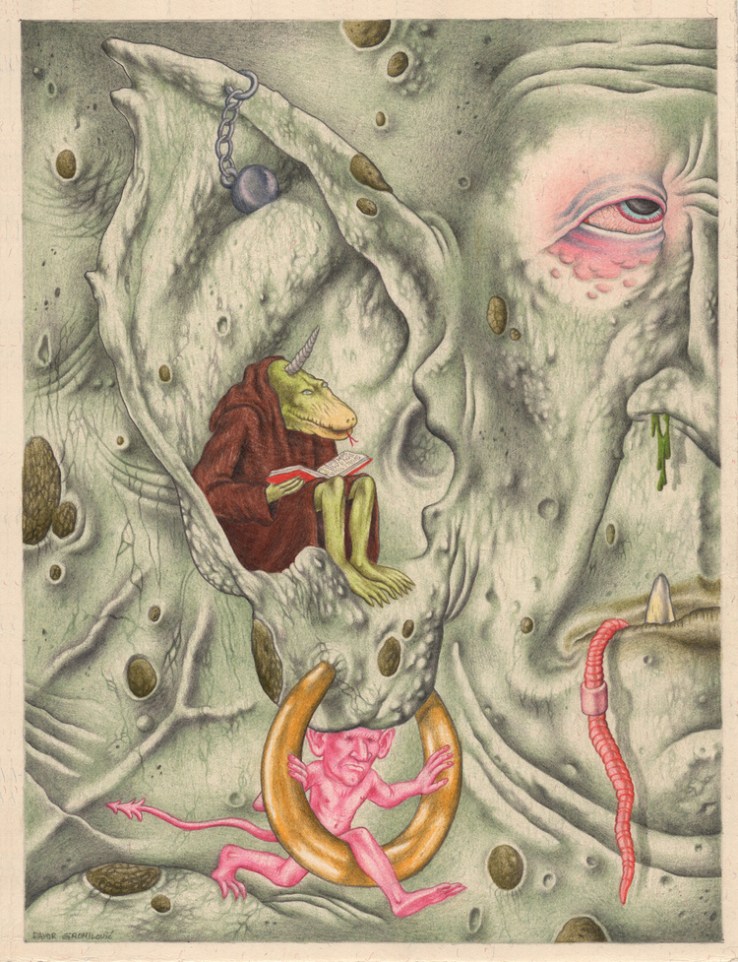
The Blind Reading Stories to Storyteller, 2018 by Davor Gromilovic (b. 1985)
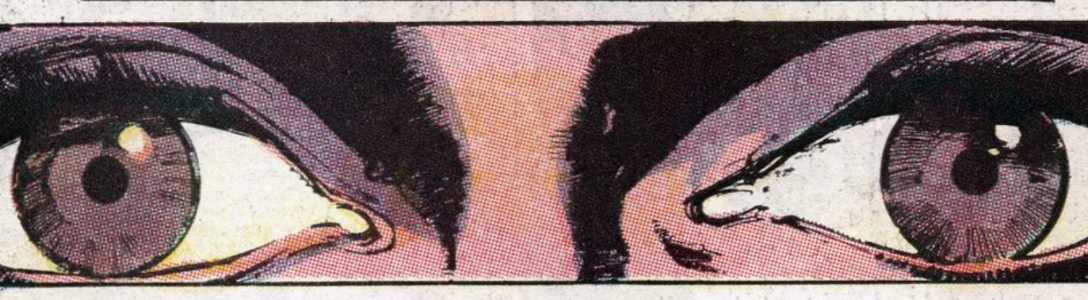
The Blind Reading Stories to Storyteller, 2018 by Davor Gromilovic (b. 1985)

Hidden Presence, 2014 by Alessandro Papetti (b. 1958)

Un signe, un cygne (A Sign, a Swan), 1978 by Mimi Parent (1924–2005)
“Human Moments in World War III”
A note about Vollmer. He no longer describes the earth as a library globe or a map that has come alive, as a cosmic eye staring into deep space. This last was his most ambitious fling at imagery. The war has changed the way he sees the earth. The earth is land and water, the dwelling place of mortal men, in elevated dictionary terms. He doesn’t see it any more (storm-spiralled, sea-bright, breathing heat and haze and colour) as an occasion for picturesque language, for easeful play or speculation.
At two hundred and twenty kilometres we see ship wakes and the larger airports. Icebergs, lightning bolts, sand-dunes. I point out lava flows and cold-core eddies. That silver ribbon off the Irish coast, I tell him, is an oil slick.
This is my third orbital mission, Vollmer’s first. He is an engineering genius, a communications and weapons genius, and maybe other kinds of genius as well. As mission specialist, I’m content to be in charge. (The word specialist, in the standard usage of Colorado Command, refers here to someone who does not specialize.) Our spacecraft is designed primarily to gather intelligence. The refinement of the quantum-burn technique enables us to make frequent adjustments of orbit without firing rockets every time. We swing out into high, wide trajectories, the whole earth as our psychic light, to inspect unmanned and possibly hostile satellites. We orbit tightly, snugly, take intimate looks at surface activities in untravelled places. The banning of nuclear weapons has made the world safe for war.
I try not to think big thoughts or submit to rambling abstractions. But the urge sometimes comes over me. Earth orbit puts men into philosophical temper. How can we help it? We see the planet complete, we have a privileged vista. In our attempts to be equal to the experience, we tend to meditate importantly on subjects like the human condition. It makes a man feel universal, floating over the continents, seeing the rim of the world, a line as clear as a compass arc, knowing it is just a turning of the bend to Atlantic twilight, to sediment plumes and kelp beds, an island chain glowing in the dusky sea.
I tell myself it is only scenery. I want to think of our life here as ordinary, as a housekeeping arrangement, an unlikely but workable setup caused by a housing shortage or spring floods in the valley.
Continue reading “Read “Human Moments in World War III,” a sci-fi story by Don DeLillo”
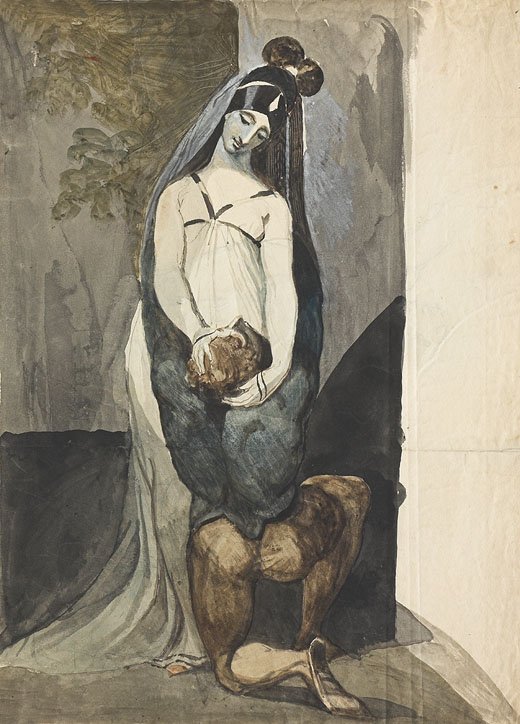
Siegfried and Kriemhild, 1807 by Henry Fuseli (1741–1825)
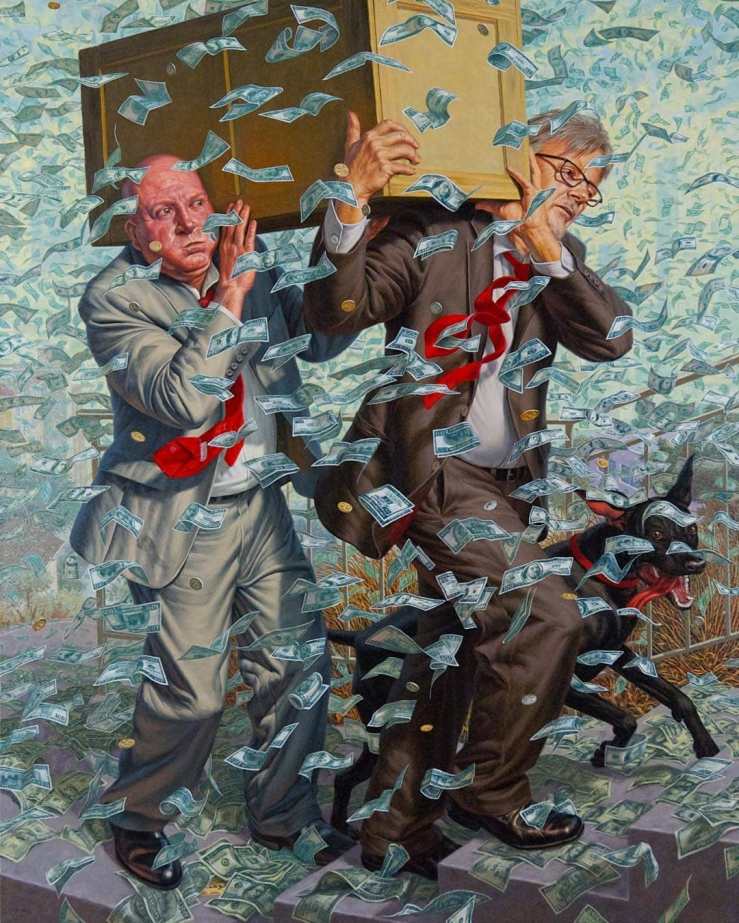
Good Luck, 2015 by F. Scott Hess (b. 1955)
July 10th.–A fishing excursion, last Saturday afternoon, eight or ten miles out in the harbor. A fine wind out, which died away towards evening, and finally became quite calm. We cooked our fish on a rock named “Satan,” about forty feet long and twenty broad, irregular in its shape, and of uneven surface, with pools of water here and there, left by the tide,–dark brown rock, or whitish; there was the excrement of sea-fowl scattered on it, and a few feathers. The water was deep around the rock, and swelling up and downward, waving the seaweed. We built two fires, which, as the dusk deepened, cast a red gleam over the rock and the waves, and made the sea, on the side away from the sunset, look dismal; but by and by up came the moon, red as a house afire, and, as it rose, it grew silvery bright, and threw a line of silver across the calm sea. Beneath the moon and the horizon, the commencement of its track of brightness, there was a cone of blackness, or of very black blue. It was after nine before we finished our supper, which we ate by firelight and moonshine, and then went aboard our decked boat again,–no safe achievement in our ticklish little dory. To those remaining in the boat, we had looked very picturesque around our fires, and on the rock above them,–our statues being apparently increased to the size of the sons of Anak. The tide, now coming up, gradually dashed over the fires we had left, and so the rock again became a desert. The wind had now entirely died away, leaving the sea smooth as glass, except a quiet swell, and we could only float along, as the tide bore us, almost imperceptibly. It was as beautiful a night as ever shone,–calm, warm, bright, the moon being at full. On one side of us was Marblehead light-house, on the other, Baker’s Island; and both, by the influence of the moonlight, had a silvery hue, unlike their ruddy beacon tinge in dark nights. They threw long reflections across the sea, like the moon. There we floated slowly with the tide till about midnight, and then, the tide turning, we fastened our vessel to a pole, which marked a rock, so as to prevent being carried back by the reflux. Some of the passengers turned in below; some stretched themselves on deck; some walked about, smoking cigars. I kept the deck all night. Once there was a little cat’s-paw of a breeze, whereupon we untied ourselves from the pole; but it almost immediately died away, and we were compelled to make fast again. At about two o’clock, up rose the morning-star, a round, red, fiery ball, very comparable to the moon at its rising, and, getting upward, it shone marvelously bright, and threw its long reflection into the sea, like the moon and the two light-houses. It was Venus, and the brightest star I ever beheld; it was in the northeast. The moon made but a very small circuit in the sky, though it shone all night. The aurora borealis shot upwards to the zenith, and between two and three o’clock the first streak of dawn appeared, stretching far along the edge of the eastern horizon,–a faint streak of light; then it gradually broadened and deepened, and became a rich saffron tint, with violet above, and then an ethereal and transparent blue. The saffron became intermixed with splendor, kindling and kindling, Baker’s Island lights being in the centre of the brightness, so that they were extinguished by it, or at least grew invisible. On the other side of the boat, the Marblehead light-house still threw out its silvery gleam, and the moon shone brightly too; and its light looked very singularly, mingling with the growing daylight. It was not like the moonshine, brightening as the evening twilight deepens; for now it threw its radiance over the landscape, the green and other tints of which were displayed by the daylight, whereas at evening all those tints are obscured. It looked like a milder sunshine,–a dreamy sunshine,–the sunshine of a world not quite so real and material as this. All night we had heard the Marblehead clocks telling the hour. Anon, up came the sun, without any bustle, but quietly, his antecedent splendors having gilded the sea for some time before. It had been cold towards morning, but now grew warm, and gradually burning hot in the sun. A breeze sprang up, but our first use of it was to get aground on Coney Island about five o’clock, where we lay till nine or thereabout, and then floated slowly up to the wharf. The roar of distant surf, the rolling of porpoises, the passing of shoals of fish, a steamboat smoking along at a distance, were the scene on my watch. I fished during the night, and, feeling something on the line, I drew up with great eagerness and vigor. It was two of those broad-leaved sea-weeds, with stems like snakes, both rooted on a stone,–all which came up together. Often these sea-weeds root themselves on mussels. In the morning, our pilot killed a flounder with the boat-hook, the poor fish thinking himself secure on the bottom.
From Nathaniel Hawthorne’s journal entry for July 10th, 1838. From Passages from the American Note-Books.
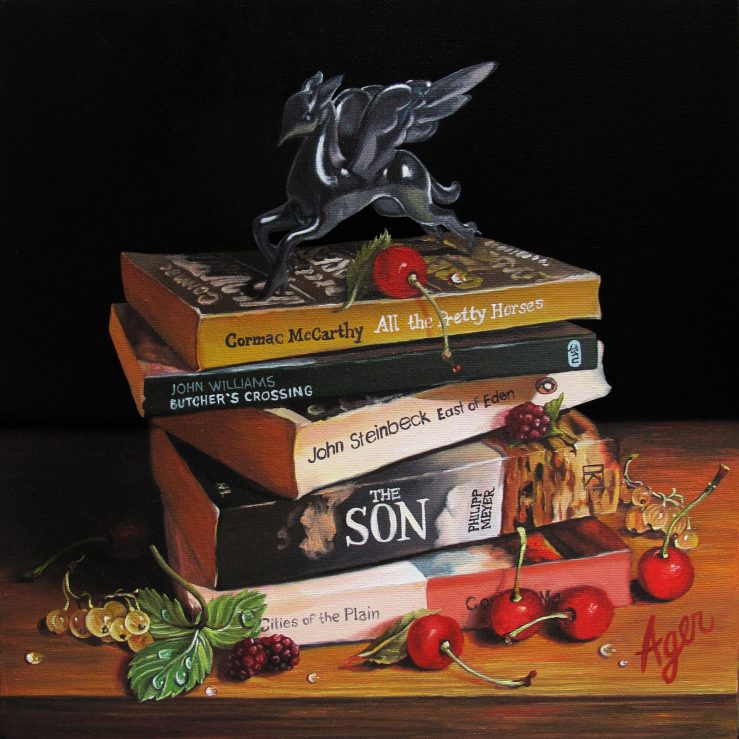
All the Pretty Horses (I See the Same Hoes), 2019 by Kathy Ager (b. 1981)
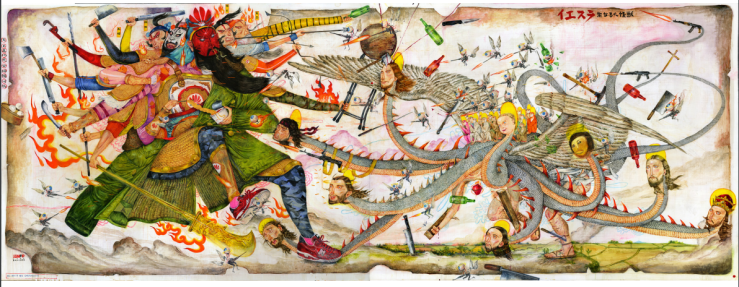
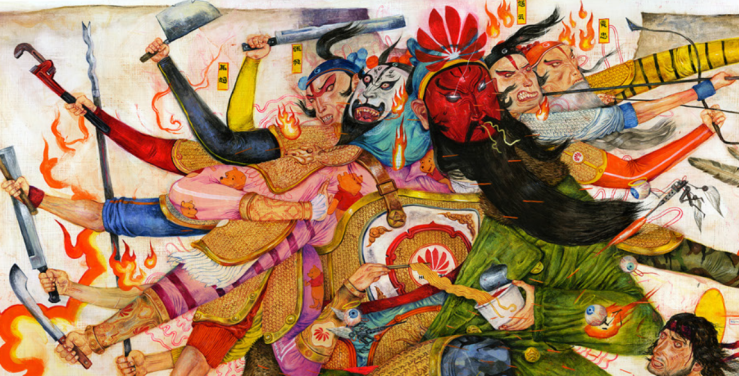
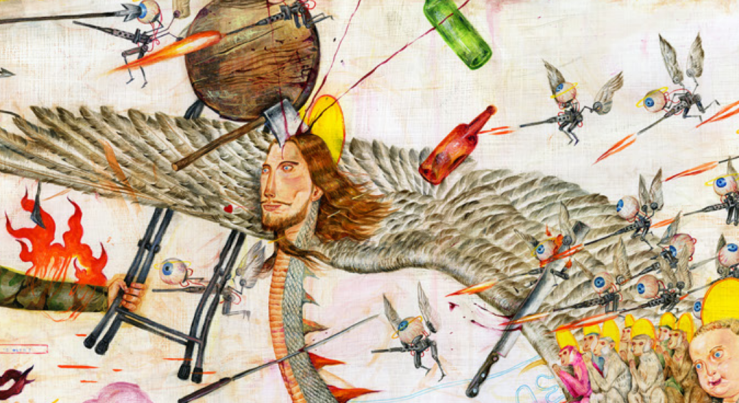
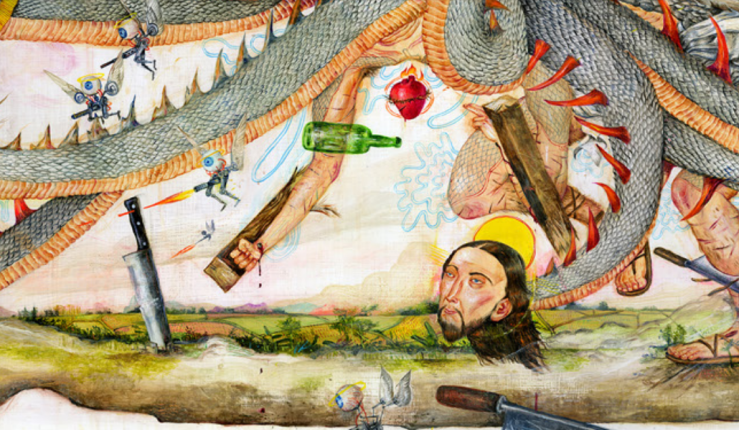
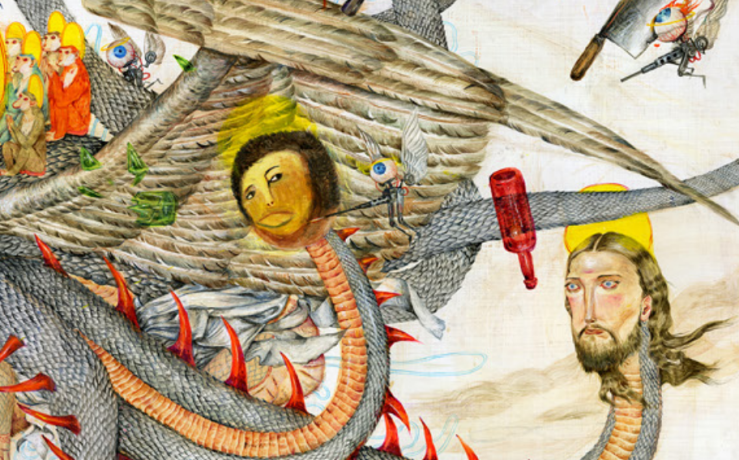
Jesura the Holy Kaiju, 2019 by Mu Pan (b. 1976)

Island of the Cyclops: The Early Years, 2018, by Eric Fischl (b. 1948)
“Baseball and Classicism”
by
Tom Clark
Every day I peruse the box scores for hours
Sometimes I wonder why I do it
Since I am not going to take a test on it
And no one is going to give me money
The pleasure’s something like that of codes
Of deciphering an ancient alphabet say
So as brightly to picturize Eurydice
In the Elysian Fields on her perfect day
The day she went 5 for 5 against Vic Raschi

Queen Mab’s Cave, 1846 by Joseph Mallord William Turner (1775–1851)
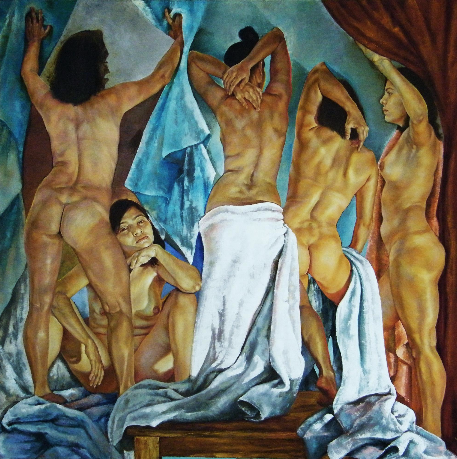
Mientras Pablo no me vea (As Long as Pablo Doesn’t See Me) by Carmen Chami (b. 1974)
“4th of July”
by
William Carlos Williams
I
The ship moves
but its smoke
moves with the wind
faster than the ship
— thick coils of it
through leafy trees
pressing
upon the river
II
The heat makes
this place of the woods
a room
in which two robins pain
crying
distractedly
over the plight of
their unhappy young
III
During the explosions
at dawn, the celebrations
I could hear
a native cuckoo
in the distance
as at dusk, before
I’d heard
a night hawk calling
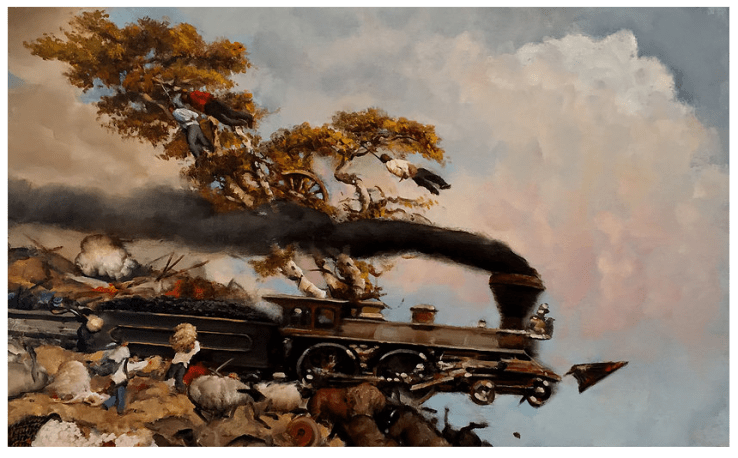
Manifest, 2015 by Scott Greene
“Beehive”
by
Jean Toomer
Within this black hive to-night
There swarm a million bees;
Bees passing in and out the moon,
Bees escaping out the moon,
Bees returning through the moon,
Silver bees intently buzzing,
Silver honey dripping from the swarm of bees
Earth is a waxen cell of the world comb,
And I, a drone,
Lying on my back,
Lipping honey,
Getting drunk with that silver honey,
Wish that I might fly out past the moon
And curl forever in some far-off farmyard flower.
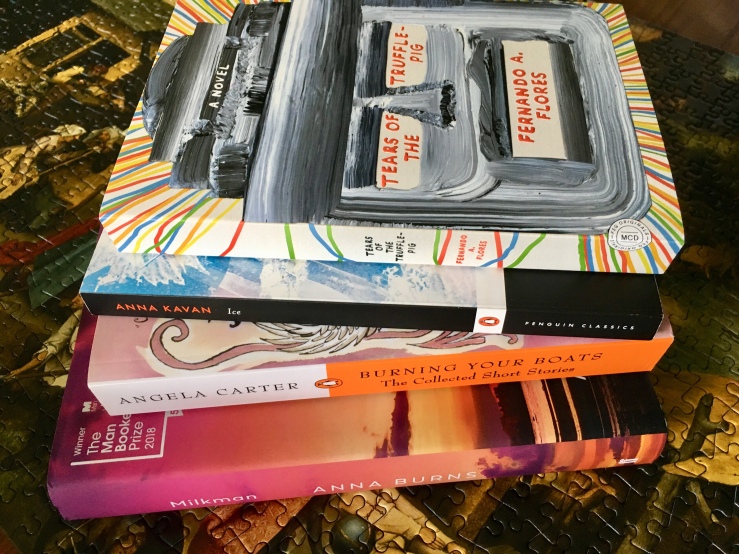
The copy I ordered of Fernando A. Flores’ novel Tears of the Trufflepig arrived today and I finished the first three chapters before putting on the USA-ENG World Cup game—sort of a noir sci-fi tone so far (Flores’ novel, not the World Cup match).
I ordered the book after reading the first five paragraphs of J. David Gonzalez’s review in the Los Angeles Review of Books a few days ago. I’ll read the rest of the review after I finish Trufflepig; these are the paragraphs I stopped with—
Now, about the plot. Drugs have been made legal, so the cartels have taken to trafficking “filtered” animals, bio-engineered exotics brought back from extinction and served at black market dinners for the incredibly rich and extraordinarily vacuous. The death (by filtered ostrich, no less) of El Gordo Pacheco, the leader of the world’s most powerful cartel, has led to a global turf war for control of the filtering syndicates. Australia, Helsinki, Tangiers, New Hampshire: They all want in. Enter Leone McMasters, the silver-mustached head of McM Imports, a shadowy multinational corporation. Think Pynchon’s Golden Fang. Think Monsanto.
Also, there is a thriving black market for the shrunken heads of the Aranaña Indians, a fictional tribe of indigenous people at the heart of Trufflepig’s mystery. Having been vanished for over 400 years, their sudden reappearance portends something. Perhaps it’s doom, but perhaps it’s nothing at all, simply the passing of time. Still, tokens of their existence have led to a Möbius strip of tragedy, “with Indians now killing other Indians for their heads, because they are left out on the margins of the modern world and have few recourses to feed their families.”
I finished Anna Kavan’s novel Ice a few days ago (I wrote about it here, here, and here). I realized after having written about Ice that I’d neglected to compare it favorably to a number of other novels and stories. By compare—well, what I want to say is that reading Ice feels a particular way; it’s disorienting, a bit upsetting, and truly strange. I had meant to compare it to Georg Büchner’s novella Lenz, the novels of João Gilberto Noll, Kazuo Ishiguro’s “A Village after Dark,” plenty of Poe, and the films of David Lynch.
After Ice I read a bit of Anna Burns’ recent novel Milkman, but it didn’t stick for whatever reason—I’ll give it a proper effort soon though. I ended up pulling a collection of Angela Carter from the shelf and rereading some of the tales in The Bloody Chamber (specifically, Carter’s riffs on Bluebeard and Beauty and the Beast). I think maybe it was the lingering Kavan flavors—the fable-making psychosexual thrust of it all—that prompted rereading a bit of Carter, which served as almost a palate cleanser. I’ll probably read a few more tales from it after I finish Trufflepig. But now back to the soccer match, which just tied up at 2-2.

