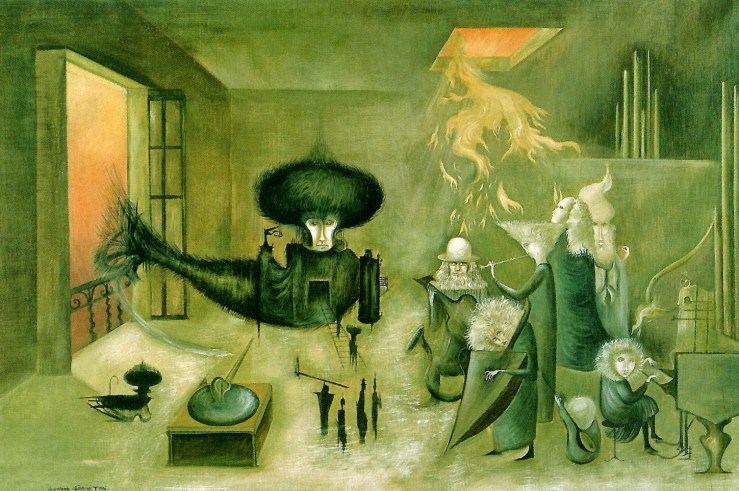
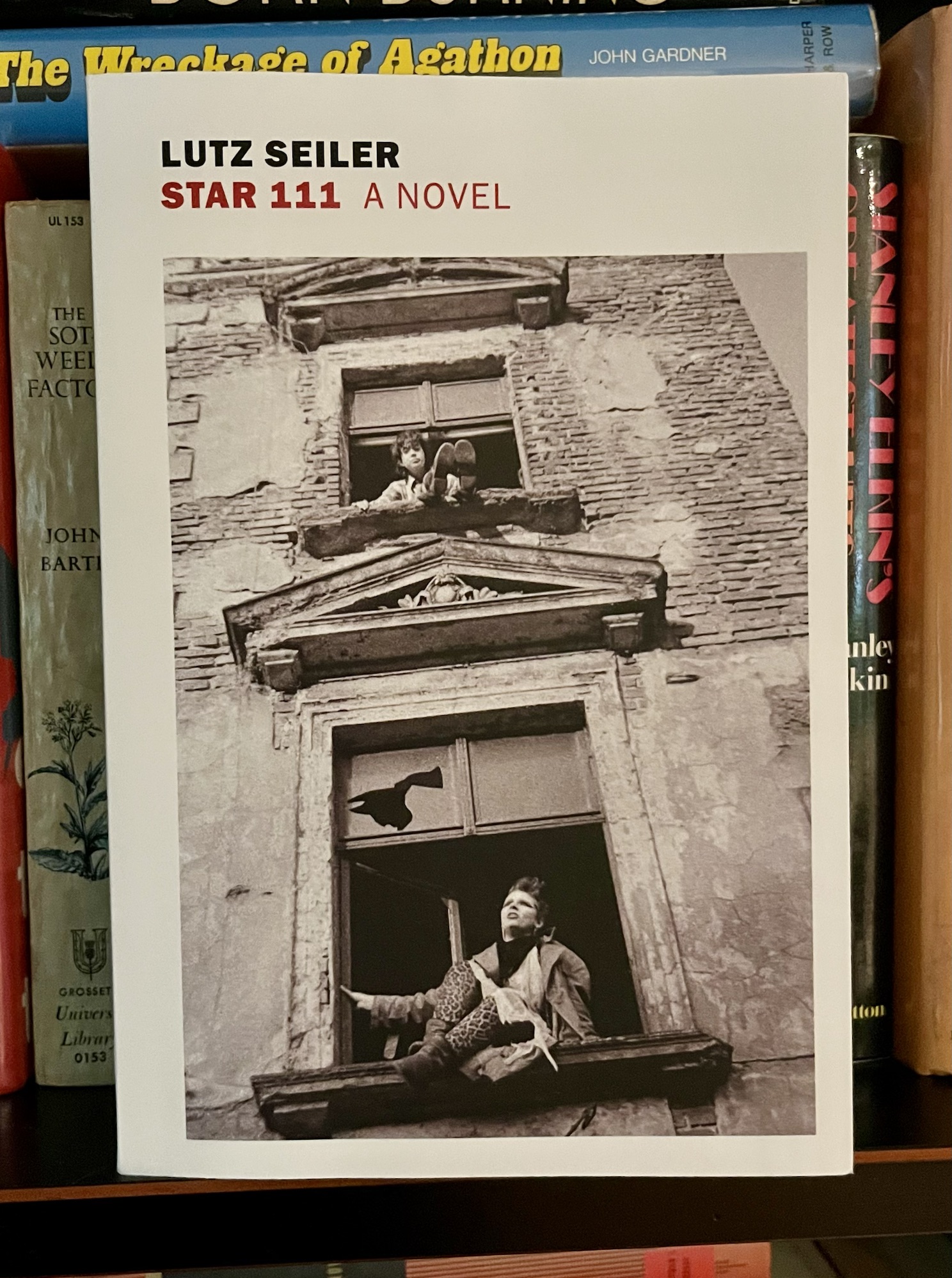
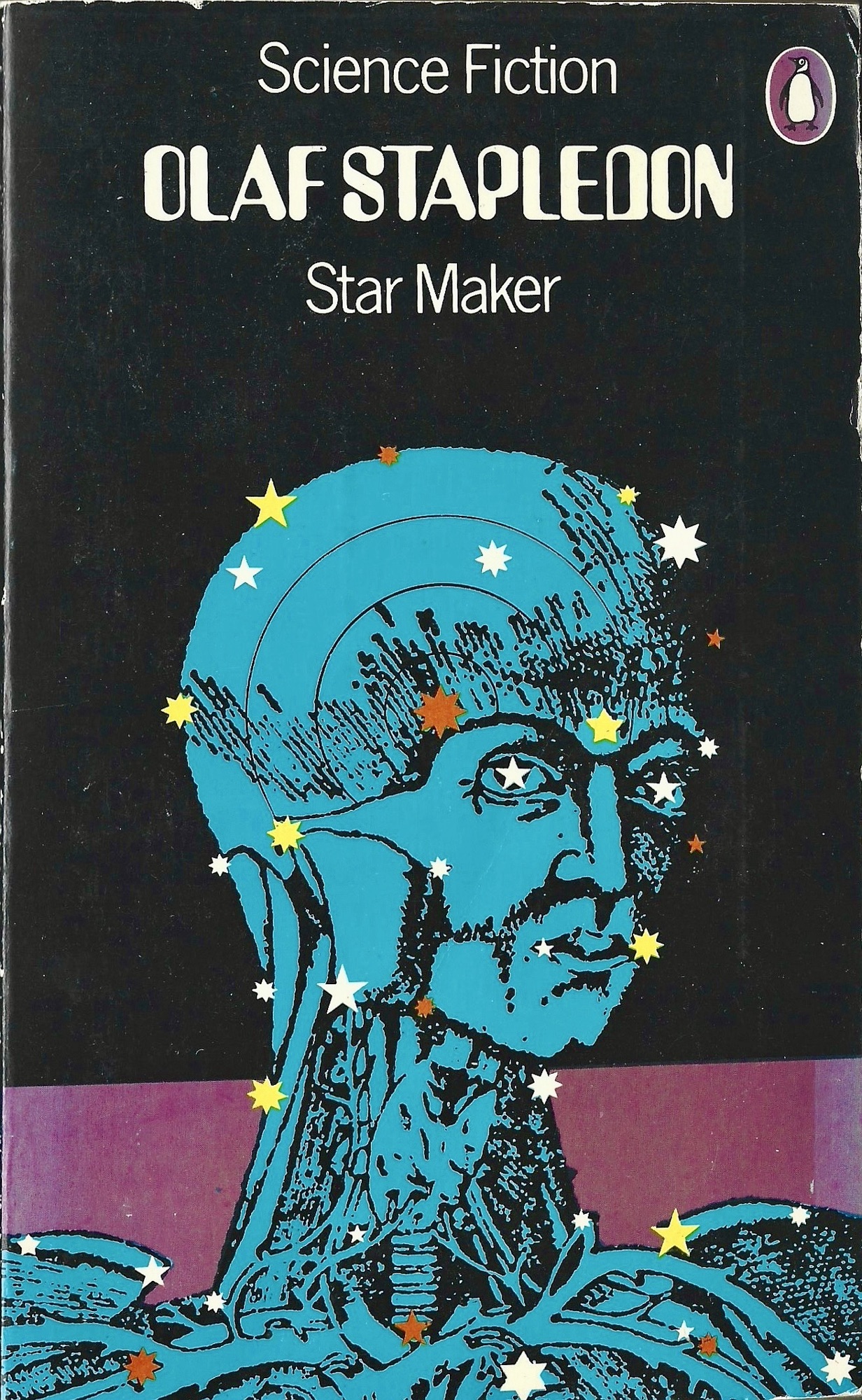
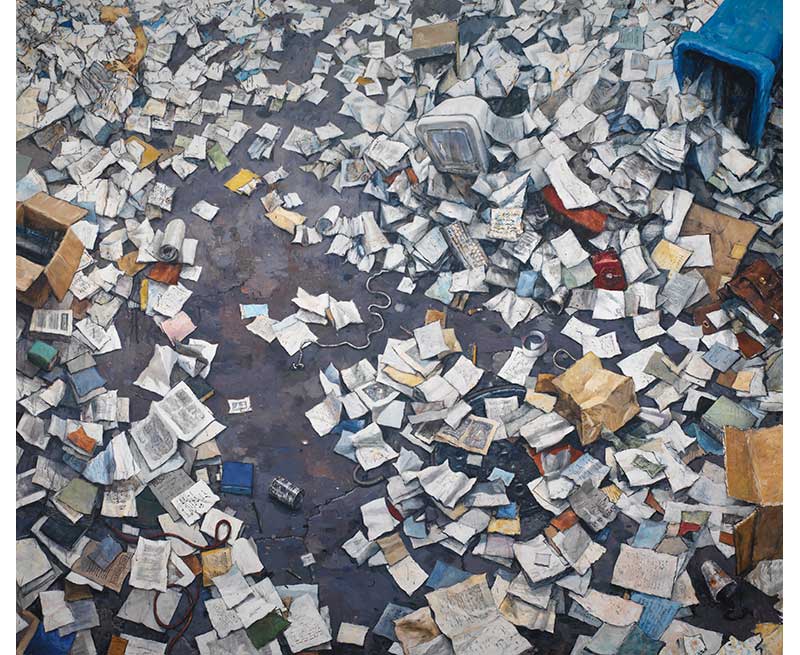
He thinks of different ways to shoplift a book

Title: Gorland at Large

Location in archive (Box.Folder): 82.1

Date: Not dated

Complete? Yes

Extent of preserved material: A five-page lightly-corrected typescript, plus an earlier draft of five pages, heavily corrected and with other holograph notes.

The Story: Gorland as a boy of nine shoplifted cheap fishing tackle, and then his cousin stole a pocket knife from him. This sense that even those who steal for fun can be stolen from fills him with disappointment. As an adult in the narrative present, he meets a young woman who tells him that her friends are of two kinds: those who feel shame when they steal and those who don’t: Gorland feels sadness at this vision of a world of thieves. Gorland as an adult is a collector of books and finds out that an unpleasant bookshop owner has somehow stolen some of his, making him wonder if all the books in her shop are stolen. He thinks of different ways to shoplift a book, and takes a new standard edition of Kierkegaard’s Works of Love on his way out as she is distracted.

Works of Love is Kierkegaard’s most direct engagement with the concept of love-across-humankind: that is, agapē. The relevance is presumably that the model of human relations in which everyone steals from everyone else as a way of getting even and balancing their debts is a purely inverted counterpart to an Agapeic world of interaction through love.

Relation to Gaddis’s Published Writings: Ends with direct reference to a theorist of agapē, and hence a relevant text for Agapē Agape. A character in the shop asks for a book of poetry by WH Auden, whose early poems (eg “A Summer Night” or “Lullaby”) often suggest the precedence of love for all people over love for individuals.

Also a mention of central character “felt for a moment like Raskolnikov,” so another source for Gaddis’s explicit reference to the 19th-century Russians.

Other Notes and Mentions Elsewhere? N/A

The above selection is included in an exhaustive (but not exhausting) trip through the Gaddis archives, part of Electronic Book Review’s special issue, “Gaddis at His Centenary.” Our trip conductors are Gaddis scholars Ali Chetwynd (who organized and edited the special issue) and Joel Minor (who curates Washington University’s marvelous Modern Literature Collection. Titled “William Gaddis’s Unpublished Stories and Novel-Prototypes: An Archival Guide,” the piece diligently details Gaddis’s unpublished prose fiction, situating the pieces in the larger context of his five published novels. There are even some plot charts for Ducdame, a precursor for The Recognitions. 

I chose to share the entry for “Gorland at Large” above because it concerns a biblioklept.

Charles Ricketts and Charles Shannon as Medieval Saints — Edmund Dulac

Charles Ricketts and Charles Shannon as Medieval Saints, 1920 by Edmund Dulac (1822–1953)

Read “The Candy Country,” a strange tale by Louisa May Alcott

“The Candy Country”

by

Louisa May Alcott


“I shall take mamma’s red sun umbrella, it is so warm, and none of the children at school will have one like it,” said Lily, one day, as she went through the hall.

“The wind is very high; I’m afraid you’ll be blown away if you carry that big thing,” called Nurse from the window, as the red umbrella went bobbing down the garden walk with a small girl under it.

“I wish it would; I always wanted to go up in a balloon,” answered Lily, as she struggled out of the gate.

She got on very well till she came to the bridge and stopped to look over the railing at the water running by so fast, and the turtles sunning themselves on the rocks. Lily was fond of throwing stones at them; it was so funny to watch them tumble, heels over head, splash into the water. Now, when she saw three big fellows close by, she stooped for a stone, and just at that minute a gale of wind nearly took the umbrella out of her hand. She clutched it fast; and away she went like a thistle-down, right up in the air, over river and hill, houses and trees, faster and faster, till her head spun round, her breath was all gone, and she had to let go. The dear red umbrella flew away like a leaf; and Lily fell down, down, till she went crash into a tree which grew in such a curious place that she forgot her fright as she sat looking about her, wondering what part of the world it could be.

The tree looked as if made of glass or colored sugar; for she could see through the red cherries, the green leaves, and the brown branches. An agreeable smell met her nose; and she said at once, as any child would, “I smell candy!” She picked a cherry and ate it. Oh, how good it was!—all sugar and no stone. The next discovery was such a delightful one that she nearly fell off her perch; for by touching her tongue here and there, she found that the whole tree was made of candy. Think what fun to sit and break off twigs of barley sugar, candied cherries, and leaves that tasted like peppermint and sassafras!

Lily rocked and ate till she finished the top of the little tree; then she climbed down and strolled along, making more surprising and agreeable discoveries as she went.

What looked like snow under her feet was white sugar; the rocks were lumps of chocolate, the flowers of all colors and tastes; and every sort of fruit grew on these delightful trees. Little white houses soon appeared; and here lived the dainty candy-people, all made of the best sugar, and painted to look like real people. Dear little men and women, looking as if they had stepped off of wedding cakes and bonbons, went about in their gay sugar clothes, laughing and talking in the sweetest voices. Bits of babies rocked in open-work cradles, and sugar boys and girls played with sugar toys in the most natural way. Carriages rolled along the jujube streets, drawn by the red and yellow barley horses we all love so well; cows fed in the green fields, and sugar birds sang in the trees.

Lily listened, and in a moment she understood what the song said,—

“Sweet! Sweet!
Come, come and eat,
Dear little girls
With yellow curls;
For here you’ll find
Sweets to your mind.
On every tree
Sugar-plums you’ll see;
In every dell
Grows the caramel.
Over every wall
Gum-drops fall;
Molasses flows
Where our river goes.
Under your feet
Lies sugar sweet;
Over your head
Grow almonds red.
Our lily and rose
Are not for the nose;
Our flowers we pluck
To eat or suck.
And, oh! what bliss
When two friends kiss,
For they honey sip
From lip to lip!
And all you meet,
In house or street,
At work or play,
Sweethearts are they.
So, little dear,
Pray feel no fear;
Go where you will;
Eat, eat your fill.
Here is a feast
From west to east;
And you can say,
Ere you go away,
‘At last I stand
In dear Candy-land,
And no more can stuff;
For once I’ve enough.’
Sweet! Sweet!
Tweet! Tweet!
Tweedle-dee!
Tweedle-dee!”

“That is the most interesting song I ever heard,” said Lily, clapping her sticky hands and dancing along toward a fine palace of white cream candy, with pillars of striped peppermint stick, and a roof of frosting that made it look like the Milan Cathedral.

“I’ll live here, and eat candy all day long, with no tiresome school or patchwork to spoil my fun,” said Lily.

Continue reading “Read “The Candy Country,” a strange tale by Louisa May Alcott”

The Enamored Mage — Jess

The Enamored Mage (Translation #6), 1965 by Jess (1923-2004)

In the Park — Marie Laurencin

In the Park, 1924 by Marie Laurencin (1883-1956)

Posted in Art

Mass-market Monday | Gabriel García Márquez’s One Hundred Years of Solitude

One Hundred Years of Solitude, Gabriel García Márquez. Translation by Gregory Rabassa. Avon Bard (1971). No cover artist credited. 383 pages.

I am a huge fan of the Avon Bard Latin American literature series. (I do wish, however, they had done a better job crediting the cover artists.)

I listened to One Hundred Years of Solitude on audiobook (narrated by John Lee) last week while undertaking a largish home project. I had read the novel maybe twelve years ago, after several false starts, and enjoyed the audiobook very much, even if the story was much, much sadder than I’d remembered. I had registered One Hundred Years of Solitude in my memory as rich and mythic, its robust humor tinged with melancholy spiked with sex and violence. That memory is only partially correct—García Márquez’s novel is darker and more pessimistic than my younger-reader-self could acknowledge.

From John Leonard’s wonderful contemporary review in The New York Times (in which he employs the word haruspex in the second sentence:

You emerge from this marvelous novel as if from a dream, the mind on fire. A dark, ageless figure at the hearth, part historian, part haruspex, in a voice by turns angelic and maniacal, first lulls to sleep your grip on a manageable reality, then locks you into legend and myth. One Hundred Years of Solitude is not only the story of the Buendia family and the Colombian town of Macondo. It is also a recapitulation of our evolutionary and intellectual experience. Macondo is Latin America in microcosm: local autonomy yielding to state authority; anticlericalism; party politics; the coming of the United Fruit Company; aborted revolutions; the rape of innocence by history. And the Buendias (inventors, artisans, soldiers lovers, mystics) seem doomed to ride biological tragi‐cycle in circles from solitude to magic to poetry to science to politics to violence back again to solitude.


Puppy Play Date — Salman Toor

Puppy Play Date, 2019 by Salman Toor (b. 1983)

Dino Buzzati’s The Singularity (Book acquired, 23 May 2024)

NYRB has another new translation of an old Dino Buzzati novel on deck—it’s a 1960 sci-fi called The Singularity in translation by Anne Milano Appel. NYRB’s blurb:

At the beginning of Dino Buzzati’s The Singularity, Ermanno Ismani, an unassuming university professor, is summoned by the minister of defense to accept a two-year, top-secret mission at a mysterious research center, isolated from the world among forests, plunging cliffs, and high mountains. What’s he supposed to do there? Not clear. How long will he be there? No saying.

Still, Ismani takes the mystifying job and, accompanied by his no-nonsense wife, Elisa, heads to the so-called Experimental Camp of Military Zone 36, wondering whether, in the midst of the Cold War, it’s some sort of nuclear project he’s been assigned to. But no, the colleagues the couple meets on arrival assure them, it’s nothing like that. It’s much, much more powerful.

At the center of the research complex is strange, shining, at times murmurous, white wall. Behind it, a deep gorge drops away, full of wires and radio towers and mobile sensors and a host of eccentric structures. A question begins to dawn: Could this be the shape of consciousness itself? And if so, whose?

Buzzati’s novella of 1960, a pioneering work of Italian science fiction, is published here in a brisk new translation by Anne Milano Appel. In it, Buzzati explores his favorite themes of love and longing while offering a startlingly prescient parable of artificial intelligence.

“The Mortician in San Francisco” — Randall Mann

“The Mortician in San Francisco”

by

Randall Mann


This may sound queer,
but in 1985 I held the delicate hands
of Dan White:
I prepared him for burial; by then, Harvey Milk
was made monument—no, myth—by the years
since he was shot.

I remember when Harvey was shot:
twenty, and I knew I was queer.
Those were the years,
Levi’s and leather jackets holding hands
on Castro Street, cheering for Harvey Milk—
elected on the same day as Dan White.

I often wonder about Supervisor White,
who fatally shot
Mayor Moscone and Supervisor Milk,
who was one of us, a Castro queer.
May 21, 1979: a jury hands
down the sentence, seven years—

in truth, five years—
for ex-cop, ex-fireman Dan White,
for the blood on his hands;
when he confessed that he had shot
the mayor and the queer,
a few men in blue cheered. And Harvey Milk?

Why cry over spilled milk,
some wondered, semi-privately, for years—
it meant “one less queer.”
The jurors turned to White.
If just the mayor had been shot,
Dan might have had trouble on his hands—

but the twelve who held his life in their hands
maybe didn’t mind the death of Harvey Milk;
maybe, the second murder offered him a shot
at serving only a few years.
In the end, he committed suicide, this Dan White.
And he was made presentable by a queer.

Manikins — Paul Cadmus

Paul Cadmus - Tutt'Art@ - (8)

Manikins, 1951 by Paul Cadmus (1904-199)

“A Glimpse” — Walt Whitman

“A Glimpse”

by

Walt Whitman


A glimpse through an interstice caught,
Of a crowd of workmen and drivers in a bar-room around the stove late of a winter night, and I unremark’d seated in a corner,
Of a youth who loves me and whom I love, silently approaching and seating himself near, that he may hold me by the hand,
A long while amid the noises of coming and going, of drinking and oath and smutty jest,
There we two, content, happy in being together, speaking little, perhaps not a word.

Tuxedo — Jean-Michel Basquiat

tumblr_ogjo6ynDDJ1sijdqzo1_1280.jpg

Tuxedo, 1983 by Jean-Michel Basquiat (1960-1988)

Mass-market Monday | Thomas Pynchon’s V.

V., Thomas Pynchon. Bantam Books, third printing (1964). No cover artist credited. 463 pages.

Although artist James Bama is not credited, you can see his signature on the right side of the cover, just above the horizon.

I reread V. a few years back, concluding my piece with,

The grist, grit, and horror of the big postwar world will cling to the present. Nobody’s stepping down from heaven, or Heaven, and there are no magic words—but there is a kind of love, a loving with your mouth shut, a kind of radical, earnest, transcendent love that Pynchon evokes, soils, and sanctifies here.

Biblioklept Does Atlanta (Books acquired, some time last week)

Last week, the wife and I drove five hours north to Atlanta, Georgia where we stayed five days in the Cabbagetown neighborhood. Our ostensible purpose was an anniversary trip focused around a Slowdive concert last Friday, but I think we really went to just hang out and eat and drink away from our kids for a few nights. It was famous times.

The Slowdive concert itself was excellent, despite the best efforts of the awful opening band, a dubious and I must assume ironic project called Drab Majesty, and the sound system at the The Eastern. The venue seemed ill-equipped to handle the tonality of either band. I don’t want to sound like a very old man but it was Too Fucking Loud. Opener Drab Majesty, whose sound came from a single guitar, a single synth, and, I’m guessing, a few loop pedals, seemed to have plugged directly into the PA system. It was the absolute worst sound I’ve ever heard. (Earlier that day, driving in awful Atlanta traffic, we listened to a seventeen-minute Merzbow song on the alternate band of Georgia Tech’s WREK radio station; although Merzbow is “noise” music, that song had more musicality, tonality, and depth of rhythm than Drab Majesty.)

Slowdive was excellent live–much more of a rock sound than I’d expected; I’ve really enjoyed their two newer records, particularly the self-titled one from a few years back, but the songs from Souvlaki sounded particularly fierce live. The setlist was great, and they closed with a cover of Syd Barrett’s “Golden Hair” that might have gone on for 10 or 12 minutes; it was hypnotic. Here is the single picture I took during the show:

But books—

Without children about and with my wife having to work half days from the rented garage apartment, I had enough time to indulge going to pretty much any bookstore I wanted to in Atlanta. I ended up sticking mostly to East Atlanta where we were staying though.

I had been to A Capella Books a few years ago and had somehow entirely missed their used book annex, which had some really great stuff in it, including a first edition of Blood Meridian and Joseph McElroy’s Women and Men. I ended up chatting with the owner Frank for a bit; a very nice guy, he showed me his personal collection of Vintage Contemporaries and we talked in general about our shared sickness of book collecting. I left with Mauro Javier Cárdenas’s new novel American Abductions and a first-edition hardback of McCarthy’s Cities of the Plain. This second purchase seems to have initiated the trip’s theme of buying editions of books I already own—but now I have all three Knopf editions of The Border Trilogy, so everyone can sleep easier.

I stopped by Criminal Records in Little Five Points and didn’t pick anything up, although I’m happy to see that CDs have made such a comeback. (I almost certainly would have bought the new Gastr del Sol box set if it was out yet.) I then made my way to Bibliotech Books in Candler Park. The proprietor assured me that he was in the process of reorganizing, but the store was frankly a mess. One bookcase was organized by the color of the book’s spines. The inventory seemed to be someone’s childhood and adolescent books.

I headed to Virginia Highland Books, a perfectly-respectable book shop in the perfectly-respectable Virginia Highland neighborhood. The perfectly-respectable inventory was not particularly interesting, although I imagine it perfectly suits the perfectly-respectable clientele. On the way to Virginia Highland Books, at a red light, I found myself stopped next to something called Videodrome, so of course I pulled in. I got dizzy in Videodrome a DVD-rental shop stuffed with thousands and thousands of cult films, non-English language films, art films, concert films…amazing stuff. The only thing I could compare it to were some of the rental shops I’d gone to decades ago when I lived in Tokyo. I mean, this place had the Cannibal Ferox soundtrack on vinyl. I spoke to the proprietor for a while. He gave me a sticker. I saw him at the Slowdive show the next night but left him alone.

My last bookshop visit that day was to Bookish, a small indie spot specializing in books by women. I liked the store but was honestly too tired to look around much after two tallboys at a PBR-themed bar in Virginia Highland.

Over the next few days, I visited three more bookshops, all more or less by chance. We went to Decatur, simply to check it out, and parked in Decatur Square right in front of Little Shop of Stories. Framed original artwork by visiting authors adorns the walls of this children’s bookshop, and there’s a life-sized reproduction of the room from Margaret Wise Brown’s classic Good Night Moon that one can hang out in. I felt a little melancholy that our children have outgrown children’s books.

On the way back to Atlanta, we swung by Eagle Eye Books, a Decatur spot specializing in used books (with a large collection of vintage sci-fi hardbacks in a back room). They have several carts of dollar books that are supposedly accessible 24/7—there are lock boxes to slide your dollars into. I ended up picking up different editions of two books I already own: Wells Tower’s Everything Ravaged, Everything Burned in hardback and the 1985 Elisabeth Sifton Books/Penguin Books printing of William Gaddis’s J R. The J R is basically falling apart and is crammed with annotations; I love it. I gave three crumpled dollars over for these two books and then drove back to our garage apartment so we could walk to tacos and then the concert.

The mid-morning after the Slowdive concert we hung out for a while at the Virginia Highland Porchfest. We parked at the Ponce City Market to walk to Porchfest and on the way back stopped at Posman Books. I’d been there before, and while it’s basically a gift shop, its literature section is surprisingly robust, and it even offers a decent number of Spanish-language novels. The vibe at Porchfest was more frat-boys-drinking-sixers and sunburned golf dads than it was hippies and freaks. The neighborhood is Nice, with plenty of In This House signs declaring Attested Beliefs. We felt more at home in Cabbagetown, with its murals and ambivalence, even if our own presence as fucking tourists made us balk at times. But in a plant shop in Virginia Highland, we did meet an interesting clerk who let me take a photograph of their Pynchon tattoo. So that was pretty cool.

Atlanta I heart you.


Leda Got a Gun — Anne Herrero

Leda Got a Gun, 2024 by Anne Herrero (b. 1984)

Mass-market Monday | Samuel R. Delany’s Nova

Nova, Samuel R. Delany. Bantam Books, ninth printing (1979). No cover artist credited. 215 pages.

Although he is not credited, Eddie Jones is the artist for this marvelous cover to Bantam’s mass-market reprint of Delany’s 1968 novel Nova. 

Nova is one of my favorite SRD novels. Let me self-plagiarize myself from a few years ago:

I couldn’t make it through Delany’s cult favorite Dhalgren a few years back, but Nova was easier sledding. The book is a riff on Moby-Dick, tarot, monoculture, and the grail quest. It’s jammed with ideas and characters, and if it never quite coheres into something transcendent, it’s a fun quick read (even if the ending, right from the postmodern metatextual playbook is too clever by half).

Oğuz Atay’s Waiting for the Fear (Book acquired, 7 May 2024)

A new translation of Oğuz Atay’s story collection Waiting for the Fear by Ralph Hubbell is forthcoming later this year from NYRB. Their blurb:

Adored in Turkey for his post-modern fiction and regarded internationally as one of Turkey’s greatest writers, Oğuz Atay remains largely untranslated into English. First published in 1975, Waiting for the Fear is Atay’s only collection of short stories, a book that is routinely praised in Turkey, by, among others, the Nobel Prize winner Orhan Pamuk, for having transformed the art of short fiction.

The eight stories that the book contains, all of them focused on characters living on the margins of society, are dramatic and even tragic, while also being shot through with irony and a humor. In the title story, a nameless young man, of a thoughtful and misanthropic turn of mind, returns to his home on the outskirts of an enormous nameless city to find waiting for him a letter in a foreign language of which he has no knowledge at all, and from this anomalous, if seemingly trivial, turn of events, one thing after another unfolds with stark inevitablity. Another story nods to Gogol’s “The Overcoat”: its hero is a speechless beggar wandering around the back streets of Istanbul dressed in a woman’s fur coat who will end up stuck in a shop window like a manikin. Elsewhere, a professional story peddler lives in a hut beside a train station in a country that is at war—unless it isn’t. He can’t remember. What do such life and death realities matter, however, so long as there are stories to tell? Atay’s stories are full of a vivid sense of life’s absurdities while also being psychologically true to life; his characters, oddballs and losers all, are also utterly individual with distinctive voices of their own, now plainspoken, wistful, womanly, now sophisticated and acerbic, with a dangerous swagger. And if Atay is a brilliant examiner of the inner life, he is no less aware of the flawed social world in which his people struggle to make their way.

Waiting for the Fear is a book that, page by beguiling page, holds the reader’s attention from beginning to end, the rare collection of short stories that not only reflects a unique authorial vision but reads like a page-turner. Ralph Hubbell’s new translation will introduce readers of English to a still insufficiently known giant of modern Turkish and world literature.