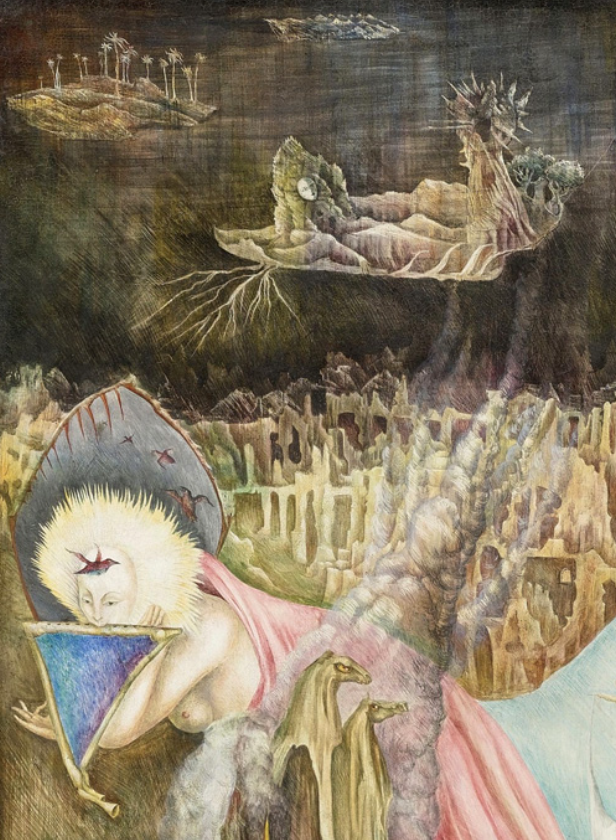
The Pleasures of Dagobert (detail), 1945 by Leonora Carrington (1917–2011)

The Pleasures of Dagobert (detail), 1945 by Leonora Carrington (1917–2011)

RIP Michael Zulli, 1952-2024
Comics artist Michael Zulli passed away this week at the age of 71. While Zulli was likely most known for his work on Neil Gaiman’s The Sandman comic (as well as an unpublished comic where Swamp Thing meets Jesus Christ), it was his work on The Puma Blues that really sank into my spirit as a kid.
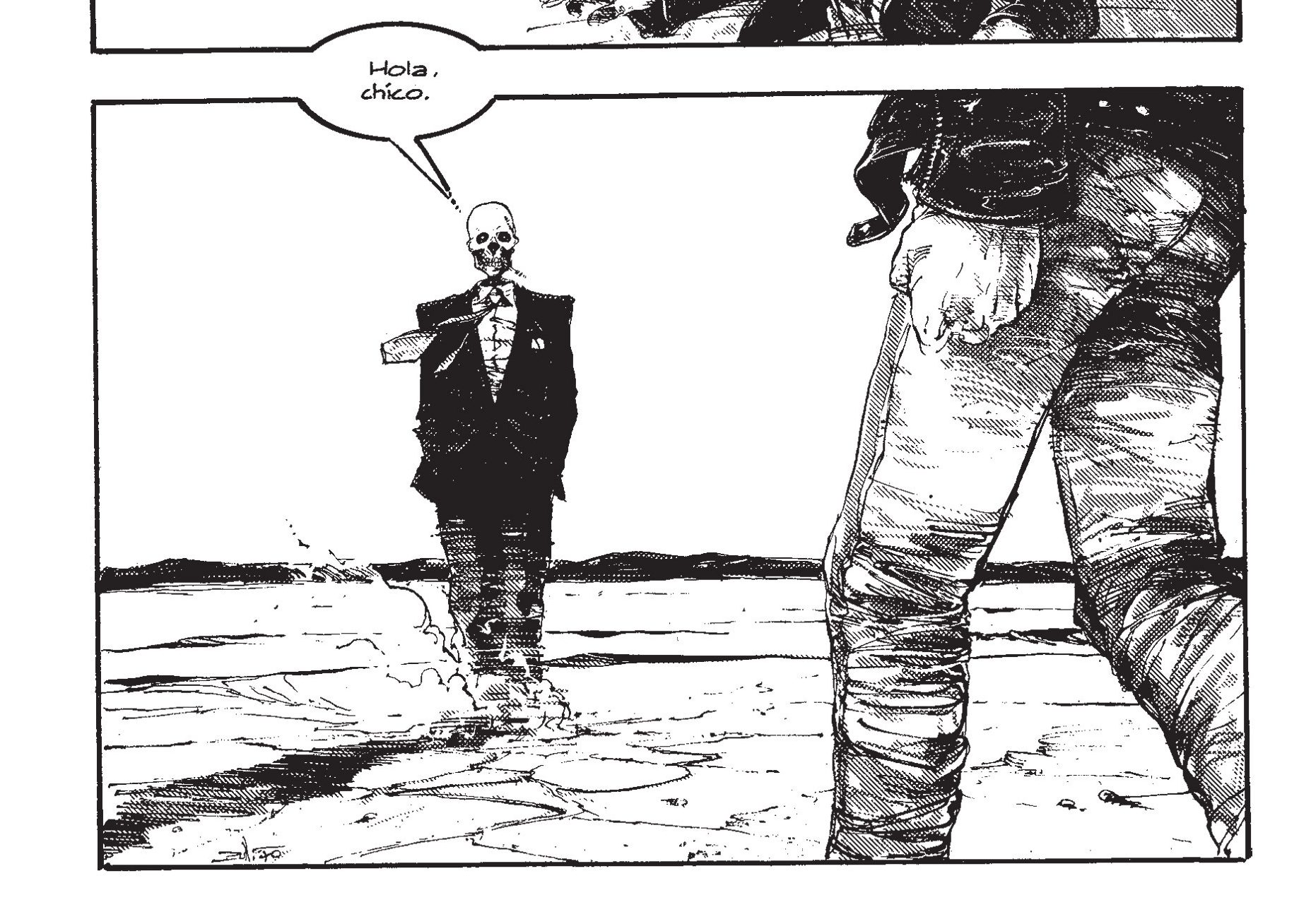
I came to The Puma Blues in the very early nineties via the proselytizing of Dave Sim in Cerebus comics; I managed to a hold of a handful of back issues from very late in the comic’s run. I of course had no idea what was going on, but that didn’t matter. Working from Stephen Murray’s enigmatic script, Zulli crafted a post-apocalyptic dreamscape, an evocation in black and white. His wild animals always seemed more detailed, more pure, more real than the humans who walked through the world he’d conjured in black and white.
I quit regularly visiting comic shops by the mid-nineties, but if I ever happened to be adjacent to one I’d pop in to look for back issues of The Puma Blues (and a handful of other indie titles). It wasn’t until a decade or so later that (with the extralegal help of the internet) I was able to read the entire series. Great stuff—baffling, evocative, Zulli and Murray’s series ran on its own aesthetic logic.
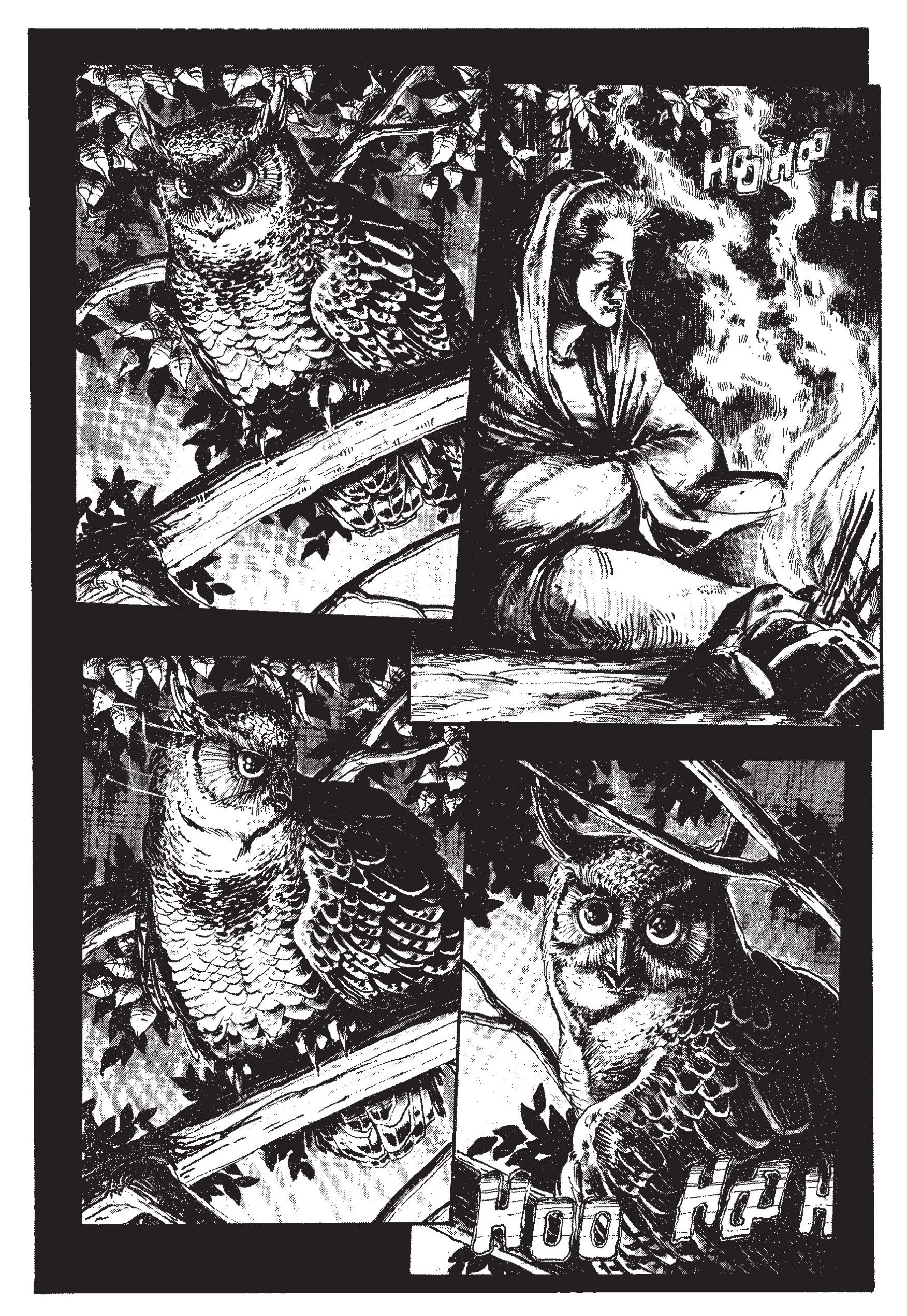
In a 2016 interview at The Comics Journal to mark the publication of a complete volume of The Puma Blues, Zulli spoke on the work as an act of ecological witnessing:
The nature drawings in Puma especially, but so much of the detail in the book feels like an act of witness.
It is. It’s an idea that we’re surrounded in what scientists call the ecosphere, for lack of a better word. It’s this incredibly beautiful and sophisticated system and somehow we think we’re separate from it? I don’t think so. We are not superior to it, we are a part of it and we should take care of it because in doing so we take care of ourselves as a species, too. If not for nature and the earth’s own sake, do it at least for your sake and your children’s sake. That’s all we have got. One day somebody could stop your electricity. What are you going to do? You’re completely unprepared to think about life without your support systems. I don’t mean to be excessively grim. I see a lot of hope. I cling tenaciously to it, but at the same time, Puma is sort of a shot across the bow to wake the fuck up. Take a real good look around you and see what’s really there. Participate in it. Because like it or not you are part of it.
“The Priest”
by
William Faulkner
His novitiate was almost completed. Tomorrow he would be confirmed, tomorrow he would achieve that complete mystical union with the Lord, which he had so passionately desired. In his studious youth he had been led to expect it daily; he had hoped to attain it through confession, through talk with those who seemed to have it; through living a purging and a self denial until the earthly fires which troubled him had burned themselves out with time. He passionately desired a surcease and an easing of the appetites and hunger of his blood and flesh, which he had been taught to believe were
harmful: he expected something like sleep, a condition to which he would attain in which those voices in his blood would be stilled. Or rather, chastened. Not to trouble him more, at least: an exalted plane wherein the voices would be lost, sounding fainter and fainter, soon to be but a meaningless echo among the canyons and majestic heights of the glory of God.
But he had not gotten it. After talk with a father in his seminary he could return to his dormitory in a spiritual ecstasy, an emotional state in which his body was but the signboard bearing a flaming message to shake the world. His doubts were then allayed; he had neither doubt nor thought. The end of life was clear: to suffer, to use his blood and bone and flesh as a means for attaining eternal glory—a thing magnificent and astounding, forgetting that history and not the age made Savonarolas and Thomas a Beckets. To be of the chosen despite the hungers and gnawings of flesh, to attain a spiritual union with Infinite, to die—how could physical pleasure toward which his blood cried, be compared with this?
But, once with his fellow candidates, how soon was this forgotten! Their points of view, their callousness, were enigma to him. How could one be of the world and not of the world at the same time? And the dreadful doubt that perhaps he was missing something, that perhaps after all life was only what one could make of his short three score and ten of time, might be true. Who knows? who could know? There was Cardinal Bembo living in Italy in an age like silver, like an imperishable flower, creating a cult of love beyond the flesh, purged of all torturings of flesh. And was not this but an excuse, a palliation for this terrible fearing and doubting? was not the life of that long dead, passionate man such a one as his own: a fabric of fear and doubt and a passionate grasping after something beautiful and fine? Even something beautiful and fine meant to him a Virgin not calm with sorrow and fixed like a watchful benediction in the western sky; but a creature young and slender and helpless and (somehow) hurt, who had been taken by life and toyed with and tortured—a little ivory creature reft of her first born and raising her arms vainly upon a dying evening. In other words, a woman, with all of woman’s passionate grasping for today, for the hour itself; knowing that tomorrow may never come and that today alone signifies, because today alone is hers. They have taken a child and made of her a symbol of man’s old sorrows, he thought; and I too am a child reft of his childhood. Continue reading “Read “The Priest,” a very early short story by William Faulkner”

The Pleasures of Dagobert (detail), 1945 by Leonora Carrington (1917–2011)
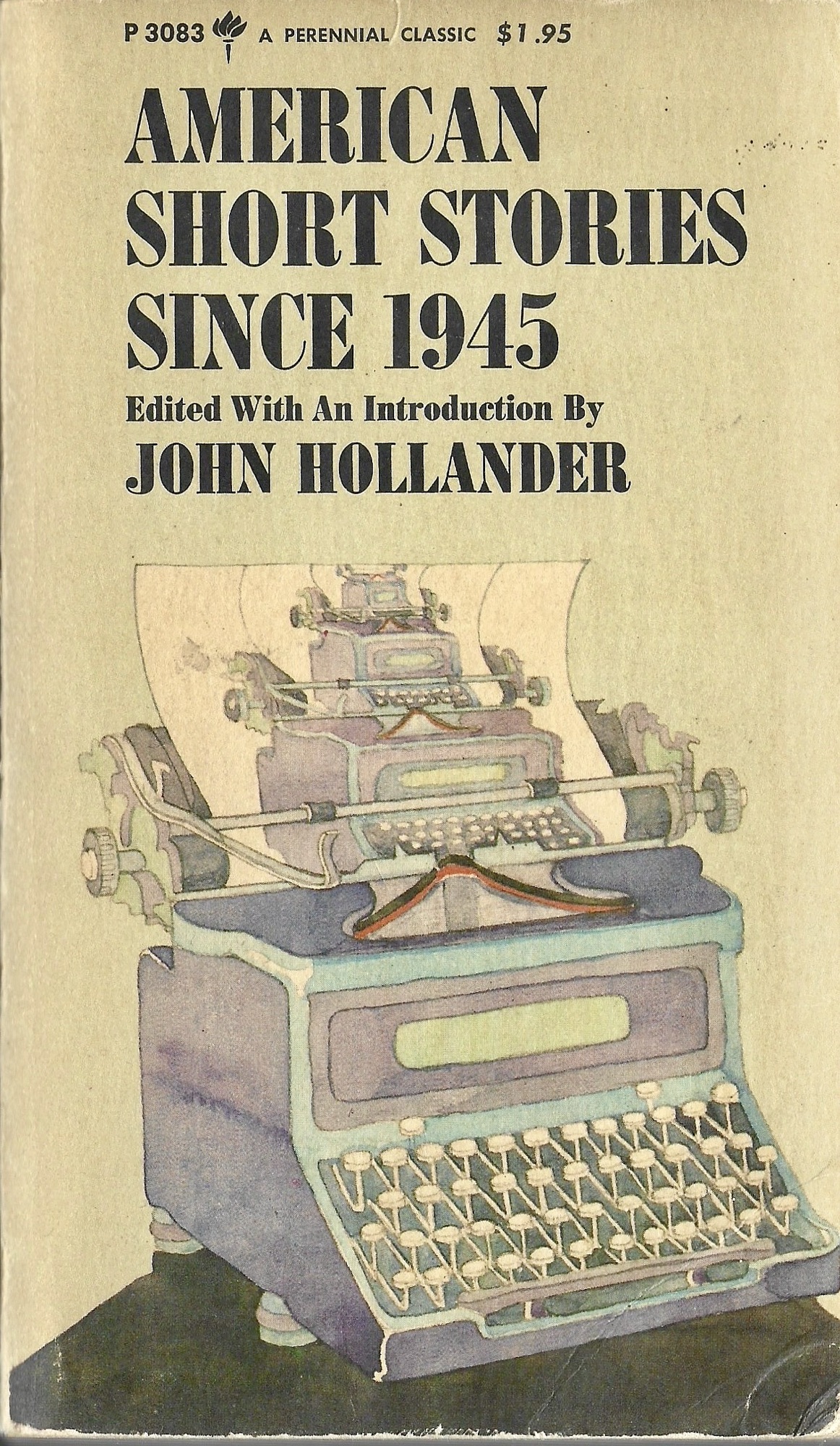

American Short Stories since 1945, edited by John Hollander. Perennial Classics, first edition, 1968. Cover design by Emanuel Schongut. 525 pages.
I think it was the title and the spine that first intrigued me when I pulled American Short Stories since 1945 from the shelf of a used book store: What would the selections be? How many years does the collection span? If Emanuel Schongut’s exquisite cover didn’t sell me on the book (which it did, all two dollars of it!), then the track list on the back certainly would have. And not so much for the authors I’d already read–Gass, Pynchon, Barthelme, O’Connor, Baldwin, and so on—but for the ones I hadn’t heard of, or at least didn’t think I’d heard of. Paul Goodman? Gilbert Rogin? Jeremy Larner? George P. Elliott? The poet who compiled the collection, John Hollander, writes in his introduction that it “aims to show the major shapes taken by shorter fiction in America since the end of World War II.” It’s the sort of book I wish I’d found when I was much, much younger, the kind of mixtape that would have sent me a lot of strange, wonderful directions.
The Pleasures of Dagobert (detail), 1945 by Leonora Carrington (1917–2011)
[Editorial note: The following citations come from one-star Amazon reviews J.G. Ballard’s novel Crash. I’ve preserved the reviewers’ original punctuation and spelling. More one-star Amazon reviews.].
Honestly.
massive car wrecks
I like Ballard’s work
nearly killing his wife
I can’t wrap my brain around the idea
I don’t consider myself to be socially conservative, but
Also won’t the police be keeping track of the guy’s driving record?
I find it gross that wounds from these car wrecks would turn women on
talked extensively of the steering column, instrument panel, and bonnet
Contrary to this book’s classification as a social technological fiction,
having sex with any women he can find
and lots of masturbating
messed up fetish
hard to believe
crashing it
unrealistic
gratuitous
assigned reading
required for a college course
hated every twisted minute of it
I wish I could scrub it from my brain
one must debate the author’s motives
an obsession which could only be satisfied by having sex in car
the perverse inner workings of the author, J.G. Ballard’s, mind
automobiles, sex, and death
perverse and sick fantasies
fuel his obsession
so disturbing
Poppycock.
lewd, dark, introvert
driven by his own libido
mind is completely altered
His sexual relations were not sincere
scars and disfigurements
truly fails on all levels
conniving ways
obsessing
obsessive
minions
mangled leftovers
mere marionettes
perverse sexuality
increasingly disturbing
perverse way of thinking
hardly worth a sexual climax
It was written in 1973 and seems to take place in 1973
Just some perverts lobbing semen around car wrecks.
a radical depiction of society’s addiction to technology
It is hard for me to make a connection between cars and sex.
sexual obsession of the body stamped by the technology of the car
What’s the commentary, car wrecks are bad?
savage appetite for car crashes and victims
riddled with atrocious sexual fantasies
hard to follow and digest
void of any substance
surprisingly disgusting
spreading his semen
collision course
Elizabeth Taylor
scars and fantasies
former sports car
invalid car
braces
acid trip
scars and divots
the average reader
It elicits the response it is written to do so.
Read it for class, but would never read again.
Anyone reading this for its erotic content will be as disappointed
I understand books are written to prompt a question, to get somebody thinking. But
on a list of some guy’s “best science fiction” on the internet
I have read a number of Ballard’s works
one of the worst books I have ever read
fantasy story (not sexual fantasy)
How is it science fiction?
rancid mayonaise
dry, mechanical
Car fetish porn.
I don’t get it.
not art
not prose
junk
The Pleasures of Dagobert (detail), 1945 by Leonora Carrington (1917–2011)

Five years ago, I was fortunate enough to interview Margaret Carson about her translation of a collection of the artist Remedios Varo’s written work. Margaret has since expanded on that collection, adding new material from her dive into Varo’s archives, resulting in On Homo rodans and Other Writings, new this summer from Wakefield Press. On Homo rodans and Other Writings offers readers a fascinating trip through Varo’s imagination. Brimming with impossible images, surreal jokes, and dreamy fragments, the work is more than just an addendum to Varo’s career as an artist. I highly recommend it to those interested in surrealist writing in general. Margaret was kind (and patient!) enough to talk with me again over the course of a few weeks via email. I am grateful for her generosity and for her work in bringing Varo’s words to monoglots such as myself.
In addition to her Varo books, Margaret Carson’s translations include Sergio Chejfec’s Baroni, A Journey and My Two Worlds. She is Associate Professor in the Modern Languages Department at Borough of Manhattan Community College, The City University of New York.

Biblioklept: Margaret, congratulations on the publication of On Homo rodans and Other Writings, the expanded edition of your English translation of Remedios Varo’s writings! Many of our readers might be familiar with Varo’s wonderful paintings but not know about her writing. How would you characterize the prose collected in On Homo rodans and Other Writings?
Margaret Carson: Thanks, it’s great to have the translation back in print! It’s mainly writings found after Remedios Varo’s death in notebooks and on loose pages. The writings are quite varied: several odd and delightful stories (three of them new to this edition), a fairy tale, letters to friends and strangers, her famous recipe “To Provoke Erotic Dreams,” a poem that invokes the moon, dream narratives, and a few other gems, such as the title piece, “On Homo rodans,” a faux anthropological treatise that accompanied her sculpture of a human-like torso on a giant wheel, made out of chicken, turkey and fish bones.

Varo’s extraordinary creativity and weird sense of humor come across just as much in her writings as in her paintings. I think readers fascinated by Varo, the artist, will also be won over by her gifts as a writer. Simply put, she’s as clever a writer as she is a painter.
Biblioklept: So, let’s get into the stories and other material new to this edition and how you came to translate it into English. Some of this material hasn’t been published before, even in Spanish. If my understanding is correct, Walter Gruen, Varo’s last life partner, donated a significant collection of her works to the Museo de Arte Moderno in Mexico City in 2000. In 2018—after the publication of your translated collection Letters, Dreams & Other Writings—the Varo estate bequeathed more of Varo’s writings to the Museo de Arte Moderno. Is that right?
MC: Yes. In the early 2000s Walter Gruen and his wife Anna Alexandra Varsoviano (a friend of Varo’s who he married after the artist’s death) donated about thirty-eight of her works to the Museo de Arte Moderno (MAM), making it the largest repository of paintings by Varo in the world. Walter Gruen died in 2008, and Anna Alexandra Varsoviano in 2015. (I was lucky enough to meet them both in person: Walter Gruen in 2000 and Anna Alexandra Varsoviano some years later.) In her will, Anna Alexandra bequeathed a trove of Varo’s notebooks, letters, preparatory drawings, photos, and other items to MAM, many of which were displayed in 2018 in an exhibition celebrating the donation: Adictos A Remedios Varo: Nuevo Legado 2018. It was at that exhibition that I first saw Varo’s notebooks, open to pages containing narratives, letters and other pieces, in Varo’s own handwriting. I could instantly recognize them because I’d translated the same texts for Letters, Dreams and Other Writings, except for that book I used a collection of Varo’s writings published in Mexico in the 1990s, Cartas, sueños y otros textos, edited by the Spanish scholar Isabel Castells.
Because the new Wakefield edition mostly uses archival materials as its source, and isn’t a direct translation of texts from an existing book, the estate requested that we give it a new title. So, thinking about Varo’s tour-de-force anthropological spoof, we renamed it On Homo rodans and Other Writings.

Biblioklept: What kind of access did the museum give you to the manuscript materials?
MC: When I requested an appointment to consult the archive at MAM, I indicated my area of interest: Varo’s notebooks and any stray papers relating to her writings. So when I visited for a few days in July 2022, an archivist assisted me by bringing out her notebooks one at a time as well as folders containing loose papers. You can’t imagine how excited I was not only to see but to touch these old, faded composition books and to turn their pages to discover what Varo had written or drawn on them. There are about a dozen notebooks in all, mostly school composition books for children. I was snapping photos right and left! I’m very grateful to the Museo and to their archivists for guiding me through the notebooks and for their interest in the project.

Biblioklept: Varo was born in Spain, and her painting career sparked in earnest in France, but she really flourished as a painter in Mexico. Her work seems to find a growing audience in the USA; do you have a sense of her reputation in Mexico?
MC: Remedios Varo came into her own as an artist in Mexico City; when she began to exhibit, she was an immediate success. Her first solo show, in 1956 at the Galería Diana, was a sell-out, as was a subsequent solo show in 1961. Sadly, Varo suddenly died in 1963. Her posthumous reputation is in large part due to Walter Gruen and his efforts to keep her in the public eye. The first catalog of her work, whose publication was overseen by Gruen and funded by Varo’s friend and patron Eva Sulzer, came out just three years after her death, in 1966, with contributions by some heavy hitters: the poet Octavio Paz, the French intellectual Roger Caillois, and the Mexican philosopher Juliana González, a personal friend of Varo’s. Since then, four editions of Varo’s catalogue raisonné have been published in Mexico, the last in 2008. (Alas, all are now out of print but available in many research libraries.) People are deeply fascinated by Varo’s paintings. Special exhibitions of her work at the Museo de Arte Moderno always draw record crowds (as they do in other cities as well, for example, the recent Remedios Varo: Science Fictions exhibition in Chicago, which was one of their best attended shows ever).
Biblioklept: Gruen seems to have led a fascinating life.
MC: Yes, but not without its tragedies. The little I know comes from Janet Kaplan’s biography of Varo, his obituary in the Mexican daily La Jornada, and from the Adictos a Remedios Varo catalog. Like Varo, he was fortunate to get out of war-torn Europe, but only after he experienced the worst. He was born in Austria, started medical school in the 1930s, got kicked out because he was Jewish, was arrested by the Gestapo and sent to Dachau and then Buchenwald. After liberation, he made his way to Mexico City with his wife Klari Willner and it was there that he met Varo and others in the European refugee community. His wife died in Mexico in a drowning accident in the late 1940s, while Varo was living in Venezuela. It was some time after Varo’s return to Mexico that she and Gruen got together. Gruen had established his record store by then, the Sala Margolín, which for decades was the essential go-to place for classical music fans in Mexico City.
A year after Varo’s death, in 1964, Gruen organized an exhibition of her work at the Palacio de Bellas Artes, and it’s at that show that Thomas Pynchon, on a trip to Mexico City, saw Embroidering the Earth’s Mantle /Bordando el manto terrestre, which was immortalized in the novel The Crying of Lot 49. Together with Anna Alexandra Varsoviano, Gruen worked to secure Varo’s legacy as an artist and to safeguard what she left behind. From the perspective of Varo’s writings, it was crucial that her notebooks and papers remain as a single cache of documents and not dispersed. After Varsoviano’s death, the entire archive including this collection of writings passed to the Museo de Arte Moderno.

Biblioklept: This new edition of Varo’s writings includes three stories that were previously unpublished, even in Spanish. Do you know why they weren’t published before now?
MC: No, I don’t know why. The stories are unquestionably in Varo’s handwriting, and they’re marvelous. It would be a good question to ask Walter Gruen or Anna Alexandra.
Biblioklept: Speaking of her handwriting—did you revise any of the material you’d already translated after seeing it in her manuscript?
MC: To some extent, yes. As I mentioned before, for Letters, Dreams …. (2018), I used as my source text a collection that had already been published in Mexico. As I was translating, I’d occasionally come across bracketed ellipses [. . .], and I wasn’t sure what was being signaled. Had a word or sentence in the original been cut, or was it illegible at that point? I found no editorial explanation, so I simply carried over the bracketed ellipses into the English.
In preparing this new edition, I made sure to look for those same bracketed passages in the manuscripts to see if I could discover what Varo had actually written. I found some wonderful things. All the ellipses in the Mistress Thrompston story, for example, were places where Varo had drawn weird mathematical formulas meant to be read as proper names. So now, instead of “[. . .] Magazine,” you’ll see that its name is “WTrons – X√yl Magazine.” The Marquis of Ornitobello’s daughter, whose name had been dropped completely, returns to the story: she’s called √Ax8. These are the little touches where you see Varo being Varo. She loved playing with math. In Disobedient Plant/Planta insumisa she even painted mathematical formulas into the hair of the scientist and into the tendrils of the plants. Happily, Wakefield Press was able to incorporate Varo’s mathematical doodles and other hand-drawn whimsies into the published book.

Another kind of revision I made after seeing the manuscripts may seem trivial, but in all instances Varo wrote “etc.” not “et cetera,” so I restored “etc.” And in “On Homo rodans” she used the ligature “æ” in her invented Latin, so I restored that as well.
Something that surprised me on reading the original manuscripts was that Varo often wrote super-long sentences—what writing instructors would call “comma splices” or “run-ons.” I initially wanted to restore these sentences to their original length because in their raw state there’s a kind of fast-forward momentum. You get pulled along as she adds one thing after another to her narratives, almost breathlessly. But in the end, for the sake of readability, I normalized the punctuation a bit by breaking up some of the enormously long sentences.
There were maybe only one or two times when I changed the translation of a word after seeing that Varo had written something different from what the editor of the previous volume had transcribed. Nothing major. Of course, like all translators, I’m an obsessive reviser, so in preparing this new edition I couldn’t help but look over the previous translation to polish and tweak. I didn’t need the manuscripts for that. As they say, a translation is never finished….
Biblioklept: I’m curious if your “editor’s voice” clashed at all with your “translator’s voice” when it came to revising Varo’s comma splices and fused sentences. And were there clashes elsewhere, when it came to, say, new word choices?
MC: Hmm, I haven’t thought of the two roles clashing before. I think we worked pretty harmoniously together. The editor would have probably liked more time to revise the introduction and endnotes, and to think about the best way to order the texts within the book, while the translator, eager to get the translation back into print, was more like, “Let’s wrap up!”
Biblioklept: One section new to this edition are a handful of brief poemish texts collected as “Images in Words.” A few of these word-image-poem-texts (?!) contain strikethroughs and doodles, as you mentioned before. Many of these pieces feature phrases that correspond to motifs we see in Varo’s visual art (trees, pulleys, stars, knitters, etc.). To your knowledge, do these image fragments correspond to any of Varo’s paintings? Do you have a sense that these were “plans” for paintings–pieces of visual art that started in language first?
MC: It’s difficult to know with any certainty, but they do seem like plans for paintings that started off in language first. They could be Varo’s earliest ideas: flashes of images, possibly from dreams, that she developed as preliminary drawings and eventually, fully fleshed out in paintings.
When Varo was once asked if she was a writer as well as a painter, she replied, “I sometimes write as if I were making a sketch” (“A veces escribo como si trazase un boceto”). A lot has been made of that one sentence because it’s the only time we know of that Varo speaks of her writing. I used to think she was very modestly describing her writing as a whole, including her creative writing, but now I believe she was referring specifically to these poem-like fragments, these sketches in words. When an idea came to her, I imagine her grabbing her notebook and opening it to a blank page, sometimes to make a quick sketch, other times to jot down a few words. Sometimes she did both on the same page.
Do the fragments correspond to any paintings? Yes, if you’re familiar with her work, you can immediately make connections. For example, from the bottom of p. 131:
character from peeling wall participating in something with
another character who is real
Metamorphosis
Mimicry
The abandoned room, someone inside the table, inside the armchair
as well, perhaps inside the wall — — — —
The first two lines seem to describe the painting Harmony / Armonía, in which there’s an ethereal figure emerging from a peeled-back wall to play with an object on a musical staff (a snail?). The other “real” character sits at a table across from the apparition and plays with a polyhedron-like object on the staff. Why did Varo cross the lines out? Walter Gruen speculated that it was because she had finished the painting.

The next two lines refer to the well-known painting Mimesis / Mimetismo, in which she depicts a woman undergoing a metamorphosis – she’s taking on the characteristics of the chair she’s sitting in. (Side note: Varo’s catalogue raisonné translates the title of this painting as Mimesis, which isn’t wrong, but it makes me think more of the Erich Auerbach book and literary mimesis. I believe a better English translation would be “Mimicry,” as in insect mimicry, a phenomenon of particular interest to the surrealists. See Roger Caillois’s 1935 essay “Mimétisme et psychasthénie légendaire,” in the surrealist journal Minotaure).
The final lines “The abandoned room, someone inside a table,….” seem to directly describe “Visit to the Past / Visita al pasado.”

They represent just one moment in the evolution of an artist’s idea. It’s said that Varo was very private in her studio practice. No one knows for sure, but it’s likely she used her notebooks (which also doubled as sketchbooks) at the earliest stages of a painting, when her ideas were hatching.
Biblioklept: Can you expand on how Varo was private in the studio?
MC: I can only talk about her studio in a limited way, from clues provided in photos and in a few accounts. I also talked a bit about Varo’s apartment-studio with Xabier Lizarraga Cruchaga, her godson, who as a boy used to visit Varo in her studio quite often (so she didn’t completely exclude visitors). Her studio was a room on the top floor of the building she lived in, accessible by a private flight of stairs. A wide doorway in the studio opened to a small, north-facing terrace where she kept plenty of plants. You can see the studio in a series of photos Kati Horna took of Varo for a magazine article that appeared in 1960. In the article, two photos show Varo at work, one at a drafting table and the other at her easel. The painting on the easel is Farewell /La despedida, with only the architectural elements of the painting in place (she would later add the departing lovers, their shadows, and the cat that looks on). Observe the white lump on the left side of the easel. That’s a piece of quartz. She apparently used quartz to incise fine lines into her paintings to expose the gesso underneath. Quartz comes up a few times in her writings as well. Let’s say she had an affinity for quartz and its mysterious qualities.
She also mentions her studio in one of her dream narratives, which begins like this:
“I dreamed I was asleep in my bedroom and a loud noise woke me up. The noise came from upstairs, from the studio, and it was as if someone were dragging a chair. I thought that this meant someone was trying to get in from the terrace and was pushing the armchair that was against the door.” (p. 100)
She goes on to narrate a terrifying dream, but note that she’s indirectly giving the basic layout of her apartment-studio.
As to her practices while at work in her studio, more and more is being written in English. In fact, for the first time ever, an in-depth investigation of her paintings by art conservators was done in connection with the recent Remedios Varo: Science Fictions exhibition at the Art institute of Chicago. For an excellent overview of Varo’s approaches as an artist, and for descriptions of some of her techniques, check out this blog post by members of the AIC curatorial team.
Biblioklept: Varo didn’t strongly pursue exhibiting her art, and she didn’t publish any of her writing in her lifetime, right? Why do you think that was?
MC About her artwork, that’s not true. Varo was totally out there as an artist and very much interested throughout her career in exhibiting her work. As an emerging artist in the 1930s, she didn’t sit back and wait for things to happen. In the 1930s she moves to Barcelona, the home of the avant-garde in Spain, and joins artists who were radically breaking with whatever the conventions were back then. She’s on the map as an artist of note as early as 1936, when her paintings are included in the landmark Exposició Logicofobista in Barcelona. Later, after the Spanish Civil War breaks out and she moves to Paris, she’s in the 1938 Exposition Internationale du Surréalisme and images of her work are published in important Surrealist journals such as Minotaure and Trajectoire du rêve. After the Nazi invasion of France, she flees Europe for Mexico City in 1941 and there’s a pause in her exhibitions (she turned to commercial art to make a living) until 1955, when she exhibits new paintings in a group show of women artists that includes Leonora Carrington and Alice Rahon.

This is Varo’s breakthrough show in Mexico City. The following year she is offered her first solo show, which is a great success, leading to new commissions and to (among other things) the magazine article I mentioned above with photos by Kati Horna. In no way did she have a secret life as a painter.

We don’t know as much about her ambitions as a writer, but she wasn’t secretive about that, either. She definitely collaborated with Leonora Carrington on some writings—for example, they have a collaborative play, El santo cuerpo grasoso, not translated yet into English. In this new edition there’s Varo’s part of what I believe was an exquisite corpse novel written with Carrington. Another “public” writing is the title piece of the collection, On Homo rodans. It’s a handwritten manuscript that was never published in the marketplace sense of the word. But Varo certainly intended for others to read it, if only a small audience of friends. (After her death On Homo rodans would be published in a small facsimile edition of 250 copies, put out by a small press in Mexico City in 1970.)
The surprise is that Varo’s excellence as a writer and storyteller still goes unmentioned. It’s a small body of writings, but some of these stories are remarkable. For example, the first three: “In a field in the state of Morelos…,” “Dear friend, I believe it’s necessary to tell you…” “One day when Maria was coming back from school…” (They have no titles, so they’re identified by their opening lines.) I was astounded, amused, captivated when I first read them….talk about the pleasures of the text! Who knew she was such a talented writer? I’m hoping that people who are passionate about Varo, the artist, will be curious about her writings and will find some powerful connections there to her art—and that they’ll also stay with her for her writing alone.
Read “Necrology,” new writing from Jason Schwartz, in the latest issue of Evergreen Review.
Here are the first couple of sentences:
A calendar is a necrology, in the parlance, though the ornament of the seventeenth century—as here: various monstrosities arrayed in the bottom margin—may suggest otherwise. Stated more plainly: earlier versions perform the slaughter in a courtly manner, in red letters, these resembling a pattern of stains on the skin—or so one annotation explains it, alert to the keenest features of certain medieval diseases. The feasts appear on the left side, and the saints on the right. The Egyptian days are thought unlucky. In the statute book: a month is twenty-eight days, but sometimes fewer, each week shortened in accordance with the mourning period, for which the days are renamed—and later replaced with daggers. The renderings of the death scenes, centuries hence—a drowning chair, its legs splendidly embellished; a gallows imagined as a velvet hat—must await a less cursory interpretation. The gentleman, in any event, survives ninety days in his sickbed, trembling at the center of the room. But the insects are quite tranquil in disposition, while—elsewhere in the house—a blade attends to an untoward portion of mutton. In the child’s calendar: some pages display only four days—the four corners, as it were, of a boy’s disappointment—each square fashioned as a polite little room, within which the villain has hidden your possessions: hats, garments, shoes. And now the child’s device, a red X, blots out the line—just as the stock collar, his father’s, obscures the most prominent lesions and scars. No doubt the comparison is too extravagant—and yet the postscript explains the afternoon as a pane of glass, or as ashes in the hands of the family. They stand on the front lawn—not long ago the scene of a strangling—and then repair to the gallery, where the celebration begins, per tradition, at three o’clock: a choice of soups—brown or white—followed by cod’s head and buttered turnips, and then a cake of some considerable distinction.
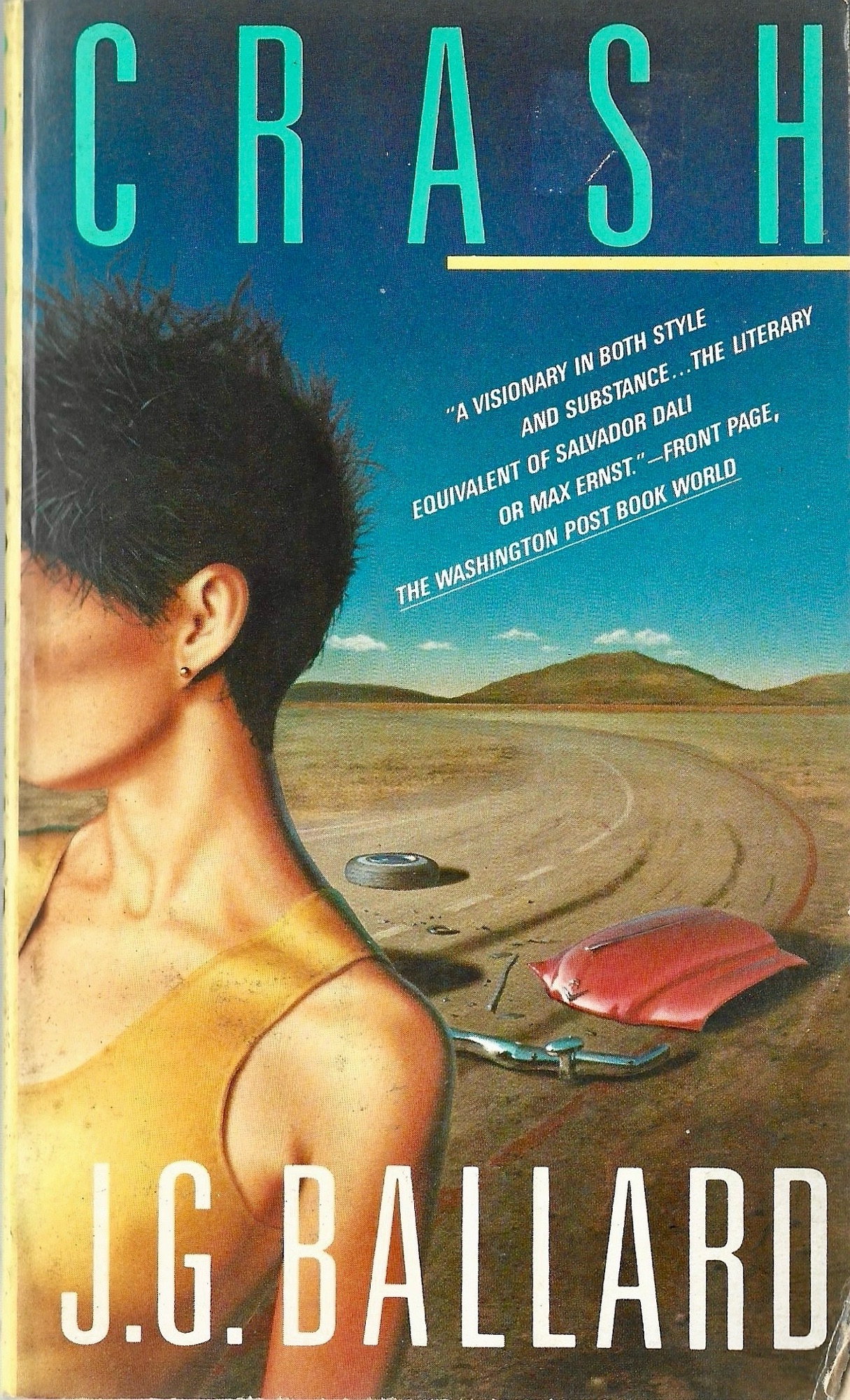

Crash, J.G. Ballard. Vintage Books, first Vintage Books edition (1985). Cover design by Carin Goldberg with art by Chris Moore. 224 pages.
A few sentences and fragments from The New York Time’s original 1973 review of Crash:
…hands-down, the most repulsive book I’ve yet to come across.
….as reader, I promise you, only a virtuoso foulness can turn my stomach.
…a crazed, morbid roundelay of dismemberment and sexual perversion.
…I could not, in conscience, recommend it. Indeed I most cordially advise against.
…monomaniacal drive.
…The protagonists are titillated by collisions as dogs are by curb smells.
…Punched out eyeballs. Blood. Vomit. Fecal matter. Decapitation. Sperm. Bifurcated, mashed genitals.
…Perhaps J.G. Ballard was traumatized at a drive-in theater.
…I certainly won’t read further in the Ballard oeuvre.

The Pleasures of Dagobert (detail), 1945 by Leonora Carrington (1917–2011)

We visited Seattle over the fourth week of June 2024, our first time there.
We met up with some old friends and took our son to see his favorite band play at the Woodland Park Zoo. Unlike my last getaway (to Atlanta) I was carless and a bit more encumbered (kids, friends, friends’ kids, etc.), so I wasn’t able to get to as many bookstores as I would have liked to—but I still got to quite a few.
We stayed in the Belltown neighborhood. Full of restaurants, bars, and independent shops, Belltown’s about a ten or fifteen minute walk to the famous and touristy Pike Place Market, which, despite being famous and touristy also boasts some really cool little shops—including Left Bank Books which features “anti-authoritarian, anarchist, independent, radical and small-press titles.” They also have a section devoted to “Transgressive Literature/Weird Shit.”

Left Bank’s collection of used stuff is impressive, as are the myriad and diverse offering of zines. My son picked up a bunch of art zines and comix and I left with anarcho-surrealist Ron Sakolsky’s prose mixtape Scratching the Tiger’s Belly.
Also impressive at Pike Place is BLMF Literary Saloon, brimming with towers of reasonably-priced used books. Lionheart Bookstore is a bit less chaotic than BLMF and sells newer titles, with fewer used books. (Less chaotic is not a knock on BLMF, by the way.) I didn’t succumb to picking up a first-(US)-edition of J.G. Ballard’s The Day of Creation there, maybe because I was already carrying around some LPs my son bought at Holy Cow Records. We also stopped by Chin Music Press. They make some beautiful books.

I think my favorite spot at Pike Place though was Lamplight Books. There was a nice collection of used literature (including a lot of so-called weird shit). The proprietor patiently let me handle first editions of Ballard, Barthelme, Borges, and Burroughs books (among other non-B titles). They were happy when I picked up Jacob Siefring’s translation of Rabelais’s Doughnuts by Pierre Senges, proudly letting me know that I was supporting not just a local indie bookshop but a local indie press, Sublunary Editions.

Despite the crowds of tourists in Pike Place lining up to go into the world’s oldest Starbucks (which, as my pal pointed out, is no different than lining up to gawk at the first CVS or first Harbor Freight), Pike Place has some nice niche shops. (Our lunch at the terrace of The Pink Door was lovely, too.)
While thrifting and record shopping in the so-called “hipster” Capitol Hill neighborhood, my crew indulged me in a too-long browse at The Elliot Bay Book Company. I’m generally a used-bookstore guy–I tend to order new titles from my local used bookshop, and I’m mostly out looking for the weird shit–but I’m always impressed by stores like Elliot Bay, which features the kind of odd and out of the way stuff you won’t find at a Barnes & Noble. I have silly little “tests” I like to do in stores that sell new books, checking to see if they stock certain authors, and, if so, which titles, and Elliot Bay excelled. (No Antoine Volodine, though, but I assume someone picked up the last copy of Radiant Terminus.) There, I picked up Lord Jim at Home by Dinah Brooke. The lovely evocative cover was facing outward and appended with a bookseller’s note. The flap copy notes that when “Lord Jim at Home, was first published in 1973, it was described as ‘squalid and startling,’ ‘nastily horrific,’ and a ‘monstrous parody’ of upper-middle class English life” so I figured I could get down with that.

I suppose I could remark more on Seattle itself.
We were there for six days and seven nights, which is clearly not long enough to take the measure of any major city. The weather was wonderful—sunny with maximum temps of around 80 degrees Fahrenheit, a relief after weeks of a Florida heatwave mired in a humid and insufferable drought. Even a day hiking on Mt. Ranier was warmer than we expected. (We had a nice early dinner in Enumclaw that day; a charming town, we all agreed. Curious about this quaint hamlet, I read the Enumclaw Wikipedia page aloud to my crew as we drove back to our Belltown digs before stopping, aghast, thinking of the children.) Seattle itself was more touristy than I expected, and perhaps a bit more depressing. In both Belltown and Capitol Hill we witnessed far more addicts nodding than I might have expected, although no one bothered us. Most of the patrons in the bars, restaurants, and shops we visited in these neighborhoods seemed like they were from Some Other Place, transplants to this big city who might also move at any time to Some Other Place. Even in the warm weather it was a bit cold.
We did some of the touristy things, too: The Museum of Pop Culture (the Nirvana exhibit was depressing; I loved looking at their guitar collection and jamming with my wife and son in their Sound Lab space. The stop-motion-animation exhibit was cool); the Chihuly Garden and Glass museum was unexpectedly beautiful and curated in a way that made me appreciate the glass anew (we saw a baby rabbit, wholly unafraid, snacking in the garden); the Space Needle views were amazing (its history, an optimistic ideal of American progression, brought me down before I got on the fast elevator up). I’m not sure if any of it really cohered for me into the kernel of angst I get when I fall in love with a city—a city like Mexico City or New Orleans or Tokyo or Los Angeles—but that’s fine. We shouldn’t be falling in love all the time.
The show at the zoo provides a nice addendum to what I’ve written (even if it happened in the middle of the week). My son loved seeing the band with the awful name that I am Too Old to really get and I loved seeing him get to see them and loving them. What I loved was seeing the crowd of freaks and weirdos and nerds and normies, all so unconcerned, it seemed to me, with being hip or being seen as hip, so unconcerned with doing anything aside from taking the sensual summer solstice air. Everyone seemed so chill, so unuptight.
Maybe it was the overpriced zoo beers coursing in my ugly veins, but I loved the city a little bit right then, forgiving it for any of the ways it had failed to live up to the imaginary picture of Seattle that my twelve-year-old brain had manifested over three decades ago. Maybe I was seeing the fruition of the dream I’d latched onto, so so long ago, a dream for a place where people didn’t have to struggle so hard just to like, be who they are. I think I remember, for maybe a good half hour or so then, loving Seattle.
“The Mirror of Ink”
by
Jorge Luis Borges
Translated by Norman Thomas di Giovanni
All history knows that the cruelest of the rulers of the Sudan was Yaqub the Ailing, who delivered his country to the rapacity of Egyptian tax collectors and died in a palace chamber on the fourteenth day of the moon of Barmahat, in the year 1842. There are those who hold that the wizard Abd-er-Rahman al-Masmudi (whose name may be translated as the ‘Servant of the All-Merciful) slew him by means of a dagger or poison. That he died a natural death is more likely, however, since he was called the Ailing. Captain Richard F. Burton spoke to the wizard in 1853, and recounts the tale I quote here:
It is true that as a consequence of the conspiracy woven by my brother Ibrahim, with the treacherous and useless support of the black chiefs of Kordofan, who betrayed him, I suffered captivity in the castle of Yaqub the Ailing. My brother perished by the sword, on the blood-red skin of Justice, but I flung myself at the hated feet of the Ailing, telling him that I was a wizard, and that if he spared my life I would show him shapes and appearances still more wonderful than those of the magic lantern. The tyrant demanded an immediate proof. I asked for a reed pen, a pair of scissors, a large leaf of Venetian paper, an inkhorn, a chafing dish with some live coals in it, some coriander seeds, and an ounce of benzoin. I cut up the paper into six strips, wrote charms and invocation on the first five, and on the remaining one wrote the following words, taken from the glorious Koran: ‘And we have removed from thee thy veil; and thy sight today is piercing.’ Then I drew a magic square in the palm of Yaqub’s right hand, told him to make a hollow of it, and into the centre I poured a pool of ink. I asked him if he saw himself clearly reflected in it, and he answered that he did. I told him not to raise his head. I dropped the benzoin and coriander seeds into the chafing dish, and I burned the invocations upon the glowing coals. I next asked him to name the image he desired to see.
He thought a moment and said, ‘A wild horse, the finest of those that graze along the borders of the desert.’ Looking, he saw a quiet, green pasture, and a minute later a horse drawing near, lithe as a leopard, with a white spot on its face. He asked me for a drove of horses as handsome as the first one, and on the horizon he saw a cloud of dust, and then the drove. It was at this point that I knew my life was spared.
From that day on, with the first streak of light in the eastern sky, two soldiers would enter my cell and lead me to the Ailing’s bedchamber, where the incense, the chafing dish, and the ink were already laid out. So it was that he demanded of me, and I showed him, all the visible things of this world. This man, whom I still hate, had in his palm everything seen by men now dead and everything seen by the living: the cities, the climates, the kingdoms into which the earth is divided; the treasures hidden in its bowels; the ships that ply its seas; the many instruments of war, of music, of surgery; fair women; the fixed stars and the planets; the colours used by the ungodly to paint their odious pictures; minerals and plants, with the secrets and properties they hold locked up in them; the silvery angels, whose only food is the praise and worship of the Lord; the awarding of prizes in schools; the idols of birds and kings buried in the heart of the pyramids; the shadow cast by the bull that holds up the world and by the fish that lies under the bull; the sandy wastes of Allah the All-Merciful. He saw things impossible to tell, like gaslit streets and the whale that dies on hearing the cry of a man. Once, he ordered me to show him the city called Europe. I let him see its main thoroughfare, and it was there, I believe, in that great stream of men all wearing black and many using spectacles that he first set eyes on the Man with the Mask.
This figure, at times in Sudanese garments and at times in uniform, but always with a veil over his face, from then on haunted the things we saw. He was never absent, and we dared not divine who he was. The images in the mirror of ink, at first fleeting or fixed, were more intricate now; they obeyed my commands without delay, and the tyrant saw them quite plainly. Of course, the growing cruelty of the scenes left us both in a state of exhaustion. We witnessed nothing but punishments, garrottings, mutilations, the pleasures of the executioner and of the merciless.
In this way, we came to the dawn of the fourteenth day of the moon of Barmahat. The circle of ink had been poured into the tyrant’s hand, the benzoin and coriander cast into the chafing dish, the invocations burned. The two of us were alone. The Ailing ordered me to show him a punishment both lawful and unappealable, for that day his heart hungered to view an execution. I let him see the soldiers with their drums, the spread calfskin, the persons lucky enough to be onlookers, the executioner wielding the sword of Justice. Marveling at the sight of him, Yaqub told me, ‘That’s Abu Kir, he who dealt justice to your brother Ibrahim, he who will seal your fate when it’s given me to know the science of bringing together these images without your aid.’
He asked me to have the doomed man brought forward. When this was done, seeing that the man to be executed was the mysterious man of the veil, the tyrant paled. I was ordered to have the veil removed before justice was carried out. At this, I threw myself at his feet, beseeching, ‘O king of time and sum and substance of the age, this figure is not like any of the others, for we do not know his name or the name of his fathers or the name of the city where he was born. I dare not tamper with the image, for fear of incurring a sin for which I shall be held to account.’
The Ailing laughed, and when he finished he swore that he would take the guilt on his own head if guilt there were. He swore this by his sword and by the Koran. I then commanded that the prisoner be stripped and that he be bound on the calfskin, and that the mask be torn from his face. These things were done. At last, Yaqub’s stricken eyes could see the face it was his own. He was filled with fear and madness. I gripped his trembling hand in mine, which was steady, and I ordered him to go on witnessing the ceremony of his death. He was possessed by the mirror, so much so that he attempted neither to avert his eyes nor to spill the ink. When in the vision the sword fell on the guilty head, Yaqub moaned with a sound that left my pity untouched, and he tumbled to the floor, dead. Glory be to Him, who endureth forever, and in whose hand are the keys of unlimited Pardon and unending Punishment.
From The Lake Regions of Central Africa (1860) by Richard F. Burton
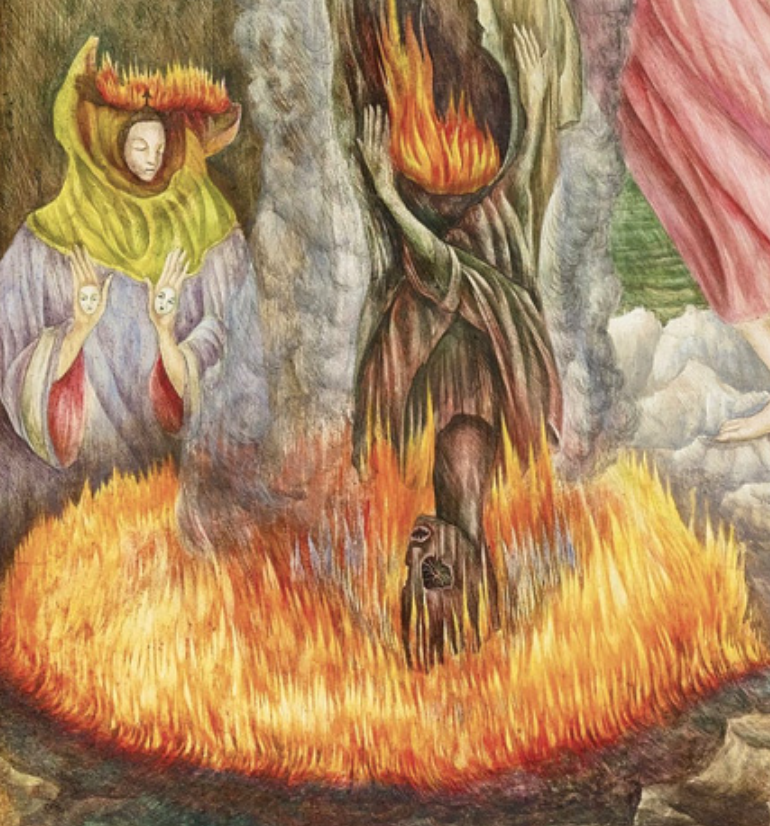
The Pleasures of Dagobert (detail), 1945 by Leonora Carrington (1917–2011)
an archivist
ripple effects
cursed history
perimenopause
estranged friend
small-town Texas
thirst for revenge
Gatsbyish parties
vampire geneticist
pregnant girlfriend
locked-room thriller
globe-trotting romp
magical realist romp
decades of instability
long-held class issues
moment of transition
deep into his own past
teenager goes missing
a torrent of memories
religious-zealot husband
wealthy summer resident
Adirondack summer camp
personal assistant disappears
across Italy, France and Spain
crumbling Victorian mansion
missing father officially dead
the beloved private detective
dreams of becoming a sommelier
turning all of their lives upside down
hellbent on reliving his very dark past
latest in this best-selling mystery series
who can rack up more sexual conquests
a new historical novel with an artistic bent
where sex, power and corruption intersect
young lovers try to forge a future together
the life-changing epiphany of a hydrologist
a fellow émigré with whom he had an affair
stymied by the responsibilities of motherhood
reshaping American science fiction and fantasy
the family fortune has dwindled to almost nothing
more interested in luxury wellness than social justice
a kid full of promise whose life changed one summer night
must reckon with how to build a future for their young twins
a wealthy family grappling with the aftershocks of its patriarch’s kidnapping
must put his retirement plans on hold and find the missing girl
must join forces with one of the unknowable robots
the sisters take it as a sign to change their lives
embarking on a search for his missing brother
expelled from Maine’s Penobscot Reservation
embroiled in some murky business dealings
following a family of Murano glassblowers
the world careens toward global conflict
a narrative that comments on ambition
he crosses paths with two sex workers
idyllic but aging house on Cape Cod
a New England mill town in decline
a gangster who works in nightlife
comfort in a 14th-century poem
her own mother’s ambivalence
crucible of domestic pressure
grappling with the intensities
cult-favorite art house film
industrial dynasty grapples
cookie-cutter McMansion
working-class community
caused a stir on the island
ghosts of a different kind
life’s pivotal moments
lesser-known players
two forbidden lovers
wealthy tourist island
off-grid hunting trip
into the underworld
hyperbaric chamber
family’s revelations
impending baptism
rags-to-riches story
tech-free getaway
murderous youth
home burns down
Maine hometown
dystopian reality
emotional needs
worrisome ways
ultimate fates
tragedy struck
scholar-witch
refugees fled
middle-aged
old-money
epic
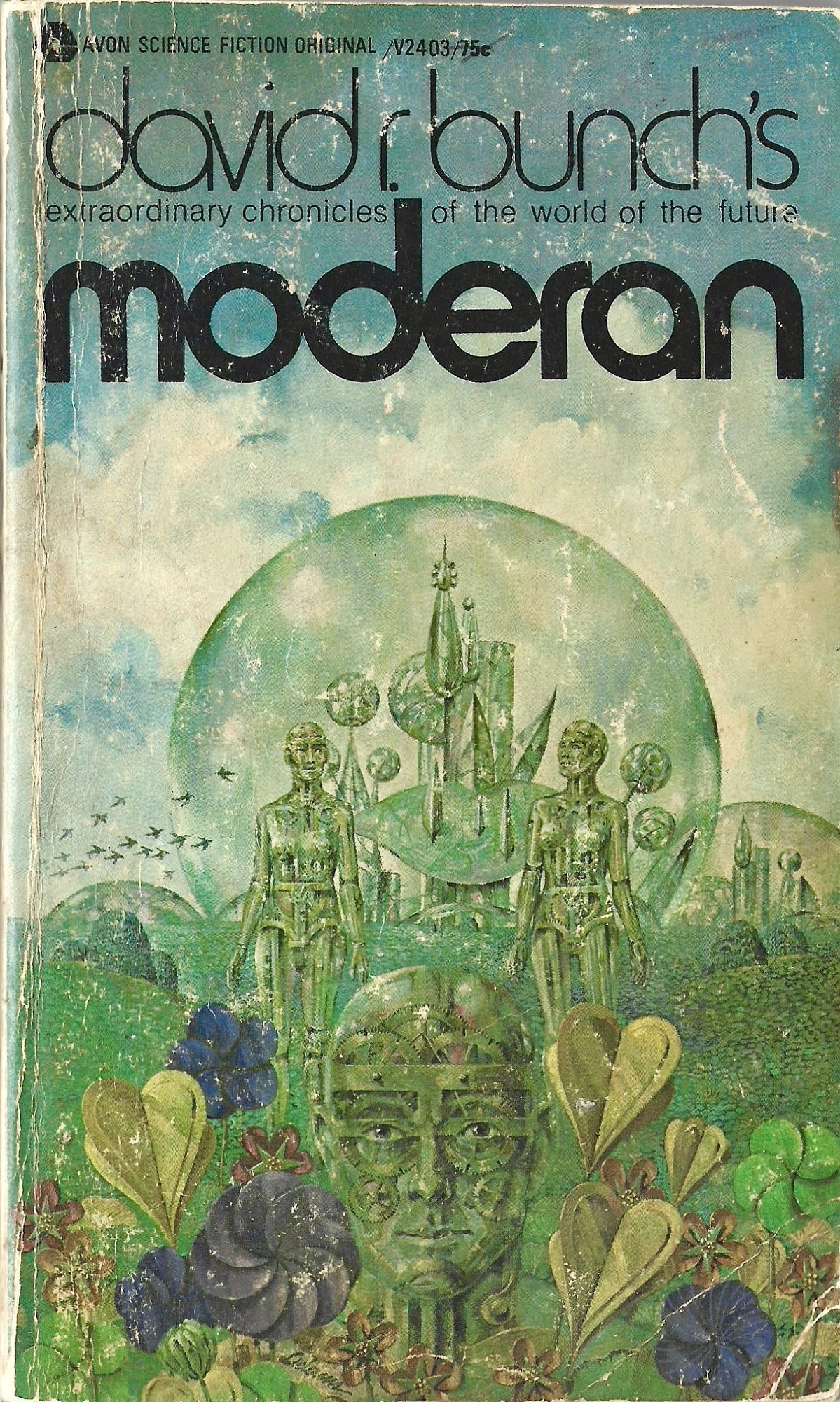
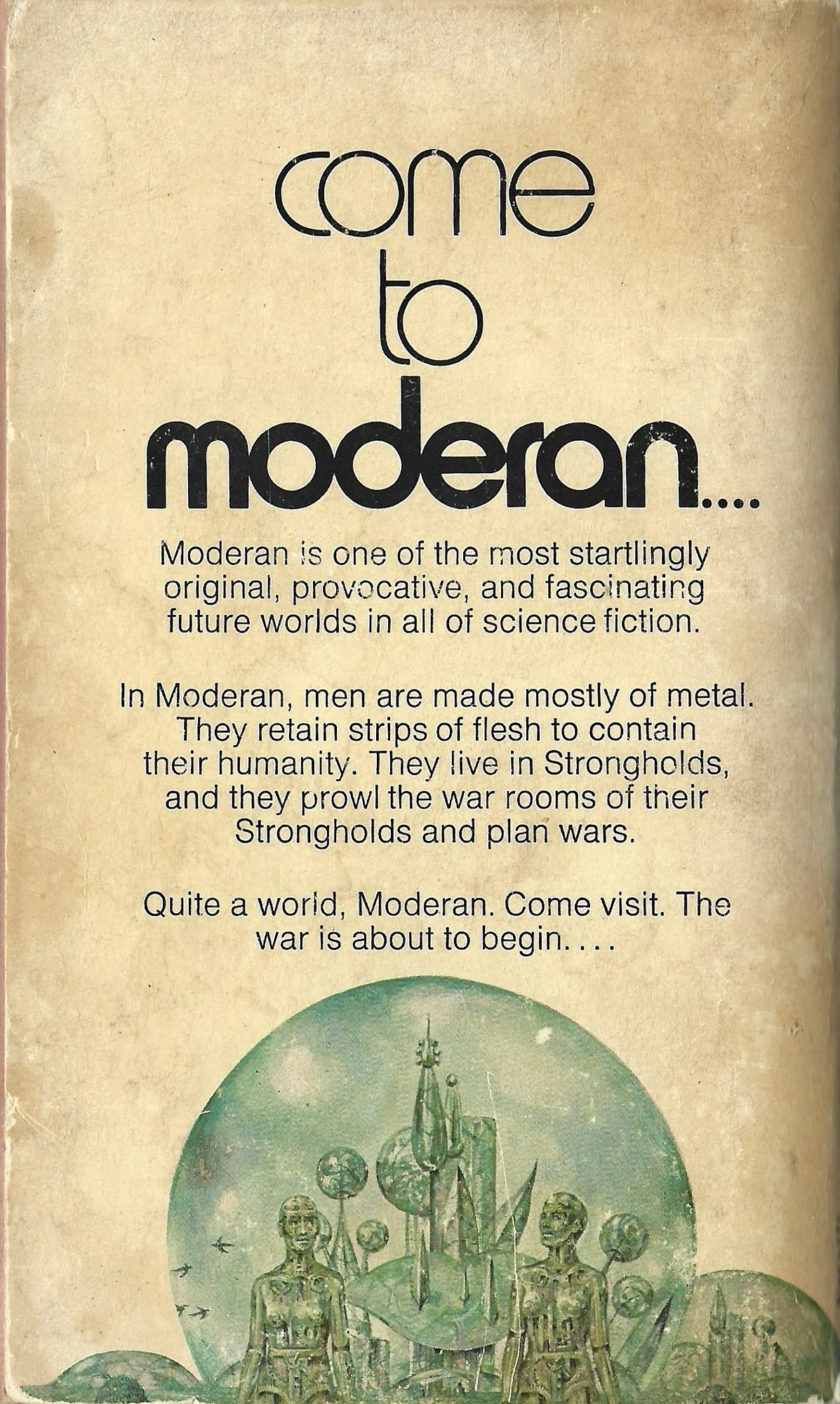
Moderan, David R. Bunch. Avon Books, first edition (1971). No cover artist credited. 240 pages.
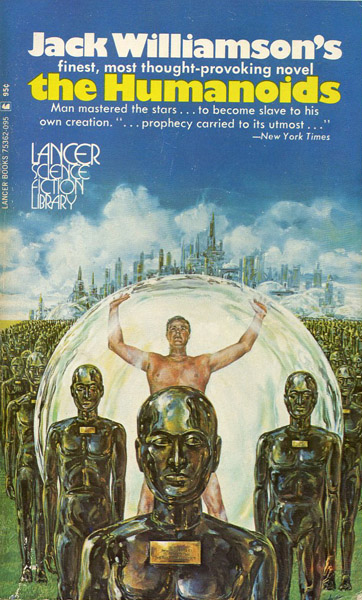
The uncredited Boschian cover for this 1971 mass-market paperback edition of Moderan is by Norman Adams. (Adams did a similar cover in 1972 for Jack Williamson’s novel The Humanoids.)
I think copies of this volume were expensive and hard to find previous to NYRB’s 2018 release of a new edition of Moderan (which included eleven new tales). That’s the version I read—although I was happy to snap this old paperback up for three bucks at a used bookstore. I wrote of the novel in my 2018 reading round-up:
Moderan works as a post-nuke dystopian satire on toxic masculinity. The tropes here might seem familiar—cyborgs and dome homes, caste systems and ultraviolence, a world of made and not born ruled by manunkind (to steal from E.E. Cummings)—it’s the way that Bunch conveys this world that is so astounding. Moderan is told in its own idiom; the voice of our narrator Stronghold-10 booms with a bravado that’s ultimately undercut by the authorial irony that lurks under its surface. The book seems equal to the task of satirizing the trajectory of our zeitgeist in a way that some contemporary satirists have failed to.
 Biblioklept