“The Ethnographer” — Jorge Luis Borges

“The Ethnographer”
by
Jorge Luis Borges

I was told about the case in Texas, but it had happened in another state. It has a single protagonist (though in every story there are thousands of protagonists, visible and invisible, alive and dead). The man’s name, I believe, was Fred Murdock. He was tall, as Americans are; his hair was neither blond nor dark, his features were sharp, and he spoke very little. There was nothing singular about him, not even that feigned singularity that young men affect. He was naturally respectful, and he distrusted neither books nor the men and women who write them. He was at that age when a man doesn’t yet know who he is, and so is ready to throw himself into whatever chance puts in his way — Persian mysticism or the unknown origins of Hungarian, the hazards of war or algebra, Puritanism or orgy. At the university, an adviser had interested him in Amerindian languages. Certain esoteric rites still survived in certain tribes out West; one of his professors, an older man, suggested that he go live on a reservation, observe the rites, and discover the secret revealed by the medicine men to the initiates. When he came back, he would have his dissertation, and the university authorities would see that it was published. Murdock leaped at the suggestion. One of his ancestors had died in the frontier wars; that bygone conflict of his race was now a link. He must have foreseen the difficulties that lay ahead for him; he would have to convince the red men to accept him as one of their own. He set out upon the long adventure. He lived for more than two years on the prairie, sometimes sheltered by adobe walls and sometimes in the open. He rose before dawn, went to bed at sundown, and came to dream in a language that was not that of his fathers. He conditioned his palate to harsh flavors, he covered himself with strange clothing, he forgot his friends and the city, he came to think in a fashion that the logic of his mind rejected. During the first few months of his new education he secretly took notes; later, he tore the notes up — perhaps to avoid drawing suspicion upon himself, perhaps because he no longer needed them. After a period of time (determined upon in advance by certain practices, both spiritual and physical), the priest instructed Murdock to start remembering his dreams, and to recount them to him at daybreak each morning. The young man found that on nights of the full moon he dreamed of buffalo. He reported these recurrent dreams to his teacher; the teacher at last revealed to him the tribe’s secret doctrine. One morning, without saying a word to anyone, Murdock left.

In the city, he was homesick for those first evenings on the prairie when, long ago, he had been homesick for the city. He made his way to his professor’s office and told him that he knew the secret, but had resolved not to reveal it.

“Are you bound by your oath?” the professor asked.

“That’s not the reason,” Murdock replied. “I learned something out there that I can’t express.”

“The English language may not be able to communicate it,” the professor suggested.

“That’s not it, sir. Now that I possess the secret, I could tell it in a hundred different and even contradictory ways. I don’t know how to tell you this, but the secret is beautiful, and science, our science, seems mere frivolity to me now.”

After a pause he added: “And anyway, the secret is not as important as the paths that led me to it. Each person has to walk those paths himself.”

The professor spoke coldly: “I will inform the committee of your decision. Are you planning to live among the Indians?”

“No,” Murdock answered. “I may not even go back to the prairie. What the men of the prairie taught me is good anywhere and for any circumstances.”

That was the essence of their conversation.

Fred married, divorced, and is now one of the librarians at Yale.

(Translation by Andrew Hurley).

The Japanese Book — William Merritt Chase

Dazzled (Kafka)

IMG_0101

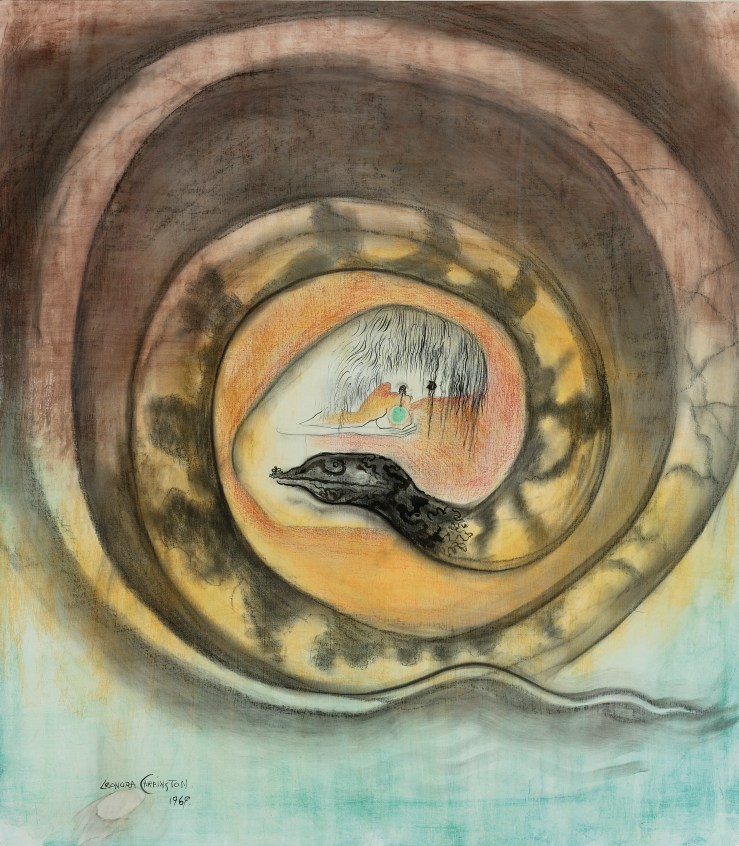
The 4706th Floor — Leonora Carrington

The 4706th Floor

I had never heard of Faulkner, Kafka, Joyce (Flannery O’Connor)


I didn’t really start to read until I went to Graduate School and then I began to read and write at the same time. When I went to Iowa I had never heard of Faulkner, Kafka, Joyce, much less read them. Then I began to read everything ay once, so much so that I didn’t have time I suppose to be influenced by any one writer. I read all the Catholic novelists, Mauriac, Bernanos, Bloy, Greene, Waugh; I read all the nuts like Djuna Barnes and Dorothy Richardson and Va. Woolf (unfair to the dear lady, of course); I read the best Southern writers like Faulkner and the Tates, K.A. Porter, Eudora Welty and Peter Taylor; read the Russians, not Tolstoy so much as Doestoyevsky, Turgenev, Chekhov and Gogol. I became a great admirer of Conrad and have read almost all his fiction. I have totally skipped such people as Dreiser, Anderson (except for a few stories) and Thomas Wolfe. I have learned something from Hawthorne, Flaubert, Balzac and something from Kafka, though I have never been able to finish one of his novels. I’ve read almost all of Henry James – from a sense of High Duty and because when I read James I feel something is happening to me, in slow motion but happening nevertheless. I admire Dr. Johnson’s Lives of the Poets. But always the largest thing that looms up is The Humerous Tales of Edgar Allan Poe. I am sure he wrote them all while drunk too.

From a letter by Flannery O’Connor.

The letter, dated 28 August, 1955, was addressed to a young woman who began writing O’Connor after reading her work. Their correspondence lasted until O’Connor’s early death in 1964, and, as editor Sally Fitzgerald notes in The Habit of Being (where the letter is published), the letters to this woman (identified only as “A,” as she wished to remain anonymous) are particularly rich, in that all O’Connor “had to say to this almost uniquely important friend did not go up in talk but had to be written down.”

Watch Drums West, a 1961 Cut-paper Animation by Jim Henson

Surest sign (Calvin and Hobbes)

CalvinHobbes

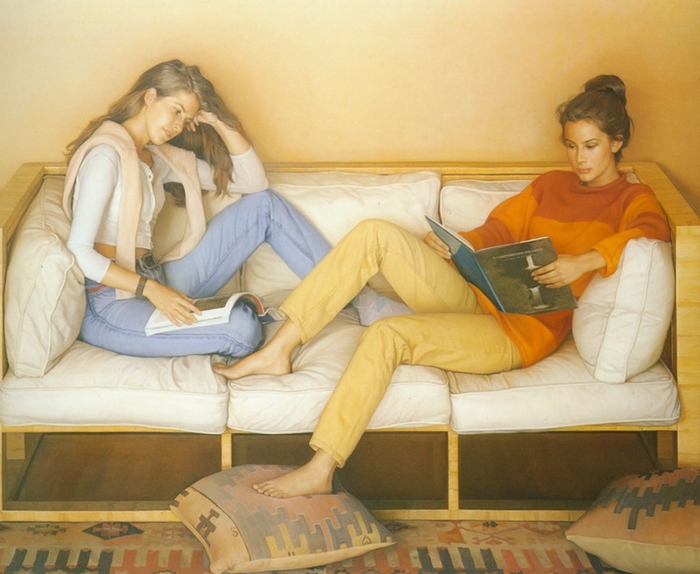
Bookshelf — Jessica Rohrer

Bookshelf_2010_15x11 inches

The Sleepers — Gustave Courbet

Watch Children, A Short Film by Terrence Davies

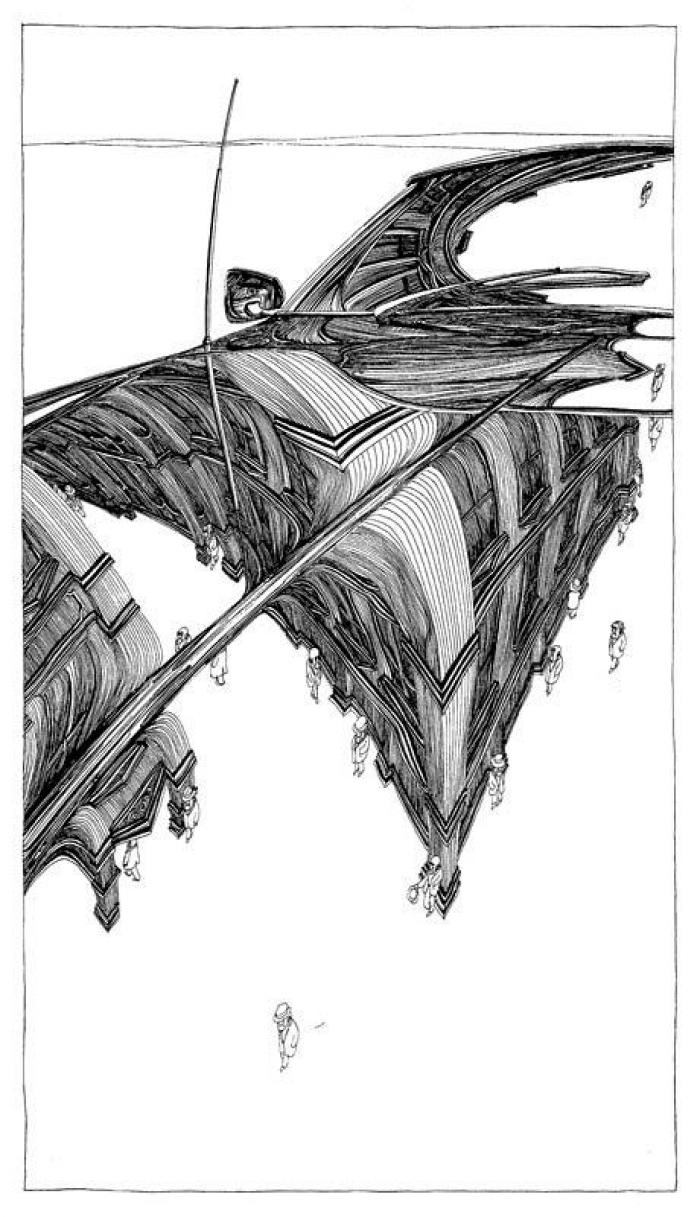
The Bus — Paul Kirchner

bus

Fable that will Foretell a Parable — Ged Quinn

David Mitchell’s The Bone Clocks (Book Acquired, 8.19.2014)

IMG_3128

David Mitchell’s new novel The Bone Clocks showed up at Biblioklept World Headquarters earlier this week, but I’ve been busy with the start of the Fall semester and haven’t had a chance to get into it yet. Here’s publisher Random House’s blurb:

Following a terrible fight with her mother over her boyfriend, fifteen-year-old Holly Sykes slams the door on her family and her old life. But Holly is no typical teenage runaway: A sensitive child once contacted by voices she knew only as “the radio people,” Holly is a lightning rod for psychic phenomena. Now, as she wanders deeper into the English countryside, visions and coincidences reorder her reality until they assume the aura of a nightmare brought to life.

For Holly has caught the attention of a cabal of dangerous mystics—and their enemies. But her lost weekend is merely the prelude to a shocking disappearance that leaves her family irrevocably scarred. This unsolved mystery will echo through every decade of Holly’s life, affecting all the people Holly loves—even the ones who are not yet born.

A Cambridge scholarship boy grooming himself for wealth and influence, a conflicted father who feels alive only while reporting on the war in Iraq, a middle-aged writer mourning his exile from the bestseller list—all have a part to play in this surreal, invisible war on the margins of our world. From the medieval Swiss Alps to the nineteenth-century Australian bush, from a hotel in Shanghai to a Manhattan townhouse in the near future, their stories come together in moments of everyday grace and extraordinary wonder.

Rich with character and realms of possibility, The Bone Clocks is a kaleidoscopic novel that begs to be taken apart and put back together by a writer The Washington Post calls “the novelist who’s been showing us the future of fiction.”

An elegant conjurer of interconnected tales, a genre-bending daredevil, and a master prose stylist, David Mitchell has become one of the leading literary voices of his generation. His hypnotic new novel, The Bone Clocks, crackles with invention and wit and sheer storytelling pleasure—it is fiction at its most spellbinding.

Nathaniel Hawthorne Runs Into Ralph Waldo Emerson and Margaret Fuller in Sleepy Hollow (Note-Book Entry for August 22nd, 1842)

Monday, August 22d.

I took a walk through the woods yesterday afternoon, to Mr. Emerson’s, with a book which Margaret Fuller had left, after a call on Saturday eve. I missed the nearest way, and wandered into a very secluded portion of the forest; for forest it might justly be called, so dense and sombre was the shade of oaks and pines. Once I wandered into a tract so overgrown with bushes and underbrush that I could scarcely force a passage through. Nothing is more annoying than a walk of this kind, where one is tormented by an innumerable host of petty impediments. It incenses and depresses me at the same time. Always when I flounder into the midst of bushes, which cross and intertwine themselves about my legs, and brush my face, and seize hold of my clothes, with their multitudinous grip,–always, in such a difficulty, I feel as if it were almost as well to lie down and die in rage and despair as to go one step farther. It is laughable, after I have got out of the moil, to think how miserably it affected me for the moment; but I had better learn patience betimes, for there are many such bushy tracts in this vicinity, on the margins of meadows, and my walks will often lead me into them. Escaping from the bushes, I soon came to an open space among the woods,–a very lovely spot, with the tall old trees standing around as quietly as if no one had intruded there throughout the whole summer. A company of crows were holding their Sabbath on their summits. Apparently they felt themselves injured or insulted by my presence; for, with one consent, they began to Caw! caw! caw! and, launching themselves sullenly on the air, took flight to some securer solitude. Mine, probably, was the first human shape that they had seen all day long,–at least, if they had been stationary in that spot; but perhaps they had winged their way over miles and miles of country, had breakfasted on the summit of Graylock, and dined at the base of Wachusett, and were merely come to sup and sleep among the quiet woods of Concord. But it was my impression at the time, that they had sat still and silent on the tops of the trees all through the Sabbath day, and I felt like one who should unawares disturb an assembly of worshippers. A crow, however, has no real pretensions to religion, in spite of his gravity of mien and black attire. Crows are certainly thieves, and probably infidels. Nevertheless, their voices yesterday were in admirable accordance with the influences of the quiet, sunny, warm, yet autumnal afternoon. They were so far above my head that their loud clamor added to the quiet of the scene, instead of disturbing it. There was no other sound, except the song of the cricket, which is but an audible stillness; for, though it be very loud and heard afar, yet the mind does not take note of it as a sound, so entirely does it mingle and lose its individuality among the other characteristics of coming autumn. Alas for the summer! The grass is still verdant on the hills and in the valleys; the foliage of the trees is as dense as ever, and as green; the flowers are abundant along the margin of the river, and in the hedge-rows, and deep among the woods; the days, too, are as fervid as they were a month ago; and yet in every breath of wind and in every beam of sunshine there is an autumnal influence. I know not how to describe it. Methinks there is a sort of coolness amid all the heat, and a mildness in the brightest of the sunshine. A breeze cannot stir without thrilling me with the breath of autumn, and I behold its pensive glory in the far, golden gleams among the long shadows of the trees. The flowers, even the brightest of them,–the golden-rod and the gorgeous cardinals,–the most glorious flowers of the year,–have this gentle sadness amid their pomp. Pensive autumn is expressed in the glow of every one of them. I have felt this influence earlier in some years than in others. Sometimes autumn may be perceived even in the early days of July. There is no other feeling like that caused by this faint, doubtful, yet real perception, or rather prophecy, of the year’s decay, so deliciously sweet and sad at the same time.

Continue reading “Nathaniel Hawthorne Runs Into Ralph Waldo Emerson and Margaret Fuller in Sleepy Hollow (Note-Book Entry for August 22nd, 1842)”

The Red Lamp — Francine van Hove

francine-van-hove2

The American Poseur’s Journal | Doris Lessing’s The Golden Notebook

This section of Doris Lessing’s novel The Golden Notebook actually made me laugh aloud. She offers a wonderful parody of “a young American living on an allowance from his father who works in insurance”; the section recalls William Gaddis’s similar send-ups in The Recognitions (and again links the two novels together in my consciousness).

[The right side of the black notebook, under the heading Money, continued.]

Some months ago I got a letter from the Pomegranate Review, New Zealand, asking for a story. Wrote back, saying I did not write stories. They replied asking for ‘portions of your journals, if you keep them’. Replied saying I did not believe in publishing journals written for oneself. Amused myself composing imaginary journal, of the right tone for a literary review in a colony or the Dominions: circles isolated from the centres of culture will tolerate a far more solemn tone than the editors and their customers in let’s say London or Paris. (Though sometimes I wonder.) This journal is kept by a young American living on an allowance from his father who works in insurance. He has had three short stories published and has completed a third of a novel. He drinks rather too much, but not as much as he likes people to think; takes marihuana, but only when friends from the States visit him. He is full of contempt for that crude phenomenon, the United States of America.

April 16th. On the steps of the Louvre. Remembered Dora. That girl was in real trouble. I wonder if she has solved her problems. Must write to my father. The tone of his last letter hurt me. Must we be always isolated from each other? I am an artist – Mon Dieu!

April 17th. The Gare de Lyon. Thought of Lise. My God, and that was two years ago! What have I done with my life? Paris has stolen it … must re-read Proust.

April 18th. London. The Horseguards’ Parade. A writer is the conscience of the world. Thought of Marie. It is a writer’s duty to betray his wife, his country and his friend if it serves his art. Also his mistress.

April 18th. Outside Buckingham Palace. George Eliot is the rich man’s Gissing. Must write to my father. Only ninety dollars left. Will we ever speak the same language? Continue reading “The American Poseur’s Journal | Doris Lessing’s The Golden Notebook”