Portrait of the Artist’s Mother — Franz Marc

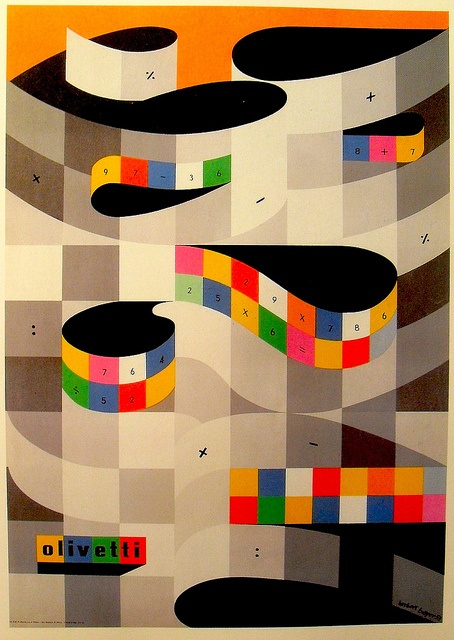
Olivetti Poster — Herbert Bayer

olivetti

“What in water did Bloom, waterlover, drawer of water, watercarrier, returning to the range, admire?” (Ulysses)

What in water did Bloom, waterlover, drawer of water, watercarrier, returning to the range, admire?

Its universality: its democratic equality and constancy to its nature in seeking its own level: its vastness in the ocean of Mercator’s projection: its unplumbed profundity in the Sundam trench of the Pacific exceeding 8000 fathoms: the restlessness of its waves and surface particles visiting in turn all points of its seaboard: the independence of its units: the variability of states of sea: its hydrostatic quiescence in calm: its hydrokinetic turgidity in neap and spring tides: its subsidence after devastation: its sterility in the circumpolar icecaps, arctic and antarctic: its climatic and commercial significance: its preponderance of 3 to 1 over the dry land of the globe: its indisputable hegemony extending in square leagues over all the region below the subequatorial tropic of Capricorn: the multisecular stability of its primeval basin: its luteofulvous bed: its capacity to dissolve and hold in solution all soluble substances including millions of tons of the most precious metals: its slow erosions of peninsulas and islands, its persistent formation of homothetic islands, peninsulas and downwardtending promontories: its alluvial deposits: its weight and volume and density: its imperturbability in lagoons and highland tarns: its gradation of colours in the torrid and temperate and frigid zones: its vehicular ramifications in continental lakecontained streams and confluent oceanflowing rivers with their tributaries and transoceanic currents, gulfstream, north and south equatorial courses: its violence in seaquakes, waterspouts, Artesian wells, eruptions, torrents, eddies, freshets, spates, groundswells, watersheds, waterpartings, geysers, cataracts, whirlpools, maelstroms, inundations, deluges, cloudbursts: its vast circumterrestrial ahorizontal curve: its secrecy in springs and latent humidity, revealed by rhabdomantic or hygrometric instruments and exemplified by the well by the hole in the wall at Ashtown gate, saturation of air, distillation of dew: the simplicity of its composition, two constituent parts of hydrogen with one constituent part of oxygen: its healing virtues: its buoyancy in the waters of the Dead Sea: its persevering penetrativeness in runnels, gullies, inadequate dams, leaks on shipboard: its properties for cleansing, quenching thirst and fire, nourishing vegetation: its infallibility as paradigm and paragon: its metamorphoses as vapour, mist, cloud, rain, sleet, snow, hail: its strength in rigid hydrants: its variety of forms in loughs and bays and gulfs and bights and guts and lagoons and atolls and archipelagos and sounds and fjords and minches and tidal estuaries and arms of sea: its solidity in glaciers, icebergs, icefloes: its docility in working hydraulic millwheels, turbines, dynamos, electric power stations, bleachworks, tanneries, scutchmills: its utility in canals, rivers, if navigable, floating and graving docks: its potentiality derivable from harnessed tides or watercourses falling from level to level: its submarine fauna and flora (anacoustic, photophobe), numerically, if not literally, the inhabitants of the globe: its ubiquity as constituting 90 percent of the human body: the noxiousness of its effluvia in lacustrine marshes, pestilential fens, faded flowerwater, stagnant pools in the waning moon.

From the penultimate episode of James Joyce’s Ulysses.

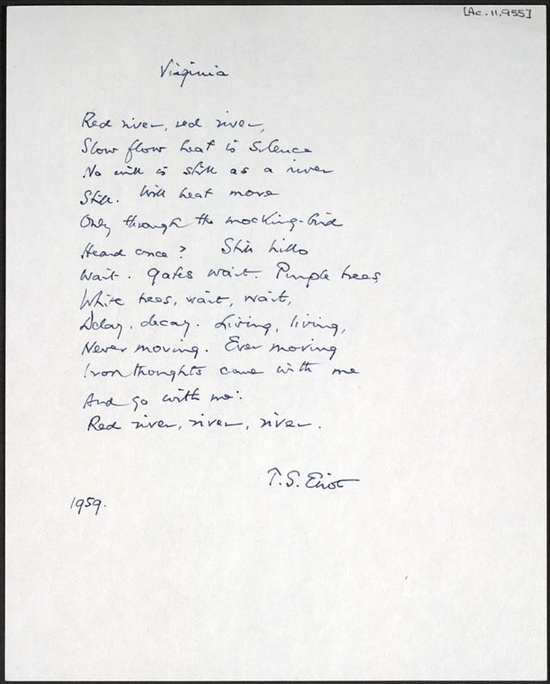
T.S. Eliot’s Handwritten Manuscript for “Virginia”

virginia_eliot

Red river, red river,
Slow flow heat is silence
No will is still as a river
Still. Will heat move
Only through the mocking-bird
Heard once? Still hills
Wait. Gates wait. Purple trees,
White trees, wait, wait,
Delay, decay. Living, living,
Never moving. Ever moving
Iron thoughts came with me
And go with me:
Red river, river, river.


(Via).

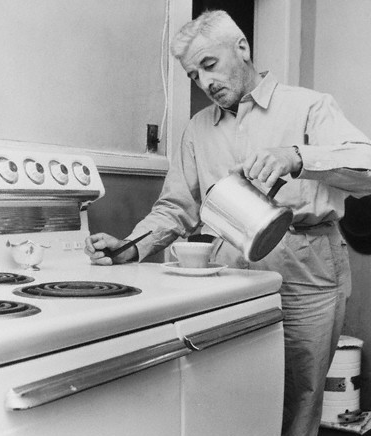
William Faulkner Pouring Some Coffee

tumblr_lrix0cDh9r1r2nz2so1_r1_400

(Via).

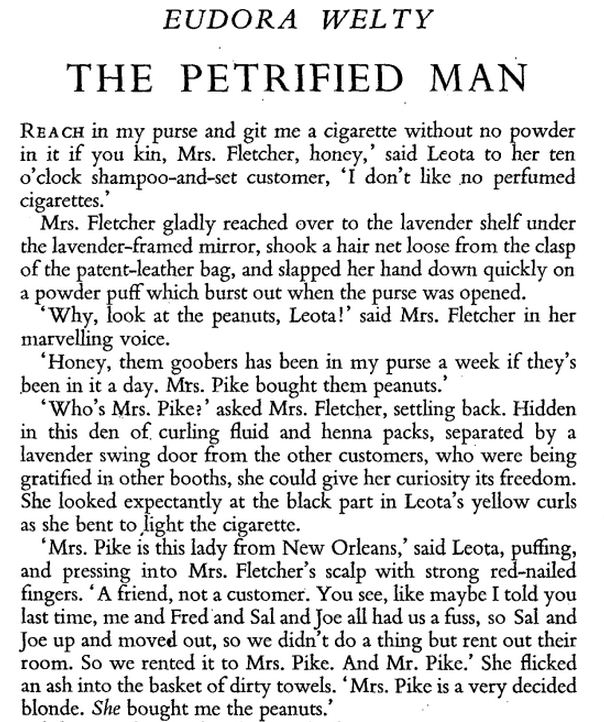
“Petrified Man” — Eudora Welty

ew

(Read the rest of “Petrified Man”).

Compartment Car — Edward Hopper

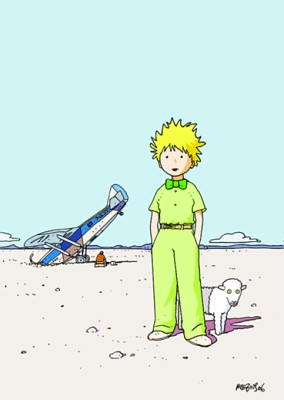
The Little Prince — Moebius

prince moebius

Handsome Devil William S. Burroughs, Smiling

William Burroughs in his flat, London, 1971. Photo by Baron Wolman

(Via).

Minotaur — William Blake

Joseph Heller’s Handwritten Outline for Catch-22

heller

(Via/more).

Duel (From A Week of Kindness) — Max Ernst

A Dwarf Holding a Tome in His Lap — Diego Velazquez

Vertigo — Leon Spilliaert

Plagiarism

Criminal man has lost all enterprise and originality.

And this same progeny of evils comes
From our debate, from our dissension;
We are their parents and original.

Those with no memory insist on their originality.

Books serve to show a man that those original thoughts of his aren’t very new after all.

Great poets steal.

The one and the only.

All my best thoughts!

Stolen by the ancients.

Ah! Gooblazqruk brukarchkrasht!

Truth! stark, naked truth, is the word; and I will not so much as take the pains to bestow the strip of a gauze wrapper on it, but paint situations such as they actually rose to me in nature, careless of violating those laws of decency that were never made for such unreserved intimacies as ours; and you have too much sense, too much knowledge of the originals, to sniff prudishly and out of character at the pictures of them.

Tear him for his bad verses, tear him for his bad verses.

Mature poets steal.

Nothing new except what has been forgotten.

It’s not a real leg, only a false leg.

And there’s a mighty difference between a living thump and a dead thump.

O! Weeshwashtkissinapooisthnapoohuck?

An original artist is unable to copy. So he has only to copy in order to be original.

Let a splinter swerve.

It hath it original from much grief, from study, and perturbation of the brain.

Great artists steal.

The original papers, together with the scarlet letter itself—a most curious relic—are still in my possession, and shall be freely exhibited to whomsoever, induced by the great interest of the narrative, may desire a sight of them. I must not be understood affirming that, in the dressing up of the tale, and imagining the motives and modes of passion that influenced the characters who figure in it, I have invariably confined myself within the limits of the old Surveyor’s half-a-dozen sheets of foolscap. On the contrary, I have allowed myself, as to such points, nearly, or altogether, as much license as if the facts had been entirely of my own invention. What I contend for is the authenticity of the outline.

Necessary to any originality: the courage to be an amateur.

It is all for the taking.

Great artists.

We have always been shameless about stealing great ideas.

The great artist who is truly schizophrenic will break the wall, reaching the unknown country where he does not belong to any age, any environment, any school.

And all that poets feign of bliss and joy.

Now, do you doubt that your bird was true?

Design for a Giant Crossbow — Leonardo da Vinci

Read “The Dark Arts,” A New Story by Ben Marcus

On a dark winter morning at the Müllerhaus men’s hostel, Julian Bledstein reached for his Dopp kit. At home, he could medicate himself blindfolded, but here, across the ocean, it wasn’t so easy. The room stank, and more than one young man was snoring. The beds in the old gymnasium were singles, which didn’t keep certain of the guests from coupling when the lights went out. Sometimes Julian could hear them going at it, fornicating as if with silencers on. He studied the sounds when he couldn’t sleep, picturing the worst: animals strapped to breathing machines, children smothered under blankets. In the morning he could never tell just who had been making love. The men dressed and left for the day, avoiding eye contact, mesmerized in the glow of their cell phones.

Julian held his breath and squeezed the syringe, draining untold dollars’ worth of questionable medicine into the flesh of his thigh. He clipped a bag holding the last of his money to the metal underside of his bed. His father’s hard-earned money. Not enough euros left. Not nearly enough. He’d have to make a call, poor-mouth into the phone until his father’s wallet spit out more bills.

Read the rest of Ben Marcus’s “The Dark Arts” at The New Yorker.