RIP Low’s Mimi Parker

Pitchfork and other media sites have reported the death of Mimi Parker. Parker was diagnosed with ovarian cancer in late 2020, and I’d hoped that she would recover. She was 55.

Along with her husband Alan Sparhawk, Parker was the core at the heart of the long-running band Low. She was the primary percussionist for the band, and traded vocals with Sparhawk to create slow, haunting, and deceptively simple songs.

I have intense memories of listening to Low’s 1994 debut I Could Live in Hope on repeat on my Walkman (but only in the winter). I loved their 1995 follow up, Long Division (somehow darker and crueler than the first record), but it’s 1996’s The Curtain Hits the Cast that will probably always be the definitive Low album for me. The dark opener “Anon” slides into two perfect, restrained pop songs — “The Plan” and “Over the Ocean,” a track carried by Parker’s perfect harmonies and spare percussion. The album’s penultimate track, “Do You Know How to Waltz?” is definitive slowcore noise, ambient and menacing and thrilling and hypnotic. (It was probably around this time that I made the Low t-shirt my wife later adopted, and then my daughter took up.)

I got to see Low play on the tour for their next album, Songs for a Dead Pilot. It was at a goth club in Orlando, on a small stage. I recall their being kids dancing to stuff like KMFDM in the main part of the club, and the sound drifted over. Everyone sat down. My friend Scott laid down and slept. It was wonderful. I got lost driving home to Gainseville and got home when the sun was coming up.

In 1999, Low released the perfect Christmas EP. Their original track “Just Like Christmas” is our favorite Christmas song in my household, and I know when we break it out in a few weeks I’ll feel like crying. There’s something perfect about how Parker characterizes a Scandinavian tour: “By the time we got to Oslo / The snow was gone / And we got lost / The beds were small / But we felt so young / It was just like Christmas.”

I got to see Low again, sometime around the summer of 2000. They played a small record store that I had ostensibly been working at (really, we used the space upstairs to rehearse our own band), and the owner offered a chance to meet them. I declined. The Canadian band Godspeed You! Black Emperor opened for them. There seemed to be no room for their ensemble and the audience to watch. The Low trio sat in the audience with us. Their set was like comedown music. Ethereal.

Things We Lost in the Fire came out in the spring of 2001. It was recorded by Steve Albini and it soundtracked a lot of my last year in college, which was often confusing and depressing and scary. Parker’s vocal on “In Metal” still destroys me.

In 2000s, I stopped keeping up with many of the nineties acts that I’d loved. With a handful of exceptions (the most notable being Lambchop), most indie acts were doing the same thing again and again, just not as well as they had once done. Low were different though. 2005’s The Great Destroyer, while not perfect, featured faster, poppier songs like “California.” The 2007 follow up, Drums and Guns is one of Low’s harshest, meanest, and best albums—a perfect response to the venomous Bush years. 2011’s C’Mon pushed their sound even further, while still holding on to their melodic core, as we can hear in a song like “Especially Me.”

Low’s 2015 record Ones and Sixes pointed to yet another direction—noisy, angular, chromatic. Low used the studio and self-sampling to create strange beauty. The trend continued on 2018’s Double Negative, where the band took the production techniques even farther, but it was last year’s 2021 that really saw the fruition of those experiments on HEY WHAT, an album that captures the weirdness and beauty of isolation, of unrelieved tension that folds into itself. Parker’s voice gliding through the digital noise and haze at the end of “Hey” is as wonderful as ever. Thank you so much for the gift of your music, Mimi.

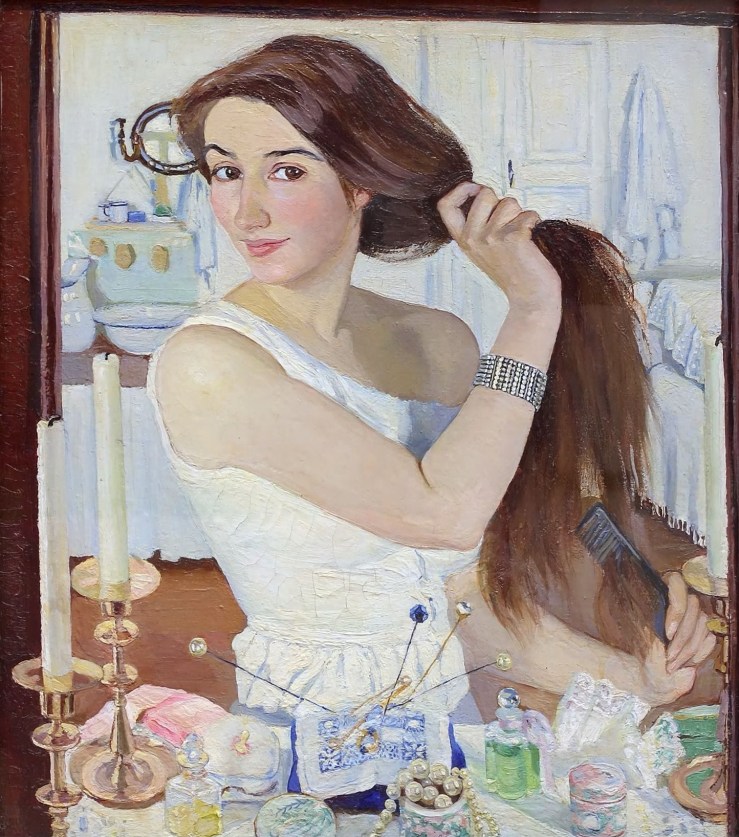
Girl (Portrait of Conchita) — Ángeles Santos Torroella

Girl (Portrait of Conchita), c. 1929 by Ángeles Santos Torroella (1911-2013)

“Detective Novel” — Robert Walser

“Detective Novel”

by

Robert Walser

translated by Tom Whalen


HE PRETENDED to possess technical expertise. Anyway, the title seemed quite brilliant. I resolved to learn more and started reading him, but he left much to be desired. Both he and his author lacked a certain finesse. He seemed to have no place to call home. How can I cuddle up to someone who isn’t comfortable with himself? His sentences were laborious paths for those who tread on them. I remember far more beautiful rambles and gladly admit this, since I gain by this admission. He was viewed quite kindly. An attempt to create interesting situations was discovered with delight. Already the first chapter stretched out to the most accommodating length imaginable. Each paragraph elicited from me a grateful yawn. By the way, I think the time of the detective novel is over. The puzzling disappearance of refined, charming people doesn’t seem very fresh these days. Authors have operated more than enough with chemicals and the like. I did my best to succumb to his charms, but alas I failed in this endeavor. Perhaps I lack the openness, I said, smiling at one of those persons (I mean myself) unsympathetic to some new releases. In fact, I find it aggravating to say yes to everything. In the course of the events he let me gaze into a Russian female. It may be that I’m expressing myself a bit sloppily here. All in all, for what he was, I found him unable to live up to himself. I hold his father responsible that I’m pained by his existence. My contemporaries may note his innocuousness. But can a detective novel be innocuous? Doesn’t he fail when, instead of arousing suspense, he allows us to be bored in his presence? Ambitious lackey, it would be best if you vanished. That you were published was your misfortune. Whoever reads you pities you. Whoever investigates you has to laugh at you, though, alas, alas, you’re innocent! In any case, you’re not what you should be. What you could be if things had turned out right you aren’t, because things didn’t turn out right. Fare thee well, unwarranted detective novel.

The incest thing | More scattered thoughts on Cormac McCarthy’s novel The Passenger

He’s in love with his sister and she’s dead.

The Passenger, Cormac McCarthy


The theme of brother-sister incest haunts the early American novel on its lower levels of literacy as well as on the higher—a nightmare from which our writers do not choose to awake too soon, since it is one their readers are willing to pay to share.

Love and Death in the American Novel, Leslie Fiedler


When he woke she was leaning against his shoulder. He thought she was asleep but she was looking out the plane window. We can do whatever we want, she said.

No, he said. We cant.

The Passenger, Cormac McCarthy


She turned to the Kid. What does it say on the trunk?

What does what say? 

There’s a sticker on the trunk.

Yeah. It says progeny of Western Union.

Progeny?

The Passenger, Cormac McCarthy


The last in the series of quotes above is an exchange between Alicia Western and her hort/figment/projection the Thalidomide Kid. The Kid has caused to be brought to Alicia a wiseassed—cruel, even—ventriloquist dummy. The dummy is another fitting prop in the Alicia-Kid episodes that punctuate The Passenger. It again underlines the vaudevillian aspect of these interstitial pieces, while also highlighting the novel’s themes of ventriloquism—of how memory of the dead might speak through the living, as the living grapple with death.

The quips above feature another of the Kid’s malapropisms — in this case his substitution of “progeny of Western Union” for property of Western Union. The Freudian slip (never really a slip on our imp’s tongue) points to The Passenger’s incest motif. It turns out that the dummy’s name is Crandall (perhaps named for the typewriter?). It’s likely Alicia herself named Crandall, and her grandmother tailored his clothes. I think the strong implication is that handy Bobby Western built (fathered) Crandall. In this sense, Crandall is the dreamchild born of a Western union. “I was only six,” Alicia cries as he disappears back into his case.


The incest motif perforates the literary tradition. We find it in Oedipus, in Lot seduced by his daughters, in David’s children Tamar and Amnon–a tale recapitulated in Faulkner’s southern Gothic Absalom! Absalom! We find it coded in Poe’s tale “The Fall of the House of Usher” or made strange but more clear in Melville’s baffling Pierre. We find it in the tawdry attic of V.C. Andrew’s lurid Dollanganger novels (likely read by many more Americans than the other novels I’ve named).

The incest thing in literature is, of course, an exploration of taboo, and is such the rightful property (or progeny) of literature. In his seminal (and often bombastic) study Love and Death in the American Novel, Leslie Fiedler suggests that “brother-sister incest in particular comes to stand in Romantic symbology for the rebellion against paternal authority, for the spirit of revolution itself.” He continues, declaring that the “Oedipal significance” of this revolutionary spirit “projects not only the desire to revolt, but also to die; that is to say, beneath the yearning for rebellion lies hidden the wish to be punished for it.”


Le’ts follow Fiedler’s reading (ahem, rehashing of Freud) and stick it on to the Western children: What is the paternal authority they rebel against—that is, beyond the actual literal father (a marginal memory)? Père Western was one of the lead authors of the atomic bomb. He changed the American relationship to death, permanently.


I have a little under a hundred pages left to go in The Passenger, but if either Bobby or Alicia has expressed overt familiar guilt over their father’s work in engineering mass death, I’ve missed it. What does linger is a deep-seated, unspoken anxiety about their father’s deeds.


At the end of his own surreal and improbable conversation with the Thalidomide Kid, Bobby expresses the only loss of his life, the only ashes in his world:

There is no other loss. Do you understand? The world is ashes. Ashes. For her to be in pain? The least insult? The least humiliation? Do you understand? For her to die alone? Her? There is no other loss. Do you understand? No other loss. None.

The emotional outburst, with its plaintive tone and cycle of repetitions, is rare for Bobby Western: for the most part, when The Passenger juts its free indirect speech into Bobby’s skull, we get simple, direct (if increasingly paranoid) language.


It’s when he thinks of his sister Alicia that Bobby’s voice gives over to passion, to a kind of Gothic romantic language that recalls Poe more than Hemingway. Consider how Gothic frills in the following passage soon give way to an archaic and obscure (yet still ornate) style that recalls the Cormac McCarthy of Blood Meridian:

In his dreams of her she wore at times a smile he tried to remember and she would say to him almost in a chant words he could scarcely follow. He knew that her lovely face would soon exist nowhere save in his memories and in his dreams and soon after that nowhere at all. She came in half nude trailing sarsenet or perhaps just her Grecian sheeting crossing a stone stage in the smoking footlamps or she would push back the cowl of her robe and her blonde hair would fall about her face as she bent to him where he lay in the damp and clammy sheets and whisper to him I’d have been your shadowlane, the keeper of that house alone wherein your soul is safe. And all the while a clangor like the labor of a foundry and dark figures in silhouette about the alchemic fires, the ash and the smoke. The floor lay littered with the stillborn forms of their efforts and still they labored on, the raw half-sentient mud quivering red on the autoclave. In that dusky penetralium they press about the crucible shoving and gibbering while the deep heresiarch dark in his folded cloak urges them on in their efforts. And then what thing unspeakable is this raised dripping up through crust and calyx from what hellish marinade. He woke sweating and switched on the bedlamp and swung his feet to the floor and sat with his face in his hands. Dont be afraid for me, she had written. When has death ever harmed anyone?


(I had not intended to type out the entire passage above, but once I got going I couldn’t stop.)


Bobby’s dream begins as an erotic manifestation of his sister, a Gothic evocation in silk ribbon or Grecian garb. She takes to a “stone stage,” again underscoring the shift into high drama. “I’d have been your shadowlane, the keeper of that house alone wherein your soul is safe,” she declares. The word shadowlane here seems like a symbolic substitution for the near homphone chatelaine, an archaic word for a woman who keeps a castle or great house (readers of Wolfe’s Book of the New Sun series will be familiar with the word).

A chatelaine also refers to a chain belt used for holding keys, an image that carries over into the second half of Bobby’s dream, which shifts from eroticism to terror. Shadowy figures inhabit a “dusky penetralium,” an innermost chamber, a locked place. Here, the figures labor with red “half-sentient mud” (Adamic atoms) in an “autoclave” (self-key). Amidst a litter of stillbirths, the figures toil to bring a new creature into being.

Bobby’s dream moves from brother-sister incest to the Gothic terror of a laboratory creation coming to life—an evocation of the father’s sins. Bobby’s subconscious mind transmutes the Manhattan Project into a satanic ritual presided over by a clandestine “heresiarch” — the damning father figure whose strange experiment impede Bobby’s incestuous consummation. Instead, we get another Western union. And the promise of death.


(More thoughts to come.)

To Each His Own — Michaelina Wautier

To Each His Own, Michaelina Wautier (1604–1689)

Danced All Night — Bill Sienkiewicz

A panel from “Slow Dancer” by Bill Sienkiewicz (b. 1958). Published in Epic Illustrated #34, Feb. 1986.

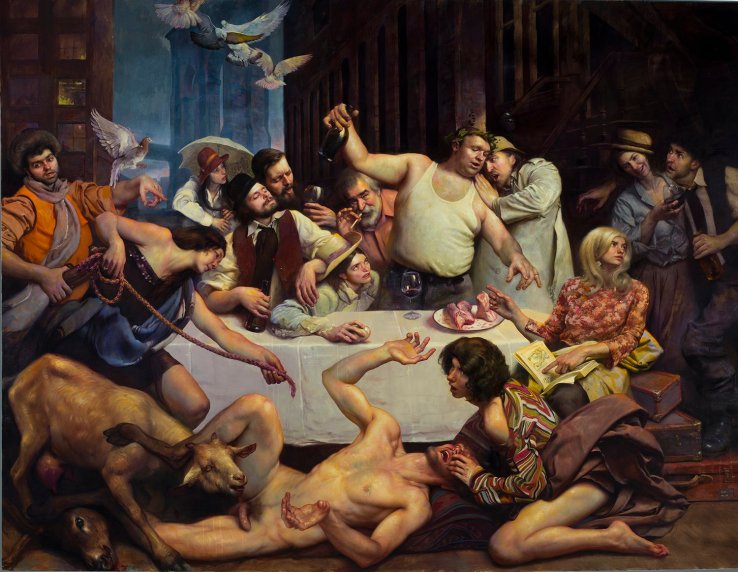
Bacchanalia – Fall (5 Days in November) — Cy Twombly

Bacchanalia – Fall (5 Days in November), 1977 by Cy Twombly (1928-2011)

You never did the Thalidomide Kid | More scattered thoughts on Cormac McCarthy’s novel The Passenger

The Thalidomide Kid found her in a roominghouse on Clark Street. Near North Side. He knocked on the door. Unusual for him. Of course she knew who it was. She’d been expecting him. And anyway it wasn’t really a knock. Just a sort of slapping sound.

–The Passenger, Cormac McCarthy

Maybe you did fool the Philadelphia, rag the Rochester, josh the Joliet. But you never did the Kenosha kid.

–Gravity’s Rainbow, Thomas Pynchon.

Surely you must know who it is who cuts the ludicrous figure here.

Do I? Who you gonna ask? And don’t call me Shirley.

The Passenger, Cormac McCarthy

Either They have put him here for a reason, or he’s just here.

–Gravity’s Rainbow, Thomas Pynchon.

What do they want? What does who want?

The Passenger, Cormac McCarthy [italics mine]

The wankers had a word for it.

We saw it in a book Crosseyed Ruby showed us. Phocomelia. Ruby said that’s Greek and means seal limb. Fukkin seal limb!

Skin, Peter Milligan, Brendan McCarthy, and Carol Swain


I’m a bit over halfway through Cormac McCarthy’s new novel The Passenger and enjoying it very much. I haven’t read any reviews, but I’ve seen some tweets and some other internet buzz that seems to indicate that Reviews Are Mixed. I went into the novel with minimal expectations, as I admitted in my first little riff on it. 

But so far The Passenger has done what I hoped it might do: show McCarthy venturing into new territory, but territory still anchored in his roots. It also is, at least up through its first 200 pages, McCarthy’s most accessible novel.

As I write the words “McCarthy’s most accessible novel,” I realize that it’s entirely possible that previous McCarthy novels have taught me to read The Passenger—but I don’t think that’s so. The Passenger offers a somewhat-straightforward frame of alternating strands. Numbered chapters (composed in italics) hover in the mind of the schizophrenic genius Alicia Western, whose suicide (no spoiler) initiates the novel. These short chapters then give way to the main narrative thrust of The Passenger in unnumbered chapters that focus on Alicia’s brother Bobby Western, a near-genius with an eidetic memory and a hole in his soul.

Bobby Western is a salvage diver based out of New Orleans. In his initial chapter, he searches the wreck of a small plane in the Gulf of Mexico, and quickly realizes that–gasp!–a passenger from the manifest is missing (along with a control panel) from the wreck. Bobby’s subsequent investigations into the whereabouts of the missing passenger lead to his being tailed and surveilled by a nebulous They. Paranoia!

The prose mechanics of the Bobby chapters are reminiscent of No Country for Old Men (lots of men-doing-stuff in detail), as well as the genre fictions of George V. Higgins, Chester Himes, or James Ellroy. The Bobby chapters also lend a bagginess to the novel. They often sprawl out into long conversations with his friends that amount to pleasant asides from the plot proper—a Vietnam vet, a transwoman, a college buddy turned petty thief. We also start to cobble together the Western family history. Alicia and Bobby’s father was a physicist who worked with Oppenheimer to develop the atomic bomb.

With the specter of a They and the haunted past of the Bomb, The Passenger drifts into Pynchon territory. The Alicia chapters go a step beyond superficial connections, unexpectedly approaching Pynchonian prose, particularly in the figure of Alicia’s interlocutor, the Thalidomide Kid (usually simply called The Kid, an echo perhaps of Blood Meridian).

(Parenthetically–The Thalidomide Kid, who shows up almost immediately in The Passenger, is only the second so-called “thalidomide baby” that I’ve seen appear in a work of fiction. The first was Martin Atchet in the graphic novel Skin, written by Peter Milligan, with art by Brendan McCarthy, and colors by Carol Swain. Track it down if you dare.)

The Thalidomide Kid presides over the “horts,” the cohort of intelligences and personalities that vie for space in Alicia’s troubled mind. The Kid is part carny, part philosopher, slipping on malapropisms and dealing in corny jokes and bad puns. He could have walked right out of a Pynchon novel. He dons costumes, performs parlor tricks, and runs vaudeville routines. In one bit, wearing “frockcoat and frightwig,” he mocks modern psychiatry, playing false Freud to Alicia’s patient (she’s recently returned from analysis, soon on her way to electroshock therapy). Elsewhere, they discuss the philosophy of math. Or maybe the math of philosophy–these bits might be beyond my ken (and beyond McCarthy’s ken). The Thalidomide Kid episodes are simultaneously hallucinatory and lucid, zany and sinister, comic and tragic. The mode, again, strikes me as more Pynchonian than what we might think of as classic McCarthy (Blood Meridian and The Border Trilogy).

I’ve overemphasized (and foregrounded, both in the title of this post and the quotes I’ve pulled) a connection between The Passenger and Pynchon’s fiction, but to be clear, there is no sense that McCarthy is aping Pynchon. Indeed, I’d be surprised if McCarthy has ever read Pynchon. What I see in common between the fiction of these two old masters (just five years apart in age) is a kind of filtering of the twentieth century, a distillation of not just themes, but also style. Pynchon has always made his ventriloquist act clear to his audience, (even as he ironizes it). In The Passenger, McCarthy finally seems a bit looser, more relaxed, more willing to let the genres and voices bend and refract. It might not be as cutting and heavy as Blood Meridian or Suttree, but it’s every bit as vibrant and inventive. More thoughts to come.

November — Telemaco Signorini

November, 1870 by Telemaco Signorini (1835-1901)

Devil Playing the Bagpipes — Erhard Schond

Devil Playing the Bagpipes, c. 1530 by Erhard Schond (c. 1491-1542)

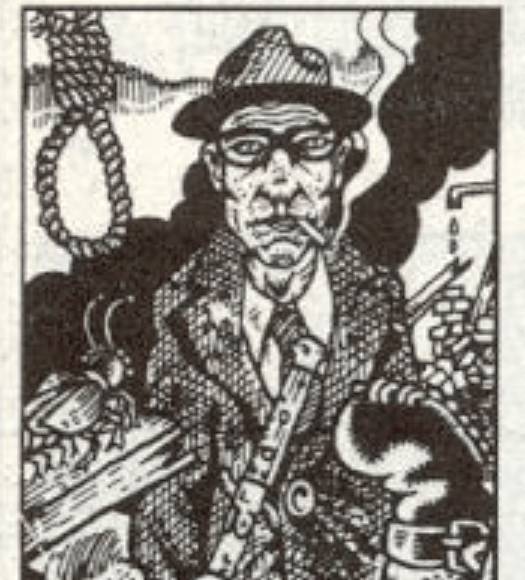
Happy Halloween, Kiddies | Bernie Wrightson

Frontispiece from Eerie #71 by Bernie Wrightson (1948-2017)

Read “55 Miles to the Gas Pump,” a very short horror story by Annie Proulx

“55 Miles to the Gas Pump”

by

Annie Proulx


Rancher Croom in handmade boots and filthy hat, that walleyed cattleman, stray hairs like the curling fiddle string ends, that warm-handed, quick-foot dancer on splintery boards or down the cellar stairs to a rack of bottles of his own strange beer, yeasty, cloudy, bursting out in garlands of foam, Rancher Croom at night galloping drunk over the dark plain, turning off at a place he knows to arrive at a canyon brink where he dismounts and looks down on tumbled rock, waits, then steps out, parting the air with his last roar, sleeves surging up, windmill arms, jeans riding over boot tops, but before he hits he rises again to the top of the cliff like a cork in a bucket of milk.

Mrs. Croom on the roof with a saw cutting a hole into the attic where she has not been for twelve years thanks to old Croom’s padlocks and warnings, whets to her desire, and the sweat flies as she exchanges the saw for a chisel and hammer until a ragged slab peak is free and she can see inside: just as she thought: the corpses of Mr. Croom’s paramours – she recognizes them from their photographs in the paper: MISSING WOMAN – some desiccated as jerky and much the same color, some moldy from lying beneath roof leaks, and, all of them used hard, covered with tarry handprints, the marks of boot heels, some bright blue with remnants of paint used on the shutters years ago, one wrapped in newspaper nipple to knee.

When you live a long way out you make your own fun.

Quelques Books: More of My Favorite SF Novels and Films — Moebius

Illustration for Frankenstein — Bernie Wrightson

Illustration for Frankenstein by Bernie Wrightson (1948-2017)

Heart of a Dog — Andrzej Pagowski

Poster for a theatrical production of Heart of a Dog, 1982 by Andrzej Pagowski (b. 1953)

The Sun, the Moon and a Basilisk — Albrecht Durer 

The Sun, the Moon and a Basilisk, c. 1512 by Albrecht Durer (1471-1528)

Scattered thoughts on starting Cormac McCarthy’s novel The Passenger (Book acquired, 25 Oct. 2022)

I picked up Cormac McCarthy’s new novel The Passenger today. The last Cormac McCarthy novel was The Road, which came out way back in 2006, year of this blog’s birth. I read most of The Road in the delivery ward over a few days when my daughter was born. Since then I’ve read pretty much everything by McCarthy that’s been published (excepting the screenplay for The Counselor), and a lot of it more than once. (I’ve reread Blood Meridian more times than I can think of. I fall asleep to the audiobook version sometimes when I have trouble sleeping, starting at a random chapter.) In the decade and a half after his last novel The Road became an unlikely, Oprah-endorsed hit, McCarthy wrote a screenplay for a film I can’t even pretend is any good and an article about “The Kekulé Problem,” which was published in Nautilus. He seemed to devote most of his time to hanging around the Santa Fe Institute, where he is a trustee.

Rumors of The Passenger have slipped around the internet for the past seven years—it would be about lawyer, it would be about a mathematician, it would be the first McCarthy novel to feature a woman as its main character, it would be in a wholly new style. Scraps and rumors seeped out, but like a lot of readers, I suspect, or at least readers I spoke to online and even in the flesh, I didn’t expect to see a completed version of The Passenger published in McCarthy’s lifetime. (He’s 89, just a few years younger than my dear sweet grandmother, also from Tennessee, who passed away this past Thursday.) I thought that we might see a version of the text, eventually, posthumous, possibly even cobbled together, a la Wallace’s The Pale King or Hemingway’s Garden of Eden.

But Knopf announced not only would The Passenger publish in 2022, so too would a shorter, connected novel Stella Maris. I’ll admit I was both excited and apprehensive, especially after reading The Silence by Don DeLillo two years ago. DeLillo is (like Thomas Pynchon) just four years younger than Cormac McCarthy. And The Silence is hardly his strongest stuff. But apples and oranges: who am I to worry one old master against another old master? So I was excited. (But apprehensive.)

So I picked up Cormac McCarthy’s new novel The Passenger today. The cover is not as bad as it looked in the early internet promotional pics—not as static and flat. But it’s still not a great cover (and I say this as one partial to blue and orange, colors of my alma mater).

But a cover is not a book. I went into the pages. Before I get into the words on the pages, here’s a bit on the form of The Passenger. The novel appears to switch between two viewpoint characters: Alicia and her brother Bobby Western. (Bobby Western sounds like a William S. Burroughs character.) The Alicia passages are shorter, written completely in italics (which is fucking annoying) and given chapter numbers. The Bobby Western chapters look like regular ole Cormac McCarthy chapters.

And so well: I ended up reading the first chapter, the Alicia chapter twice. It is unlike anything else McCarthy has written. The chapter takes place in Alicia’s head in the form of a discursive discussion with “the Thalidomide Kid,” a vaudevillian interlocutor who’s quick with punning wordplay that’s rare in McCarthy’s work (of the apparent suicide note Alicia aims to write, he chides that it will be a “wintry summary”). With all his japes and clowning and weird zany energy (and hell, that name), the Thalidomide Kid seems like something more out of a Pynchon or Robert Coover story than a McCarthy novel. The closest thing that I can compare it to, at least in McCarthy’s oeuvre, is the trip scene in Suttree. I really really dig it. It’s dark and weird.

The first Alicia section ends with a dream of her brother, whom we then meet in the next section. Bobby Western is a salvage diver working with the Coast Guard in the Gulf of Mexico. It’s three am and freezing cold and there’s a jet with nine dead bodies down in the dark water. The writing here is what I would expect from McCarthy: lots of ands and thens, a general disregard for punctuation, and a lot of descriptions of men doing things. (There’s even a He spat in there!) This particular section was excerpted in The New York Times a fortnight ago, and you can read it without anything being spoiled for you, but I don’t think it’s nearly as interesting without the hallucinatory Alicia chapter that precedes it.

And that’s all I’ve got for now. I saw some lit folks I respect who have apparently read the novel already suggest that it’s Not Good, but I’ve liked what I’ve seen so far, and Want More.