Peace and happiness through all the land | Pharaoh Sanders

RIP Pharaoh Sanders, 1940-2022

Thanks for the music.


Mild derealization at the used bookstore (Books acquired, 23 Sept. 2022)

The first time that I remember having intense derealization in my adult life was when I spent a few hours cleaning out a large spare closet in the house my wife and I were then living in.

This was about sixteen years ago, close to the birth of our first child, our daughter, and I was removing from the closet boxes of nostalgia: high school and college papers, paintings and sketches, patches, guitar pedals, old issues of MAD Magazine, punk zines, stereo wire, soon-to-be obsolete audiovisual cables, record sleeves without records, 3.5 inch floppy disks, memory cards from abandoned cameras, rolls of film, tennis balls, band t-shirts I’d never fit into again, heavy stereo equipment, and so on and etc.

I was removing all these old things to make space for new things, a pattern that I’ve followed ever since. And well anyway, not an hour into the process I began to get an odd dizziness, a feeling that none of this was real. I was not thinking about any of the objects but something about their accumulated physicality overruled my subjectivity. I recall having to turn off the record I was listening to, drinking a lot of cold water, and lying down. But the sensation kept on, like a low-grade psychotropic trip.

I experienced similar misadventures later in similar circumstances—reorganizing large bookshelves, moving offices, more stuff with closets. I also began to (rarely) experience full-blown anxiety attacks later in life, usually triggered by driving an automobile over a large bridge or on a complex highway, and the feelings of derealization I’d previously experienced were a part of those attacks, but they were also accompanied by feelings of dread and difficulty breathing. Those kinds of attacks are awful; the derealization thing is just trippy and weird. And it happened to me today while I was browsing for books. I’m not sure if it was the closeness of the aisles or the smell or a certain book or the mild change in weather that we had in north Florida today, where the throbbing humidity and scorching sun relaxed to a cloudy eighty. I think it was the screaming child who triggered it though, thrashing around on the ancient cut carpet, slapping the carpet, kicking her feet like a swimmer. Her mother and siblings walked away from her, walked into another aisle of this mazelike used bookstore, while I completely lost and never regained the name of the author I was searching for in the “T” section of Classics.

From there I leaned into the unreality and made a nice little trip of it, reminding myself that if I am a little bit crazy, that makes me a normal American. I too have microplastics in my blood! I too feel the stress of the appearance of unrelenting, non-stop change!

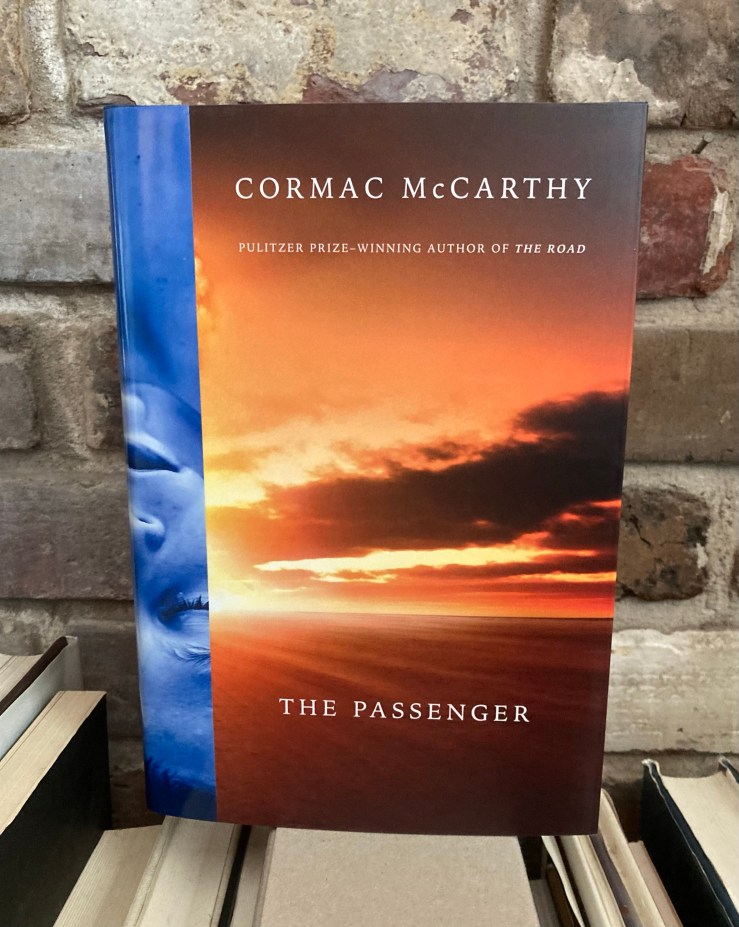
I picked up two books: Javier Marías’s Thus Bad Begins and Osvaldo Soriano’s A Funny Dirty Little War. I mostly knew Marías from his “La Zona Fantasma” columns in The Believer, and I have read only one book by MaríasVoyage Along the Horizon, which I scarcely remember. But I know Roberto Bolaño was a fan, so I’d always meant to return and try again. Today, I saw a hardback copy of Thus Bad Begins (translated by Margaret Jull Costa) propped lazily up against a hardback copy of Hilary Mantel’s novel Beyond Black. Mantel died yesterday; Marías died a dozen days ago; both books had strayed from their author’s placards, not unusual in this wonderful sprawling store. So I picked it up. It’s probably not the best starting place for Marías, right? I’ll try. I love the title; I am shallow.

The title on the spine attracted me to Osvaldo Soriano’s A Funny Dirty Little War (translated by Nick Caistor), the goofy, menacingly violent cover intrigued me and the Calvino blurb and first three pages sold me.

I don’t have a conclusion for this blog. I still feel a little outside of myself.


No failed work, only work pending | Hilary Mantel

It has always been axiomatic that when the dying speak, they cannot lie. I knew a man whose mother told him, as she lay dying, who his real father was: like a woman in a Victorian melodrama. She might as well have climbed out of bed and kicked his feet from under him. The truth was far too late to do him any good, and just in time to plunge him into misery and confusion and the complex grief of a double loss. Some truths have a sell-by date. Some should not be uttered even by the dying. Some cannot be uttered. When a victim of Henry VIII faced the headsman, the standard scaffold speech praised the king: his justice, his mercy. You didn’t mean this, but you had to think about the people left behind: some flattery might help them. Oppressors don’t just want to do their deed, they want to take a bow: they want their victims to sing their praises. This doesn’t change, and it seems there are no new thoughts, no new struggles with censorship and self-censorship, only the old struggles repeating: half-animated corpses of forbidden childhood thoughts crawling out of the psychic trenches we have dug for them, and recurring denials by the great of the truths written on the bodies of the small.

I have 97 notebooks in a wooden box. I do not count them as suppressed volumes. I work on the principle that there is no failed work, only work pending: that there is nothing I won’t say, only what I haven’t said yet. In my novel in progress I have written, “If you cannot speak truth at a beheading, when can you speak it?” A notebook written eight years ago says, “I am searching for a place where the truth can be uttered: a place, I mean, that is not an execution ground.”

From Hilary Mantel’s essay “Blot, Erase, Delete,” published in Index on Censorship, Vol. 45, Issue 3, 2016.

A review of Hilary Mantel’s novel Beyond Black

In Hilary Mantel’s 2005 novel Beyond Black, a fat psychic named Alison endures the harrowing torment of a collective of ghosts she calls the Fiends, the spirits of cruel men from her childhood. When a young, aimless woman named Colette comes into Alison’s life and assumes managerial duties for her career, Alison’s bilious past comes to a head. Colette engineers more and better gigs for Alison (the death of Princess Diana causes a huge spike in business), who, despite her genuine psychic talents, must nonetheless run the kind of scam the “punters” in her audience crave. Colette and Alison soon move in together, buying a new house in a quiet, boring suburb outside of London; their prefab homestead is drawn in sharp contrast to the slums of Aldershot where Alison grew up–the novel’s second setting. As Beyond Black progresses, contemporary suburban Britain increasingly crumbles into Alison’s grim, greasy past in Aldershot. Alison’s chief tormentor is, ironically, her “spirit guide,” a mean little man named Morris, a one-time frequent customer for Alison’s prostitute mother. Alison, like many victims, has suppressed much of her grotesque childhood, but it’s hard to black out everything with psychic baggage like Morris weighing her down. In time, more and more of the Fiends reemerge, forcing Alison to confront her mother and the abuse they both suffered at the hands of those awful men. As the book lurches to its chilling climax, Alison asserts independence, casting out her metaphysical and psychological demons.

At its core, Beyond Black asks what it means to be haunted and how one might survive an abusive past intact. A slim specter of a character named Gloria floats through the book. The Fiends, whose vile antics are sometimes compared to a gypsy circus, have dismembered Gloria with the old saw trick. In Alison’s memory, pieces of Gloria are scattered around her childhood home, parceled out, fed to dogs, transported in boxes at midnight, hidden. Alison’s awful mother frequently alludes to Alison herself being “sawed up,” a metaphor that dances on the literal as we come to realize that the old drunk has pimped out her daughter repeatedly. Mantel’s novel investigates the return of the repressed, and although she gives us something like a happy ending, the book’s central thesis seems to be that pain cannot be abandoned or hidden, but only mitigated through direct confrontation.

The book’s humor does nothing to lighten its grim subject–if anything it exacerbates and confounds the darkness at the heart of Beyond Black. Mantel’s gift for dialogue fleshes out her characters (even the spectral ones), and while the book aims for a satirical tone at times, its characters are too richly drawn to be mere cutouts in a stage production. Mantel’s satire of contemporary English life is sharp and bleak; you laugh a little and then feel bad for laughing and a page later you’re horrified. It’s a successful book in that respect. It’s one real weakness is in the character of Colette, whose voice gives way to Alison’s past by the book’s end. This is actually no problem, as Colette’s narrative life is not nearly as interesting as Alison’s psychic traumas; Colette is, however, catalyst for the changes in Alison’s life. It would’ve been nice to see more resolution here, but I suppose Beyond Black hews closer to real life here, with all its messy loose ends.

I chose to read Beyond Black because I enjoyed Mantel’s recent Booker Prize winner Wolf Hall so much. The books have little in common other than being well-written and tightly paced, and I think that anyone who wanted more Mantel after an introduction via Wolf Hall would do right to pick up Beyond Black. Recommended.

[Ed. note—Biblioklept first published this review in 2010. RIP to Hilary Mantel, who died “suddenly but peacefully” yesterday at 70.]

I’d Harass God | Emily Dickinson

Reading Girls — Helene Schjerfbeck

Lukevat tytöt (Reading Girls), 1907 by Helene Schjerfbeck (1862-1946)

Salome — Henry Ossawa Tanner

Salome, 1900 by Henry Ossawa Tanner (1859-1937)

King Kong à Paris — Sergio Ceccotti

King Kong à Paris, 2019 by Sergio Ceccotti (b. 1935)

From Naoji’s Moonflower Journal | From Osamu Dazai’s novel The Setting Sun

From Naoji’s Moonflower Journal

from

The Setting Sun

by

Osamu Dazai

Translated by Donald Keene


A sensation of burning to death. And excruciating though it is, I cannot pronounce even the simple words “it hurts.” Do not try to shrug off this portent of a hell unparalleled, unique in the history of man, bottomless!

Philosophy? Lies. Principles? Lies. Ideals? Lies. Order? Lies. Sincerity? Truth? Purity? All lies. They say the wisteria of Ushijima are a thousand years old, and the wisteria of Kumano date from centuries ago. I have heard that wisteria clusters at Ushijima attain a maximum length of nine feet, and those at Kumano of over five feet. My heart dances only in those clusters of wisteria blossom.

That too is somebody’s child. It is alive.

Logic, inevitably, is the love of logic. It is not the love for living human beings.

Money and women. Logic, intimidated, scampers off precipitously.

The courageous testimony of Dr. Faust that a maiden’s smile is more precious than history, philosophy, education, religion, law, politics, economics, and all the other branches of learning.

Learning is another name for vanity. It is the effort of human beings not to be human beings.

I can swear even before Goethe that I am a superbly gifted writer. Flawless construction, the proper leavening of humor, pathos to bring tears to the reader’s eyes—or else a distinguished novel, perfect of its kind, to be read aloud sonorously with the deference due it, this (shall I call it running commentary on a film?) I claim I could write were I not ashamed. There’s something fundamentally cheap about such awareness of genius. Only a madman would read a novel with deference. In that case it had best be done in formal clothes, like going to a funeral. So long as it does not seem as affected as a good work! I will write my novel clumsily, deliberately making a botch of it, just to see a smile of genuine pleasure on my friend’s face—to fall on my bottom and patter off scratching my head. Oh, to see my friend’s happy face!

What is this affection which would make me blow the toy bugle of bad prose and bad character to proclaim, “Here is the greatest fool in Japan! Compared to me, you’re all right—be of good health!”

Friend! You who relate with a smug face, “That’s his bad habit, what a pity!” You do not know that you are loved.

I wonder if there is anyone who is not depraved.

A wearisome thought.

I want money.

Unless I have it….

In my sleep, a natural death!

I have run up a debt of close to a thousand yen with the pharmacist. Today I surreptitiously introduced a clerk from the pawnshop into the house and ushered him to my room. I asked, “Is anything here valuable enough to pawn? If there is, take it away. I am in desperate need of money.”

The clerk, with scarcely a glance at the room, had the effrontery to say, “Why don’t you forget the whole idea? After all, the furniture doesn’t belong to you.”

“Very well!” I said with animation, “just take the things I have bought with my own pocket money.” But not a one of all the odds and ends I piled before him had any value as a pledge.

Item. A hand in plaster. This was the right hand of Venus. A hand like a dahlia blossom, a pure white hand, mounted on a stand. But if you looked at it carefully you could tell how this pure white, delicate hand, with whorl-less finger tips and unmarked palms, expressed, so pitifully that even the beholder was stabbed with pain, the shame intense enough to make Venus stop her breath; in the gesture was implicit the moment when Venus’ full nakedness was seen by a man, when she twisted away her body, flushed all over with the prickling warmth of her shock, the whirlwind of her shame, and the tragedy of her nudity. Unfortunately, this was only a piece of bric-à-brac. The clerk valued it at fifty sen.

Items. A large map of the suburbs of Paris. A celluloid top almost a foot in diameter. A special pen-point with which one can write letters finer than threads. All things bought by me under the impression that they were great bargains.

The clerk laughed and said, “I must be leaving now.”

“Wait!” I cried, holding him back. I finally managed to load him down with an immense stack of books for which he gave me five yen. The books on my shelves were, with a few exceptions, cheap paper-bound editions, and at that I had bought them secondhand. It was not surprising that they fetched so little.

To settle a debt of a thousand yen—five yen. That is approximately my effective strength. It is no laughing matter.

But rather than the patronizing “But being decadent is the only way to survive!” of some who criticize me, I would far prefer to be told simply to go and die. It’s straightforward. But people almost never say, “Die!” Paltry, prudent hypocrites!

Justice? That’s not where you’ll find the so-called class struggle. Humanity? Don’t be silly. I know. It is knocking down your fellow-men for the sake of your own happiness. It is a killing. What meaning has it unless there is a verdict of “Die!” It’s no use cheating.

Continue reading “From Naoji’s Moonflower Journal | From Osamu Dazai’s novel The Setting Sun”

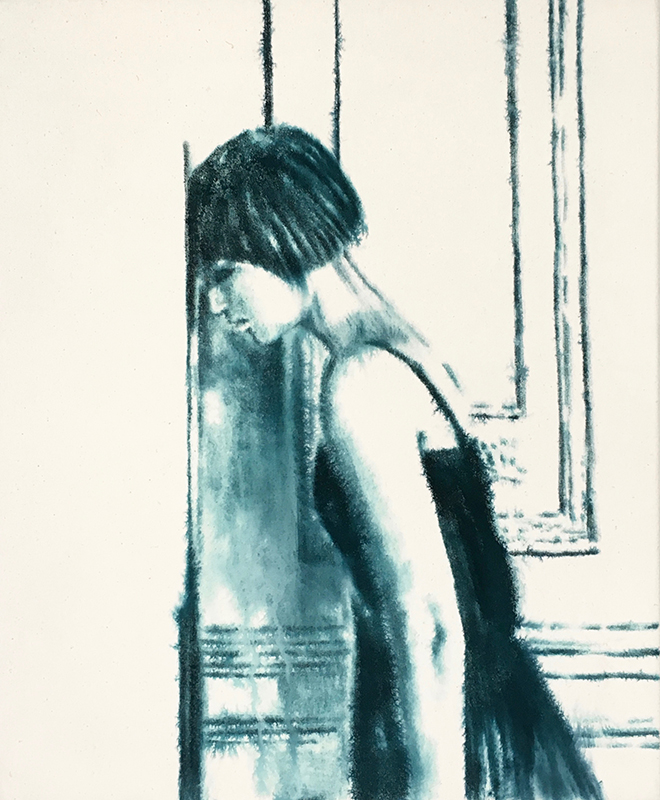
The Dice Are Cast — Francine Van Hove

Les dés sont jetés (The Dice Are Cast), 2016  by Francine Van Hove (b. 1942)

“The Challenge” — Jorge Luis Borges

“The Challenge”

by

Jorge Luis Borges

Translated by d by Norman Thomas di Giovanni


All over the Argentine runs a story that may belong to legend or to history or (which may be just another way of saying it belongs to legend) to both things at once. Its best recorded versions are to be found in the unjustly forgotten novels about outlaws and desperadoes written in the last century by Eduardo Gutiérrez; among its oral versions, the first one I heard came from a neighborhood of Buenos Aires bounded by a penitentiary, a river, and a cemetery, and nicknamed Tierra del Fuego. The hero of this version was Juan Muraña, a wagon driver and knife fighter to whom are attributed all the stories of daring that still survive in what were once the outskirts of the city’s Northside. That first version was quite simple. A man from the Stockyards or from Barracas, knowing about Muraña’s reputation (but never having laid eyes on him), sets out all the way across town from the Southside to take him on. He picks the fight in a corner saloon, and the two move into the street to have it out. Each is wounded, but in the end Muraña slashes the other man’s face and tells him, “I’m letting you live so you’ll come back looking for me again.”

What impressed itself in my mind about the duel was that it had no ulterior motive. In conversation thereafter (my friends know this only too well), I grew fond of retelling the anecdote. Around 1927, I wrote it down, giving it the deliberately laconic title “Men Fought.” Years later, this same anecdote helped me work out a lucky story—though hardly a good one—called “Streetcorner Man.” Then, in 1950, Adolfo Bioy-Casares and I made use of it again to plot a film script that the producers turned down and that would have been called On the Outer Edge. It was about hard-bitten men like Muraña who lived on the outskirts of Buenos Aires before the turn of the century. I thought, after such extensive labors, that I had said farewell to the story of the disinterested duel. Then, this year, out in Chivilcoy, I came across a far better version. I hope this is the true one, although since fate seems to take pleasure in a thing’s happening many times over, both may very well be authentic. Two quite bad stories and a script that I still think of as good came out of the poorer first version; out of the second, which is complete and perfect, nothing can come. Without working in metaphors or details of local color, I shall tell it now as it was told to me. The story took place to the west, in the district of Chivilcoy, sometime back in the 1870’s. Continue reading ““The Challenge” — Jorge Luis Borges”

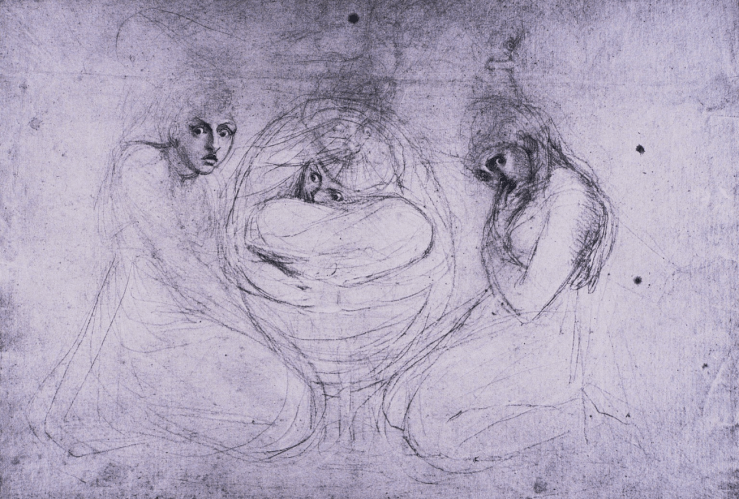
Head — Cecil Collins

Head, 1963 by Cecil Collins 1908-1989

The Vision and Inspiration of Joan of Arc — Louis Maurice Boutet de Monvel

The Vision and Inspiration of Joan of Arc, c. late 1909-early 1913 by Louis Maurice Boutet de Monvel (1850-1913)

Maxim Osipov’s Kilometer 101 (Book acquired, early Sept. 2022)

Maxim Osipov’s Kilometer 101 collects six stories and four essays by the Russian author. The translations are by Boris Dralyuk, Nicolas Pasternak Slater, and Alex Fleming. Kilometer 101 is out next month from NYRB. Their copy:

The town of Tarusa lies 101 kilometers outside Moscow, far enough to have served, under Soviet rule, as a place where former political prisoners and other “undesirables” could legally settle. Lying between the center of power and the provinces, between the modern urban capital and the countryside, Tarusa is the perfect place from which to observe a Russia that, in Maxim Osipov’s words, “changes a lot [in the course of a decade], but in two centuries—not at all.” The stories and essays in this volume—a follow-up to his debut in English, Rock, Paper, Scissors—tackle major questions of modern life in and beyond Russia with Osipov’s trademark blend of daring and subtlety. Deceit, political pressure, ethnic discrimination, the urge to emigrate, and the fear of abandoning one’s home, as well as myriad generational debts and conflicts, are as complexly woven through these pieces as they are through the lives of Osipov’s fellow Russians and through our own. What binds the prose in this volume is not only a set of concerns, however, but also Osipov’s penetrating insights and fearless realism. “Dreams fall away, one after another,” he writes in the opening essay, “some because they come true, but most because they prove pointless.” Yet, as he reminds us in the final essay, when viewed from ground level, “life tends not towards depletion, towards zero, but, on the contrary, towards repletion, fullness.”

“The Wall” — Anne Sexton

“The Wall”

by

Anne Sexton


Nature is full of teeth
that come in one by one, then
decay, fall out.
In nature nothing is stable,
all is change, bears, dogs, peas, the willow,
all disappear. Only to be reborn.
Rocks crumble, make new forms,
oceans move the continents,
mountains rise up and down like ghosts
yet all is natural, all is change.

As I write this sentence
about one hundred and four generations
since Christ, nothing has changed
except knowledge, the test tubes.
Man still falls into the dirt
and is covered.
As I write this sentence one thousand are going
and one thousand are coming.
It is like the well that never dries up.
It is like the sea which is the kitchen of God.

We are all earthworms,
digging our wrinkles.
We live beneath the ground
and if Christ should come in the form of a plow
and dig a furrow and push us up into the day
we earthworms would be blinded by the sudden light
and writhe in our distress.
As I write this sentence I too writhe.

For all you who are going,
and there are many who are climbing their pain,
many who will bepainted out with a black ink
suddenly and before it is time,
for these many I say,
awkwardly, clumsily,
take off your life like trousers,
your shoes, your underwear,
then take off your flesh,
unpick the lock of your bones.
In other words
take off the wall
that separates you from God.

Cigninota — Walton Ford

Cigninota, 2020 by Walton Ford (b. 1960)

Jean-Luc Godard’s film Goodbye to Language