I was pleasantly surprised yesterday to find a big ole biography of Paul Cézanne on my doorstep. I probably won’t get to Alex Danchev’s Cézanne: A Life anytime soon (at least not until I finish Robert Hughes’s Goya bio), but it looks like a pretty solid read—with lovely glossy pictures to boot:
Or, if you’re too busy, here’s the Kirkus write up in full:
A formidable biography of the Father of Modern Art bound for the annals of academia.
Danchev . . . has researched every facet and nuance of Paul Cézanne’s life (1839–1906). His comfortable childhood in Provence, his years in Paris, where he was influenced by the Impressionists, and his dependence on the allowance from his father created the artist some suggested was “not all there.” There is a wealth of information in the correspondence between the artist and his childhood friend, Émile Zola, in which they parodied Virgil, joked in Latin and discussed Stendhal. Zola knew that Cézanne’s art was a corner of nature seen through his own curious temmpérammennte. The artist didn’t paint things; he painted the effect they had on him. He saw colors as he read a book or looked at a person, understood the inner life of an object and let his brain rework that object, sometimes illuminating it, sometimes distorting it. Danchev rightly subscribes to the theory that understanding the man is important to understanding his work, and he attempts to parse Cézanne’s psyche, digging into the background of nearly every author he discussed in his letters, quoting every writer who based a character on the man. Cézanne’s work will influence artists and confuse patrons for decades to come, especially those who have the patience to study Danchev’s comprehensive, occasionally ponderous tome.
A fairly impressive achievement of a Sisyphean task—definitely a book to keep in your library.
Nice article at Slate on Cormac McCarthy’s Blood Meridian, touching on how “all the way to galley proof in 1984, McCarthy whittled Blood Meridian downinto the lean nightmare we now know. He cut whole characters and became more and more sparing of his description of the ones that remained. This was nowhere more pronounced than with the character of the kid, the nameless ruffian and pseudo-protagonist of the tale.” Good stuff. (Thanks to Garrett for alerting me to it).
After a mild pulmonary infection, tended too little and too late, had suddenly turned into a severe pneumonia that took its toll of my entire body and laid me up for at least three months at nearby Wels, which has a hospital renowned in the field of so-called internal medicine, I accepted an invitation from Hoeller, a so-called taxidermist in the Aurach valley, not for the end of October, as the doctors urged, but for early in October, as I insisted, and then went on my own so-called responsibility straight to the Aurach valley and to Hoeller’s house, without even a detour to visit my parents in Stocket, straight into the so-called Hoeller garret, to begin sifting and perhaps even arranging the literary remains of my friend, who was also a friend of the taxidermist Hoeller, Roithamer, after Roithamer’s suicide, I went to work sifting and sorting the papers he had willed to me, consisting of thousands of slips covered with Roithamer’s handwriting plus a bulky manuscript entitled “About Altensam and everything connected with Altensam, with special attention to the Cone.” The atmosphere in Hoeller’s house was still heavy, most of all with the circumstances of Roithamer’s suicide, and seemed from the moment of my arrival favorable to my plan of working on Roithamer’s papers there, specifically in Hoeller’s garret, sifting and sorting Roithamer’s papers and even, as I suddenly decided, simultaneously writing my own account of my work on these papers, as I have here begun to do, aided by having been able to move straight into Hoeller s garret without any reservations on Hoeller’s part, even though the house had other suitable accommodations, I deliberately moved into that four-by-five-meter garret Roithamer was always so fond of, which was so ideal, especially in his last years, for his purposes, where I could stay as long as I liked, it was all the same to Hoeller, in this house built by the headstrong Hoeller in defiance of every rule of reason and architecture right here in the Aurach gorge, in the garret which Hoeller had designed and built as if for Roithamer’s purposes, where Roithamer, after sixteen years in England with me, had spent the final years of his life almost continuously, and even prior to that he had found it convenient to spend at least his nights in the garret, especially while he was building the Cone for his sister in the Kobernausser forest, all the time the Cone was under construction he no longer slept at home in Altensam but always and only in Hoeller’s garret, it was simply in every respect the ideal place for him during those last years when he, Roithamer, never went straight home to Altensam from England, but instead went every time to Hoeller’s garret, to fortify himself in its simplicity (Hoeller house) for the complexity ahead (Cone), it would not do to go straight to Altensam from England, where each of us, working separately in his own scientific field, had been living in Cambridge all those years, he had to go straight to Hoeller’s garret, if he did not follow this rule which had become a cherished habit, the visit to Altensam was a disaster from the start, so he simply could not let himself go directly from England to Altensam and everything connected with Altensam, whenever he had not made the detour via Hoeller’s house, to save time, as he himself admitted, it had been a mistake, so he no longer made the experiment of going to Altensam without first stopping at Hoeller’s house, in those last years, he never again went home without first visiting Hoeller and Hoeller’s family and Hoeller’s house, without first moving into Hoeller’s garret, to devote himself for two or three days to such reading as he could do only in Hoeller s garret, of subject matter that was not harmful but helpful o him, books and articles he could read neither in Altensam or in England, and to thinking and writing what he found possible to think and write neither in England nor in Altensam, here I discovered Hegel, he always said, over and over again, it was here that I really delved into Schopenhauer for the first time, here that I could read, for the first time, Goethe’s Elective Affinities and The Sentimental Journey, without distraction and with a clear head, it was here, in Hoeller’s garret, that I suddenly gained access to ideas to which my mind had been sealed for decades before I came to this garret, access, he wrote, to the most essential ideas, the most important for me, the most necessary to my life, here in Hoeller’s garret, he wrote, everything became possible for me, everything that had always been impossible for me outside Hoeller’s garret, such as letting myself be guided by my intellectual inclinations and to develop my natural aptitudes accordingly, and to get on with my work, everywhere else I had always been hindered in developing my aptitudes but in Hoeller’s garret I could always develop them most consistently, here everything was congenial to my way of thinking, here I could always indulge myself in exploring all my intellectual possibilities, here my intellectual possibilities, here in Hoeller’s garret my head, my mind, my whole constitution were suddenly relieved from all the outside world’s oppression, the most incredible things were suddenly no longer incredible, the most impossible (thinking!) no longer impossible. It was in Hoeller’s garret that he found the conditions necessary and most favorable to thought, for getting the mechanism of his thought going in the most natural, most undistracted way, all he had to do was to come to Hoeller’s garret from wherever he might be, and the mechanism worked.
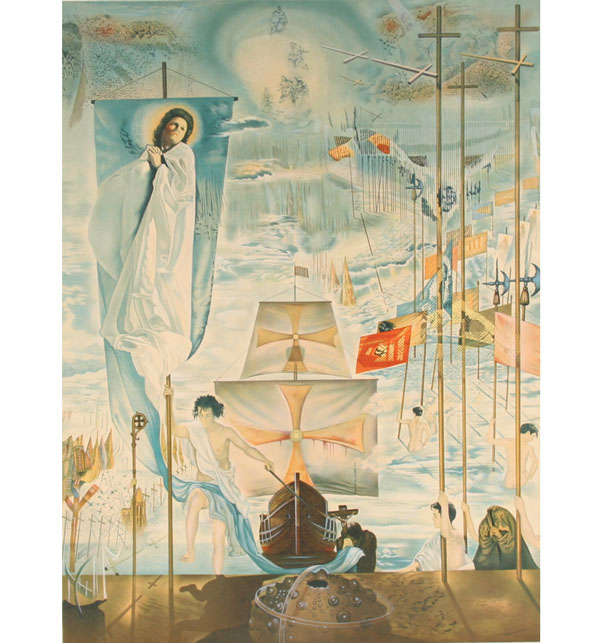
Salvador Dalí, The Discovery of America by Christopher Columbus
“Prayer of Columbus” by Walt Whitman
A batter’d, wreck’d old man,
Thrown on this savage shore, far, far from home,
Pent by the sea and dark rebellious brows, twelve dreary months,
Sore, stiff with many toils, sicken’d and nigh to death,
I take my way along the island’s edge,
Venting a heavy heart.
I am too full of woe!
Haply I may not live another day;
I cannot rest O God, I cannot eat or drink or sleep,
Till I put forth myself, my prayer, once more to Thee,
Breathe, bathe myself once more in Thee, commune with Thee,
Report myself once more to Thee.
Thou knowest my years entire, my life,
My long and crowded life of active work, not adoration merely;
Thou knowest the prayers and vigils of my youth,
Thou knowest my manhood’s solemn and visionary meditations,
Thou knowest how before I commenced I devoted all to come to Thee,
Thou knowest I have in age ratified all those vows and strictly kept them,
Thou knowest I have not once lost nor faith nor ecstasy in Thee,
In shackles, prison’d, in disgrace, repining not,
Accepting all from Thee, as duly come from Thee.
All my emprises have been fill’d with Thee,
My speculations, plans, begun and carried on in thoughts of Thee,
Sailing the deep or journeying the land for Thee;
Intentions, purports, aspirations mine, leaving results to Thee.
O I am sure they really came from Thee,
The urge, the ardor, the unconquerable will,
The potent, felt, interior command, stronger than words,
A message from the Heavens whispering to me even in sleep,
These sped me on.
By me and these the work so far accomplish’d,
By me earth’s elder cloy’d and stifled lands uncloy’d, unloos’d,
By me the hemispheres rounded and tied, the unknown to the known.
The end I know not, it is all in Thee,
Or small or great I know not–haply what broad fields, what lands,
Haply the brutish measureless human undergrowth I know,
Transplanted there may rise to stature, knowledge worthy Thee,
Haply the swords I know may there indeed be turn’d to reaping-tools,
Haply the lifeless cross I know, Europe’s dead cross, may bud and
blossom there.
One effort more, my altar this bleak sand;
That Thou O God my life hast lighted,
With ray of light, steady, ineffable, vouchsafed of Thee,
Light rare untellable, lighting the very light,
Beyond all signs, descriptions, languages;
For that O God, be it my latest word, here on my knees,
Old, poor, and paralyzed, I thank Thee.
My terminus near,
The clouds already closing in upon me,
The voyage balk’d, the course disputed, lost,
I yield my ships to Thee.
My hands, my limbs grow nerveless,
My brain feels rack’d, bewilder’d,
Let the old timbers part, I will not part,
I will cling fast to Thee, O God, though the waves buffet me,
Thee, Thee at least I know.
Is it the prophet’s thought I speak, or am I raving?
What do I know of life? what of myself?
I know not even my own work past or present,
Dim ever-shifting guesses of it spread before me,
Of newer better worlds, their mighty parturition,
Mocking, perplexing me.
And these things I see suddenly, what mean they?
As if some miracle, some hand divine unseal’d my eyes,
Shadowy vast shapes smile through the air and sky,
And on the distant waves sail countless ships,
And anthems in new tongues I hear saluting me.
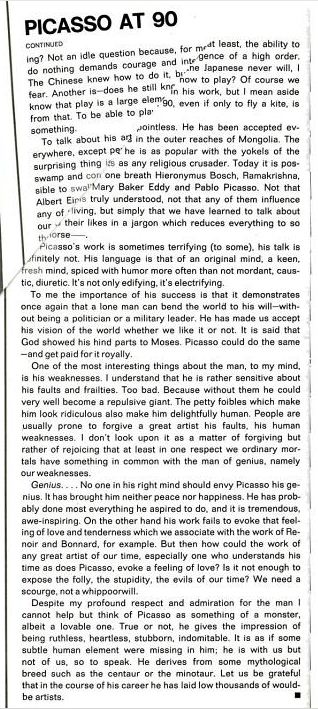
“Picasso at 90” is an October, 1971 profile on the artist by Henry Miller, presented here via Google Books. In a felicitous cubist twist, the second page of the article (featuring the full portrait of Picasso and, on its back, the column of text) seems to have been cut (or ripped) and then repaired.





 Biblioklept