Handwritten Draft of Auden’s “Musée des Beaux Arts”

(Via the Library of Congress).

Book Shelves #17, 4.22.2012

Book shelves series #17, seventeenth Sunday of 2012.

20120422-114730.jpg

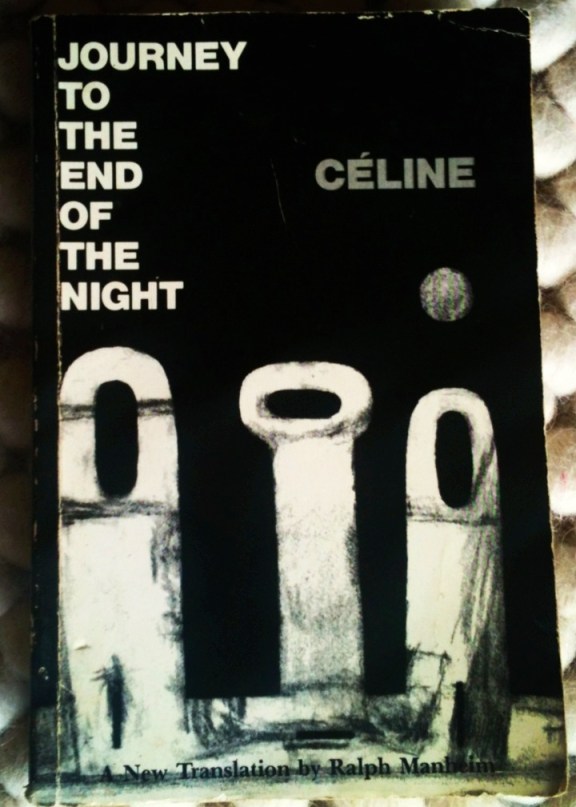
Hemingway, Fitzgerald, Steinbeck, Camus, Nabokov, Celine, Kafka.

20120422-130058.jpg

Jonathan Littell’s The Kindly Ones with Revere movie camera as bookend. Littell’s lurid, bizarre book is only shelved here temporarily (he’s in too-rarefied company, perhaps).

20120422-130453.jpg

A friend gave me this in high school.

Travel Scene, Malick’s Days of Heaven

“What David Lynch Is Really Like” — David Foster Wallace

2 what David Lynch is really like

I have absolutely no idea. I rarely got closer than five feet away from him and never talked to him. One of the minor reasons Asymmetrical Productions let me onto the set is that I don’t even pretend to be a journalist and have no idea how to interview somebody and saw no real point in trying to interview Lynch, which turned out perversely to be an advantage, because Lynch emphatically didn’t want to be interviewed while Lost Highway was in production, because when he’s shooting a movie he’s incredibly busy and preoccupied and immersed and has very little attention or brain-space available for anything other than the movie. This may sound like PR bullshit, but it turns out to be true—e.g.:

The first time I lay actual eyes on the real David Lynch on the set of his movie, he’s peeing on a tree. I am not kidding. This is on 8 January in West LA’s Griffith Park, where some of Lost Highway’s exteriors and driving scenes are being shot. Lynch is standing in the bristly underbrush off the dirt road between the Base Camp’s trailers and the set, peeing on a stunted pine. Mr. David Lynch, a prodigious coffee-drinker, apparently pees hard and often, and neither he nor the production can afford the time it’d take him to run down the Base Camp’s long line of trailers to the trailer where the bathrooms are every time he needs to pee. So my first sight of Lynch is only from the back, and (understandably) from a distance. Lost Highway’s cast and crew pretty much ignore Lynch’s urinating in public, and they ignore it in a relaxed rather than a tense or uncomfortable way, sort of the way you’d ignore a child’s alfresco peeing.

David Foster Wallace,  “David Lynch Keeps His Head”  (A Supposedly Fun Thing I’ll Never Do Again)

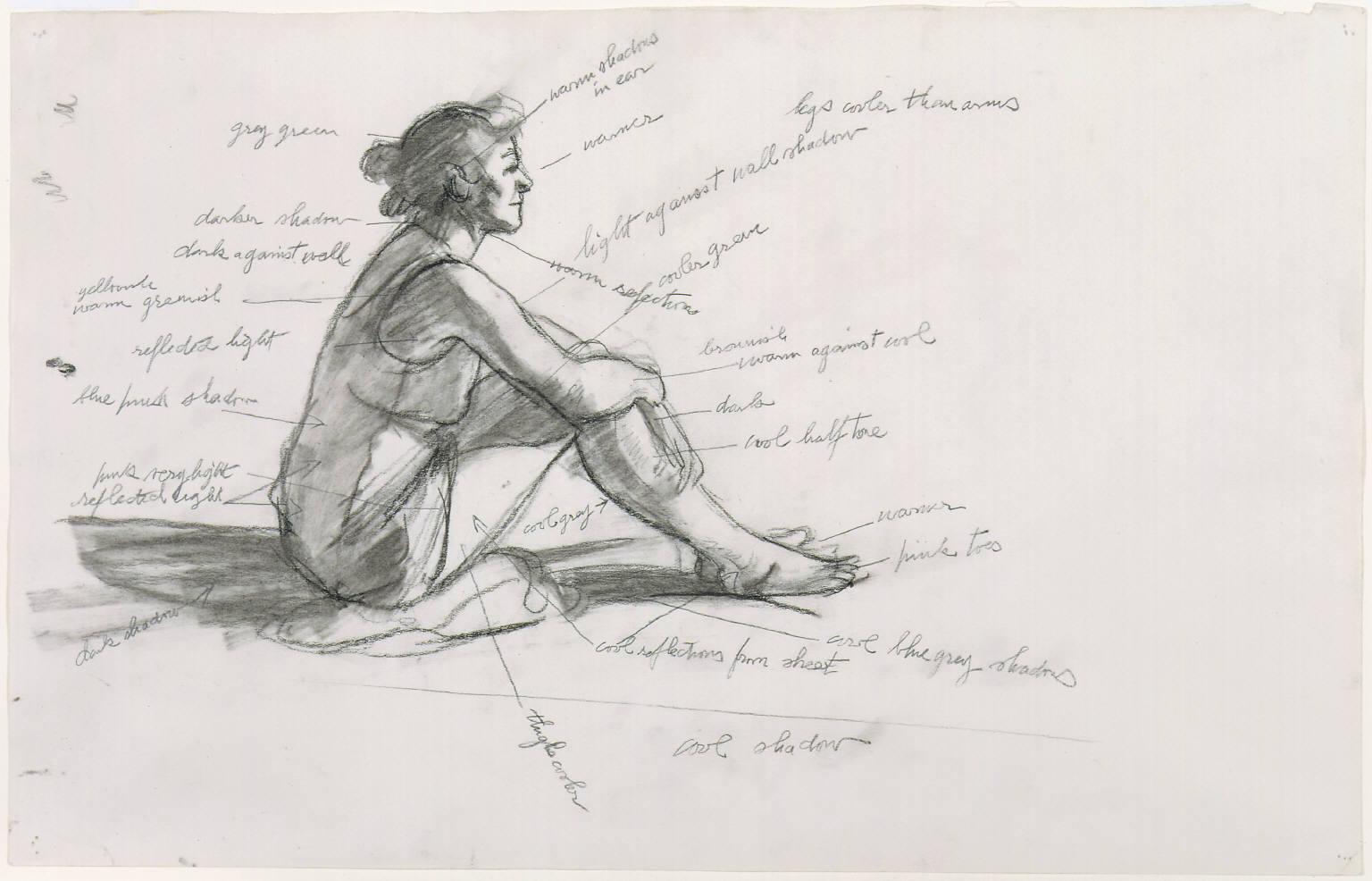
Study Sketch for Morning Sun — Edward Hopper

“The Unicorn in the Garden” — James Thurber

James Joyce’s Prescription for New Glasses

(Via Disonancia, which is very fine stuff).

“At Christmas a boy lame of a leg goes round the country summoning the devil’s followers, who are countless, to a general conclave . . . and the whole multitude become wolves.”

At Christmas a boy lame of a leg goes round the country summoning the devil’s followers, who are countless, to a general conclave. Whoever remains behind, or goes reluctantly, is scourged by another with an iron whip till the blood flows, and his traces are left in blood. The human form vanishes, and the whole multitude become wolves. Many thousands assemble. Foremost goes the leader armed with an iron whip, and the troop follow, “firmly convinced in their imaginations that they are transformed into wolves.” They fall upon herds of cattle and flocks of sheep, but they have no power to slay men. When they come to a river, the leader smites the water with his scourge, and it divides, leaving a dry path through the midst, by which the pack may go. The transformation lasts during twelve days, at the expiration of which period the wolf-skin vanishes, and the human form reappears. This superstition was expressly forbidden by the church. “Credidisti, quod quidam credere solent, ut illæ quæ a vulgo Parcæ vocantur, ipsæ, vel sint vel possint hoc facere quod creduntur, id est, dum aliquis homo nascitur, et tunc valeant illum designare ad hoc quod velint, ut quandocunque homo ille voluerit, in lupum transformari possit, quod vulgaris stultitia, werwolf vocat, aut in aliam aliquam figuram?”–Ap. Burchard. (d. 1024).

From Sabine Baring-Gould’s marvelous volume The Book of Were-Wolves (1865).

Put the book in the head not on the head

(Via Disonancia ).

Diogenes and Plato — Paul Ollswang

(Read Paul Ollswang’s fantastic comic Cynicism here)

Six (More) Stoner Novels (And a Bonus Short Story)

A few years ago, to celebrate 4/20, Sam Munson at the Daily Beast wrote an article praising “The Best Stoner Novels.” Not a bad list—Wonder Boys, sure, Invisible Man, a bit of a stretch, The Savage Detectives, a very big stretch, but sure, why not. Anyway, six more stoner novels (not that we advocate the smoking of the weed)—

Junkie, William Burroughs

Burroughs’s (surprisingly lucid) early novel Junkie may take its name from heroin, but it’s full of weed smoking. Lesson: weed smoking leads to heroin. And the inevitable search for yage.

Inherent Vice, Thomas Pynchon

Doc Sportello, the wonky PI at the off-center of Pynchon’s California noir, is always in the process of lighting another joint, if not burning his fingers on the edges of a roach. A fuzzy mystery with smoky corners.

Infinite Jest, David Foster Wallace

Hal Incandenza, protagonist of Wallace’s opus, spends much of his time hiding in the tunnels of Enfield Tennis Academy, feeding his bizarre marijuana addiction, which is, in many ways, more of an addiction to a secret ritual than to a substance. Hal’s hardly the only character in IJ who likes his Mary Jane; there’s a difficult section near the novel’s beginning that features a minor character preparing to go on a major weed binge. His pre-smoking anxiety works as a challenge to any reader seeking to enter the world of Infinite Jest.

The Lord of the Rings, J.R.R. Tolkien

I’m pretty sure “pipe-weed” isn’t tobacco.

Chronic City, Jonathan Lethem

I kind of hated Chronic City, a novel where characters seem to light up joints on every other page. It seems to have been written in an ambling, rambling fog, absent of any sense of immediacy, urgency, or, uh, plot. Bloodless stuff, but, again, very smoky.

Stoner, John Williams

Okay. Stoner has nothing to do with marijuana. But, hey, it’s called Stoner, right?

Bonus short story: Raymond Carver’s “Cathedral”

Carver’s classic story features a myopic narrator who comes up against his own shortcomings when he meets an old friend of his wife, a blind man who ironically sees deeper than he does. After drinking too much booze, they spark up, share a doob, and take in a documentary about European cathedrals. Great stuff.


The Bath — Pierre Bonnard

(Via Anthony at Times Flow Stemmed).

RIP Levon Helm

What’s there to say? My two year old son and I are listening to Music from Big Pink right now; he’s humming along. He likes to sing. I got into The Band through Bob Dylan, like a lot of people my age—The Basement Tapes, of course—I guess, only to realize that I already knew a lot of the songs. Great music. Levon Helm was clearly the soul of the band (we know he sang all the best Band songs). Dude was rad. He and Garth Hudson played on Deserter’s Songs, Mercury Rev’s last good album. Such a distinctive voice—bright and soulful and deep. “The Night They Drove Old Dixie Down” is one of my favorite songs—complex and sad and strangely triumphant, as good as a Faulkner short story—really better than most—but apples and oranges. Great legacy and great work. RIP Levon Helm.

Denis Johnson, Malcolm Lowry, Ben Marcus (Books Acquired, 4.18.2012)

20120418-144738.jpg

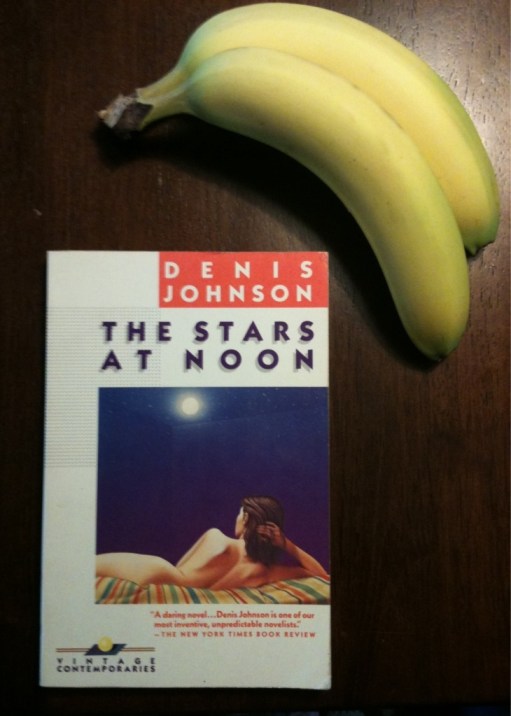
I went to the bookstore to pick up a graduation present and then spent too much time wandering the stacks. While looking for Mat Johnson’s Pym, I found a first printing paperback of Denis Johnson’s The Stars at Noon and had to have it—haven’t read it yet, and it makes a nice sister for my copy of Angels—but honestly, I’m just in love with these 1980s Vintage Contemporary editions with awful, awful covers.

20120418-144806.jpg

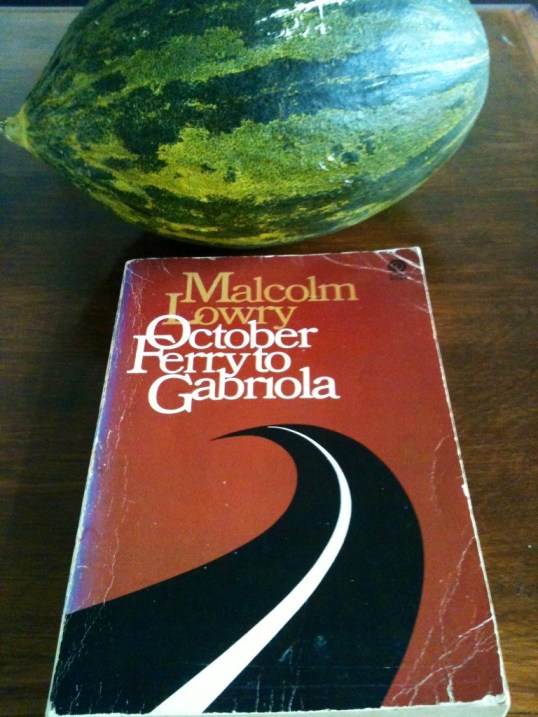
Malcolm Lowry’s last novel, the posthumously published October Ferry to Gabriola. Kind of a hideous cover.

20120418-144816.jpg

 I was looking for something by David Markson (no dice) when I came across The Age of Wire and String by Ben Marcus; I’ve been meaning to check out Marcus’s stuff, and a few minutes with the volume sold me—short vignettes, sort of like Lydia Davis or DFW or Dennis Cooper or William Burroughs (but probably not; I’m just using these as a short hand reference).

William Gaddis on the Pulitzer Prize: “The Ultimate Seal of Mediocrity”

In William Gaddis’s last novel Agapē Agape (2002), our embittered narrator excoriates the Pulitzer Prize:

. . . write what they want you’ll end up with a Pulitzer Prize follow you right to the grave. Maybe won the Medal of honor the George Cross even the Nobel but once you’ve been stigmatized with the ultimate seal of mediocrity your obit will read Pulitzer Prize Novelist Dies at whatever because they’re not advertising the winner no. No, like this whole plague of prizes wherever you look, it’s the prize givers promoting themselves, trying to rescue their thoroughly discredited profession of journalism. “The press is a school that serves to turn men into brutes,” Flaubert writes to George Sand “because it relieves them from thinking.” The prize winners? They’re just props, cartoonists, sports writers, political pundits, front page photos the bloodier the better for that instant of fame wrap the fish in tomorrow, good God how many Pulitzer Prizes are there? Over fifteen hundred entries, fourteen categories for journalists because if you started your bondage there you’re halfway home with that whole gang of sponsors, trustees, juries, God knows what who’ve survived that Slough of Despond and floated to the top. Just look at the next day’s New York Times, page after page bulging with self-congratulation with seven more categories to leech on, music, what they call drama and of course books where the Grey Lady finally got it both ways with their journalist who reviews books, like the misty-eyed ingenue but also destroys women writers and just for fairness crosses the gender line for an occasional assassination, give that lady a Pulitzer with oak leaf clusters! The books that are candidates are read by a jury whose decisions are passed up to the Olympian trustees with an eye to the multitude. We are thousands and they are millions, write the fiction they want or don’t write at all, ruling out Pound’s cry for the new, the challenging or what’s labeled difficult, so when Gravity’s Rainbow is being devoured by college youth everywhere and wins the National Book Award, its unanimous recommendation is overturned by the trustees for a double-talk spoof of academic vagaries by a bogus “Professor,” to everyone’s relief, and the author at peril escapes unblemished by the, no, no, no you can’t depend on it.

“People Got A Lotta Nerve” — Neko Case

Charles Dickens’s Traveling Cutlery Kit

(Via the Library of Congress).