Anteater — Erica il Cane

(More).

Patti Smith, Book Thief

Patti Smith’s story about stealing a book was published last month in The New Yorker; somehow we missed it. It’s good to see this blog return to its original mission sometimes. Here’s an excerpt, but the whole piece is lovely and moving:

The next Saturday, my mother gave me a dollar and sent me to the A. & P. alone. Two quarts of milk and a loaf of bread: that’s what a dollar bought in 1957. I went straight to the World Book display. There was only one first volume left, which I placed in my cart. I didn’t need a cart, but took one so I could read as I went up and down the aisles. A lot of time went by, but I had little concept of time, a fact that often got me in trouble. I knew I had to leave, but I couldn’t bear to part with the book. Impulsively I put it inside my shirt and zipped up my plaid windbreaker. I was a tall, skinny kid, and I’m certain every contour of the book was conspicuous.

I strolled the aisles for several more minutes, then went through the checkout, paid my dollar, swiftly bagged the three items, and headed home with my heart pounding.

Suddenly I felt a heavy tap on my shoulder and turned to find the biggest man I had ever seen. He was the store detective, and he asked me to hand it over. I just stood in silence. “We know you stole something—you will have to be searched.” Horrified, I slid the heavy book out from the bottom of my shirt.

He looked at it quizzically. “This is what you stole, an encyclopedia?”

“Yes,” I whispered, trembling.

“Why didn’t you ask your parents?”

“I did,” I said, “but they didn’t have the money.”

“Do you know it’s wrong?”

“Yes.”

“What Is Imposed on You from Outside Is of No Value” — Bertrand Russell Explains Why He Isn’t a Christian

Book Acquired, Sometime Last Week (I’m Not Exactly Sure, It Showed Up While I Was Doing the Thanksgiving Thing in South Florida)

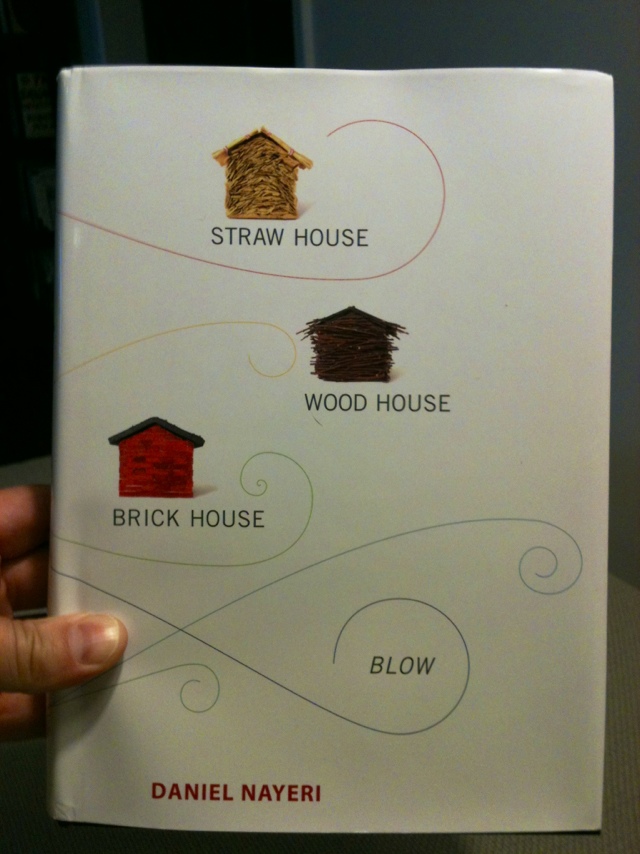
20111129-161210.jpg

This one looks pretty cool: Daniel Nayeri’s quartet of novels  Straw House, Wood House, Brick House, Blow. Publisher’s description—

Written entirely on an iPhone, this quartet of YA novellas by Another Pan and Another Faust author Daniel Nayeri showcases four different genres.

This bold collection of novellas by Another series author Daniel Nayeri features four riveting tales. These modern riffs on classic genres will introduce young adult readers to a broad range of writing styles that explore universally compelling themes such as identity and belonging, betrayal and friendship, love and mortality.

Straw House: A Western sizzling with suspense, set in a land where a rancher grows soulless humans and a farmer grows living toys.

Wood House: This science-fiction tale plunges the reader into a future where reality and technology blend imperceptibly, and a teenage girl must race to save the world from a nano-revolution that a corporation calls “ReCreation Day.”

Brick House: This detective story set in modern NYC features a squad of “wish police” and a team of unlikely detectives.

Blow: A comedic love story told by none other than Death himself, portrayed here as a handsome and charismatic hero who may steal your heart in more ways than one. With humor, suspense, and relatable prose, this hip and cutting-edge collection dazzles.

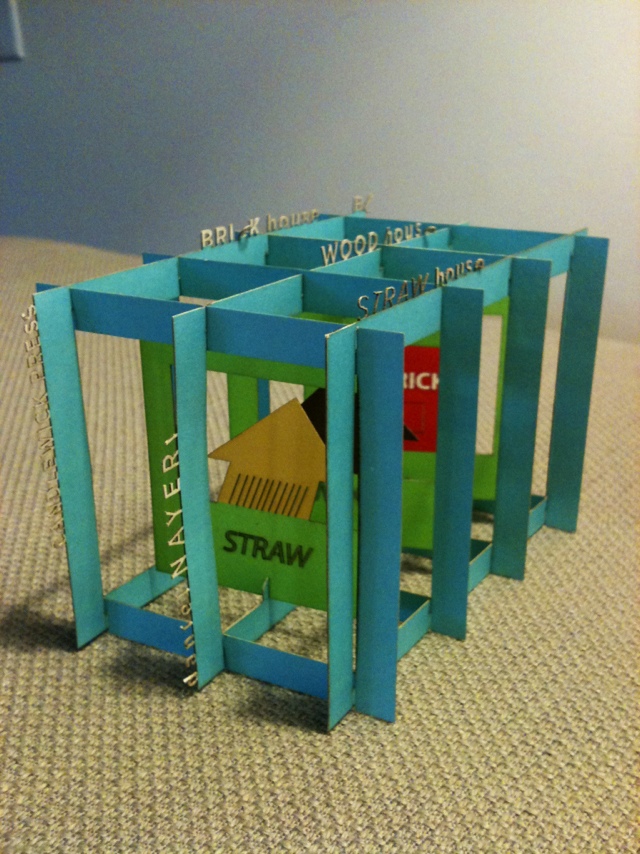
The book also came with this cool, I dunno whatchacallit, bookmark? It’s flat:

20111129-161218.jpg

—and then it pops up, 3-D style. Zing!

20111129-161225.jpg

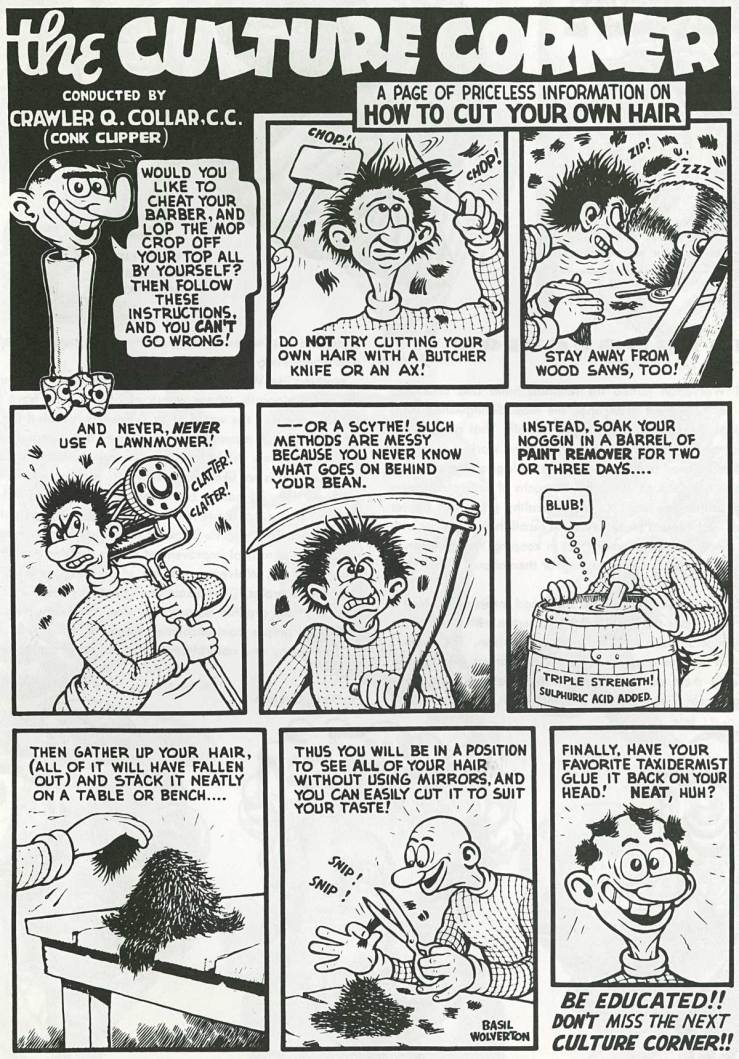
“How to Cut Your Own Hair” — Basil Wolverton

Jeff Bridges Compares Pulp Fiction to Talking Heads, Creating Trifecta of Cool

RIP Ken Russell

RIP Ken Russell.

Filmmaker Ken Russell died last night at 84. I was a huge fan of his weird wonderful films, including Lisztomania, The Music Lovers, overlooked gem The Lair of the White Worm, Altered States,  and my personal favorite, The Devils (based on Aldous Huxley’s The Devils of Loudon).

Russell’s films deeply divided critics, who alternately lauded his hyperbolic visual flair and dramatic staging or lashed out at the perceived bad taste of his films. Simply put, a Russell film is turned to 10 from the get go, a style that worked well for strange projects like Lisztomania and Tommy, based on The Who’s concept album.

Russell’s career began provocatively with an adaptation of D.H. Lawrence’s Women in Love; the film featured a nude wrestling match between Oliver Reed and Alan Bates. Russell was able to push the limits of good taste, narrative cohesion, and sensory overload throughout the 1970s, but his career faltered in the 1980s, due in part, perhaps, because mainstream culture eventually caught up with him. Despite the histrionics and camp that marks much of his work, Russell’s singular vision as a filmmaker undoubtedly influenced a generation of filmmakers who would go on to turn the music video into an art form.

While Russell’s sensational synesthesia is not for everyone (I distinctly remember friends asking me to turn off The Devils in college), his films hold up remarkably well—and not just as documentation of the strange, grand period of filmmaking that was the 1970s. They are still provocative, even today. Russell was a strange bird, a filmmaker blending high art with popular culture who constantly pushed his audience. Do yourself a favor and check out one of his mind twisting films.

“He Wanted Someone Who Would Fall in Love with a Sheep and Not Do It as a Joke” — Gene Wilder on Woody Allen

Fear and Loathing on Tatooine — Anton Marrast

Napoleon Bonaparte’s Death Mask

Martin Scorsese on Realism and Artifice in Film

“Shopping Is a Feeling” — David Byrne

Enjoy Thanksgiving with Our Literary Recipes Roundup

Happy Thanksgiving! Enjoy Turkey Day with Biblioklept’s menu of literary recipes:

F. Scott Fitzgerald’s Turkey Twelve Ways

Zora Neale Hurston’s Mulatto Rice

Ian McEwan’s Fish Stew

James Joyce’s Burnt Kidney Breakfast

Herman Melville’s Whale Steaks

Ernest Heminway’s Absinthe Cocktail, Death in the Afternoon

Vladimir Nabokov’s Eggs à la Nabocoque

Thomas Pynchon’s Banana Breakfast

Cormac McCarthy’s Turtle Soup

Robert Crumb’s Macaroni Casserole

Christmas Bonus:  George Orwell’s Recipes for Plum Cake and Christmas Pudding

Cormac McCarthy’s Turtle Soup

Another literary recipe to celebrate Thanksgiving—

In Cormac McCarthy’s novel Suttree, an Indian named Michael prepares a turtle soup for Suttree. First, catch the turtle. Then, kill the turtle, making sure to discard its head–

The Indian braced his feet and swung it up dripping from the river and onto the rocks and it squatted there watching them, its baleful pig’s eyes blinking. It was tied through the lower jaw with a section of wire and the Indian took hold of the wire and tugged at it. The turtle bated and hissed, its jaws gasped. The Indian had out his pocketknife and now he opened it and he pulled the turtle’s obscene neck out taut and with a quick upward motion of the blade severed the head. Suttree involuntarily drew back. The turtle’s craggy head swung from the wire and what lay between the braced forefeet was a black and wrinkled dog’s cunt slowly pumping gouts of near black blood. The blood ran down over the stones and dripped in the water and the turtle shifted slowly on the rock and started toward the river. The Indian undid the wire and flung the head into the river . . .

Appetizing, no? Now that you’ve thrown the bloody head in the river (or your garbage can or wherever you throw turtle heads), it’s time to dress the beast–

Suttree laid the turtle on the rock and the Indian scouted about him until he came up with a goodsized stone.

Watch out, he said.

Suttree stepped back.

The Indian raised the stone and brought it down upon the turtle’s back. The shell collapsed with a pulpy buckling sound.

I never saw a turtle dressed before, said Suttree. But the Indian had knelt and was cutting away the broken plates of shell with his pocketknife and pitching them into the river. He pulled the turtle’s meat up off the plastron and gouged away the scant bowels with his thumb. He skinned out the feet. What hung headless in his grip as he raised it aloft was a wet gray foetal mass, a dim atavism limp and dripping.

Plenty of meat there, said the Indian. He laid it out on the rock and bent and swished the blade of his knife in the river.

Okay. Now that you’ve removed the shell and gouged away the scant bowels with your thumbs, it’s time to prepare the wet gray foetal mass.

Put him in a pot and cook him slow. Lots of vegetables. Lots of onions. I got my own things I put in.

Got it? Lots of onions. Slow cook that dim, limp, dripping atavism. The fact that the Indian has his “own things” that he puts in implies a call to the reader to experiment with the recipe. And how did Suttree like his turtle?

He spooned up a piece of the meat and cradled it in his mouth to cool it. He chewed it. It was succulent and rich, a flavor like no other.

Vladimir Nabokov’s Recipe for Eggs à la Nabocoque

Another literary recipe to celebrate Thanksgiving—

Vladimir Nabokov’s recipe for eggs à la Nabocoque —

Boil water in a saucepan (bubbles mean it is boiling!). Take two eggs (for one person) out of the refrigerator. Hold them under the hot tap water to make them ready for what awaits them.

Place each in a pan, one after the other, and let them slip soundlessly into the (boiling) water. Consult your wristwatch. Stand over them with a spoon preventing them (they are apt to roll) from knocking against the damned side of the pan.

If, however, an egg cracks in the water (now bubbling like mad) and starts to disgorge a cloud of white stuff like a medium in an oldfashioned seance, fish it out and throw it away. Take another and be more careful.

After 200 seconds have passed, or, say, 240 (taking interruptions into account), start scooping the eggs out. Place them, round end up, in two egg cups. With a small spoon tap-tap in a circle and hen pry open the lid of the shell. Have some salt and buttered bread (white) ready. Eat.

V.N.
November 18, 1972

Thomas Pynchon’s Banana Breakfast

Another literary recipe to celebrate Thanksgiving—

At the beginning of Thomas Pynchon’s massive tome Gravitys Rainbow, Captain Geoffrey “Pirate” Prentice cooks up a bodacious banana breakfast for a bunch of hung over army officers—

Routine: plug in American blending machine won from some Yank last summer, some poker game, table stakes, B.O.Q. somewhere in the north, never remember now….Chop several bananas into pieces. Make coffee in urn. Get can of milk from cooler. Puree ‘nanas in milk. Lovely. I would coat all the booze-corroded stomachs of England. . . . Bit of marge, still smells all right, melt in the skillet. Peel more bananas, slice lengthwise. Marge sizzling, in go long slices. Light oven whoomp blow us all up someday oh, ha, ha, yes. Peeled whole bananas to go on broiler grill soon as it heats. Find marshmallows. . . .

Here’s how it all turns out–

With a clattering of chairs, upended shell cases, benches, and ottomans, Pirate’s mob gather at the shores of the great refectory table, a southern island well across a tropic or two from chill Corydon Throsp’s mediaeval fantasies, crowded now over the swirling dark grain of its walnut uplands with banana omelets, banana sandwiches, banana casseroles, mashed bananas molded into the shape of a British lion rampant, blended with eggs into batter for French toast, squeezed out a pastry nozzle across the quivering creamy reaches of a banana blancmange to spell out the words C’est magnifique, mais ce n’est pas la guerre (attributed to a French observer during the Charge of the Light Brigade) which Pirate has appropriated as his motto . . . tall cruets of pale banana syrup to pour oozing over banana waffles, a giant glazed crock where diced bananas have been fermenting since the summer with wild honey and muscat raisins, up out of which, this winter morning, one now dips foam mugsfull of banana mead . . . banana croissants and banana kreplach, and banana oatmeal and banana jam and banana bread, and bananas flamed in ancient brandy Pirate brought back last year from a cellar in the Pyrenees also containing a clandestine radio transmitter. . . .

James Joyce’s Burnt Kidney Breakfast

Another entry in our ongoing series of literary recipes to celebrate Thanksgiving.

Leopold Bloom, hero of James Joyce’s Ulysses likes kidneys for breakfast. In fact–

Mr Leopold Bloom ate with relish the inner organs of beasts and fowls. He liked thick giblet soup, nutty gizzards, a stuffed roast heart, liverslices fried with crustcrumbs, fried hencods’ roes. Most of all he liked grilled mutton kidneys which gave to his palate a fine tang of faintly scented urine.

Okay, so there’s not much to this recipe. First, you’ve gotta buy the kidney–

A kidney oozed bloodgouts on the willowpatterned dish: the last. He stood by the nextdoor girl at the counter. Would she buy it too, calling the items from a slip in her hand? Chapped: washingsoda. And a pound and a half of Denny’s sausages.

Then you cook it with some butter in a frying pan (don’t forget to share with the cat, and don’t forget the pepper)–

While he unwrapped the kidney the cat mewed hungrily against him. Give her too much meat she won’t mouse. Say they won’t eat pork. Kosher. Here. He let the bloodsmeared paper fall to her and dropped the kidney amid the sizzling butter sauce. Pepper. He sprinkled it through his fingers ringwise from the chipped eggcup.

Then take your lazy adulterous wife her breakfast that you’ve lovingly prepared for her (she’ll need her strength for later). Oh, and don’t forget about the kidney that’s still cooking for you (unless you’re making some kind of subconscious symbolic burnt offering or something)–

—There’s a smell of burn, she said. Did you leave anything on the fire?

—The kidney! he cried suddenly.

He fitted the book roughly into his inner pocket and, stubbing his toes against the broken commode, hurried out towards the smell, stepping hastily down the stairs with a flurried stork’s legs. Pungent smoke shot up in an angry jet from a side of the pan. By prodding a prong of the fork under the kidney he detached it and turned it turtle on its back. Only a little burnt. He tossed it off the pan on to a plate and let the scanty brown gravy trickle over it.

Enjoy with gravy, toast, and a cup of tea–

Cup of tea now. He sat down, cut and buttered a slice of the loaf. He shore away the burnt flesh and flung it to the cat. Then he put a forkful into his mouth, chewing with discernment the toothsome pliant meat. Done to a turn. A mouthful of tea. Then he cut away dies of bread, sopped one in the gravy and put it in his mouth. What was that about some young student and a picnic? He creased out the letter at his side, reading it slowly as he chewed, sopping another die of bread in the gravy and raising it to his mouth.

He sopped other dies of bread in the gravy and ate piece after piece of kidney.