Flannery O’Connor on Freaks in the Christ-haunted South

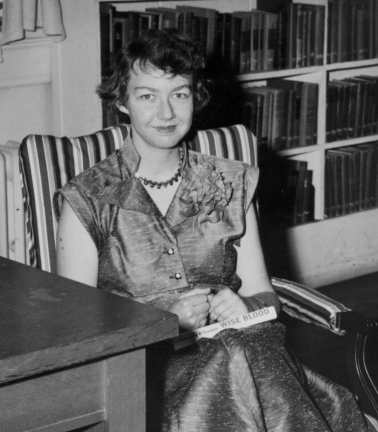
From Flannery O’Connor’s 1960 lecture, Some Aspects of the Grotesque in Southern Fiction

Whenever I’m asked why Southern writers particularly have a penchant for writing about freaks, I say it is because we are still able to recognize one. To be able to recognize a freak, you have to have some conception of the whole man, and in the South the general conception of man is still, in the main, theological. That is a large statement, and it is dangerous to make it, for almost anything you say about Southern belief can be denied in the next breath with equal propriety. But approaching the subject from the standpoint of the writer, I think it is safe to say that while the South is hardly Christ-centered, it is most certainly Christ-haunted. The Southerner, who isn’t convinced of it, is very much afraid that he may have been formed in the image and likeness of God. Ghosts can be very fierce and instructive. They cast strange shadows, particularly in our literature. In any case, it is when the freak can be sensed as a figure for our essential displacement that he attains some depth in literature.

Hear O’Connor read a version of her lecture here.

New Books from Dinaw Mengestu, Stephen-Paul Martin, and Susan Straight

Dinaw Menestu’s new novel How to Read the Air tells the story of a family over two generations. The novel opens in the 1970s as Mariam and Josef, a young married couple from Ethiopia, take a road trip through the American heartland. The pair has been separated for over three years–after just one year of marriage–and they hope that the trip will help renew their bonds and in some way forge their new identities as Americans. But they don’t really know each other, and perhaps they can’t; the violence they sought to escape in Ethiopia’s communist revolution recapitulates in their own marriage, eventually sundering it. Nearly 30 years later, their son Jonas–the introspective, sensitive, and inventive narrator of this novel–tries to come to terms with his own crumbling marriage, job, and identity, by re-examining the past. By literally recreating his parents’ journey, Jonas tries to convert his father’s pain and fear into a stable identity in this moving novel about family, place, and the need to move both our bodies and our souls. How to Read the Air is new in hardback from Riverhead Books.
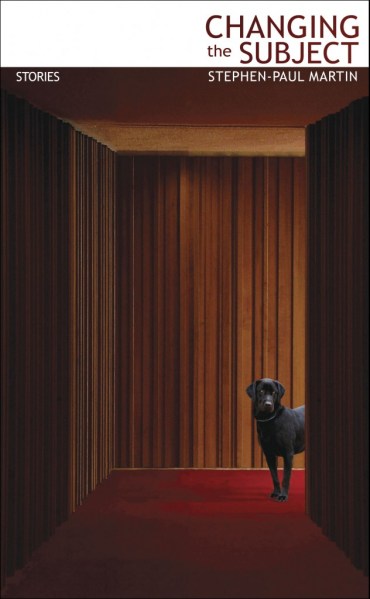
There’s a thread of vengeful anger that runs through Stephen-Paul Martin’s new collection of stories, Changing the Subject. Although a tidy portion of that anger is reserved for George W. Bush and his nefarious gang (the stories seem to have been composed under last decade’s regime), Martin’s various characters also aim their anger at scientists, whalers, cell phones, born-again Christians, college students, journalists, fast food restaurants, Americans, and all the people of the world. That anger works best when working in a reflective mode, especially when Martin blends his vitriol with humor. The opening paragraph of the first story “Safety Somewhere Else” provides a nice illustration of Martin at his finest–

The greatest mistake of all time took place thousands of years ago, when God let Noah’s family survive the flood. God’s plan was to start a new human race with a man he though he could trust, but the limits of Noah’s moral awareness were obvious right from the start. No sooner had God’s rainbow vanished into the clouds than Noah was getting drunk and cursing his grandson, declaring that Canaan’s descendants–one-third of the human race–would be the lowest of slaves, a monstrous over-reaction that would have tragic consequences for countless generations of innocent people. Clearly, Noah wasn’t the man God thought he was.
The story then shifts into a bizarre picaresque involving revenge against a scientist who uses animals as research subjects (there’s also an attack on a whaling vessel, a fascinating reading of The Odyssey, and a woman whose son was consumed by a bear). Great stuff, but I think I would have been just as happy to hear more of Martin’s thoughts (or, his narrator’s thoughts, to be fair) on the Old Testament. Changing the Subject is new in trade paperback from Ellipsis Press.


Susan Straight’s
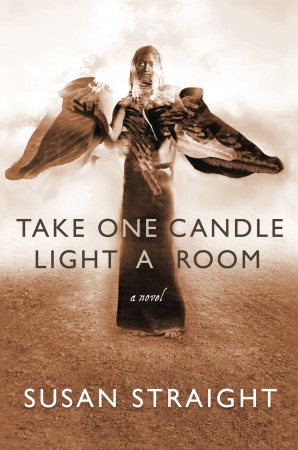
new novel Take One Candle Light a Room explores the physical and psychic traumas that evince from America’s long, painful, complicated history of race relations. FX Antoine, the novel’s narrator, is an LA-based travel writer who found herself, as a young girl, transplanted from rural Louisiana to California at the end of the fifties, in order to escape the rapes perpetrated by a local plantation owner on three of her sisters. In 2005, FX–Fantine to her friends and family–watches over Victor, her godson, a recent community college graduate. Fantine encourages Victor to expand his unlikely success (he is the son of a crack-addicted murder victim, one of Fantine’s childhood friends) by applying to four-year schools; however, after Victor is implicated in a shooting (wrong place, wrong time), he runs away to Louisiana. Fantine follows, attempting to save the young man and find some sense of personal redemption as well. The novel’s climax is set against the devastating backdrop of Hurricane Katrina. For more on Take One Candle, read Francesca Mari’s review at The New York Times. Take One Candle Light a Room is new in hardback from Pantheon Books.
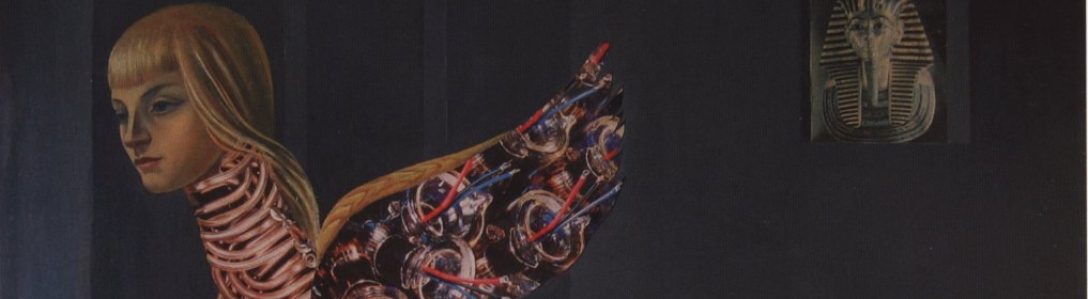
A Selection from “Hierogylphic Silence” by William S. Burroughs

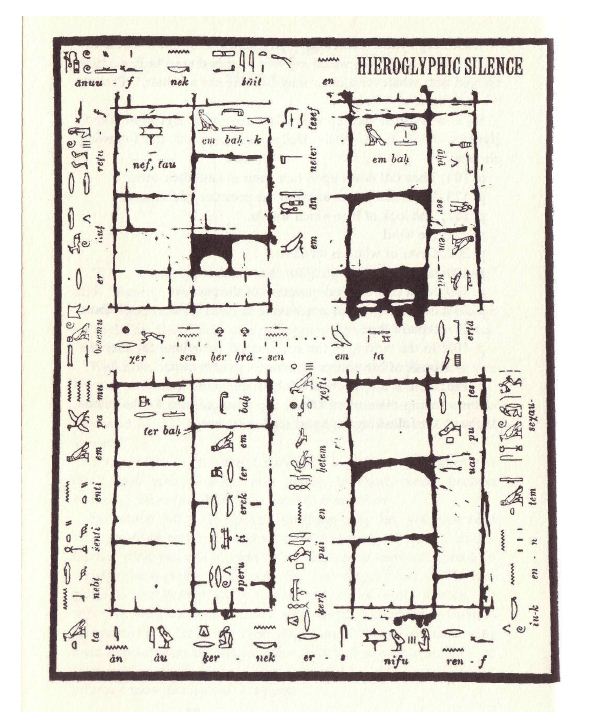
The following selection is from William S. Burroughs’s “Hieroglyphic Silence,” collected in the totally out-of-print volume The Third Mind, a book of cut-ups Burroughs co-authored with Brion Gysin (you can access the book here via extralegal means). From “Hieroglyphic Silence”–

“I am the Egyptian,” he said, looking all flat and silly, and I said: “Really, Bradford, don’t be tiresome.”

All right, let’s put it apple-pie simple with a picture of a wedge of apple pie there, containing fifty-three grams of carbohydrates.(See the L-C diet.)

Well now, if you don’t know the word for apple pie where you happen to be and want it, you can point to it or you can draw it. So, when and why do you need a word for it? When and why do you need to say, I want apple pie, if you just don’t care how fat you get?

You need to say it when it isn’t there to point to and when you don’t have your drawing tools handy\ In short, words become necessary when the object they refer to is not there.

No matter what the spoken language may be, you can read hieroglyphs, a picture of a chair or what have you; makes no difference what you call it, right? You don’t need subvocal speech to register the meaning of hieroglyphs. Learning a hieroglyphic language is excellent practice in the lost art of inner silence. “It would be well, today, if children were taught a good many Chinese ideograms and Egyptian hieroglyphs as a means of enhancing their appreciation of our alphabet.” If you are able to look at what is in front of you in silence, you will be able to write about it from a more perceptive viewpoint.

What keeps you from seeing what is in front of you? Words for what is in front of you, which are not what is there. As Korzybski pointed out: whatever a chair may be, it is not a “chair.” That is,it is not the label “chair.”So, now try this: pick up your Easy Lessons in Egyptian Hieroglyphics, by Sir E. A. Wallis Budge, and copy out the following phrases:

p. 104; They fall down upon face their in land their own.

p. 173; Stood the prince alone in the presence of the gods.

p. 181; The lock of hair which was in.

p. 79; the wind

p. 202; Giver of winds is its name.

p. 190; coming forth waiting for thee from of  old

p. 200; night that of the destruction of the enemies

p. 208; come thou to us not having thy memories of evil come thou in thy form

p. 103; In the writing of the god himself he writeth for thee the book of breathings with his fingers his own.

p. 195; Shall it be that thou wilt be silent about it.

Now, having memorized the above passage, turn to the hieroglyphs on the following page and read in silence.

Historic Photos of Heroes of the Old West

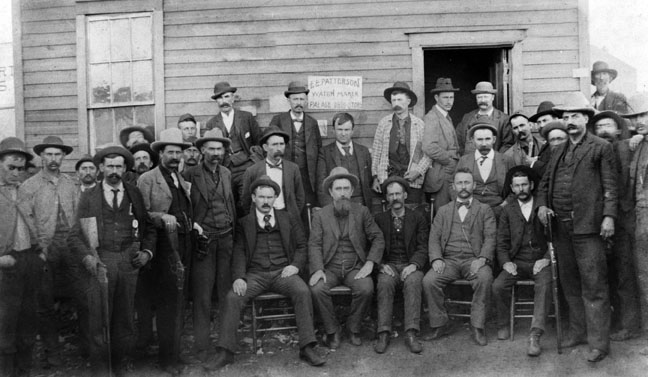
In 200 black and white archival photos with accompanying captions by historian Mike Cox, Historic Photos of the Old West winds its way through almost two centuries of American history, tracing the exploration of the West from its earliest pathfinders like Lewis and Clark, through later generations who mythologized the practitioners of Manifest Destiny. Along the way, we’re treated to photos of lawmen and settlers, civilizers and politicians, along with plenty of roustabouts, rustlers, and rascals (admittedly, some of these “heroes” had no problem slipping from the former category to the latter and back). There are all the famous names you’d expect to see in here–Wild Bill Hickok, Calamity Jane, Pat Garrett, the Earp brothers, just to name a few–but its photos like this one, below, of a pioneer family in Nebraska that signal the less sensational (and perhaps more human) side of the Western migration.

Of course, those settlers needed land when they arrived out West, as well as protection from the Indians who had been there first (not to mention each other). The picture below shows the bureaucrats of the U.S. Land Office who doled out Indian land to white people, along with the armed U.S. marshals who enforced these actions. Are they heroes?

The following picture depicts a company of Texas Rangers, posing with their Winchesters in South Texas in the mid 1880s. Some tough-looking hombres.

Historic Photos of Heroes of the Old West, available now from Turner Publishing, makes a nice companion piece to Historic Photos of Outlaws of the Old West.

Noël Coward’s Death Mask

Vladimir Nabokov, Butterfly Hunter

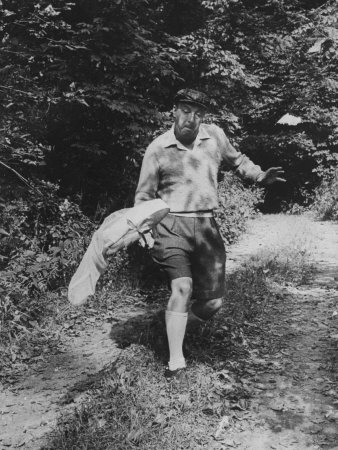
Oh my god. Look at that poise. That athleticism. That self-assurance. That spark of incandescent grace vibrating through his form. The lower lip lunging over the upper. The short pants.  Vladimir Nabokov, hunting butterflies. See the whole set.

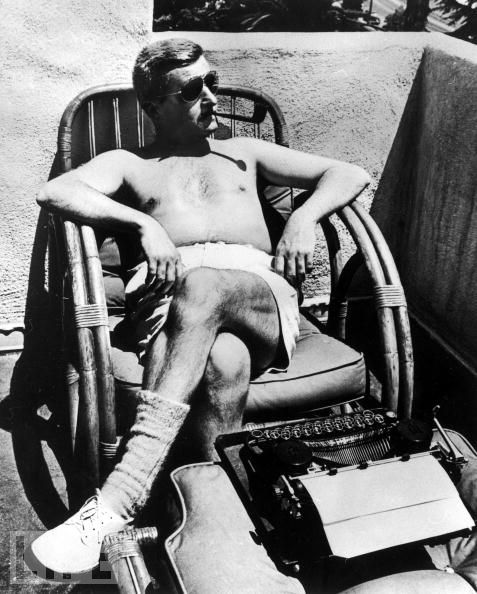
Faulkner Goes Topless

William Faulkner and Phil Stone

Sophie Crumb and Robert Crumb on NPR

Illustration by Sophie Crumb from Evolution of a Crazy Artist

Robert Crumb and his daughter Sophie Crumb spoke with Neal Conan on on NPR’s Talk of the Nation program today to discusses her art, her new book, Evolution of a Crazy Artist, and her relationship with her parents. From the web edition’s write-up:


Sophie Crumb grew up in a family of artists — her parents, Robert Crumb and Aline Kominsky-Crumb, are two of the most famous graphic artists in the world. So it’s only natural that she found herself gravitating toward their profession as early as the age of 2.

Her new book, Sophie Crumb: Evolution Of A Crazy Artist, is a collection of her work up to age 28. She and her father tell NPR’s Neal Conan about collaborating on her book and life in the Crumb household.

Sophie Crumb features a comprehensive collection of Sophie’s drawings, and that was no accident.

“My dad is a compulsive archivist,” she says. “He was into them, so I kind of did them to make him laugh.”

Sophie Crumb grew up in a family of artists — her parents, Robert Crumb and Aline Kominsky-Crumb, are two of the most famous graphic artists in the world. So it’s only natural that she found herself gravitating toward their profession as early as the age of 2.

Her new book, Sophie Crumb: Evolution Of A Crazy Artist, is a collection of her work up to age 28. She and her father tell NPR’s Neal Conan about collaborating on her book and life in the Crumb household.

Sophie Crumb features a comprehensive collection of Sophie’s drawings, and that was no accident.

“My dad is a compulsive archivist,” she says. “He was into them, so I kind of did them to make him laugh.”

2001: Art History with Metaphor

(Via).

David Simon Explains How Paths of Glory Influenced The Wire

At Penguin Classics on Air, David Simon explains how Stanley Kubrick’s film Paths of Gloryand the Humphrey Cobb novel it was based on–influenced his epic crime drama The Wire. (Via).

Vodpod videos no longer available.


Brian Eno Interviewed

Dick Flash (jeez, what a great name) of Pork Magazine (another great name) interviews mad genius Brian Eno:

“Alone and Unafraid” — A Sample from Trevor Paglen’s Book about Black Op Patches, I Could Tell You But Then You Would Have To Be Destroyed By Me

Trevor Paglen’s book I Could Tell You But Then You Would Have To Be Destroyed By Me examines the secret history of America’s military-industrial complex by examining the different patches worn by military intelligence officers who work in covert operations. I Could Tell You is out in a new paperback edition from Melville House this November. See Paglen on Colbert below.

Vodpod videos no longer available.

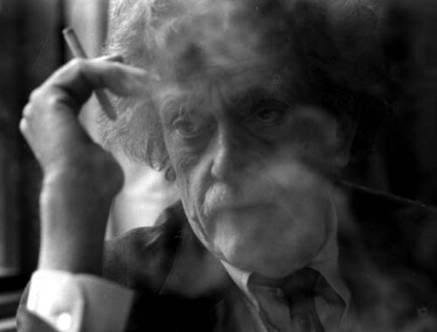
“I Had Made a Bad Trade” — Kurt Vonnegut on Quitting (and Resuming) Smoking

From The Paris Review interview archive: Kurt Vonnegut discusses quitting smoking and then starting again and then quitting and then stating again–

INTERVIEWER: Have you ever stopped smoking?

VONNEGUT: Twice. Once I did it cold turkey, and turned into Santa Claus. I became roly-poly. I was approaching two hundred and fifty pounds. I stopped for almost a year, and then the University of Hawaii brought me to Oahu to speak. I was drinking out of a coconut on the roof of the Ili Kai one night, and all I had to do to complete the ring of my happiness was to smoke a cigarette. Which I did.

INTERVIEWER: The second time?

VONNEGUT: Very recently—last year. I paid Smokenders a hundred and fifty dollars to help me quit, over a period of six weeks. It was exactly as they had promised—easy and instructive. I won my graduation certificate and recognition pin. The only trouble was that I had also gone insane. I was supremely happy and proud, but those around me found me unbearably opinionated and abrupt and boisterous. Also: I had stopped writing. I didn’t even write letters anymore. I had made a bad trade, evidently. So I started smoking again. As the National Association of Manufacturers used to say, “There’s no such thing as a free lunch.”

Cormac McCarthy’s Bloody Mary and Other Author Cocktails

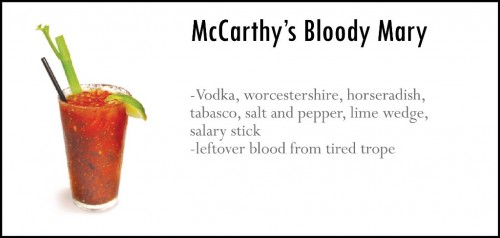
At HTML, chief mixologist Jimmy Chen has concocted a satirical round of writer cocktails. Here’s “Cormac McCarthy’s Bloody Mary” (which calls for something called a “salary stick” — not sure what that is, but we suggest a celery stalk if you can’t find one)–

This is fun-mean–

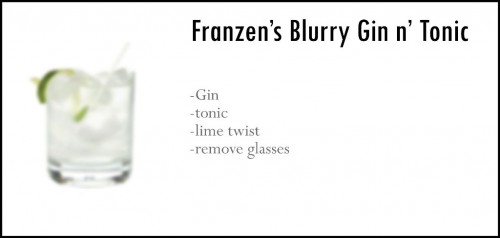
And this is just mean-mean–


Single Sentence Animation from Ben Stroud’s “Byzantium”

Peter Lundren animates a sentence from Ben Stroud’s short story “Byzantium,” published in Electric Literature No. 4. Music by William “Lucky” Lee.

The sentence reads: “There I would watch others taking their pleasure—keeping to the shadows, my hand hidden, as I studied a chariot racer leaning into a prostitute, her leg wrapped round his torso, or libertines goading a gilded crocodile in the bearpit, their bodies slurred by powders from the east.”

“It Was Like a Romance” — Norman Mailer on Marijuana