
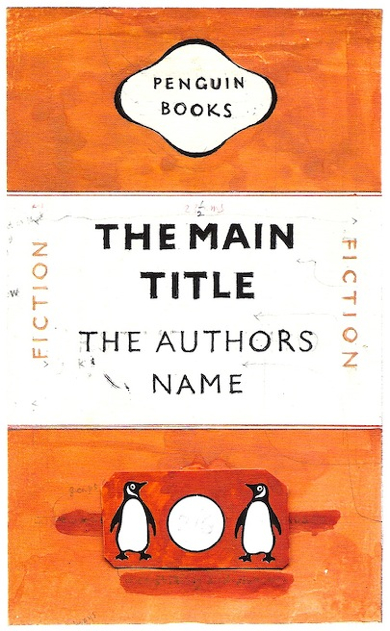
 Penguin Books turns 75 today. Happy birthday! More here. There’s a great Penguin Books sci-fi cover gallery here. If you are the sort of philistine who doesn’t dig Penguin’s iconic covers, you can order your own blank art paper quality covered books here.
Author: Biblioklept
David Foster Wallace on Education
J.D. Salinger Puts On His Socks
Here’s a recently unearthed photo of the famously reclusive author J.D. Salinger putting on his socks. Earth shattering! Now if we could only get a peek of Thomas Pynchon adjusting his bolo . . . (More info here).

Tom McCarthy Talks C
James Wood on Virginia Woolf and the Anxiety of Influence
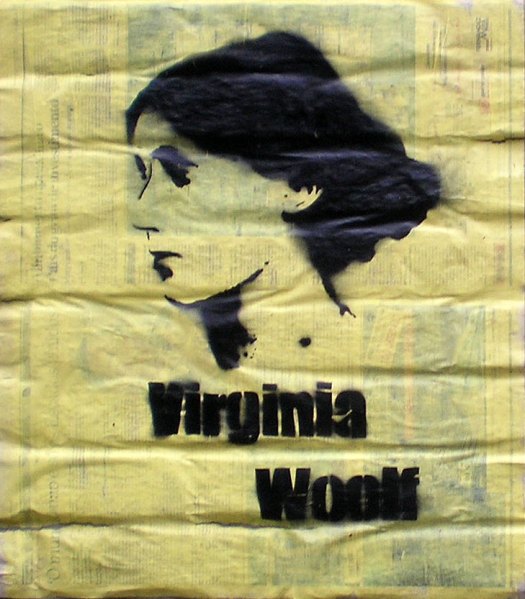 James Wood, writing about Virginia Woolf in his essay “Virginia Woolf’s Mysticism” (collected in The Broken Estate)–
Woolf, I think, became a great critic, not simply a “great reviewer.” The Collected Essays, which are still being edited, is the most substantial body of criticism in English this century. They belong in the tradition of Johnson, Coleridge, Arnold, and Henry James. This is the tradition of poet-critics, until the modern era, when novelists like Woolf and James join it. That is, her essays and reviews are a writer’s criticism, written in the language of art, which is the language of metaphor. The writer-critic, or poet-critic, has a competitive proximity to the writers she discusses. The competition is registered verbally. The writer-critic is always showing a little plumage to the writer under discussion. If the writer-critic appears to generalize, it is because literature is what she does, and one is always generalizing about oneself.
Wood’s description of Woolf is really Wood’s description of Wood.
Christopher Hitchens on J.D. Salinger
China Miéville Profiled at The New York Times
Today’s New York Times profiles one our favorite bizarros, China Miéville. Read the article here. Topics include embarrassing apocalypses, Star Trek, and his new book Kraken. From the article:
Mr. Miéville says what attracts him to the genre, as a reader and a writer, is the importance of the imagination — “that sense of the world blown apart, that sense of a crack in reality, that visionary sense, that ecstatic sense,” as he described it.
“At a certain stage some people end up not trusting their own imagination,” Mr. Miéville said. “You get this kind of baleful set of voices in your head that tell you, ‘That’s silly; you’re being silly.’
“But I think most people have more ideas in their heads than they think they do. It’s just that those of us in the fantastic fields — either we don’t listen to our own filters, or we have a much higher ridiculousness threshold.”
Tom McCarthy on Technology and the Novel
Great essay today at The Guardian from Tom McCarthy, author of Remainder and the the forthcoming, highly-anticipated C. McCarthy discusses technology, modernity, and literature, mulling over writers like Blake, Cervantes, Shelley, Joyce, and Ballard. He also talks about some of the research that went into C. From his essay:
C takes place, specifically, between 1898 and 1922. The dates aren’t accidental: they mark the period between Marconi’s early short-distance radio experiments and the founding of that centralised state broadcaster of entertainment, news and propaganda that we still know as the BBC. In 1922, Britain was erecting, in its colonial territory Egypt, the first long-distance pylons of its proposed imperial wireless chain – and as it went about this, it lost Egypt, which gained independence in February of that year. For ancient Egyptians, “pylons” were gateways to the underworld: these modern ones came to symbolise bereavement on a national scale. In November, also in Egypt, Howard Carter disinterred what would become the most famous family crypt of all time. 1922 was also modernism’s annus mirabilis, seeing the publication of The Waste Land, in which voices, dialogues and even weather reports drift in and out of audibility as its author-operator fiddles with his literary dial – and Ulysses, a huge textual switchboard in which the themes of death and media are plugged into each other time and again.
Look for our full review of C sometime next week.
Even More Images from Codex Seraphinianus
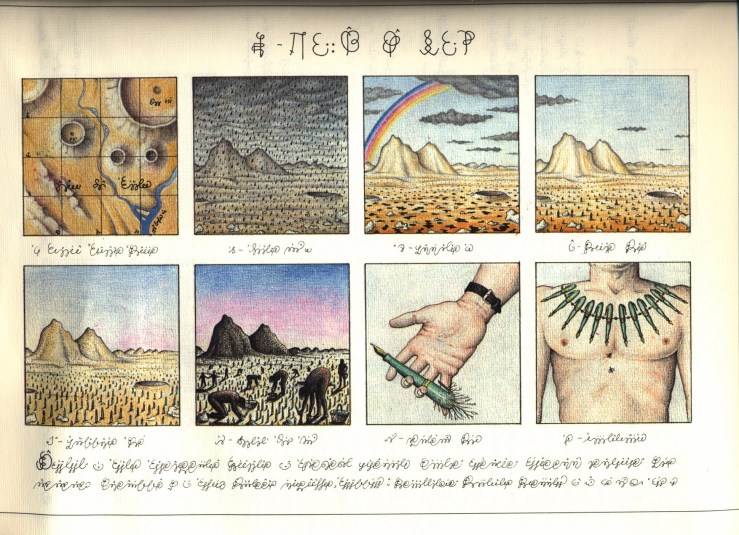
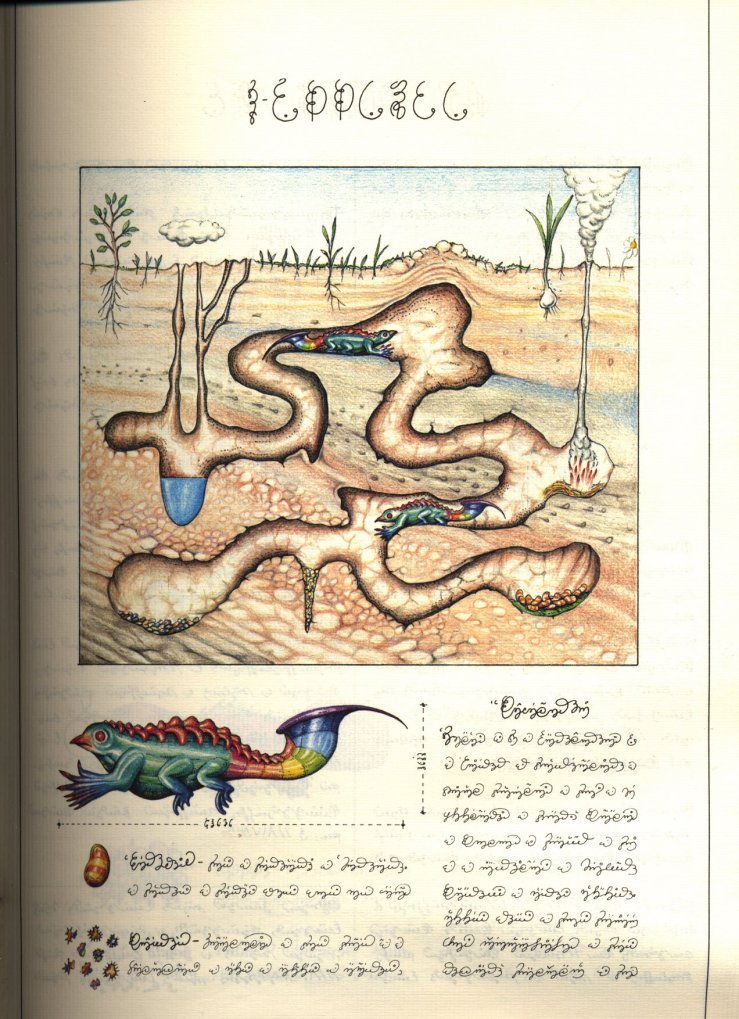
More images from Luigi Serafini’s surreal cryptoencyclopedia, Codex Seraphinianus. Learn more by reading Justin Taylor’s essay from the May 2007 issue of The Believer.



Vanity Fair Interviews David Mitchell
Vanity Fair interviews David Mitchell about his new book The Thousand Autumns of Jacob de Zoet. The interviewer mistakenly (I believe, anyway) thinks James Wood is joking in his New Yorker review when he wonders if the book is “post-postmodernist.” Mitchell’s answer sounds about right.
VF: James Wood in the New Yorker was describing your books and he jokingly came up with the phrase post-postmodernism. If there were such a thing as post-postmodern literature, what do you think that might be?
DM: Oddly enough, I’m not sure if novelists are the best people to ask whither-the-novel questions. For me, it’s a little like I’m a duckbilled platypus and I’m being asked a question about taxonomy. You won’t get much of an answer out of a platypus because they’re busy going about their business digging tunnels, catching fish, and having sex. You really have to ask a critic, or a taxonomist. I feel like I should have a pithy answer because I’m a novelist and you’re asking a question about the future of the novel, but the biggest question I ever get to is, “How can I make this damned book work?” I rarely ever put my head above the rampart and see where this big lumbering behemoth called global literature is going.
(Thanks to the Bored Bookseller for the tip).
Woody Allen on Recording Audiobooks

Woody Allen talks to The New York Times about recording audiobook versions of his anthologies Getting Even, Without Feathers, Mere Anarchy, and Side Effects. Here’s Woody, from the interview, emitting his usual positive vibes:
I imagined it would be quite easy for me, and, in fact, it turned out to be monstrously hard. I hated every second of it, regretted that I had agreed to it, and after reading one or two stories each day, found myself exhausted. The discovery I made was that any number of stories are really meant to work, and only work, in the mind’s ear and hearing them out loud diminishes their effectiveness. Some of course hold up amusingly, but it’s no fun hearing a story that’s really meant to be read, which brings me to your next question, and that is that there is no substitute for reading, and there never will be. Hearing something aloud is its own experience, but it’s hard to beat sitting in bed or in a comfortable chair turning the pages of a book, putting it down, and eagerly awaiting the chance to get back to it.
“The Unwanted” — Joe Sacco
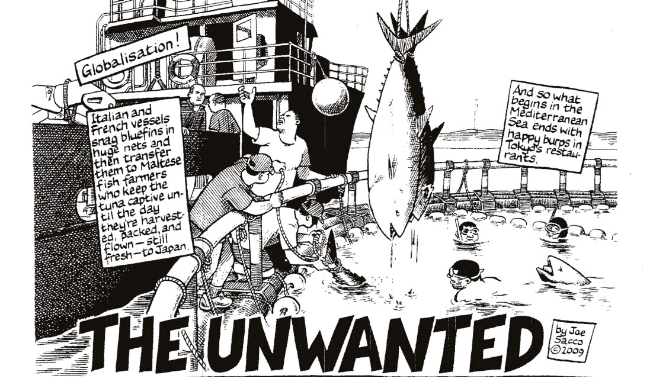
Read Joe Sacco’s comic “The Unwanted” at The Guardian. As usual, Sacco approaches a complex problem at the human level in his story about African immigration to Malta. Go here for more on Joe Sacco, his journalism, and his fantastic books, Safe Area Goražde and Palestine.
David Mitchell Discusses His New Novel, The Thousand Autumns of Jacob de Zoet
Hear the whole interview here.
In Honor of the Confounding Kafka Cache Caper, Listen to Susan Sontag, Paul Auster, David Foster Wallace and Others on Kafka’s Work
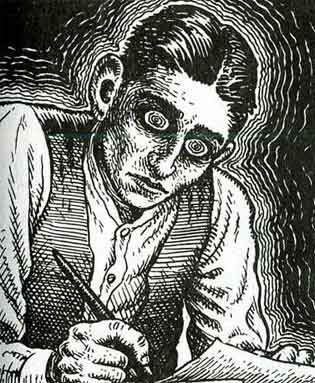
Yesterday, lawyers in Zurich opened four anonymous safety deposit boxes supposedly containing original manuscripts, letters, and drawings by Franz Kafka. The question of who owns the literary cache has turned into something of an international debacle, with lawyers and judges jostling for control.
In appreciation of Kafka (and this whole cosmically-ironic fiasco), we direct you to audio clips of the PEN fellowship’s March 26, 1998 tribute, which featured, among others, E.L. Doctorow, Susan Sontag, Cynthia Ozick, and Paul Auster, reading from their own essays on Kafka, or the Czech’s work. The highlight is David Foster Wallace’s essay “A Series of Remarks on Kafka’s Funniness from Which Not Enough Has Been Removed.”
You can stream the tracks here. True biblioklepts can download them directly from here.
David Foster Wallace on Commercial Literature and the Dread of Reading
R. Crumb’s Depression Graph
Bret Easton Ellis Disses David Foster Wallace
At a in a reading in Hackney, England, two days ago, Bret Easton Ellis dissed the late great David Foster Wallace:
Question: David Foster Wallace – as an American writer, what is your opinion now that he has died?Answer: Is it too soon? It’s too soon right? Well I don’t rate him. The journalism is pedestrian, the stories scattered and full of that Mid-Western faux-sentimentality and Infinite Jest is unreadable. His life story and his battle with depression however is really quite touching . . .
Via HTMLGIANT, via The Howling Fantods. The discussion at HTMLGIANT’s comment section is pretty great right now (see our own comment thread below for comments detailing HTMLGIANT readers who claim that BEE’s quote is misrepresented/mistranscribed), with a few commentators bringing up an interview in which DFW said the following about BEE:
I think it’s a kind of black cynicism about today’s world that Ellis and certain others depend on for their readership. Look, if the contemporary condition is hopelessly shitty, insipid, materialistic, emotionally retarded, sadomasochistic, and stupid, then I (or any writer) can get away with slapping together stories with characters who are stupid, vapid, emotionally retarded, which is easy, because these sorts of characters require no development. With descriptions that are simply lists of brand-name consumer products. Where stupid people say insipid stuff to each other. If what’s always distinguished bad writing—flat characters, a narrative world that’s cliched and not recognizably human, etc.—is also a description of today’s world, then bad writing becomes an ingenious mimesis of a bad world. If readers simply believe the world is stupid and shallow and mean, then Ellis can write a mean shallow stupid novel that becomes a mordant deadpan commentary on the badness of everything. Look man, we’d probably most of us agree that these are dark times, and stupid ones, but do we need fiction that does nothing but dramatize how dark and stupid everything is? In dark times, the definition of good art would seem to be art that locates and applies CPR to those elements of what’s human and magical that still live and glow despite the times’ darkness. Really good fiction could have as dark a worldview as it wished, but it’d find a way both to depict this world and to illuminate the possibilities for being alive and human in it. You can defend “Psycho” as being a sort of performative digest of late-eighties social problems, but it’s no more than that.
 Biblioklept