J.T. LeRoy, James Frey, Herman Rosenblat, Margaret Seltzer . . . recent years have seen an explosion of memoirists lying, faking, or otherwise hoaxing the public–but this is hardly anything new. In honor of April Fool’s Day we present seven April Fools.
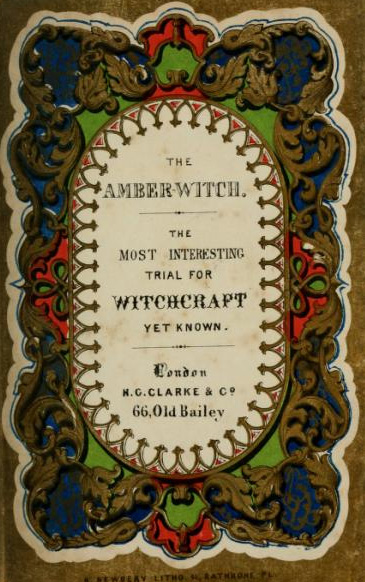
The Amber Witch — Johannes Wilhelm Meinhold (1844)
Meinhold pretended that The Amber Witch was the true story of a seventeenth-century minister’s daughter falsely accused of witchcraft. Meinhold claimed he found the minister’s manuscript in the refuse of an old church. When the book received critical attention, Meinhold admitted to the hoax, but audiences didn’t believe him at first.
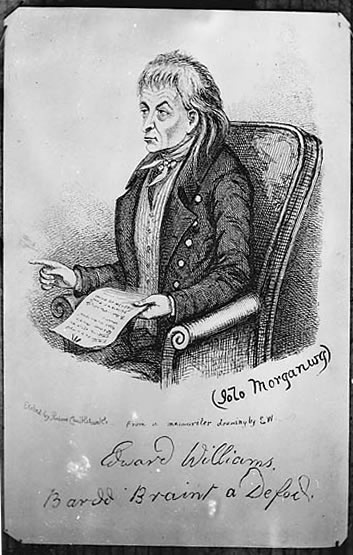
“Geraint the Blue Bard” aka Iolo Morganwg aka Edward Williams (1747-1826)
Welshman Edward Williams was widely considered a leading antiquarian and expert on the antiquities of the British Isles. After his death, however, many of his manuscripts were revealed to have been forgeries, including those produced by “Geraint the Blue Bard,” supposedly a ninth-century composer. Oh well.
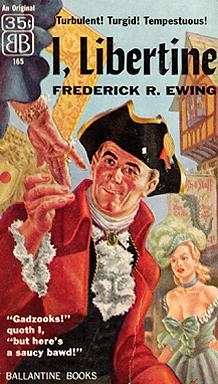
I, Libertine — Frederick R. Ewing (1956)
Proto-shock jock Jean “Shep” Shepherd perpetrated I, Libertine as a purposeful hoax. He told his radio audience to demand the (non-existent) book by the (non-existent) author “Frederick R. Ewing” from their local booksellers, and even fabricated a basic plot for listeners to in turn relate (he even included the salacious detail that the book had been banned in Boston). Publisher Ballantine hired sci-fi scribe Theodore Sturgeon to write the book from Shepherd’s outline, and the book was published very soon after. All proceeds went to charity.

Naked Came the Stranger — Penelope Ashe (1969)
To prove that American culture was smutty and degraded, Newsday columnist Mike McGrady enlisted 24 of his fellow writers to write a smutty and degraded novel that they believed would top the bestseller list in spite of its lack of literary value. By the time “Penelope Ashe” had put out Naked Came the Stranger, the hoax had linked, and it was unclear if this is what led to the book actually topping the New York Times bestseller list (for one slim week). The book later became the basis of a porno film.
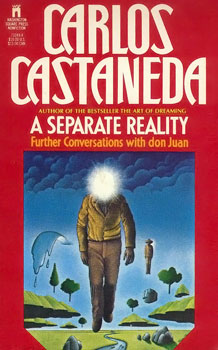
A Separate Reality — Carlos Castaneda (1971)
The debate around Castaneda’s series of “memoirs” in some ways gets to the heart of the problems of truth and invention, facts and authenticity, experience and memory. Castaneda claimed that he trained under Don Juan Matus, a Yaqui Indian sorcerer. Part of that training included taking massive amounts of psychotropic drugs like peyote as a means to “see” the energy of the universe. Don Juan Matus’s actual existence is questionable at best, but hey, when you’re doing large quantities of peyote, who knows what, like, truth is, man.
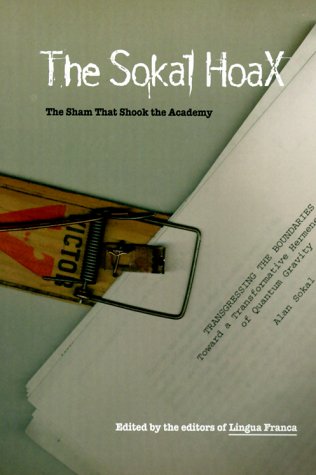
“Transgressing the Boundaries: Towards a Transformative Hermeneutics of Quantum Gravity”– Alan Sokal (1996)
Disgusted with a perceived slackness and ineptitude in modern academia, Dr. Alan Sokal published a paper full of nonsensical gibberish in Duke University’s cultural studies journal Social Text. The same day the essay was published, he announced the hoax in the journal Lingua Franca. Ouch. Biblioklept wrote a post about the incident a few years ago, if you’re interested.
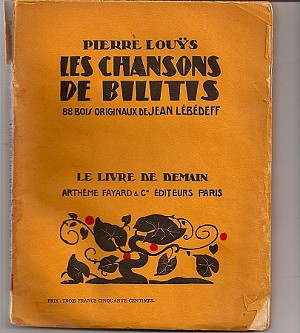
The Songs of Bilitis — Pierre Louÿs (1894)
Louÿs claimed that the erotic poems he fabricated were the work of “Bilitis,” one of Sappho’s lovers; he even invented a biography of the woman, citing a fictional archaeologist named Herr G. Heim with discovering her tomb. (“Herr G. Heim” translates roughly to “Lord S. Ecret”). Despite the hoax, many critics consider it a work of literary merit, and it’s become something of a cult book among queer theory enthusiasts.







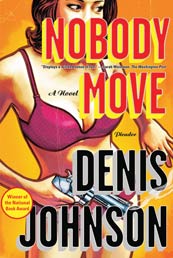 Denis Johnson’s Nobody Move is a tight snare drum of a comedy crime novel. Jimmy Luntz, still decked out in his white barbershop chorus tux (don’t ask) gets into trouble with a big gorilla he owns money too. On the run, he meets smoldering bombshell Anita. More trouble ensues. Nobody Move, originally serialized in Playboy, is a dark, funny genre exercise propelled by Johnson’s sharp dialogue and keen eye for detail. Johnson’s restraint and economy demonstrate writerly chops, but its his story and his characters that made me stay up too late reading last night.
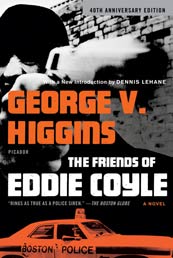 I’m kind of embarrassed that I’d never heard of George V. Higgins’s seminal crime novel, The Friends of Eddie Coyle, the story of a down-on-his luck gunrunner trying to get a break on a three-year sentence. Picador’s new edition celebrates the book’s 40th anniversary. Higgins’s electric dialogue thrusts the reader right into the action, trading narrative clarity for a smoky milieu of backroom deals and gritty alleys. But my phrasing here sounds way too corny and trite. Forgive me, I don’t really know how to write about good crime fiction because I’m so unused to it. I’ll lazily favorably compare The Friends of Eddie Coyle to David Simon’s Baltimore crime epic The Wire.
 I’ve been too engrossed with Coyle and Nobody Move the past few days to do more than skim over Clancy Martin’s How to Sell, a novel about grifters and scam artists in the jewelery world, but I did read and very much enjoy its first chapter, where the protagonist pawns his mother’s wedding ring (“the only precious thing she had left”) and yet still manages to keep reader sympathy (mine, at least). Martin worked for years in the fine jewelery business. He also translates Nietzsche and Kierkegaard. Zadie Smith says of How to Sell: “It’s a little like Dennis Cooper with a philosophical intelligence, or Raymond Carver without hope. But mostly it’s like itself.” I like that.
 Started a new audiobook: Hilary Mantel’s Wolf Hall, read competently by Simon Slater. Wolf Hall tells the familiar story of Henry VIII, only Mantel focuses (at least so far) mostly on Thomas Crownwell and Cardinal Wolsey. Most of the men in the story have the first name “Thomas.” I’m not particularly interested in the Tudor saga but I’m enjoying Mantel’s novel so far–its clean, precise style, its pacing, and, particularly Mantel’s sparing use of details. Historical novels sometimes succumb to the weight of the author’s passion with her subject. Thankfully, Mantel does not overload her prose with superfluity; instead she appoints detail in her narrative with care and precision, giving character and plot room to grow. Good dialogue too. More later.
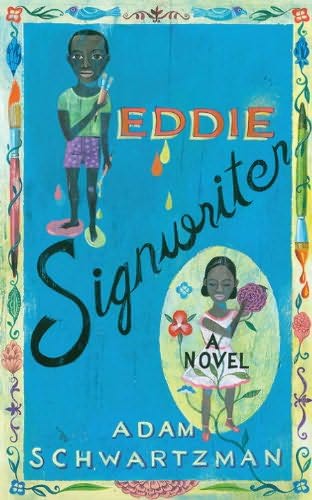 I got a review copy of Adam Schwartzmann’s début novel Eddie Signwriter last week and haven’t had a good chance to read any of it until today. The novel tells the story of Kwasi Edward Michael Dankwa aka Eddie Signwriter, who journeys from his native Ghana to Senegal, and then to France, where he takes up a new life as an illegal immigrant in Paris. The story opens in a burst of action. Nana Oforwiwaa, a village elder has died and authorities are blaming Kwasi. So far, I find Schwarzmann’s prose a bit heavy. Sentences need pruning–too many redundant verbs and clauses in his sentences for my taste. Eddie Signwriter is better when Schwartzmann moves the narrative of young Kwasi along in shorter, declarative sentences. Eddie Signwriter is available now from

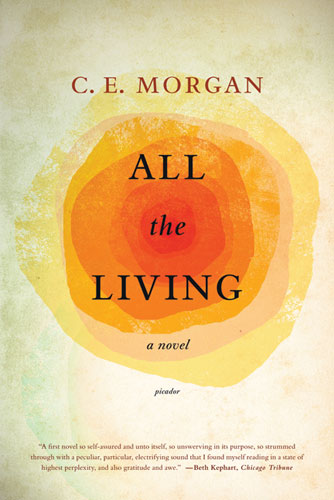 In her debut novel, All the Living, C.E. Morgan tells the story of Aloma, a would-be pianist who forgoes her dreams of artistic freedom to play wifey to her young lover Orren who must take sole responsibility of running the family tobacco farm after his family dies in a car accident. Aloma knows nothing about farming and even less about the grief Orren suffers. She’s an orphan herself, but with no memory of her own parents, she finds it hard to connect to overworked Orren as he slowly slips away. A nearby minister who hires her to play church services paradoxically relieves and exacerbates Almoa’s despair when he enters her life. Morgan’s novel is a slow-burn, often painful, sometimes slow, but also guided by a poetic spirituality that resists easy interpretations. (Oh, and she’ll also make you run for a thesaurus every few pages). All the Living is new in trade paperback from
 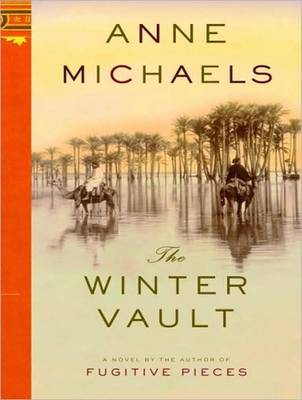 Anne Michaels’s The Winter Vault begins in Egypt, in 1964, where Canadian engineer Avery Escher is part of a team trying to help the Nubians who will be displaced by the Aswan High Dam. He and his wife Jean share a houseboat on the Nile, but what might have been a year of romantic adventure devolves into the tragedy of a culture displaced and a family eroded. The pair separate and return to Canada, where Jean takes up with Lucjan whose stories of Nazi-occupied Warsaw inform the novel’s second half. The Winter Vault is poetically dense and often overly-lyrical, sometimes offering self-important and ponderous dialogues in place of concise plotting. And while Michaels treats the tragedies of the occupied Poles and Nubians with a certain sensitivity, her engagement veers awfully close to what Lee Siegel has termed “
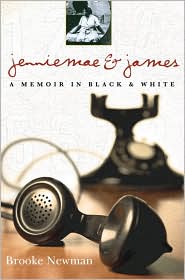 Jenniemae & James is Brooke Newman‘s new memoir about her father’s unlikely relationship with the family maid. James Newman was a brilliant mathematician (he coined the term “googol”); Jenniemae Harrington “was an underestimated, underappreciated, extremely overweight woman who was very religious, dirt poor, and illiterate.” Newman wants us to see a unique–and deep–friendship between the pair that defies 1940s/50s norms in Washington D.C., but it’s hard not to think that there’s at least some whitewashing going on here. Undoubtedly the two shared an affinity and connected through a love of numbers, but it’s hard to see more in this than an employer-employee relationship–and one still colored by the politics of the pre-Civil Rights era. Jenniemae, black mammy, sassy, Southern, larger-than-life, quick with folk wisdom and colorful quips–it all seems like a one-sided vision, a take on the
  Biblioklept