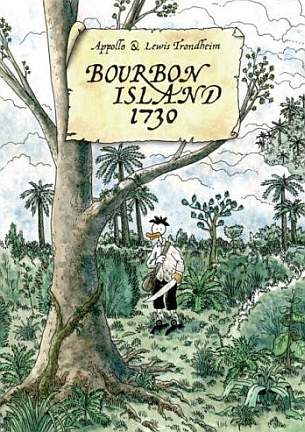
Bourbon Island 1730 — Olivier Appollodorus and Lewis Trondheim

Bourbon Island 1730, part funny animal graphic novel, part historical literature, recounts the story of Raphael Pommeroy who travels from France to Bourbon Island with his ornithology professor in search of a living dodo. On the journey to the French colony, Raphael becomes entranced by pirate tales, and when he arrives to Bourbon Island, he immediately tries to join up with some ex-pirates–unsuccessfully, of course. The French government has offered an amnesty to all pirates, and many have become successful plantation owners. However, their new wealth comes at the expense of the large population of slaves brought to Bourbon Island from Madagascar and Mozambique. The most interesting subplot of Bourbon Island 1730 involves a network of maroons, runaway slaves who have colonized their own villages at the top of the island’s treacherous terrain. When the notorious pirate Captain Buzzard is captured, some of the maroons plan to set him free and lead a revolt against the French colonials. In the meantime, the colonial authorities, including the scheming governor and the greedy priest, are trying to get Buzzard to reveal where he’s hidden a large cache of treasure.

Lewis Trondheim’s art strikes a nice balance between vivid detail and the classic funny animal style, and the book’s measured pacing delivers the story at a nice clip. Appollodorus and Trondheim never rush, taking the time to convey the cultural complexity of Bourbon Island–quite a feat, really, when you consider how much is going on here: the end of a pirate age, the horrors of slavery, and the problematics of colonization. Appollodorus and Trondheim envision Bourbon Island as a strange nexus of slavery and freedom, piracy and central authority, of the meeting of the cultures of Africa, India, and Europe. Leading man Raphael is a hopeless romantic who pines wistfully for the absolute freedom he sees as the life of a pirate and the natural right of all men. And yet, as the book makes clear, idealism can rarely stand up to the corrosive complexity of the real world.
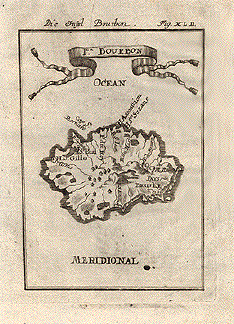
Allain Mallet's 1719 Map of Bourbon Island

With twelve pages of endnotes, Bourbon Island 1730 is just the kind of well-researched historical fiction that would fit neatly into any post-colonial studies course. There’s only one major fault with the book: it ends too quickly. Appollodorus and Trondheim have too many fascinating subplots that they don’t bother to resolve. While we have no problem with ambiguous conclusions, Bourbon feels simply rushed at the end, as it sprints to a virtual non-conclusion. We would’ve been much happier with a cliff-hanger and a promise of a part two. Nonetheless, anyone interested in colonialism and post-colonial studies should check out this book.

Bourbon Island 1730 is available October 28th, 2008 from First Second.

Syntactic Decay

Like many Americans, my main interest in last night’s Vice-Presidential Debate was the hope for a little schadenfreude: I wanted to see Palin dissolve in a “nucular” meltdown. And while the clumsy silences and passive aggressive volleys of her previous interviews weren’t on show last night, Palin still managed to cram her “answers” with stock speaking points and vague generalities–namely, what passes for political rhetoric today. What gets me is this: expectations for the doltish Palin were so low that without a spectacle gaffe, many pundits are today declaring her jabberwocky a success. For example, take David Brooks’s gushing op-ed piece in today’s New York Times:

By the end of her opening answers, it was clear she would meet the test. She spoke with that calm, measured poise that marked her convention speech, not the panicked meanderings of her subsequent interviews.

Okay, so, now, in 2008, as America seeks to prove that we can dare to be dumber than ever, it seems that anything above “panicked meanderings” equals success (Palin’s agitated mannerisms, particularly at the beginning of the debate, didn’t really strike me as “calm” or “measured” either). Fair and balanced FOX News reported that Palin’s “cool and confident performance . . . helped John McCain regain his footing.” I don’t know what specific data they have to back this claim up.

What FOX hailed as a “bravura performance” was yet another incoherent string of non-answers tarted up in sloganeering and divisive, diversionary rhetoric. Palin doesn’t understand the traditional purpose of debate; at one point she even said as much: “I may not answer the questions that either the moderator or you [Biden] want to hear, but I’m going to talk straight to the American people and let them know my track record also.” Near the end of the debate, when asked what her biggest weakness is, Palin simply didn’t answer: she just blasted out a bunch of talking points (I thought that I might’ve misheard the question, but no–check out the transcript here). Governor Palin, the point of the debate is to respond to questions and to respond and rebut your opponent’s responses. Is it too much to ask that you do this? Or is it that you simply have no answers? I believe it’s the latter.

What fascinated me most during the debate was Palin’s syntax. Her long, elliptical answers danced around the topic at hand in a showy, glittery masquerade of stock phrases, slowly disintegrating into the kind of glowing generalities that I guess Joe Six-Pack and his hockey mom wife are supposed to lap up (being an east-coast liberal elitist I simply don’t understand such realities of the Heartland; I’m far too busy eating latte salads in my Subaru while listening to gay operas and worshiping false idols to care about this kind of mundane peasant behavior).  At least one critic got it right. Also from today’s New York Times:

After a series of stumbling interviews that raised serious doubts even among conservatives about her fitness to serve as vice president, Ms. Palin had to do little more than say one or two sensible things and avoid an election-defining gaffe. By that standard, but only by that standard, the governor of Alaska did well. But Ms. Palin never really got beyond her talking points in 90 minutes, mostly repeating clichés and tired attack lines and energetically refusing to answer far too many questions.

Are specific answers too much to ask from our leaders? Or are we now okay with our politicians not even answering the questions that we ask?

Palin Bingo, or, What to do for Kicks as You Inwardly Reel in Horror while Watching Tonight’s Debate

(Image links to fun user-friendly pdfs)

There’s also this

Palin’s Poetry

This was too good not to repost. A few selections from “The Poetry of Sarah Palin,” courtesy of today’s Slate:

“On Good and Evil”

It is obvious to me
Who the good guys are in this one
And who the bad guys are.
The bad guys are the ones
Who say Israel is a stinking corpse,
And should be wiped off
The face of the earth.

That’s not a good guy.

(To K. Couric, CBS News, Sept. 25, 2008)

“Challenge to a Cynic”

You are a cynic.
Because show me where
I have ever said
That there’s absolute proof
That nothing that man
Has ever conducted
Or engaged in,
Has had any effect,
Or no effect,
On climate change.

(To C. Gibson, ABC News, Sept. 11, 2008)

And my personal favorite:

“Secret Conversation”

I asked President Karzai:

“Is that what you are seeking, also?
“That strategy that has worked in Iraq?
“That John McCain had pushed for?
“More troops?
“A counterinsurgency strategy?”

And he said, “Yes.”

(To K. Couric, CBS News, Sept. 25, 2008)

Great stuff.

Also, if Palin’s incoherence in real interviews isn’t enough absurdity for you, check out the Sarah Palin Fictional Quote Generator. Sample:

I’m not one of those who feel like whether that is part of the solution or not and we’ve got to remember what the desire is in this nation at this time.

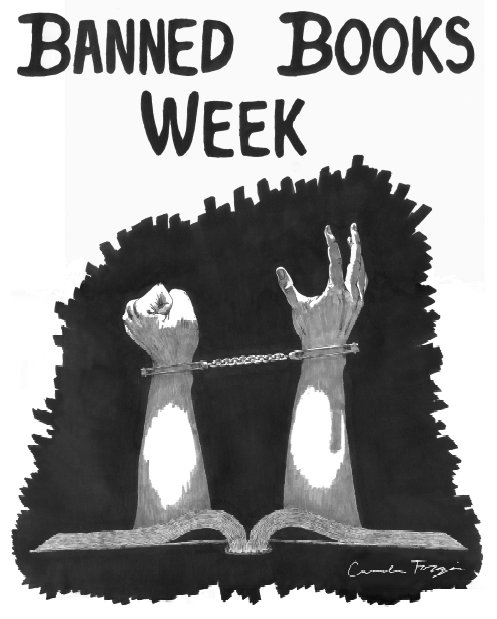
Sarah Palin, Vague Threats, and Why Banned Books Week Matters

We know Sarah Palin loves to read. In a great op/ed piece in today’s Washington Post, Ruth Marcus writes:

Asked in an interview for PBS’s Charlie Rose show last year (http://www.charlierose.com/guests/sarah-palin) about her favorite authors, Palin cited C.S. Lewis — “very, very deep” — and Dr. George Sheehan, a now-deceased writer for Runner’s World magazine whose columns Palin still keeps on hand.

“Very inspiring and very motivating,” she said. “He was an athlete and I think so much of what you learn in athletics about competition and healthy living that he was really able to encapsulate, has stayed with me all these years.”

Also, she got a Garfield desk calendar for Christmas 1987 that made a big impression.

Great stuff. Who doesn’t love to read? Books is where you gets knowledge. However, Palin is the sort of fundamentalist hardliner who thinks she knows what’s best for all of us to read–or not read. By now, you’ve probably heard of the pressure Palin exerted on the librarian of Wasilla. As mayor, Palin inquired how she might go about removing books from the library. Of course, according to most reports, including this one from The Anchorage Daily News earlier this month, “Palin didn’t mention specific books at that meeting.”

Huh. Hard to imagine that Palin didn’t get specific, right?

Palin then wrote the librarian in question a letter telling her she would be fired for lack of loyalty. Although public outcry prevented the firing, the librarian eventually moved away from Wasilla. Palin said at the time, and has maintained since then, that the question was “rhetorical”; she simply wanted to know how one would go about removing “objectionable” books.

Why would you ask how to remove books if you had no intention of removing them?

It’s too easy to dismiss Palin’s inquiries into censorship. Her moralistic will to ban what others read is really an attempt to control ideas, to control thoughts, to control bodies even–the ultimate goal of the far Christian right. It’s the middle of Banned Book’s Week, and it’s time to say “No” to the vacuous (a)moralizing of those like Palin who would presume to dictate what is and is not acceptable to be loaned in a public library. I don’t know about you, but I’m not going to let a woman who apparently believes that “dinosaurs and humans walked the Earth at the same time” tell me what to think or feel or read.

Banned Books Week calls attention to not only the great currency of ideas we have in literature, but to also points out that there are still those who seek to suppress ideas with which they don’t agree. Even as we celebrate these books, we must attack those who would ban them–especially those who work so surreptitiously.

Banned Books Weeks Begins

From the American Library Association:

Banned Books Week: Celebrating the Freedom to Read is observed during the last week of September each year. Observed since 1982, this annual ALA event reminds Americans not to take this precious democratic freedom for granted. This year, 2008, marks BBW’s 27th anniversary (September 27 through October 4).

BBW celebrates the freedom to choose or the freedom to express one’s opinion even if that opinion might be considered unorthodox or unpopular and stresses the importance of ensuring the availability of those unorthodox or unpopular viewpoints to all who wish to read them. After all, intellectual freedom can exist only where these two essential conditions are met.

BBW is sponsored by the American Booksellers Association, American Booksellers Foundation for Free Expression, American Library Association, American Society of Journalists and Authors, Association of American Publishers, National Association of College Stores, and is endorsed by the Center for the Book in the Library of Congress.

Purchase BBW promotional items—such as the BBW Kit—through the ALA Store.

Explore Banned Books Week further through these resources:

Language, Politics, Elitism, and Sarah Palin’s Horrendous Pronunciation

It wasn’t so much Governor Palin’s fumbling toward a semblance of specificity in her recent Katie Couric interview that made me cringe. It wasn’t her misapprehension that Putin is still the president of Russia (an honest mistake, I’m sure) that raised my hackles. It wasn’t her neocon-lite reduction of global politics to “good guys” vs “bad guys” that so irritated me. Even her ignorance of Henry Kissinger’s foreign policy philosophy re: Iran didn’t bother me. If anything, I delighted in watching Gov. Palin blather incoherently, especially after this fiasco two weeks ago. No, what really raised the hairs on the back of my neck was this exchange:

Couric: You recently said three times that you would never, quote, “second guess” Israel if that country decided to attack Iran. Why not?

Palin: We shouldn’t second guess Israel’s security efforts because we cannot ever afford to send a message that we would allow a second Holocaust, for one. Israel has got to have the opportunity and the ability to protect itself. They are our closest ally in the Mideast. We need them. They need us. And we shouldn’t second guess their efforts.

But, you see, it wasn’t what she said so much as it was how she said it. Or mispronounced it, rather.

Let me admit it. I’m an elitist, something of a snob I guess. I can’t help it. Although I didn’t go to five colleges, I did attend two universities to earn two degrees–nothing as prestigious as Palin’s hard-earned MS in communications, of course–but I do have some linguistic standards and expectations for our executive leadership. You see, Gov. Palin didn’t say “second guess,” as the CBS News transcript so generously credits her. No, Gov. Palin distinctly says “second guest.”

Now, we already know that Palin has had some difficulty with one of Bush’s biggest stumbling blocks, that oh-so daunting word “nuclear” (as in “nü-klē-ər” not “nyoo-kyoo-lar”). Observe:

Unfortunately, as of right now there’s no full footage of tonight’s interview up on a site that WordPress will allow me to embed here, and most of the posted clips focus on Palin’s rambling knowledge of basic geography (even Miss Teen South Carolina still managed to get more specific than Palin — “They don’t have maps”).

VIDEO UPDATE–Palin mispronounces “second guess” as “second guest” at 00:17:

If you go to CBS News and wait patiently, Palin’s redneck phrasing pops up at 8:55, wedged neatly amid a vague heap of rhetorically empty catchphrases that the neo-cons and Bush administration have been excreting for the past decade.

In the best assessment I’ve read on Palin yet, Roger Ebert points out that most middle-class Americans would brag if their kids went to Harvard on scholarship; that most of us honor travel as a form of education and the signal of intellectual curiosity. How did we get here? When, exactly, did we decide that our president needs to have the qualities of a good drinking buddy? In short, why do we think that provincialism and ignorance, so summarily captured in Palin’s groan-inducing “second guest,” are the signs of a “real,” “true” American? If we’re going to elect smug, hypocritical leaders, is it too much to ask that they exhibit a modicum of intelligence, or, at the very least, don’t trip over their words?

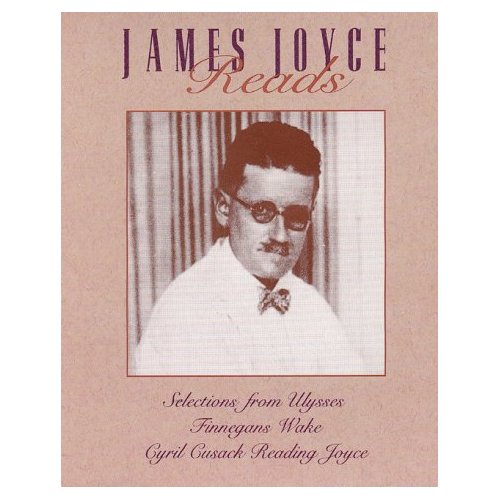
James Joyce Reads, You Listen!

Check out these mp3s of James Joyce reading selections from his novels (that word, “novel,” it doesn’t seem right…) Ulysses and Finnegans Wake. Lovely lilting rhythm. Mostly, it’s just cool to hear his voice. From the original liner notes by Sylvia Beach to the 1924 album (courtesy The Modern World):

In 1924 I went to the office of His Master’s Voice in Paris to ask them if they would record a reading by James Joyce from ULYSSES. But they would agree only if it were done at my expense. The record would not have their label on it, nor would it be listed in their catalogue. I accepted the terms: thirty copies of the recording to be paid for on delivery.

Joyce himself was anxious to have this recording made. He had made up his mind, he told me, that this would be his only reading from ULYSSES. Recording was done in a rather primitive manner in those days. All the same, I think the ULYSSES recording is a wonderful performance. I never hear it without being deeply moved.

James Joyce reads from Finnegans Wake (part I)

James Joyce reads from Finnegans Wake (part II)

Jams Joyce reads from Ulysses (from the “Aeolus” episode)

Or, if you prefer, check out Jim Norton reading the first few pages of Finnegans Wake (from the audio book version, which who knows if listening to counts as reading the thing–but it’s pretty cool to hear an adult man make these noises and think that such a thing might be Great Literature).

No Conclusion Could Be More Horrible than Solipsism

Okay. This is it. I promise.

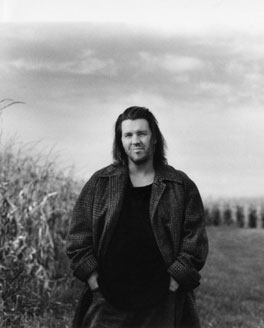
This is the last post (for now, anyway, of course, I mean of course it’s not going to be the last post on him, of course) about David Foster Wallace. I’ll get back to reviews and whatnot next week. Swear. But I need to transition here, comment on the past week, move on–

–I’ve always despised the word closure. It’s a pop-psychobabble concept used to denote a social-cultural imposition of order and telos upon an individual’s right to experience the world (and all the loss and violence and ugliness experiencing the world entails) as ambiguous and chaotic and open-ended. But I guess in all likelihood, for anyone who’s endured personal tragedy, there must be some comfort in organizing the loss, fitting it into the narrative of their life, etc. This is the traditional project of literature, is it not–turning loss and tragedy into a plot, into something meaningful and productive? (At least that’s what Aristotle said . . .)–

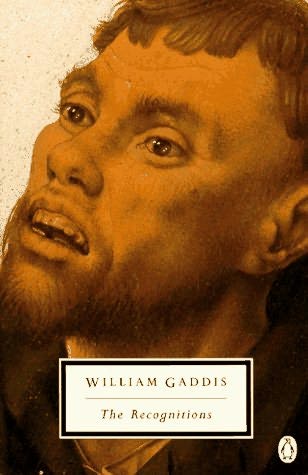
But I’m already off to a rambling start. I’ve spent the past week obsessing over eulogies and elegies, memories and anecdotes, notes and ephemera (an no real information). I’ve read old reviews that angered me. Trolls have gotten my goat. I’ve realized that the easiest charge for an anonymous dick to make about an author they haven’t bothered to read is that that author is overrated. I’ve felt the slightest sting of jealousy that I never got to hear DFW read personally. I’ve been derailed, permanently it seems, or at least for quite a while, from Roberto Bolaño’s novel The Savage Detectives (this is particularly painful, as I was over 200 pages in to the thing). I’ve initiated a third attempt at a second complete reading of Infinite Jest. I’ve spent every lunch of my work week discussing po-mo lit with the only colleague of mine who’s actually read Wallace. He made me get a copy of Gaddis’s The Recognitions: when the hell will I have time to read it? It’s like, a 1000 pages long!

Most of all, though, I’ve felt shocked; shocked in a thoroughly Wallacian way; shocked in a way-too self-aware mode of shocked behavior: I’m shocked and saddened at how shocked and saddened I am. I did not know that I had the capacity to feel so upset about the death of someone who I did not know, and I feel silly, even embarrassed about this shock, even as I write about it here, publicly, for no real reason. This is the worst kind of solipsism of course. But right now, I feel unable to comment on how Wallace translated the pain and loneliness of life into the language of empathy–all while pointing out how such empathy was, like, impossible (it’s all just language, y’know?). Wallace’s writing always went beyond the sort of navel-gazing and arch irony often identified with other writers of postmodern meta-fiction–he always communicated with his audience. He once stated that “no conclusion could be more horrible than solipsism” (he was referring to his hero Wittgenstein here, arguing that language was a “game” to be played, and thus required more than one “player”; hence, something must exist beyond one’s own mind–there is connection, something beyond the self). If Wallace realized this, that communication, and thus community was possible, at least in his fiction (much of it, yes, is very dark, even morose at times), why did he kill himself? This seems an unproductive question to ask. I take it back (even while I leave it there).

It is maddening. The question arises again and again: “Did he leave a note?” Did David Foster Wallace write something, you ask, that might tell us why he killed himself? Ahem. Ahem. “The Depressed Person.” “Good Old Neon.” James Orin Incandenza aka Himself (and all the other characters who attempt, explicitly or tacitly, to off themselves in IJ). The answer to the question, then, is he left a lot of notes. But none of them will satisfy. None of them will explicate. They can’t (that was the whole point of Infinite Jest, the point missed by critics who thought the book had no conclusion). And it is maddening. And it provides no closure. But at least we have the books, the words, the ideas. Thanks.

An Intellectual Seed Crystal Dropped into the Supersaturated Solution of American Motorsports

Of all the David Foster Wallace obituaries and appreciations floating around the internet–many of them moving and insightful–today’s feature at The Onion, “NASCAR Cancels Remainder Of Season Following David Foster Wallace’s Death” strikes me as the strangest. The conceit of the piece, that NASCAR drivers are keenly attuned, even motivated by the literary world, is frankly some of the basest, dumbest, most obvious irony ever, and possibly the kind of contrived situation at which Wallace might’ve cringed. Yet there’s something sweet in The Onion elegy’s clumsiness. Consider this analysis of Infinite Jest they attribute to Greg Biffle:

I first read Infinite Jest in 1998 when my gas-can man gave me a copy when I was a rookie in the Craftsman Truck Series, and I was immediately struck dumb by the combination of effortlessness and earnestness of his prose. Here was a writer who loved great, sprawling, brilliantly punctuated sentences that spread in a kind of textual kudzu across the page, yet in every phrase you got a sense of his yearning to relate and convey the importance of every least little thing.

Well said. Or Jimmie Johnson‘s beautiful critique of DFW’s style:

David Foster Wallace could comprehend and articulate the sadness in a luxury cruise, a state fair, a presidential campaign, anything. But empathy, humanity, and compassion so strong as to be almost incoherent ran through that same sadness like connective tissue through muscle, affirming the value of the everyday, championing the banal yet true, acknowledging the ironic as it refused to give in to irony.

And so well here we are then–an ironic piece acknowledging Wallace’s ability to acknowledge and yet resist irony in his own work. The Onion simply can’t unpack the thoroughly Wallacian conundrum that results. But what I think they do is better–they eulogize a writer I think they love in the only way the mission of their site allows. And unlike their previous jibes at Wallace, “Girlfriend Stops Reading David Foster Wallace Breakup Letter at Page 20,” and the Weekender edition pictured above, it seems that The Onion staffers are too sad to make the piece funny–which, I think, is appropriate.

David Foster Wallace mp3s

Update: Go to the David Foster Wallace Audio Project for DFW audio needs.

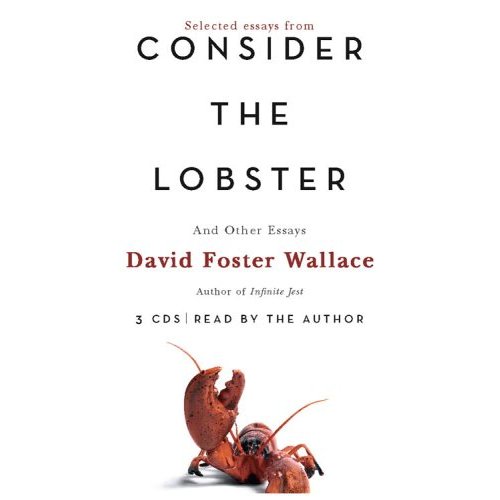
What follows are some of the better recordings I’ve collected over the years of DFW reading his work and being interviewed. Links take you to a site where you can download the mp3s. You can find most of these recordings dispersed over the net, but I thought I’d try to collate it all here. If you like what you hear, get a hold of DFW reading his own work in the audiobook version of Consider the Lobster (his handling of footnotes is pretty cool). Enjoy.

David Foster Wallace reads some unpublished stuff. December 6, 2000, Lannan Foundation. The middle section, beginning around 12:50 is particularly fantastic.

John O’Brien interviews DFW. December 6, 2000, Lannan Foundation.

DFW reads “A Series of Remarks on Kafka’s Funniness from Which Not Enough Has Been Removed.” March, 1998. Part of “Metamorphosis: A New Kafka,” a symposium sponsored by the PEN American Center in New York City. Text here. Republished in Consider the Lobster.

Michael Silverblatt interviews DFW about Consider the Lobster on KCRW’s Bookworm show. March 2, 2006.

Michael Goldfarb’s radio interview with DFW for The Connection. June 25, 2004.

Of course, the March 27, 1997 Charlie Rose interview is pretty well known to DFW fans, but if you haven’t seen it, it’s well worth checking out.

Also, if you feel like parsing through The Howling Fantods collection of audio links, I’m sure some of them are still working.

Etymology for Republicans

Conservative Republicans seem to be having an awfully tough time with their vocabulary lately. They keep misusing words, poor old dears. In particular, these confused politicos keep using words that have traditionally had a positive connotation in a pejorative sense. Therefore, we present a little gloss that might help them with their sorry diction.

1. Liberal

“c.1375, from O.Fr. liberalbefitting free men, noble, generous,” from L. liberalisnoble, generous,” lit. “pertaining to a free man,” from liber “free,” from PIE base *leudheros (cf. Gk. eleutheros “free”), probably originally ‘belonging to the people'” (Online Etymological Dictionary)

From the Indo-European root “leudh,” meaning “grow, rise,” as in progressive (Joseph T. Shipley, The Origins of English Words)

2. Elite

“1823, from Fr. éliteselection, choice,” from O.Fr. fem. pp. of elire, elisre “pick out, choose,” from L. eligere “choose” (see election). Borrowed in M.E. as “chosen person,” esp. a bishop-elect, died out c.1450, re-introduced by Byron’s “Don Juan.” (Online Etymological Dictionary)

“1a singular or plural in construction : the choice part. 1b singular or plural in construction : the best of a class” (Merriam-Webster)

A Tender Hug Betwixt Mavericks

3. Maverick

“1867, “calf or yearling found without an owner’s brand,” in allusion to Samuel A. Maverick (1803-70), Texas cattle owner who was negligent in branding his calves. Sense of “individualist, unconventional person” is first recorded 1886, via notion of ‘masterless.'” (Online Etymological Dictionary)

Samuel A. Maverick refused to brand his cattle, ostensibly claiming that the practice was cruel. However, by not branding his cattle, he was able to claim any stray cows as his own property. What a devious genius! How’s that for laissez-fair?

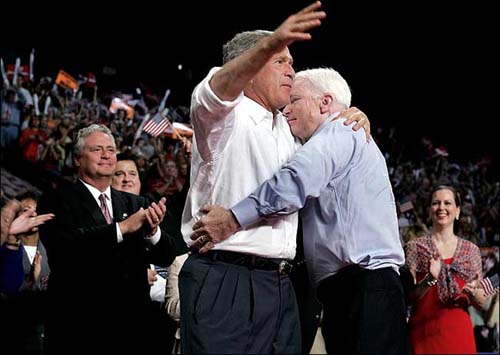
Clearly, a maverick would never let himself be branded with someone else’s label. He’d cut his own path, forge his own trail, create his own hackneyed metaphor, and not, f’r’instance, vote with the President 95% of the time.

4. Conservative

“Conservative, n. A statesman who is enamored of existing evils, as distinguished from the Liberal, who wishes to replace them with others.” ( Ambrose Bierce, Devil’s Dictionary)

5. Change

“From the Indo-European root “(s)kamb: bend, change; exchange, barter . . . Fr, change, exchange. Gc, change, changeable, unchanging, etc. . . . This root is related to camp, campus, campaign, etc.” (Joseph T. Shipley, The Origins of English Words)

Synonyms for “change” include: modification, variation, transformation, revolution, conversion, adjustment, amendment, difference, and alteration.

When used in politics, the word connotes a dramatic shift in ideology from the previous regime to its successors (e.g. “The idea that a new set of Republicans would be a change from the old set was both a paradox and a misuse of language”)

Let Them Eat Cake!
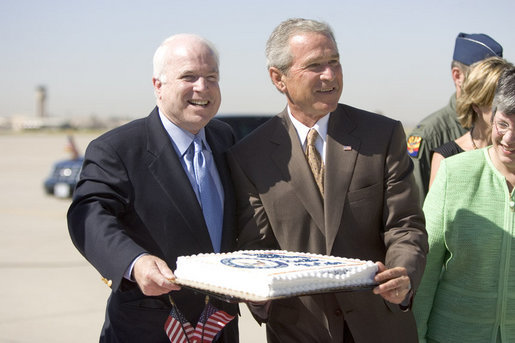
Let Them Eat Cake! W and Mav McCain Enjoy A Tasty Treat as Katrina Drowns New Orleans

Caged Bedouins, Uruguayan Cannibals, Mr. Max Tundra, Absent Adventurer Anniversary, and a Few Morsels of Hurricane Lit

Attention:

1. Friends of the ‘klept have embarked on a new culinary adventure. Read all about it at brand new blog Confined Nomad. Their mission:

The goal of this journey is to find cuisines from every United Nations member state, within New York City limits, in alphabetical order. We realize that there are a few flaws to this logic, and will make every attempt to handle these wisely when we reach a questionable issue. For instance, cuisines are not defined by the UN. There are regional specialties, there are countries not internationally recognized, there are border disputes, and new countries are being formed all the time . . . This blog will serve as documentation of the adventure, in which we will do our best to describe not only the food we eat, but also things we learn about its nation of origin, culture, and the immigrant communities here in New York City. We hope this will be much more than a food blog.

The virgin entries on Afghanistan and Albania are tasty fare (sorry!) and we’re looking forward to plenty more delectable treats (yikes! sorry again!).

2. We finally saw Frank Marshall’s 1993 film Alive this weekend. Alive, based on Piers Paul Read’s book of the same name, tells the true story of the Uruguayan Air Force Flight 571 crash of October 13, 1972, in which a Uruguayan rugby team’s chartered flight crashes in the Andes. The survivors eventually resort to cannibalizing the dead to survive (let’s see what happens when Confined Nomad gets to ‘U’ on their list). Despite plenty of strange flaws, including egregious over-acting, the film is oddly great. An intense, chest-tightening narrative that offers few moments of relief, Alive is a real-life horror movie masquerading as an adventure tale. Recommended.

3. With distinguished Englishman Max Tundra’s new album Parallax Error Beheads You ready to drop any day now (glowing review forthcoming), we thought we’d bring up the greatness of his last CD, Mastered by Guy at the Exchange. Max’s MBGATE was easily one of our favorite albums of the early aughties. Weird and tuneful and splendid and frenetic, MBGATE is a neglected classic, perhaps due to its unclassifiable sound. Max programs old Amigas, plays dozens of instruments, and sings along with his sister on a strange group of songs about Michel Gondry, delivery jobs, amino acids, the break up of Don Caballero (with Storm & Stress as consolation prize), and, uh, girls. We love it and so should you. His website is awesome, by the way.

4. Today marks the one-year anniversary of gazillionaire adventurer Steve Fossett disappearing along with his single-engine Bellanca Super Decathlon airplane. We don’t think Fossett is dead, and neither, apparently, does Chris Irvine, who speculated in the Telegraph that Fossett faked his own death. We now invite our readers, again, to speculate on the whereabouts of Mr. Fossett. Check out our Steve Fossett Fan Fiction Contest blog for all the details!

5. Down here in The Florida, we continue to have hurricane concerns. And, because this blog likes to masquerade as a a literary affair, we offer a few lines from books on the subject:

In Shakespeare’s King Lear, Act 3 scene 2, we find one of the earliest usages of the word hurricane in the English language:

Blow, winds, and crack your cheeks! rage! blow!
You cataracts and hurricanoes, spout
Till you have drenched our steeples, drowned the cocks!
You sulphurous and thought-executing fires,
Vaunt-couriers to oak-cleaving thunderbolts,
Singe my white head! And thou, all-shaking thunder,
Strike flat the thick rotundity o’ the world!
Crack nature’s molds, all germens spill at once
That make ingrateful man!

Bit of a drama queen, Lear, what with all these apocalyptic fantasies. Speaking of drama queens, how about the opening lines of Walt Whitman’s “With Husky-haughty Lips, O Sea!”:

With husky-haughty lips, O sea!
Where day and night I wend thy surf-beat shore,
Imaging to my sense thy varied strange suggestions,
(I see and plainly list thy talk and conference here,)
Thy troops of white-maned racers racing to the goal,
Thy ample, smiling face, dash’d with the sparkling dimples of the sun,
Thy brooding scowl and murk–thy unloos’d hurricanes,
Thy unsubduedness, caprices, wilfulness

Fanciful stuff. For a less romanticized description, might we suggest the end of Zora Neale Hurston’s Their Eyes Were Watching God, where a massive hurricane turns Lake Okeechobee into a “monstropolous beast,” a monster that floods the streets and destroys homes. Stay away, Hannah.

On the Third Beer

I thought this notation, from Toni Morrison’s Song of Solomon, was too beautiful not to share (also, I’ve been too busy to write and appropriating the words of Nobel prize winners seems like an easy alternative to actually, y’know, coming up with original content). Context unimportant:

She was the third beer. Not the first one, which the throat receives with almost tearful gratitude; nor the second, that confirms and extends the pleasure of the first. But the third, the one you drink because it’s there, because it can’t hurt, and because what difference does it make?

Abolish No Child Left Behind

I teach at an inner-city school, and I’ve witnessed first hand just how awful NCLB has been: it basically aims to make zombies out of kids. Here’s a personal anecdote that best sums up how NCLB’s rigid testing processes work to attack the fostering of free thought: I was administering an FCAT practice test, and a young lady of about 15 years or so raised her hand for my assistance. Her problem was that the answer box for a short response question was far too small to accommodate her answer (her handwriting was also large). We are teaching kids to literally “think inside the box”; we are also mandating that there is always only “one right” answer to problems, which is plainly false.

Please take a few seconds to sign the online petition to abolish this heinous crime against our young people.

More information–far more salient than my anecdotal ranting–from Stan Karp’s excellent critique of NCLB (via the ANCLB Facebook Group):

Claim: Annual standardized testing is the key to bringing school improvement and accountability to all schools. “For too long,” says the Department of Education, “America’s education system has not been accountable for results, and too many children have been locked in underachieving schools and left behind. … Testing will raise expectations for all students and ensure that no child slips through the cracks.”

Reality: A huge increase in federally mandated testing will not provide the services and strategies our schools and students need to improve. Most states and local districts have dramatically increased the use of standardized tests over the past two decades, but this did not solve the problems of poor schools. Some estimate that the new federal law will require states to give more than 200 additional tests at a cost of more than $7 billion.
Many studies show that standardized testing does not lead to lasting increases in student achievement and may in fact reduce it. Researchers at Arizona State University recently completed the largest study ever done on the issue. They concluded that “rigorous testing that decides whether students graduate, teachers win bonuses and schools are shuttered, an approach already in place in more than half the nation, does little to improve achievement and may actually worsen academic performance and dropout rates.” (New York Times, 12/28/02)

Continue reading “Abolish No Child Left Behind”

“Some Principles of Democracy and Deconstruction—American or Otherwise” by A. S. Kimball

“Some Principles of Democracy and Deconstruction—American or Otherwise” by Sam Kimball.

1. Democracy and deconstruction name the namelessness of a we, the people in relation to this people’s unimaginable possibilities of collective self-identification to come.

2. For this reason democracy and deconstruction locate the we in a future that transcends any possible transcendence of time, and therefore that remains utterly contingent and extinguishable, able to be obliterated in an apocalypse of the name.

3. Democracy and deconstruction attempt to respond to a demand—untraceable to any face or mind, to any consciousness—for absolute justice.

4. To this end, and because “we are all heir, at least, to persons or events marked, in an essential, interior, ineffaceable fashion, by crimes against humanity” (Derrida, Of Cosmopolitanism and Forgiveness, 29), democracy and deconstruction demand of the citizen to come an attitude of radical forgiveness and hospitality.

5. To this same end, and for similar reasons, democracy and deconstruction also entail a radical affirmation—that is, they are ways of saying “Yes?” or “Who’s there?” in the absence of any determinate voicing.

6. This means that democracy and deconstruction respond to a call that comes from an unimaginable and indeterminate future.

7. For all these reasons as well as the fact that “all nation-states are born and found themselves in violence” (Of Cosmopolitanism and Forgiveness, 57), democracy and deconstruction are provisional names for an historically unrealized ideal.

8. Thus, democracy and deconstruction require an incessant work of critique.

9. Democracy and deconstruction are ways of working toward forms of community that must necessarily exceed, transgress, transcend, and therefore remark all political borders, most especially those that define the sovereignty of the nation-state.

10. The spirit of the spirit of democracy and deconstruction has no single emotional marker, cannot be contained within or encompassed by any single emotional apprehension, is not identifiable as an affective state.

11. Democracy and deconstruction are inseparable from the fictionalizing, virtualizing power of literature.

Great American Heroes

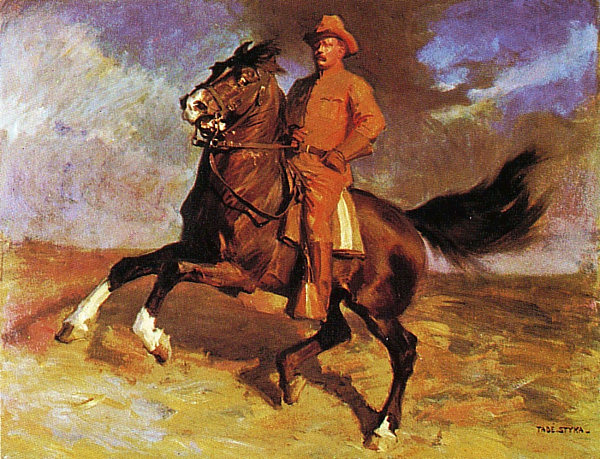
Teddy Roosevelt was the best American president. Just look at this guy. TR: the original rough rider. Painting by Tadé Styka.