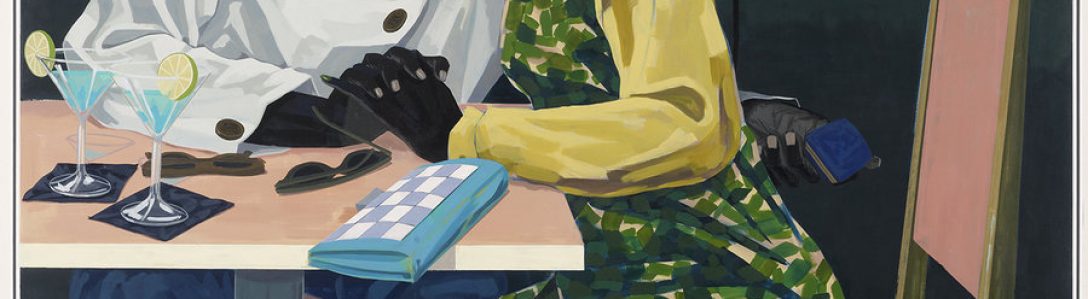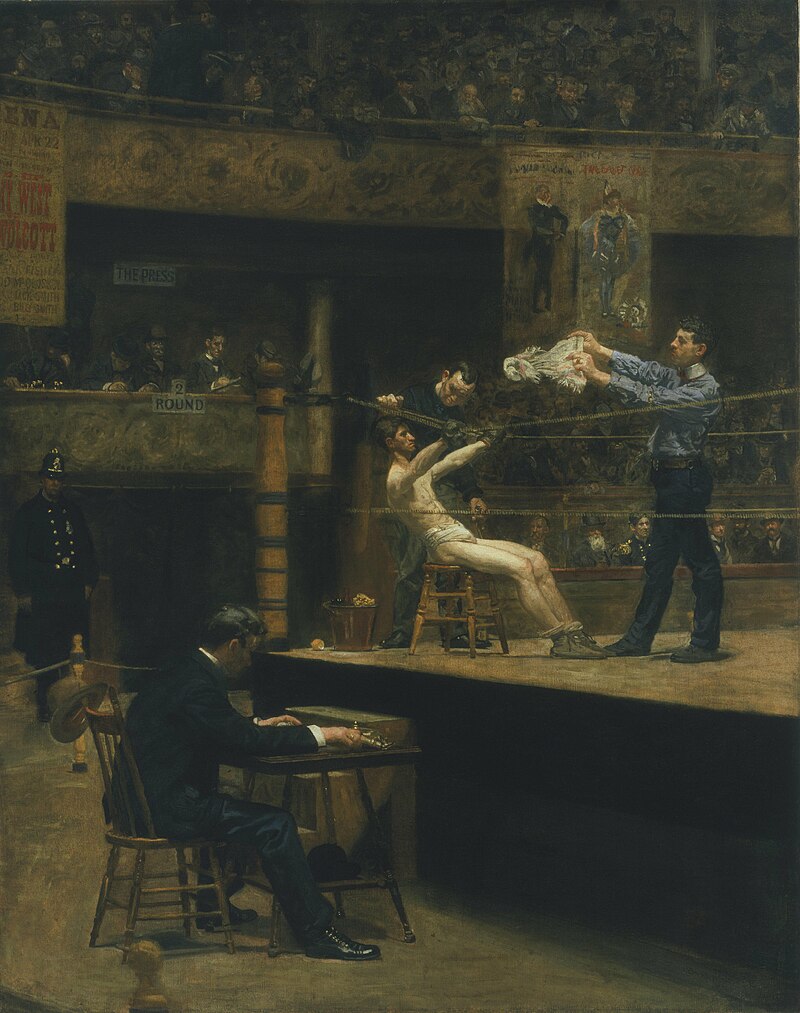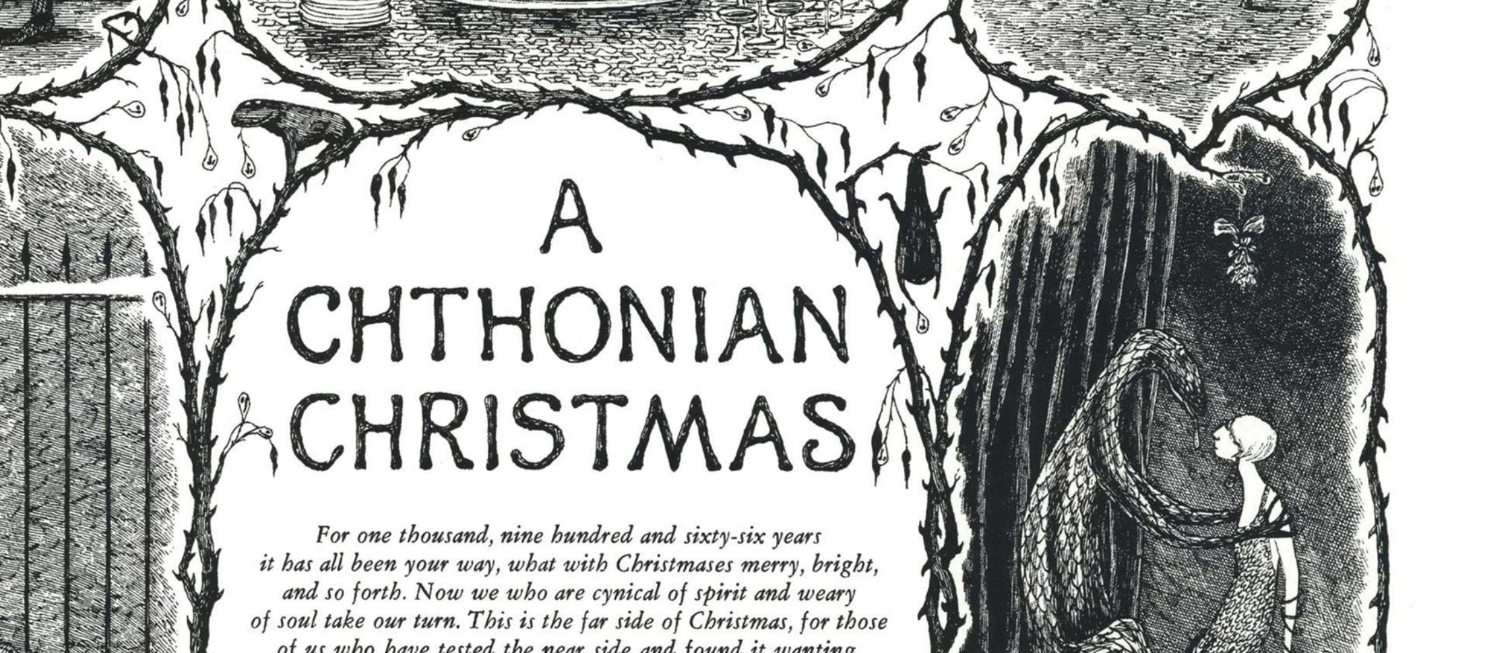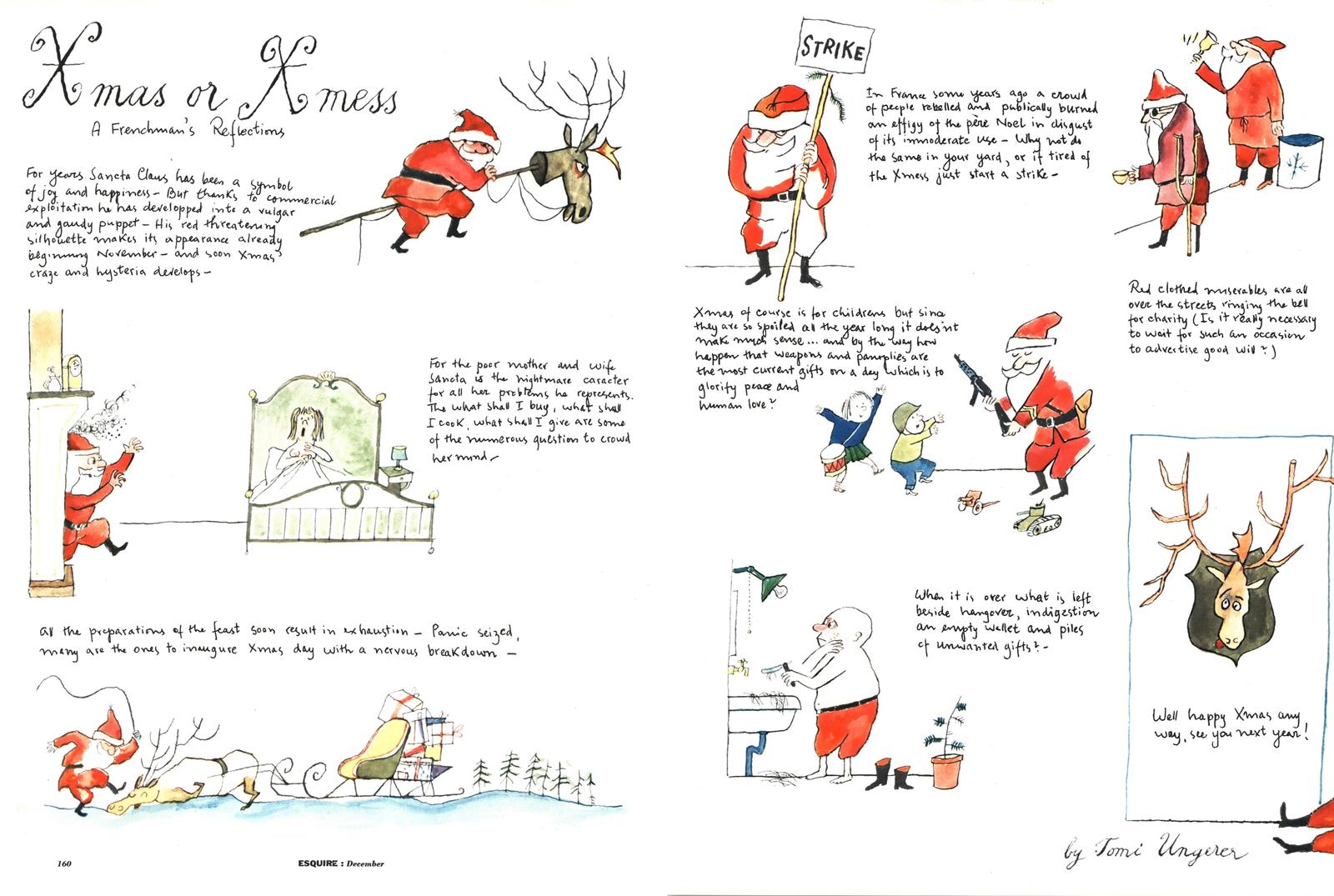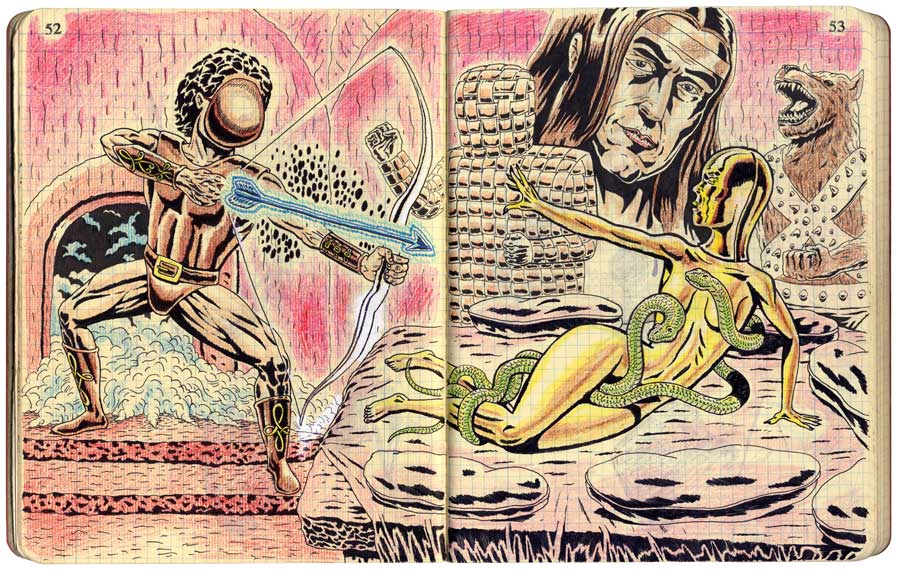
Persephone and Pluto — Adam Miller

Persephone and Pluto, 2023 by Adam Miller (b. 1979)

Charles Burns’ Final Cut explores the irreal reality of artistic ambition

Charles Burns’ latest graphic novel Final Cut tells the story of Brian, an obsessive would-be auteur grappling with an unrealized film project. Brian hopes to assemble his film — also titled Final Cut — from footage he shoots with friends on a weekend camping trip, but the messiness of reality impinges the weird glories of his vibrant imagination. He cannot bring his vision to the screen. He cannot capture all the “fucked-up shit going on inside my head.”

Capturing all the fucked-up shit going on inside my head is a neat encapsulation of the Artistic Problem in general. It’s not that Brian doesn’t try; if anything, he tries too hard. His best friend and erstwhile cameraman Chris is there to help him, along with his crush Laurie and their friend Tina—but ultimately, these are still kids at play. They indulge Brian’s artistic whims, but at a certain point they’d rather swim, drink, and smoke than shoot yet another scene they can’t comprehend.

Eschewing straightforward narrative conventions, Final Cut unfolds in a blend of flashbacks, dreamscapes, and flights into Brian’s imagination. The book also gives over to Laurie’s consciousness, providing an essential ballast of realism to anchor Brian’s (and Burns’, I suppose) surrealism. Brian would have Laurie as his muse, trying to capture her in his sketchbook, in his film, and in the intense gaze of his mind’s eye. And while Laurie is fascinated by Brian’s visions, she doesn’t understand them.

The last member of Brian’s would-be acting troupe is Tina, an earthy, funny gal who drinks a bit too much. She plays foil to Brian’s ambitions; her animated spirit punctures the seriousness of his film shoot. Again, these are just kids in the woods with a camera and camping gear.

And the film itself? Well, it’s about kids camping in the woods. And an alien invasion. And pod people.

The pod-people motif dominates Final Cut. We get the teens in their larval sleeping bags, transformed into aliens in their cocoons (echoed again in Brian’s imagination and in his sketches). The motif looms larger: Can we really know who a person is? Could they be someone else entirely? Can we really ever know all the fucked-up shit going on inside their head?

Indeed, Don Siegel’s 1956 film Invasion of the Body Snatchers is a major progenitor text for Final Cut. Brian even takes Laurie on a date to a screening of Invasion; he’s so mesmerized by the film that he weeps. Burns renders stills from the film in heavy chiaroscuro black and white, contrasting with the vibrant reds, maroons, and pinks that reverberate through the novel.

Burns recreates stills from another black and white film, Peter Bogdanovich’s 1971 coming-of-age heartbreaker The Last Picture Show. Again, Brian is obsessed with the film—or by the film, perhaps. In particular, he’s infatuated with Cybill Shepherd’s Jacy, whose character he imaginatively merges with his conception of Laurie.

While Invasion of the Body Snatchers is a science-fiction horror film, a deep sense of reality-soaked dread underpins it; The Last Picture Show is utterly real in its evocations of the emotional and physical lives of teenagers. Both films convey a maturity and balance of the fantastic with the real that Brian has not yet purchased via his own experiences, his own failures and heartbreaks. 

The maturity and balance that Brian can imagine but not execute in his Final Cut is precisely the maturity and balance that Burns achieves in his Final Cut. Simply put, Final Cut is the effort of a master performing at the heights of his power, rendered with inspired technical proficiency. It delivers on themes Burns has been exploring from the earliest days of his career.

There’s the paranoia and alienation of adolescence Burns crafted in Black Hole, here delivered in a more vibrant, cohesive, and frankly wiser book. There’s the hallucinatory trauma and repression he conveyed in the X’ed Out trilogy (collected a decade ago as Last Look, the title of which prefigures Final Cut). There’s also an absence of parental authority here, a trope that Burns has deployed since 1991’s Curse of the Molemen. (In Final Cut, Brian’s mentally-unstable mother is a dead-ringer for Mrs. Pinkster, the domestic abuse victim rescued by the child-hero of Curse of the Molemen). There’s all the sinister dread and awful beauty that anyone following Burns’ career would expect, synthesized into his most lucid exploration of the inherent problems of artistic expression.

Ultimately, in Final Cut Charles Burns crafts a portrait of the artist as a weird young man. Brian wrestles with the friction sparked from his vital imagination butting up against cold reality. His ambitious unfinished film mirrors his own incomplete journey as an artist, highlighting the clash between youthful creative fervor and the inevitable constraints of life, experience, and maturity. Burns’ themes of alienation and artistic ambition may be familiar, but Final Cut feels fresh and vibrant, the culmination of the artist’s own entanglements with the irreality of reality. Highly recommended.

Mass-market Monday | Lawrence Durrell’s Nunquam

Nunquam, Lawrence Durrell. Pocket Books (1971). No cover artist or designer credited. 258 pages.

Saint Jerome in His Study — Joos van Cleve

y1982-76

Saint Jerome in His Study, 1528 Joos van Cleve, (c. 1485–1540/41)

Shadow Work (Chapters) — Dominic Chambers

Shadow Work (Chapters), 2022 by Dominic Chambers (b. 1993)

Woman Reading — Agnes Goodsir

Woman Reading, c. 1910 by Agnes Goodsir (1864-1939)

“Samuel Delany’s Babel-17 only looks like a traditional space opera…” — Moebius

October — Karoly Ferenczy

October, 1903 by Karoly Ferenczy (1862-1917)

Imagine Buster — Samplerman

Imagine Buster, 2024 by Samplerman (Yvan Guillo)

Nude Reader — Greg Burak

Nude Reader, 2023 by Greg Burak (b. 1986)

Palestine — Walid Ebeid


Palestine, 2018 by Walid Ebeid (b. 1970)

We have the right to convey the fictive of any reality at all | Gil Orlovitz

We have the right to convey the fictive of any reality at all–and there is nothing that is not real—by any method we wish, and to have as our goal, if we so opt, only that we maintain the reader’s tension, the solitary indication, itself mercurial, of a work-of-art event.

Syntax being nothing more nor less than the codification of selected usages, we may alter syntax or reject it wholly.

We may compose the fictive in such a manner that the result is ambiguous, baffling and sometimes altogether impossible significantly to paraphrase-but so long as the piece seizes and holds the reader, a basic meaning, impossible to state in language as we know it, has been established, a meaning that belongs to a time series of seizing-and-holding.

The notion, we submit, of clarity, remains simply a notion, real enough, of course, under whatever category it is sub-sumed, but of no universal vigor, necessarily, nor marked by socalled objective truth; clarity is a notion identifying a particular social agreement in a one-to-one sense as to what construct evokes similarity of analysis.

Empirically all that is demonstrable is that we experience as creator or audience a series of perceptions. Now, if we set forth that demonstration in the fictive in such a fashion as to generate and sustain tension in the reader whether or not he is mystified by the significs, we have met the sole possible criterion.

We are not of course here in any way concerned with the alleged scalar values of a given fiction-the notion of value belongs to ad hominen pleaders usually involved in depressing or elevating a status for economic reasons—just as we cannot in any way be concerned with the alleged scalar values of the given reader. Fiction and reader are conjoined, and may not with any sense be disjunct if we are trying to penetrate the nature of the esthetic.

Such being the case, I believe we can with some innocence look at the choices of the contemporary avant-garde herein, and digest them according to our lights or chiaroscuras.

We need remember only how much more we usually discern if we take the trouble, to begin with, to clean our own canvasses-within reason.

—Gil Orlovitz


Gil Orlovitz’s introduction to The Award Avant-Garde Reader (1965).

Reification #91 — Dario Maglionico

Reification #91, 2024 by Dario Maglionico (b. 1986)

Ozymandias — Alasdair Gray

Ozymandias, 2017 by Alasdair Gray (1934-2019)

Friday the Thirteenth — Leonora Carrington

friday-the-13th-leonora-carrington

Friday the Thirteenth, 1965 by Leonora Carrington (1917-2011)

Baquiné — Marcos Irizarry

Baquiné, 1967 by Marcos Irizarry (1936–1995)

Portrait of Kafka — Adolph Hachmeister

Portrait of Kafka, c. 1967 by Adolph Hachmeister