An episode from Robert Coover’s new novel Huck Out West
It was up in Minnysota that Tom made up his mind to give over cowboying and take on the law. Becky Thatcher was the daughter of a judge and maybe she give him the idea how to set about doing it. Before that him and me was mostly adventuring round the Territories without no thoughts about the next day. We run away from home all them years ago because Tom was bored and hankered to chase after what he said was the noble savages. At first they was the finest people in the world and Tom wanted to join up with them, and then they was the wickedest that ever lived and they should all get hunted down and killed, he couldn’t make up his mind. Some boys in a wagonload of immigrants we come across early on learnt us how to ride and shoot and throw a lasso so that we got to be passing good at all them things.
That story turned poorly and we never seen what was left of them afterward, but ending stories was less important to Tom than beginning them, so we was soon off to other adventures that he thought up or read about in a book or heard tell of. Sometimes they was fun, sometimes they warn’t, but for Tom Sawyer they was all as needful as breathing. He couldn’t stand a day that didn’t have an adventure in it, and he warn’t satisfied until he’d worked in five or six.
Once, whilst we was still humping mail pouches back and forth across the desert on our ponies, I come on a rascally fellow named Bill from near where we come from. He was also keen on adventures and he was heading back east to roust up a gang of bushwhackers in our state to kill jayhawks over in the next one. The way he told it, he had a bunch of swell fellows joining his gang and he wondered if Tom and me might be interested. With the war betwixt the states starting, there were lots of gangs forming up and making sport of burning down one another’s towns, which seemed like sure enough adventures, not just something out of books, so maybe we was looking in the wrong place. But when I told Tom about it the next time we crossed up at a relay station, he says he reckoned he’d just stay out west and maybe get up a gang of his own, because he couldn’t see no profit in going back. But I knowed that warn’t the real reason. The real reason was he couldn’t be boss of it.
The way in which my friendship with Sensini developed was somewhat unusual. At the time I was twenty-something and poorer than a church mouse. I was living on the outskirts of Girona, in a dilapidated house that my sister and brother-in-law had left me when they moved to Mexico, and I had just lost my job as a night watchman in a Barcelona campsite, a job that had exacerbated my tendency not to sleep at night. I had practically no friends and all I did was write and go for long walks. starting at seven in the evening, just after getting up, with a feeling like jet lag: an odd sensation of fragility, of being there and not there, somehow distant from my surroundings. I was living on what I had saved during the summer. and although I spent very little, my savings dwindled as autumn drew on. Perhaps that was what prompted me to enter the Alcoy National Literature Competition, open to writers in Spanish, whatever their nationality or place of residence. There were three categories: for poems, stories, and essays. First I thought about going in for the poetry prize, but I felt it would be demeaning to send what I did best into the ring with the lions (or hyenas). Then I thought about the essay, but when they sent me the conditions, I discovered that it had to be about Alcoy, its environs, its history, its eminent sons, its future prospects, and I couldn’t face it. So I decided to enter for the story prize, sent off three copies of the best one I had (not that I had many), and sat down to wait.
I’m in the middle of Paul Bowles’s stories right now, and loving the weird sinister menace of it all. I’ll probably take a crack at some of his novels this year too (The Sheltering Sky next? I’ll need to pick them up).
Senges’s The Major Refutation is also on deck.
Not pictured, because it’s not out yet, is Leonora Carrington’s The Complete Stories (forthcoming in the spring from Dorothy); I’m really looking forward to this one. The NYRB is also publishing Carrington’s memoir Down Below, which looks really cool. I’ve only read the collection The Oval Lady (and that through samizdat means), so I’m happy to see Carrington’s words in print.
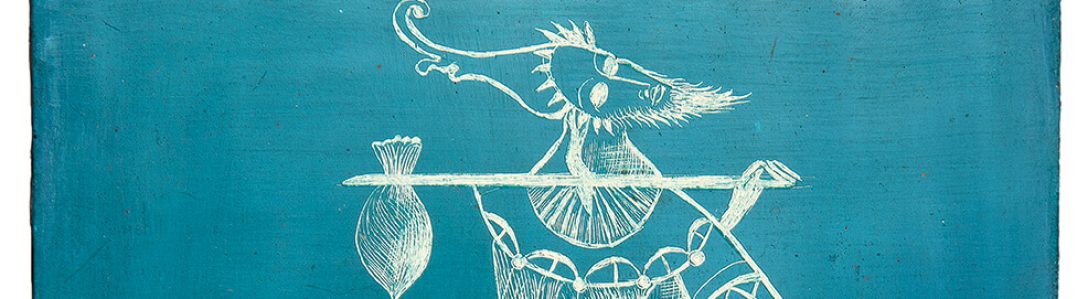
The Expedition of Dr. Ramsbottom, Leonora Carrington, 1961
Also not pictured because its forthcoming (from Two Lines Press) is Atlantic Hotel by João Gilberto Noll (translated by Adam Morris). I’m anxious to read more from Noll after digging his novella Quiet Creature on the Corner.
Back to the stack in the picture: I loved Ishmael Reed’s Mumbo Jumbo and The Freelance Pallbearers (which strikes me as a really under-remarked upon novel), and I plan on getting to Yellow Back Radio Broke-Down at some point this year.
I’ve had a few false starts with Arno Schmidt’s The Egghead Republic, but maybe I can knock it out in a weekend.
I’ve taken multiple cracks at the novels by Gray, Murdoch, and Hawkes in the stack…so we’ll see.
I read Leon Forrest’s There Is a Tree More Ancient Than Eden in a blur; I’d like to reread it and the other Forrest novel I picked up last month, Two Wings to Veil My Face.
I’ve read enough Pynchon now to make a better effort with Vineland…but again, we’ll see (I’m actually kind of jonesing to reread Against the Day).
(And oh I didn’t make a list like this in 2016, but I was 4 for 8 in the one I did in 2015).