Ascent of the Blessed — Hieronymus Bosch

ascent-of-the-blessed-1504

Two Women in the Woods — Vincent van Gogh

two-women-in-the-woods-1882

Blessed Art Thou among Women — Gertrude Käsebier

dp233037

The Abduction of Ganymede — Gustave Moreau

gustave_moreau_-_the_abduction_of_ganymc3a8de2c_1886

In the beginning Dardanus was the son of Jove, and founded Dardania, for Ilius was not yet stablished on the plain for men to dwell in, and her people still abode on the spurs of many-fountained Ida. Dardanus had a son, king Erichthonius, who was wealthiest of all men living; he had three thousand mares that fed by the water-meadows, they and their foals with them. Boreas was enamoured of them as they were feeding, and covered them in the semblance of a dark-maned stallion. Twelve filly foals did they conceive and bear him, and these, as they sped over the rich plain, would go bounding on over the ripe ears of corn and not break them; or again when they would disport themselves on the broad back of Ocean they could gallop on the crest of a breaker. Erichthonius begat Tros, king of the Trojans, and Tros had three noble sons, Ilus, Assaracus, and Ganymede who was comeliest of mortal men; wherefore the gods carried him off to be Jove’s cupbearer, for his beauty’s sake, that he might dwell among the immortals.

From Book XX of The Iliad (translation by Samuel Butler).

Witch’s Head — August Natterer

witch-s-head-1915

Putney Swope

putney_swope_xlg

Lucia — László Moholy-Nagy

dp111651

Broken Eggs — Jean-Baptiste Greuze

990px-jean_baptiste_creuze_broken_eggs

Woman with Three Arms — Jean-Auguste-Dominique Ingres

women-with-three-arms

August — Alex Colville

august-1979large

Giraffe — Michael Sowa

giraffelarge

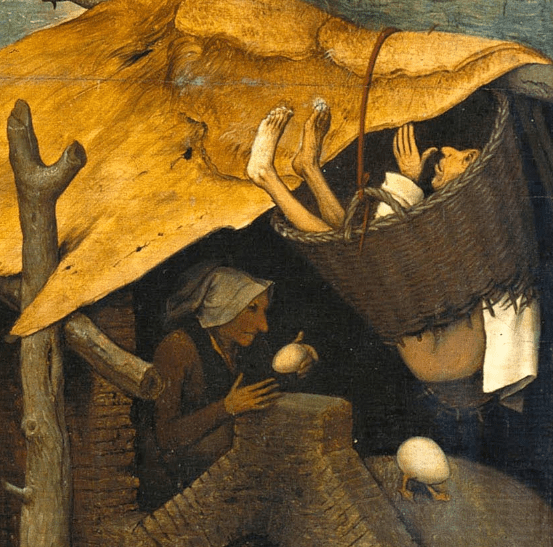
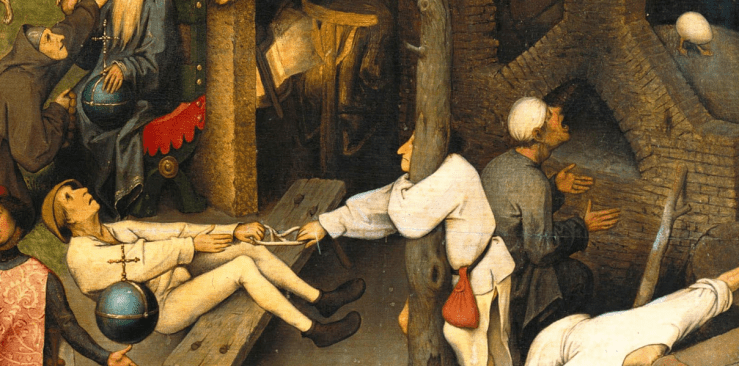
Netherlandish Proverbs (detail) — Pieter Bruegel the Elder

Screenshot 2016-06-26 at 11.59.56 AM

August Morning — Kazuo Nakamura

august-morning-1961large

Cariatide Délivrée — Leonor Fini

33638a171513

Reviews, riffs, etc. of June-July, 2016 (and an unrelated pig)

I read a lot of great books over the past few months and failed to write proper reviews for some of them, including two by Stanley Elkin—The Franchiser and The Dick Gibson Showa double feature of two novellas by W.D. Clarke called White Mythology, and Marketa Lazarova by Vladislav Vančura. But I did riff on other books.


One of the best books I’ve read in ages is Brazilian writer João Gilberto Noll’s 1991 novella Quiet Creature on the Corner (new in English translation (by Adam Morris) from Two Lines Press). I reviewed the book, but also noted

The book is probably best read without any kind of foregrounding or forewarning.

Forewarning (and enthusiastic endorsement): Quiet Creature on the Corner is a nightmarish, abject, kinetic, surreal, picaresque read, a mysterious prose-poem that resists allegorical interpretation. I read it and then I read it again. It’s a puzzle. I enjoyed it tremendously.


I also wrote about the books I’ve started the most times without ever finishing, asking readers in turn what books they’ve started the most times without finishing. 

img_2691

Frequent answers (both on the blog, on Twitter, and via email) included lots of “big” books, especially Gravity’s RainbowWar and PeaceMoby-Dick, and Infinite Jest. I was also surprised at how many readers cited Dostoevksy’s novel The Idiot, a book I’ve started at least four times without success.


Readers also told me that I needed to stick it out with The Charterhouse of Parma, which I did. I wrote about French Stendhal’s “Italian” novel here and here. Short version: Parts were great but the novel was often exhausting—Charterhouse is a novel about boredom that is frequently boring. But the fault is mine.


Another French novel I got bored with was Hell, Henri Barbusse’s 1908 novel of voyeurism (I read (and often just skimmed, to be honest) 1966 English translation by Robert Baldick. (As an aside, I think my boredom and comprehension of the novel made it easy to write about—whereas I sometimes have difficulty writing about a novel that I find perplexing and which I feel a passion for, like Vančura’s Marketa Lazarova).


I was very passionate about an Italian “Italian” novel (or set of novels, I suppose), Elena Ferrante’s so-called Neapolitan Novels. I wrote about Ferrante’s powers of abjection, stating—

From the earliest pages of the first novel, My Brilliant Friend, Ferrante crafts a world—a brutal neighborhood in Naples—which seems real, full, squirming with dirty bloody life. The novel also reminded me of 2666, although I couldn’t figure out why at first (my friend had not suggested a connection). A simple answer is that both novels are propulsive, addictive, impossibly rich, and evocative of specific and real worlds, real worlds anchored in dreams and nightmares.

But it’s also the horror. Ferrante, like Bolaño, captures the horrific violence under the veneer of civilization. While My Brilliant Friend and its three “sequels” (they are one novel, to be sure) undertake to show the joys and triumphs and sadnesses of a life (and more than one life), they also reverberate with the sinister specter of abjection—the abjection of violence, of history, and of the body itself. The novels are messy, bloody, and tangled, their plot trajectories belying conventional expectations (in the same way that the novels’ awful covers belie their internal excellence—kitschy romantic smears glossing over tumult).

I’m glad I finished the quartet.


As a sort of sequel or answer or rejoinder or whatever to my question posing post about books I’ve attempted the most without ever finishing, I wrote about the novels I’m always dipping into without ever hoping to really finish.

img_2732


I also recycled two older posts: A thing I wrote about The BFG as a love letter Dahl wrote to his deceased daughter (recycled for the Spielberg film) and a review of Hemingway’s overlooked novel of doomed polyamory, The Garden of Eden (recycled for the man’s birthday).


I also spent a fun Friday afternoon browsing old sci-fi covers.


Also: Derek Pyle, of Waywords and Meansigns,  interviewed novelist Brian Hall about a bunch of stuff, including his work adapting Finnegans Wake, a novel on my “I probably will never really read this all the way through, but…” list.


Promised pig: Jamie Wyeth’s Winter Pig, 1975–

jamie-wyeth-winter-pig-1975

A Friend of Order — Rene Magritte

c5e4f8aecffa08e1f51120cc805468c2

Three Books

img_3214

A Test of Poetry by Louis Zukofsky. Trade paperback (cardstock cover) by Jargon/Corinth, 1964. A Test of Poetry is a fun companion piece to Ezra Pound’s ABC of Reading.

I don’t usually post the back covers when I do these Three Books posts, but:

img_3215

The cover design is by Jargon Society poet/publisher Jonathan Williams. The book includes this note:

img_3218

img_3216

Symbols of Transformation: Volume 1–An Analysis of the Prelude to a Case of Schizophrenia by C.G. Jung. English translation by Beatrice M. Hinkle. Harper Torchbook, cardstock, 1962. Cover design by Anita Walker. I read this book in 2004 or 2005. It is not really a book about psychoanalysis; it’s about interpretive mythology, I suppose. Or better yet, a poem with pictures.

img_3217-1

Composers of Tomorrow’s Music by David Ewen. Dodd, Mead & Company/Apollo Editions, 1971. No designer/illustrator credited. I bought this maybe 15 years ago from a guy selling books off a card table somewhere in the Garden District in New Orleans. Chapters on the usual suspects—Cage, Xenakis, Boulez, etc. Charles Ives.