Frenetic, chaotic, and unceasingly energetic, the Safdie brothers’ 2019 film Uncut Gems plays out like a two-hour panic attack. Uncut Gems opens in the turbulent aftermath of a mining accident. An Ethiopian mine worker is borne up by his frenzied fellows, his leg a raw mangled bloody mess. The Ethiopian workers’ voices mix into the Chinese mine operators’ attempts to calm the situation. This initial cacophony signals the babble and buzz that will continue through the rest of the film, and the camera’s lingering on the destroyed leg signals the violent cost that underwrites the material splendor at the heart of Uncut Gems.
Two Ethiopian miners take a gamble and use the chaos as an opportunity to sneak away, back into the mine to make off with a rare black opal, the titular uncut gem. One of the miners peers into the gem, and the camera follows his gaze. We are taken into a kaleidoscope of shifting colors as Daniel Lopatin’s beautiful synth score kicks in. The camera swirls through the gem and, in an opening sequence that rivals Gaspar Noé’s Enter the Void, eventually enters the colon of our hero, Howard Ratner.
A title card informs us it is two years later. It is 2012 in New York City and Howard Ratner is getting a colonoscopy. There is probably some metaphor here—the aesthetic journey from the gem’s dazzle of color to the interior glistening-chewing-gum-pink flesh of Howard’s colon—but I’ll avoid remarking further upon it.
Here is the film’s premise: Howard owns and runs a jewelry store in the Diamond District. His associate Demany brings rappers and athletes to him to buy unique, high-end pieces. He is flush with cash all the time, but is also severely indebted to a loan shark named Arno (among other folks). However, his debts don’t stop him from continuing to place bets. He is also in the middle of an affair with one of his employees, Julia, whom he keeps in his Manhattan apartment, barely-concealed from his wife and children in Long Island.
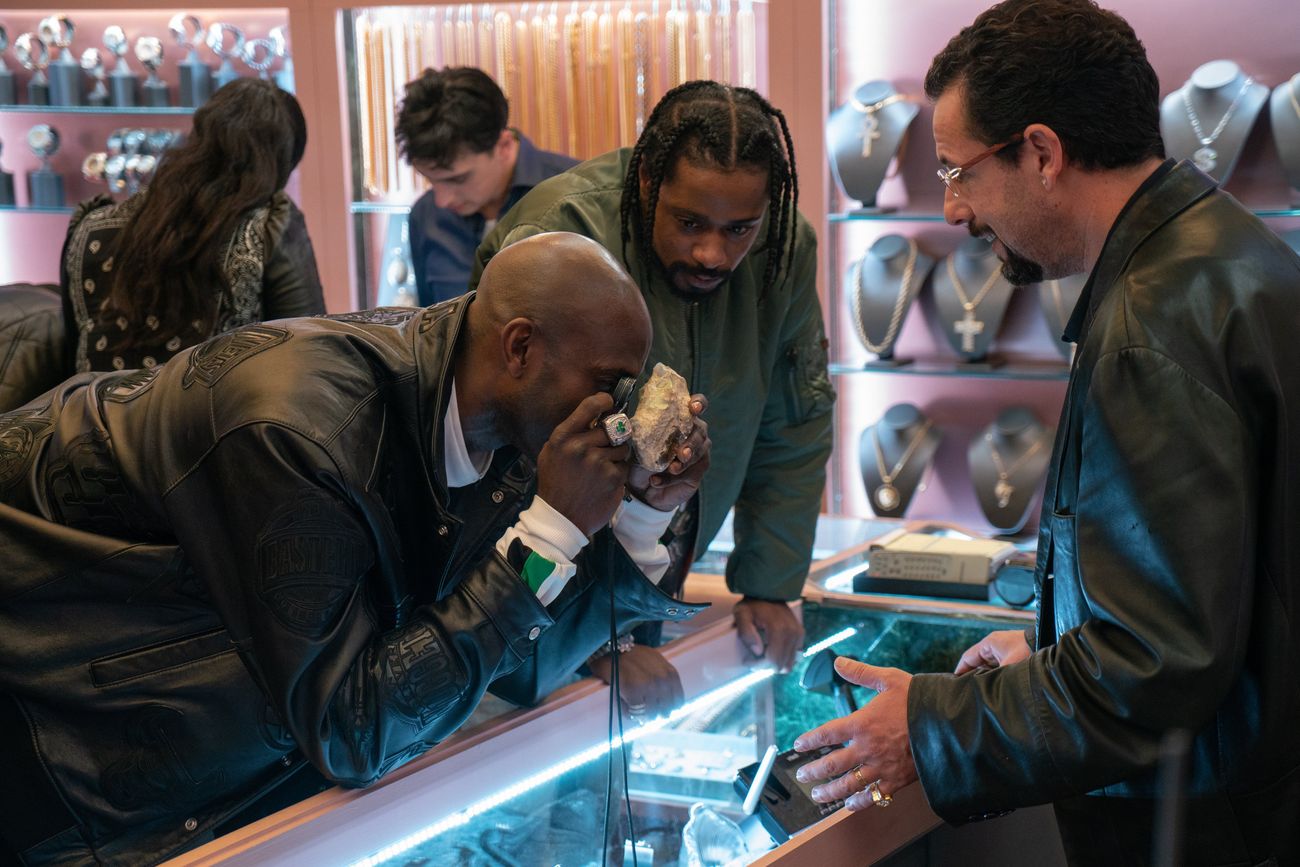
Three things happen on the day we meet Howard: Arno’s henchmen come to prove good on their threats of violence towards him if he does not pay back his loans; Demany brings Boston Celtics power forward Kevin Garnett to Howard’s shop; and Howard receives the titular uncut black opal, which he plans to sell at auction for at least a million dollars. Seeking to impress Kevin Garnett (“KG!”), the jeweler shows off his opal, Ratner’s star. In one of the film’s most extraordinary visual sequences, KG gazes into the opal and undergoes a seismic epiphany. He demands to buy the gem, but Howard refuses—he needs the money from the auction to get clean of debt. However, Howard allows KG to borrow the gem for the night, taking Garnett’s 2008 NBA Championship ring as collateral for its return. KG is convinced that the gem will lead to his success in that night’s Eastern Conference Semifinals game against the Philadelphia ’76ers (it does).
From this early point in the film Howard goes on to make a series of increasingly-nerve-wracking decisions against the backdrop of his loan shark’s enforcers’ increasingly-violent promises of retribution. I will not spoil any more of the plot—my “premise” paragraph seems too long as it is—I’ll simply say that there were moments that I (and other audience members) audibly gasped (in shock, in exasperation, in frustrated disbelief) at Howard’s choices.
Uncut Gems never really lets up. There are a few moments of respite as well as moments of comedy, but they mostly serve to suspend the anxiety the film creates, not release it. Uncut Gems is a horror film posing as a crime thriller, an anxiety film equal to Aronofsky’s mother! or Polanski’s Repulsion. The Safdies conjure a hectic, bustling world in Uncut Gems, a world of babble and noise and beauty and ugliness. Characters crowd the frames, their voices colliding in a way reminiscent of the films of Altman, Cassavetes, or early Scorsese.
Under and through the noise of voices in Uncut Gems floats Daniel Lopatin’s wonderful score. Waves of synths swing between between evocations of romance and horror; menacing swells and whimsical melodies, simultaneously busy and calming, cascade over the film. Lopatin, better known as the electronic artist Oneohtrix Point Never, is a highlight of this film.
Another highlight of Uncut Gems is Darius Khondji’s cinematography . The not-overly-saturated shots are reminiscent of his work on Wong Kar-Wai’s under-rated 2007 film My Blueberry Nights (as well as his work the same year on Haneke’s equally-anxiety-producing black comedy/horror Funny Games). Khondji conjures a candy-colored Manhattan, lush and opulent. The painterly frames are seductive but also dangerous, recalling the neon-noir of films by Gaspar Noé and Nicolas Winding Refn.
And of course the acting. I have spent close to 800 words not pointing out that this is an Adam Sandler film. Sandler inhabits his role as Howard Ratner with a vibrating energy that is hard to capture in words. It’s hard to imagine any one else playing the part. Sandler’s Howard is a degenerate gambler, addicted to the thrills of his own confidence games, a trickster blowing up his life in real time. He’s in love with his own chaos, and it’s hard not to root for him, even as he destroys everything around him.
Kevin Garnett is fantastic as himself. His eyes are especially expressive, and his screen presence is utterly natural. His final scene with Sandler’s Howard is a highlight of the film, as he seems to deliver any sane person’s remarks to the gambling addict. Lakieth Stanfield is also excellent in the film as Demany, Howard’s procurer. He both balances and matches Howard’s energetic chaos, even if he can’t ground his erstwhile partner. Eric Bogosian brings ballast to the role of Arno, Howard’s loan shark, as does Judd Hirsch, playing his father-in-law. Idina Menzel plays Howard’s (soon-to-be-ex-) wife with an unflinching meanness that the character deserves. Newcomer Julia Fox is a standout as Julia, Howard’s mistress. She enables Howard, but in some ways she’s also the hero of the film.
Uncut Gems is a very good film and I was very relieved when it was over. The Safdie brothers have created something that sustains a feeling that many of us take SSRIs to avoid. “Wow, I really hated that,” the young woman next to me remarked to her date as the closing credits began. I can understand that reaction. Uncut Gems will not be entertaining for most folks, but I thought it was great. Its initial evocations of worldly violence as the cost of worldly pleasures are answered in its final moments. Catch it in the theater if you can.
Norwood by Charles Portis. 1985 trade paperback by Vintage Contemporaries. Cover design by Lorraine Louie. Cover illustration by Rick Lovell.
I could’ve picked any of the four novels by Portis that I read this year, but I read Norwood first, so. I wrote about his novels in a post here.
Berlin Alexanderplatz by Alfred Döblin. English translation by Michael Hoffmann. Book design by Katy Homans, featuring Georg Grosz’s painting Down with Liebknecht (1919). NRYB trade paperback, 2018.
Berg by Ann Quin. 2019 trade paperback (advanced reader proof) from And Other Stories. No designer credited on the advanced reader proof, but the cover photograph (of Ann Quin) is by Oswald Jones. The designer credited with the final version of the cover is Edward Bettison.
Berg might have been my favorite reading experience of 2019. Who can resist an opening sentence like this one?
A man called Berg, who changed his name to Greb, came to a seaside town intending to kill his father…
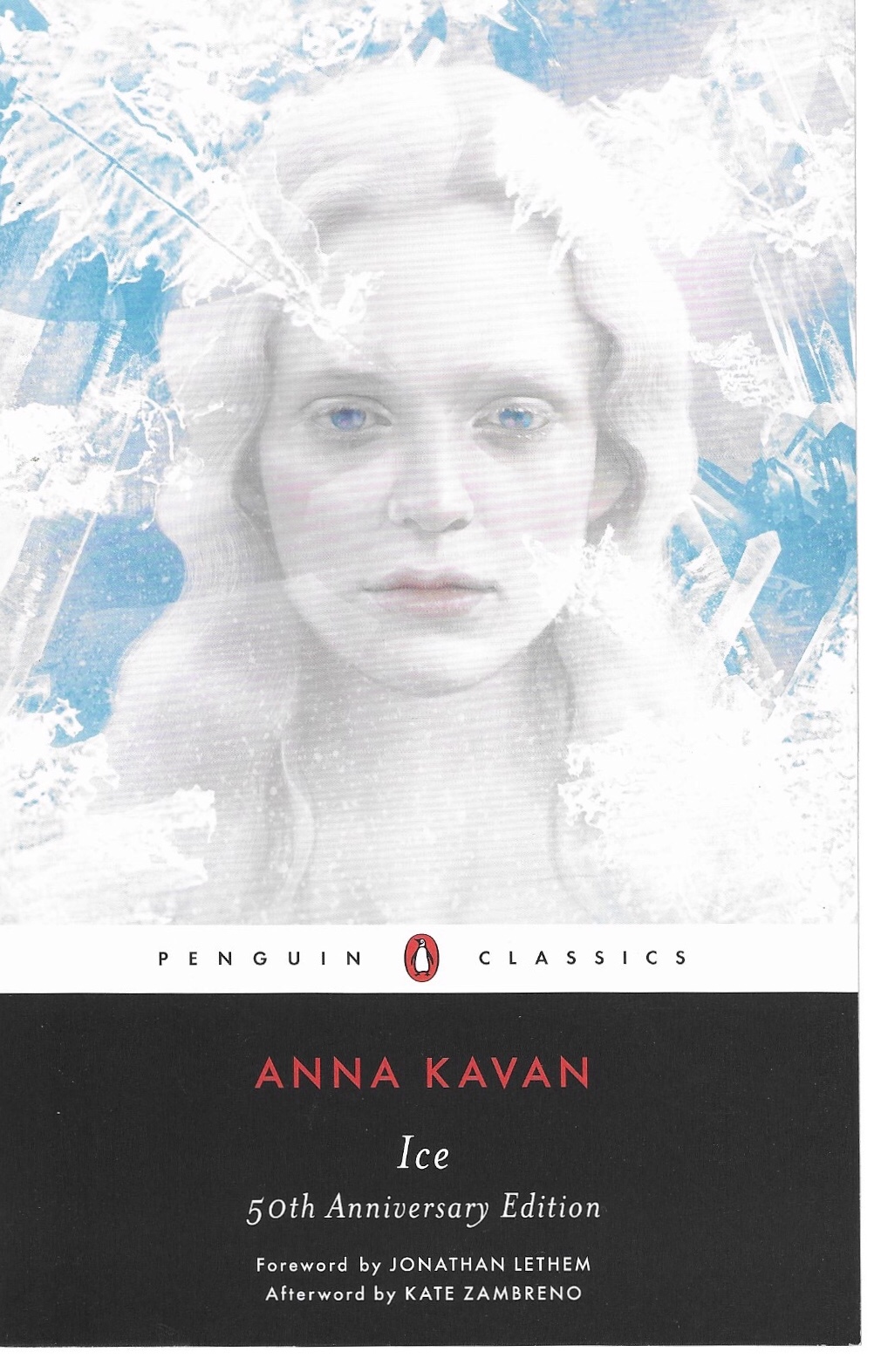
Every other sentence in the book is great as well. I read Berg in a grimy haze, the last little bit of our brief Florida spring burning off into an early muggy summer. I will likely always think of Berg as part of a strange trilogy I read in 2019, the first book in a series that led (how?) to Anna Kavan’s Ice and concluded (how?) with Shirley Jackson’s The Haunting of Hill House.
Read the book. There’s nothing I can do in this review that approaches the feeling of reading Ann Quin’s Berg. I can make lame comparisons, saying that it reminds me of James Joyce’s Ulysses (in its evocations of loose consciousness), or David Lynch’s Blue Velvet (in its oedipal voyeuristic griminess), or Luis Buñuel’s The Exterminating Angel (for its surreal humor and dense claustrophobia). Or I can point out how ahead of her time Quin was, how Berg bridges modernism to postmodernism while simply not giving a fuck about silly terms like modernism and postmodernism.
Lord by João Gilberto Noll in English translation by Edgar Garbelotto. 2019 trade paperback from Two Lines Press. Cover design by Gabriele Wilson using a photograph by Jeff Cottenden.
Reading Lord is a bit like dreaming through a fever, a fever that you’ve tried to subdue with a mix of over-the-counter night-time syrup and strong black coffee: get them down the gullet and let them fight it out in your nervously nervous system. From my review of Lord:
João Gilberto Noll’s short novel Lord is an abject and surreal tale of madness. Madness is perhaps not the correct term, although it does point towards Lord’s gothic and abject modes. Perhaps it’s more accurate to say that in Lord, Noll gives us a consciousness dissolving and reconstituting itself, a first-person voice shifting from one reality to the next with absurdly picaresque energy.
Geometry in the Dust by Pierre Senges with accompanying illustrations by Killoffer. English translation by Jacob Siefring. 2019 trade paperback from Inside the Castle. Cover design by Jon Trefry, adapting the original 2004 French edition from Verticales. The cover art may or may not be by Killoffer.
Senges’ prose in Geometry is syntactically thick. Sentences, like alleys in a strange city, begin in one place and end up somewhere quite different. The interposition of jostling clauses might cause a reader to lose the subject, to drop the thread or diverge from the path (or pick your metaphor). The effect is sometimes profound, with our narrator arriving at some strange philosophical insight after piling clause upon clause that connects the original subject with something utterly outlandish. And sometimes, the effect is bathetic. In one such example, the narrator, instructing his sovereign on the proper modes of religious observance in the city, moves from a description of the ideal confessional to an evocation of Limbourg’s hell to the necessity of being able grasp a peanut between two fingers. The comical effect is not so much punctured as understood anew though when Senges’ narrator returns to the peanut as a central metaphor for the scope of a city (“there are roughly as many men in the city as peanuts in the city’s bowls”), a metaphor that he extends in clause after clause leading to an invocation of “Hop o’ my Thumb’s pebbles,” a reference to Charles Perrault fairy tale about a boy who uses riverstones to find his way home after having been abandoned in the woods by his parents.
What is the path through Geometry in the Dust? The inset notes, as you can see in the image above, also challenge the reader’s eye, as do the twin columns, so rare in contemporary novels.
The Scottish novelist and artist Alasdair Gray died today, one day after his 85th birthday.
Gray’s first novel, 1981’s Lanark, is one of the strangest and most memorable novels I’ve ever read. Part dystopian fantasy, part realist autofiction, part Kafkaesque anti-quest, and part Künstlerroman, Lanark deconstructs the traditional novel, braiding multiple narratives into a complex, sharp, satirical epic.
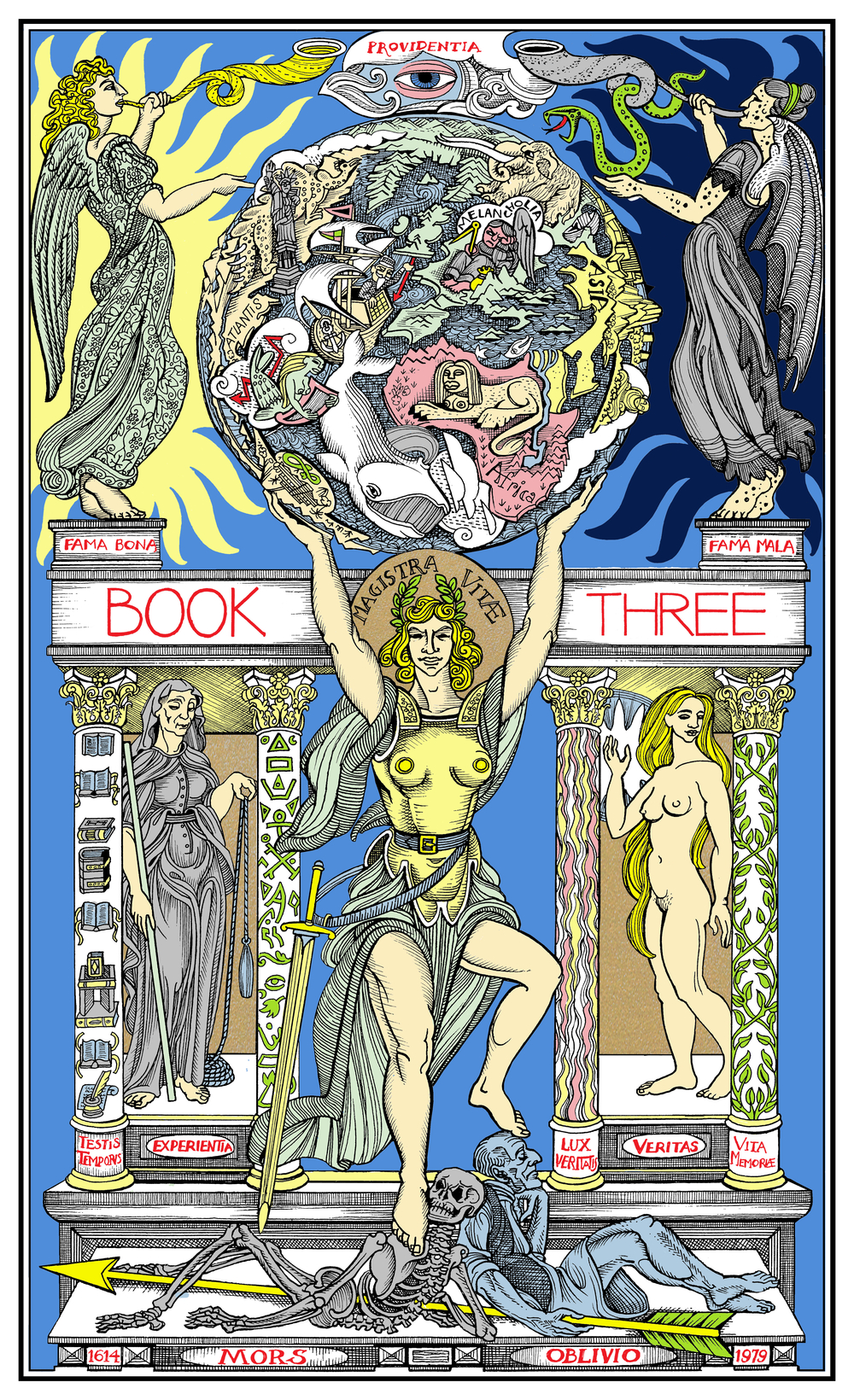
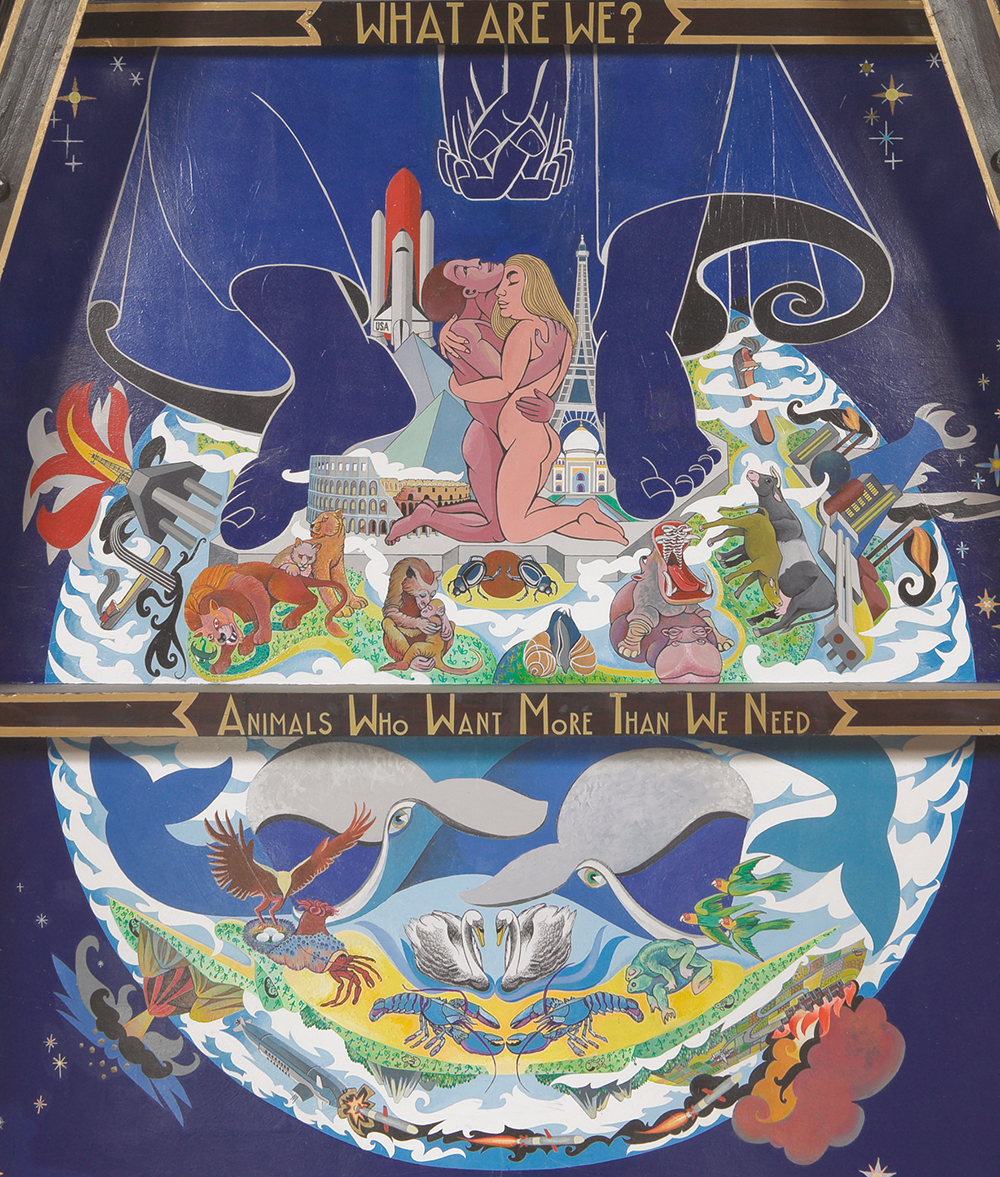
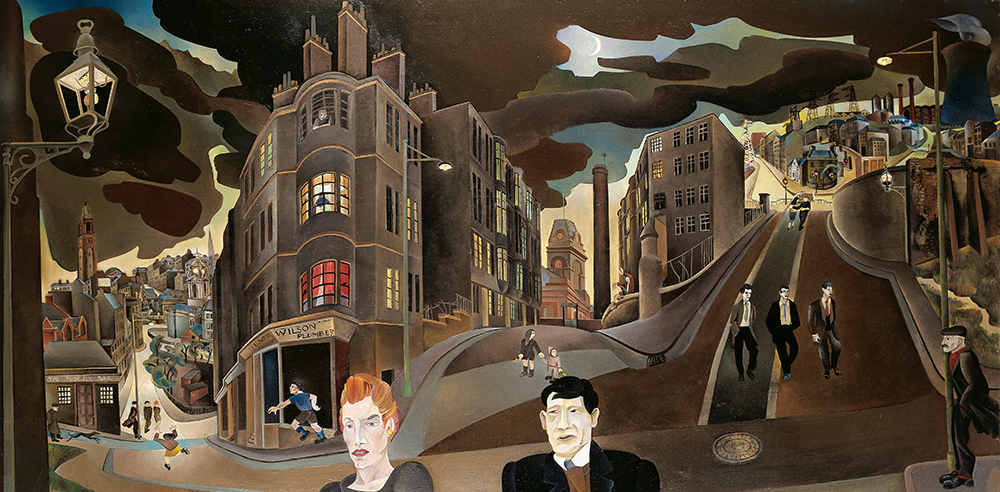
Lanark included original artwork by Gray, a trend that would continue over the course of his career as a novelist. Gray was trained as a muralist, and if I ever make it to Glasgow I plan to see his murals.
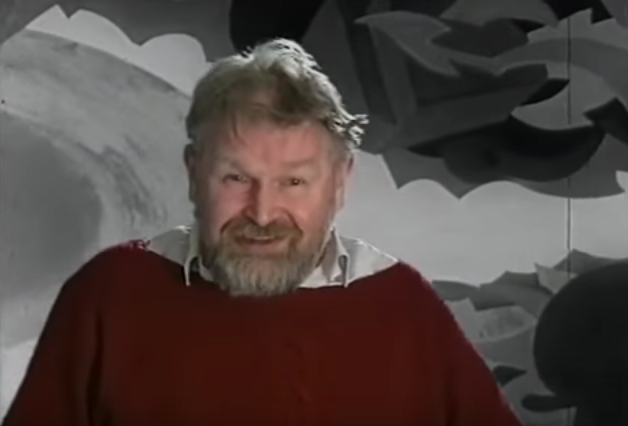
Gray’s art of course adorns his follow-up to Lanark, 1984’s 1982, Janine, a challenging novel of debauchery. 1982, Janine is conceptually, formally, and typographically challenging, a kind of answer to Finnegans Wake, and like Joyce’s big weird fun hard novel, Gray’s sophomore jaunt is a jam I return to again and again without the hope of truly ever finishing. 1982, Janine also has the best blurb I think I’ve ever read—you can watch Gray read it in this 1993 STV documentary about Gray (around 15:34)—
The Gray Matter also features Gray discussing his novels and reading from them, as well as his art. It makes a neat primer to the Gray’s work, and while I’m no expert—just a big fan of those first two novels and his art, to be clear—I think it does a nice job of letting the artist speak about his art.
I’ll close by reiterating that Lanark has stuck with me in a way that most novels don’t. It might seem a daunting read at nearly 600 pages (not to mention its four-book structure, which begins with Book Three before going to Books One and Two and then concluding with Four—and, oh the books are formally/stylistically varied)—but Lanark might be the cult novel you’ve been missing from your life.









 Biblioklept