Blog about some books acquired, mid-November 2023

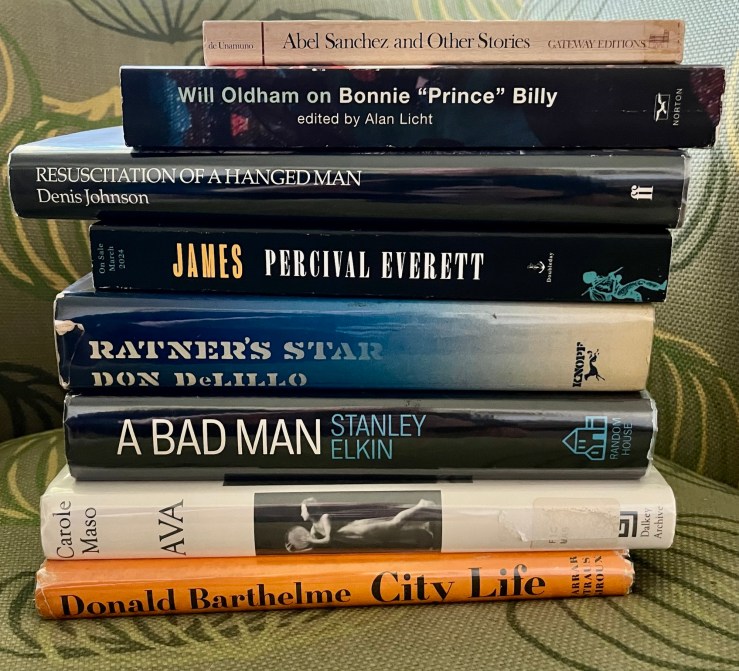
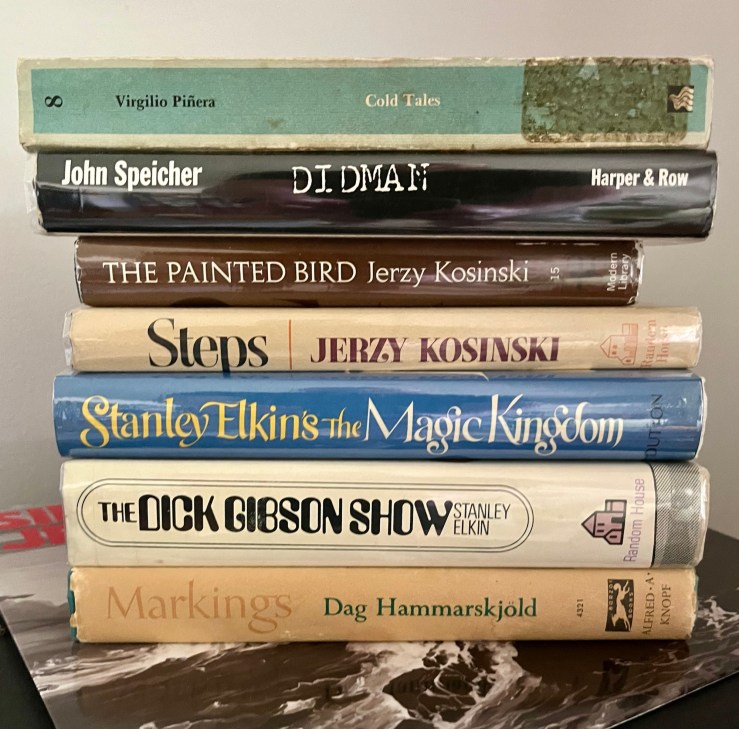
Top to bottom:

I am a huge fan of Atticus Lish’s 2014 novel Preparation for the Next Life, and I’m a fan of indie Tyrant Books, but I’d never heard of his 2011 collection of doodles, Life Is With People. The book wasn’t even shelved properly yet, and I was initially attracted to its strange pink and black cover. It turned out the bookseller who checked out my purchases that day (the Lish and some books for my son) had brought the Lish in; his interest in it was in Lish-as-son-of-Lish. We chatted about Barry Hannah a bit and I recommended he read Hob Broun, which I recommend to anyone who expresses admiration for Hannah or Father Lish.

Here is one of the cartoons from Lish’s collection:

This particular cartoon is probably my favorite in the collection, as I find it the most relatable.

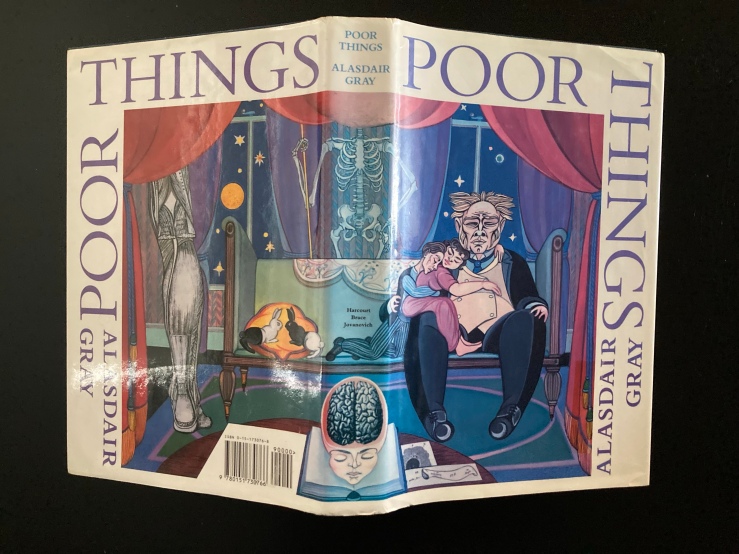
In a lovely bit of serendipity, I happened upon a first edition hardback copy of Alasdair Gray’s 1992 novel Poor Things. The previous day, I had pulled out my paperback copy to reread it in anticipation of Yorgos Lanthimos film adaptation. I ended up reading the old paperback copy, already somewhat battered, highlighted (not mine!) and dogeared (mine…), and had initially planned to trade it in toward future hardback editions of books I already own, which seems like my mission these days, but my son expressed his desire to read the novel, so it’s his I guess.

The book sans jacket is gorgeous too:

I finished Poor Things before Thanksgiving, and should have Something on it on this blog in the next week or so.

I’ve brought my son up a few times in my riff—most of these November bookstore trips were in his company; twice because he showed his art at one of the bookstore’s location, and once (the most recent, the Gray acquisition) because he’s reading like a maniac. I’m frankly jealous of how he’s reading right now—fast, somewhat indiscriminately, but with designs on reading what he calls “You know, the classics.” Initially he was reading old mass market paperbacks of mine — Kurt Vonnegut, Albert Camus, John Gardner — but he wanted his own copies (“I need to start my own little library, right?”).

I couldn’t pass up the first editions of Gass’s Middle C or Powers’ The Gold Bug Variations. I knew that I no longer had a paperback copy of The Gold Bug Variations, having loaned it to a colleague years ago who moved to Norway in the middle of a semester, leaving her history department scrambling to cover classes. Maybe it’s in Norway. I did think I had a copy of Gass’s Middle C, but I must’ve checked it out from the library or lost it, or maybe it’s shelved behind other books. I’ll shelve it by The Tunnel, a reminder that I need to take one more shot at that beast. And if that one shot is not sufficient, another shot I will take…

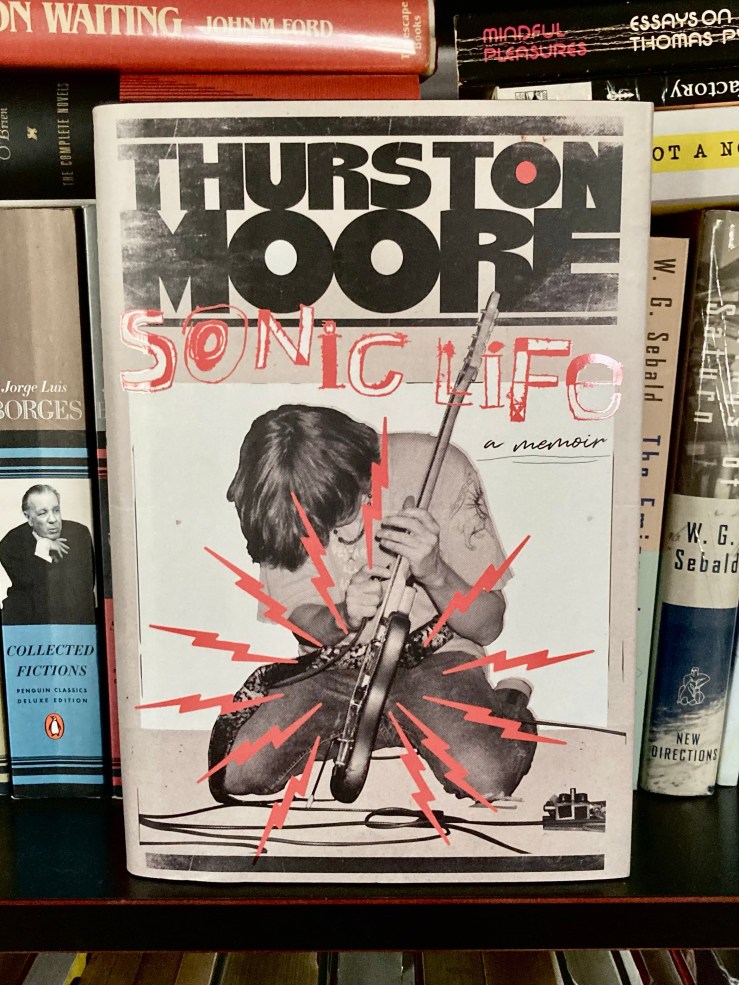
Thurston Moore’s memoir Sonic Life (Book acquired, 27 Oct. 2023)

I picked up Thurston Moore’s mammoth memoir Sonic Life yesterday afternoon, started reading it, and kept reading it. I was a huge Sonic Youth fan in my youth, introduced to the band in 1991 via a decent soundtrack to a mediocre film called Pump Up the Volume. Throughout the nineties and early 2000s, I bought all the Sonic Youth records I could get my hands on, and repeatedly watched their 1991 tour diary film The Year Punk Broke more times than I could count. Thurston Moore was a goofy avant hipster, ebullient, verbose, annoying, and endearing, the nexus of a band that were themselves a nexus of nascent bands and artists. (In his chapter on Sonic Youth in his 2001 history Our Band Could Be Your Life, Michael Azerrad repeatedly argues that DGC Records signed the band so that they would reel in the indie groups that majors wanted so badly after Nirvana et al. exploded.) When Thurston Moore and his wife and bandmate Kim Gordon separated in 2011, essentially ending Sonic Youth, I recall being strangely emotionally impacted, like my punk god parents were getting divorced. While I didn’t expect or want dishy answers from Gordon’s 2015 memoir Girl in a Band, I was still disappointed in the book, finding it cold and ultimately dull. So far, Moore’s memoir is richer, denser, sprawls more. It’s written in an electric rapid fire style loaded with phrasing that wouldn’t be out of place in the lyrics of an old SY track. I ended up reading the first 150 or so of the pages last night and this morning, soaking up Moore’s detailed account of the end of the New York punk rock scene and the subsequent birth of  No Wave. Moore’s intense love of music is what comes through most strongly. Chapter titles take their names from song titles or song lyrics, and I’ve started to put together a playlist, which I’ll add to as I read:
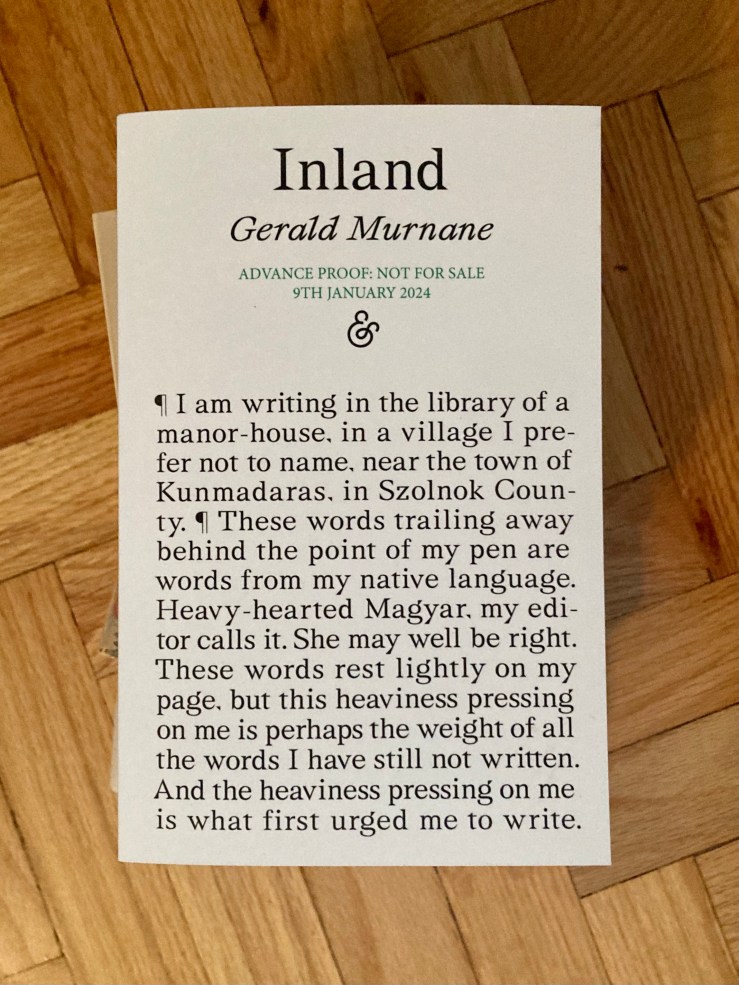
 

Gerald Murnane’s Inland (Beautiful book acquired some time last week, like maybe 11 Oct. 2023)

I love the new And Other Stories covers that just start, and I’m psyched on their edition of Gerald Murnane’s 1988 novel Inland. Their blurb:

Inland is a work which gathers in emotional power as it moves across the grasslands of its narrator’s imagination – from Szolnok County on the great plains of Hungary where a man writes in the library of his manor house, to the Institute of Prairie Studies in Tripp County, South Dakota, where the editor of the journal Hinterland receives his writing, to the narrator’s own native district in Melbourne County, between Moonee Ponds and the Merri, where he recalls the constant displacements of his childhood. ‘No thing in the world is one thing,’ he declares; ‘some places are many more than one place.’ These overlapping worlds are bound by recurring motifs – fish pond, fig-tree, child-woman, the colours white, red and green – and by deep feelings of intimacy and betrayal, which are brought to full expression as the book moves to its close.

My review closer to publication; in the meantime, read an excerpt.

Read one-time Biblioklept contributor Ryan Chang on Inland back in 2013.

Books acquired, 13 Oct. 2023

I couldn’t pass on a used copy of the second edition of Steven Weisenburger’s A Gravity’s Rainbow Companion even though it ate up most of my trade credit. I used the first edition of the Companion when I reread Gravity’s Rainbow about eight years ago and then gave it to a friend I had been encouraging to read GR. He still hasn’t read it.

I also picked up a hardcover first edition of Cormac McCarthy’s The Road and a pristine 1946 hardback edition of Joyce’s Ulysses. I’ll probably trade in the Gabler edition of Ulysses I have, but I think I’m too sentimental to let go of the copy of The Road I read in the hospital over a few days when my daughter was born.

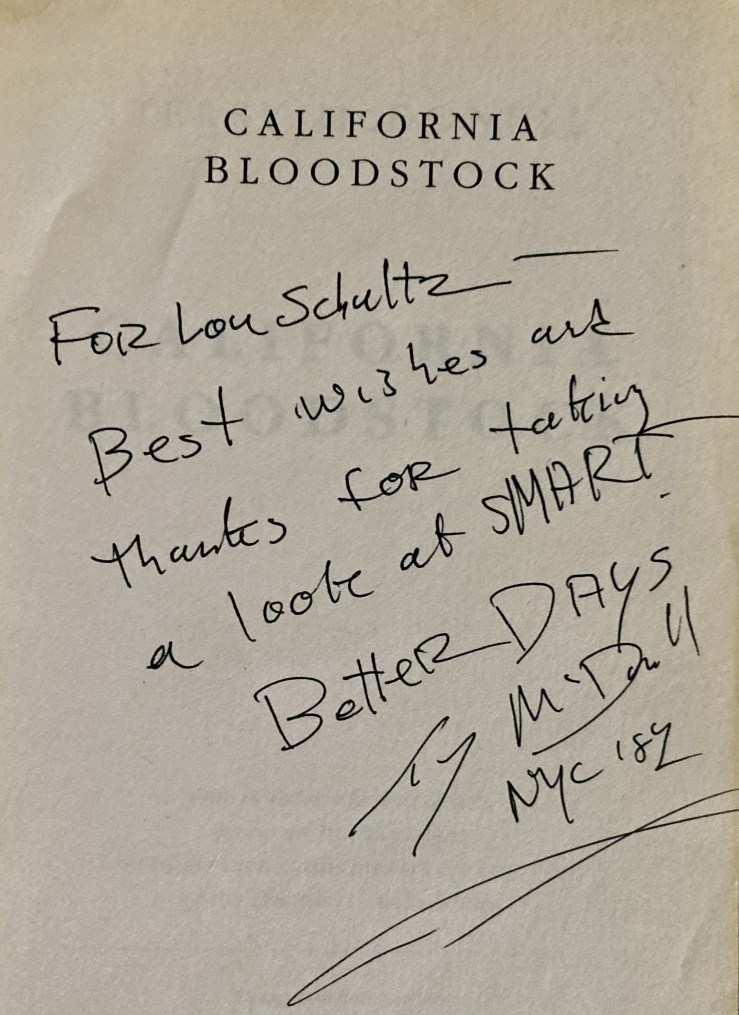
I’m a big fan of Vintage Contemporaries, but I’d never seen Terry McDonell’s California Bloodstock. I pulled it out because of its spine, and found the cover intriguing–it reminded me of these weird paintings that hang in a decrepit hotel in St. Augustine Beach that we stay at for a few nights every year. The blurb from H.S. Thompson didn’t hurt either.


I opened it to find that the novel is inscribed:

Anyone know Lou Schultz? Or what SMART might be?

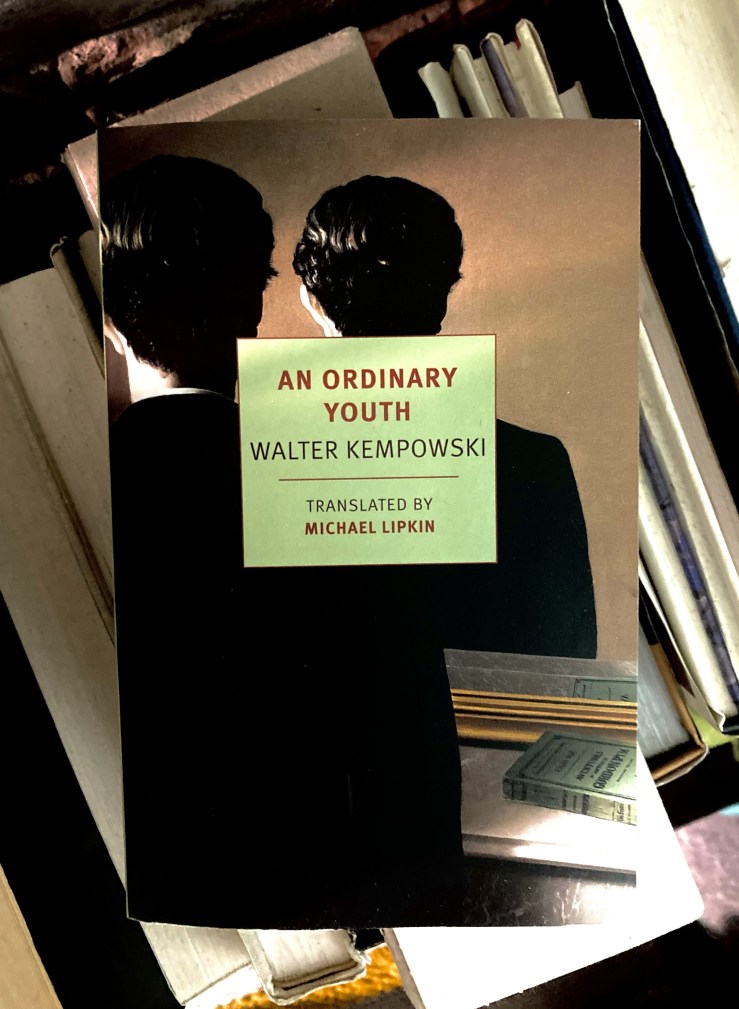
Walter Kempowski’s An Ordinary Youth (Book acquired, 2 Oct. 2023)

Walter Kempowski’s An Ordinary Youth gets its first published English translation thanks to Michael Lipkin. The book is new in print from NYRB. Their blurb—

An Ordinary Youth is a novel drawn directly from the author’s boyhood in Nazi Germany. Nine-year-old Walter’s family is moving house when the novel opens, but Walter’s main concerns are his tin soldiers and his older brother’s jazz records, his father’s fluctuating moods, and his mother’s ministrations and anxieties. While Walter is absorbed by his private life, the extraordinary accumulation of contemporary idioms that accompany his point of view—dialogue, song, literary quotations, commercials, and political slogans—tell a different story.  Through this echo chamber of voices, Kempowski shows a hugely turbulent and murderously intolerant nation racing toward disaster. An immediate bestseller when it was first published in Germany in 1971 (as Tadellöser & Wolff) and the best known of Kempowski’s novels in Germany, An Ordinary Youth is now available in English for the first time.

Portis’s Gringos, Essays on Pynchon, Elkin’s End (Books acquired, 29 Sept. 2023)

So two of the three books I picked up today I’d read before, but I couldn’t pass on the editions.

I read Stanley Elkin’s The Living End last summer, checking a digital version out from the library. I wanted something very short and funny at the time, and it worked wonders. I couldn’t pass up this Warner Books edition with design by Gene Light featuring art by Don Ivan Punchatz. I have a few other Elkins in this series and I adore them, even if my eyes are fading to the point that mass market paperbacks cause me to squint.

I also picked up another book I’ve already read, a book I already own a copy of—Charles Portis’s last novel Gringos. But I didn’t own a first edition with this fun, silly cover.

On the last day of 2020, the year I read Gringos, I wrote:

Gringos was the last of Portis’s five novels. I read the other four greedily last year, and pulled them all out when he passed away in February. I started in on Gringos, casually, then just kept reading. Sweet and cynical, spiked with strange heroism, strange grace, and very, very funny, Gringos might just be my favorite Portis novel. But I’d have to read them all again to figure that out.

I also picked up Mindful Pleasures: Essays on Thomas Pynchon, a 1976 collection that seems ahead of its time. From Scott Sanders’ essay “Pynchon’s Paranoid History”:

The cozy creepiness of Lisa Tuttle’s novella My Death

Lisa Tuttle’s 2004 novella My Death receives an American reprint this fall from NYRB. In her introduction to this new edition, novelist Amy Gentry expresses her hope the reprint will set off a “Lisa Tuttle renaissance.” My Death was first published in the UK (Tuttle’s adopted home), and released in a small run from the feminist indie press Aqueduct; their edition is now out of print.

I had never heard of Lisa Tuttle’s work until a reading copy of the novella arrived in my mail a few days ago. The enigmatic title and the wonderful cover art by Cameron (Marjorie Cameron Parsons Kimmel) intrigued me. So did, I admit, the slim shape of My Death. It is one hundred pages of dialogue-driven weirdo art mystery stuff. Skipping Gentry’s introduction, I started reading, finishing the book over the course of two nights.

My Death is very readable, in that page-turning, suspense-building way. Gentry points its readability out at in the first line of her summary of the novella, which I will steal for its precision:

The opening pages of My Death seem to promise nothing more than a cozy tale of literary detective work. The narrator, who remains unnamed throughout the story, is a recently widowed novelist living on Scotland’s craggy western shore, her career stalled out by grief. While visiting the National Gallery in Edinburgh, she comes upon a portrait of the painter and writer Helen Ralston, an early-twentieth-century visionary whose work has long been overshadowed by her tempestuous affair with a more famous male author, W.W. Logan. Having been heavily influenced by Ralston’s work as a young woman, the narrator embarks on a biography that will elevate her from muse to “forgotten modernist” — and, it is implied, help the narrator rediscover the wellspring of her own creativity.

Tuttle shuttles her plot along, pushing her narrator out of the inertia of grief and into the possibility–quite literally–of a new life. We sit upon the narrator’s shoulder, by her eyes, ears, mouth, nose, as she goes about changing her life. This process kicks off in weird earnest when she finally meets her would-be subject, Helen Elizbeth Ralston (yes, “H.E.R.”). Previous to this meeting, Tuttle spikes her tight narrative with occasional vertiginous dips into the uncanny, but for the most part the novella chugs along its track as “nothing more than a cozy tale of literary detective work.” After the two writers converge, things good far more creepy.

Creepy, but also comfortable—the narrator indulges herself in Ralston’s tales of Paris in the Modernist thirties (“she’d taken tea with Sylvia Beach and James Joyce and his Nora”; she and her pal Virginia Woolf have their photo taken), and Tuttle indulges herself and her reader in a fantasy of this celebrated time. Notably, those macho sexist sons of guns “Picasso and Hemingway were both, by then, much too grand to be known.” Tuttle subtly highlights the art of women instead: Stein, Woolf, and Barnes echo throughout My Death, as does A.S. Byatt, whose 1990 novel Possession–perched on Ralston’s shelf by Nightwood and The Rings of Saturn—might be a prototype for Tuttle’s novella. These moments, even in their oddity, confirm the old pleasures of Art Gone By, high days of Grand Modernism not to be found again, except in novels and paintings—but also to be found anew in, say, the diaries and notes of “forgotten” modernists like Helen Elizabeth Ralston. Is there a strange, unnerving, uncanny set of secrets in Ralston’s diaries?! Well of course.

The fun of My Death is in its propulsive mystery plot; the art in the novella is in the small eruptions that distort that plot. Tuttle’s prose, for the most part, is straightforward and workmanlike, delivering action and thought without any many messy seams showing. The best bits break through the surface, showing just a glimpse of all the weird writhing underneath. Consider the following passage–never mind the context:

The sounds, our unnaturally slow pace, my worries about what was going to happen all combined to affect my brain, and after a while it seemed to me that the earth beneath my feet had become flesh, that I was treading upon a gigantic female body. This was bad enough, but there was something stranger to come, as it seemed I felt the footsteps upon my own, naked, supine body: that I was the land, and it was me. My body began to ache, but it seemed there was nothing to be done. I lost track of time, and my sense of myself as an individual became tenuous.

Elsewhere, there are eruptions of raw memory that penetrate any cozy gauze, as when the narrator recalls being a child and waking screaming from a nightmare. Her mother tries to comfort her but fails. And fails indelibly, imprinting a negative epiphany on her young daughter:

…what upset me was that I’d just realized that my mother and I were separate people. We didn’t share the same dreams or nightmares. I was alone in the universe, like everybody else.

Alone in the universe underscores one of the novella’s major thematic tracks—grief. My Death does not wallow in its grief; it never wallows, it always moves. But it does explore different kinds of grief, different kinds of relief, different kinds of loneliness. And, as it hurries to its conclusion, it suggests that maybe being alone in the universe might not be so awful.

The creepy coziness of My Death evinces most strongly in its final brief twin chapters. I won’t spoil the novella—for its pleasures really do depend on plot—but simply suggest that the final moments of Tuttle’s book point to a looping abyssal structure, simultaneously finite and infinite. We get to eat our doomed cake and keep it too; the narrative is both finished and unresolved. My Death is not life changing, but it is a creepy, cozy pleasure, the kind of story that bothers a reader in the nicest sort of way.

Gert Hofmann’s Our Philosopher (Book acquired, 13 Sept. 2023)

Gert Hofmann’s 1986 novel Veilchenfeld is forthcoming in the U.S. in an English translation by Eric Mace-Tessler, The new edition is from NYRB. Their back cover copy:

The time is the 1930s. Our philosopher is Herr Veilchenfeld, a renowned thinker and distinguished professor, who, after his sudden dismissal from the university, has retired to live quietly in a country town in the east of Germany. Our narrator is Hans, a clever and inquisitive boy. He relates a mix of things he witnesses himself and things he hears about from his father, the town doctor, who sees all sorts of people as he makes his rounds, even Veilchenfeld, with his troubled heart. Veilchenfeld is in decline, it’s true—he keeps ever more to himself—but the town is in ever better shape. After the defeat of the Great War and the subsequent years of poverty, things are looking up. The old, worn people are heartened to see it. The young are exhilarated. It is up to them to promote and patrol this new uplifting reality—to make it safe from the likes of Veilchenfeld, whose very existence is an affront to it. And so the doctor listens, and young Hans looks on.

And novelist Ian McEwan’s blurb:

The best novel I’ve read that describes events through the eyes of a child is little known and a minor masterpiece….Hans, the son of a small-town doctor, watches as the life of his fascinating neighbor, Professor Veilchenfeld, unravels and is then destroyed…In this learned old man, Hofmann condenses the industrialized extermination of millions…To recount it through the limited and fragmented understanding of an innocent child was an inspired authorial choice.

The Letters of Gustave Flaubert (Book acquired, 26 Aug. 2023)

NYRB has a new one-volume edition of Francis Steegmuller’s translation of Flaubert’s letters. Their blurb:

Here we have Flaubert’s youthful, sensual outpourings to his mistress, the poet Louise Colet, and, as he advances, still unknown, into his thirties, the wrestle to write Madame Bovary. We hear, too, of his life-changing trip to Egypt, as described to family and friends, and then there are lively exchanges with Baudelaire, with the influential critic Sainte-Beuve, and with Guy de Maupassant, his young protégé. Flaubert’s letters to George Sand reveal her as the great confidante of his later years.

Steegmuller’s book, a classic in its own right, is both a splendid life of Flaubert in his own words and the ars poetica of the master who laid the foundations for modern writers from James Joyce to Lydia Davis. Originally issued in two volumes, the book appears here for the first time under a single cover.

Aira/Márquez/Moore (Books acquired, 18 Aug. 2023)

Last week I read a 1985 Washington Post profile of the American novelist William Gaddis. The profile, by Lloyd Grove, celebrated the publication of Gaddis’s third novel Carpenter’s Gothic. In the profile, Grove paraphrases literary critic Frederick Karl’s 1985 essay “The Mega-Novel” in the following way:

Karl argues that unlike “categories of Jewish novelists, gays, Black writers [and] female authors” who address special interests, “these white Protestant males [Gaddis, Pynchon, John Barth et al.] write very close to what America is,” having “sensed the country as a whole.”

I tracked down and read Karl’s essay “The Mega-Novel”; it is, almost entirely, a sustained argument for the kind of giant-assed so-called “experimental” novels typical of the bracketed Gaddis, Pynchon, and Barth above. And yet Karl seems to slide into and side with Harold Bloom in that old man’s pompous war against the so-called “School of Resentment”; once in the quote above, and then a few pages later, when he chooses to claim that “The Mega-Novelists have avoided the individuation of ethnic, gay, female (or even strictly male) experience and sensed the country as a whole.” Yes—Grove weds this second line in Karl’s covert attack on the “School of Resentment,” this maddening and dismissive “country as a whole” bit to the previous language. The effect is so odd, as if Grove has purposefully ignored every other bit of Karl’s essay and cherry-picked the lines that valorize the Real American Viewpoint™ as White Protestant Straight and Male.

Karl’s essay is, apart from these unnecessary declarations, really quite good—he champions Gaddis’s J R and Joseph McElroy’s Lookout Cartridge in particular. And yet I found myself troubled by his claim that it is the dead white guys who write very close to what America is because they sense the country as a whole, in a way that somehow, like, I guess Ishmael Reed or Fran Ross or Toni Morrison or etc. just can’t. And because I’m so simpatico with Karl’s general idea in “The Mega-Novel,” I found myself looking for his 1983 book American Fictions 1940-1980 : A Comprehensive History and Critical Evaluation.

While I didn’t find it in the literary criticism section of my beloved used bookmine, I did find the second volume of Gaddis-scholar Steven Moore’s The Novel, covering 1600-1800.

I also picked up César Aira’s An Episode in the Life of a Landscape Painter (in translation by Chris Andrews) and Gabriel García Márquez’s In Evil Hour (in translation by Gregory Rabassa). The latter is another title in Avon/Bard’s Latin American authors series, and I can’t resist them.


The next day, yesterday, Saturday, I participated in an online discussion about the literature of William Gaddis on non-academic forums. (I represented Ye Olde Bloggers, and I will share more about the forum some time in the future.) Early in our forum, one of the participants, the author Jeff Bursey, raised a copy of Frederick Karl’s American Fictions 1940-1980 in front of his webcam. I believe he declared it one of the first places he’d heard of Gaddis, although I could be misremembering. It seemed like a serendipitous moment. I hope to muster more words on most of this later.

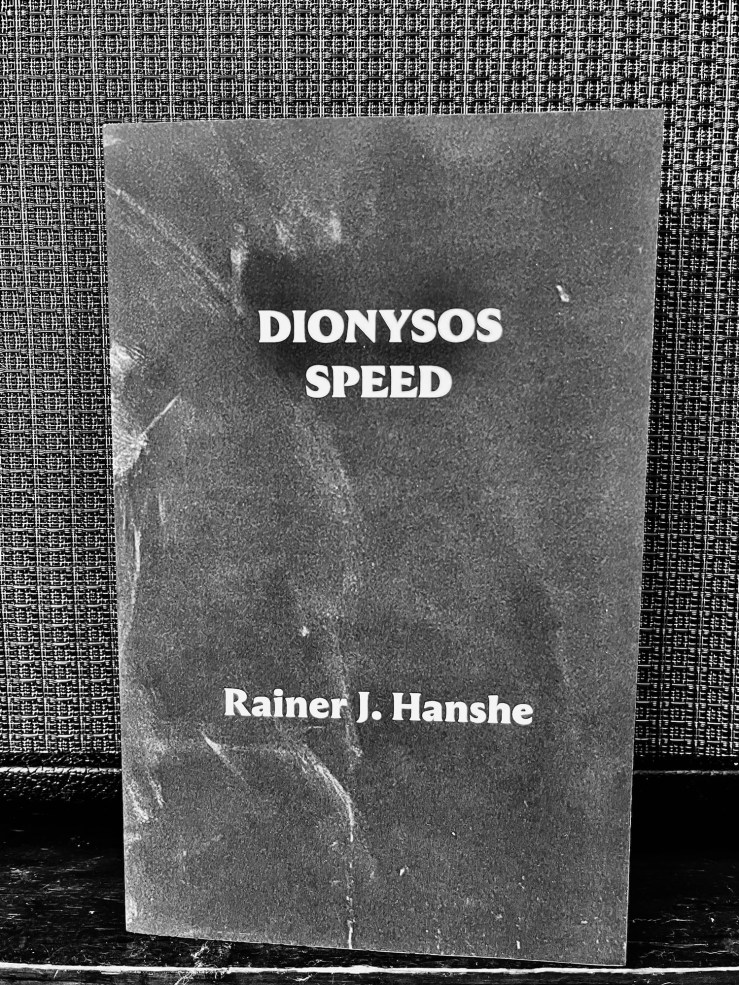
Rainer J. Hanshe’s Closing Melodies (Book acquired, 8 Aug. 2023)

Rainer J. Hanshe’s enormous, strange tome Closing Melodies is new from Contra Mundum. Their description:

As the 19th century comes to a close, Friedrich Nietzsche and Vincent van Gogh unknowingly traverse proximate geographical terrain, nearly circling one another like close but distant stars as the philosopher wanders between Nizza, Sils Maria, and Torino, and the painter wanders between Paris, Arles, and Saint-Rémy. In the midst of their philosophical and artistic pursuits, simultaneously, the Eiffel Tower, symbol of artistic progress and industrialization, begins to rise in Paris amidst clamors of protest and praise.

Through intertwining letters written to (& sometimes by) friends, family, and others, the philosopher and painter are brought into ever-greater proximity as we witness their daily personal and artistic struggles. Woven between and interrupting this panoply of voices are a series of intervals, short illuminating blasts, like a camera’s exploding flash powder, of artistic, scientific, political, and other events spanning 1888 to 1890, drawing Nietzsche and Van Gogh in and out of the wider expanses of history.

As construction of the Eiffel Tower comes to completion in Paris and Elisabeth Förster, the sister of the philosopher of the will to power, tries to found a utopic race colony in South America, the lives of Nietzsche and Van Gogh come to their terrible denouements. Her brother now a full-fledged zombie, the former queen of Nueva Germania seizes the reins of his living corpse and rides him into the future.

With no deus ex machina in sight, and none possible, WWI and the terrors and the beauties of the 20th century crack the horizon.

Susie Boyt’s Loved and Missed (Book acquired, 5 Aug. 2023)

Loved and Missed is the seventh novel by British author Susie Boyt, but the first to be published here in the States. Publisher NYRB’s blurb:

Ruth is a woman who believes in and despairs of the curative power of love. Her daughter, Eleanor, who is addicted to drugs, has just had a baby, Lily. Ruth adjusts herself in ways large and small to give to Eleanor what she thinks she may need—nourishment, distance, affection—but all her gifts fall short. After someone dies of an overdoes in Eleanor’s apartment, Ruth hands her daughter an envelope of cash and takes Lily home with her, and Lily, as she grows, proves a compensation for all of Ruth’s past defeats and disappointment. Love without fear is a new feeling for her, almost unrecognizable. Will it last?

Cortazar/Crowley/Ford (Books acquired, 27 July 2023)

I went to the bookstore today looking for a copy of Katherine Burdekin’s dystopian 1937 novel Swastika Night. I was unsuccessful there, but while browsing the scifi and fantasy section, I came across three books that I couldn’t resist.

The first was an unread hardcover first edition of John M. Ford’s 1983 novel The Dragon Waiting. This book was only on my radar because Slate republished a 2019 article on Ford by Isaac Butler and a friend sent me the link (his message was simply “?”). From Butler’s article:

The Dragon Waiting is an unfolding cabinet of wonders. Over a decade before George R.R. Martin wrote A Song of Ice and Fire, Ford created an alternate-history retelling of the Wars of the Roses, filled with palace intrigue, dark magic, and more Shakespeare references than are dreamt of in our philosophy. The Dragon Waiting provokes that rare thrill that one gets from the work of Gene Wolfe, or John Crowley, or Ursula Le Guin. A dazzling intellect ensorcells the reader, entertaining with one hand, opening new doors with another.

Wolfe blurbed the back cover of the copy I bought, by the way.

Maybe Crowley was in my subconscious too; while searching for Swastika Night under the Cs (it was first published under the pseudonym “Murray Constantine”), I came across a cheap hardcover copy of Crowley’s 1976 novel Beasts. I’d read Little, Big years ago, enjoyed it, but gone no further. (There were no copies of Little, Big in Crowley’s placarded section, all though I did find three copies in the “General Fiction” section, away from the beautiful weird scifi fantasy ghetto.)

I’ve long been a sucker for the mass market Avon Bard Latin American writers series, so I couldn’t pass up the copy of Julio Cortazar’s Hopscotch (translated by Gregory Rabassa). It sat upon a miscellaneous, dusty stack of outcasts in the middle of the “D” aisle in the scifi fantasy ghetto, waiting for me.


Bunch’s Moderan/Ginzburg’s Dry Heart (Books acquired, 14 July 2023)

Picked up two on Friday—

I’ve been wanting to read Natalia Ginzburg for a while, and when I saw a used copy of her novella The Dry Heart (translated by Frances Frenaye), it seemed like a good entry point. It was really the description on the back that grabbed me:

The Dry Heart begins and ends with the matter-of-fact pronouncement: “I shot him between the eyes.” As the tale—a plunge into the chilly waters of loneliness, desperation, and bitterness—proceeds, the narrator’s murder of her flighty husband takes on a certain logical inevitability. Stripped of any preciousness or sentimentality, Natalia Ginzburg’s writing here is white-hot, tempered by rage. She transforms the unhappy tale of an ordinary dull marriage into a rich psychological thriller that seems to beg the question: why don’t more wives kill their husbands?

I read NYRB’s collected Moderan a few years ago, but I couldn’t pass up this Avon Bard mass market paperback.

Opening track:

“THINKING BACK (OUR GOD IS A HELPING GOD!)”

by

David R. Bunch


FLESH seemed doomed that year; death’s harpies were riding down. The once-beautiful, sweet and life-sustaining air was tinged with poison now, and man drank at his peril from the streams that had once been pure. He prayed to a God that was said to be in all things good, true and beautiful, but especially was thought to be all sternness and goodness, justice and loving-care, in some milk-white place far away, “On High.” And those prayers if answered were answered very obliquely indeed. For the air got deeper in poison from the tinkering with lethal things the flesh-man indulged in when not praying, and the water got fuller with danger as each new explosion pounded the bomb-fevered air. There was talk of the End; great discussions were handled in great halls across the land. Treaties were signed among statesmen to help the air get better, to allow the streams to recover and run pure once again. But even as the flesh-hands grasped the pens to scrawl the marks of good faith in some countries, fear lashed at capitals in other countries. Arsenals were tested anew. Things done were undone. The air got sicker; the streams ran not pure but pure danger—There seemed no chance for flesh-man, and his God seemed entirely silent wherever He was, wherever His white throne was. The HOPELESS signs were out everywhere. Little children asked that they be allowed to go quickly and not grow up hurting and maimed. Adults in what should have been the full flower of brave manhood and fair womanhood quaked, looked heavenward for some hopeful sign and, finding none, fell down and cried bitterly. The aged ones, quavering and whining now, finally decided that yes, truly they were most glad that they were so very old. The flesh billions courted at the Palace of Danger so ardently had turned against them and the mass wedding of Death and Destruction seemed now all but assured.

And then—and then this chance! Offered to all. It came first as small hope, the rumor of it, a faint faint breath of a chance seeping through the flesh-fouled metropolises. And then it was confirmed as glowing fact when the tour went round that year, year of the Greatest Darkness. And yet—and yet they scoffed, scoffed by the billions at this man working his hinges and braces, would not believe his heart was an ever-last one, had no credulity for his new wonderful lungs that could breathe him a forever-life even in bomb-tainted air. When they saw that his hands were steel they yelled robot! robot! When they saw that his eyes were wide-range, mechanism-helped, and that he’d a phfluggee-phflaggee button on his talker that he pressed from time to time to aid in his speech expression they laughed and yelled . . . Continue reading “Bunch’s Moderan/Ginzburg’s Dry Heart (Books acquired, 14 July 2023)”

Jim Dodge/Steve Erickson (Books acquired, 22 June 2023)

I picked up my daughter’s assigned summer reading today — Steven King’s On Writing and Strunk & White’s The Elements of Style. It’s not exactly clear to me if she’s supposed to, like, read, the Strunk & White, although I recall actually reading it when I was around her age, but I also enjoyed reading the thesaurus. The bookstore had a used copy of Penguin’s hardback edition with illustrations by Maira Kalman for only a few bucks more than the cheap paperback copies, so I got it for my daughter. I have the same edition at my office.

wcs

I finally found a copy of Jim Dodge’s 1990 novel Stone Junction. I’d been looking casually looking for it for a few years now, and was pleased to find it in a Canon edition (although the big sticker over the tarot card on the cover is kinda bewildering). If you’re interested in Pynchon’s intro you can read it here. There’s an excerpt from the beginning of the novel here.

I didn’t really mean to pick up Steve Erickson’s third novel, Tours of the Black Clock (1989) but then I did. I mean I went to the Erickson books, picked this one out, started to read the back cover, read the sentence “Cutting a terrifying path from a Pennsylvania farm to the Europe of the 1930s, Banning Jainlight becomes the private pornographer of the world’s most evil man,” and decided I wanted to read it.” I finished Erickson’s second novel, Rubicon Beach (1986) a few days ago and his first, Days Between Stations (1985) a few weeks ago and I guess I want more of that particular flavor.

Three books (Books acquired, 8 June 2023)

I got a facsimile hardback sixtieth anniversary edition of Thomas Pynchon’s novel V. for my birthday. I also picked up two Ishmael Reed books: Conversations with Ishmael Reed and an Avon Bard edition of Shrovetide in Old New Orleans. Before I even physically picked up these last two, I knew that they formerly belonged to a guy from Perry, Florida and that a stamp with his name and address would be on the inside of the cover or first page. I was correct in this intimation. I now have probably thirty to forty books once owned by this person. I wrote about some Reeds, formerly his, here.

Maybe I should compare my shelf with the checklist he made in the inside cover of Conversations with Ishmael Reed—


Books acquired, 26 May 2023

I brought a box of old books to my spot; I did not intend to pick up any books but then I picked up six:

I’d been looking for a handsome and/or cheap copy of Aldous Huxley’s The Devils of Loudon for a few years ago; success.

I posted something on Twitter a few days ago about how much I’ve been enjoying Steve Erickson’s Days Between Stations; one of the replies put James Crumley in his company (along with McCarthy and Joy Williams), so I picked up Dancing Bear and The Last Good Kiss:

I’ve long loved Peter Mendelsund’s cover designs, so I didn’t pass up on a used copy of What We See When We Read. It has a lot of pictures and diagrams and such.

I saw a very interesting looking person reading an actor’s edition of Philip Ridley’s play Mercury Fur on the train a few weeks ago. I had never heard of the play, but looked it up, thought it sounded pretty cool, and then looked for it in the drama section of this same book store the last time I was there. I didn’t find it. I found it yesterday mixed in with the novels. (I wasn’t actually looking for it.)

I don’t own physical copies of The Last Novel and Vanishing Point, two of the three novels collected in David Markson’s This Is Not a Novel and Other Novels, so I couldn’t pass on this omnibus. I do own a copy of Reader’s Block, which is not collected in This Is Not a Novel and Other Novels.