Paranoia Alert (Inherent Vice)

paranoia alert

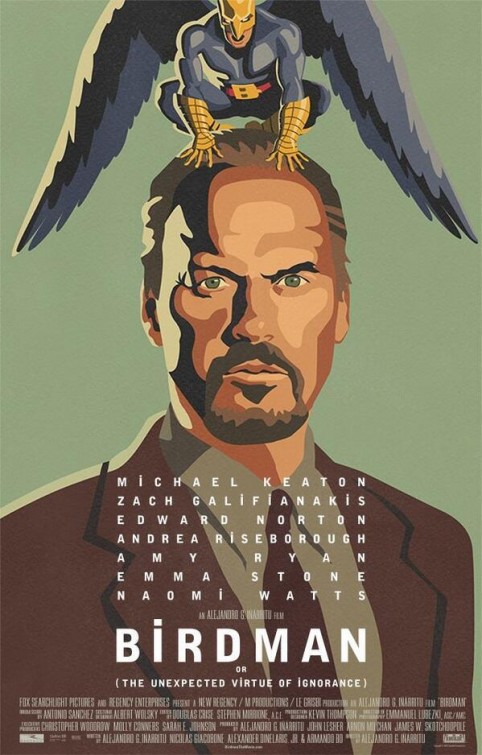
Alejandro González Iñárritu’s Film Birdman Reviewed

YLSqP80

Alejandro González Iñárritu’s film Birdman relies heavily on a central stylistic conceit: The film unfolds as one continuous uninterrupted shot, the camera unblinking, restlessly moving after Riggan Thomson (Michael Keaton), a washed-up actor who has put everything he has—financially, physically, mentally—into a Broadway adaptation of Raymond Carver’s “What We Talk About When We Talk About Love.”

The shot isn’t really continuous (any savvy viewer will spot the cuts), but the effect is powerful and engaging early on, especially when Keaton shares the lens with Edward Norton, who plays Mike, a wild foil to Keaton’s Riggan. Mike is the artist, the theater actor, the method actor, the real deal; Riggan is just a celebrity—or rather was a celebrity, the star of the Birdman franchise. The nod to Keaton’s Batman films is not even a nod, but one of several meta-crutches that Iñárritu rests all the film’s supposed “weight” on. Birdman wants to be heavy, but it feels hollow. Good thing it’s always in motion.

Birdman suffers by comparison to a handful of other films, notably Aleksandr Sokurov’s masterpiece Russian Ark in particular. Sokurov’s film, also filmed in one continuous take, does a finer job plumbing the mysteries of aesthetics (and any of aesthetics’ supposed nemeses) than Birdman. Sokurov’s film also bewilders, where Birdman’s contours are fairly familiar stuff. Another film that stages (and restages) what Birdman would like to be doing with more force is Charlie Kaufman’s deeply flawed and very brilliant film Synecdoche, New York, an alienating study of art, performance, and audience.

Of course I’ve just done exactly what Keaton’s Riggan howls against late in Birdman’s second act. He confronts the theater critic who has promised to kill his play, screaming that she, as a critic, takes no risks, puts nothing on the line. Her words are just labels; all she does is make weak comparisons. Has Iñárritu built a defense into this scene? Are we to empathize with Keaton’s Riggan? Or with Norton’s Mike? Or with the other characters whom Riggan alternately alienates and draws back in, including his ex-wife, his daughter, his girlfriend, his co-star, and his best friend? Or maybe we empathize with Riggan’s Birdman, the voice that haunts him, the voice that haunts itself into existence?

Anchored by fantastic performances—what a joy to see Keaton carry a movie again—great cinematography by Emmanuel Lubezki , and a jazz percussion score, Birdman is an entertaining way to pass two hours, but the profundity it seeks in its final moments simply isn’t there. The film’s formal structuring device, the uninterrupted shot, would like to penetrate its hero’s consciousness, but always seems to fail, necessitating voice-over or dialogue to clumsily underline the main idea. (Should I unfairly contrast this weakness with the far more powerful long-takes in Gaspar Noé’s Enter the Void? No? Okay). Birdman strives to explore the tangle between art and entertainment, but at the end we’re left with yet another Hollywood satire of ego and celebrity. Birdman is amusing when it seeks to be penetrating, clever when it seeks to be profound. And it made Raymond Carver’s story look like lurid dinner theater. But these are just labels.

DFW’s Brief Interviews with Hideous Men, books as memory objects, etc.

2015/01/img_4925.jpg

On our short walk home from her school yesterday, my darling daughter inquires if we can go to the bookstore. She needs some new Junie B. Jones, she reports. I assent.

This particular bookstore is about a mile away, a big labyrinth of shelves and stacks and strange little closets crammed with books. The owner once kindly estimated to me that the place houses somewhere between one million and two million books, but probably not more than three million books. The place is a hive, or better yet a brain. An archive.

On this warmish January afternoon, a coverless paperback wedged and warped keeps the front door propped open. My daughter doesn’t dally, fetching up a bevy of Ms. Jones’ adventures (and the third volume of Ivy + Bean to boot: “It’s Ivy “plus” Bean, not Ivy “and” Bean, her graceful correction).

We have a few minutes before we need to pick up my son, so I do a fairly regular patrol about the premises, looking for a copy of Jane Bowles’s Two Serious Ladies for a colleague. No dice. And, out of weird old habits, go past the last shelf, where Vollmann’s underattended tomes rest near David Foster Wallace novels, always depleted. I like to look at the new covers, I guess.

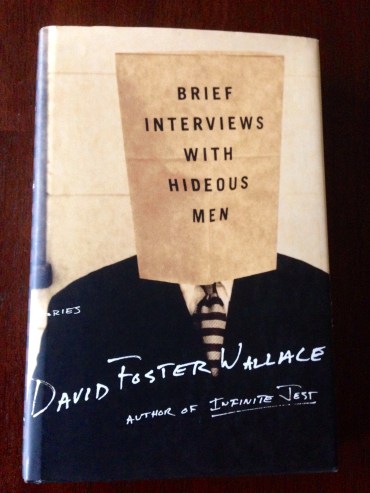
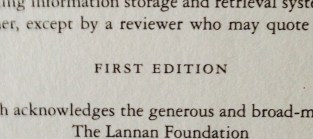
Well so and anyway, I spied a pristine hardcover copy of Brief Interviews with Hideous Men, clearly never read, and thought, Oh hey, this must be a first edition. Which it was and Oh hey you don’t need this book.
2015/01/img_4926.jpg

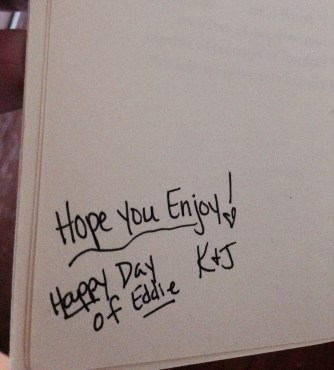
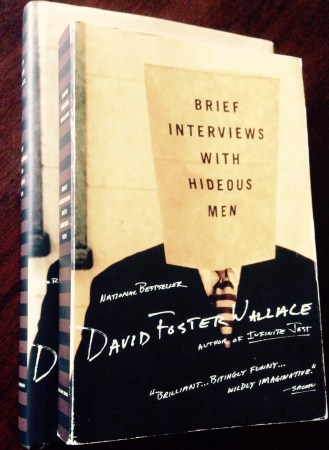
There is nothing rare or especially valuable about a first hardback U.S. edition of Hideous Men. The store is selling it for half of the publisher’s recommended price, but I have more than enough credit (thanks unsolicited review copies!) to pick it up. Which I do. Despite of course already owning it in the far more flexible trade paperback edition (first edition!) inscribed by some of the dearest damn friends who gave it to me for a birthday, an edition I reread memorably over a few weeks in Italy, an edition warped by strange moistures (I’d love to pretend the warping arose from the salty splash of the ancient Mediterranean but my own body sweat is a far more likely culprit).
2015/01/img_4927.jpg

Brief Interviews is my favorite collection of David Foster Wallace stories. The stories here are much better than those in his first collection, Girl with Curious Hair (which, the first DFW I read, has a special place in my gizzards), and though there’s nothing here that can touch the best moments of Oblivion (“The Suffering Channel” and “Good Old Neon”), the collection is cohesive, propulsive, engaging, its longer pieces punctuated by blips and vignettes. Here is the first selection, “A Radically Condensed History of Postindustrial Life”:

When they were introduced, he made a witticism, hoping to be liked. She laughed very hard, hoping to be liked. Then each drove home alone, staring straight ahead, with the very same twist to their faces.

The man who’d introduced them didn’t much like either of them, though he acted as if he did, anxious as he was to preserve good relations at all times. One never knew, after all, now did one now did one now did one.

So I picked up the hardback first edition, realizing that what I really wanted (in addition to this edition that I didn’t and don’t really need) was the copy that I read in college, the copy I borrowed from UF’s Library West (I’ll pay you $10,000 if you can think of a better library name, which you can’t), a flat brown squashed brick—-I must’ve been one of the first to read it, this was in ’99 or early ’00—I checked it out three times and then I had to return it. I ripped off “Adult World (I)” and “Adult World (II)” (these are actually the same story, but…) for a project in some bullshit class I was taking at the time, some class called Post-Historical Visual Culture or some other such nonsense—I didn’t rip off the plot, but the structure, the whole narrative/outline thing that Wallace did there. (My story was about a geneticist trying to clone a son or maybe someone to love, I can’t recall, shudder to recall…And why was I turning in a story and not an essay?!).

Why do I want the very edition that I first read, Dewey’s decimals imprinted on its drab jacketless spine? Why do I want an object that proclaims first, first, first, even though I don’t need it—why the compulsion? And then the sentimental compulsion to keep a less sturdy paperback version just because my name is incribed in itjust because I recall so vividly shaving my beard in Minori in Amalfi after reading “Tri-Stan: I Sold Sissee Nar to Ecko” and realizing that Oh my god this story is fucking terrible, DFW, I get what you’re doing, but my god. 

A book is a memory object, a placeholder, a bookmark for the memory of the reading experience, because we don’t remember what we read, not really. I have a few novels committed to memory (more or less) through yearly rereading, through teaching, but on the whole the details fade, the misremembering opens to misreading. My dream is to disband all of my books, march them out into the world, my memory secure, transcendent, stable, eternal, etc.—the objects gone, their dusty physicality imprinted in some psychic library of the soul. But I don’t believe in my dream, and even though I dig e-books, they don’t shock my memory in the same way that old pressed leaves do. So I live with these guys, nestled together unnecessarily, necessarily so.
2015/01/img_4928.jpg

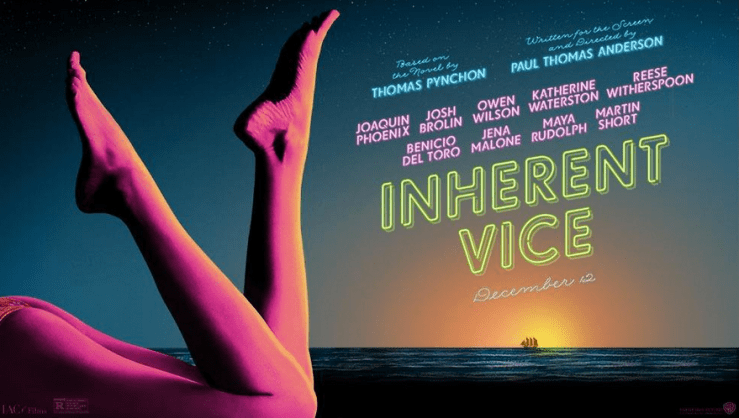
A few quick thoughts on Paul Thomas Anderson’s film Inherent Vice

IV POSTER HORIZONTAL

A. Let’s start with this: I need to see Paul Thomas Anderson’s film adaptation of Thomas Pynchon’s novel Inherent Vice again. Like, I’m compelled. 

B. But maybe a quick sketch before, no? Like, here in my office hours, before an afternoon class, when I should be shuffling through a few early papers—and, like away from the novel, which I’ve been rereading bits of? With the intention of re: point A seeing it again this weekend.

C. A claim, bold or otherwise: PTA’s film is better than Pynchon’s novel.

D. (Apples and oranges, bro, thou protest).

E. Okay so point C: What do I mean by better? I’m not really sure.

F. Maybe what I mean is: PTA slows down Pynchon’s novel. Expands the tension, the euphoria, the weirdness under the lines of dialogue.

G. (The film’s dialogue seems composed entirely from the text of the novel. Verbatim).

H. (But verbatim—how verbatim?: There are those gaps, those wonderful gaps that PTA fills—with color and smoke and sound and legs legs legs).

I. PTA also underlines plot connections for the reader, limning the paranoid contours that connect conspiracy-theory paranoia to vertically-integrated capitalism.

J. Okay, so point I: I’m not saying that clarifying the plot for the viewer (in a way that Pynchon arguably does not) makes the film, better—what I’m saying is that critics who contend the film fails to cohere are maybe missing the point.

K. Here’s a point: Inherent Vice offers the most coherent and balanced conclusion of any of Paul Thomas Anderson’s film. The final act performs the spirit behind Pynchon’s letters, offering a vision of fraternal love, or of caritas, if not love—of partnerships, of how to feed the hungry, the famished. (Poor famished Bigfoot). Of resistance to the pavement.

tumblr_l13jimngTJ1qahhqf

L. Or, another way to flesh out point C, or revise point C:

PTA gives us—and by us let’s be clear I mean me—a new reading of the novel. (And of course not just PTA, but his marvelous ensemble, too marvelous to remark on at length here). PTA’s reading of Doc’s reunion with Shasta—surely one of the film’s most intense moments—is entirely different than my own reading, and rereading that scene after viewing, I feel like Anderson and Joaquin Phoenix and Katherine Waterston read the scene right, or read the scene, depict the scene, perform the scene in a way that illustrates the darkest strands of sunny smoky searing Inherent Vice.

M. The aforementioned scene—Doc reunited with one (sort of) partner—is balanced neatly against two other key scenes: The final scene between Doc and (sort of) partner Bigfoot, and the scene in which Doc restores Coy to his family. Brother’s keeper.

N. (Parenthetically: I fell in love with the movie in its opening minutes. In those opening drumbeats of Can’s “Vitamin C”).

O. So I have to rush to class and discuss Kate Chopin and not PTA’s Inherent Vice, which is what I’d rather riff on. Not really a world of inconvenience, but…(oh, and I love how that Pynchonian byword echoed through the film).

P. End on P for Pynchon and Paul TA and Promise: Promise to rewatch, reread, rewrite.

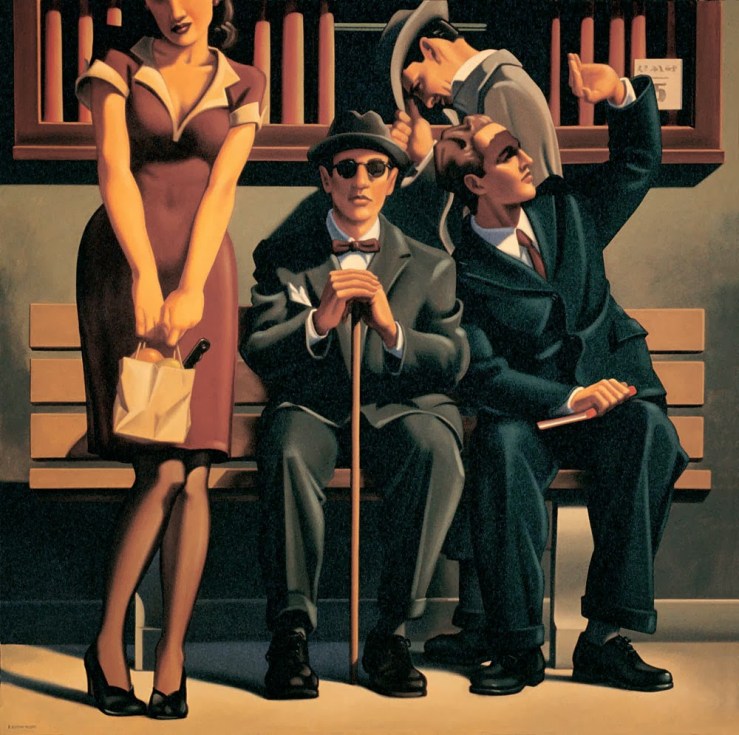
Such a Sight — Kenton Nelson

P-43

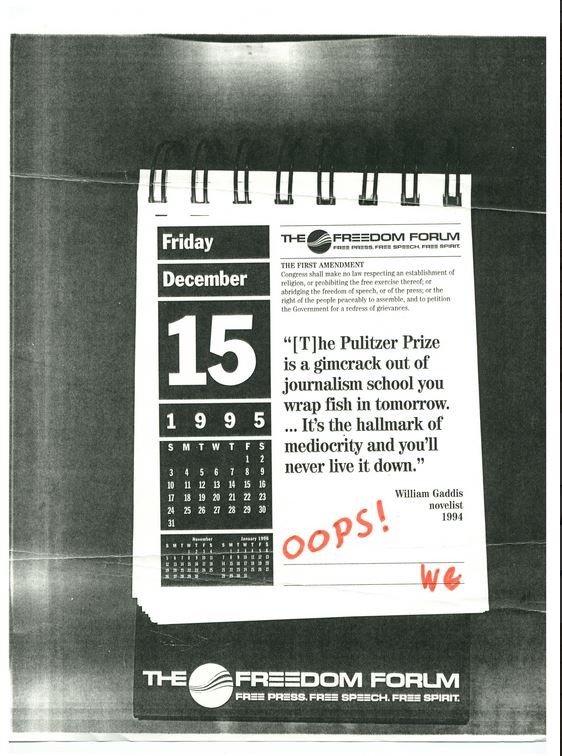
OOPS! (William Gaddis)

wg

Another little nugget from Washington University’s Modern Literature collection. Their description:

The Freedom Forum calendar showing a quote concerning the Pulitzer Prize by William Gaddis on December 15, 1995. Includes autograph commentary by Gaddis.

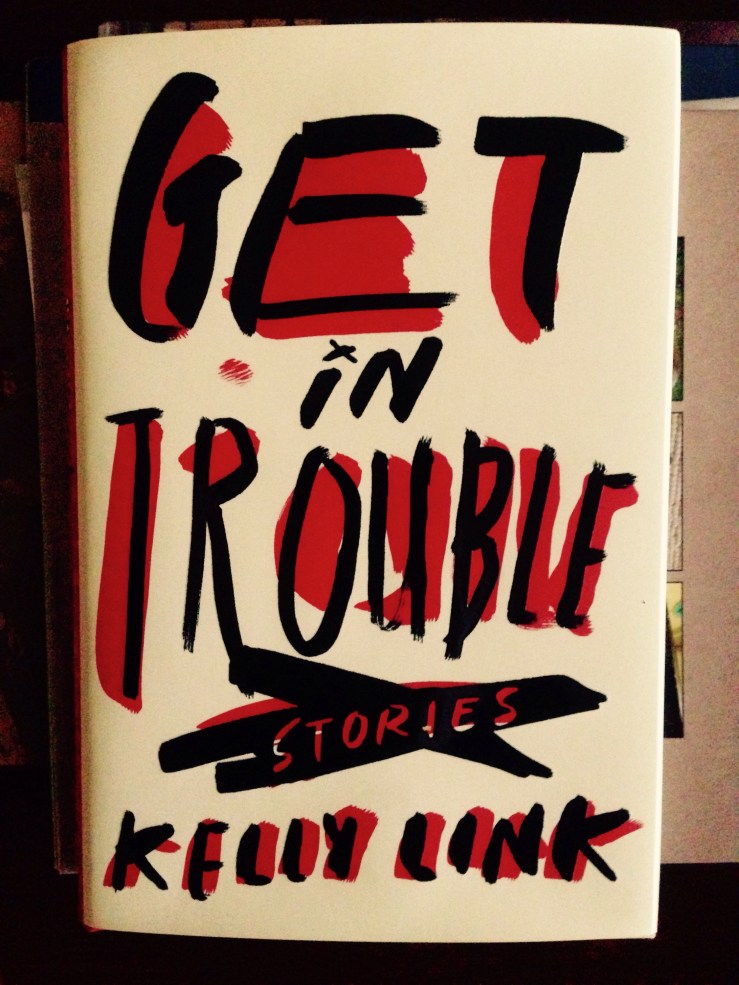
Kelly Link’s Get In Trouble (Book acquired, 1.14.2015)

IMG_4853

Kelly Link’s new collection Get In Trouble is forthcoming from Random House in hardback. Their blurb:

She has been hailed by Michael Chabon as “the most darkly playful voice in American fiction” and by Neil Gaiman as “a national treasure.” Now Kelly Link’s eagerly awaited new collection—her first for adult readers in a decade—proves indelibly that this bewitchingly original writer is among the finest we have.

Link has won an ardent following for her ability, with each new short story, to take readers deeply into an unforgettable, brilliantly constructed fictional universe. The nine exquisite examples in this collection show her in full command of her formidable powers. In “The Summer People,” a young girl in rural North Carolina serves as uneasy caretaker to the mysterious, never-quite-glimpsed visitors who inhabit the cottage behind her house. In “I Can See Right Through You,” a middle-aged movie star makes a disturbing trip to the Florida swamp where his former on- and off-screen love interest is shooting a ghost-hunting reality show. In “The New Boyfriend,” a suburban slumber party takes an unusual turn, and a teenage friendship is tested, when the spoiled birthday girl opens her big present: a life-size animated doll.

Hurricanes, astronauts, evil twins, bootleggers, Ouija boards, iguanas, The Wizard of Oz, superheroes, the Pyramids . . . These are just some of the talismans of an imagination as capacious and as full of wonder as that of any writer today. But as fantastical as these stories can be, they are always grounded by sly humor and an innate generosity of feeling for the frailty—and the hidden strengths—of human beings. In Get in Trouble, this one-of-a-kind talent expands the boundaries of what short fiction can do

The Auditor — Adrian Gottlieb

2_The_Auditor

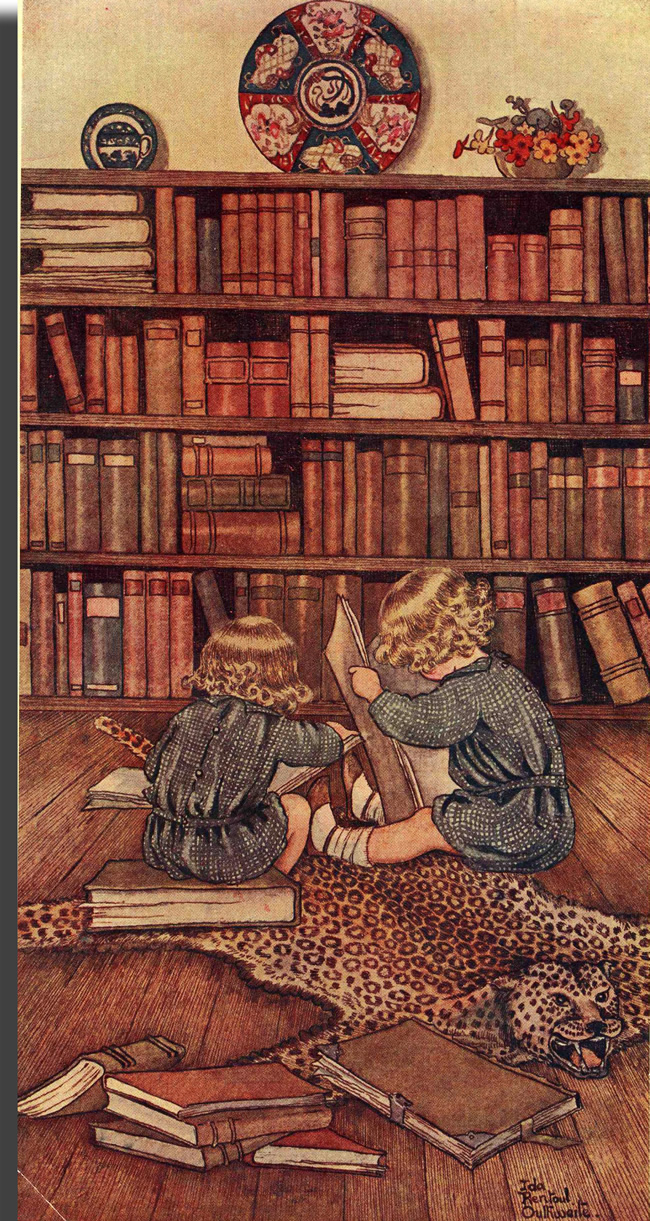
From Elves & Fairies — Ida Rentoul Outhwaite

img001-large

I review my review of Thomas Pynchon’s novel Inherent Vice an hour before seeing PTA’s film adaptation

I’m leaving to (finally) see Paul Thomas Anderson’s film Inherent Vice in a few minutes.

I’m going with my uncle. (I also saw No Country for Old Men with him in the theater. This point seems hardly worth these parentheses).

Below, in block quotes, is my review of Thomas Pynchon’s Inherent Vice (which I published here—the review obviously—in 2009). My 2015 comments are interposed.

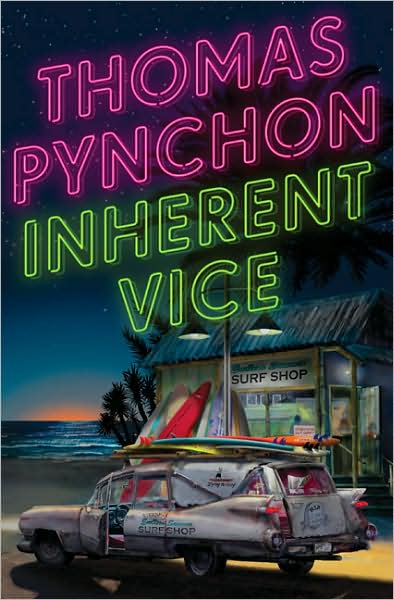
inherent_vice

Thomas Pynchon’s latest novel, Inherent Vice

Oh god I used to bold face key terms jesus christ sorry.

is a detective-fiction genre exercise/parody set in a cartoonish, madcap circa-1970 L.A. redolent with marijuana smoke, patchouli, and paranoia.

“genre exercise”…”madcap”…ugh!

Navigating this druggy haze is private detective Doc Sportello, who, at the behest of his ex-girlfriend, searches for a missing billionaire in a plot tangled up with surfers, junkies, rock bands, New Age cults, the FBI, and a mysterious syndicate known as the Golden Fang–and that’s not even half of it.

Not a bad little summary, bro.

At a mere 369 pages, Inherent Vice is considerably shorter than Pynchon’s last novel Against the Day, not to mention his masterpieces Gravity’s Rainbow and Mason & Dixon, and while it might not weigh in with those novels, it does bear plenty of the same Pynchonian trademarks: a strong picaresque bent, a mix of high and low culture, plenty of pop culture references, random sex, scat jokes, characters with silly names (too many to keep track of, of course), original songs, paranoia, paranoia, paranoia, and a central irreverence that borders on disregard for the reader.

Uh…

And like Pynchon’s other works, Inherent Vice is a parody, a take on detective noir, but also a lovely little rip on the sort of novels that populate beaches and airport bookstores all over the world. It’s also a send-up of L.A. stories and drug novels, and really a hate/love letter to the “psychedelic 60s” (to use Sportello’s term), with much in common with Pynchon’s own Vineland (although comparisons to Elmore Leonard, Raymond Chandler, The Big Lebowski and even Chinatown wouldn’t be out of place either).

When I heard the PTA was adapting Inherent Vice, I thought: Wait, the Coens already did that before Pynchon wrote the book.

While most of Inherent Vice reverberates with zany goofiness and cheap thrills,

Clichés, bro.

Pynchon also uses the novel as a kind of cultural critique, proposing that modern America begins at the end of the sixties (the specter of the Manson family, the ultimate outsiders, haunts the book). The irony, of course–and undoubtedly it is purposeful irony–is that Pynchon has made similar arguments before: Gravity’s Rainbow locates the end of WWII as the beginning of modern America; the misadventures of the eponymous heroes of Mason & Dixon foreground an emerging American mythology; V. situates American place against the rise of a globally interdependent world.

Uh…

If Inherent Vice works in an idiom of nostalgia, it also works to undermine and puncture that nostalgia. Feeling a little melancholy, Doc remarks on the paradox underlying the sixties that “you lived in a climate of unquestioning hippie belief, pretending to trust everybody while always expecting be sold out.” In one of the novel’s most salient passages–one that has nothing to do with the plot, of course–Doc watches a music store where “in every window . . . appeared a hippie freak or a small party of hippie freaks, each listening on headphones to a different rock ‘n’ roll album and moving around at a different rhythm.” Doc’s reaction to this scene is remarkably prescient:

. . . Doc was used to outdoor concerts where thousands of people congregated to listen to music for free, and where it all got sort of blended together into a single public self, because everybody was having the same experience. But here, each person was listening in solitude, confinement and mutual silence, and some of them later at the register would actually be spending money to hear rock ‘n’ roll. It seemed to Doc like some strange kind of dues or payback. More and more lately he’d been brooding about this great collective dream that everybody was being encouraged to stay tripping around in. Only now and then would you get an unplanned glimpse at the other side.

Oh cool you finally quoted from the book. Not a bad little riff.

If Doc’s tone is elegiac, the novel’s discourse works to undercut it, highlighting not so much the “great collective dream” of “a single public self,” but rather pointing out that not only was such a dream inherently false, an inherent vice, but also that this illusion came at a great price–one that people are perhaps paying even today. Doc’s take on the emerging postmodern culture is ironized elsewhere in one of the book’s more interesting subplots involving the earliest version of the internet. When Doc’s tech-savvy former mentor hips him to some info from ARPANET – “I swear it’s like acid,” he claims – Doc responds dubiously that “they outlawed acid as soon as they found out it was a channel to somethin they didn’t want us to see? Why should information be any different?” Doc’s paranoia (and if you smoked a hundred joints a day, you’d be paranoid too) might be a survival trait, but it also sometimes leads to this kind of shortsightedness.

Will PTA’s film convey the ironies I found here? Or were the ironies even there?

Intrinsic ironies aside, Inherent Vice can be read straightforward as a (not-so-straightforward) detective novel, living up to the promise of its cheesy cover. Honoring the genre, Pynchon writes more economically than ever, and injects plenty of action to keep up the pace in his narrative. It’s a page-turner, whatever that means, and while it’s not exactly Pynchon-lite, it’s hardly a heavy-hitter, nor does it aspire to be.

I’m not sure if I believe any of that, bro. Did I believe it even when I wrote it? It’s a shaggy dog story, and shaggy dogs unravel, or tangle, rather—they don’t weave into a big clear picture. And maybe it is a heavy hitter. (Heavy one-hitter).

At the same time, Pynchon fans are going to find plenty to dissect in this parody, and should not be disappointed with IV‘s more limited scope (don’t worry, there’s no restraint here folks–and who are we kidding, Pynchon is more or less critic-proof at this point in his career, isn’t he?). Inherent Vice is good dirty fun, a book that can be appreciated on any of several different levels, depending on “where you’re at,” as the hippies in the book like to say. Recommended.

Oh geez.

Okay, I should write more but my uncle says it’s time to roll.

John the Evangelist — Carlo Crivelli

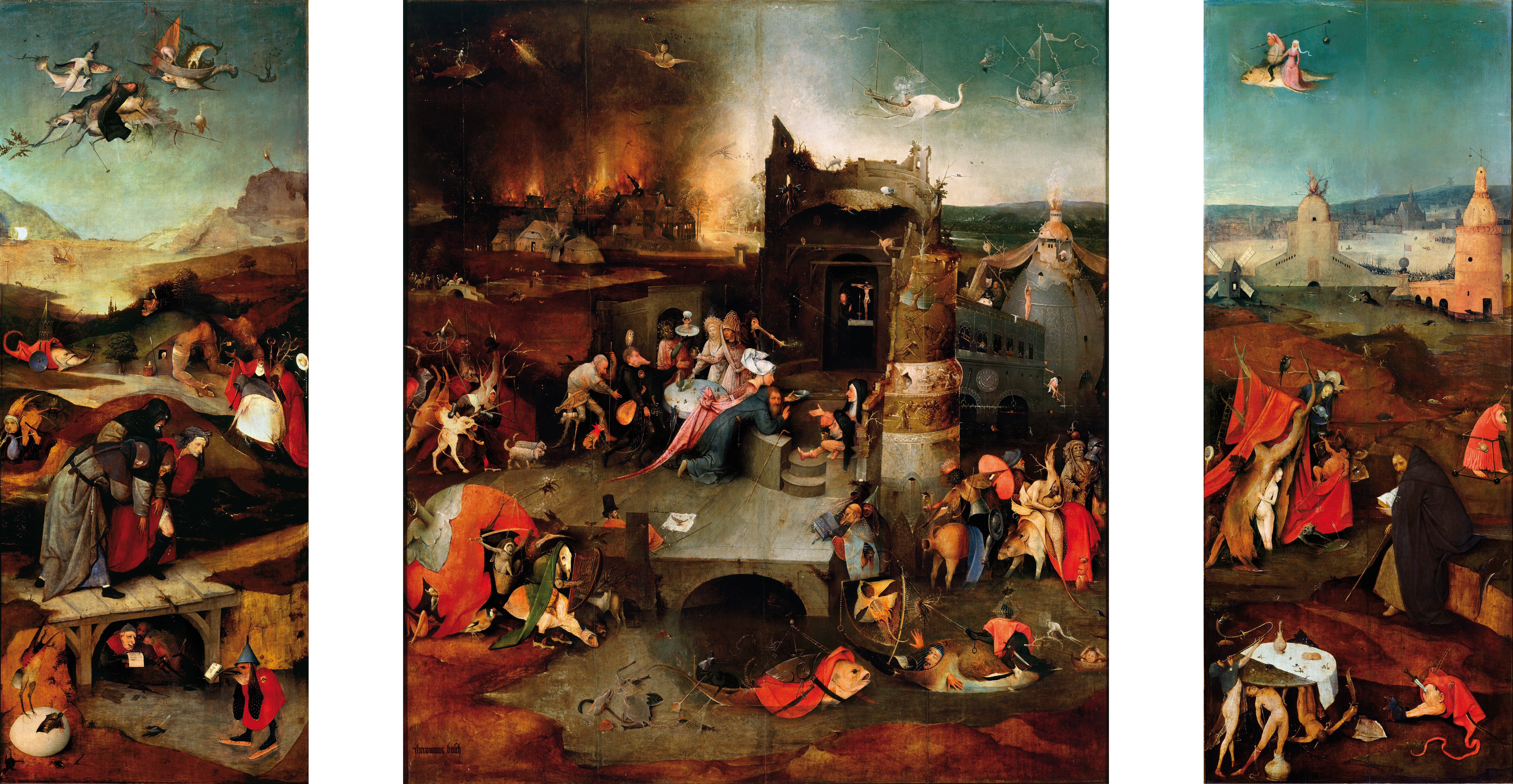
The Temptation of St. Anthony (Detail) — Hieronymus Bosch

19

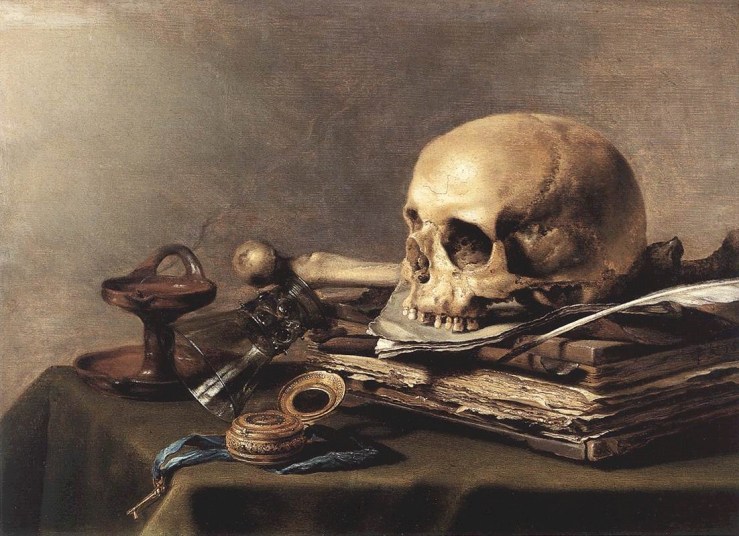
Vanitas — Pieter Claesz

tumblr_ltm1vlfhl01r5569zo1_1280

Reading a Book — Felice Casorati

tumblr_msbssc4MqC1rrnekqo1_1280

The Novel Reader — Antoine Wiertz

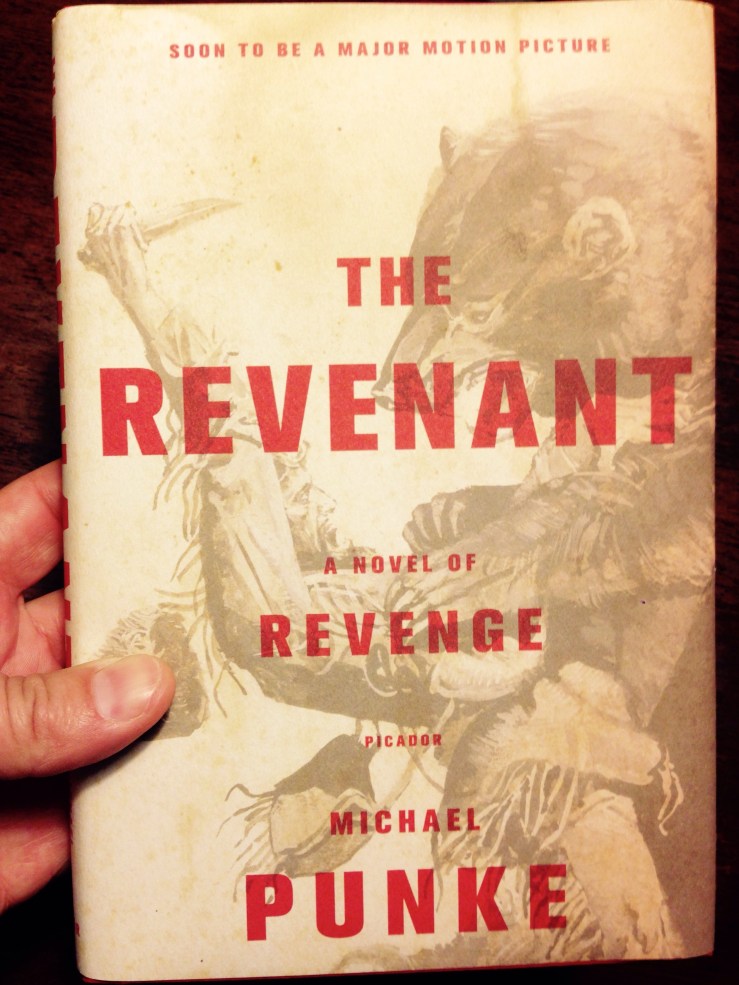
The Revenant (Book acquired some time in December, 2014)

2015/01/img_4851.jpg

Michael Punke’s novel (of revenge!) The Revenant is being adapted into an upcoming Iñárritu film, and consequently getting the hardback reissue treatment. The Wikipedia entry:

The Revenant is an upcoming American westernthriller film produced and directed by Alejandro González Iñárritu. The screenplay, adapted from Michael Punke’s 2003 novel of the same name, was written by González Iñárritu and Mark L. Smith and is partially based in the life of frontiersman Hugh Glass. The film is set to star Leonardo DiCaprio, Tom Hardy, Will Poulter, and Domhnall Gleeson.

Development of the film began in August 2001 when Akiva Goldsman purchased Punke’s manuscript with the intent of producing the film. The film was originally set to be directed by Park Chan-wook with Samuel L. Jackson in mind to star, and later by John Hillcoat with Christian Bale in negotiations to star. Both directors left the project, and González Iñárritu signed on to direct in August 2011. In April 2014, after several delays in production due to other projects, González Iñárritu confirmed that he was beginning work on The Revenantand that DiCaprio would play the lead role. Principal photography began in October 2014, and is scheduled to last 80 days.

I still haven’t seen Birdman.

Woman Reading in the Reeds, Saint-Jacut-de-la-mer — Edouard Vuillard

Édouard Vuillard - Woman Reading in the Reads, Saint-Jacut