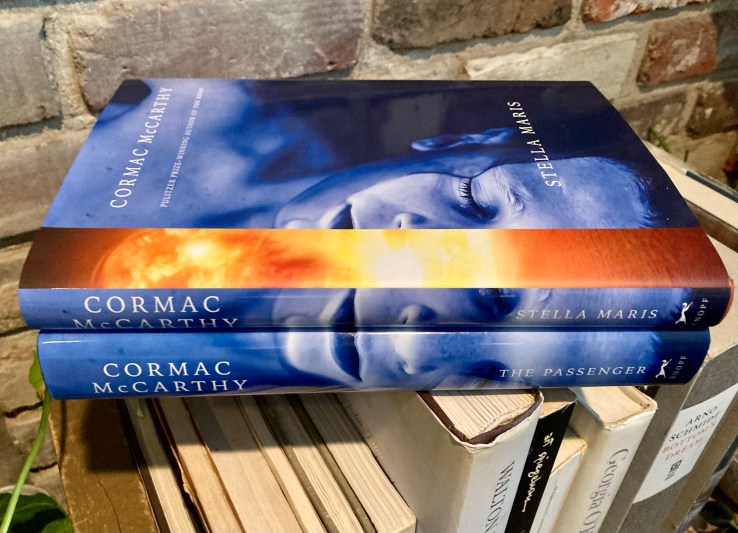
White Meridian | More scattered thoughts on Cormac McCarthy’s novel The Passenger

He’d bought a small ruled notebook at the stationer’s in Ibiza. Cheap pulp paper that would soon yellow and crumble. He took it out and wrote in it with his pencil. Vor mir keine Zeit, nach mir wird keine Sein.

The Passenger, Cormac McCarthy

In the second paragraph of the last chapter of Cormac McCarthy’s new novel The Passenger, protagonist Bobby Western, now living on a Spanish island near Ibiza, writes in German a sentence in a cheap notebook. The sentence translates to something like, Before me there will be no time, after me there will be none.


Vor mir war keine Zeit, nach mir wird keine seyn,
Mit mir gebiert sie sich, mit mir geht sie auch ein.

Sexcenta Monodisticha Sapientum, III, II, Daniel von Czepko (1655)

Western’s line appears to be cribbed from an epigram by the early seventeenth-century German poet, Daniel von Czepko. Czepko’s epigram translates to something like, Before me there was no time, after me there will be none / With me she gives birth, with me she dies.


I deny, in a high number of instances, the existence of succession. I deny, in a high number of instances, contemporaneity as well.

“A New Refutation of Time,” Jorge Luis Borges, translated by James E. Irby

Did McCarthy find Czepko’s in Borges’ essay “A New Translation in Time,” where I found it when I first searched the German phrase?


All language is of a successive nature: it does not lend itself to reasoning on eternal, intemporal matters.

“A New Refutation of Time,” Jorge Luis Borges, translated by James E. Irby


I feel like I’ve jumped into the deep end here too quickly for this riff, what with the seventeenth-century German poet and the wonky Borges essay that feels like a gimmicky (and perhaps ironic) championing of idealism in service towards forging an aesthetics of time. Let me put in a simpler substitution for Western’s (McCarthy’s (Borges’ (Czepko’s))) epigram, a favorite line from another life-and-deather with oceanic motifs:

Perhaps an individual must consider his own death to be the final phenomenon of nature.

“The Open Boat,” Stephen Crane


Start again: This is a scattered mess. I finished The Passenger yesterday, punched in the face by the final chapter, where McCarthy condenses characters and tropes and symbols and allegories into a slim 19 pages that points to both infinity and death. The Passenger is possibly McCarthy’s baggiest novel, messier than Suttree, and eschewing even a glimmer of the precision of Blood Meridian. Like No Country for Old MenThe Passenger is bound in genre fiction tropes—crime novels, detective novels, 1970s paranoia novels, Westerns, and so on. Like No Country, The Passenger purposefully derails reader expectations for what the genre plot should do. The refusal to go forward with the initial promised plot (Who is the missing passenger, escaped or removed from the sunken plane?) reinforces the tense ambiguity in the core of McCarthy’s worldview. The apparent abandoning of a tight plot might alienate some readers, but I suspect most fans of the trajectory of McCarthy’s work would have been disappointed if he’d stuck to a story that Makes Sense and Follows a Clear Trajectory and Ultimately Resolves. I would have been furious if the end of The Passenger gave up some kind of easy answer.


For only Gossamer, my Gown –
My Tippet – only Tulle –
“Because I could not stop for Death” (poem 479), Emily Dickinson

In her white gown carrying the barnlantern out through the trees. Holding the hem of her gown, her slender form candled in the sheeting. The shadows of the trees, then just the dark. The cold in the stone amphitheatre and the slow turning of the stars overhead.

The Passenger, Cormac McCarthy


Last time I wrote about The Passenger, I wrote about its dominant incest motif. I suggested that the dummy Crandall was the dreamchild of incestuous Western union. I had not yet gotten to the episode where Bobby, on the lam in Idaho, dreams of an incestuous stillborn child, one with only the rudiments of a brain. Bobby queries the dream doctor of his dreamchild: “Does it have a soul?” Bobby’s True Love, his sister Alicia, is the barest slip of a ghost in the final chapter of The Passenger (in contrast to the ghost of Long John Sheddan, who gets a full last dialogue with Bobby), but she shows up again here—theatrical, ghostly, an echo of the speaker of Emily Dickinson’s “Because I could not stop for Death.” I hope we get more from Alicia Western in Stella Maris.


His father. Who had created out of the absolute dust of the earth an evil sun by whose light men saw like some hideous adumbration of their own ends through cloth and flesh the bones in one another’s bodies.

The Passenger, Cormac McCarthy


Père Western, coauthor of the atom bomb (“evil sun”/evil son, evil Adam) is a background wraith in The Passneger (although more present than Ma Western—but I’m sure the lack of mothers in McCarthy’s oeuvre has been commented on at length, perhaps in academic papers. Dude doesn’t include mothers, and mother figures, if they appear, are tangential, marginalized). Wait, where was I? Père Western, haunting the background of The Passenger, takes a bit more of the stage (just a bit) in the final chapter of The Passenger. His Big Crime seems to soak diver Bobby, even if Bobby can’t directly address it.


It was a lone tree burning on the desert. A herladic tree that the passing storm had left afire. The solitary pilgrim drawn up before it had traveled far to be here and he knelt in the hot sand and held his numbed hands out while all about in that circle attended companies of lesser auxiliaries routed forth into the inordinate day, small owls that crouched silently and stood from foot to foot and tarantulas and solpugas and vinegarroons and the vicious mygale spiders and beaded lizards with mouths black as a chowdog’s, deadly to man, and the little desert basilisks that jet blood from their eyes and the small sandvipers like seemly gods, silent and the same, in Jedda, in Babylon. A constellation of ignited eyes that edged the ring of light all bound in a precarious truce before the torch whose brightness had set back the stars in their sockets.

Blood Meridian, Cormac McCarthy


His father spoke little to them of Trinity. Mostly he’d read it in the literature. Lying face down in the bunker. Their voices low in the darkness. Two. One. Zero. Then the sudden whited meridian. Out there the rocks dissolving into a slag that pooled over the melting sands of the desert. Small creatures crouched aghast in the sudden and unholy day and then were no more. What appeared to be some vast violetcolored creature rising up out of the earth where it had thought to sleep its deathless sleep and wait its hour of hours.

The Passenger, Cormac McCarthy.


More than a decade ago, I suggested on this site that the moral core of McCarthy’s best novel Blood Meridian is a sequence wherein a host of creatures coalesce into a “constellation of ignited eyes…in a precarious truce” to observe a burning tree in the desert. Witness and attendant, his own eyes presumably ignited, is the kid, the hero of Blood Meridian. The sequence rebukes the pronouncements of Judge Holden, satanic anchor of that novel, pointing towards coexistence and peace.

The whited meridian sequence in The Passenger, evoking the first ever detonation of a nuclear weapon, reverses McCarthy’s previous passage—blanches it, makes a ghost of it, turns its blood white. Whites it.


(I have a few more thoughts scribbled on a cheap yellow legal pad but the hour grows late and a big storm looms—so, more thoughts to come (including a kind of peace with mules?)

 

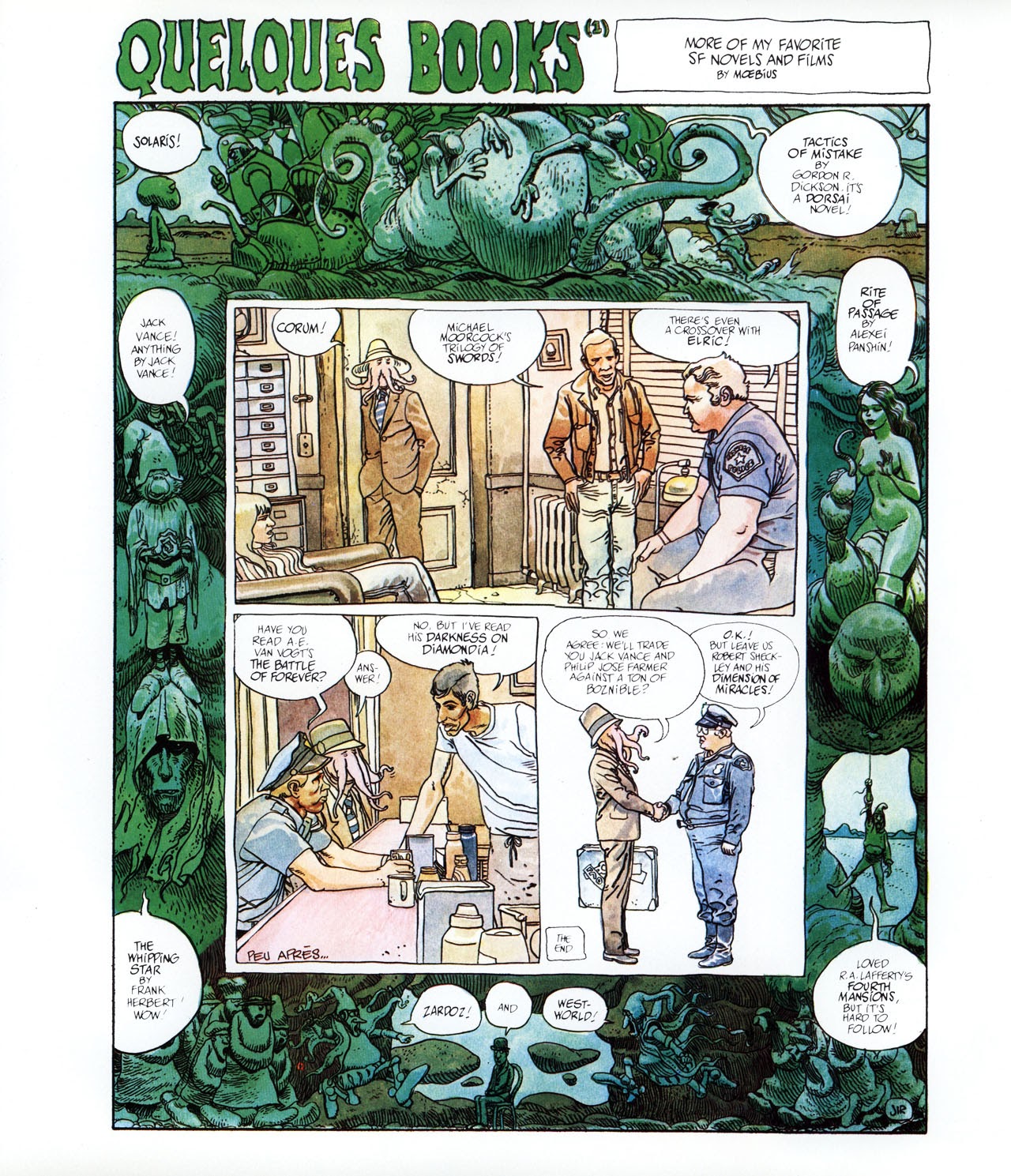
Quelques Books: More of My Favorite SF Novels and Films — Moebius

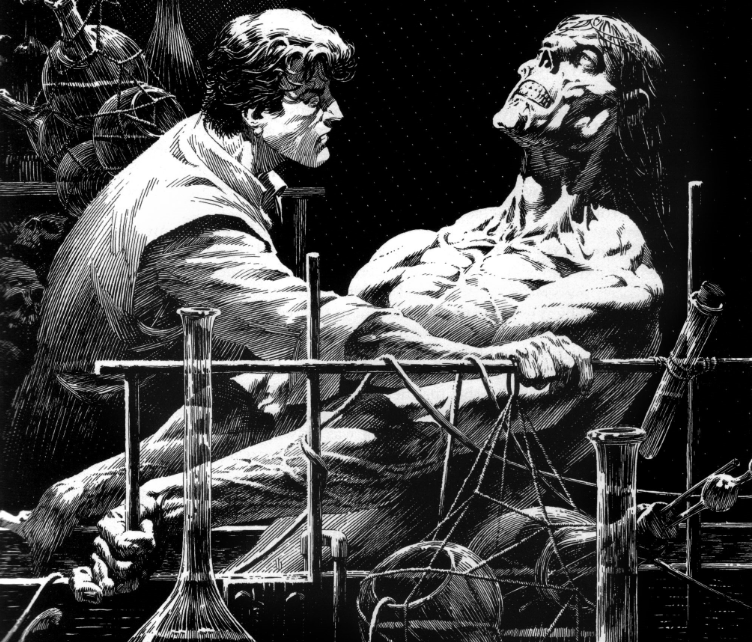
Illustration for Frankenstein — Bernie Wrightson

Illustration for Frankenstein by Bernie Wrightson (1948-2017)

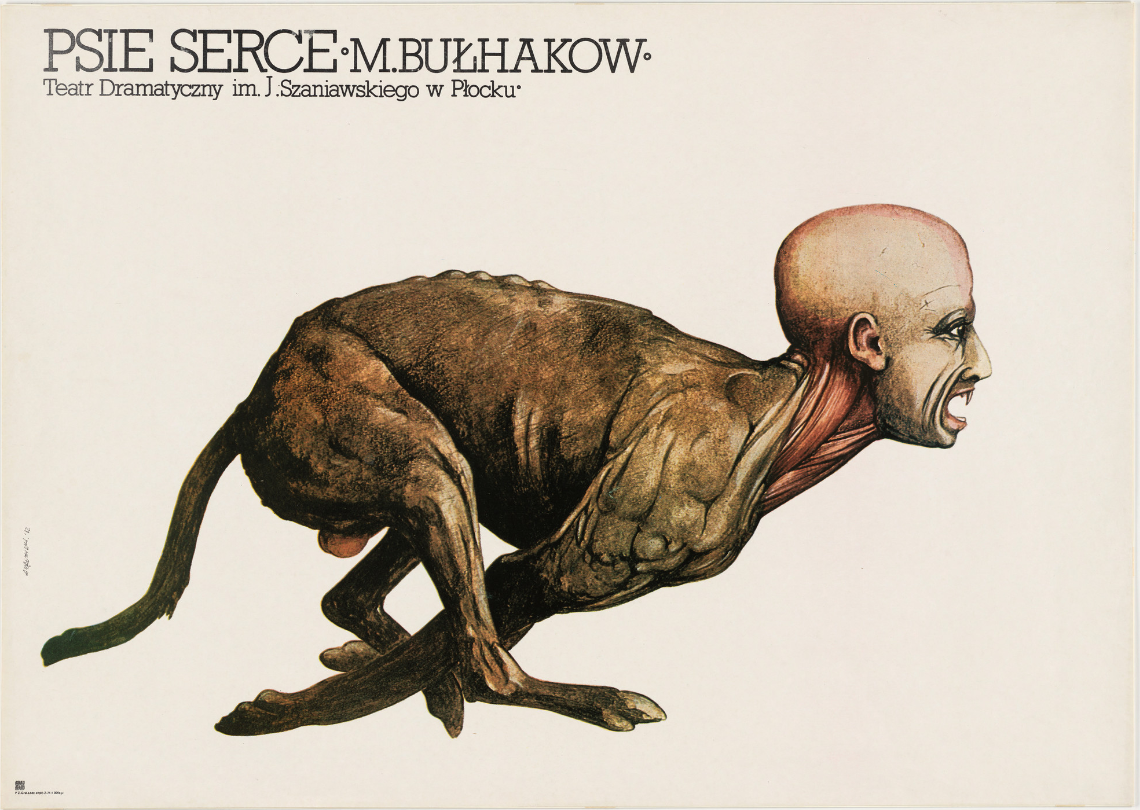
Heart of a Dog — Andrzej Pagowski

Poster for a theatrical production of Heart of a Dog, 1982 by Andrzej Pagowski (b. 1953)

Aw, kick him, honey | Gérard DuBois illustration for Blood Meridian

Illustration for Cormac McCarthy’s novel Blood Meridian by Gérard DuBois. From the Folio Society edition of Blood Meridian.

Mary Shelley’s Frankenstein, but just the punctuation.

; , . . . , . . , . , — — . . ; , . ; , , , . ? , , . , . ; . , , ; , . — — , , — — ; , , . , . ? ; , . , . , , , , . , , , , ; , , , . , ; , — — . . . , ‘ . , . , , , ‘ . , , , . , ; . , . , . . , , . . – ; , , , ; , , , . – , . , , ; . , , ? ; . , ! ; , . , : , , . . ; , , , – . , , — — ; , . – . . ; , , – . ; ? , , ? , , , , . , , . , , . , , . , . . . . , . , , — — . , ! . , ; , , . ; . , : , ; , . , ; . ; . , , . , , , , . ! , . – : , ‘ . ; , . – , . , ; ( ) ; , . , ; , , . , , . , , ; : , , . , , , . : , . , . , , . , , , : ; , , . , . , , . , , ; – , . ; , , , , , , . , , . , ; , – , ‘ . , ; , , , . ” ! ” . ; : , , , , . , , , . ; . ; , ; . : , . . , , . , ” ” ; , , ” ” ? ; . , , , . , . — — – ; — — : — — , , , , , . . , , ? , . : . . , . , . . . , . , , — — . , , . ; , , , . , , : , ; , , . ; , , , , . . , , ; . , . , , , . , , . . ? , : . ? ? . . ! . . . . , . , — — . , , . ( ) , , , – . , . , . ‘ , , , , . , , , . , , , : , , , . , . . , , ; , , . , , , , . , ; , . , , , . . , , , , , . , , , , , . ; , . , , , . , , ” , . ” , , . ” , ” , ” ? ” , . , , . , . ! , , . , . . ; , . , , . , . , , . ; . , , . : , ; , , , , , . ; , . , , ; , . , , , ? ; , ” . ” ” ? ” ” . ” ” ; , , , . ” ‘ ; , , . , , , — — ” , , , ; . ” ” ; . ” ” ; . ” ? , ; , ; . . , ; , . , . . , , . , , . , ; . , . , , ; , , . , . , — — . . . , ? , ; ; , , . , , . , , , . , . , . , ; ; , , , , , . ‘ ; . , ‘ . ; ; , , — — . ; — — , : — — ” ! ? ? , — — , ! ” , , ; , . , ; , . . : . — — ; , . ” , ” ; ” , , , , — — — — . , , , , . , , . — — , . ” , , . , . , . , , , . : , ; , , , , . ? , . , , , ; . , . ; – ; , ; , – . . — — . , ” , , . , , ; . , ; , . ; , , , ; , . . , , ; , – : — — . ” ; . , , , . . ” , ” , ” , ; . , . , ” , ; ” , , ; : , . ” , . . , , , , . , . : , , , ! , , – ; ; , . ; , — — ! . ; . ; . , . ; , . , . , , , , , . , , , . , , , , . , . . , . ; . , , , . , . ; , ‘ . , , ; , ; , , . ; , . ; . ; ; . . ; ; ; , . ; ‘ , , . , ; , , . . , . ‘ , . – , . , , , , , , . . , , , . , , . ; , , . . , , , . . , . ‘ , ‘ , . , — — , , , , . , , , , – , , . . , . , , . . , , ; , , — — , , — — . , , – , . , , , , . , , , . . . – , ; , . , , , . , , , , – , . , , . , . , . : . , . , — — , . . , , . , . , , – . , , — — , . . . . ; , . , , ‘ — — — — . . , , . , , — — ” — — – . ” , , , , , , — — , , . , . . , — — , . . ; . . , . ; , , , . ; — — ; ; ; , , — — . , . . , , , , . , , , . , , , . , . , . , , ; . . . , , , . . , . , , , , . . . , . , , . , ; , , , . , , , . ; , , , , , . , , . , , , ; , . – . ; , , , . : , , . — — ? — — , — — , , . , , . , , , , : , , , , ; , , , , . ; , , , . , : . . ; , , . ; , , . , , ” ! ! , ; . ” , , , , , , , ; , , , , . , . ; . , , . ; . . , . . , ‘ , . , . . , . , , ; , , . , . , . , . ; , , , . , ‘ , ‘ . , ‘ ; . ; , , ! . , ; , , . , , , , , , . , – . ; . , , . , , ; , , . , . , . . . , , , , . , , , ; . . . , , ; ; – , . , , , . , . , — — , . , . , . ; . , . . , . ; , , . ; , , — — , , . ; , . , . , , ; , . , — — , — — , . ; , . – . : — — ” , ” , ” . . , , . ! ; , , ? ; , . ” ; . ; ; . , , , — — , , , , . ; , . ? , ? , ; , , . , ; , , . , , . . , , , . , . ; , , . , . , . . , . . . . , ; . – , . . ; , , . . . , ” ! ” ; , : ‘ , — — , , , . , . , , , . , , , . ; . , , ; ” ; ” . ; , . . , , , , . , , , . , . . , , . , . — — , , ‘ — — . , . , . . ; , , . : ” , ” , ” ? ” . ” , ” . , ” . . ! , , , , ? , , . , . ” , , , ; , , . , – , . , , ; , . . , ; , , . , , . , . , , , . , . , ; , , : . . . , , . , . . , . , , . , , , . . . , ; , . , ; . , , . , . , , : — — ” , ” , ” , . ; , . , , , . , . : , . ; , , . ” ‘ — — , . , ; : , , , . , , — — , , : , , , . . ; , . , ‘ , . , ‘ . , . , . . ; , . – . , , . . , ” . , , , , . , , . ” , ; , ; , , ( ) . . ” , ” . , ” ; , . : ; . . , , , . ” , ; , . ; . : . . , , , . , , . , , ; . , , , , . . . ; , . , . ; , , . , . , . , , ? . – . , , , , , . . , ; . , , ; , , , , , , , . , , , , . , , , . , , ? , ; , . , . , , . , . : ; . . , . ; , , , . , – . . ; ; . , , , , — — , , , , , . , . , . , . , ; , , . . , , . , , . . , , : , . , , , , . , , , ; : , . , , . , , , , , . , . , , , , , . , ; . ; . ; , : , , . . . , , , ; , , . , , . , , . , , . ; . . , , , ( ) . , . , . , , ; . ; , , , – . , , ? , ; , , , ; . , , , . – ; , , . , , , , : – . – ; , , , . , , . ; , : . , . ; : ” , , . . ” ‘ ; , , . , , , , . , ; . , . . , , , , . ; , ; ; ; . ; . , . , , ; — — — — . ; . , , , . , ; , – . ; : , ; . . , . , , . ; , , , – , ; , . ” – , , ; , , . . . . ” , ? , . ! — — ! ; , ; ; , , . . , . . ; , , . , , , . ; , . : , , . , , . , ; , ; , ; , – . ; , , : , , , — — . ; , , . , , . , ; , , , . ; , , , . ! . . ; ; , . . , ; , . , ; ; , ! , , , , , . , , , , . , , . , , , . , , . ; , : — — ” , , , , , , ; . ” [ ] , . , ; . , : ; , , , , , . ” , ” , ” ! ! ” ; , , . , ; , , . , , , . , . ” , ” , ” – ; , , , : — — ‘ , . ‘ , . ” ” ; , , . ” ” , , . , . — — , , ” , , , ” ; ; . ” ” ; , , : , , , . ” ; , , . , . , , , , . ; . , , , . . ; . , ; . : ; – . ; , , . , ; . ; , . ; , , . ; , ; , , , . ” , ” , ” , ‘ , ? . ! ? ” ” , ” , , ; ” . — — , ! ! ” ; , . ! ? , , . ; , , . , . . , ‘ , , , . ; , , , , . ; . , . : ; , . , , , . , , . ; . ; , . ” , ” , ” , . , , , . ? ; . ” ” , , ; , , ? ” . ! ? ? ” , ” , , ” , ; . , . ” ” , ? , , . ” ” , , : , . ” . . : — — ” , ” , , . — — ; , , . , . ; ! , , . : . . ” — — . , , . ‘ , , — — ; . ! , . , ; , . ; . ; — — , . , , . ” , , . , – , ; — — , . , , . , . ? ; , , . , , , . ; , , , , . , . ; , , . . ; , , . . , , ; , , , . ” , , ; , – , , — — – . , . ; : ; ; . , , . , , . ” , , . ; . ” , ; , , . ; . ; . , , . ! ; ; , . ‘ . . , . , , . , . ; . , ; , . ” , , . ; , , , . , , . , , . ” , , . , , . , , . , , . , , . , , . , ; , . ” , ; . , , — — — — . , , : . ! ; ; , , ! ” . ” , , — — . ” ” , ! ” , , ” , . ” , ; , . . . , , . , , , . , . , . ; . . . , , . ; , , , , , , . ? , . , , . , . , , , , , ; . , . , ; , , . . ; , , . . ” — — ! ” ; ” , . , . , ; . , , , ; , . — — , , ” , , ” . ; . , , . : ; . ” . , . ; . , . , , . , , , . , , , – , . , , , . , . , , . , , — — , . ! , ; , , , . ; . , , . , , ; , . , , , . : , . : , , , . – , ; ; , . ! , ! , ; , , , . , . . ; , . , , . , : , . : ; , , . , , . : , . , . . , : — — ” , ” ; , . , . , , , , , ? , , ? ; ? , ; , . ” ! — — , , , ! , ! ” ; . ” ( ) , , , , . , . ; , , . . , : , , , , , . ” , , . . , ; , , ; . , , : ‘ . ” , . . ; , , , , ‘ ! ! ‘ ” , . , . , . , . , ; ! ” , ; . , ; . ; , , ? ! , ! , , ! ” , ; , , , , . , , , . ” , ” . ” , , — — . ” , , . , . ” , ” , , ” ? , ? ” , . , . ” , , ” ; ” . ? ” ” : , , . ” , ; – . ” ! ” , ” , ! , ! ; ‘ ! , ! ! ; , . , . , . ; . ” ; , . , , , . . , ; , . . , . ! ; , , , . ; , , . , . : ; ; , ” , ” . , . , . , . . ” ! ! ? ; . , ? ” , , ; , . , ! , , , , ! , , . ; , . , . ! , , , . ; ; , . ; , , . , . . ; , , , . ; , , . , , , . , , ; , , ; , . , , . , . ; , . , , . ; , , ” , ! , ! ” , ; , : . , ; , , , , , . ? ( ) ? , ; , . , . . ! . . ; , , . , . . ; , . : ; ; . ; ? ! , ; ? , , , . ; . , , , , , . ; . , ‘ . , . . , , . , . , . , , . ? ? , . ‘ . , . , , . ! . , – . , ‘ , , . , ; , . ; . , : , . : ” , , ” . ” ! , . ; , , , ; – . — — ! ! ” , , ‘ ; . , ; , , . ; , . ” , ” , ” ; , . — — ” ” ! ! ? ? ; , – . ; ! ” ” , ” , , ” . ; , . , , , , , ? ” ” ! , , ? ; ; , , ? ” ” ; , ; , , , . – , . ” , , , . , , , , . , , , ; , , . , . , ; , ” ; . , , , . ” . , ; , , , , ” , ! . ” ” , , ” ; ” . ” ” , ; . ” ” , . – , , , . ” . , , . , , . ; . , , , , , ? . ; . , , . . ” , , ” , ” . . ! , ? . ; , , , . , . , ; , . ” ” , , ” , ” ; , . ” ” ! , , : . ” . ” , ” , ” . , , , , . ” . , ‘ , . , . . , – : , ; , . , : ; ! ; , , . . ; , , , , . , , ; , . , ; , . , , . ; , . ; , , . , . , – . ; , . ‘ ; , , , . , , . , ; , , , , , . . , . , , . ; , , , , , . ” , ” , ” . : ; , . ” , , , . , ‘ , , . , , , , , . ; ; , . , , . , . – , , . . ” , ” , ” , ; , . . , . ? ; , , , ? ” , . ; , , . ” , , ; , , , . , , , , , . ” , ” , ” , , , , . ; – , , . . , , . . , , , ; , ; ‘ , . , . , , , , . : , , ; . ” ‘ ; , , , . , . . ; . , ( ) , ? ; , , , . ; , , . . ; . ; , . ; , . . ; , – . , . ” , ” , ” , ; , , , . ” ; ? ? , ? , . ” , ” , ” ; , . . ” , ‘ . ” ! ” , ” ? , , ? , . ” . ; , . ” , ” , ” , ; , , : . ” , . – , ; , . ; , , . . ” , ! ” , ” ? ; , . ” ” , ? , ? ” . ” , , ” , ” , ? ; , , . , , ; , , , . ” ” ; . , ; . ! , ; , . , . , ; . ? ; . ” , , — — ” , , , , , . ! ! , ; , . ” ” , ! . ? , . . , . . ! — — , – , , , ! ! ! . ” . ” , ” ; ” . , . ; , , . , , ! ” – , . ! ? , , , . , , . . , , , ” , ; , , ? ” . ” , , ” ; ” ; , . ” ” . . ! ; , , , . ” . . , , – , . , ; ‘ , , , . ; , . ; . ” , ” , ” ; . ” , . , , – , ” , , , ; , , ; ! , , . ” . ‘ – . . , , . , . ! , . ! ‘ , — — – ! , ; ! , ! , , , , – ; — — , — — , — — — — ; , , ! , , , , , , . . , , , , . ; ; . , , . ; , , , ( ) , . , . , , – . : , – , , , , . , . ; ; — — , , . , , , . ” , , ” , ” ? ; ” ( ; ) ” , ? ; , , . ” , , ; , , , . , . . . ‘ , , . . , , , . , , ; , , , . , , — — , , — — , , , . , , , . , : ? , . . . ; , . , , . , . . , , , . , . , , , . , , . . ‘ . ; ; ; . , , . , , . ” , , ” , ” , . , , , , ; , ; , ‘ . . ; , . , , , ! ; . . , ; , . ! , , ? , , . , ; , . , . ” . , , , . , , , ” , . , ; . , , , . , . , . ? ! — — , , , , — — ? ” , ? , ; . , , , : . . , , — — . : , , . , , , , , , . . . : — — . . , – , . : , ; . . — — , , — — , , . , , . ; , , . , , , . , , , , . . , , , . ; . ; , . , , , . – . , , , – . , . — — , . , , , , , — — , , , , . . . , , , . : , ; , . . . , , , . ; ; ; – , , , , , , , , . . ; , . , , . ; , , . ; – , , , ; , — — , . ? – , . , , . , . ? , . – . , , . , . , , . , , . . , ; , , , . , , , ; , , , . , , . ; , , , , . ! ; . , , , ; , . ; . ; ‘ . , , ; , , ; : , , . ‘ ‘ ; ! . . . , . , , , . , . . , ; , . , . , , , . . , , ; — — ” , , , , , , . ” , , , . , ; , , , . : , ; . , ( ! ) . , , . ; , , . ; , . ” , ” , ” ? ? , ! , , ! , ! , , ! ” ” , ” . ” ; , , , ! , , , , . . ? , . , ; , , . ” ” ! ! . ! ; , , . ” ; , . , — — ” ! , . , ? , , , . , ; ; . . , , , . , , , , , , . , ; ; , . , . ; . , . ” ” ! . ; . , , . ” ” ? , ? , : ; : , ? , , ; – , ? . . ; , , , . , – . , , . ? . , . , , , , . , . : , , . . , , , . , . ; , , . , ! : ; , , , . ” ” , ” , ” , , ? , , ! ( ) ! . , . ! . ” ” , , ” , , ; ” . , . , . ; , ; . ; , , , . , , , – , . ” , : . , ; , , , . , . , . , , , . . , , . , : , , , . ; , , . . ” : . , , , , , ; , , . , , , . , ; , , , , . , , , ; . , , ; , . ; , , . ; , . , , . ; , . ” ; , – , , . , , ; . , , ; , , ; , . ” , . , . [ ] . , ; . , , , . ; . , , , ; , : , . ” , , . , . , , . , , , . , . , . ” , , , , . , , , . , ; , , , . , . ” , , , . , . , , ! , . ; , . , . , . ; , , , , , . , , . , ; , , , . ” , . , . , , . , , , ; ; , . , , , . , . ” , , ; . , , . , , . ; ; , , . , . , ; , . ” , ; , , . ; . , . , , . ; , , , , , . , , , . : ; ; . ‘ , , , , ; , , . , , , . ” ; , , , ; , ‘ , , . ! , , , . , , . ; , , . ; , , , , , , , . , , ; , , . , , . , , , , ; , . ” , , , , . ” , , , . , – . , ; , : , . ” , , ; , , . , , , , , , , . , , . ” , , . , , , – , . , , , , , , . , , – . , ; , : , . ; , , . , , , . , , . , . , , ; , , . ” , , . , . , , . , , , . ; , , , , , , . , , ! . , . , , , ; , , , . , , : , , , ; , . ” , . , , , , ; , . , , , . , , . , , . ” , , ; , , , . . ; , . . , : , ; . ; , , . ” ; , , , . , ; . , , , , ‘ : , . ” , , , , , . ” . ” , . . ; , . , , , , , . ” . , ; . ” . , . , , . . ; . ” . , . ; . , , , . ? ( ) ; , ; ; , , ‘ , . ? ? ; . ” : ; . , , , . , , , ; , . ” . , , ; , , , , , . ” . ; , , , , . ” , , , , . , , . , , , , . ” . . , , , . , . . ; , , . , , , ; , , , , . . , , . , ; , , . , . , ; , , . ” . : , ; , . ; , . , , , , . , . , , ; . . ; , , . , , . ” , , , . , . , , – , , – , , , . , , , , , . ; , , . ” ; , , , . , , , ; , ? , , , , : , , ; ; . ” — — , , : , ! , ; , . ! . ” , , , . ; – . , , , ; . , ; . ” , , , , . ; , . ” . , ; , : . , , – , , . , , , . , , ; , , , ; . ” , ; , . ( ! ) . , , , , , . , . , . , , , , . ” , . , ; , . – ; , , . ” . , , , . , . , ! , , , , , . ; , , , . ” . ” . , , , . ” ; , . , . , . ” , — — , — — ; ; , ‘ . , , . ” , . , . ; , , . , . , ; , , , . , ; , , ; , , . ” , , , ; , ; . ; , , , , , . , . , , . ; ‘ , , , . ” , , , , , . ; , . , . , – , ; , , . , , , , . , , ; , . , , , , . ” , . , , , ‘ , . ‘ , ; , , . , , . ” ; , , , , , , . , , , . ” , , . , , . , , , . ” , , . ; , . ” , , , ; , ; , ; , . ” , ; , , , . ” , , ; . ” ‘ ‘ . ‘ , , , . , , . , ; , , . ; ; — — — — ; , , . , . ” . , , , , , ? , , . ; , , , . , ; , , . ” . , . , ; , , . ” . – , . ; , , , , , ! ? ; , , . , , ; . , ; ; . , . , , , ? ” : , . , , , , ! ” ! , , . ; , — — . , ; , , , . , , . , , . , ! ” . ; ; , ; ; ; , , . ” ? , ; , , . . , . ? , . ” ; , , , , ( , , – , ) . ” . ” . , , . ” . , , , . ; . , , , , , , , , . ” . , , , , . . , . ; ; , , . ” ; , . , , , . , , ; , , . , . , , . ; , , , , , , . ” , , . ; . ” , , , , , . ; . ” ; , , ; . , , ; , , . ” , , ; , , . , , , . , , , . ; , , , , , . , , . ” ; , , , . , , . , , , , , . ” , , . ” , ; ; , . , ; . ” , , . ; , ; , . , . . ” , . , . , . , , , , . . , , ; , , , , . ” . ; , . ” , . , – , , , , , , , . ” , , , . ; , : , , . . ” , , , . ; , , . ” , ‘ , , , ; , , . , , . ” , . ; . , , , . , . , , , , , . ” , . ; , , , . , , . ; , , . ” . ” . . , , , . ” ; , . , , . ” , , , , , . , . , ; ‘ , ‘ ‘ ‘ , ‘ ‘ . ‘ ; , . ” . , , . ‘ , ‘ , , , – . , , , , . ; , . . , , , . ” , , . , , . , , ; , . ‘ ; ‘ . , ? ? ? ? ? ? , . ” ‘ ‘ , ‘ , . ‘ . ‘ ‘ : ; , . . , , , . , . ; . , . , , , , , . , , , , , . ; , , , . ” ‘ ‘ . , , . , . , , . , ; . , , ; , , : , , . ; , , , . ” . , . ; , . . ; . , , . . ; , ; , , . . ‘ ! ‘ . ‘ ! ? , , , ; , . , – , ; . ‘ ” ; , , , , . , , ? , , , . ; . , ‘ , . ” , , . ; . , . , ; , . . , ; , , , . ” , ; , , , , ; . ; , ; . ‘ . ? , , . ” . , , , . ; . , , ; , . . , ; , , . , ; : , . . . , , : ; . ” , . , , . ; , . , . , , ; , , , , – , , , . ” , , , , , , , , , . , , , . , , , ; , , . ” ; , , . . : ; , , , . ; , , . , , , . ” . ‘ ? ‘ — — ‘ . ‘ ” ; ‘ , ‘ : ‘ ; , . ‘ ” ‘ , ‘ ; ‘ ; , , , , , . ‘ ” ‘ , , ; . ‘ ” , . , ; — — ” ‘ , , ; — — ? ‘ ” ‘ ; , . , , . ‘ ” ‘ ? ‘ ” ‘ , . . ; , . , . ; , . ‘ ” ‘ . ; , – , . , , ; , . ‘ ” ‘ — — ; , , . ; , ; , , . ‘ ” ‘ ; , ? ‘ ” ‘ ; . ; , , ; , . ‘ ” ‘ ? ‘ ” ‘ . ‘ ” , , ‘ , . , , , . , ; . ‘ ” ‘ ! , . ; , , – . ‘ ” ‘ ! ; , . ; , : , , . ‘ ” ‘ , ? ; ; . ‘ ” ‘ ? ‘ ” . , , , , . , ; , . . ; , , , ‘ ! — — ! . ! ‘ ” ‘ ! ‘ , ‘ ? ‘ ” , , , . ? ; , , . , , : , , . , . , . , , , , . ” . ” , ! ? , , ? ; ; . , . ” , , ; , , . ; , – . ! ! , : . , , : , – , ; , , , , . ” ; , . ; ? : , , , , . ” ; , . , . ” , , ; , . . , . , , . ; , , , , . ” , ; . ; , ‘ . ; , , – , . ” , – . . , . , , . , . , ; . ” ; , , , ; , , . , , : , , , , . ” ‘ , ‘ , ‘ ‘ , ? , . ‘ ” ‘ , ‘ ; ‘ . , . . . , . ‘ ” . , , . . ” . , . , ; , , . , , , , , . , , , ; , , . , ; , , . ” , , : , , . , , , . , ; , , , , , , . , , , . ” , , . ” , , ? ; , , . . , ; ? , : . ; . ” ? – ; . , ; . , . , ! , . , . ” , . . , . , ; ; ; , , . , ! ! , . , . , ; . , ; . : ; , , , . ” , . , , , ; , , . , , . , ; , , . , . ” , , , , . , , , . , , , . , , . – ; , , , . ; , , , , . , , , . , ; , , , , . , , , . ” ! , , , , . , , . , . ; , . ” , . , ; . . — — , . ” , . ; , , . ” ; , , . ” , – , . , , . ” , , , . , , , , . , , , , . ” , , . , , : , , ‘ , ? ; . ‘ ” . ‘ , ‘ ; ‘ ! ! , — — — — , . ‘ ” ‘ , ; . ‘ ” ‘ ! . — — . — — . . ‘ ” ‘ ! — — ; . ‘ ” , ; , . ” , : , , ‘ , , ; ; , . ‘ ” , . ; . , . , , ; : ; , , . ” ? , , , . ” , , – , . ; : ; , . , , – . , ‘ , , — — : , ! ‘ ” ; . , , , ? , , . ; — — , : , . : ! , . , . , . ” ; , . , , . . , ; ; . , . . ” . , . , , . — — ” , . ; . ” , , , . ” , ” ; ” . , . , . ! ; , . ” ” , ” ; ” , , . . ? , , , ; , ? , – , , . , ? ; , , . ; . . : , ; – , , . : , , . ” ; ; — — ” . ; . , ; ‘ , ! . ; , ; , , . , , ; . , , . ! , ; ! ; ! ” . ; . , , ; , ? , — — ” , : . ; ; . , . ; , . , . , ; , . ” ” , ” , ” , . , , ? , , ; , . : , . ” ” ! , ? , , , , , , , . , ! , , , . ” . , ; , , , . ; , , . ” , ” , ” ; ? . ” ” ? : . , ; , , . ; . , , . ” , . , . : – , , . , – . , , — — ” , , , . ” ” , ” , ” , , , , . , : ; . ” , , , , . , . ; . , ; , . , , , . , – – , . , ; , : , . ; , , ” ! , , : , ; ; , , , . ” ; , , . ; , . — — ‘ , . , , . ; , . — — — — . ; , . ; . . , , ; . , . . , , ‘ ; , . : , , ; , , . , , , . . , , , . ; , , . , , , : — — ” , , , . , . ; , , . , . ” , — — ” , , , . ; , , , . , , . , , , . , ; , , . ” ” , . . , , . . ” ” , , . , , . , . , , . , – . ; , , . , , , . , , , . ” , . , . ! . , , ; , , ! , . , , . , , . : , ‘ , . , . – , . . , , . , . ( ) , . . ; , , , . , , , , , . ; , , . . , , , . ; , , . , . , , , ? , , , . ‘ . , — — ; , , , . ; , . , , . ; ? , , . . , ; , . . , , , : , , . — — , ‘ . , — — , . , , . , , . , ; . , . , , , . . , ! ; , , . , . ” , ” , ” ! , , ! ” , , , . — — , , , , . , , . , . , , . , , , . . , , , , . , , . , , . , , ; , , , , , . , , . , , , . , , , . , ? – , . ” , ” , ” ; , , , , ; , , – ; , , ; , : , , . ; , . ; , ; ; . , , , , . ” ! ! , . ” . ” . , – . . , , : — — — — — — ” : , , , , ; , , , , ‘ ” [ ] ? ? , , , , ; — — ? ? , ; , , , . ; , , . . ; ; , . ; , . , , . ; , , . , ; , , , . , . ‘ , . . ; . ; ; , , . , . , . ; , ; , . . – ; ; . ; , . . . , , , . . ; . , , , . , , . , . , , . , , . , , . ; , , , – . , . . , , , , , . , , . , , . ; , , , . . , . . . , . , , , , , , , . , . , . ; ; , , , , , , . ; , . . ; , , , , . ; ; , — — , , . , , . . , . , – , . , ; , , , . , , . , , ; , , . , , . , ; , . , , . . , , , . , . ; , . ” , ” ; ” . ” ‘ . ; , , , . , , , . . , ‘ . , . , . : , , ; , , . , . , , , . , . , , . ; . : . , , , , ‘ , . ‘ , , , . . , , . ‘ , , , . , ; . ” , ” , ” , . ; , : ; , , . ” ; , , . . ” , ” , ” , , : , , , , . ” , , . , , . , . , , . , , , , . , , , , . , . . , . , , . , , ; , , , . , , ; . ; , , , . – . ; . , . ; , , , . ; , , . ; . , , . , ; , . , . , , , ; . . , , . – , . , . , , , . . ; , ; , , , . , , . , , . , ; , , , . , ; ; , , . ; , ? ; , , . , , , , . , , ? ; : , , ; , , , . , ; , , , , . , . , ; , , ; , . , . , , . , , , . , , , ; , , . ; , . , ; , , . , , . , , , . , , . ; , ; , , , . ; , . , , , — — ” ; ? ? : ; , , . , . , , ; ? ” ” ! ; , . ” ” , , . ; , . , ; — — ! ” ” , . ; . , , , ? ! , . ” , . ” , ” , ” , , ? , . ! ; ! , . , ? ; — — , ! ; , , . ; , . , . , . ” ” , ; . , . ; . ” ” . ; , – . ” , , ” ! – , . ” ; , . , , . ; . , . , . , ? , . . — — ” – . ” . , . ; , — — , , — — , , , . , ; , . , ‘ , , – ; , . , , , . , , . , , . , , , . , , . ; , , ; – , , . , , , , , – , ; , , . ; . ; , , , . , , , , . , . , , , : ; , , . , , , . – , , , . , . ; ; , , , , ; , . . , , , ; , , , . ; , . , ; . ; , , . : , . , – . , , , , : , . ; , – . , , ; , , . , , , ; , . , . , . – , . , , , . , . . , , . , , . , , . , , : , . ” , ” , ” ! ” , , ; , . , , , , . ; , , , . : , , . , , , , , . , ! , . ; , , . , . , . , , . . , , , . , . ; , , . , ; : ” , ” , ” , ? ” ” , ” . ” ; , . ” ; . ” ? ” ; ” . ” ” , ” , ” ; . ” , . , , . ; . , ; – , , , ” , , . ‘ , . ” ” . ? ? ? ” ” , , . . ; . ” ; . ; : , . ; , , , . , . ; , , . . , , . , , : , , . ; , , , – – , , , ‘ , , . , ; , , , . , , . , , . ; , , , . , , ; , , , . , , , . , . ; , . ; , , ; , , . , . ‘ : , , , , , ; , , . , , , , , , , . ; . , ; , . ; , , , , . , , , , * * * . . , , , . . , , . ; , , . , . ? , . , , , . ; , , , ” , , ? ; : , , , — — — — ” , . . : , , ; , , . ; , , . , , . ; . ? , ? , : , ! , , , , ? ; , , , , , , , , . , , : , ; , , , , . . , , . , . ; , : — — ” , ? ” . , , ” ; , , . ” ” , ” , ” , , ! , ‘ ; , ; ; . ” , ; , . ; , . , ; : ; . , ; , . , ? ; . . ( ) ; . , ; , , . , , , ; , . , , , , . , . , , . , , . . ; , — — ” ; ? ” ” ; : . ” ” . , , ; , , . ” ” : , , . , ? ” ” . , , , ; , . , , , , . ” . , , . ; . — — ” , , . , , , . : . — — ; : . ” ” : , ? ” ” , ” . , ; ” , , . ” , , , , . , — — ” ! ! ; ‘ , ! ” . . , , — — ” , , , . ” ” ! ” , : ” ? , ! , ? ” ; , . , , . , , . , — — ” — — — — ? ” , , , ; . ” , ! ” , , . ” , . — — ” ; . ” ! , , ” ; ” , , . ” , . . , . , . , , . , . . ! ? , . , ! , , ; , , . , ; , . . ; , , – , . . , . , . , ; . , , . ; . ; , , , . , , , ; , , . . , — — ; . , , ; , , ; , , , : , ; . ; . , . , ; , , , , , . , : , — — . . ; . , , . – – , . . , , . ; . ; , , , , , , . , , ; , , . , , , . ; , . , ; . , , . ; . – ; ‘ , ; . , , , ; : ; : , , , , . . . , . , . ‘ ; , . . . , ! , , , . . , , . , , , , , ! , . , . ” ! , ” , ” . , , . , , , ; ; — — . , , — — . ” , , ; , , , , , , . , . ; . , , , . , , , . , . ; . , , ” , ? , . ” ” , ” ; ” , , . ; . , , ; , , . ” , , . , , . : , ; . – , , ; . , : — — ” , ” ; , . , ! . , ; , . ” , . , ; . ” ! ; ? , , . , , ; , , , , , . ” , , . , . , , , . , , ? , . , , , — — ? ” ; ; , , , , , , , . . , , , . , , , . , , , , , . , , , . ! , . , ; , . ” ; – , , , . ; , , . ” . ” , , — — . ” , — — ” ! ” , , . . , ; , , . , . ! ? , , , , , , , . , ; ! , . ! – , , ; , ‘ . . , ; , , . ; , , , . – , ; , , . , , ‘ , ‘ . . . ” , , ” , ” ; . ; , . , , ; , , , , . ; , , . , , . , . ” ‘ , . ; , . . , ; , , . . ; , ; , ; . , , , . ; , . , . , , . ! , . . , . . ” , , ? ” ” . , . ; , , . ” ” , . ; , , . , . , . ” . : , , , ; , ” – , ” . , ; , , , , , , , . ! , , , . , , ; , . , , . , , – . , , , , , . ; ; . , , , , . ‘ , . . , , , . , . , ; . , , , , , , . ; . , , ; . , , , . , ‘ ; , , . , , . . : , , , , , , , , , ; , , . : ” , . ! , , , . ” ” , , ” ; ” , , ; , . ; . , , , . , . ! ! ” . ; , . ; , , . , . , . , , ; , , . ; , , , . . ‘ ; , , , , , , , . , , . , ; , , , . . ; , . , ; ; , , , . ; , , ” , ? ? ” ” ! , , , ” ; ” , : , . ” , , , . , , . , ; . . , , , ; , . ; , . ! ! , ? , , , , . — — . , ? ! , . ; . , ; : , . , , , , , . ; , , , , . , ; , . ‘ , . , . , . ; , , . ; , . , , ; , , , , . . , ; , . , , . , , . , ; , , ; , . , , ; , . , , , , . — — , — — ; , , . . , , , ; ; , . , . , . , ; , . , , . , ; . , , . ; , . , , . . , ; . . , : . : ; . ? ; , . , , ; . ; , , . . ; . , ! , — — , , , , , . , , ! ; : , . ? ; , . , , ; , . , , . ; , , . , , , , , . , — — , . , . ; ; , , , ; ; . : — — ” , , ” , ” . ” ” , ” ; ” , , . , , , , . , . ” , , , ; ; , . , , , , . , ; , , , . , , ” , . , . ” . ; , . , , , ” ; . , ? , , , . ” ” ; , , . : , . ” , ; : — — ” , ” , ” ; , . , , ; , , . ” ” ; . ; , , . , , , . : ; , , . ” ; , , , . , , . , . ” , ” , ” ! ; . ” , . . . ; ; , , . ; , , , , , , . , , . , . , , , . ; , . ; , . , . ; , . , , , . , . , , ; ; . , , , . . , ; , . , , , ” , , , ; , , , , , . : , , , . , ; , , . ; . ” , ; , . . ; – , . , , , . ; – , , — — ” : ! , . ” ; . , , . ; . , , . ; , , , . ; , . , , . , , ; , , , . , . , , , , ? , , , ; , ; ; , , . , , , , , . , , , ; . , , , , , , . , , ; , . ; . , ; , , , . , , , . ! , , , . , , , . , . : , , ; , ‘ , . , , , . ! , , ! , , , , , , . . , , , , , . ” , ” ( ; ) ” , . ; , , . , , ; , . , ; ; . ” ! ; , , . , ; , , ! , , . , – . , ; . . : — — ” ! : , ; . ” ; ; , , , , . ! ! , . , . ; , , , , ‘ , . , . ; , , : , , ‘ , . , , , – . , . , , , ; , . , , , , , , – , ; , . , . ; , — — , , , . , , , , . , , , . – ; , . ; , . , , . , . , ; , , . , . , – , , , , , . , , – . ! ! , , ; , , , . : , ; , ‘ , , , . ; , – . ; , ‘ , , . , , , . ; , , . , . ; ; , , , . : , , , . ; ; , , . , . ; , , – . , , . . . , — — . ! , , ; , ? , , , ; , . , ? ; . , , ; , — — , . ; : . , . ; , , , , , , . , . , . , — — . , ; , ? , , ; , , , . , , . , , ; , , , . , ; , , , , . ! ; . ‘ : . ” , ? ” ; ” ? ? , ! , . ” : , ; . ” , ” , ” . ” , . , , , , , . ; , , ? , ! . , : , , , , , , . . . , . ; , , , . , ! , . ” , ” , ” . ; . , ; – . , , . , , . ; , , . , ; , . , , . , , . ; ! ! , , . ; , , , . ” ? ; . , ; , , , . , . ” , , ” , ” ; , , ? ; ? , , . , , , ; . , , , , , , , . , , ; , , , . ; . , – , . ; ; , . ” . , , , , . , , . , , ; . , . . , . , , ? , . , , . ! , – , , . , ; : , ! . ; . , , , , . : , ; , , , – , . ; , . . , , . , . , . : ; , , , . . , — — , , — — , . , . , , , , . , ; , , , , , , . , , , . . ; , . , , , ? ; , , , , , ; , . , — — ” ? ? ? ? ? , ; , , , ; , . , . ; , , . , , , , , , , ; , , , – . , ; , , . ! , . , . ; , , . . , , . ” , , ? , . ; , : , ; , , . , ; , . , ; , — — . ; , , . . ; , . ; . , . . ; . ; — — . , ; , , , . , , , . ; , , , , . , ; , . , , , – . , , , . ” , ” , ” . ” ” ? ” ” ! ; . , . ” ” , ; . , , . ; . ” , , ; , . ; . ; , . , . , . ; , . , ; , ; , , , — — ” ! ; , , , . , , , , ; . ; . , , , , – . ; . , . , , , . , : ; , , ; . , , . , . , ; , . ” , ; , , . , , ; . , . ” ; , , , . , . , ! , , . ? , . ” ; , , . , ; , , . , ? , ? . ; . , . . ? ; , . ; , ; . , . , . ! ! . ; . , – . ; , . , ; , . , , . , , . , . . , ; , , , . ” ! ” : ” ; ! , ! – ! ? , . ! , . ” ; , , , . ; , . , . – . : ” , ” , ” . , , , . ” ? ” ; ” ? — — , ” , , ” — — ! – . , . ? ; , , , . ” , , – . ; : . , , ; , , . , . ; , , , , . ! — — , . , , . . , . . ; ! ” ; , , , . ” ! ” , ” . ; , , , . ! , , , . ; . ” ” , — — , ” ; ” . – . . , , , . , , , ? , : , . , , . , , , . . . , , , , . , . ; . ; . ” , , . , , , . , . ; , . ? , ? , ? ? , ! , , , , , . . ” . ; , . , , ; . , . ; . ; , , . ” . . ‘ , ; . . – , ; , , , . . , , . ; , . , . , , ; . , , , , , ; . , , ? ” ! , . , ! , , . ; , ; , , , . , ; . ” , ” , , ” , . . , . ; . ; , . . ” – , , – . , . .


Mary Shelley’s Frankenstein, but just the punctuation.

RECENT HISTORY OF THE WORKERS OF THE WORLD | Don DeLillo

The day after that he experienced what at first he thought might be some variation of déjà vu. He’d finished lunch and stood at the door of a corner restaurant, able to see, at a severe angle, the lean elderly man who frequently appeared outside Federal Hall holding a hand-lettered political placard over his head for the benefit of those gathered on the steps. He, Lyle, was cleaning his fingernails, surreptitiously, using a toothpick he’d taken from a bowl near the cash register inside the restaurant. The paradox of material flowing backward toward itself. In this case there was no illusion involved. He had stood on this spot, not long ago, at this hour of the day, doing precisely what he was doing now, his eyes on the old man, whose body was aligned identically with the edge of a shadow on the façade of the building he faced, his sign held at the same angle, it seemed, the event converted into a dead replica by means of structural impregnation, the mineral replacement of earlier matter. Lyle decided to scatter the ingredients by heading directly toward the man instead of back to the Exchange, as he was certain he’d done the previous time. First he read the back of the sign, the part facing the street, recalling the general tenor. Then he sat on the steps, with roughly a dozen other people, and reached for his cigarettes. Burks was across the street, near the entrance to the Morgan Bank. People were drifting back to work. Lyle smoked a moment, then got up and approached the sign-holder. The strips of wood that steadied the edges of the sign extended six inches below it, giving the man a natural grip. Burks looked unhappy, arms folded across his chest.
“How long have you been doing this?” Lyle said. “Holding this sign?”

The man turned to see who was addressing him.

“Eighteen years.”

Sweat ran down his temples, trailing pale outlines on his flushed skin. He wore a suit but no tie. The life inside his eyes had dissolved. He’d made his own space, a world where people were carvings on rock. His right hand jerked briefly. He needed a haircut.

“Where, right here?”

“I moved to here.”

“Where were you before?”

“The White House.”

“You were in Washington.”

“They moved me out of there.”

“Who moved you out?”

“Haldeman and Ehrlichman.”

“They wouldn’t let you stand outside the gate.”

“The banks sent word.”

Lyle wasn’t sure why he’d paused here, talking to this man. Dimly he perceived a strategy. Perhaps he wanted to annoy Burks, who obviously was waiting to talk to him. Putting Burks off to converse with a theoretical enemy of the state pleased him. Another man moved into his line of sight, middle-aged and heavy, a drooping suit, incongruous pair of glasses—modish and overdesigned. Lyle turned, noting Burks had disappeared.

“Why do you hold the sign over your head?”

“People today.”

“They want to be dazzled.”

“There you are.”

Lyle wasn’t sure what to do next. Best wait for one of the others to move first. He took a step back in order to study the front of the man’s sign, which he’d never actually read until now.

RECENT HISTORY

OF THE WORKERS OF THE WORLD

CIRCA 1850–1920 Workers hands cut off on Congo rubber plantations, not meeting work quotas. Photos in vault Bank of England. Rise of capitalism.

THE INDUSTRIAL AGE Child labor, accidents, death. Cruelty = profits. Workers slums Glasgow, New York, London. Poverty, disease, separation of family. Strikes, boycotts, etc. = troops, police, injunctions. Bitter harvest of Ind. Revolution.

MAY 1886 Haymarket Riot, Chicago, protest police killings of workers, 10 dead, 50 injured, bomb blast, firing into crowd.

SEPT 1920 Wall St. blast, person or persons unknown, 40 dead, 300 injured, marks remain on wall of J. P. Morgan Bldg. Grim reminder.

FEB 1934 Artillery fire, Vienna, shelling of workers homes, 1,000 dead inc. 9 Socialist leaders by hanging/strangulation. Rise of Nazis. Eve of World War, etc.

There was more in smaller print fitted onto the bottom of the sign. The overweight man, wilted, handkerchief in hand, was standing five feet away. Lyle, stepping off the sidewalk, touched the old man, the sign-holder, as he walked behind him, putting a hand on the worn cloth that covered his shoulder, briefly, a gesture he didn’t understand. Then he accompanied the other man down to Bowling Green, where they sat on a bench near a woman feeding pigeons.

From Don DeLillo’s novel Players.

More evil than we’d imagined | From Don DeLillo’s novel Players

Our big problem in the past, as a nation, was that we didn’t give our government credit for being the totally entangling force that it was. They were even more evil than we’d imagined. More evil and much more interesting. Assassination, blackmail, torture, enormous improbable intrigues. All these convolutions and relationships. Assorted sexual episodes. Terribly, terribly interesting, all of it. Cameras, microphones, so forth. We thought they bombed villages, killed children, for the sake of technology, so it could shake itself out, and for certain abstractions. We didn’t give them credit for the rest of it. Behind every stark fact we encounter layers of ambiguity. This is all so alien to the liberal spirit. It’s a wonder they’re bearing up at all. This haze of conspiracies and multiple interpretations. So much for the great instructing vision of the federal government.

From Don DeLillo’s novel Players.

“The Movie” — Don DeLillo

“The Movie”

the overture for the novel Players

by Don DeLillo


Someone says: “Motels. I like motels. I wish I owned a chain, worldwide. I’d like to go from one to another to another. There’s something self-realizing about that.”

The lights inside the aircraft go dim. In the piano bar everyone is momentarily still. It’s as though they’re realizing for the first time how many systems of mechanical and electric components, what exact management of stresses, power units, consolidated thrust and energy it has taken to reduce their sensation of flight to this rudimentary tremble. Beyond the windows not a nuance of sunset remains. Four men, three women inhabit this particular frame of arrested motion. The only sound is drone. One second of darkness, all we’ve had thus far, has been enough to intensify the implied bond which, more than distance, speed or destination, makes each journey something of a mystery to be worked out by the combined talents of the travelers, all gradually aware of each other’s code of recognition. In the cabin just ahead, the meal is over, the movie is about to begin.

As light returns, the man seated at the piano begins to play a tune. Standing nearby is a woman, shy of thirty, light-haired and unhappy about flying. There’s a man to her left, holding the rim of his drinking glass against his lower lip. They’re clearly together, a couple, wearing each other.

The stewardess moves past with pillows and magazines, glancing into the cabin at the movie screen, credits super-imposed on a still image of a deserted golf course, early light. Near the entrance to the piano bar, about a dozen feet from the piano itself, are two chairs separated by an ashtray stand. Another obvious couple sits here, men in this case. Both look at the piano player, anticipating their own delight at whatever pointed comment his choice of tunes is meant to suggest.

The third woman sits near the rear of the compartment. She pops cashew nuts into her mouth and washes them down with ginger ale. She’s in her early forties, indifferently dressed. We know nothing else about her. Continue reading ““The Movie” — Don DeLillo”

A review of Hilary Mantel’s novel Beyond Black

In Hilary Mantel’s 2005 novel Beyond Black, a fat psychic named Alison endures the harrowing torment of a collective of ghosts she calls the Fiends, the spirits of cruel men from her childhood. When a young, aimless woman named Colette comes into Alison’s life and assumes managerial duties for her career, Alison’s bilious past comes to a head. Colette engineers more and better gigs for Alison (the death of Princess Diana causes a huge spike in business), who, despite her genuine psychic talents, must nonetheless run the kind of scam the “punters” in her audience crave. Colette and Alison soon move in together, buying a new house in a quiet, boring suburb outside of London; their prefab homestead is drawn in sharp contrast to the slums of Aldershot where Alison grew up–the novel’s second setting. As Beyond Black progresses, contemporary suburban Britain increasingly crumbles into Alison’s grim, greasy past in Aldershot. Alison’s chief tormentor is, ironically, her “spirit guide,” a mean little man named Morris, a one-time frequent customer for Alison’s prostitute mother. Alison, like many victims, has suppressed much of her grotesque childhood, but it’s hard to black out everything with psychic baggage like Morris weighing her down. In time, more and more of the Fiends reemerge, forcing Alison to confront her mother and the abuse they both suffered at the hands of those awful men. As the book lurches to its chilling climax, Alison asserts independence, casting out her metaphysical and psychological demons.

At its core, Beyond Black asks what it means to be haunted and how one might survive an abusive past intact. A slim specter of a character named Gloria floats through the book. The Fiends, whose vile antics are sometimes compared to a gypsy circus, have dismembered Gloria with the old saw trick. In Alison’s memory, pieces of Gloria are scattered around her childhood home, parceled out, fed to dogs, transported in boxes at midnight, hidden. Alison’s awful mother frequently alludes to Alison herself being “sawed up,” a metaphor that dances on the literal as we come to realize that the old drunk has pimped out her daughter repeatedly. Mantel’s novel investigates the return of the repressed, and although she gives us something like a happy ending, the book’s central thesis seems to be that pain cannot be abandoned or hidden, but only mitigated through direct confrontation.

The book’s humor does nothing to lighten its grim subject–if anything it exacerbates and confounds the darkness at the heart of Beyond Black. Mantel’s gift for dialogue fleshes out her characters (even the spectral ones), and while the book aims for a satirical tone at times, its characters are too richly drawn to be mere cutouts in a stage production. Mantel’s satire of contemporary English life is sharp and bleak; you laugh a little and then feel bad for laughing and a page later you’re horrified. It’s a successful book in that respect. It’s one real weakness is in the character of Colette, whose voice gives way to Alison’s past by the book’s end. This is actually no problem, as Colette’s narrative life is not nearly as interesting as Alison’s psychic traumas; Colette is, however, catalyst for the changes in Alison’s life. It would’ve been nice to see more resolution here, but I suppose Beyond Black hews closer to real life here, with all its messy loose ends.

I chose to read Beyond Black because I enjoyed Mantel’s recent Booker Prize winner Wolf Hall so much. The books have little in common other than being well-written and tightly paced, and I think that anyone who wanted more Mantel after an introduction via Wolf Hall would do right to pick up Beyond Black. Recommended.

[Ed. note—Biblioklept first published this review in 2010. RIP to Hilary Mantel, who died “suddenly but peacefully” yesterday at 70.]

From Naoji’s Moonflower Journal | From Osamu Dazai’s novel The Setting Sun

From Naoji’s Moonflower Journal

from

The Setting Sun

by

Osamu Dazai

Translated by Donald Keene


A sensation of burning to death. And excruciating though it is, I cannot pronounce even the simple words “it hurts.” Do not try to shrug off this portent of a hell unparalleled, unique in the history of man, bottomless!

Philosophy? Lies. Principles? Lies. Ideals? Lies. Order? Lies. Sincerity? Truth? Purity? All lies. They say the wisteria of Ushijima are a thousand years old, and the wisteria of Kumano date from centuries ago. I have heard that wisteria clusters at Ushijima attain a maximum length of nine feet, and those at Kumano of over five feet. My heart dances only in those clusters of wisteria blossom.

That too is somebody’s child. It is alive.

Logic, inevitably, is the love of logic. It is not the love for living human beings.

Money and women. Logic, intimidated, scampers off precipitously.

The courageous testimony of Dr. Faust that a maiden’s smile is more precious than history, philosophy, education, religion, law, politics, economics, and all the other branches of learning.

Learning is another name for vanity. It is the effort of human beings not to be human beings.

I can swear even before Goethe that I am a superbly gifted writer. Flawless construction, the proper leavening of humor, pathos to bring tears to the reader’s eyes—or else a distinguished novel, perfect of its kind, to be read aloud sonorously with the deference due it, this (shall I call it running commentary on a film?) I claim I could write were I not ashamed. There’s something fundamentally cheap about such awareness of genius. Only a madman would read a novel with deference. In that case it had best be done in formal clothes, like going to a funeral. So long as it does not seem as affected as a good work! I will write my novel clumsily, deliberately making a botch of it, just to see a smile of genuine pleasure on my friend’s face—to fall on my bottom and patter off scratching my head. Oh, to see my friend’s happy face!

What is this affection which would make me blow the toy bugle of bad prose and bad character to proclaim, “Here is the greatest fool in Japan! Compared to me, you’re all right—be of good health!”

Friend! You who relate with a smug face, “That’s his bad habit, what a pity!” You do not know that you are loved.

I wonder if there is anyone who is not depraved.

A wearisome thought.

I want money.

Unless I have it….

In my sleep, a natural death!

I have run up a debt of close to a thousand yen with the pharmacist. Today I surreptitiously introduced a clerk from the pawnshop into the house and ushered him to my room. I asked, “Is anything here valuable enough to pawn? If there is, take it away. I am in desperate need of money.”

The clerk, with scarcely a glance at the room, had the effrontery to say, “Why don’t you forget the whole idea? After all, the furniture doesn’t belong to you.”

“Very well!” I said with animation, “just take the things I have bought with my own pocket money.” But not a one of all the odds and ends I piled before him had any value as a pledge.

Item. A hand in plaster. This was the right hand of Venus. A hand like a dahlia blossom, a pure white hand, mounted on a stand. But if you looked at it carefully you could tell how this pure white, delicate hand, with whorl-less finger tips and unmarked palms, expressed, so pitifully that even the beholder was stabbed with pain, the shame intense enough to make Venus stop her breath; in the gesture was implicit the moment when Venus’ full nakedness was seen by a man, when she twisted away her body, flushed all over with the prickling warmth of her shock, the whirlwind of her shame, and the tragedy of her nudity. Unfortunately, this was only a piece of bric-à-brac. The clerk valued it at fifty sen.

Items. A large map of the suburbs of Paris. A celluloid top almost a foot in diameter. A special pen-point with which one can write letters finer than threads. All things bought by me under the impression that they were great bargains.

The clerk laughed and said, “I must be leaving now.”

“Wait!” I cried, holding him back. I finally managed to load him down with an immense stack of books for which he gave me five yen. The books on my shelves were, with a few exceptions, cheap paper-bound editions, and at that I had bought them secondhand. It was not surprising that they fetched so little.

To settle a debt of a thousand yen—five yen. That is approximately my effective strength. It is no laughing matter.

But rather than the patronizing “But being decadent is the only way to survive!” of some who criticize me, I would far prefer to be told simply to go and die. It’s straightforward. But people almost never say, “Die!” Paltry, prudent hypocrites!

Justice? That’s not where you’ll find the so-called class struggle. Humanity? Don’t be silly. I know. It is knocking down your fellow-men for the sake of your own happiness. It is a killing. What meaning has it unless there is a verdict of “Die!” It’s no use cheating.

Continue reading “From Naoji’s Moonflower Journal | From Osamu Dazai’s novel The Setting Sun”

Vladimir Sorokin’s novel Telluria is a polyglossic satirical epic pieced together in vital miniatures


Vladimir Sorokin’s 2013 novel Telluria, in its first English translation thanks to the estimable talents of Max Lawton, is one of the best contemporary novels I’ve read in a long time. Telluria is a polyglossic satirical epic pieced together in vital miniatures. Its fifty sections are simultaneously discrete and porous, richly dense but also loose and funny. It teems with life and language, exploding notions of stable storytelling into a carnival of wild voices.

The world Sorokin conjures in Telluria is best experienced without map or gloss. My joy in reading the novel came from wandering through its fifty chapters and slowly building my own sense of this post-collapse world. You explore Telluria, finding footing after stumbling initially over the disorienting newness of a particular section. And just as you’ve tuned into the particular section’s frequency, you find yourself in a new chapter, a new idiom, a new voice. It’s a goddamn linguistic picaresque best enjoyed on its own terms, terms it refuses to spell out in simple exposition.

Telluria does not have a plot in the traditional sense, although its sum is greater than its parts. The fifty sections are not mere exercises in style, but rather a reflection of post-twentieth century consciousness: fractured, paranoid, hallucinatory, kaleidoscopic, chaotic, joyous, dystopian, utopian, ironic, earnest, strange…The reader who wanders through the fifty chapters will piece together a brave weird world where our contemporary nation states and political alliances have splintered into a cacophony of fiefdoms, city states, monarchies, republics, and so on. (There’s even a system of “enlightened theocratocommunofeudalism.”)

The needle that threads through it all is tellurium, a real (if earth-rare) element (as you’ll undoubtedly recall from your high-school chemistry class). In our world, tellurium is mostly employed in creating alloys for machines. In the world of Telluria, it is a drug that can take its user on a transcendental journeys, Those lucky enough to get their hands on a tellurium spike might find themselves transported into metaphysical spaces. Expert “carpenters” hammer tellurium nails into the heads of seekers, and these seekers go on to communicate with the dead, rampage fearlessly in battle, meet Christ in heaven, fly above mountaintops, or, in some cases, simply perish.

I should have by now offered a taste of the language in Telluria. A nice chunk of text set within the gum of context, no? But I don’t know how to do that effectively–Telluria is a dazzle of tongues. Offering a taste of just two or three of the sections would insufficient. It would amount to something like the parable of the blind men and the elephant.

Instead, I’ll offer Max Lawton’s thoughts on translating Telluria, from an interview he granted me earlier this year

Sorokin’s conceit in writing the thing was not to symbolically represent a particular historical period or something like that, but to give voice to difference itself. 50 voices and 50 differences. Because of that, my task was monomaniacal in its complexity: to follow Sorokin out into deep waters of difference and, like him, give birth to 50 absolutely unique voices…I had to be impenetrable where he was impenetrable, ungainly where he was ungainly, and senseless where he was senseless; anything less would have been a betrayal of what makes the book worth reading. As such, I appealed to Chaucer (for the centaur), Céline (for the bagmen), Turgenev translations (for the hunting), Faulkner and McCarthy (for the oral narratives about highly rural situations…), Ginsberg (for the “Howl” rip-off), Mervyn Peake (for the overripe fantasy-novel fun), and a great many others.

Telluria’s verbal carnival matches (and, really, engenders) seemingly endless imaginative invention on Sorokin’s part. We get dog-headed mutants engaged in philosophical discourse, “litluns” planning a revolution over the normies, the Carpenters of Western Europe hammering tellurium spikes into an army of Knights Templar who are about to set off on their thirteenth flying crusade against Islamic invaders. There are late-night, drug-fueled, multilingual bullshitting sessions, orgies, a princess who gets her kicks slumming it in disguise and fucking the serfs. There are lovers separated by thousands of miles, mutated horses larger than three-story houses, tourists in the USSR — the Ultra-Stalinist Soviet Socialist Republic. A centaur falls in love. Etc.

I copped out of citing any passages from Telluria above, protesting that it might offer an incomplete picture—and that’s true. But reviewing my notes, I think it’s worth sharing one passage at some length, a passage that I think both describes the milieu of the novel as well as approaches a kind of moral vision for the novel (with the strong caveat that any one distinct moral vision is necessarily exploded and ironized by the other voices that thread through the novel—as Lawton stated in our interview, Telluria is “an ode to difference….For Sorokin, the world is a million different textures, a million different languages, and no ONE can be said to triumph.”)

“We must not take anyone else’s karma upon ourselves, not even in small matters,” the brigadier continued. “Especially now in our renewed, post-war world. Take a look at the Eurasian continent: after the collapse of ideological, geopolitical, and technological utopias, it was finally plunged back into the blessèd and enlightened Middle Ages. The world returned to human scale. Nations found themselves. Man ceased to be the sum of the technology around him. Mass production is living out its final years. There aren’t two identical nails beaten into humanity’s head. Man regained a sense of the thing, started to eat healthy grub and ride horses again. Genetic engineering helps man to feel his true size. Man has regained faith in the transcendental. Regained his sense of time. We’re not rushing anywhere anymore. Most importantly–we understand that there can be no technological heaven on earth. And, and in broader terms, no heaven at all. Earth has been given to us as an island of overcoming. Everyone chooses what to overcome and how to overcome it. And they make that choice themselves!”

Sorokin’s post-collapse world doesn’t seem all that bad to me. 

Telluria was my first encounter with Sorokin, and I think it makes a grand introduction. I’ve since read Day of the Oprichnik (translated by Jamey Gambrell) and Blue Lard (forthcoming next year from NYRB and also translated by Max Lawton). I’m currently reading Lawton’s translation of Their Four Hearts. While I think Blue Lard is the strongest of these titles (and I look forward to/dread reviewing it in the future), Telluria is an excellent introduction to Sorokin’s work, offering an engaging taste of his methods (all through Lawton’s lively translation). The book’s energy and imagination offer a nice counter to the dour dystopian narratives that abound these days.

Telluria is Not For Everyone. Readers interested in clear “worldbuilding” or plots that tie up all the loose ends will find themselves exasperated, as will readers who actively resist the linguistic playfulness of Lawton’s translation. Similarly, readers searching for a moral analogy for contemporary Russian politics and culture will find themselves straining to apply whatever mold they’ve already forged in their minds. Neither is this book particularly interested in the Americas or Western Europe. Sorokin’s province is the vast vacillating mass of Eurasia. In his 2012 book Russia: A Very Short History, Geoffrey Hosking notes “the arduous and challenging task of building a coherent polity on the flat open plains of northern Eurasia,” arguing that although Russia “has been a remarkable success story,” it is nevertheless a country “which had its own weaknesses programmed into it.” Hoskings continues: “[Russia] rested on a tacit compact between ruler, elites, and communities of ordinary people, renewed after periods of upheaval and crisis, yet never wholly harmonious, always subject to internal strains.” Telluria is an ecstatic and jarring exploration of those upheavals, those crises, those wonderful strains, a satire on the very notion of a coherent polity.

I loved it. Very highly recommended.

I never found my audience | Stanley Elkin

Bodies rose to the surface of the seas and began swimming. They were released from faded, colorless flags, stove ships, hidden pilings where they had snagged for years. They came up out of shoals and split sandbars. The drowned and murdered floated up from the bottoms of lakes, their faces and bodies in the same dishabille in which they had died. They seeped out of riverbanks, they surfaced in wells. A rising tide of the dead.

In woods and rain forests they quickened, corpses lost years. They came to in deserts, they waked up on mountains, a treasury of jigsaw death. One could not have suspected their numbers, that so many random had fallen. These were merely the discards, the old boot dead, stochastic as beer can, deposit bottle.

They woke up in battlefields. They gathered themselves where they had exploded. They got up in hospitals, their deaths not yet discovered. They still wore identification bracelets, IVs dangled from their wrists like slack banderillas. They woke up in archeology, cities done in by earthquake, fire, and time.

They climbed out of eaves, out of canyons, geology.

Up out of mine shafts they came, comrades in cave-ins.

They worked their way through holes they had melted in glaciers.

All earth gave up its dead.

They strained against coffin lids, against sealers. Stymied as escape artists they banged encumbrance.

They swarmed, they popped through, the hatched, frantic chicks of death.

A man named Ladlehaus climbed out of his grave like someone backing out a window.

Like elopers they left their burials. They touched their tombs and niches as if they were the old rooms of childhood, brushing them lightly, as if they were dusting. They scrutinized their plots and read their markers like people hunting addresses. They loitered in their graveyards as if they were keeping appointments. Already they missed their deaths. There were complaints. They were cold in just sunlight after the heat of Hell. Those who had donated organs had lost them forever. They could feel the cavities and hollows, the terrible gouged and amputate absentness A woman who had given her eyes away stirred her fingers in her weeping holes.

“So grotesque,” she moaned, “death grotesque as life. All, all grotesque.”

They came down from churchyards on hillsides and in from cemeteries on the outskirts of town. They bestirred themselves in the celebrated tombs and sepulchers of the big-shot dead.

Their bodies shone with gore like wet paint, They sooted the world as if it were carpet. The living and dead were thrown together, and the dead looked away first.

Tribes covered the earth now, families did, clans, races. Mary, squeamish in the press of population, could not bear the stench. It’s morning sickness, she told herself. Joseph couldn’t get over how much things had changed, and Christ flinched when he saw soldiers. Quiz, looking for sanctuary, pulled Flanoy into a Y.M.C.A.

Into the Valley of jehoshaphat they came and along all the coasts of Palestine. They covered the ranges of Samaria and Judea, of Abilene and Gilead, and stood in the Plains of jezreel and Sharon and spread out by Kinnereth’s Sea and the salted waters between Idumea and Moab. And were a million deep all about the tough shores of the ruined Mediterranean circle.

They seemed a kind of vegetation, their burnt skin a smear of sullen growth. Pressed together, Coney Island’d, Woodstock’d, Tivoli Garden’d, jonestownd, they seemed spectators at some game less stadium, vast as the world.

They waited. They did not know what was going to happen. They consulted the religious among them but they didn’t know either.

Then God was there and, strangely, all could see Him. There was not a bad seat in the house. It was short and sweet.

“Because I never found My audience,” God said.

“Because I never found My audience.” He looked at the assembled dead, at the living billions anxious at ground zero.

“You gave me, some of you, your ooh’s and aah’s, the Jew’s hooray and Catholic’s Latin deference-all theology’s pious wow. But I never found My audience.” He looked at Mary, who had feared Him, victim to His blue ribbon force, distrustful still, savoring the ordinary who had been taken out of all that.

“I never found My audience. What had you,” He asked His audience, “to complain of? You had the respect of peers. You had peers.” He looked at Jesus.

“You were no audience. You had all the advantages. You were only God’s clone.” And at Joseph.

“You were a carpenter,” He said.

“You did things with your hands. Why didn’t you admire Me more?” At the damned.

“I gave you pain. Do you appreciate the miracle? To make it up out of thin air, deep, free-fall space, the gifted, driven atoms of remonstrance? Trickier than orange juice or the taste of Brie. Because I never found My audience,” said God and annihilated, Mother Mary and Christ and Lesefario and Flanoy and Quiz in their Y.M.C.A. sea front room in Piraeus and all Hell’s troubled sighed, everything.

From Stanley Elkin’s novel The Living End.

God gave a gala | Stanley Elkin

God gave a gala, a levee at the Lord’s.

All Heaven turned out.

“Gimme,” He said, that old time religion.” His audience beamed. They cheered, they ate it up. They nudged each other in Paradise.

“What did I tell you?” He demanded over their enthusiasm.

“It’s terrific, isn’t it? I told you it would be terrific. All you ever had to do was play nice. Are you disappointed? Is this Heaven? Is this God’s country? In your wildest dreams-let Me hear it. Good-in your wildest dreams, did you dream such a Treasury, this museum Paradise? Did you dream My thrones and dominions, My angels in fly-over? My seraphim disporting like dolphins, tumbling God’s sky in high Heaven’s high acrobacy? Did you imagine the miracles casual as card tricks, or ever suspect free lunch could taste so good? They should see you now, eh? They should see you now, trembling in rapture like neurological rut. Delicious, correct? Piety a la mode! That’s it, that’s right. Sing hallelujah! Sing Hizzoner’s hosannas, Jehovah’s gee whiz! Well,” God said, .1 that’s enough, that will do.” He looked toward the Holy Family, studying them for a moment.

“Not like the creche, eh?” He said.

“Well is it? Is it?” He demanded of Jesus.

“No,” Christ said softly.

“No,” God said, “not like the creche. just look
at this place- the dancing waters and indirect lighting. I could put gambling in here, off-track betting. Oh, oh, My costume jewelry ways, My game show vision.

Well, it’s the public. You’ve got to give it what it wants. Yes, Jesus?”

“Yes,” Jesus said.

“It just doesn’t look lived in, is that what you think

“Call on someone else,” Christ said.

“Sure,” God said.

“I’m Hero of Heaven. I call on Myself.”

That was when He began His explanations. He revealed the secrets of books, of pictures and music, telling them all manner of things-why marches were more selfish than anthems, lieder less stirring than scat, why landscapes were to be preferred over portraits, how statues of women were superior to statues of men but less impressive than engravings on postage. He explained why dentistry was a purer science than astronomy, biography a higher form than dance. He told them how to choose wines and why solos were more acceptable to Him than duets. He told them the secret causes of inflation-“It’s the markup,” He said-and which was the best color and how many angels could dance on the head of a pin. He explained why English was the first language at Miss Universe pageants and recited highlights from the eighteen-minute gap.

Mary, wondering if she showed yet, was glad Joseph was seated next to her. Determined to look proud, she deliberately took her husband’s hand. So rough, she thought, such stubby fingers. He explained why children suffered and showed them how to do the latest disco steps. He showed them how to square the circle, cautioning afterwards that it would be wrong.

He revealed the name of Kennedy’s assassin and told how to shop for used cars.

From Stanley Elkin’s novel The Living End.

Ann Quin’s novel Passages collapses hierarchies of center and margin

Ann Quin’s third novel Passages (1969) ostensibly tells the story of an unnamed woman and unnamed man traveling through an unnamed country in search of the woman’s brother, who may or may not be dead.

The adverb ostensibly is necessary in the previous sentence, because Passages does not actually tell that story—or it rather tells that story only glancingly, obliquely, and incompletely. Nevertheless, that is the apparent “plot” of Passages.

Quin is more interested in fractured/fracturing voices here. Passages pushes against the strictures of the traditional novel, eschewing character and plot development in favor of pure (and polluted) perceptions. There’s something schizophrenic about the voices in Passages. Interior monologues turn polyglossic or implode into elliptical fragments.

Quin repeatedly refuses to let her readers know where they stand. Indeed, we’re never quite sure of even the novel’s setting, which seems to be somewhere in the Mediterranean. It’s full of light and sea and sand and poverty, and the “political situation” is grim. (The woman’s brother’s disappearance may or may not have something to do with the region’s political instability.)

Passage’s content might be too slippery to stick to any traditional frame, but Quin employs a rhetorical conceit that teaches her reader how to read her novel. The book breaks into four unnamed chapters, each around twenty-five pages long. The first and third chapters find us loose in the woman’s stream of consciousness. The second and fourth chapters take the form of the man’s personal journal. These sections contain marginal annotations, which might be meant to represent actual physical annotations, or perhaps mental annotations–the man’s stream of consciousness while he rereads his journal.

Quin’s rhetorical strategy pays off, particularly in the book’s Sadean climax. This (literal) climax occurs at a carnivalesque party in a strange mansion on a small island. We see the events first through the woman’s perception, and then through the man’s. But I’ve gone too long without offering any representative language. Here’s a passage from the woman’s section, just a few paragraphs before the climax. To set the stage a bit, simply know that the woman plays voyeur to a bizarre threesome:

Mirrors faced each other. As the two turned, approached. Slower in movement in the centre, either side of him, turning back in the opposite direction to their first movement. Contours of their shadows indistinct. The first mirror reflected in the second. The second in the first. Images within images. Smaller than the last, one inside the other. She lay on the floor, wrists tied together. She bent back over the chair. He raised the whip, flung into space.

Later, the man’s perception of events at the party both clarify and cloud the woman’s account. As you can see in the excerpt above, the woman frequently refuses to qualify her pronouns in a way that might stabilize identities for her reader. Such obfuscation often happens in the course of a sentence or two:

I ran on, knowing I was being followed. She came to the edge, jumped into expanding blueness, ultra violet tilted as she went towards the beach. We walked in silence.

The woman’s becomes a She and then merges into a We. The other half of that We is a He, the follower (“He later threw the bottle against the rocks”), but we soon realize that this He is not the male protagonist, but simply another He that the woman has taken as a one-time lover.

The woman frequently takes off somewhere to have sex with another man. At times the sex seems to be part of her quest to find her brother; other times it’s simply part of the novel’s dark, erotic tone. The man is undisturbed by his lover’s faithlessness. He is passive, depressive, and analytical, while she is manic and exuberant. Late in the novel he analyzes himself:

How many hours I waste lying in bed thinking about getting up. I see myself get up, go out, move, drink, eat, smile, turn, pay attention, talk, go up, go down. I am absent from that part, yet participating at the same time. A voyeur in all senses, in my actions, non-actions. What a delight it might be actually to get up without thinking, and then when dressed look back and still see myself curled up fast asleep under the blankets.

The man longs for a kind of split persona, an active agent to walk the world who can also gaze back at himself dormant, passive.

This motif of perception and observation echoes throughout Passages. Consider one of the man’s journal entries from early in the book:

Above, I used an image instead of text to give a sense of what the journal entries and their annotations look like. Here, the man’s annotation is a form of self-observation, self-analysis.

Other annotations dwell on describing myths or artifacts (often Greek or Talmudic). In a “December” entry, the man’s annotation is far lengthier than the text proper. The main entry reads:

I am on the verge of discovering my own demoniac possibilities and because of this I am conscious I am not alone with myself.

Again, we see the fracturing of identity, consciousness as ceaseless self-perception. The annotation is far more colorful in contrast:

An ancient tribe of the Kouretes were sorcerers and magicians. They invented statuary and discovered metals, and they were amphibious and of strange varieties of shape, some like demons, some like men, some like fishes, some like serpents, and some had no hands, some no feet, some had webs between their fingers like gees. They were blue-eyed and black-tailed. They perished struck down by the thunder of Zeus or by the arrows of Apollo.

Quin’s annotations dare her reader to make meaning—to put the fragments together in a way that might satisfy the traditional expectations we bring to a novel. But the meaning is always deferred, always slips away. Passages collapses notions of center and margin. As its title suggests, this is a novel about liminal people, liminal places.

The results are wonderfully frustrating. Passages is abject, even lurid at times, but also rich and even dazzling in moments, particularly in the woman’s chapters, which read like pure perception, untethered by traditional narrative expectations like causation, sequence, and chronology.

As such, Passages will not be every reader’s cup of tea. It lacks the sharp, grotesque humor of Quin’s first novel, Berg, and seems dead set at every angle to confound and even depress its readers. And yet there’s a wild possibility in Passages. In her introduction to the new edition of Passages recently published by And Other Stories, Claire-Louise Bennett tries to capture the feeling of reading Quin’s novel:

It’s difficult to describe — it’s almost like the omnipotent curiosity one burns with as an adolescent — sexual, solipsistic, melancholic, fierce, hungry, languorous — and without limit.

Bennett, whose anti-novel Pond bears the stamp of Quin’s influence, employs the right adjectives here. We could also add disorienting, challengingabject and even distressing. While clearly influenced by Joyce and Beckett, Quin’s writing in Passages seems closer to William Burroughs’s ventriloquism and the hollowed-out alienation of Anna Kavan’s early work. Passages also points towards the writing of Kathy Acker, Alasdair Gray, and João Gilberto Noll, among others. But it’s ultimately its own weird thing, and half a century after its initial publication it still seems ahead of its time. Passages is clearly Not For Everyone but I loved it. Recommended.

[Ed. note: Biblioklept first published this review in May, 2021. Quin’s fourth and final novel, Tripticks, is being reissued this month by And Other Stories.]

An interview with Max Lawton about translating Vladimir Sorokin’s brilliant novel Telluria

Max Lawton and Vladimir Sorokin, under a painting by Sorokin entitled Whether I Am a Trembling Creature. Photograph by Ecem Lawton.

My favorite book this year is Vladimir Sorokin’s novel Telluria, which is new in English thanks to NYRB and translator Max Lawton. I was deeply impressed with Lawton’s translation—lively, humorous, polyglossic, and lots of fucking fun. I was thrilled that Lawton agreed to an interview. We spent the last few weeks trading emails and also chatting via Twitter in what ended up being a very fun conversation for me.

While our interview takes Telluria as its starting point, Lawton talks at length about his other Sorokin translations, as well as forthcoming translations by Jonathan Littell, as well as his own fiction.


Biblioklept: Please: describe Telluria.

Max Lawton: TELLURIA is “Oxen of the Sun” as sci-fi novel, without any notion of a language’s generation—without any notion of “progress.” It is fractal and rhizome, scattered out over 50 chapters, with the only hint of redemption coming in a narcotic vision of Christ. TELLURIA is about pushing one’s mastery of style to the point where it begins to break down—in the mode of late Miles. It is at these moments of breaking down that something new begins to come into being. On the level of content, TELLURIA suggests that the small is always more charming—more desirable—than the master narrative. Nationalism, he suggests, can only be cute if it’s a doll-sized state that’s doing the nationalizing. Anything bigger is monstrous. The book, then, is an ode to difference. And a challenge to land-grabbing, logos-hijacking imperialists who believe in a single story. For Sorokin, the world is a million different textures, a million different languages, and no ONE can be said to triumph.

Biblioklept: I want to come back to notions of triumph and redemption later, particularly with the final chapter of Telluria in mind. But before we get in the weeds (a favorite place of mine), tell us a little bit about how you came to translate Sorokin. When did you first read him?

ML: I first read Sorokin after encountering a comparison made between him and Houellebecq in a review of ICE (probably in The New York Times). Angsty teen that I was, there could have been no higher praise. As it turned out, however, this was a red herring. Sorokin neither bore nor bears any resemblance to Houellebecq. Given that introduction, ICE was mostly confusing.

A few years after that, I dug into BLUE LARD in French, which was a truly formative reading experience. To read something so chilly, brutal, beautiful, and, most importantly, incomprehensible––it changed me entirely. I read it while teaching at a French immersion camp for children and a fellow counselor and I took to using neologisms from the book as slang between ourselves (“mais, c’est top-direct, mon brave!”). Embarrassing to think about now, but perhaps important.

During my four years of Russian study, then, at constant war with the thorniness of the language, Sorokin was the carrot on the stick that kept me going. All I wanted was to read him in the original. To read what hadn’t been translated. To translate him, perhaps. I bought BLUE LARD in Brighton Beach during a class field trip after one year of study and nearly wept when I tried to read it. It would take a great deal more work than I’d already done.

Immediately after college, my Russian good enough (I thought), I translated a big chunk of BLUE LARD and sent it to Sorokin. He liked it, impressed by whatever promise he saw in first swing, and we began to work together. It was then that I realized how ill-prepared I was for the job and, during the next few years at Oxford, Middlebury, and Columbia, I worked very hard to get my Russian up to snuff––to deserve the work I’d somehow lucked into.

Sorokin and I also began to become friends––a process that was crystallized by my first night in Russia: supper with Vladimir at Café Pushkin and a long stroll through the city.
For the next four years, we worked together relentlessly with no prospect of publication, emailing almost every day. I drafted four books before we eventually broke through with NYRB and Deep Vellum (which acquired Dalkey soon after we got in touch). While I would never recommend this approach to any other young translator, the drafts (fairly polished) helped get editors interested––no one really trusts the readers they hire to write reports about books in languages they can’t read…

Max Lawton. Photograph by Ecem Lawton.

Biblioklept: What I’ve read so far of Blue Lard has made my head spin. The idea of attempting it in a whole other alphabet seems unreal to me, so I could imagine going about translating it might be daunting at times–but also very rewarding.

When I was reading Telluria, I would often think, This seems like it would be really fun to translate! There’s all these different voices, registers, dialects, grammars, and so on bubbling along (I loved the centaur’s voice in particular).

ML: TELLURIA was a work that offered me immense freedom as I translated it. Sorokin’s conceit in writing the thing was not to symbolically represent a particular historical period or something like that, but to give voice to difference itself. 50 voices and 50 differences. Because of that, my task was monomaniacal in its complexity: to follow Sorokin out into deep waters of difference and, like him, give birth to 50 absolutely unique voices. I felt like a guitarist called up to play with Miles Davis on the DARK MAGUS tour. I had to be impenetrable where he was impenetrable, ungainly where he was ungainly, and senseless where he was senseless; anything less would have been a betrayal of what makes the book worth reading. As such, I appealed to Chaucer (for the centaur), Céline (for the bagmen), Turgenev translations (for the hunting), Faulkner and McCarthy (for the oral narratives about highly rural situations––what a blessing that we have a commensurate American tradition of SOUTHERN SKAZ FICTION able to render the Leskovian oral narratives that Sorokin fucks with), Ginsberg (for the “Howl” rip-off), Mervyn Peake (for the overripe fantasy-novel fun), and a great many others. Sometimes, Sorokin’s deranged signifiers come forth from very specific literary and historical phenomena. At others, he plays freely. In the former case, I tread very carefully (and Sorokin also watches my step). You’re right to say that TELLURIA was fun to translate for precisely that reason. And, indeed, BLUE LARD was also very fun to translate at certain points––dealing with the futuristic neologisms in the epistolary section and the Earthfuckers’ world––, but I had to tread carefully when dealing with the arch deconstructions of Soviet speech and the parodies of famous Russian writers.

Maybe the common trajectory of both Miles’s and Coltrane’s careers would be valuable to think of here. Playing in their early bands, you would have been constantly (and neurotically) thinking of the impending changes as you played. Later on, not so much… But that didn’t mean there wasn’t something rather precise at stake within the chaos… I too sometimes think and worry about impending changes––in THE NORM, certain sections of BLUE LARD, certain sections of MARINA’S 30TH LOVE… ––, whereas, at others, I am more free, but still after something very precise.

Biblioklept: Is Blue Lard the next one NYRB will publish?

ML: Yes, BLUE LARD is coming out in 2023, along with a collection of Soviet-themed short stories entitled DISPATCHES FROM THE DISTRICT COMMITTEE from Dalkey (the latter of which will also be illustrated by Greg Klassen).

Then THE NORM is coming out in 2024, along with ROMAN from Dalkey.

Then RED PYRAMID (selected stories) is coming out in 2025, along with MARINA’s 30TH LOVE from Dalkey. All dates are subject to change.

We have yet to place DOCTOR GARIN, THE SUGAR KREMLIN, MANARAGA, some of the short stories, and the complete plays. Sorokin is, thank God, still writing an awful lot. So there is much to look forward to.

In lining up this release schedule, our goal was to marry the extremity of Sorokin’s early work to the evenness and warmth of his later work. Leaving out either side of the equation creates an image that is simultaneously distorted and uninteresting. Insane, aberrant violence is just as valuable as Chekhovian sentence-surface.

Greg Klassen, illustration for “A Hearing of The Factory Committee.” From Dispatches from the District Committee.

Biblioklept: Your use of the adjective “Chekhovian” in your last sentence prompts me to ask where you situate Sorokin within (or perhaps against) the Russian literary tradition. You were quoted in a recent New York Times profile as saying, “Sorokin has earned his place in the canon.” Can you expand on that? How do you believe Sorokin sees himself with respect to the history of Russian literature?

ML: Canon-formation doesn’t depend so much on author as on reception––and, since BLUE LARD, Sorokin has been very lucky in that regard. So, whereas many people once treated Sorokin’s work with a high degree of suspicion, they no longer have that luxury. His influence on younger writers, on philosophers, on philologists, on cinema, on popular thought… his unbelievable ability in having predicted what Russia’s become… beyond the question of quality, Sorokin is simply too important not to be read.

He also happens to be the best writer writing in Russian since Nabokov, but I digress…

In a certain respect, one might think of him as a Sadean trickster who, in the second half of his career, developed a Chekhovian or Zhivago-esque soul… I’m not sure how Sorokin himself would respond to such a characterization. He’s been a very religious dude since he started writing, but I know he’s also highly cognizant of the difference between DOCTOR GARIN (which I’m very excited to translate) and THEIR FOUR HEARTS. His early work has a highly destructive relationship to the canon. For example, here’s the back-cover text of DISPATCHES FROM THE DISTRICT COMMITTEE as I wrote it (which means this will double as a record of the censorship imposed upon me by Dalkey (just kidding Will and Chad!):

For the new to come into being, the old must be destroyed: burnt to the ground. Cultural stagnation and unreflective canon-worship are a sure recipe for aesthetic decay. In the career-spanning Soviet-themed stories that make up DISPATCHES FROM THE DISTRICT COMMITTEE (many of which are drawn from his legendary collection MY FIRST WORKING SATURDAY), Sorokin eviscerates the old, the dull, and the calcified with a feces-dipped dagger. Once upon a time, it seemed that the coprophagia, necrophilia, grievous bodily harm, Joycean gibberish, transgressive sexuality, and aberrant Bataillean metaphysics that make up these stories might be a satanic incantation uttered to bring a New Russia into being. Alas, they’ve now become a monument to that which never was: a rune etched in PUS, SHIT, CUM, and LARD.

Sorokin’s later work still has this pus-, shit-, and cum-drenched side to it, but paired with a deep sort of Christian warmth––as in the chapter in TELLURIA that describes the man who spent a great deal of time with the apostles by way of tellurium-wedges. I can’t help but see Sorokin himself in that man. The latter mode of Christian mysticism is, of course, more in line with the Russian canon as a whole, but what happens when you combine it with the former impulse I describe in the back-cover text?

Greg Klassen, illustration for “Geologists.” From Dispatches from the District Committee.

Biblioklept: So, you’ve now brought up that particular late chapter of Telluria twice, where an exhausted man returns to his family after a long philosophical quest for meaning—the chapter ends in an affirmation, one delivered via a tellurium nail trip.

Many of the characters seek similar confirmations or comforts when they have tellurium nails hammered into their heads by the professional “carpenters” who are almost something like a class of monks. Other voices in the book search for escape or novelty via tellurium—not necessarily transcendence.

Do you think that the returning father in the particular chapter you’ve mentioned embodies a moral vision in Sorokin’s work?

And what do you make of the final chapter, where the driver — the same one we’ve seen earlier in the novel, if I’m not mistaken? — goes alone into the woods to make a new and solitary life for himself: “Seemed like my hands’d been longin’ for carpenters’ work,” he declares, before hewing logs and building a cabin.

ML: As for Sorokin’s moral compass, it’s hard to say. It seems to me that Sorokin mostly portrays God by way of His absence. THEIR FOUR HEARTS is a particularly striking example of this. But there’s also a strain of more old-fashioned Russian mysticism (which I’ve alluded to above) sometimes at play. The religious chapter is a good example of this (the Jesus trip), as is the hankering for a more simple rural life—the plagal cadence with which the novel comes to an end. That ending is a near-perfect rhyme with another Sorokin story called “The Governor,” which I’d be happy to send you. This longing for rural Russian Orthodoxy is often submitted to the same brutal criticism as everything else in his work is (like in ROMAN and THE NORM, in which Sorokin destroys his own personal ideal, just as the Bolsheviks destroyed the great cathedrals of Moscow).

At what point does violence intersect with God? If one were to strip out the explicitly religious and moral moments, what would it look like for a kind religious man to submit what he considers his highest impulses to a brutal species of live surgery—sort of like in the underwhelming  [David Cronenberg film] CRIMES OF THE FUTURE? I don’t have the answer to this question. But it’s the same ambiguity that exists between Sorokin’s dissidence and his apolitical aestheticism: the driving enigma of his work.

Biblioklept: Telluria might be many English-language readers’ first introduction to Sorokin. How representative do you think it is of his work as a whole—thematically, formally, linguistically…?

ML: As I suggest above, TELLURIA is the work of a kinder and more gentle Sorokin—a Sorokin whose masterpiece is DOCTOR GARIN. His early work is far more likely to call forth an affective bodily rejection to the content that’s been read (a good, honest response to any work of literature: vomiting).

More than anything else, the early Sorokin responds to a single dictate: in an interview he gave when he was younger, he complains that Tolstoy was such a consummate God of his own creation in WAR AND PEACE that he should also have included descriptions of how Natasha Rostova shits and fucks—of how her sweaty underarms smell at the end of long balls. This is the mission of much of Sorokin’s early work: to become the God of every level of his literary creation.

The later Sorokin operates in a more logocentric world—one in which the body is not quite so overwhelmingly present (though it’s certainly still there…).

I recommend any new reader of Sorokin to immediately chase TELLURIA with THEIR FOUR HEARTS: those two combined give something like a complete picture of the master at work.

Biblioklept: In Telluria and Blue Lard, certain words and phrases are italicized, quoted, or capitalized—and particular voices tend to showcase this kind of emphasized phrasing more than others. Is this part of your translation technique? Something original to Sorokin’s typographic style?

ML: For the most part, I adhere quite rigidly to Sorokin’s own typographical choices. This is true without exception when it comes to boldface, quotes, and capital letters. However, the italics seem to play a more complex role in Sorokin’s voice. Sometimes, they’re merely used to indicate a sort of fantastical technology or a new concept. In those cases, I don’t fiddle. At other moments, they represent a kind of ironical intonation. Or… maybe not ironical. Let’s say: a very Sorokinian tone. As such, when this tone appears in the translation in a way that it didn’t in the original, I think the italics can be used as a powerful tool to smooth out some of the weirdnesses that might otherwise have been bothersome in the new text.

However, I use this technique sparingly. It’s something of an emergency fix––mimicking Sorokin’s sometimes overripe and ironical tone when normal language disappears in the interstitial moment between the two languages…

I’m generally very devoted to Sorokin’s original, but in spirit rather than letter. The experience of reading my translations should be much like that of reading Sorokin in the original; this goal necessitates creative solutions that are not––though fools may call them––mistranslations.

As a footnote: though my own fiction generally couldn’t be more different from Sorokin’s, I did take the italics and run with ’em––a feature of my style for which I’m also indebted to Will Self’s style in the Technology Trilogy––UMBRELLA, SHARK, and PHONE (three of my all-time favorites).

Biblioklept: I’m also curious about the footnotes in Telluria, which give a gloss for certain non-English words and phrases (usually Chinese). Are those Sorokin’s or yours?

ML: All of the footnotes dealing with other languages are Sorokin’s, all of the ones dealing with Russian are mine (I think there are two of the latter).

Biblioklept: There’s no introduction composed for Telluria, which is unusual for NYRB classics. Do you have any insight on that editorial choice?

ML: For a little while, I was rather taken up by the notion (one held very dearly by Vladimir) that the book should speak for itself entirely––without the intercession of any scholar or critic. Part of this has to do with the weird stranglehold held by Slavic scholars over the words of the writers they purport to explain to the world. In no other comparable world literature do scholars demand such a high degree of compliance from their authors. Sorokin has often complained to me that “Slavicists always want the forewords and never the afterwords.” And is it so insane that he should want the first word of the book to be… the first word of the book?

In this context, Sorokin and I love to bring up the anecdote of Pound showing Mussolini the Cantos and being so utterly delighted when il Duce exclaimed, “ma questo è divertente!”

This, then, is what the ideal reader of Sorokin’s work should immediately exclaim upon reading the first few lines of his texts. And his reader will surely not have such an unmediated reaction if, on the first page, he meets, not with the words of the author, but with a tangled gristle-bit of academic jargon:

TELLURIA exists in the interstitial space between the ultra-left Hegelian notion of the state’s disintegration as reinterpreted by Marx, but without reference to the monetary policy predominantly worked out in the initial chapters of DAS KAPTIAL, whereas the aberrant references to rightist dogma serve to underpin the fundamentally ambiguous approach to polyphony-as-palimpsest in the context of a global carnival utterly distinct from Dostoevskian scandal.

However, I’ve since softened.

Sorokin’s stuff could use a little explanation and, especially if we get interesting writers to engage with and write on Sorokin, the benefits of such critical apparati far outweigh the downsides. As such, Will Self will be introducing two of the coming short-story collections, Blake Butler will be introducing another, and I can’t yet reveal the other INCREDIBLE writers we have lined up.

Introductions dope enough to make the ideal reader also exclaim “ma questo è divertente!”

Biblioklept: I totally get Sorokin’s point. When I set out to read a book by an author I love or watch a film by filmmakers I love, I like to go in cold—no summaries or trailers. But the key there is that I already love (or pick your verb) the creator in question, which means at some point there’s already been an introduction. For a lot of us that’s as simple as a friend whose taste we trust (like my friend who insisted we see Fargo in the theater), or maybe a teacher who can present a frame for us to better understand the work (I can’t imagine reading The Sound and The Fury without at least a fuzzy precis). For the record, I think Telluria works great without an introduction, because the book’s shape (or “plot,” such as it is), reveals itself in the reading. And the reading is delicious. I do think though that Blue Lard might benefit from a brief introduction, so I’ll offer my unasked-for services: “This shit is wild. Just go for it. Don’t try to make it do what you think a novel should be doing. Just go with it.”

ML: BLUE LARD is about that state of confusion—ontological and linguistic—as it unfurls. To introduce the text beyond something like your pithy statement above might be a disservice to the book. The reader should be confused and it should hurt—then feel fucking good. This isn’t gloppy OLDOSEX; when reading Sorokin, we’re fucking nostrils with forked dicks (or—getting our nostrils fucked by the same).

The book’s real introduction is the Nietzsche quote at the beginning.

Does FINNEGANS WAKE need an introduction? Is one even possible?

I loved BLUE LARD when I first read it precisely because I had no point of reference for understanding it. Much like SCHATTENFROH (another text I’m working on).

Biblioklept: The Michael Lentz novel, right? Tell us about that one.

ML: Oh man… where to start. The book is a brick. The densest thing I’ve translated and among the densest things I’ve ever read. It’s a story about a Father. And Nazi Germany. And the Baroque (as such). And a chair. And online torture vids. It’s written in a very alienating mode. Like chewing on the blackest of black bread. And yet there’s something so enticing about the damn thing. As with BLUE LARD, a cliff face made of only black ice. I want to climb it, want not to slip, but the sliding down once I’ve lost hold is part of the pleasure. I’m honored to be working with the mighty Matthias Friedrich on this. Without him, I fear my German wouldn’t be quite up to the task.

I’m close online pals with Andrei of THE UNTRANSLATED and SCHATTENFROH is one of a few books he’s proselytized that I’m sampling. I’ll do the first that gets picked up. The others are: Moresco’s GAMES OF ETERNITY trilogy (with the great Francesco Pacifico on board as editor), Laiseca’s LOS SORIAS (would like an editor for this as well––ideally a Hispanophone translator from English into Spanish), and Goldshtein’s REMEMBER FAMAGUSTA. These books are not the easiest of reading (and they’re long––hence: expensive for me (us) to translate). If you’d like to see one of these samples, just ask! Especially if you work at a publishing house!

And there are more possible future plans in the works as well…

Biblioklept: You’re also translating titles by Jonathan Littell. Can you tell us a little about those?

ML: So I’ve just finished his short book on a Belgian Nazi entitled THE DAMP AND THE DRY (turned it in today). Despite all my little polemics with the notion of a Skeleton Key, one might be forgiven for reading THE DAMP AND THE DRY as a Skeleton Key for THE KINDLY ONES (one of my 30 fave books, for sure).

AN OLD STORY is the real juicy bit: a novel, 300-some pages of metaphysics in superposition—war, sex, death, solitude, orgy, pegging, self-dissection… as if Sade had happened to write the best nouveau roman ever put to page. The book absolutely rules. My first time through, I read it in a day. Vomiting, weeping, and throbbingly erect for ten hours straight.

It’s a great experience to work with Jonathan who edits my work a lot, as compared to Vladimir who just hands me the wheel. Two different styles, both with downsides and benefits.

I also want to translate a few old Russian  novels: PETER THE FIRST by Alexei Nikolaevich Tolstoy, IT’S ME, EDDIE by Eduard Limonov, THE SILVER PRINCE by Alexei Konstantinovich Tolstoy, THE LESSER DEMON by Fyodor Sologub, and A HUNTER’S SKETCHES by Ivan Turgenev. And am determined to do two novels by the great Turkish novelist Oğuz Atay, working with the formidable Ralph Hubbell (whose translation of Atay’s stories coming out next year from NYRB is a must-read––WAITING FOR THE FEAR). And… and… maybe a few things by Céline, working with Iain Sinclair, one of my favorite novelists. And the three insanely fucked volumes of MICROFICTIONS––the most contemporary of abjectness in 10 frames or less, but 500 times––1000 pages per book. And Guyotat’s late novels––would kill to do those. And be killed by doing them. And… and…

Enough for now. Enough to keep me busy for decades. But also some things I’m not allowed to talk about.

Biblioklept: An Old Story sounds to be cut from the same cloth as The Kindly Ones, which I loved too. You mentioned your own fiction—can you touch on that some?

ML: The cool thing is how different UVH [Une vielle histoireAn Old Story] is from THE KINDLY ONES. It shows the extent to which Jonathan has legs as a writer. To do something that doesn’t deal in history or linear narrative AT ALL, then to succeed no less spectacularly than in THE KINDLY ONES… well, it rocks to have done something that dope.

My own fiction is difficult to talk about. Until it’s published, it really is unbecomingly vain to wax eloquent on the subject. I can say that I have two collections of intertwined stories (THE WORLD vols. 1+2)––tangled up in the same way A HUNTER’S SKETCHES and THE ATROCITY EXHIBITION are––and a novel (PROGRESS). In the interests of being as objective and unannoying as possible, here’s the synopsis of PROGRESS agents and publishers get:

It’s October, 2020. On a Saturday night, a college sophomore and his best friend engage in a radical act of sexual experimentation with their female acquaintance. The next day, a prolonged series of crashes heard through a dormitory window heralds the end of something. In simple terms: all wheels stop spinning and all screens stop shining. Afraid of this new world and the people they share a city with, the two boys make the precipitous decision to begin walking from their place of study in NYC to the narrator’s home in Ohio. As they walk, the formerly platonic contours of their relationship give way to something else. Maneuvering across the concrete skin of America, the boys slumber in the empty belly of a dead country in blissful ignorance of the threat hanging over them.

Opening as a campus novel, morphing into a melancholy psychogeographic exploration of a country-carcass, and ending as a psychedelic vision of the end of history, Progress is about what happens when rules change. Conceived of and started before the pandemic, this novel is a particularly relevant read in our current historical moment. Written with the chilly object-fixation of Peter Handke and the wry humor of Will Self, Progress is also deeply indebted to Vladimir Sorokin’s shamanistic and scatological engagements with Russian history. To put it another way: Progress is The Road meets Call Me By Your Name with a dash of Dhalgren. It is a transmission both awful and enormous from the heart of our new American age.

It’s not for me to say if it’s good or not. Hopefully it sees the light of day soon, then the Owl of Minerva shall get to flying… Greg Klassen will be illustrating both volumes of stories and I hope my friend Zoe Guttenplan, an amazing book designer who will be doing hyper-Soviet designs for four (or more) of the coming Sorokin books, will be doing abstract, pornographic photo-art to accompany them as well. PROGRESS will be simple in its publication: a normal book with only text. I want both volumes of THE WORLD to be hyper-decadent editions. Coming soon. I hope.

As it happens, Zoe might also be snapping pics for an article Will Self and I will hopefully be co-writing next year around Bloomsday… a throwback to a more Gonzo style of journalism… all I can say…

Greg Klassen, illustration for “My First Working Saturday.” From Dispatches from the District Committee.

Biblioklept: Have you ever stolen a book?

ML: For my translation process, digital texts are a necessity. They really do save me a lot of time. As such, the ready availability of Russian novels in PDF form on the internet has been an occasional boon to my work. However, I always then buy the physical copy too (if I don’t have it already).

Digital without physical is like body without soul. Feeling the translated pages tick up from 0 is also something I can’t do without (their almost furred texture on my right thumb as I flip through ‘em).

But I’ve never stolen a physical book. Never even lost a library book. A boring dude who saves his wildest transgressions for the printed page.


Max Lawton is not a boring dude. (Stealing books does not make you interesting, kids. Unless it does.)

Max Lawton is a translator, novelist, and musician. He received his BA in Russian Literature and Culture from Columbia University and his MPhil from Queen’s College, Oxford, where he wrote a dissertation comparing Céline and Dostoevsky. He has translated many books by Vladimir Sorokin and is currently translating works by Jonathan Littell. Max is also the author of a novel and two collections of stories currently awaiting publication. He is writing his doctoral dissertation on phenomenology and the twentieth-century novel at Columbia University, where he also teaches Russian. He is a member of four heavy-music groups.

On Herman Melville’s novella Benito Cereno

Near the middle of Herman Melville’s 1855 novella Benito Cereno, our erstwhile protagonist Captain Amasa Delano encounters an old sailor tying a strange knot:

For intricacy, such a knot he had never seen in an American ship, nor indeed any other. The old man looked like an Egyptian priest, making Gordian knots for the temple of Ammon. The knot seemed a combination of double-bowline-knot, treble-crown-knot, back-handed-well-knot, knot-in-and-out-knot, and jamming-knot.

At last, puzzled to comprehend the meaning of such a knot, Captain Delano addressed the knotter:—

“What are you knotting there, my man?”

“The knot,” was the brief reply, without looking up.

“So it seems; but what is it for?”

“For some one else to undo,” muttered back the old man…

This knot serves as a metaphor for the text of Benito Cereno itself. We readers (along with our hapless surrogate Captain Delano) are the ones tasked with unknotting the text’s central mystery.

Part of the great pleasure of reading Benito Cereno for the first time rests in Melville’s slow-burning buildup to the eventual unknotting. I was fortunate enough to have been ignorant of the plot (and eventual revelation) of Benito Cereno when I first read it over a dozen or so years ago (although even then I cottoned on to what was really happening earlier than Captain Delano did). I read the novella again last week and marveled at Melville’s narrative control, enjoying it anew by seeing it anew.

Benito Cereno is a sharply-drawn tale about the limits of first-person consciousness and the cultural blinders we wear that prevent us from seeing what is right in front of us. The book subtly critiques the notion of a naturally-ordered morality in which every person has a right and fitting place, whether that be a place of power or a place of servitude. Melville shows the peril and folly of intrinsically believing in the absolute rightness of such a system. There is comfort in belief, but unquestioning belief makes us radically susceptible to being wrong. When we most believe ourselves right is often when we are the most blinded to the reality around us. We cannot see that we cannot see. And Benito Cereno is about how we see—about how we know what we know. Melville’s novella is also about how seeing entails not seeing, and, further, not seeing what we are not seeing—all that we do not know that we do not know. Melville makes his readers eventually see these unknown unknowns, and, remarkably, shows us that they were right before our eyes the entire time.

Forgive me—much of the previous paragraph is far too general. I want you to read Benito Cereno but I don’t want to spoil the plot. Let’s attempt summation without revelation: The novella is set in 1799 off the coast of Chile. Amasa Delano, captain of the American sealing vessel the Bachelor’s Delight, spies a ship floating adrift aimlessly, apparently in distress. Captain Delano boards one of his whale boats and heads to the San Dominick, a Spanish slaving ship, and quickly sees that the enslaved Africans on board dramatically outnumber the Spanish sailors. Delano offers aid to the San Dominick’s captain, Benito Cereno, who tells Delano that most of the Spanish crew perished in a fever (along with the “owner” of the slaves, Alexandro Aranda). Benito Cereno himself seems terribly ill and not entirely fit to command, so Delano waits aboard the San Dominick while his men fetch food and water from the Bachelor’s Delight. In the meantime, he tours the ship and talks with Benito Cereno and Cereno’s enslaved valet Babo.

Delano is frequently troubled by what he sees on the ship, but his good nature always affords him a natural and acceptable answer that assuages the sinister tension tingling in the background. Even though he’s troubled by the “half-lunatic Don Benito,” Delano’s “good-natured” sense of moral authority can explain away what he sees with his own eyes:

At last he began to laugh at his former forebodings; and laugh at the strange ship for, in its aspect, someway siding with them, as it were; and laugh, too, at the odd-looking blacks, particularly those old scissors-grinders, the Ashantees; and those bed-ridden old knitting women, the oakum-pickers; and almost at the dark Spaniard himself, the central hobgoblin of all.

For the rest, whatever in a serious way seemed enigmatical, was now good-naturedly explained away by the thought that, for the most part, the poor invalid scarcely knew what he was about…

These paragraphs not only summarize some of the images that give Delano pause, they also show Melville’s remarkable prose style, which follow’s Delano’s psychological state: laughing dismissal returns back to anxious image; anxious image gives way again to relieved certitude. All that is “enigmatical” in life can be “good-naturedly explained away.” And yet as the narrative progresses, good-natured explanations will fail to answer to visceral reality. Melville’s slow burn catches fire, burning away the veils of pretense.

The rest of this post (after the image) contains significant spoilers. I highly recommend Benito Cereno, which is reprinted in any number of Melville collections (I read it again in Rinehart’s Selected Tales and Poems), including The Piazza Tales (which you can download for free at Project Gutenberg). While I think that Benito Cereno has gained more recognition in recent years, it remains under-read compared to Melville’s more famous novellas Bartleby and Billy Budd. Those are great books too, but I’d argue that Benito Cereno, with its critique of white supremacy, is more timely than ever. Check it out. (Again, spoilers ahead).

IMG_0160

Continue reading “On Herman Melville’s novella Benito Cereno”