Theresa Levitt’s A Short Bright Flash, new in hardback from WW Norton, traces the story of scientist and engineer Augustin Fresnel, a major contributor to wave optics. Fresnel originated a lens that lighthouses adopted; the Fresnel lens is still used today.
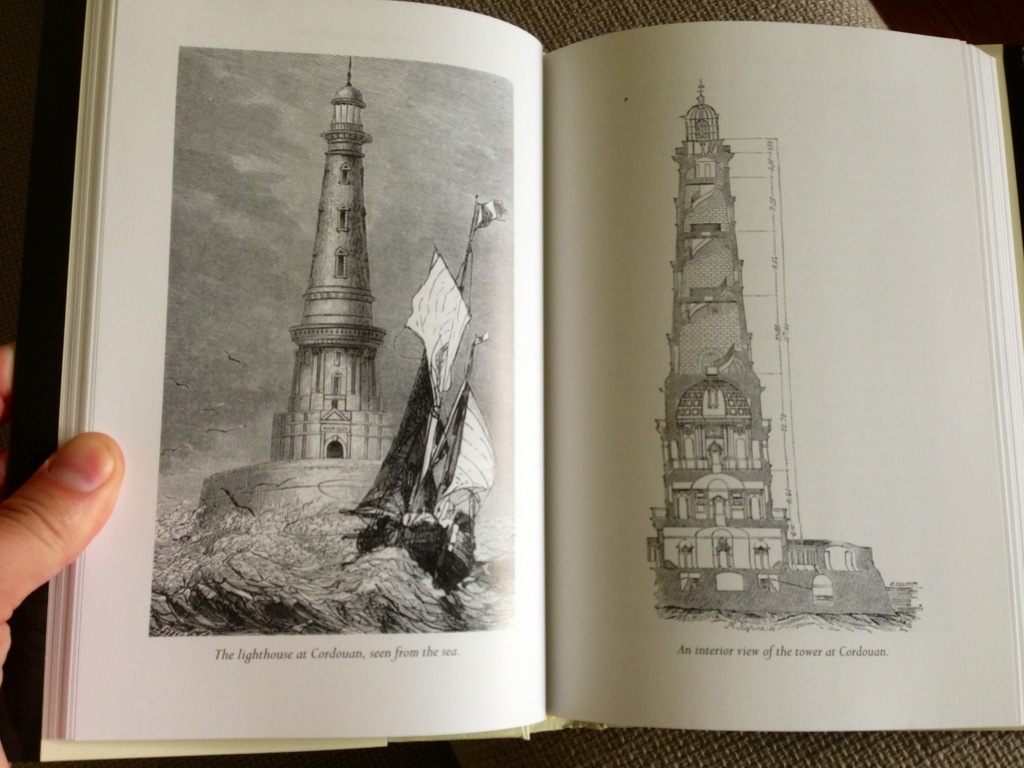
Levitt’s book focuses on Fresnel’s mission to change some of the fundamental ways lighthouses operated and the legacy of the Fresnel lens. The book is handsome an illustrated in glorious black and white:
Here’s the publisher’s blurb:
How a scientific outsider came up with a revolutionary theory of light and saved untold numbers of lives.
Augustin Fresnel (1788–1827) shocked the scientific elite with his unique understanding of the physics of light. The lens he invented was a brilliant feat of engineering that made lighthouses blaze many times brighter, farther, and more efficiently. Battling the establishment, his own poor health, and the limited technology of the time, Fresnel was able to achieve his goal of illuminating the entire French coast. At first, the British sought to outdo the new Fresnel-equipped lighthouses as a matter of national pride. Americans, too, resisted abandoning their primitive lamps, but the superiority of the Fresnel lens could not be denied for long. Soon, from Dunkirk to Saigon, shores were brightened with it. The Fresnel legacy played an important role in geopolitical events, including the American Civil War. No sooner were Fresnel lenses finally installed along U.S. shores than they were drafted: the Union blockaded the Confederate coast; the Confederacy set about thwarting it by dismantling and hiding or destroying the powerful new lights.
Levitt’s scientific and historical account, rich in anecdote and personality, brings to life the fascinating untold story of Augustin Fresnel and his powerful invention.
There were two white men in charge of the trading station. Kayerts, the chief, was short and fat; Carlier, the assistant, was tall, with a large head and a very broad trunk perched upon a long pair of thin legs. The third man on the staff was a Sierra Leone nigger, who maintained that his name was Henry Price. However, for some reason or other, the natives down the river had given him the name of Makola, and it stuck to him through all his wanderings about the country. He spoke English and French with a warbling accent, wrote a beautiful hand, understood bookkeeping, and cherished in his innermost heart the worship of evil spirits. His wife was a negress from Loanda, very large and very noisy. Three children rolled about in sunshine before the door of his low, shed-like dwelling. Makola, taciturn and impenetrable, despised the two white men. He had charge of a small clay storehouse with a dried-grass roof, and pretended to keep a correct account of beads, cotton cloth, red kerchiefs, brass wire, and other trade goods it contained. Besides the storehouse and Makola’s hut, there was only one large building in the cleared ground of the station. It was built neatly of reeds, with a verandah on all the four sides. There were three rooms in it. The one in the middle was the living-room, and had two rough tables and a few stools in it. The other two were the bedrooms for the white men. Each had a bedstead and a mosquito net for all furniture. The plank floor was littered with the belongings of the white men; open half-empty boxes, torn wearing apparel, old boots; all the things dirty, and all the things broken, that accumulate mysteriously round untidy men. There was also another dwelling-place some distance away from the buildings. In it, under a tall cross much out of the perpendicular, slept the man who had seen the beginning of all this; who had planned and had watched the construction of this outpost of progress. He had been, at home, an unsuccessful painter who, weary of pursuing fame on an empty stomach, had gone out there through high protections. He had been the first chief of that station. Makola had watched the energetic artist die of fever in the just finished house with his usual kind of “I told you so” indifference. Then, for a time, he dwelt alone with his family, his account books, and the Evil Spirit that rules the lands under the equator. He got on very well with his god. Perhaps he had propitiated him by a promise of more white men to play with, by and by. At any rate the director of the Great Trading Company, coming up in a steamer that resembled an enormous sardine box with a flat-roofed shed erected on it, found the station in good order, and Makola as usual quietly diligent. The director had the cross put up over the first agent’s grave, and appointed Kayerts to the post. Carlier was told off as second in charge. The director was a man ruthless and efficient, who at times, but very imperceptibly, indulged in grim humour. He made a speech to Kayerts and Carlier, pointing out to them the promising aspect of their station. The nearest trading-post was about three hundred miles away. It was an exceptional opportunity for them to distinguish themselves and to earn percentages on the trade. This appointment was a favour done to beginners. Kayerts was moved almost to tears by his director’s kindness. He would, he said, by doing his best, try to justify the flattering confidence, &c., &c. Kayerts had been in the Administration of the Telegraphs, and knew how to express himself correctly. Carlier, an ex-non-commissioned officer of cavalry in an army guaranteed from harm by several European Powers, was less impressed. If there were commissions to get, so much the better; and, trailing a sulky glance over the river, the forests, the impenetrable bush that seemed to cut off the station from the rest of the world, he muttered between his teeth, “We shall see, very soon.”
Next day, some bales of cotton goods and a few cases of provisions having been thrown on shore, the sardine-box steamer went off, not to return for another six months. On the deck the director touched his cap to the two agents, who stood on the bank waving their hats, and turning to an old servant of the Company on his passage to headquarters, said, “Look at those two imbeciles. They must be mad at home to send me such specimens. I told those fellows to plant a vegetable garden, build new storehouses and fences, and construct a landing-stage. I bet nothing will be done! They won’t know how to begin. I always thought the station on this river useless, and they just fit the station!”
“They will form themselves there,” said the old stager with a quiet smile.
The fact that Henry Armstrong was buried did not seem to him to prove that he was dead: he had always been a hard man to convince. That he really was buried, the testimony of his senses compelled him to admit. His posture – flat upon his back, with his hands crossed upon his stomach and tied with something that he easily broke without profitably altering the situation – the strict confinement of his entire person, the black darkness and profound silence, made a body of evidence impossible to controvert and he accepted it without cavil.
But dead – no; he was only very, very ill. He had, withal, the invalid’s apathy and did not greatly concern himself about the uncommon fate that had been allotted to him. No philosopher was he – just a plain, commonplace person gifted, for the time being, with a pathological indifference: the organ that he feared consequences with was torpid. So, with no particular apprehension for his immediate future, he fell asleep and all was peace with Henry Armstrong.
But something was going on overhead. It was a dark summer night, shot through with infrequent shimmers of lightning silently firing a cloud lying low in the west and portending a storm. These brief, stammering illuminations brought out with ghastly distinctness the monuments and headstones of the cemetery and seemed to set them dancing. It was not a night in which any credible witness was likely to be straying about a cemetery, so the three men who were there, digging into the grave of Henry Armstrong, felt reasonably secure.
Two of them were young students from a medical college a few miles away; the third was a gigantic negro known as Jess. For many years Jess had been employed about the cemetery as a man-of-all-work and it was his favorite pleasantry that he knew “every soul in the place.” From the nature of what he was now doing it was inferable that the place was not so populous as its register may have shown it to be.
Outside the wall, at the part of the grounds farthest from the public road, were a horse and a light wagon, waiting.
The work of excavation was not difficult: the earth with which the grave had been loosely filled a few hours before offered little resistance and was soon thrown out. Removal of the casket from its box was less easy, but it was taken out, for it was a perquisite of Jess, who carefully unscrewed the cover and laid it aside, exposing the body in black trousers and white shirt. At that instant the air sprang to flame, a cracking shock of thunder shook the stunned world and Henry Armstrong tranquilly sat up. With inarticulate cries the men fled in terror, each in a different direction. For nothing on earth could two of them have been persuaded to return. But Jess was of another breed.
In the gray of the morning the two students, pallid and haggard from anxiety and with the terror of their adventure still beating tumultuously in their blood, met at the medical college.
“You saw it?” cried one.
“God! yes – what are we to do?”
They went around to the rear of the building, where they saw a horse, attached to a light wagon, hitched to a gatepost near the door of the dissecting-room. Mechanically they entered the room. On a bench in the obscurity sat the negro Jess. He rose, grinning, all eyes and teeth.
“I’m waiting for my pay,” he said.
Stretched naked on a long table lay the body of Henry Armstrong, the head defiled with blood and clay from a blow with a spade.
1. I managed to avoid reading anything about Shane Carruth’s new film Upstream Color before I saw it.
I just knew that this was the guy who did Primer, this was his new film, and I wanted to see it because Primer was so strange and engaging.
2. Two immediate responses after viewing Upstream Color:
i). The desire to see Upstream Color again and
ii). The desire to read what other people thought about Upstream Color.
3. (My wife and I, reading the credits, pausing the credits, reassessing the film against the backdrop of the credits, arguing about the film, discussing the film, etc.).
4. I think it’s better that if you have any interest at all in Upstream Color that you just see it cold [update/warning: the comments section of this post is full of spoilers]. But I know that 100 minutes is an investment of time, so maybe you’d like some kind of précis or at least description. So, a loose attempt, which surely will devolve into fragments and references:
Upstream Color is a sci-film, sort of.
Or maybe its a mystery film about ethics and biology.
Maybe a nature film, sort of.
Henry David Thoreau’s Walden.
Worms—parasites.
Theft.
Pigs.
Shades of Philip K. Dick, David Cronenberg, Terence Malick, but also something utterly original.
Mind control.
Trauma.
Ambient music.
Orchids.
Sampling nature.
Memory.
Swimming.
Drowning.
Creation: knitting, paper chains, music, seeds, life, children, etc.
A film that can and should be described as poetic.
It’s a love story, too.
5. It occurs to me that there’s a trailer for the film. I haven’t seen it yet. Should we watch it?
6. Does that do it for you? I don’t know how to do this anymore. Recommend things. I don’t know, the trailer makes the film perhaps look more pretentious than it is. It isn’t pretentious. It isn’t even confusing—just perplexing, haunting, troubling.
7. (Wanted: Quinoa Valley Record Co., complete discography).
8. My take on Upstream Color, spoiler-free, supporting-detail-free:
The film is about agency, about drive, about how the characters (and, implicitly, us, we, the audience, who identify with the characters on the screen) may be driven by something beyond us, something controlling us like a parasite (internal) or from afar like a ventriloquist (external). That even when we do assert agency the effect, the fallout, the shape lays beyond us, upstream.
9. (This morning, my wife telling me about her dream, a nightmare that our young daughter had ingested hallucinogenic mushrooms, clearly a response to the film).
10. I haven’t done a good job of really saying anything about the film. So, lazily:
I think Caleb Crain provides a perceptive and persuasive reading of the film in his essay “The Thoreau Poison.” He reads the film through the American transcendentalists, particularly Thoreau, of course, but also Emerson and Hawthorne.
There’s also a piece at Slate by Forrest Wickman that perhaps over-explicates but nonetheless offers perspective, including elements of Carruth’s own take.
11. (I will avoid Carruth’s explanation of the film until I’ve seen it a second time. Maybe I’ll avoid his explanation forever).
12. A take on Upstream Color that I don’t quite buy into (the take is my own): The film perhaps invites us to find metaphysical entities in two of its secondary characters, both of whom exert influence (creative and destructive) over the primary characters. Something something godlike, something something devillike.
I like that the film offers this simple duality and then crushes it, shows something far more complicated, suggests a cycle far more strange.
13. (White orchid. Blue orchid. Yellow orchid).
14. Upstream Color features minimal dialogue and nothing approaching traditional exposition, but we still learn about its characters, come to feel for them, feel their desires and traumas. The film is cerebral and philosophical, but it’s also emotional, offering an aesthetic that sublimely overwhelms the viewer.
15. Carruth wrote, produced, directed, scored, photographed, cast and starred in Upstream Color. (I’m sure he did a lot of other stuff too). He also distributed the film himself. The entire filmmaking process was untouched by the Hollywood system. There’s so much hope for film as an art form in this knowledge.
16. Parting thoughts: See Upstream Color. Resist imposing whatever film grammar you usually bring with you to the movies. Resist the temptation to see the film as a puzzle to figure out. See Upstream Color.
What are fairy stories for? Freud gave an answer – they were related to daydreams and wish-fulfilment fantasies, in which the questing self meets helpers and enemies, and in which the ending is always happy. He wondered if myths were the “secular dreams of youthful humanity” but distinguished myths from fairy tales by claiming that myth is “related to disaster”. It can also be argued that myth is related to the human need to know what was before, and what will be after the individual life, the living society. Myths are concerned with origins, the fear of death, and the hope for the overcoming of death in another world. The universe of Asgard and Valhalla, of Olympus and Hades, is not the fairy-tale unreal world with its visiting suns and moons, castles and undifferentiated forests. We don’t put it together in our imaginations in the same way. There is neither explanation nor teaching in the true wonder tale.
Other things which are not essentially part of true fairy tales are character, psychological causation, and real morality. Princesses are virtually interchangeable – they are either kind and modest and housewifely, or vain and stupid and inconsiderate. They are called “princesses” but peasants and merchants’ daughters have the same limited and recognisable natures. Simpletons and gallant princes have the same chance of solving riddles, obtaining magic feathers, or keys, the same insect or fishy helpers. Lazy girls are caught out by boasts that they can spin flax into gold, and are helped by strange brownies, or dwarves, or other creatures. The best single description I know of the world of the fairy tale is that of Max Lüthi who describes it as an abstract world, full of discrete, interchangeable people, objects and incidents, all of which are isolated and are nevertheless interconnected, in a kind of web or network of two-dimensional meaning. Everything in the tales appears to happen entirely by chance – and this has the strange effect of making it appear that nothing happens by chance, that everything is fated.
We were stationed in the little town of N—-. The life of an officer in the army is well known. In the morning, drill and the riding-school; dinner with the Colonel or at a Jewish restaurant; in the evening, punch and cards. In N—- there was not one open house, not a single marriageable girl. We used to meet in each other’s rooms, where, except our uniforms, we never saw anything.
One civilian only was admitted into our society. He was about thirty-five years of age, and therefore we looked upon him as an old fellow. His experience gave him great advantage over us, and his habitual taciturnity, stern disposition and caustic tongue produced a deep impression upon our young minds. Some mystery surrounded his existence; he had the appearance of a Russian, although his name was a foreign one. He had formerly served in the Hussars, and with distinction. Nobody knew the cause that had induced him to retire from the service and settle in a wretched little village, where he lived poorly and, at the same time, extravagantly. He always went on foot, and constantly wore a shabby black overcoat, but the officers of our regiment were ever welcome at his table. His dinners, it is true, never consisted of more than two or three dishes, prepared by a retired soldier, but the champagne flowed like water. Nobody knew what his circumstances were, or what his income was, and nobody dared to question him about them. He had a collection of books, consisting chiefly of works on military matters and a few novels. He willingly lent them to us to read, and never asked for them back; on the other hand, he never returned to the owner the books that were lent to him. His principal amusement was shooting with a pistol. The walls of his room were riddled with bullets, and were as full of holes as a honey-comb. A rich collection of pistols was the only luxury in the humble cottage where he lived. The skill which he had acquired with his favourite weapon was simply incredible; and if he had offered to shoot a pear off somebody’s forage-cap, not a man in our regiment would have hesitated to place the object upon his head.
Our conversation often turned upon duels. Silvio — so I will call him — never joined in it. When asked if he had ever fought, he drily replied he had; but he entered into no particulars, and it was evident that such questions were not to his liking. We came to the conclusion that he had upon his conscience the memory of some unhappy victim of his terrible skill. Moreover, it never entered into the head of any of us to suspect him of anything like cowardice. There are persons whose mere look is sufficient to repel such a suspicion. But an unexpected incident occurred which astounded us all.
One day, about ten of our officers dined with Silvio. They drank as usual, that is to say, a great deal. After dinner we asked our host to hold the bank for a game at faro. For a long time he refused, for he hardly ever played, but at last he ordered cards to be brought, placed half a hundred ducats upon the table, and sat down to deal. We took our places round him, and the play began. It was Silvio’s custom to preserve a complete silence when playing. He never disputed, and never entered into explanations. If the punter made a mistake in calculating, he immediately paid him the difference or noted down the surplus. We were acquainted with this habit of his, and we always allowed him to have his own way; but among us on this occasion was an officer who had only recently been transferred to our regiment. During the course of the game, this officer absently scored one point too many. Silvio took the chalk and noted down the correct account according to his usual custom. The officer, thinking that he had made a mistake, began to enter into explanations. Silvio continued dealing in silence. The officer, losing patience, took the brush and rubbed out what he considered was wrong. Silvio took the chalk and corrected the score again. The officer, heated with wine, play, and the laughter of his comrades, considered himself grossly insulted, and in his rage he seized a brass candlestick from the table, and hurled it at Silvio, who barely succeeded in avoiding the missile. We were filled with consternation. Silvio rose, white with rage, and with gleaming eyes, said:
Out fifteen miles below Monterey, on the wild coast, the Torres family had their farm, a few sloping acres above a cliff that dropped to the brown reefs and to the hissing white waters of the ocean. Behind the farm the stone mountains stood up against the sky. The farm buildings huddled like the clinging aphids on the mountain skirts, crouched low to the ground as though the wind might blow them into the sea. The little shack, the rattling, rotting barn were gray-bitten with sea salt, beaten by the damp wind until they had taken on the color of the granite hills. Two horses, a red cow and a red calf, half a dozen pigs and a flock of lean, multicolored chickens stocked the place. A little corn was raised on the sterile slope, and it grew short and thick under the wind, and all the cobs formed on the landward sides of the stalks.
Mama Torres, a lean, dry woman with ancient eyes, had ruled the farm for ten years, ever since her husband tripped over a stone in the field one day and fell full length on a rattlesnake. When one is bitten on the chest there is not much that can be done.
Mama Torres had three children, two undersized black ones of twelve and fourteen, Emilio and Rosy, whom Mama kept fishing on the rocks below the farm when the sea was kind and when the truant officer was in some distant part of Monterey County. And there was Pepe, the tall smiling son of nineteen, a gentle, affectionate boy, but very lazy. Pepe had a tall head, pointed at the top, and from its peak coarse black hair grew down like a thatch all around. Over his smiling little eyes Mama cut a straight bang so he could see. Pepe had sharp Indian cheekbones and an eagle nose, but his mouth was as sweet and shapely as a girl’s mouth, and his chin was fragile and chiseled. He was loose and gangling, all legs and feet and wrists, and he was very lazy. Mama thought him fine and brave, but she never told him so. She said, “Some lazy cow must have got into thy father’s family, else how could I have a son like thee.” And she said, “When I carried thee, a sneaking lazy coyote came out of the brush and looked at me one day. That must have made thee so.”
Pepe smiled sheepishly and stabbed at the ground with his knife to keep the blade sharp and free from rust. It was his inheritance, that knife, his father’s knife. The long heavy blade folded back into the black handle. There was a button on the handle. When Pepe pressed the button, the blade leaped out ready for use. The knife was with Pepe always, for it had been his father’s knife.
One sunny morning when the sea below the cliff was glinting and blue and the white surf creamed on the reef, when even the stone mountains looked kindly, Mama Torres called out the door of the shack, “Pepe, I have a labor for thee.”
There was no answer. Mama listened. From behind the barn she heard a burst of laughter. She lifted her full long skirt and walked in the direction of the noise.
Pepe was sitting on the ground with his back against a box. His white teeth glistened. On either side of him stood the two black ones, tense and expectant. Fifteen feet away a redwood post was set in the ground. Pepe’s right hand lay limply in his lap, and in the palm the big black knife rested. The blade was closed back into the handle. Pepe looked smiling at the sky.
Suddenly Emilio cried, “Ya!”
Pepe’s wrist flicked like the head of a snake. The blade seemed to fly open in midair, and with a thump the point dug into the redwood post, and the black handle quivered. The three burst into excited laughter. Rosy ran to the post and pulled out the knife and brought it back to Pepe. He closed the blade and settled the knife carefully in his listless palm again. He grinned self-consciously at the sky.