

Category: Books
Book Shelves #22, 5.27.2012
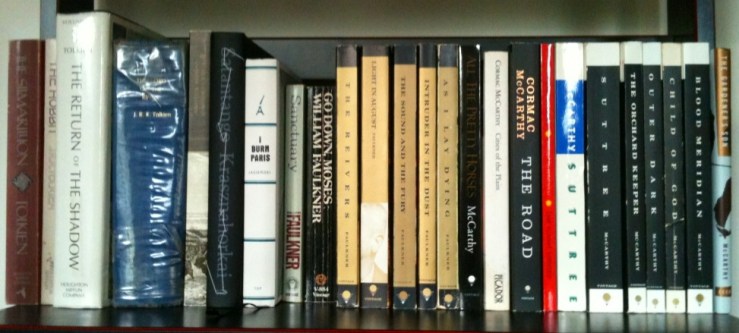
Book shelves series #22, twenty-second Sunday of 2012: Tolkien, Faulkner, McCarthy
As always, sorry for the glare. Shooting this case head on is almost impossible because of the windows on the other side of the room. Anyway.
I’ve read everything by Cormac McCarthy with the exception of his screenplay for The Gardener’s Son, which I found a week or two and picked it up. I don’t own a copy of No Country for Old Men because I haven’t found one that isn’t a movie tie-in.

This copy of The Lord of the Rings—my first—was a kind gift from some friends we were staying with in Melbourne (the one in Australia, not Florida).

I’ve read it at least four times; I have other copies of LoTR and have read them too. It’s probably the book I’ve read the most, although I haven’t read it since 2002. This copy is kindly inscribed:

There’s a slim space on the shelf that currently holds a few books that I’ve been meaning to read:

“They Hate Me More Than I Hate Them” — Michel Houellebecq on Critics and the Press
INTERVIEWER
What about your critics? Can you just sum up briefly what you hold against the French press?
HOUELLEBECQ
First of all, they hate me more than I hate them. What I do reproach them for isn’t bad reviews. It is that they talk about things having nothing to do with my books—my mother or my tax exile—and that they caricature me so that I’ve become a symbol of so many unpleasant things—cynicism, nihilism, misogyny. People have stopped reading my books because they’ve already got their idea about me. To some degree of course, that’s true for everyone. After two or three novels, a writer can’t expect to be read. The critics have made up their minds.
From his Paris Review interview.
Interrupted Reading — Camille Corot

“Jimber-jawed Serge” and Other Names from F. Scott Fitzgerald’s Notebooks
A grand duke—“Jimber-jawed Serge.”
Name: Umphadel Piluski
Gangster Salve Spitale—Saliva Spit.
Gooshoofenstein Von Beasinghausen
Meglomania McCarthy
English clubman named Cumbersom
Names Lee Spurgeon, Stoner, Mortimer, Flieshhacker, Henry P. Jacques. Borre.
Bryon Appledeck
Name for movie house “What’s at the Dementia?”
Mr. Schlchgd from Notre Dame in novel.
Beauty boy Johnston
Name Howya Bartlett
Joe Crusoe
Hummer for name
The Marquise de la Close d’Hirondelle
Tookey Ledoux
Harry Fantum
George Gratteciel
Marylyn Miller Swann, Sherlock Holmes Swann
Futility Trust Company
Name of “La Paix” changed to “Thropaca”
Grandfather called Mo’papa
—F. Scott Fitzgerald, The Notebooks
The Virgin Reading — Vittore Carpaccio

Ed Sanders and a Drunken Jack Kerouac on William F. Buckley’s Firing Line in 1968
Reading Monkey — Gabriel von Max

Little Libraries, Guerrilla Libraries, Ad Hoc Libraries and More

Read Shannon Mattern’s great essay “Marginalia: Little Libraries in the Urban Margins” (published at Places). From the essay:
These new library projects might seem to emerge from a common culture and uphold a common mission — a flurry of press coverage in late 2011 represented them as a coherent “little library” movement. But in fact they don’t. They have varied aims and politics and assumptions about what a library is and who its publics are; their collections and services differ significantly; and their forms and functions vary from one locality to another. I want to attempt here to identify a loose, and inevitably leaky, typology of “little libraries” — to figure out where they’re coming from, how they relate to existing institutions that perform similar roles, and what impact they’re having on their communities.
Finn Mac Cool Relates Those Musics He Has Found the Sweetest — A Passage from O’Brien’s Novel At-Swim-Two-Birds
Extract, from my typescript descriptive of Finn Mac Cool and his people, being humorous or quasi-humorous incursion into ancient mythology: Of the musics you have ever got, asked Conan, which have you found the sweetest?
I will relate, said Finn. When the seven companies of my warriors are gathered together on the one plain and the truant clean-cold loud-voiced wind goes through them, too sweet to me is that. Echo-blow of a goblet-base against the tables of the palace, sweet to me is that. I like gull-cries and the twittering together of fine cranes. I like the surf-roar at Tralee, the songs of the three sons of Meadhra and the whistle of Mac Lughaidh. These also please me, man-shouts at a parting, cuckoo-call in May. I incline to like pig-grunting in Magh Eithne, the bellowing of the stag of Ceara, the whinging of fauns in Derrynish. The low warble of water-owls in Loch Barra also, sweeter than life that. I am fond of wing-beating in dark belfries, cow-cries in pregnancy, trout-spurt in a laketop. Also the whining of small otters in nettle-beds at evening, the croaking of small-jays behind a wall, these are heart-pleasing. I am friend to the pilibeen, the red-necked chough, the parsnip land-rail, the pilibeen mona, the bottle-tailed tit, the common marsh-coot, the speckle-toed guillemot, the pilibeen sleibhe, the Mohar gannet, the peregrine plough-gull, the long-eared bush-owl, the Wicklow small-fowl, the bevil-beaked chough, the hooded tit, the pilibeen uisce, the common Corby, the fish-tailed mud-piper, the cruiskeen lawn, the carrion sea-cock, the green-lidded parakeet, the brown bog-martin, the maritime wren, the dove-tailed wheatcrake, the beaded daw, the Galway hill-bantam and the pilibeen cathrach. A satisfying ululation is the contending of a river with the sea. Good to hear is the chirping of little red-breasted men in bare winter and distant hounds giving tongue in the secrecy of fog. The lamenting of a wounded otter in a black hole, sweeter than harpstrings that. There is no torture so narrow as to be bound and beset in a dark cavern without food or music, without the bestowing of gold on bards. To be chained by night in a dark pit without company of chessmen – evil destiny! Soothing to my ear is the shout of a hidden blackbird, the squeal of a troubled mare, the complaining of wild-hogs caught in snow.
Relate further for us, said Conan.
It is true that I will not, said Finn.
A lovely early passage from Flann O’Brien’s first novel At Swim-Two-Birds.
Old Man Reading — Vincent van Gogh

“Accounts to reconcile: Anecdotes to pick up: Inscriptions to make out: Stories to weave in: Traditions to sift: Personages to call upon: Panegyricks to paste up at this door; Pasquinades at that” — A Passage from Sterne’s Tristram Shandy
Chapter 1.XIV. Upon looking into my mother’s marriage settlement, in order to satisfy myself and reader in a point necessary to be cleared up, before we could proceed any farther in this history;–I had the good fortune to pop upon the very thing I wanted before I had read a day and a half straight forwards,–it might have taken me up a month;–which shews plainly, that when a man sits down to write a history,–tho’ it be but the history of Jack Hickathrift or Tom Thumb, he knows no more than his heels what lets and confounded hindrances he is to meet with in his way,–or what a dance he may be led, by one excursion or another, before all is over. Could a historiographer drive on his history, as a muleteer drives on his mule,– straight forward;–for instance, from Rome all the way to Loretto, without ever once turning his head aside, either to the right hand or to the left,- -he might venture to foretell you to an hour when he should get to his journey’s end;–but the thing is, morally speaking, impossible: For, if he is a man of the least spirit, he will have fifty deviations from a straight line to make with this or that party as he goes along, which he can no ways avoid. He will have views and prospects to himself perpetually soliciting his eye, which he can no more help standing still to look at than he can fly; he will moreover have various Accounts to reconcile: Anecdotes to pick up: Inscriptions to make out: Stories to weave in: Traditions to sift: Personages to call upon: Panegyricks to paste up at this door; Pasquinades at that:–All which both the man and his mule are quite exempt from. To sum up all; there are archives at every stage to be look’d into, and rolls, records, documents, and endless genealogies, which justice ever and anon calls him back to stay the reading of:–In short there is no end of it;–for my own part, I declare I have been at it these six weeks, making all the speed I possibly could,–and am not yet born:–I have just been able, and that’s all, to tell you when it happen’d, but not how;–so that you see the thing is yet far from being accomplished. These unforeseen stoppages, which I own I had no conception of when I first set out;–but which, I am convinced now, will rather increase than diminish as I advance,–have struck out a hint which I am resolved to follow;–and that is,–not to be in a hurry;–but to go on leisurely, writing and publishing two volumes of my life every year;–which, if I am suffered to go on quietly, and can make a tolerable bargain with my bookseller, I shall continue to do as long as I live.
Chapter XIV of the first book of Laurence Sterne’s The Life and Opinions of Tristram Shandy, Gentleman.
Man, Standing, Reading a Book — Vincent van Gogh

Man, Sitting, Reading a Book — Vincent van Gogh

I Review the Trailer for Baz Luhrmann’s Adaptation of The Great Gatsby
There’s a part in William Gaddis’s big novel The Recognitions where Basil Valentine talks about how forged paintings are always outed as fakes over time because they ultimately illustrate not the original genius of the artist, but instead show how the current zeitgeist interprets the artist. Film adaptations of books aren’t painted forgeries, but they are highly susceptible to the same critical limitations that Valentine discusses. We can see this plainly in Baz Luhrmann’s 1996 adaptation of Romeo & Juliet, a messy, vibrant, flaky film thoroughly shot-through with the aesthetic spirit of the nineties. I like Luhrmann’s R&J, despite its many, many faults. One of its great saving graces is that it seems aware of its own spectacle—it unselfconciously acknowledges itself as a product of its time, as just one of many, many adaptations of Shakespeare’s deathless work.
Lurhmann has taken a stab at F. Scott Fitzgerald’s The Great Gatsby. He’s not the first. Others attempted to turn Fitzgerald’s classic novel of the jazz age into a movie in 1926 (the film is lost), 1949 (there’s a reason you never saw it in high school), and 1974 (I’ll come back to the Redford Gatsby in a moment). Most recently, a 2000 anemic TV production featured Mira Sorvino as Daisy and Paul Rudd as a terribly miscast Nick Carraway. Up until now, high school teachers across the country who wanted to foist an adaptation on their students (and maybe free up a day or two of lesson planning) have had to choose between the 2000 A&E production or Jack Clayton’s 1974 Francis Ford Coppola-penned debacle—this is the one I was subjected to in high school. It features Robert Redford as Gatsby, Sam Waterston as Nick, and Mia Farrow as Daisy, and none of them are terrible, but the movie is dull, overly-reverential of its source material, and heavy-handed. It also looks incredibly dated now, its evocations of the 1920’s jazz age petrified in gauzy ’70s soft-focus shots. It just looks and feels very 1970s.
Judging by its trailer, Lurhmann’s Gatsby is making absolutely no play at all for timelessness. Just as his earlier mashup, 2001’s Moulin Rouge!, essentially uses the Belle Époque as a sounding board for transgenerational spectacle, Lurhmann’s Gatsby looks like another thoroughly interpretative gesture, a hyperkinetic, hyperstylized film that makes no bid at realism. This is what 2012 thinks 1922 should look like (or at least this is 2012’s ideal, shimmering, sexy version of 1922.) Here’s the trailer:
Overwrought, frenetic spectacle is exactly what I would expect from Luhrmann. There’s a transposition of meaning here, where Gatsby’s famous party turns into a rave of sorts, where Daisy’s phrasing of “You always look so cool” takes on anachronistic dimensions. But the trailer seems faithful (if hyperbolic) to images described in the book. By way of comparison, let’s look at the first shot in the trailer, the car full of young black people treating said car as a party scene. Here’s the text:
As we crossed Blackwell’s Island a limousine passed us, driven by a white chauffeur, in which sat three modish Negroes, two bucks and a girl. I laughed aloud as the yolks of their eyeballs rolled toward us in haughty rivalry.
“Anything can happen now that we’ve slid over this bridge,” I thought; “anything at all. . . .”
Even Gatsby could happen, without any particular wonder.
The energy of the scene is expressed—and magnified—in Luhrmann’s shot, but it’s impossible to say yet whether or not the invocation to change expressed in this citation will transfer to film.
It’s also obviously too early to make any pronouncements on the casting, although I’ll submit that you could find a worse Jay Gatsby than Leonardo DiCaprio (who I think, for the record, was great as petulant, whiny Romeo in Luhrmann’s breakthrough film). I’m not sure about Tobey Maguire as Nick Carraway, but there’s a certain, I don’t know, emptiness to him that may work well in our unreliable narrator. My big concern is Carey Mulligan, who I think is very sweet and I will admit to having a mild crush on—is she right for Daisy Buchanan, one of the meanest, most selfish creatures in literature? The other Buchanan, husband Tom, is portrayed by Joel Edgerton with a kind of seething rage here in the clip. Dude looks positively evil—cartoonishly so (which is really saying something, because Luhrmann seems to turn everything into a cartoon). Edgerton’s Tom presents as the glowering obstacle to the pure, positive love between Daisy and Gatsby. And here might be the biggest trip up with the film: The trailer seems to be advertising a love story.
Now, of course reading is an act of interpretation, a highly subjective experience dependent on any number of factors (see also: the opening paragraph to this riff). But good reading and good interpretation is generally supported by textual evidence, and the textual evidence in Gatsby reveals not so much a love story, but a bunch of nefarious creeps and awful liars who ruin the lives of the people around them with little thought or introspection. I mean, really, the principal characters are basically vile people (hence the reason your high school English teacher loved to point out Nick Carraway’s signature unreliability as a narrator—he glosses over so much evil). But again, it’s just a trailer, and trailers are made to make people buy tickets to movies, and people will pay to see a love story. We’ll have to wait for the film to assess Lurhmann’s interpretation. For now, it’s enough to suggest that the trailer achieved what it needed to—as of now, The Great Gatsby is still trending on Twitter. This is buzz; this is what a trailer is supposed to create. And if a byproduct of that buzz is to get more people reading or rereading, that can’t be a bad thing.
Books Acquired, 5.17.2012—Or, Here’s What’s New from Picador This June
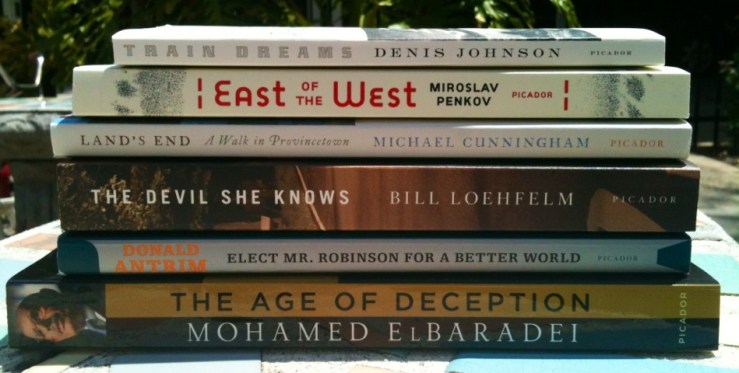
Nice little batch from the good folks at Picador, including Bill Loehfelm’s thriller The Devil She Knows, Mohamed ElBarardei’s The Age of Deception, an analysis of nuclear politics, and Michael Cunningham’s Land’s End, which I assume is a novelization of the clothing catalog.
Also in the batch: Denis Johnson’s novella Train Dreams, which I read in one sitting this Sunday. It’s a perfect novella, its pathos balanced with humor, its realism tempered in something of the mythic spirit of the American frontier. Full review forthcoming.

Miroslav Penkov’s collection East of the West looks pretty cool.
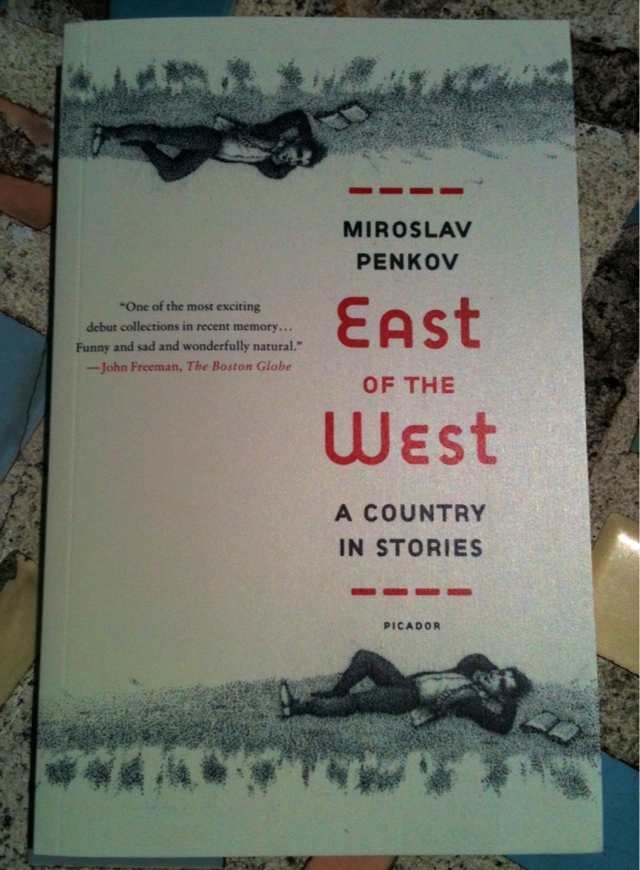
Here’s a description from his website:
A grandson tries to buy the corpse of Lenin on eBay for his Communist grandfather. A failed wunderkind steals a golden cross from an Orthodox church. A boy meets his cousin (the love of his life) once every five years in the river that divides their village into east and west. These are Miroslav Penkov’s strange, unexpectedly moving visions of his home country, Bulgaria, and they are the stories that make up his charming, deeply felt debut collection.

Donald Antrim’s debut Elect Mr. Robinson for a Better World has also been reissued with a new intro by Jeffrey Eugenides. Here’s an excerpt of the novel:
It was Friday, the day of the big theriomorphism workshop Rotary luncheon out at the Holiday Inn. My wife, Meredith, and I and a crowd of red-faced Rotarians and their well-dressed wives (Rotary Anns) sat around hotel banquet tables and listened to a visiting anthropology professor at the junior college say, “Pick an animal, any animal, fish, fowl, beast. Concentrate on aspects of the animal. Is it big? Small? Cute? Does it eat other animals? What color fur? If the animal is a bird, what color are its feathers? What song does it sing?”
“This is stupid,” I whispered to Meredith.
“It’s your fault we’re here, Pete. Why don’t you give it a chance?”
The anthropologist said, “Why don’t we all think about it for a minute? Okay, everybody got one?”
“Yes,” “No,” “Wait,” people said. Meredith whispered, “What’s yours?”
“I don’t know, what’s yours?”
“Coelacanth.”
“The prehistoric fish?”
“I need a volunteer,” declared the professor. Meredith raised her hand, and the man at the podium said, “Yes, back there. Tell us your name and the name of the animal you’ve chosen to become today.”
“Meredith Robinson. Coelacanth. It’s a kind of fish that scientists believed extinct until one was caught off the coast of Africa.”
“Excellent. Come forward. Sit here. Would someone please dim the lights?” I watched Rotary guys watch my wife. Bill Nixon, Tom Thompson, Abraham de Leon, Dick Morton, Terry Heinemann, Robert Isaac—all the usuals, plus others. Jerry and his wife, Rita, sat up front. The professor soothingly said, “Close your eyes, breathe deeply, and tell us about the coelacanth. Everybody else, let’s all breathe deeply too, and be thinking about our own animals. Go ahead, Meredith.”
“Well, it’s four feet long, deep slate blue, with bony, protruding fins and big jaws with scary teeth. It goes back seventy million years. It moves slowly, it dwells in dark water.” The professor nodded. Audience members inched forward in their seats. Meredith said, “At night it swims upside down with its head pointed to the sea bottom, bobbing along.”
“A feeding technique?”
“Maybe.”
“How’s the water?” I could see Meredith’s head settle forward as she softly answered, “Cold.”
“Feel the cold. Breathe that cold. Inhale that water. What do you feel?”
“Colors.”
“Colors?”
“Blue, black, indigo.”
Discussion of Fears (A Passage from Roberto Bolaño’s Novel 2666)
There are odder things than sacraphobia, said Elvira Campos, especially if you consider that we’re in Mexico and religion has always been a problem here. In fact, I’d say all Mexicans are essentially sacraphobes. Or take gephyrophobia, a classic fear. Eots of people suffer from it. What’s gephyrophobia? asked Juan de Dios Martinez. The fear of crossing bridges. That’s right, I knew someone once, well, it was a boy, really, who was afraid that when he crossed a bridge it would collapse, so he’d run across it, which was much more dangerous. A classic, said Elvira Campos. Another classic: claustrophobia. Fear of confined spaces. And another: agoraphobia. Fear of open spaces. I’ve heard of those, said Juan de Dios Martinez. And one more: necrophobia. Fear of the dead, said Juan de Dios Martinez, I’ve known people like that. It’s a handicap for a policeman. Then there’s hemophobia, fear of blood. That’s right, said Juan de Dios Martinez. And peccatophobia, fear of comitting sins. But there are other, rarer, fears. For instance, clinophobia. Do you know what that is? No idea, said Juan de Dios Martinez. Fear of beds. Can anyone really fear beds, or hate them? Actually, yes, there are people who do. But they can deal with the problem by sleeping on the floor and never going into a bedroom. And then there’s tricophobia, or fear of hair. That’s a little more complicated, isn’t it? Yes, very much so. There are cases of tricophobia that end in suicide. And there’s verbophobia, fear of words. Which must mean it’s best not to speak, said Juan de Dios Martinez. There’s more to it than that, because words are everywhere, even in silence, which is never complete silence, is it? And then we have vestiphobia, which is fear of clothes. It sounds strange but it’s much more widespread than you’d expect. And this one is relatively common: iatrophobia, or fear of doctors. Or gynophobia, which is fear of women, and naturally afflicts only men. Very widespread in Mexico, although it manifests itself in different ways. Isn’t that a slight exaggeration? Not a bit: almost all Mexican men are afraid of women. I don’t know what to say to that, said Juan de DiosMartinez. Then there are two fears that are really very romantic: ombrophobia and thalassophobia, or fear of rain and fear of the sea. And two others with a touch of the romantic: anthophobia, or fear of flowers, and dendrophobia, fear of trees. Some Mexican men may be gynophobes, said Juan de DiosMartinez, but not all of them, it can’t be that bad. What do you think optophobia is? asked the director. Opto, opto, something to do with the eyes, my God, fear of the eyes? Even worse: fear of opening the eyes. In a figurative sense, that’s an answer to what you just said about gynophobia. In a literal sense, it leads to violent attacks, loss of consciousness, visual and auditory hallucinations, and generally aggressive behavior. I know, though not personally, of course, of two cases in which the patient went so far as to mutilate himself. He put his eyes out? With his fingers, the nails, said the director. Good God, said Juan de Dios Martinez. Then we have pedophobia, of course, which is fear of children, and ballistophobia, fear of bullets. That’s my phobia, said Juan de Dios Martinez. Yes, I suppose it’s only common sense, said the director. And another phobia, this one on the rise: tropophobia, or the fear of making changes or moving. Which can be aggravated if it becomes agyrophobia, fear of streets or crossing the street. Not to forget chromophobia, which is fear of certain colors, or nyctophobia, fear of night, or ergophobia, fear of work. A common complaint is decidophobia, the fear of making decisions. And there’s a fear that’s just beginning to spread, which is anthrophobia, or fear of people. Some Indians suffer from a heightened form of astrophobia, which is fear of meteorological phenomena like thunder and lightning. But the worst phobias, in my opinion, are pantophobia, which is fear of everything, and phobophobia, fear of fear itself. If you had to suffer from one of the two, which would you choose? Phobophobia, said Juan de Dios Martinez. Think carefully, it has its drawbacks, said the director. Between being afraid of everything and being afraid of my own fear, I’d take the latter. Don’t forget I’m a policeman and if I was scared of everything I couldn’t work. But if you’re afraid of your own fears, you’re forced to live in constant contemplation of them, and if they materialize, what you have is a system that feeds on itself, a vicious cycle, said the director.
From “The Part About the Crimes,” 2666 by Roberto Bolaño.
 Biblioklept