

Category: Books
António Lobo Antunes (Book Acquired, 5.15.2012)
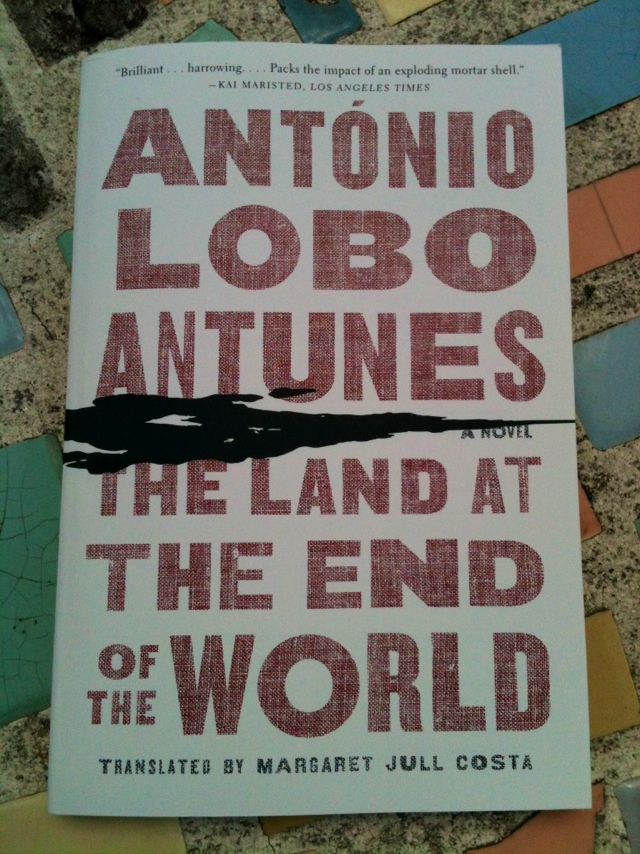
I’ve never read anything by Portuguese author António Lobo Antunes, so I was psyched when his novel The Land at the End of the World showed up in paperback. Here’s an excerpt from Larry Rohter’s review at the NTY:
Combat experiences are like Tolstoy’s unhappy families: no two are alike, which may be why they often make for great novels, as Tolstoy also knew. The cause need not even be noble, since a hopeless situation and senseless violence can actually fortify a work of fiction. Certainly that is the case with António Lobo Antunes’s “Land at the End of the World,” set in Angola in the early 1970s, as Portugal’s ludicrous effort to preserve its African empire was meandering to an inglorious end. . . .
“The Land at the End of the World,” newly translated by Margaret Jull Costa, was originally published in 1979, four years after Portugal’s withdrawal from Africa and the final collapse of America’s intervention in Vietnam. At that time it was interpreted as a comment on the inherent futility of those recent Western adventures in the third world. But read at more than 30 years’ remove from those events much of this account of what Mr. Lobo Antunes’s narrator calls a “painful apprenticeship in dying” would no doubt make sense to survivors of the Iraq and Afghanistan wars.

Slavoj Žižek Finally Weighs in on Santa Claus
“Morality Is the Adjustment of Matter to Its Environment” — H.P. Lovecraft
Morality is the adjustment of matter to its environment—the natural arrangement of molecules. More especially it may be considered as dealing with organic molecules. Conventionally it is the science of reconciling the animal Homo (more or less) sapiens to the forces and conditions with which he is surrounded. It is linked with religion only so far as the natural elements it deals with are deified and personified. Morality antedated the Christian religion, and has many times risen superior to coexistent religions. It has powerful support from very non-religious human impulses. Personally, I am intensely moral and intensely irreligious. My morality can be traced to two distinct sources, scientific and aesthetic. My love of truth is outraged by the flagrant disturbance of sociological relations involved in so-called wrong; whilst my aesthetic sense is outraged and disgusted with the violations of taste and harmony thereupon attendant. But to me the question presents no ground for connexion with the grovelling instinct of religion. However—you may exclude me from the argument, if you will. I am unduly secluded though unavoidably so. We will deal only with materials that may presumably lie within my feeble reach. Only one more touch of ego. I am not at all passive or indifferent in my zeal for a high morality. But I cannot consider morality the essence of religion, as you seem to. In discussing religion, the whole fabric must bear examination before the uses or purposes are considered. We must investigate the cause as well as alleged effects if we are to define the relation between the two, and the reality of the former. And more, granting that the phenomenon of faith is indeed the true cause of the observed moral effects; the absolute basis of that phenomenon remains to be examined. The issue between theists and atheists is certainly not, as you seem to think, the mere question of whether religion is useful or detrimental.
— From H.P. Lovecraft’s 1918 letter to his friend Maurice W. Moe; the letter is collected in The Portable Atheist (ed. Christopher Hitchens).
Roberto Bolaño Crochet Doll

Roberto Bolaño crochet doll by Santo Crochet; via Matt Bucher on Twitter
David Markson, Cormac McCarthy, Slavoj Žižek (Books Acquired, 5.19.2012)
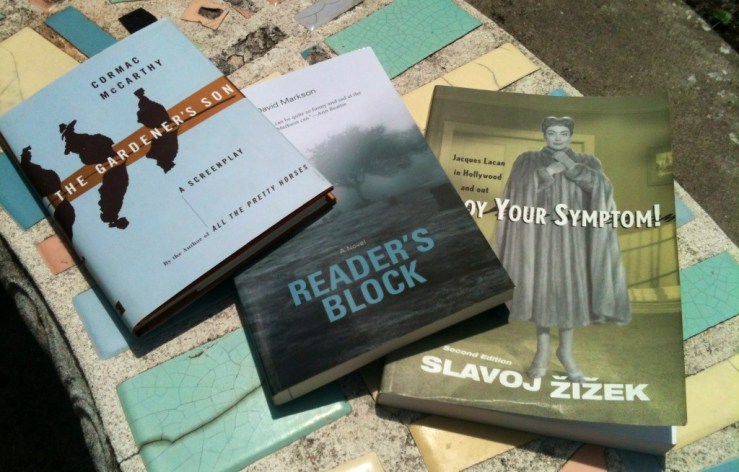
I ordered David Markson’s Reader’s Block from my local book shop, and intended to get it—and only it—this Saturday. Somehow I took a detour through the film section and picked up the Žižek and didn’t put it back; in the same section I also picked up McCarthy’s screenplay The Gardener’s Son, which is the only thing I haven’t read by him to date, so I picked it up too. So there you go.
Woman Reading to a Little Girl — Felix Vallotton

I Review Patience (After Sebald), an Oppressively Overstylized Documentary

Let’s get this out of the way first:
I love W.G. Sebald’s The Rings of Saturn.
I think it’s an important book—but more than that I think it’s an engrossing, good, excellent book, an enlarging book, a bewildering book, a depressing book, an intelligent book, an extraordinarily affecting book.
I reviewed The Rings of Saturn and you can read that review if you feel the urge for me to support those claims in greater detail.
Better yet, read Sebald’s book.
Whatever you do, please don’t use Grant Gee’s new documentary Patience (After Sebald) as a substitution for actually reading Sebald. It’s not that Gee’s film doesn’t lovingly attempt to approximate the spirit of Saturn. No, Gee and his cast of writers, architects, historians, and other Sebaldians clearly attempt to match the rhythms and moods and content of Saturn—and herein lies the film’s failure.
In an essay on Virginia Woolf—a writer who shows up in both Sebald and in Patience—literary critic (and Sebald champion) James Wood notes the anxiety of influence always at work between the artistic subject and the would-be critic: “The competition is registered verbally. The writer-critic is always showing a little plumage to the writer under discussion.” Wood here is specifically calling attention to Woolf’s own critical powers—of her ability to transcend merely reviewing a work, of her status as a poet-critic—but I think he gives us a simple little rubric for evaluating critical work in general: the truly excellent stuff goes its own route. Gee’s film so dutifully commits to visually and aurally replicating the melancholy and erudite mood of Saturn that it often seems cartoonish or clumsy—or, even worse, dreadfully boring.
It’s not fair to put down one filmmaker for not being more like another, but I wish Gee had taken a page out of, say Errol Morris’s book. Morris’s style is, in a sense, to remove style, to eliminate the aesthetic shield between the subject and the camera/audience. In contrast, Patience is overstylized to an almost embarrassing degree. The film veers between lethargic, numbing black and white shots of the places that Sebald visited on his walking tour in Saturn, occasional archival footage, and slippery impositions of text, maps, documents, and talking heads—sometimes delivered in a bizarre, agitated pace. Perhaps the tone I’ve just described may seem appropriate to any critical measurement of Saturn; in my review of Sebald’s novel, I noted that one element of saturnine melancholy is “sluggishness and moroseness, paradoxically paired with an eagerness for action” — but Gee’s lack of restraint here is bad art school stuff. It’s as if he doesn’t trust the viewer to simply listen to (let alone watch) a talking head for a minute.
A few notes on those talking heads:
There are some very smart people here saying some really cool things about Sebald—writers like Rick Moody and Iain Sinclair, lit critic Barbara Hui (if you’re a Sebald fan you might’ve already seen her maps of his walks), some historians and architects and so on. There are also excerpts of Michael Silverblatt’s Bookworm interview with Sebald woven into the film, sometimes to great effect. Especially interesting are remarks from Christopher MacLehose, Sebald’s publisher, who recounts the time he asked the author which genre his book belonged to. Sebald replied, “Oh, I like all of the categories.”
Gee’s technique with his band of experts is to mostly cast their voices over cold landscape shots, occasionally superimposing a head for a few seconds in a ghostly mishmash that dissolves—along with the voice—into another shot or another voice. Sometimes this is really frustrating because, hey, maybe we’re missing some enlightening remarks, but more often than not it’s frustrating in its sloppiness. Film editing that constantly calls attention to itself is tiresome. The film is at its best when it it stops trying to honor/compete with Saturn and instead imparts some meaningful information about the man and his work. When Patience relaxes enough to simply show archival footage of RAF training flights, it’s a welcome moment from the film’s earnest, torpid buzz.
I realize “torpid buzz” is an oxymoron, but I think it fits Patience. In fact, it might be exactly what Gee was going for. There’s an oppressiveness about the film that belies the often gorgeous and expansive and empty shots of Suffolk, and yes, to be clear, there’s often a similar oppressiveness in Sebald’s book—an oppression of history, of self, of other—but this paradox does not translate well into film.
Sebald makes ample room for his reader; we get to go on this excursion with him. He lets us puzzle out his themes, connect all his strange dots (or not, if we so choose, or, perhaps just as likely, find ourselves unable). The gaps in clear meaning make Saturn such a strange, engrossing book, the kind of book that you return to again and again, the kind of book you press on others (I’ve given away two copies to date). In contrast to the breathing room that Sebald allows his readers, Patience feels somehow stifling and simultaneously small. There’s a brickishness to it, a forceful inclination to fill in all those marvelous Sebaldian gaps. And while yes, some of these people have some really keen insights about Sebald and Saturn, over the film’s interminable 80 minutes these opinions and insights and back stories start to torture meaning out of the text. Any potential reader has had much of her intellectual work removed at this point.
But perhaps I’ve been harsh without illustrating enough. Here’s psychoanalytic critic Adam Phillips who probably gets more voice time than anyone else in Patience; throughout the film he repeatedly over-explains Sebald’s project. I’ll shut up and let him talk (these are a few clips strung together, if my memory is sussing this out right):
Did you watch it? I watched it too—and it seems pretty cool at under four minutes, I’ll admit. But over the course of the film the heavy, “arty” edits, the overexplaining, well . . . it’s too much.
Admittedly, only ten minutes into the film I asked myself who the film was for. As a fan of the book I’d much prefer to just spend 80 minutes of my time rereading parts of it. Or, alternately, a straightforwardish biography would be nice too. And I suppose there are many, many people who will love what Gee’s done (the film has gotten plenty of rave reviews, including one by A.O. Scott at the Times). I also suppose many folks will commend Gee for trying out his own hybrid, for showing a little plumage. This is another way of saying that I think that Gee has turned in the film he intended to make—it just wasn’t for me.
Farmer Sitting at the Fireside and Reading — Vincent van Gogh

Book Shelves #21, 5.20.2012

Book shelves series #21, twenty-first Sunday of 2012: William T. Vollmann and David Foster Wallace
Sorry about the glare in the photo above. As I seem to attest weekly, photography is hard. Photographing books is hard. Lighting issues, glare etc. Anyway, this shelf is half Vollmann, half DFW. I’ve written so extensively about these guys on the site that I won’t bother linking to anything here. A few months ago, Gaddis’s JR and The Recognitions was hanging out here, but then I put Expelled and Imperial on the shelf, bought Everything and More, and also picked up some more Gaddis, and, well, anyway, had to move him up with Joyce, where he seems to belong. The paperback of The Pale King is a review copy; it has additional stuff. Maybe I should part with the hardback. It seems ridiculous to have them both.
The copy of Girl with Curious Hair is extremely important to me, as silly as that sounds. It was one of the first books I ever “reviewed” on this blog, back when I still focused almost entirely on books I’d stolen or books I’d never returned to. From that review:
Scott Martin was kind enough to loan me this book. Did he know that it would forever change the way I read? It was the first semester of my freshman year in college, and I was slowly reaching beyond stuff like Henry Miller, Wm Burroughs and Franz Kafka. David Foster Wallace’s short story collection Girl With Curious Hair introduced me to a whole new world of writing. Reading DFW is like having a very witty friend tell you a moving and funny story over a few beers. He’s hilarious, thought-provoking, and not nearly as hard to read as people seem to think.
I leave the bookmark I’ve been using in almost every book I read. When I pulled Girl from the shelf, I found a Polaroid of my cat:

He’s just a kitten here. His name is Remy. He no longer lives with us, but he’s still around. We moved a year ago from a bungalow set above the ground (i.e. with cat crawl space) to a ranch on a block (i.e. no crawl space). He didn’t want to move because he was having this romance with a stray my daughter named Pearly. I eventually trapped him and moved him to the new place, but I foolishly forgot he’d have no place to run and hide while getting acclimated. He ran away. A few months later I found him down the street. He looked happy and came up and talked to us. He followed us back to the new place and we gave him some people food treats. Then he left again. We seem him every now and then. He’s gotten surprisingly fat and seems to like the new people he’s taken up with. They have two boys, a little older than my kids. Sometimes I miss my cat.
Charles Bukowski Talks About Coping with Depression
“The House That Twain Built” (Mark Twain Sketch)

(Via/about).
Survival Story (Fragment from Roberto Bolaño’s 2666)
A small story from Roberto Bolaño’s 2666. Context not important:
Instead of ghosts, now the passengers in front of him were talking about a person they called Bobby. This Bobby lived in Jackson Tree, Michigan, and had a cabin on Lake Huron. One time this Bobby had gone out in a boat and capsized. He managed to cling to a log that was floating nearby and waited for morning. But as night went on, the water kept getting colder and Bobby was freezing and started to lose his strength. He felt weaker and weaker, and even though he did his best to tie himself to the log with his belt, he couldn’t no matter how hard he tried. It may sound easy, but in real life it’s hard to tie your own body to a floating log. So he gave up hope, turned his thoughts to his loved ones (here they mentioned someone called Jig, which might have been the name of a friend or a dog or a pet frog he had), and clung to the branch as tightly as he could. Then he saw a light in the sky. He thought it was a helicopter coming to find him, which was foolish, and he started to shout. But then it occurred to him that helicopters clatter and the light he saw wasn’t clattering. A few seconds later he realized it was an airplane. A great big plane about to crash right where he was floating, clinging to that log. Suddenly all his tiredness vanished. He saw the plane pass just overhead. It was in flames. Maybe a thousand feet from where he was, the plane plunged into the lake. He heard two explosions, possibly more. He felt the urge to get closer to the site of the disaster and that’s what he did, very slowly, because it was hard to steer the log. The plane had split in half and only one part was still floating. Before Bobby got there he watched it sinking slowly down into the waters of the lake, which had gone dark again. A little while later the rescue helicopters arrived. The only person they found was Bobby and they felt cheated when he told them he hadn’t been on the plane, that he’d capsized his boat when he was fishing. Still, he was famous for a while, said the person telling the story.
“And does he still live in Jackson Tree?” asked the other man.
“No, I think he lives in Colorado now,” was the response.
Then they started to talk about sports. The man next to Fate finished his water and belched discreetly, covering his mouth with his hand.
“Lies,” he said softly.
“What?” asked Fate.
“Lies, lies,” said the man.
Right, said Fate, and he turned away and stared out the window at the clouds that looked like cathedrals or maybe just little toy churches abandoned in a labyrinthine marble quarry one hundred times bigger than the Grand Canyon.
Albrecht of Brandenburg as St. Jerome in His Study — Lucas Cranach the Elder

William Gaddis’s Self-Portrait

Lot and His Daughters — Joachim Wtewae

 Biblioklept