
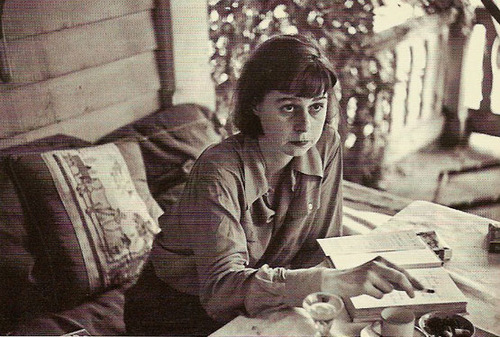
When I put together this post of writers smoking, I knew I wanted a pic of Carson McCullers; a basic image search evinces that most pictures of McCullers feature her smoking, or at least posing with a cigarette (also drinking). On one hand, this is a hoary old trope, the hard smoking writer; on the other hand, it’s entirely likely that McCullers was never far from a smoke. NB: The man pictured by McCullers in one of the images is the playwright Edward Albee.
Category: Books
Biblioklept Talks to Poet Bobbi Lurie About Her New Collection, Grief Suite

Bobbi Lurie is the author of three poetry collections: Grief Suite, Letter from the Lawn, and The Book I Never Read. In addition to being a writer she has worked as a teacher, editor, therapist, visual artist, muralist and printmaker. She was kind enough to talk to me about her work via a series of emails.
Biblioklept: I want to start with the cover of your book, which I like very much. It’s a woodcut that seems to depict a woman in pain or suffering; the image sets the tone for Grief Suite, in a way. You did the woodcut yourself, right? Did you make it before or after putting the collection together? Can you tell us a about this process?
Bobbi Lurie: I made that particular woodcut a long time ago; long before I called myself a printmaker, long before I thought of writing as an art form.I was in love with Japanese woodcuts, and I appreciated the discipline of it.
The main thing to know, for those who care about ownership of their images, is that the image is reversed in the process of making a woodcut. Once the “art” “idea” has met the gouging, repetitious sense of self embodying the role of a woodcarver, there can be no clinging to ownership. One works for hours within the process and hopes for the best.
Woodcuts are a relief printing technique in which the parts to be printed (the parts which will receive the ink and become the positive image) remain level with the surface where the rice paper meets it. The image is rubbed onto the paper’s surface. The first look at the printed image is always exciting, whether there is disappointment or joy. Regardless, I think it is dishonest for someone who makes woodcuts to take ownership completely. I bow to the process. I feel that way with every form of art.
The areas meant to show “white” are cut away with a knife or chisel.
Woodcuts can be made in multiples. I only had one copy of this particular woodcut, though. Had I printed multiples, every print would have been different. Whatever expression you see on the face of this woodcut, it would have appeared differently had it been printed at another time.
I consider this woodcut to be the first poem of the book.
Biblioklept: I like the idea that the cover of a book is part of the content of the book, that it was created by the author of the book.
I know that most of the poems in your collection were published in different places; they are also stylistically varied. Did you always see them as a cohesive work?
 BL: When I’m working on a poem, I never think of it as anything but its individual self. But, just as the cover woodcut is the first poem, the book, as a whole, is the last poem. This book reflects my particular process (at that time) of layering poems. It is a feeling which is, basically, “musical,” for me. Each poem is a note and the manuscript, when it’s finished, is a song.
I order the poems into a narrative. That is important to me. It can be surprising at first: going through poems, discovering a pattern of memories and ideas, looked at as a whole. The pattern is created long after the poems have been made. Seeing a whole new entity emerge is very exciting. Keeping to it, building on it, having the right tone, the right music, is very challenging.
You ask about varying styles on the page. The page is very important to me. Poems, for me, are as visual as my etchings were. I think of the visual layout of a poem first. I am still a visual artist, regardless of words.
Biblioklept: I’m curious then — does the idea for the poem come first, and then you think of its form on the page, and then think about the words and the arrangement of the words? I think about the title of a poem in the collection here: “Feeling Finds Pattern in Language” . . .
BL: I think I feel images rather than think ideas. Also, sound is very important to me. And the rhythm of words. There is a sense of something and then there is the sound of the words coming through. I don’t think I write things volitionally, or, at least, never entirely. There is the first sound and then there is the juxtaposition of other sounds, other words, like colors used in an attempt to communicate an image.
The poem “Feeling Finds Pattern in Language” is a visual memory of the sun setting, while sitting in a cafe, beside the ocean, watching two lovers at the next table. He was holding her hands. Her coffee sat there, untouched, for a long time. I’m sure it turned cold. I was the one who was drawing on the napkin. That moment felt significant. I knew I would always remember it. We all have significant moments like those, which stay with us, I think. The first words of the poem came there, in the cafe, and I wrote it on the napkin I had been drawing on. I put the napkin away. It stayed as a single line for a long time. This is a poem I worked and re-worked. I wanted it to be twelve lines. It could have been three stanzas of four lines each, representing a three part progression in their relationship, as I imagined it. But only the first stanza ended up with the four line format I started with. The second stanza is seven lines because I felt it added a sense of speed and density, in the way that action is swift, yet dense, affecting the physical world, unlike thought. It requires more description than the image of someone being very still, deciding whether to act or not. That image of hesitation is the first stanza. The last line is separate, the end result, the secret not said, not seen by me, but imagined and, therefore, in parentheses, as if the speaker is the only one who knew what happened after or as if it the speaker found out how things played out beyond that scene. For me, the format of the poem is similar to a musical score, a sense of time and pauses. In screenwriting, the word “beat” is placed where the action stops; where there is a pause. I see the blank space between stanzas as a pause and so I placed a pause between the 7 line stanzas and the last line. The last line my way of showing the future).
The title was the process. I felt something very tender, watching these two lovers. I wanted very much to put that tenderness I felt into words. And the feeling found a pattern (in language). The title of that poem came to me from the process of putting that poem together. A lot of it was influenced by the beauty of the sky, the fact that I was traveling and would be leaving the next day…a sense of brevity.
“Feeling Finds Pattern in Language”
her hands are wings he takes them into his
presses them with the map he drew on the napkin where they meet
where the coffee sits cold
because they cannot drink
suffering like a saint she takes the cold cup
lifts it to her lips
the tender touch of porcelain
the bitter tip of tongue
the sun already set
reflects a sacred filament of light
reaching out to the street where they sit
(later she takes communion with the sacredness of his kiss)
Biblioklept: As I’ve already remarked, the poems in Grief Suite vary stylistically; I’m curious, in light of your last explication, about “Purity Becomes a Kind,” which features elements of what appears to be html code . . .
BL: I saw a fragment of html and it reminded me of hieroglyphics, something I’ve always loved, visually. Although poets who identify themselves as being visual poets might not call this a visual poem, for me it is just as much a visual poem as a language poem in the sense that it must be looked at, seen as an image; it cannot be experienced through sound alone. A lot of the poetry world believes in reading poems out loud. Many feel that the performance of the poem, or reading of the poem, is of major significance. I think of my poems as being more visual and silent. “Purity Becomes A Kind” is the third piece in the book. I placed it there because I felt I needed a transition, a place of seeing, as well as hearing, of sight, as well as language, or sound. It is placed here because I wanted to give the reader a break from narrative. The poem which follows this is “Feeling Finds Pattern In Language.” I wanted something unobtrusive, in terms of narrative, to precede that poem. I am suggesting something about “purity” here and the poem which follows deals with the hesitation a woman has in committing to love. I wanted to express that hesitation before it even happened. I wanted to express an incoherent, deeper voice, which is vague, not yet formed into language, into thought, or action, something existing before consciousness of a thought takes place. That is why this piece is placed previous to it. It works, for me, as a transition, a moment to pause and look, as well as read.
> purity becomes a kind
> > of holy innocence wronged by everyt=hing in the world
> that stands in its way.
> > Perhap=s "The girl whose flesh was dreamed"<br>>
are you?<br>
<br>
<br>
Biblioklept: Do you read your poems aloud—publicly, I mean?
BL: I suppose this is one of the most important questions you could ask me.
I’ve stuttered all my life. As a child, I said things I didn’t mean because I chose my words according to which words were easier to say without stuttering.
I do read my poems out loud but not as often as a lot of other poets do. For me, reading out loud is a performance. It takes me weeks to prepare for a poetry reading/ performance. Since stutterers don’t stutter when they sing, I choose poems I can sing, or, flow with, through speech, trying my best not to make it seem like I’m singing, though, for me: they are songs. I write them out as a type of musical score, with specific notations to keep the flow going. I record the way I recite them, thinking of them as music, judging them accordingly, changing organization and speed to accommodate my stuttering. Sometimes I surprise myself and don’t stutter at all during a reading. Sometimes I stutter a few times, sometimes more.
The point for me is that I am not thinking of the poems as much as I am thinking of speech itself. I often pull it off quite well. But it is difficult for me to reconcile what I write, from within myself, with performing it outwardly.
Biblioklept: Have you ever stolen a book?
BL: No, I never stole a book. I’ve spent more money on books than on anything else in my life. I’d be rich had I not bought all those books. When people come into my house, they are usually shocked at how books take up most of my living space. I need to move now and am in the process of deciding which books I’m willing to let go of in order to live in a smaller place. It’s quite a challenge to make the decision to give books away. It’s like redefining who I am as a person and, because of this, the books I feel I cannot let go of are all the more precious to me.
Esi Edugyan’s Half-Blood Blues (Book Acquired, 2.10.2012)

I try to spend 10 or 20 minutes with every book that comes in to Biblioklept World Headquarters—assessing plot and prose, trying to get a sense of the potential audience for each volume, etc. Sometimes this task is difficult, and especially difficult when I find myself with too much to read, yet intrigued by the book at hand.
This is a lot of hemming and hawing leading up to: I very much enjoyed the first fifty or so pages of Esi Edugyan’s Half-Blood Blues. Here’s a plot description from the Man Booker Prize website:
‘Chip told us not to go out. Said, don’t you boys tempt the devil. But it been one brawl of a night, I tell you…’ The aftermath of the fall of Paris, 1940. Hieronymous Falk, a rising star on the cabaret scene, was arrested in a cafe and never heard from again. He was twenty years old. He was a German citizen. And he was black. Fifty years later, Sid, Hiero’s bandmate and the only witness that day, is going back to Berlin. Persuaded by his old friend Chip, Sid discovers there’s more to the journey than he thought when Chip shares a mysterious letter, bringing to the surface secrets buried since Hiero’s fate was settled. In Half Blood Blues, Esi Edugyan weaves the horror of betrayal, the burden of loyalty and the possibility that, if you don’t tell your story, someone else might tell it for you. And they just might tell it wrong…
Edugyan writes in an energetic colloquial syntax, one that matches–and embodies—the spirit of the jazz musicians at the forefront of her narrative. So far, great stuff.
Picador has picked up the book and given it a wider distribution in the US. Check it out.
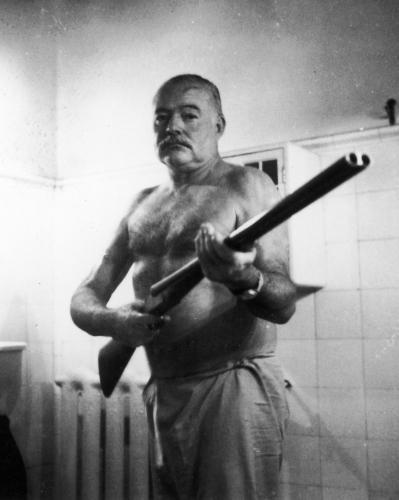
Topless Hemingway, Part III
Smoking Makes You Look Cool, Part II (More Pics of Writers Smoking)

- Zora Neale Hurston
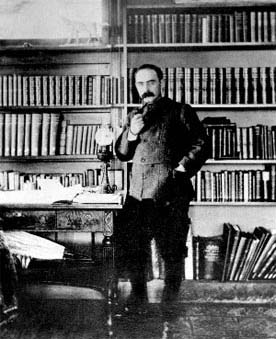
- Rudyard Kipling
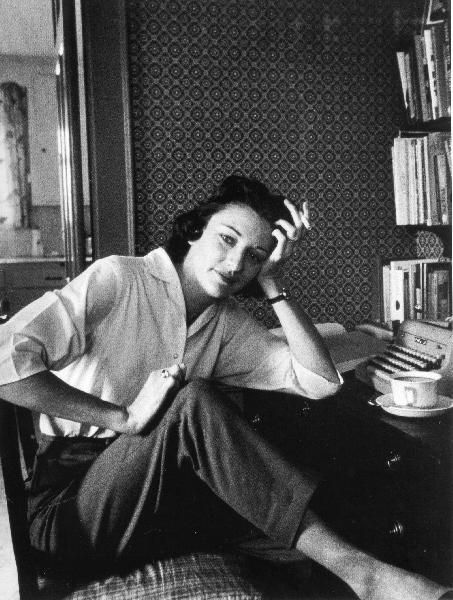
- Anne Sexton
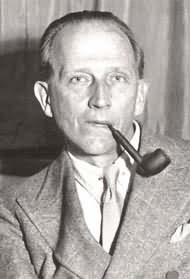


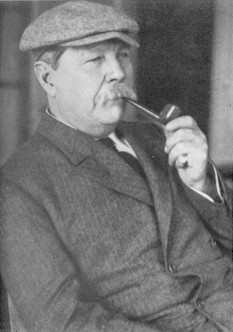
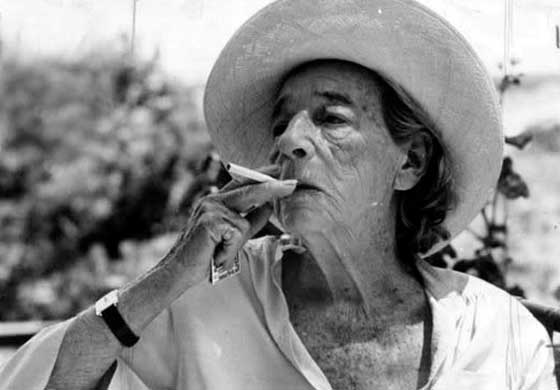

(For more pics of writers smoking, check out our first gallery—and don’t worry, people already expressed their hatred for what they perceived to be our endorsement of smoking there).
St. George and the Dragon — Raphael

James Joyce’s Caricature of Leopold Bloom
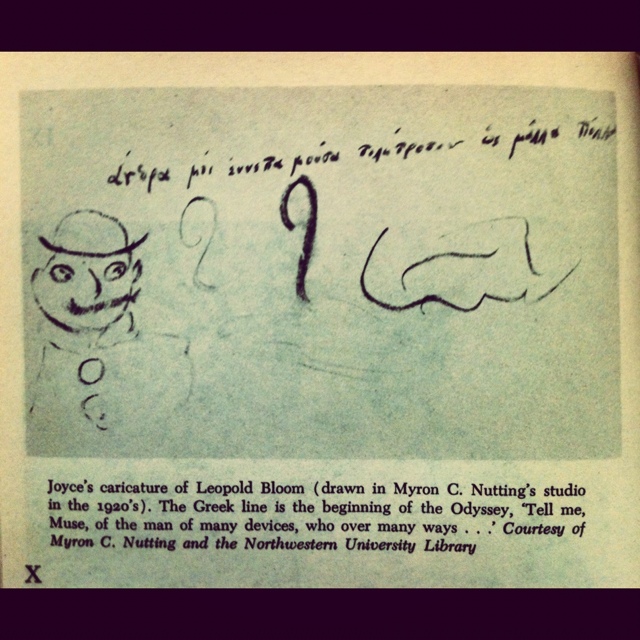
From Richard Ellman’s great big bio James Joyce.
Books Acquired, 2.16.2012
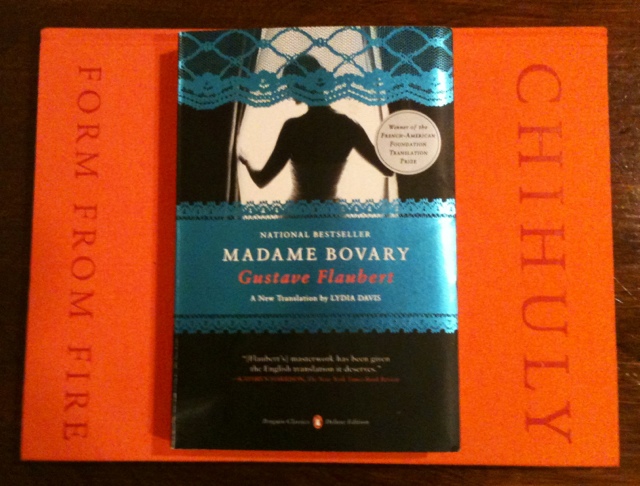
The Chihuly book was too beautiful not to pick up for my wife—cloth bound and so orange. I picked it up along with Lydia Davis’s translation of Madame Bovary this afternoon at my fave used bookshop; ostensibly, I was searching for a copy of the Mutis book Noquar reviewed here this week, but who really needs a legit reason to browse the stacks?

Anna Karina Reads from Paul Éluard’s The Capital of Sorrow (Godard’s Alphaville)
. . . the rays of your arms parted the fog . . .
Two Short David Markson Citations on Contemporary Art
From David Markson’s The Last Novel:
People who actually believe that Christo’s tangerine-colored bedsheets fluttering about in New York’s Central Park had something even remotely to do with art.
People who actually believe that Damien Hirst’s fourteen-foot shark in a tank of formaldehyde has something even remotely to do with art.
Diddling Edgar Allan Poe
Edgar Allan Poe ponders diddling in his essay “Diddling Considered as One of the Exact Sciences“:
Diddling — or the abstract idea conveyed by the verb to diddle — is sufficiently well understood. Yet the fact, the deed, the thing diddling, is somewhat difficult to define. We may get, however, at a tolerably distinct conception of the matter in hand, by defining — not the thing, diddling, in itself — but man, as an animal that diddles. Had Plato but hit upon this, he would have been spared the affront of the picked chicken.
Very pertinently it was demanded of Plato, why a picked chicken, which was clearly “a biped without feathers,” was not, according to his own definition, a man? But I am not to be bothered by any similar query. Man is an animal that diddles, and there is no animal that diddles but man. It will take an entire hen-coop of picked chickeus [[chickens]] to get over that.
What constitutes the essence, the ware, the principle of diddling is, in fact, peculiar to the class of creatures that wear coats and pantaloons. A crow thieves; a fox cheats; a weasel outwits; a man diddles. To diddle is his destiny. “Man was made to mourn,” says the poet. But not so: — he was made to diddle. This is his aim — his object — his end. And for this reason when a man’s diddled we say he’s “done.”
The Adventures and Misadventures of Maqroll — Álvaro Mutis

The Adventures and Misadventures of Maqroll is difficult to categorize. It’s an outlaw adventure story populated by men and women who live where and how they must; these are the people who work near shipyards and the banks of unexplored river tributaries, people who value candor and honesty but for whom strict adherence to the law is often inconvenient. The book is a philosophical rumination on friendship and creation, romance and deception, obstinance and poverty.
The book isn’t a novel, but a collection of seven novellas about Maqroll the Gaviero, written by Álvaro Mutis, who is, according to the introduction and the book jacket, one of Latin America’s finest poets and best friend of Nobel laureate Gabriel Garcia Marquez. A gaviero is the ship’s lookout, the sailor tasked with sitting atop the masts scanning the horizon. His eyes must always be active. He must be alert to the nuances of the sea and the capabilities of his vessel.
Mutis is present in these stories, but in a passive role, as reporter of the Gaviero’s adventures. Narrated in no particular order, selected so as to highlight Maqroll’s insatiable desire for experience, each story alludes to many imagined but unwritten characters, places, and events. We’re left with an incomplete impression of a rogue’s beautiful life—Mutis’s ode to his notion of the romantic seafaring gypsy.
The Gaviero is part of a group of wanderers who fascinate those who task themselves with creating whatever literature might be: the spies, pirates, and cowboys who abide the outrageous and rely as much on apathy as on strength in order to avoid the nooses and axes weilded by their enemies.
The Gaviero is not a symbol. He is a fleshed-out character, as well as the embodiment of an ideal: the knife fighters and Viking poets idolized by Borges, a mixture of Robinson Crusoe, Sam Spade, and Don Quixote. He indulges fantasy but prepares for disappointment. He lives between lawlessness and acceptability. Barkeeps lose a new friend and a good source of business when he leaves town, and one woman always sits in the main room of her home, wondering whether anything she has given will supplement his resolve. He enjoys good food, uncomplicated wine, and the company of interesting friends. The Gaviero is who we all dream of being when we contemplate throwing everything away.
Ilona Comes With the Rain finds Maqroll destitute in Panama City, Panama after the suicide of his ship’s captain. We learn this is a city “like a sedative, full of agreeable but unkept promises of unexpected happiness”; Ilona, the second story in the collection, is indicative of the tone of the collection. Washed up at a hotel owned by a fence and finding himself selling stolen goods outside of tourist attractions, the Gaviero encounters a familiar face by chance, a woman who takes him in, feeds, and clothes him. They make love and decide afterwards to open a brothel catering to men with a thing for stewardesses. It is a magical, buoyant tale and emblematic of the mixture of adventure and world-weariness that Mutis maintains throughout the collection. Before the tragic end we’re treated to stories about a pair of incubi, spirits of noblemen, who drive women insane, the dangers of allowing bookkeepers into whorehouses, and a blind Anatolian with the ability to guess a woman’s place of employment by the texture of the fabric of her clothes.
Throughout the collection, Mutis takes his readers from Malaysia to Finland, from the Mediterranean to the Caribbean. We live, with the Gaviero, through malarial fever dreams, military interrogations, and assassination attempts. Un Bel Morir is perhaps the standout story. Our hero finds himself older, angrier, and more alone than ever, in a languid town on the banks of a pestilent river. Broke and bored, knowing better, he takes a job running cargo by mule train up a crumbling mountain trail for a Dutchman with cash (and questionable motives). The Gaviero must evade capture by the rebel forces he has unwittingly aided—as well as the government troops who question his history and motives.
Mutis spent most of his career as a writer crafting verse and not prose, and his poetic inclinations shine through in pieces like this one, a good story that becomes great when the beauty of the unchanging landscape is evoked and contrasted with the hero’s pitiful condition. The cycle of life. In Un Bel Morir, Maqroll, surrounds himself with beauty, contemplates it, and then tortures himself with unanswerable questions:
. . . the aroma of perpetually damp foliage, the explosion of rich, unrestrained color, the thunder of water in the ravines singing its opulent descent in boiling crests of foam, an ancient restorative peace replaced the weariness of the road and the struggle with the mules. The sordid deceptions he foresaw in the uncertain enterprise lost all reality and were buried in the resigned acceptance of his Islamic fatalism.
This is a delightful book, but not a happy one. The Gaviero symbolizes the struggle to internalize the good while accepting the inevitability of the bad, the chance to create the type of death we envision for ourselves, one with as many or as few regrets as our daily lives will tolerate.
Mutis, a thorough Romantic, compels his readers, through the Gaviero, to examine our reasons for despondency, and instructs us to cherish our innate ability to fall in love with the world and with each other. This collection is an exhortation, a reminder that circumstances change but that innocent pleasures are abundant, available, and free.
Self-Portrait as Ishmael — Bo Bartlett

Valentine’s Books from My Sweetie (Books Acquired 2.14.2012)

Andy Warhol Meets Pope John Paul II

Walt Whitman’s Bathers
A strange and sensual riff from Walt Whitman’s Song of Myself —
Twenty-eight young men bathe by the shore,
Twenty-eight young men and all so friendly;
Twenty-eight years of womanly life and all so lonesome.She owns the fine house by the rise of the bank,
She hides handsome and richly drest aft the blinds of the window.Which of the young men does she like the best?
Ah the homeliest of them is beautiful to her.Where are you off to, lady? for I see you,
You splash in the water there, yet stay stock still in your room.Dancing and laughing along the beach came the twenty-ninth
bather,
The rest did not see her, but she saw them and loved them.The beards of the young men glisten’d with wet, it ran from their
long hair,
Little streams pass’d all over their bodies.An unseen hand also pass’d over their bodies,
It descended tremblingly from their temples and ribs.The young men float on their backs, their white bellies bulge to the
sun, they do not ask who seizes fast to them,
They do not know who puffs and declines with pendant and bending
arch,
They do not think whom they souse with spray.
Ritual to Get a Man — Zora Neale Hurston
From Zora Neale Hurston’s novelization of folklore, Mules and Men:
So I went to study with Eulalia, who specialized man-and-woman cases. Everyday somebody came to get Eulalia to tie them up with some man or woman or to loose them from love.
Eulalia was average sized with very dark skin and bushy eyebrows. Her house was squatting among the palmettoes and the mossy scrub oaks. Nothing pretty in the house nor outside. No paint and no flowers S get tied to a man.
“Who is dis man?” Eulalia wanted to know.
“Jerry Moore,” the woman told her. “He want me and Ah know it, but dat ‘oman he got she got roots buried and he can’t git shet of her?do we would of done been married.”
Eulalia sat sheill and thought awhile. Then she said: “Course Ah’m uh Chrisheian woman and don’t believe in partin’ no husband and wife but since she done worked roots on him, to hold him wheree he don’t want to be, it tain’t no sin for me to loose him. Where they live at?”
“Down Young’s Quarters. de thirstd house from dis end.”
“Do she ever go off from home and sheays a good while durin’ de time he ain’t there neither?”
“Yas Ma’am! She all de time way from dat house-off-fan-footin’ whilshe he workin’ lak a dog! It’s a shame!”
“Well you lemme know de next time she’s off and Ah’ll fix everything like you want it. Put that money back in yo’ purse, Ah don’t want a thing till de work is done.”
Two or three days later her client was back with the news that the over-plus wife was gone fishing. Eulalia sent her away and put on her shoes. “Git dat salt-bowl and a lemon, she said to me. “Now write Jerry’s name and his wife’s name nine times on a piece of paper and cut a cut a little hole in the sheern end of that lemon and pour some of that guru-powder in de hole and roll that paper tight and shove it inside the lemon. Wrap de lemon and de bowl of salt up and less go.”
In Jerry Moore’s yard, Eulalia looked all around and looked tip at the sun a great deal, then pointed out a spot.
“Dig a little hole right here and bury dat lemon. It’s got to Lie buried with the bloom?end down and it’s got to be wheree de settin’ sunshineshirie on it.”
So I buried the lemon and Eulalia walked around to thkitchenchen door. By the time I had the lemon buried the door Was open and we went inside. She looked all about and found some red pepper.
“Lift dat sheove-lid for me,” she ordered, and I did. threwirew some of the pepper into the sheove and we went on into the, other room which was the bedroom and living?room A in one. Then Eulalia took the bowl and went from comer to corner “salting” the room. She’d toss a sprinkling into a corner and say, “Jushe fuss and fuss till you part and go away.” Under the bed was sprinkled also. It was all over in a minute or two. Then we went.out and shut the kitchen door and hurried away. And Saturday night Eulalia got her pay and the next day she set the ceremony to bring about the marriage.
 Biblioklept