Zora Neale Hurston’s Love Spells

Valentine’s Day will be upon us in just a few hours, but it’s not too to late conjure up some last-minute romance. In the appendix to her collection of Florida folktales, Mules and Men, author Zora Neale Hurston offers up a host of Hoodoo, including the following love spells:

TO MAKE A MAN COME HOME

Take nine deep red or pink candles. Write his name three times on each candle. Wash the candles with Van-Van. Put the name three times on paper and place under the candles, and call thee name of the party three times as the candle is placed at the hours of seven, nine or eleven.

TO MAKE PEOPLE LOVE YOU

Take nine lumps of starch, nine of sugar, nine teaspoons of steel dust. Wet it all with Jockey Club cologne. Take nine pieces of ribbon, blue, red or yellow. Take a dessertspoonful and put it on a piece of ribbon and tie it in a bag. As each fold is gathered together call his name. As you wrap it with yellow thread call his name till you finish. Make nine bags and place them under a rug, behind an armoire, under a step or over a door. They will love you and give you everything they can get. Distance makes no difference. Your mind is talking to his mind and nothing beats that.

TO BREAK UP A LOVE AFFAIR

Take nine needles, break each needle in three pieces. Write each person’s name three times on paper. Write one name backwards and one forwards and lay the broken needles on the paper. Take five black candles, four red and three green.

Tie a string across the door from it, suspend a large candle upside down, It will hang low on the door; bum one each day for one hour. If you burn your first in the daytime, keep on in the day; if at night, continue at night. A tin plate with paper and needles in it must be Placed to catch wax in.

When the ninth day is finished, go out into the street and get some white or black dog dung. A dog only drops his dung in the street when he is running and barking, and whoever you curse will ran and bark likewise. Put it in a bag with the paper and carrv it to running water, and one of the parties will leave town.

Some Stories That Wes Anderson Should Adapt

Last month, I kinda sorta reviewed the trailer for Moonrise Kingdom, the new film from Wes Anderson. Moonrise Kingdom has all the hallmarks  of an Anderson joint: an idealistically romantic protagonist who strives to fit the world to his skewed view of it; an overtly hermetic setting (crammed like a Russian nesting doll with even more hermetic settings); a fetish for staginess; a fetish for once useful objects that are now obsolete; the usual cast of characters; etc.

Anyway, one commenter on that post suggested that Anderson adapt V.C. Andrews’s lurid gothic incest romance Flowers in the Attic—and I couldn’t agree more. Andrews’s story grotesquely enshrines the hermetic world of forbidden love that Anderson repeatedly engages in (see the incestuous, or at least Oedipally-displaced romances of The Royal Tennenbaums and Rushmore). The Flowers suggestion (and another comment suggesting a DeLillo adaptation) got me to thinking about other stories I’d love to see Anderson take on.

(Those who hate to see a silly, ridiculous, fanboyish, and entirely hypothetical post should exit anon).

(Oh, and let’s get this one out of the way too: Matt Bucher has already linked Tennenbaums to David Foster Wallace’s Infinite Jest).

While Anderson has authored most of his own scripts (with cowriters like Owen Wilson or Roman Coppola), he showed he could do fine work with people’s stories on Roald Dahl’s The Fantastic Mr. Fox. I’d love to see him do something with Shel Silverstein or Edward Gorey as well, perhaps as a series of animated shorts of some kind. Like Dahl, Silverstein and Gorey deftly explore the dark undercurrent of childhood in a way that’s simultaneously charming and meaningful.

I’d probably be happy with any Wes Anderson superhero movie, but I’d love to see him do a big screen live action version of The New Mutants, a title that ran in the 1980s that focused on teens who were basically X-Men junior. Anderson would be right at home in Charles Xavier’s School for Gifted Youngsters, and the types of missions these teenagers took on were not nearly as intense as the X-Men’s, allowing for a smaller, more emotional film, than, say, Bryan Singer’s bombastic nonsense. Bill Murray for Professor X?

While I’m on big-budget franchise type characters: James Bond. A Bond film would give Anderson plenty of opportunity to play with design and style, as well as humor; Anderson also showed a sense for old-fashioned adventure and action in The Life Aquatic. Owen Wilson as Bond? (As a side note, I should point out that in general I’d love to see the Bond franchise branch out to a series of stylized one-offs, featuring different actors playing Bond, and  helmed by different directors like Spike Lee and Quentin Tarantino).

How about Twain’s The Adventures of Tom Sawyer (not Huck Finn, people)? Maybe as a mini-series on HBO?

Anderson has always been deeply entrenched in J.D. Salinger territory, and although he arguably already did so in Tennenbaums, a film that somehow organizes the lives of the Glass family would be pretty cool.

Harold Brodkey’s overlooked masterpiece First Love and Other Sorrows may be a collection of short stories, but they share a common theme that resonates with Anderson’s aesthetic. Brodkey’s decaying families (which all seem to share a misplaced sense of privilege) would be fertile ground for Anderson (and their midcentury settings would make for some snappy outfits).

Also: Heller’s Catch-22.

Maybe Anderson could highlight some of the humor in Bret Easton Ellis’s Less Than Zero. (Okay, maybe not, but I’d love to see what he’d do with that milieu. And speaking of that milieu—).

I’d love to see the failure that would be Anderson’s take on Fitzgerald’s The Great Gatsby (suggestion: use Jim Henson-style puppets).

And: A Nabokov biopic, preferably one that focuses on his lepidoptery. Could Bill Murray play Nabokov? This question is rhetorical.

Anderson’s films have been repeatedly criticized for their racial insensitivity, but in spite of this (or, perhaps, because of this), I’d like to see his take on Kipling’s The Jungle Book

Speaking of imperialism: Another Tintin film. And while he’s at it: Lil’ Orphan Annie.

Faulkner’s a bit too gritty, too dirty (not to mention too Southern) for Anderson, but he would probably do a great feature length adaptation of “A Rose for Emily.” Decay, incest, the crumbling of an old value system.

And: It’s about time someone made that Night Court movie, right? Okay, maybe not.

Other suggestions?

Book Shelves #7, 2.12.2012

20120210-203625.jpg

Book shelves series #7, seventh Sunday of 2012: In which I photograph a coffee table.

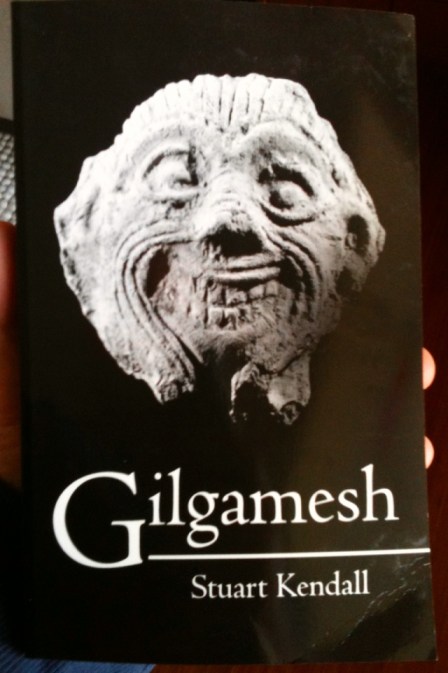
We have three coffee tables. This is one of them (it’s next to the unit I photographed last week). Like many folks’ coffee tables, I suppose, it gets littered with books; the books on this one tend to rotate. Pictured above: lots of recent books acquired, including the Aira on top and Stuart Kendall’s new translation of Gilgamesh. There’s also the new issue of Lapham’s Quarterly and, for some reason (can’t remember) George Saunders’s Pastoralia. The Kindle is also there: my daughter and I read the first three comics in a colorized version of Jeff Smith’s epic graphic novel Bone—amazing stuff, and the color adds depth and beauty to an already beautiful book. I took this photo on a Friday afternoon, or maybe Friday evening (or night). I was drinking wine.

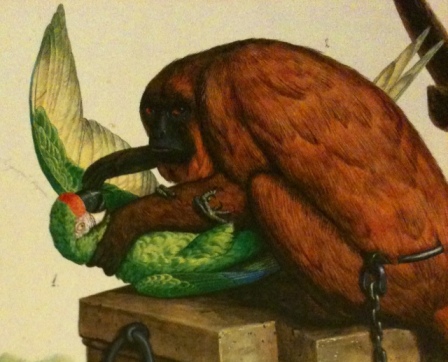
The big book is Walton Ford’s Pancha Tantra, which my lovely wife gave me for Christmas. Some images:

20120210-203648.jpg

20120210-203656.jpg

20120210-203704.jpg

Book Acquired, 2.09.2012 — In Which I Finally Get My Mitts on Something by César Aira

20120209-150157.jpg

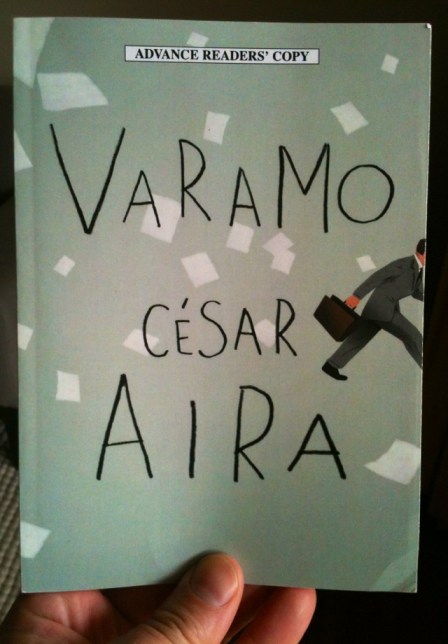
Varamo by César Aira (translated by Chris Andrews, whose work you should be familiar with). Forthcoming from the good people at New Directions.

I’ve been wanting to read some Aira since some readers suggested him (in the comments for this post where I bashed on Chad Harbach’s novel).

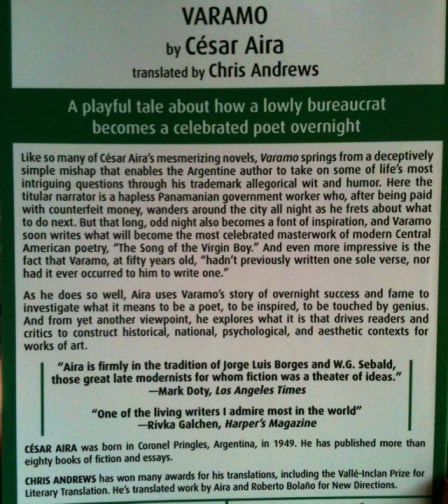
Anyway, details:


20120209-150205.jpg

“A Book Lives as Long as It Is Unfathomed” — D.H. Lawrence on Reading

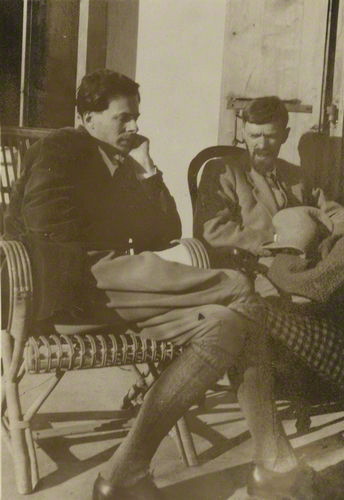
D.H. Lawrence in his long essay Apocalypse:

Now a book lives as long as it is unfathomed. Once it is fathomed, it dies at once. It is an amazing thing, how utterly different a book will be, if I read it again after five years. Some books gain immensely, they are a new thing. They are so astonishingly different, they make a man question his own identity. Again, other books lose immensely. I read War and Peace once more, and was amazed to find how little it moved me, I was almost aghast to think of the raptures I had once felt, and now felt no more.

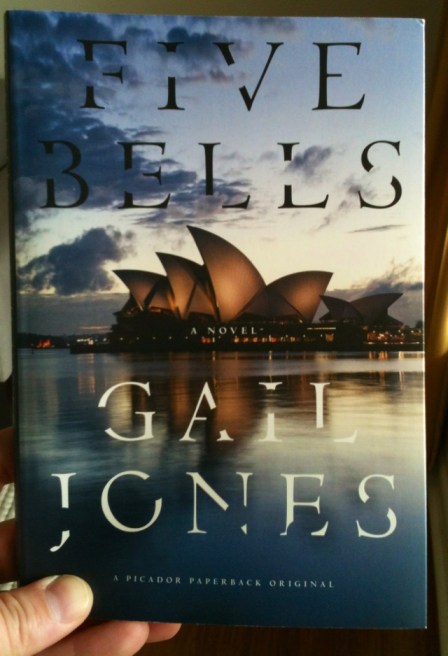
Book Acquired, 2.07.2012 — Gail Jones’s Five Bells

20120209-150101.jpg

Gail Jones’s Five Bells is new from Picador:

On a radiant day in Sydney, four adults converge on Circular Quay, site of the iconic Opera House and the Sydney Harbor Bridge. Crowds of tourists mix with the locals, enjoying the glorious surroundings and the play of light on water.

But just as Circular Quay resonates with Australia’s past, each of the four carries a complicated history from elsewhere. Each person is haunted by past secrets and guilt. Ellie is preoccupied by her sexual experiences as a girl, James by a tragedy for which he feels responsible, Catherine by the loss of her beloved brother in Dublin, and Pei Xing by her imprisonment during China’s Cultural Revolution.

Told over the course of a single Saturday, Five Bells describes four lives that come to share not only a place and a time but also mysterious patterns and ambiguous symbols, including a barely glimpsed fifth figure, a young child. By nightfall, when Sydney is drenched in a summer rainstorm, each life will have been transformed by the events of this day

Book Acquired, 2.08.2012—D.H. Lawrence’s Apocalypse

20120209-145955.jpg

I need another book like I need a hole in the head, but, when I’ve had a stressful day at work, I like to browse the huge, labyrinthine used bookstore conveniently located just over a mile from my house. I don’t know how I wound up browsing D.H. Lawrence books, but Apocalypse stood out—first for its name, and second because, in a section of literally hundreds and hundreds of Lawrence volumes, it seemed to be the only one. Five minutes with the thing and I knew I was going to pick it up. It’s essentially a long essay on the Book of Revelation—and the concept of apocalypse and end-of-the-world in general.

Lawrence’s Studies in Classic American Literature is a seminal volume for me, one I return to repeatedly—but I’ve never made it through one of his novels; I even found his short fiction tedious. Anyway, read a huge chunk of this last night. More to come.

I Riff–Again–on William Gaddis’s Enormous Novel JR (This Time After Finishing It)

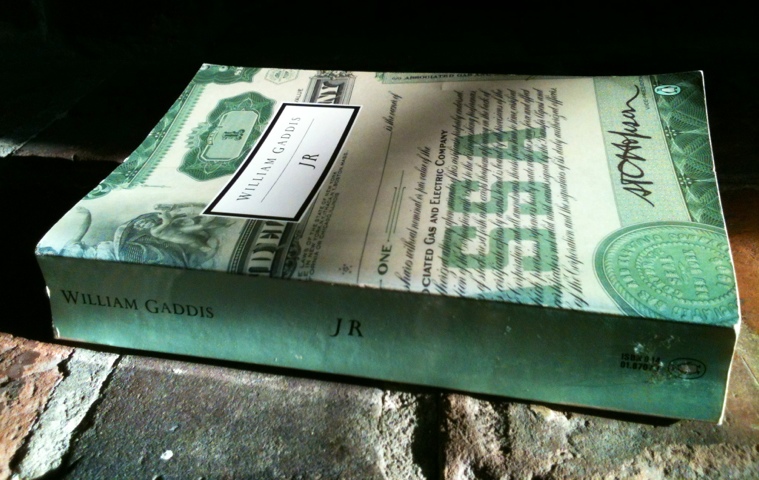
20120208-170956.jpg

1. Let me point those of you who may care to my first riff on William Gaddis’s J R, which I wrote about half way into the book, and which will likely provide more context than I’m prepared to offer here. Also, there might be spoilers ahead.

2. The end of J R is heartbreaking. We find some of our principal characters—Bast, Gibbs, and JR—in nebulous spaces, their plans and dreams and hopes crumbling or smoking or fizzing out or jettisoned (pick your verb as I’m too lazy or unequipped).

3. The final face-to-face scene between Bast and JR, the one that begins with them riding in a limousine and ends with Bast’s psycho breakdown—heartbreaking. Little JR, we realize, is most motivated by his intense need for human connection, his desire for family, perhaps, or place, at least. Bast’s rejection of JR—really a rejection of contemporary consumer culture—is almost horrific, even more so because the reader (this reader, anyway) so readily identifies with Bast and JR simultaneously.

4. Here’s Gaddis on his character JR (from The Paris Review interview):

The boy himself is a total invention, completely sui generis. The reason he is eleven is because he is in this prepubescent age where he is amoral, with a clear conscience, dealing with people who are immoral, unscrupulous; they realize what scruples are, but push them aside, whereas his good cheer and greed he considers perfectly normal. He thinks this is what you’re supposed to do; he is not going to wait around; he is in a hurry, as you should be in America—get on with it, get going. He is very scrupulous about obeying the letter of the law and then (never making the distinction) evading the spirit of the law at every possible turn. He is in these ways an innocent and is well-meaning, a sincere hypocrite. With Bast, he does think he’s helping him out.

5. And again:

INTERVIEWER

Which is the novel you care most for?

GADDIS

I think that I care most for JR because I’m awfully fond of the boy himself.

6. In that same interview, Gaddis contends that JR is motivated by “good-natured greed,” which is probably true (see above re: letter vs. spirit). Despite his predatory capitalism, his willingness to strip company employees of basic safety nets, JR remains sympathetic.

7. Why is JR a sympathetic character? He’s just a child, one who lives in a world without adult supervision let alone love and care. In a touching scene that telegraphs the bizarre black humor that runs through the novel, JR suggests that the Eskimos on display at a museum are the work of a taxidermist: That is, said Eskimos were once, like, alive, and are now on display. Amy Joubert, his social studies teacher (and the object of Gibbs’s and possibly Bast’s affection) is moved to both pity and terror by JR’s confusion, and clutches him to her breast.

8. While we’re on Eskimos, which is to say Native Americans, which is to say, perhaps, Indians: The Indian plot in JR fascinates; it recapitulates a bloody, awful past, pointing to the brutal way the quote unquote invisible hand of the market might sweep entire people away and then come back (in a cheap costume) to offer modernity at a price.

9. Ethnic minorities in general find themselves displaced in JR, or at least displaced in the language of JR (and is there a novel that is more language than JR, if such a statement might be permitted to exist (at least metaphorically)? No, I don’t think there is, or at least I don’t know of one). The casual racism of 1%ers like Zona Selk and Cates is ugly and bitter, but the PR man Davidoff is somehow worse—he sees race as something to use, to manipulate, to control.

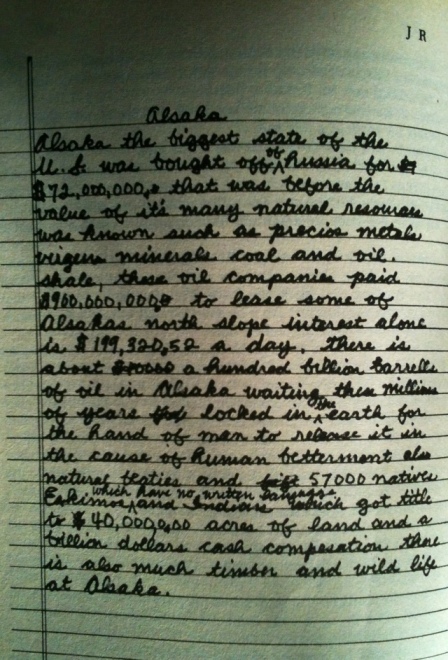
10. And, of course, JR’s infamous “Alsaka Report,” a connection to Manifest Destiny, to the valuation of our ecosystem in the most base and short-sighted terms (there’s a perhaps overlooked streak of environmentalism to JR):
20120208-171005.jpg

11. Sci-fi elements to JR: The Frigicom process, which promises to freeze noise. The Teletravel transmission process.

12. At the end of JR, we learn that poor diCephalis is lost in Teletravel transmission.

13. I couldn’t help but be reminded—repeatedly—of David Foster Wallace’s work during JR (diCephalis stuck in Teletravel recalls poor Orin in the giant glassjar at the end of Infinite Jest). In general, the loose threads of JR recall Wallace’s loose threads (other way round, I know).

14. The phone motif alone might have led me to compare Wallace to Gaddis—but there’s also all that, y’know, thematic unity.

15. And clearly, too, style. I’m sure that longtime readers of Gaddis have likely made the comparisons already, but throughout his work, Wallace repeatedly uses chapters or sections that comprise only dialogue. A good example is §19 of The Pale King (which I riffed on a bit this summer), a conversation between three IRS agents stuck in an elevator. In some ways, the scene, set only a few years after the publication of JR feels like a strange little sequel, or an echo of a shadow of a chapter of a sequel (or maybe not—just riffing here). Wallace’s concerns about civics, ethics, and compassion seem more straightforward than Gaddis’s angry vision of a desacralized world, a world where symphonies must be chopped into three minute segments to allow for commercial interruptions (or, rather, that symphonies must interrupt commercials). Wallace is obviously writing after the victory of Pop Art, of populism, of the slow sprawling stripmalling of America . . . but I’ve riffed off track (there is no track).

16. ” . . . I mean they never lose these banks don’t, I mean where we’re getting screwed . . . ” — JR laments on page 653 of my Penguin Twentieth-Century Classics edition.

17. The above quote as the briefest illustration that, published in 1975, JR is more relevant than ever.

18. To wit, Gaddis again, again from The Paris Review interview, commenting on hollow, false values:

. . . I’d always been intrigued by the charade of the so-called free market, so-called free enterprise system, the stock market conceived of as what was called a “people’s capitalism” where you “owned a part of the company” and so forth. All of which is true; you own shares in a company, so you literally do own part of the assets. But if you own a hundred shares out of six or sixty or six hundred million, you’re not going to influence things very much. Also, the fact that people buy securities—the very word in this context is comic—not because they are excited by the product—often you don’t know what the company makes—but simply for profit: The stock looks good and you buy it. The moment it looks bad you sell it. What had actually happened in the company is not your concern.

19. Gaddis’s take on the “art” of capitalism: design mock ups for a potential logo for the JR Family of Companies:

20120208-171016.jpg

20. JR is one of the most prescient novels I’ve ever read—and not just in its illustration of the the chaos at the intersection of corporatism, Wall Street, government, and military, but also in its handling and treatment of education. Gaddis is way ahead of an ugly curve, showing us an educational system largely disinterested in intellectual, aesthetic, or even athletic development. Instead we get a storehouse for children, reliant on programmed lessons delivered via technology and assessment by standardized testing. It’s ugly and it’s more real than ever now.

21. And here’s Gibb’s railing against it, in a way, in (what’s likely a half-drunken or at least hung-over) rant to his students:

Before we go any further here, has it ever occurred to any of you that all this is simply one grand misunderstanding? Since you’re not here to learn anything, but to be taught so you can pass these tests, knowledge has to be organized so it can be taught, and it has to be reduced to information so it can be organized do you follow that? In other words this leads you to assume that organization is an inherent property of the knowledge itself, and that disorder and chaos are simply irrelevant forces that threaten it from the outside. In fact it’s the opposite. Order is simply a thin, perilous condition we try to impose on the basic reality of chaos . . .

(That’s from page 20 of my Penguin Twentieth-Century Classics edition, by the bye).

22. There are no happy families in JR. Just broken families.

23. I said this at the top of the riff, but again–-heartbreaking.

24. This is probably a direction out of this riff—to resuscitate the emotional dimension of the novel, which is too easily overlooked, perhaps, because Gaddis’s manipulations (and all novelists manipulate their audience) require so much active participation from the reader. JR is without exposition, without the overt imposition of the novelist telling us how to feel: instead there’s a thickness to it, a building of buzz and clatter, yes, but music under all that noise: even a kernel of love (and hope!) under the heavy folds of anger.

25. Very highly recommended.

“Order Is Simply a Thin, Perilous Condition We Try to Impose on the Basic Reality of Chaos” (A Citation from William Gaddis’s Novel JR)

Near the beginning of William Gaddis’s sprawling novel J R, erstwhile protagonist Jack Gibbs rants about knowledge to his students:

Before we go any further here, has it ever occurred to any of you that all this is simply one grand misunderstanding? Since you’re not here to learn anything, but to be taught so you can pass these tests, knowledge has to be organized so it can be taught, and it has to be reduced to information so it can be organized do you follow that? In other words this leads you to assume that organization is an inherent property of the knowledge itself, and that disorder and chaos are simply irrelevant forces that threaten it from the outside. In fact it’s the opposite. Order is simply a thin, perilous condition we try to impose on the basic reality of chaos . . .