
Category: Books
David Markson: “Originally I Was Calling It Wittgenstein’s Niece”
More from David Markson’s interview at the Dalkey Archive:
DM: Originally I was calling it “Wittgenstein’s Niece.” Never knowing, of course, that Thomas Bernhard would eventually publish something called “Wittgenstein’s Nephew.” But even before I submitted it I knew I’d have enough trouble finding a publisher as was—hardly the amount I did have, but some—and so not wanting to compound the difficulty I changed it to “Keeper of the Ghosts.” Which is something I swiped from Lowry, by the way, from a character named Ghostkeeper. But once the manuscript wound up in the hands of a small press that wasn’t going to be worried about recognition value in Downers Grove, Illinois, or among the knuckleheads at a sales conference, I went back to Wittgenstein. “Mistress” had been on the same scratch sheet with “Niece,” and I decided I liked it better by then.
JT: And meaning basically that your heroine is mistress to Wittgenstein’s thought?
DM: Well, along with several other people’s yes. But as I started to say a few minutes ago, the Wittgenstein is frequently most obvious in the very way she questions so many of her own “propositions,” as it were.
“I Suppose You Become Addicted to a Certain Kind of Writing” — David Markson on Lowry, Joyce, and Gaddis
David Markson talked with Joseph Tabbi about (among many other things) his friendship with Malcolm Lowry, his love for William Gaddis’s The Recognitions, and how James Joyce teaches us to read. Read the entire interview at the Dalkey Archive:
JT: You mention your critical study of “Volcano.” But you did a master’s thesis on it at Columbia much earlier?
DM: While we were in touch, but before I’d actually met him, yes. In 1951.
JT: Which means it was only four years after the novel had been published. Isn’t that rare, an academic paper on an entirely “new” writer with no body of criticism to verify his status?
DM: As a matter of fact I had to wander around the English department knocking on doors looking for someone to approve the project. I remember Lionel Trilling’s dismissal in particular: “What is all this drunkenness all about?” My whole object was to explain just that, obviously, but I decided to find less of a current to buck. Finally William York Tindall gave me a go-ahead.
JT: That brings up a question of a different sort, however. “Volcano” is scarcely your everyday traditional novel. What sort of training or background did you have that let you feel able to confront the challenge of interpreting something that difficult?
DM: To tell the truth, I’m not sure if I had any real idea what I was getting into, or if any of us do, the first time we’re seduced by a book of that sort. Though Joyce certainly teaches us, for starters. By which I mean that we all learn quickly with “Ulysses” that we cannot simply read the novel itself but have to lean on some of the critical crutches.
JT: But you had no crutches at all?
DM: Oh, well, but there are always clues in the text itself—this reference to that which leads to patterns you begin to trace out. On one level I impressed the hell out of myself, surprised at what I did know. And evidently I impressed a few other creatures as well, since I kept hearing that the thesis was being stolen from by students all over the place. The again when I sat down years later to turn that early stuff into a full length book I was almost embarrassed at how little I’d seen after all.
JT: Not long after that original Lowry thesis you were proselytizing fairly extensively for “The Recognitions” too?
DM: I suppose you become addicted to a certain kind of writing. There’s little enough of it extant, God knows. I’m not sure how much actual “proselytizing” I did for Gaddis, however. Except of course for practically button-holing friends on street corners.
JT: But I understand you were very directly responsible for the first reissue of the book, also?
DM: Evidently I was. It’s a funny story, actually. I was living in Mexico, and someone—well, old Aiken, in fact—gave my address to Aaron Asher, who was the editor of Meridian Books at the time. I picked him and his wife Linda up at their hotel and brought them out to where Elaine and I were living—outside Mexico City—for dinner and then spent approximately three solid hours talking nonstop about Gaddis. Finally Aaron threw up his hands in despair, telling me, “Please, please, I promise I’ll read the darned thing as soon as I get home! But now tell us something about where to go and what to see in Mexico, for heaven’s sake!”
JT: And then he did publish it. Did Gaddis himself know about the impetus?
DM: That’s fairly funny too, as it happens. “The Recognitions” came out in 1955. I’d read it twice when it did, and then wrote Gaddis a letter. It’s perhaps the only other letter I’ve written to an author I didn’t know, but it was completely different from the one I wrote to Lowry. In this case I’d just been infuriated by the rotten reviews and simply wanted to tell the man the hell with them all, that there were some few of us out there who did see what he’s accomplished. I didn’t get an answer, though I eventually heard secondhand that Gaddis had been too depressed at the time to send one. Or that he’d ultimately decided it was too late. But then sometime in 1961, not long after the Asher incident, I did hear. Six years after the fact, this was, a long letter beginning with something like, “Dear David Markson, if I can presume to answer yours of June whatever, 1955!” Which went on to say that Asher was in fact about to do a first reprint.
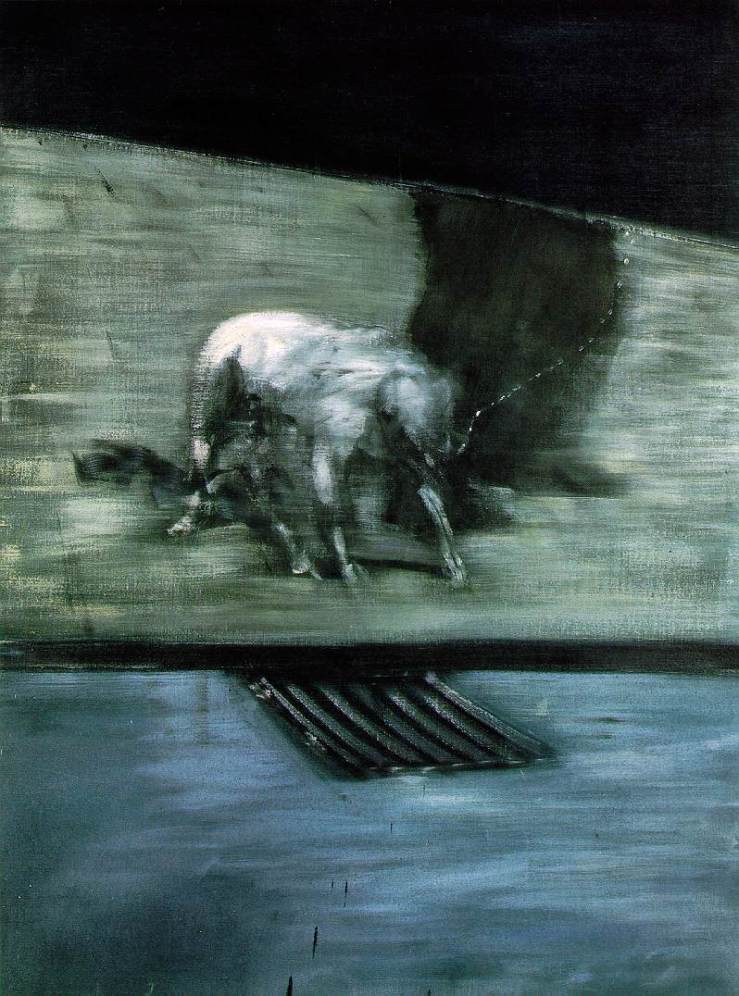
Man with Dog — Francis Bacon
Book Shelves #2, 1.08.2012
. . . it’s not too difficult, very obviously, to keep ten or twenty or let’s say even a hundred books; but once you start to have 361, or a thousand, or three thousand, and especially when the total starts to increase every day or thereabouts, the problem arises, first of all of arranging all these books somewhere and then of being able to lay your hand on them one day when, for whatever reason, you either want or need to read them at last or even to reread them.
Thus the problem of a library is twofold: a problem of space, first of all, then a problem of order.
—Georges Perec, from “Brief Notes on the Art and Manner of Arranging One’s Books” (1978)
Book shelves series #2, second Sunday of 2012. Master bedroom: Corner piece bookshelf in the southwest corner; two tiers + top shelf.
I didn’t take a picture of the entire bookshelf, a humble little two-tier piece that abuts the corner of any room with corners. Actually, I did take a picture—a few—but they just looked awful. Like I said in the first installment of this series, it’s not my goal to present aesthetically pleasing portraits of bookshelves.
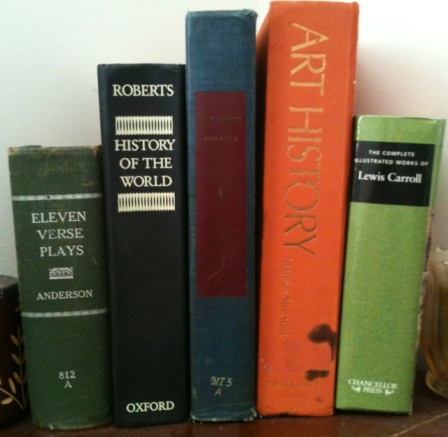
This corner bookshelf was my grandmother’s and I’ve had it for at least 10 years. The top shelf holds five books that rest there for entirely aesthetic purposes; looking at them now I realize that, with the exception of the Audubon volume in the middle and the Lewis Carroll on the end, I’ve never even bothered to flick through them. They look strange photographed here without the framed photographs, plants, and tchotchkes that attend most shelves in the house:
At one point, this entire piece of furniture was double shelved (is this a term? Do you know what I mean here?) with cheap mass market paperbacks, the kind of books that I bought and received for years. I rarely buy mass markets anymore; nor do I like hardbacks. I’m a trade paperback man. Still, some of the sci-fi/dystopian lit here was fundamental to my early reading habits, to the point where I even pick up newer volumes (like Philip Pullman’s books) in mass market paperback.
We also see here the first of many cameras scattered throughout the books in this house. This particular Polaroid is likely the least antiquated; I think it’s from 1999 or 2000. I took all these photos with an iPhone:

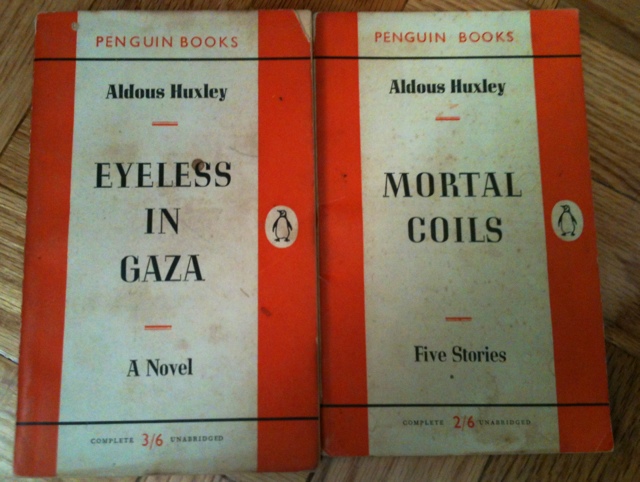
The shot is blurry, so you might not make out the cracked spines, but there are many Huxley books there (although it occurs to me now how odd it is that only one Vonnegut volume is there, when I know that I have so many more somewhere). Two noteworthy Huxleys:
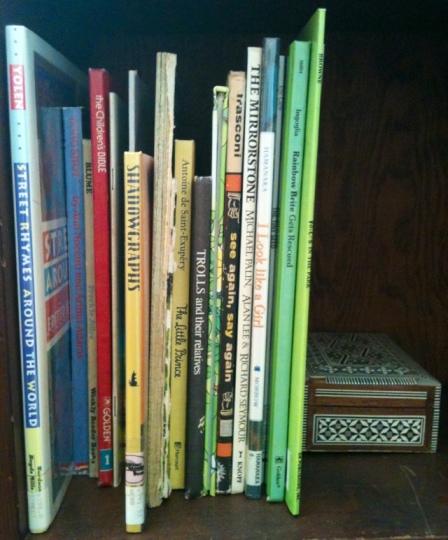
We have children. There are children’s books everywhere in the house, organized in no particular fashion. The drawing and painting books belonged to my grandmother, who was an amateur painter. I am fairly familiar with these books.

More kids books. They were probably stuffed here after piling up on the floor one night. The box is full of homemade dice and preserved insects:
And more mass markets—sci-fi and fantasy. Many of these were, uh, “borrowed” and never returned, either from a school that I used to work for (The Left Hand of Darkness; Alas Babylon, the aforementioned Pullman volumes), or from dear friends (I’m looking at you, William Gibson books). There are probably 50 more books like this in a secret stash in the back of the house, out of sight:

The Lord of the Rings trilogy is an early paperback edition, sporting Tolkien’s original illustrations. My aunt gave me these. I’ve probably read The Lord of the Rings more than any other book, and I’m almost certain that I’ve owned it in more editions than any other book:

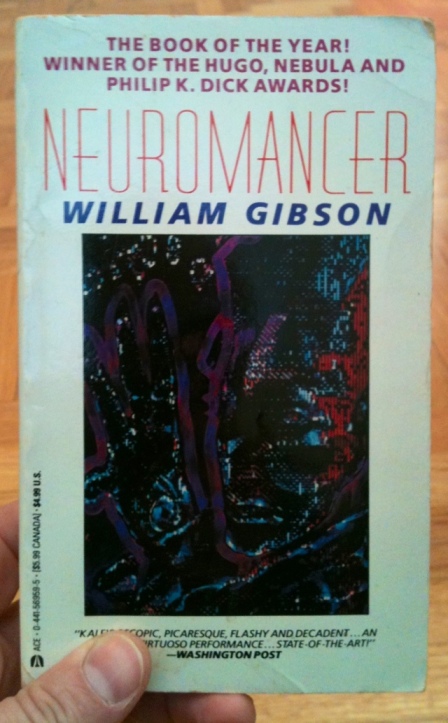
A dear friend lent me Gibson’s Neuromancer years ago; I know Gibson’s other early books (the first two trilogies) must be somewhere around the house, unless I passed them on, but I’ve always been fond of this book, which taught me how to read in some ways:
So we’ve made it out of my bedroom—I chose not to take a picture of my wife’s night stand, for her privacy, I suppose, although she might not have cared. (She doesn’t read this blog and is likely unaware of this weird project). There was a Hayao Miyazaki adaptation she was reading to our daughter there, and Hemingway’s novel The Garden of Eden, which I think she finished just the other night.
Book Acquired, 1.06.2012 — H.G. Adler’s Panorama, A Lost Modernist Classic

Like Kafka, H.G. Adler was a German-speaking Jewish writer from Prague. About a year ago, Adler’s Panorama was released for the first time in in English (by Peter Filkins); The book is now available in trade paperback (Random House). Adler survived the Holocaust, forced first into Theresienstadt and then Auschwitz, where his wife and mother were murdered in the gas chambers. Panorama is an autobiographical bildungsroman, with its hero, young Josef Kramer, standing in for Adler. While the book clearly works its way into grim territory, the beginning is bucolic and sweet and strange, an account of young Josef at home with his family. There’s a cinematic scope to Adler’s prose – Panorama is a Modernist work, one where the narrative freely dips into its protagonist’s mind. By the bye, W.G. Sebald references Adler in Austerlitz, a book that tries to measure the continental memory of the Holocaust.
“Being Dead While You’re Alive — That’s Real Death” — Henry Miller & Anaïs Nin on Death and Dreams
Michel Houellebecq, Curmudgeonly Pain in the Ass
From Michel Houellebecq’s 2010 Paris Review interview:
INTERVIEWER
You’ve said that you are “an old Calvinist pain-in-the-ass.” What do you mean?
HOUELLEBECQ
I tend to think that good and evil exist and that the quantity in each of us is unchangeable. The moral character of people is set, fixed until death. This resembles the Calvinist notion of predestination, in which people are born saved or damned, without being able to do a thing about it. And I am a curmudgeonly pain in the ass because I refuse to diverge from the scientific method or to believe there is a truth beyond science.
“Nothing but Misery, Nothing but Monsters” — Henry Miller Walks Around New York, Talking About His Childhood
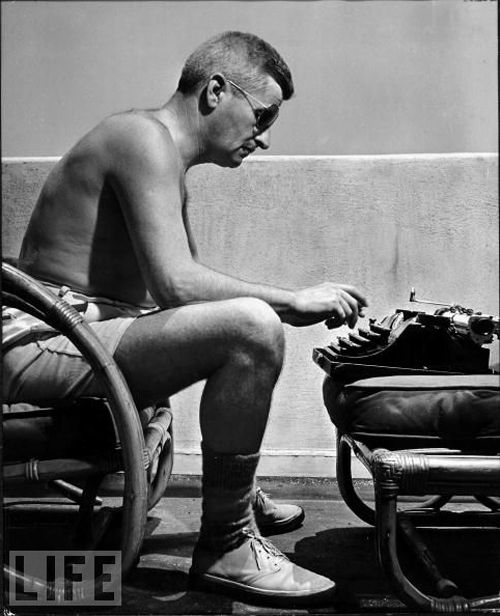
Topless Faulkner, Part II
Book Acquired, 1.04.2012

The Sweet Relief of Missing Children by Sarah Braunstein. I like the awkwardness of the title: what is “missing” modifying? Is it an adjective, describing the children? Is it a gerund? Who is gaining relief from what?
Publisher Norton’s description:
In New York City, a girl called Leonora vanishes without a trace. Years earlier and miles upstate, Goldie, a wild, negligent mother, searches for a man to help raise her precocious son, Paul, who later discovers that the only way to save his soul is to run away. As the narrative moves back and forth in time, we find deeper interconnections between these stories and growing clues about Leonora—this missing girl whose face looks out from telephone poles and billboards—whom one character will give anything to save.
The Sweet Relief of Missing Children is a suspenseful novel about the power of running and the desire for reinvention. It explores the terror and transcendence of our most central experiences: childhood, parenthood, sex, love.
Grand Larousse — Guy Laramée

Book Acquired 1.03.2012 — Tim Tebow Edition
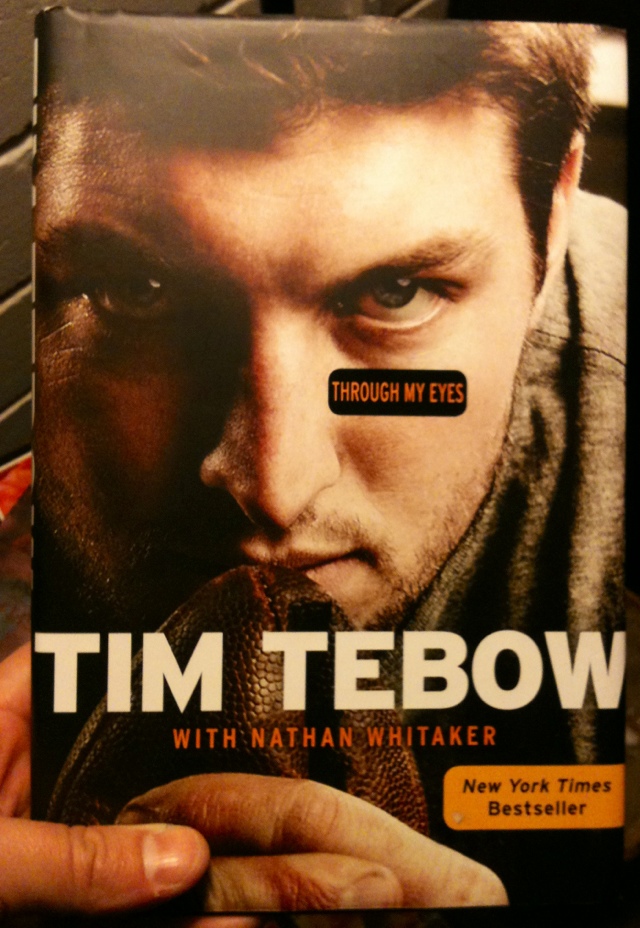
My father doesn’t read a lot of books, or at least I don’t think he does, but I know he read Through My Eyes, the Tim Tebow memoir. I’m pretty sure he must have gotten a duplicate for Christmas, because he sent a copy my way yesterday.
If you don’t know who Tim Tebow is (that is, if you’re not a fan of U.S. football, or not from the States, or you just don’t care about sports, or Twitter, or whatever), he was one of the greatest college players of all time, leading the Florida Gators to two national championship titles and two SEC titles. He’s also a devout Christian, the son of missionaries. He currently is the starting quarterback for the Denver Broncos, a team he helped take (quite improbably) to the playoffs this year.
Also: a vocal contingent of people really enjoy hating on him.
Not me. Tebow is from my hometown. I went to the University of Florida. I’m a big Gator fan. And even though I’m not exactly simpatico with evangelical Christianity, Tebow has always struck me as a genuinely good, nice person.
Anyway, I have some interest in the book, although I’m sure it’s pretty standard ghostwritten sports celebrity memoir stuff.
Here is what my dad also got for Christmas: a signed Tebow ball. (My name is also Ed, so one day maybe I will have this ball too):

“Seen in a Junk Yard” — F. Scott Fitzgerald
From F. Scott Fitzgerald’s Notebooks—
Dogs, chickens with few claws, brass fittings, T’s elbow, rust everywhere, bales of metal 1800 lbs., plumbing fixtures, bathtubs, sinks, water pumps, wheels, Fordson tractor, Acetylene lamps for tractors, sewing machine, bell on dingy, box of bolts, No. 1 van, stove, auto stuff (No. 2), army trucks, cast iron, body hot dog stand, dinky engines, sprockets like watch parts, hinge all taken apart on building side, motorcycle radiators, George on the high army truck.
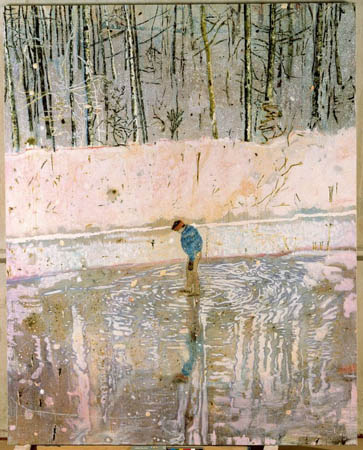
Blotter — Peter Doig
“Books Are Like Ghosts” — Roberto Bolaño on Lost Books

Roberto Bolaño on lost books. From Between Parentheses:
To search for those copies or similar copies, the same font, the same layout, the same plot, the dark or bright syntax, somehow forces me to remember a time when I was young and poor and careless, though I know that the same copies, the exact same ones, will never be found, and to set myself to such a task would be like marching into Florida in search of El Dorado.
Even so, I often browse used bookstores, sorting through stacks of books left behind by others or sold in a dark moment, and in corners like these I try to find the books that I lost or forgot more than thirty years ago on another continent, with the hope and dedication and bitterness of those who search for their first lost books, books that if found I wouldn’t read anyway, because I’ve already read them over and over, but that I would look at and touch just as the miser strokes the coins under which he’s buried.
But books have nothing to do with greed, though they do have something to do with coins. Books are like ghosts.
Book Shelves #1, 1.01.2012
Every library answers a twofold need, which is often also a twofold obsession: that of conserving certain objects (books) and that of organizing them in certain ways.
—Georges Perec, from “Brief Notes on the Art and Manner of Arranging One’s Books” (1978)
For all of 2011 and half of 2010, I ran a death mask on this blog every Sunday. I liked the idea of having a regular, uniform post on the blog, and I enjoyed searching for death masks (and life masks) and learning about them. However, my interest is waning; it’s time to move on.
Still wanting to run a regular post each Sunday, I’ve elected to photograph the bookshelves, or the surfaces that hold books in my house. These will not be beautiful, arranged pictures, but rather simple pics from my iPhone documenting the spaces that books occupy. I will photograph each space “as is” and then remove a book or two, photograph it, and then comment on it.
I didn’t know where to start, so I started with what may be the most plain book shelves in my home, the nightstand next to my bed. (Right now it is unusually tidy, having been cleaned out and partially restocked for the new year; in a week or two it will be crammed to its wooden gills). Here is what it looks like:
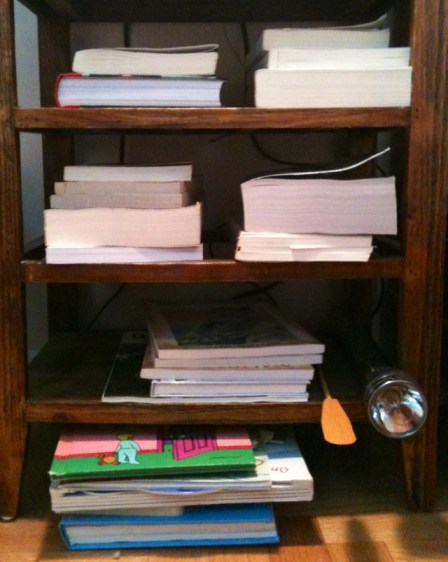
Not very exciting, I know! This is perhaps the only photo in this book shelf series that will not feature shots of spines. Like I said, I don’t plan to arrange any of the shots in this series. I talked about a lot of what’s in here in yesterday’s riff on recent reading and a post last week on stuff I plan to read in 2012.
Stuff on the top tier tends to be stuff I’m currently reading; the second shelf is filled with books I’m always rereading, or picking at slowly. The third shelf is where stuff goes to marinate or get dusty or cry to be shelved.
There’s also a bunch of kids book on the floor. More kids books are in this giant magazine stand, along with some notebooks, art pads, and probably an actual magazine or two (Anthony Browne’s book Changes is a surrealist masterpiece for kids, by the way):
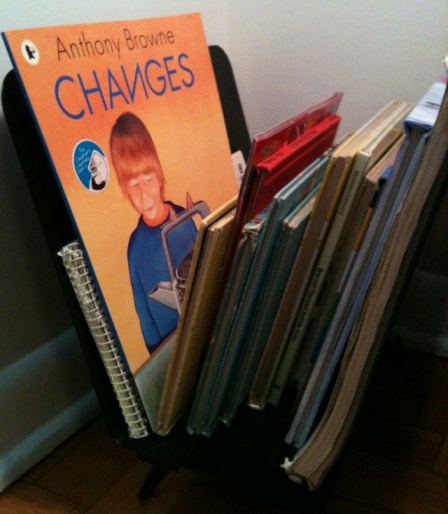
The Perec quote above comes from an essay collected in Species of Spaces and Other Pieces. “Brief Notes on the Art and Manner of Arranging One’s Books” will be in some ways the guiding inspiration for the Biblioklept book shelf series; my aim is not so much to present beautiful pictures that show off my books (I’m not equipped to do that, and other people do it very well already), but to comment on how my books are arranged and how they move and flow throughout the house; it will also give me a good opportunity to pick up books that might have been lingering (do books linger?) on a shelf for sometime.
I pulled these three books, not quite at random, from the shelves. The Perec book is one of those volumes I like to read scattershot-style. The latest issue of Paris Review still has a few pieces I haven’t read. Nausicaa: I meant to start it the other night. It will migrate to another room, a day-reading room, not a night-reading room:

I don’t anticipate future book shelf posts being quite this long; my intention here is to kind of set the ground rules (for myself) or delineate both spirit and letter to this project. As such, a final note on movement: I will move “outward” from this nightstand, photographing any place where books are set. I will photograph every kind of book in this house in its natural habitat; this includes children’s books and cookbooks, but does not include personal photograph albums, instruction manuals, or anything else of that nature. I plan to do 53 total book shelf posts, including this one (there are 53 Sundays in 2012).
My hope is that readers will respond to these posts by sharing their own bookshelving habits.
 Biblioklept