The following passage from Michel Houellebecq’s novel The Elementary Particles is part of a dialog between half brothers Michel and Bruno. Otherwise, context unimportant:
When Bruno arrived at about nine o’clock, he had already had a couple of drinks and was eager to talk philosophy. “I’ve always been struck by how accurate Huxley was in Brave New World,” he began before he’d even sat down. “It’s phenomenal when you think he wrote it in 1932. Everything that’s happened since simply brings Western society closer to the social model he described. Control of reproduction is more precise and eventually will be completely disassociated from sex altogether, and procreation will take place in tightly guarded laboratories where perfect genetic conditions are ensured. Once that happens, any sense of family, of father-son bonds, will disappear. Pharmaceutical companies will break down the distinction between youth and old age. In Huxley’s world, a sixty-year-old man is as healthy as a man of twenty, looks as young and has the same desires. When we get to the point that life can’t be prolonged any further, we’ll be killed off by voluntary euthanasia; quick, discreet, emotionless. The society Huxley describes in Brave New World is happy; tragedy and extremes of human emotion have disappeared. Sexual liberation is total—nothing stands in the way of instant gratification. Oh, there are little moments of depression, of sadness or doubt, but they’re easily dealt with using advances in anti-depressants and tranquilizers. ‘Once cubic centimeter cures ten gloomy sentiments.’ This is exactly the sort of world we’re trying to create, the world we want to live in.
“Oh, I know, I know,” Bruno went on, waving his hand as if to dismiss an objection Michel had not voiced. “Everyone says Brave New World is supposed to be a totalitarian nightmare, a vicious indictment of society, but that’s hypocritical bullshit. Brave New World is our idea of heaven: genetic manipulation, sexual liberation, the war against aging, the leisure society. This is precisely the world that we have tried—and so far failed—to create.”
From Ralph Ellison’s Invisible Man, a shocking, weird, gross, Christmasy reference near the end of the book. The context is that, in 1950s America, Sibyl, a white woman, wants the narrator, a black man, to fulfill her rape fantasy. Page 522 of my edition–
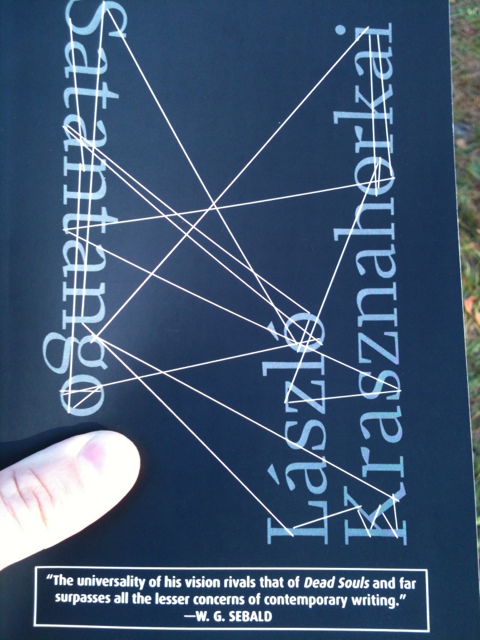
Damn. Check this out. László Krasznahorkai’s novel Satantango, the title of which does not apparently include diacritical marks in its new (first published!) English translation.
Publisher New Direction’s description:
Already famous as the inspiration for the filmmaker Béla Tarr’s six-hour masterpiece, Satantango is proof, as the spellbinding, bleak, and hauntingly beautiful book has it, that “the devil has all the good times.” The story of Satantango, spread over a couple of days of endless rain, focuses on the dozen remaining inhabitants of an unnamed isolated hamlet: failures stuck in the middle of nowhere. Schemes, crimes, infidelities, hopes of escape, and above all trust and its constant betrayal are Krasznahorkai’s meat. “At the center of Satantango,” George Szirtes has said, “is the eponymous drunken dance, referred to here sometimes as a tango and sometimes as a csardas. It takes place at the local inn where everyone is drunk. . . . Their world is rough and ready, lost somewhere between the comic and tragic, in one small insignificant corner of the cosmos. Theirs is the dance of death.” “You know,” Mrs. Schmidt, a pivotal character, tipsily confides, “dance is my one weakness.”
New Directions has a fantastic record when it comes to lit in translation, and Satantango has been long anticipated by English-reading audiences, due in large part to Béla Tarr’s movie (which is more like seven and a half hours, which I meant to watch this summer but couldn’t because I want to watch it with no interruptions, but I have kids and a wife, so, hey).
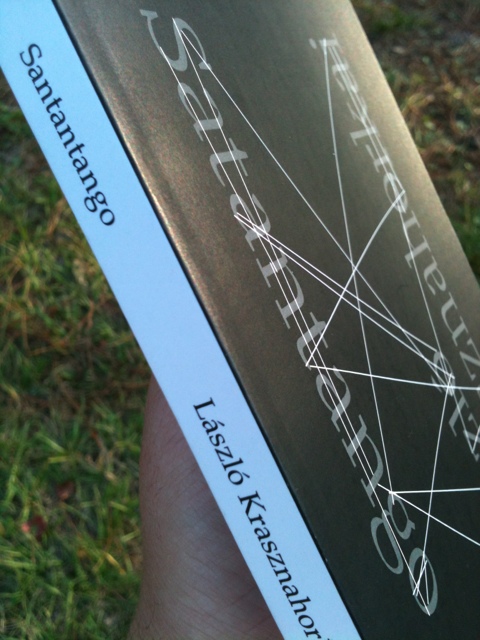
I got into it a bit last night, and, I don’t know if it’s just the advance reader copy I got or what, but there are no paragraph breaks, which is a grueling rhetorical technique, a big dare to readers, really (see also: W.G. Sebald’s Austerlitz (note: Sebald blurbs Satantango)). The advance reader copy also has a delightful typo on the spine, one that makes the book sound like, I dunno, if Santana made a tango record. Or maybe Santa n’ Tango for ever (Cash will no doubt be jealous). More to come.
Cormac McCarthy’s seminal anti-Western Blood Meridian isn’t exactly known for visions of peace on earth and good will to man. Still, there’s a strange scene in the book’s final third that subtly recalls (and somehow inverts) the Christmas story. The scene takes place at the end of Chapter 15. The kid, erstwhile protagonist of Blood Meridian, has just reunited with the rampaging Glanton gang after getting lost in the desert and, in a vision-quest of sorts, has witnessed “a lone tree burning on the desert” (a scene I have argued is the novel’s moral core).
Glanton’s marauders, tired and hungry, find temporary refuge from the winter cold in the town of Santa Cruz where they are fed by Mexicans and then permitted to stay the night in a barn. McCarthy offers a date at the beginning of the chapter — December 5th — and it’s reasonable to assume, based on the narrative action, that the night the gang spends in the manger is probably Christmas Eve. Here is the scene, which picks up as the gang — “they” — are led into the manger by a boy–
The shed held a mare with a suckling colt and the boy would would have put her out but they called to him to leave her. They carried straw from a stall and pitched it down and he held the lamp for them while they spread their bedding. The barn smelled of clay and straw and manure and in the soiled yellow light of the lamp their breath rolled smoking through the cold. When they had arranged their blankets the boy lowered the lamp and stepped into the yard and pulled the door shut behind, leaving them in profound and absolute darkness.
No one moved. In that cold stable the shutting of the door may have evoked in some hearts other hostels and not of their choosing. The mare sniffed uneasily and the young colt stepped about. Then one by one they began to divest themselves of their outer clothes, the hide slickers and raw wool serapes and vests, and one by one they propagated about themselves a great crackling of sparks and each man was seen to wear a shroud of palest fire. Their arms aloft pulling at their clothes were luminous and each obscure soul was enveloped in audible shapes of light as if it had always been so. The mare at the far end of the stable snorted and shied at this luminosity in beings so endarkened and the little horse turned and hid his face in the web of his dam’s flank.
The “shroud of palest fire” made of sparks is a strange image that seems almost supernatural upon first reading. The phenomena that McCarthy is describing is simply visible static electricity, which is not uncommon in a cold, dry atmosphere–particularly if one is removing wool clothing. Still, the imagery invests the men with a kind of profound, bizarre significance that is not easily explainable. It is almost as if these savage men, naked in the dark, are forced to wear something of their soul on the outside. Tellingly, this spectacle upsets both the mare and her colt, substitutions for Mary and Christ child, which makes sense. After all, these brutes are not wise men.
[Ed. note — Yes, this post is recycled (regifted?) from last year].
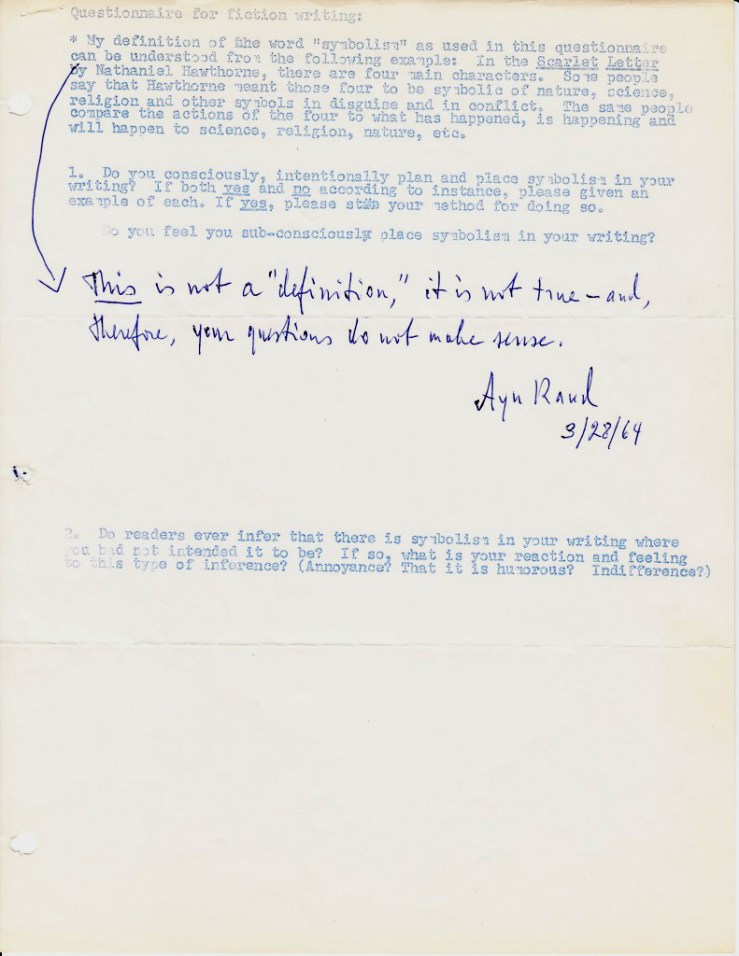
In 1963, a sixteen-year-old San Diego high school student named Bruce McAllister sent a four-question mimeographed survey to 150 well-known authors of literary, commercial, and science fiction. Did they consciously plant symbols in their work? he asked. Who noticed symbols appearing from their subconscious, and who saw them arrive in their text, unbidden, created in the minds of their readers? When this happened, did the authors mind?
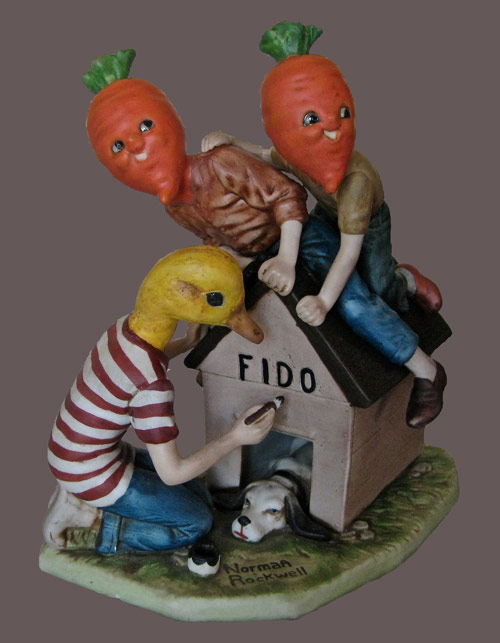
Duck and Carrots Putting the Final Touches on a Doghouse -- Click Mort
Click Mort makes surreal, charming, disarming sculptures that synthesize pre-existing figures into strange new forms. Largely self-taught, Click works out of his home in his native L.A., where he lovingly decapitates and recapitates antique statuettes. Click’s sculptures were featured in a solo exhibit earlier this year in L.A.’s La Luz de Jesus gallery and are currently on display at the Webb Gallery in Waxahachie, Texas. Click was kind enough to talk to me in detail about his work over a series of emails around Thanksgiving. Check out Click’s website to see more of his fantastical stuff.
Biblioklept: I love your sculptures. They’re disconcerting and surreal but also charming. They’re bizarre and clever, but not whimsical. Can you tell us about how you make them?
Click Mort: Thanks. I’m especially happy to hear them described as “not whimsical.” As for how they’re made, I should probably backtrack a bit since the porcelain pieces I’m doing now weren’t the actual starting point. The first things I tried recapitating were resin figurines from the 99 Cent Store: cute kid couples strolling hand-in-hand, adorable angel-tots, etc.. They were pleasantly awful on their own merits, but when I saw some particularly crappy plastic barnyard animals in the toy section that were roughly the same scale, the gears started turning. Those first head-swaps were pretty crude: I’d just hack off both heads mid-neck with a jeweler’s saw, attach the non-native head with some sculpting resin, and paint over the seam. Voila … Angel-tot with a pig’s head (or angel-pig with a tot’s body, depending on how you look at things).
After a few years of working with cheap resin figures, I kind of burnt out on them. My technique had developed to the point where the swaps were reasonably undetectable, but the available subject matter — tots, tots, and … tots — had gotten monotonous. Also, the figures gave off a really horrible smell when sawed; I strongly suspected they were made of something creepy like melamine. At that point, I decided to try doing the same thing with porcelain figures.
Right … so now I can answer your actual question. Once a suitable head and body match have been found (and describing that process would add a few more paragraphs to an already inhumanely long and dull answer) the first job is to remove all the unwanted material. A jeweler’s saw — or any cutting implement whose description doesn’t include the words “diamond-edged” — won’t even mar the finish on porcelain. I use a high-speed Dremel with some sort of diamond-dust edged cutting tool attachment. Assuming we’re talking about a human body getting an animal head, everything from the collar up has to go on the body figure. This includes hair, headgear, ribbons, or whatever connecting the head and body. If any of these drape over a collar or lapel, those parts have to go too. For the heads, the amount that gets hacked off depends on the animal. On a quadruped, because of the different angle the spine intersects the skull relative to a biped, almost everything behind the ears and under the jawline has to be removed and then re-sculpted after the head has been attached to the body.
This slideshow requires JavaScript.
In order to get a really good bond between the head and body, I fill the upper torso with sculpting resin and sink an aluminum rod into it. A length of rod is left protruding up, and the head—which also gets stuffed with resin—is then positioned on it. After that, all the missing areas have to be sculpted back on. Finally, whatever painting is needed to cover the recreated areas and blend them into the original parts gets done.
And however tedious that was to read, the actual process is several thousand times more so.
Biblioklept: I liked reading about the process, but I suppose when we do something all the time, it seems tedious to us. Your process fascinates me, because the images of your figures don’t show any “seams” — your figures look like little mass produced statues from an alternate dimension. There’s a surreal synthesis at play in your work, not just in the actual combination of, say, a dog’s head on human body, but also in the tone of the work. Your pieces strike me as both creepy and tender at the same time. I’m curious how you know if a piece “works” — when are you satisfied with your figures?
CM: That mass-produced quality is something I really try not to lose when putting together the figures. There’s something inherently familiar and low-key about mass-produced objects, and I like the idea of art that doesn’t scream for attention but just sort of sits there mumbling to itself. The down side to this is it sometimes works against the figures getting noticed at all. In the few gallery shows they’ve been in, it seemed a lot of people never looked at them from closer than a few feet away. Maybe they thought someone had just lined up a bunch of old lady tschotske crap as some sort of conceptual piece.
As for the figures working as much on a tonal as objective level, yeah, that’s becoming more and more the case. Or at least my intention. On the early pieces, I was getting figures that I thought were awful to begin with and simply trying to change the nature of their awfulness. Over the course of hundreds of hours on eBay looking for working materials, I started noticing how great some of these cheap figurines were in their own right, particularly the stuff made in Japan in the fifties and sixties. At that point, I really started paying less attention to what kind of head would seem funniest on a piece and focusing more on how the shape and expression of the new head would fit into what was already a wonderful figure. It became more about trying to maintain the geometry of the whole thing while shifting the mood.
“Creepy and tender” is as good a description as I’ve heard. I guess the tenderness is a product of my real affection for the original figures showing through. And while I don’t consider the finished pieces particularly creepy, a lot of people have described them that way. As near as I can figure, it’s because the heads I like to use almost always have sort of neutral expressions, and that lack of expression is unsettling to us on some fundamental level.
And to a great degree, when a piece “works” is determined almost as soon as I have the original figure in hand. The only finished pieces I’ve been unhappy with are ones where as soon as I unpackaged a figure bought online, I hated it but followed through with a head-swap anyway rather than just eat the cost of the figure. Usually though, if I like the original piece, I’m going to be happy with the finished figure. It might be a week or a year for the right head to show up, but I’ll know when it does. And from there, it’s only a matter of taking the time (and typically, this is something like ten to twenty hours) to bring the two together.
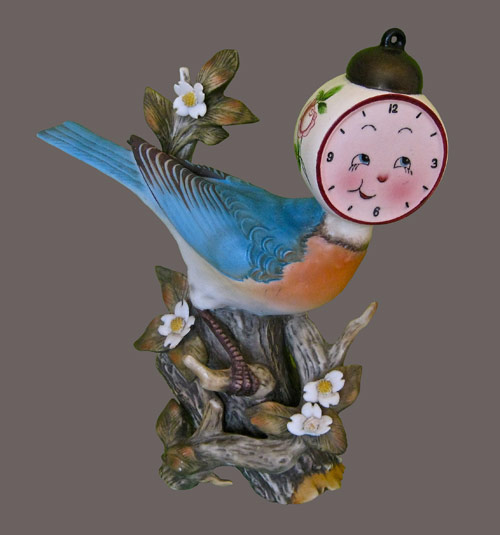
Clock Headed Harpy -- Click Mort
Biblioklept: There’s a clear appreciation or even adoration of kitsch in your work, but there’s also this level to it where you’re literally grafting two tchotchkes to each other in a way that transcends kitsch (I don’t know if that description is clear or valid). What I like about your work is that it doesn’t rely solely on an ironic aesthetic shared by both artist and audience, but that’s nevertheless part of the experience. What is it about the awful that attracts us?
CM: I wouldn’t describe my composite pieces as transcending their components, but that’s probably an extension of my regard for the original, unaltered figures. I mean, obviously I don’t think they’re sacrosanct or whatever or I wouldn’t be doing what I’m doing. Still, if there were only one — rather than thousands — of a given figure, I’d absolutely leave it alone. The same holds true for figures I think are already so wonderfully bizarre that anything I could possibly do to them would only diminish their oddity.
I guess I consider what I do as just condensing what I like about these things: taking the most expressive elements of each and putting that all in one figure in a way that enhances (but doesn’t necessarily transcend) what was already going on to some degree in the original.
It’s really hard to say what perceptions I share with whatever audience my work has. Originally, the only place that would carry them was a little boutique retail store, and now the figures have gotten into a couple of gallery group shows. In both instances, I almost never know who’s bought them, so there’s no opportunity for any sort of dialogue. For me, there’s no irony whatsoever at work in these things, but I’m pretty much literal to the point of dullness and don’t really see them as operating on any level other than the apparent. All I’m trying to do is get objectively incongruent elements and make them visually and aesthetically congruent.
But that’s just my take on them. I can be a didactic goon about a lot of stuff, but it would really be pointless to try and dictate what anyone else is or isn’t seeing in these pieces. And while there’s a definite attraction to awfulness, I don’t perceive these figures as awful. Alien, yeah. Absolutely. Which is pretty funny, given that they were originally produced as innocuous home garni and now something like a Norman Rockwell figurine is about as familiar as one of those lumpy Paleolithic Venus figures.
Biblioklept: A few of your pieces reference authors (Didion, Hemingway), but it’s not necessarily a recurring theme. How did these authors find their way into your titles? What do you enjoy reading?
CM: Titling the pieces is probably my least favorite part of the process. Usually, I just slap on whatever gibberish pops into my head and that’s that. The two figures you’ve posted are the only ones with literary references and, oddly enough, refer to one author who knocks me out and one I think is flat-out terrible (and I don’t think Didion is terrible).
As for what I read, it’s sort of a weird grab bag of stuff. Rather than trying to categorize my likes, I just grabbed the pile currently on the nightstand. Here’s what was there:
Wicked Bugs: The Louse That Conquered Napoleon’s Army & Other Diabolical Insects
Dada and Surrealism: A Very Short Introduction
Zippy Goes to School (The titular Zippy is a chimp, not the better-known pinhead.)
Guns, Germs, and Steel: The Fates of Human Societies (Keep trying to read this but invariably drop it in favor of something like Zippy Goes to School)
Tank Warfare: A History of Tanks in Battle
Monsters Are Attacking Tokyo: The Incredible World of Japanese Fantasy Films
And there’s other stuff I like and have been reading and rereading for decades: Saki and Flannery O’Connor are two particular faves.
Portrait of the Artist with the Easter Bunny, 2011
Biblioklept: You’ve mentioned that you don’t have an art school background. I’ll concede up front that this is one of those questions that interviewers aren’t supposed to ask, but I’d really like to know—what artists move you?
CM: Not to flip the interview, but why aren’t you supposed to ask stuff like that? It seems like a reasonable question.
Besides lacking an art school background, I’ve got a pretty skimpy art foreground. I’ve just never paid all that much attention to visual art. There are a few artists who for whatever reason caught my attention like Mark Ryden, Basil Wolverton, and Norman Saunders, but that’s about it. Oh, and Norman Rockwell, whose paintings are as wonderful as the figures inspired by them aren’t. And oddly enough, I seem much more moved by sounds than sights. It’s probably just a matter of how my neuro-wiring is laid out.
Biblioklept: I don’t know where I got the idea that you weren’t supposed to ask the interviewee questions like “What artists do you like?” or “What books do you read?” — maybe my high school journalism teacher? Not sure. I guess it just seems lazy on my part. But the questions are asked in good faith, I think.
You bring up music—I know you played guitar for The Cramps in the early eighties—do you have any musical projects underway now?
CM: Nope. While I still spend a fair amount of time banging on guitars, the interest and/or enthusiasm for any sort of group effort just isn’t there. I mean, I guess I could go the digital recording route, but rock and roll — and that’s all I really care about — has always been a real immediate, physical kind of thing to me. Anything other than playing with a clutch of similarly-minded goofballs just seems kinda clinical.
Biblioklept: What are you working on now? What projects do you have on the horizon?
CM: I’ve attached pictures of the figures currently in progress. This seemed kinder than subjecting your readers to the equivalent two thousand words.
As for events outside the “studio” (which is my apartment’s kitchen and breakfast nook), about a dozen pieces will be in a show opening December 4 at the Webb Gallery in Waxahachie, Texas. Also, La Luz de Jesus here in L.A. will have a clutch of them on hand through December. And my website will have an ongoing influx — and hopefully, outflux — of new figures.
Biblioklept: Have you ever stolen a book?
CM: Not recently, but yeah, I’ve lifted a volume or two. For a big stretch of my adult life I was a junky, and like most junkies had a terrifically flexible — and convenient — sense of morality. I used to steal books from used bookstores under the theory they were already used, so if I read them and then took them back, no one was really out anything.
And I usually did return them, but as often as not it was to sell the store their own book.
When I finally cleaned up, I felt like a crumb for having done this. All the same, I wasn’t about to risk some hothead filing charges if I told them I was sorry about what I’d done and wanted to settle up. Instead, I just went back to the various stores involved and, over time, bought all the books I’d sold them and those just read and returned. To me that seemed to square things, but this could be just more convenient moral reckoning. Beats me.
Tie: Lame “literary fiction” novels; Articles that link everything to David Foster Wallace
***
Best Literary Trend of 2011
Plagiarism!
***
Most Obvious Disclaimer
I did not read or see or hear every book or essay or audiobook or film or TV show or record or video that came out in 2011. Also, there are some days left in the year. These are all, just like, opinions man.
Adam Novy’s debut novel The Avian Gospels is one of the best novels I’ve read this year, and one of the best contemporary novels I’ve read in ages. It’s a surreal dystopian magical romance set against the backdrop of political and cultural repression, violent rebellion, torture, family, and birds. Lots and lots of birds. (Read my review).
Adam was kind enough to talk to me about his work over a month-long series of email exchanges; the interview presented below reveals much of his generous, creative energy.
Adam currently teaches writing at Scripps College, Pasadena City College, Long Beach City College and Orange Coast College.
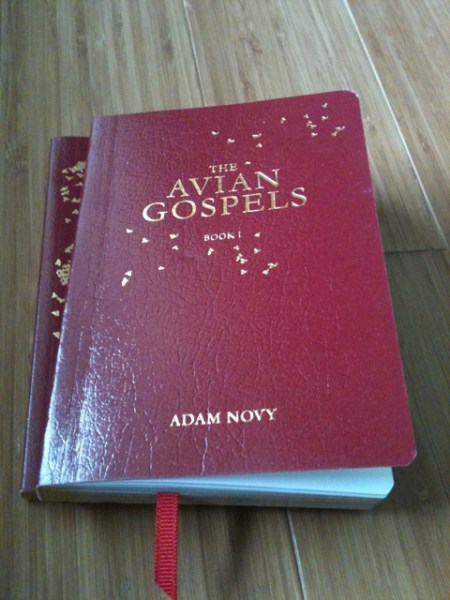
Biblioklept: I have a lot I want to ask you about what’s in your novel, but I have to start by asking about the physical book itself. The Avian Gospels is a lovely little two volume pocket-sized monograph—textured oxblood covers, gilded pages with line numbers, inset bookmarks. Visually, it recalls a Gideon bible, I guess, only not, I don’t know, chintzy. Where did the design idea come from?
Adam Novy: My editor at Hobart, Aaron Burch, had the idea of making the book look like a Bible. He’s an excellent designer and does a wonderful job with Hobart. Some boheemith press in New York City should really snap him up.
Biblioklept: How did the idea for The Avian Gospels come about? When did you start drafting the book? How long did it take to write?
AN: After 9/11, there was a moment where I felt like all Americans were on the same team. Now I wonder if we’ll ever feel that way again. Pardon me for living in the moment, but this country is just so completely fucked. This sensation of being American swiftly curdled into panic, but by then, the coordinates of my work had all been changed. I wanted to find a voice with room for both the historical and the intimate, which led me to a kind of first-person plural officialese. It ended up creating this echo-chamber effect where the personal and political identities of each character were different, and nobody could quite be who they were supposed to be, or wanted to be.
It took months of screwing around to figure this out, and most of it, of course, was accidental. The Lord of the Rings was on TV a lot at the time, and sometimes I thought I wanted to sound like Gandalf if Gandalf was full of shit and, like, a genocider who felt sorry for himself, but still was Gandalf, all mystical and officious, bossing everyone around. I understood the characters right away, except for Jane, who was always hard to deal with. She gets in arguments a lot and she’s usually right. I think I have hard time writing characters who are right. I myself am never right, so I had trouble relating to her. Of course, now she’s my second-favorite character in the book, after Mike.
I started the book in spring of 2002 and finished it in fall of 2005. In 2006, I found an agent and Hobart took the book in 2008. I went through five apartments, three different cities, three computers, one personal trainer and three therapists in that time. And nine adjunct faculty positions.
Biblioklept: It’s interesting that you mention the LOTR movies as a kind of ambient influence, because they were pretty ubiquitous in the last decade—and there’s so much of the last decade’s zeitgeist in your book: torture, despotism, political and cultural repression, the plight of a refugee class, the idea of “green zones,” etc. You foreground these themes by crafting Gospels as a kind of dystopian novel with elements of magical realism, but it’s also very much a novel about family, and even a love story. (By sheer coincidence I watched the restored edit of Metropolis in the same time frame that I was reading Gospels, and saw so many echoes there). How conscious were you of genre conventions? I’m curious because your book sometimes blends genre tropes, sometimes blurs them, and sometimes straight-up explodes them . . .
AN: The book is quite deliberately a mash-up. I think it’s normal in conversation to try out different ways of seeing things—a fussy way of saying this might be “experiment with different hermeneutics.” For example, one might reference the NBA, The Wire, Shakespeare and Dazed and Confused in a discussion about Obama. I wanted the book to enact this kind of embeddedness, this flailing for a context that makes sense, and I wanted the narrator to sound as though its vernacular was ornate and obsolete, like it trafficked in a pleasure that justified itself as satisfaction while remaining an inadequate moral lens. That’s why I write violence like I do: I want it to be horrifying and beautiful. Unfortunately, violence is cool. I’m not immune—I always watch Kill Bill and Scarface when they’re on cable. It’s disturbing. Everyone knows that torture doesn’t work as an intelligence-gathering method, but our country did it anyway because it simply couldn’t stop. It was a kind of jacking off, the only kind that certain political parties seem to approve of.
Whenever we write about power, we should always defend the powerless, even if they’re just as bad as those in power. I think I saw that in Cioran, and did you know Cioran was a Nazi sympathizer? I just read that Gertrude Stein was, too. I don’t know what kind of paradigm can reckon with this world.
Biblioklept: I had no idea about Stein or Cioran’s Nazi sympathies, but I guess many artists and writers and intellectuals were attracted to the power of fascism, particularly in the modernists’ day (I suppose Ezra Pound and GB Shaw stand out as easy examples, and Heidegger was a member of the Nazi party). Although in our own age, I suppose we also see intellectuals and writers support terrible causes—I think of Christopher Hitchens’s aggressive support of the Iraq War and Bush administration’s policies, for, example.
I don’t want to drop spoilers, but your novel traces an arc that shows how those who are powerless might, given power, recapitulate the aggressive violence that they themselves were once subjected to. In turn, you also reveal how characters who seemed to occupy a clear power position (I’m thinking of Mike here, specifically) are perhaps doomed as well to a life without agency. I found my sympathies shift dramatically throughout the novel. How important are sympathetic characters?
AN: Every writer, including me, wants the reader to cathect to their book with their whole heart. I want my readers to utterly and helplessly engrossed. But sympathy is a means to an end and not the end itself. Technically speaking, it’s just not that hard to accomplish. It’s a skill, like dribbling in basketball is a skill, but it’s not the whole game.
In The Avian Gospels, the character named Mike Giggs is seen in only one scenario—exerting power in the manner of his father—for the first two hundred pages, so he comes off like a jerk until he encounters someone who actually loves him: Chico the band leader. Suddenly, Mike discovers a love of life, a sensitivity and a feeling of camaraderie for his fellows. Not only is he is capable of compassion, he is governed by it. This leaves him ruined in certain ways, but allows him to discover who he can be, and makes him (hopefully) sympathetic.
Meanwhile, on the other end of the book, the character named Zvominir, who was whimperingly sweet for longer than Mike was mean, is meaner than Mike. Novels are fantasies of powerlessness and power—among the zillion other things they are—and I feel like we should at least be conscious of what’s happening to our minds as we are reading. How we deal with power is a serious moral question; counting how many times that we go awwww is not.We have cats on the internet for that. Still, Chad Harbach was probably right when he said that the books that get the best reception are simply “affable.” In desperate times, a nation of New York critic types are turning to . . . Mitt Romney? Or like, Cheever without the psychosexual guilt?
I don’t mean to single out Chad Harbach, whose work I haven’t read, except for his piece on Grantland about the Brewers, which I liked. But what he said is accurate. These days, people seem to feel that art should be uplifting, like art owes it to them, in a customer-service type-way. Have you been to Kinko’s, or excuse me, FedEx Office, lately? It is not a happy place. Novels used to to give the reader the truth in ways no other social narratives would. I’m pretty sure I’m not just being sentimental. There used to be a social lie which said the world was making progress and ascending, but this reversed like fifteen years ago and now we all feel doomed. We need books to tell us how we got here, not to lie about how meaningful our journeys are or however we say it these days. Of course our lives are meaningful, but such a narrow focus on making folks feel better is superficial and disempowering. Our emptiness and dread are trying to tell us something.
Biblioklept: I think you point toward a distinction between art and entertainment here. We want entertainment to comfort us, to ease our worries. In contrast, art challenges us with what we don’t want to see, or can’t see, or can’t see that we can’t see. And yeah, there’s a kind of “literature of comfort” out there, books that simply reconfirm the tropes and tricks and forms of “literary fiction” — so that, even if the protagonists suffer, that suffering is is part and parcel of some greater telos — and not just in terms of the plot, but also in the structure of the novel itself. (Lee Siegel called this camp “Nice Writing” a decade ago, pointing to its “violent affability,” its “deadly sweetness”).
At the risk of asking one of those questions an interviewer is never supposed to ask (but, hey, I really want to know the answer and I think our readers would too), what books move you as a reader?
AN: I think I’m moved by pretty standard stuff. The Portrait of a Lady. Charlotte’s Web. To My Twenties, by Kenneth Koch. On Seeing the Elgin Marbles, by Keats. Places to Look For Your Mind, by Lorrie Moore. Testimony of Pilot and Return to Return by Barry Hannah. Antony and Cleopatra. Stone Arabia, by Dana Spiotta, which is the best new book I’ve read in 2011. Chopin in Winter by Stuart Dybek. The last paragraph of CivilWarLand In Bad Decline. The scene in American Tabloid where Ward steals the pension fund books. The Widow Aphrodissia by Marguerite Yourcenar. There must be fifty different scenes in Buffy that make me cry, and five in Battlestar Galactica. Certain scenes in Lost. This is such a conventional list, I feel like I need to start a fight. FRIDAY NIGHT LIGHTS SUCKS AND YOU ARE ALL A BUNCH OF SAPS. I should also say I’m moved by spectacles of massive human folly. The image of Slim Pickens riding the bomb and waving his hat in Dr. Strangelove and the scene where Kramer and his intern throw the ball of oil out the window are somehow very moving to me.
Biblioklept: I’d love to hear your thoughts on the Occupy Wall Street movement—The Avian Gospels taps into and explores this idea of civil unrest, of disenfranchised voices, of a paramilitary state coping with a populist uprising. You’ve indicated that your novel is in some ways a response to 9/11, but it also seems predictive of the fallout we’re seeing a decade after the fact.
AN: A massive, indescribable injustice was inflicted on our world by the likes of Goldman Sachs and we seem to have no recourse. Law enforcement could not possibly care less, and seeing how they cleared Zucotti Park, they seem jealous of the impunity of Wall Street. In his review of Ron Suskind’s book, Ezra Klein suggests that Washington just did not have the will to pass a stimulus that was big enough. Slavoj Žižek is right when he says this moment is a challenge to our imagination. I think that what happened at Penn State may be a better lens for the recession than Occupy Wall Street. A massive patriarchal network mobilized their resources to preserve an ongoing atrocity. No one will admit that they were wrong, especially the figurehead, Joe Paterno. The community just does not seem to give a shit. They keep telling out-of-towners we don’t get it and rioted in self-pity. I guess this is just how power acts.
Biblioklept: What’s next? What are you working on now?
AN: I’m writing a novel about the life and times of Medusa. It’s called The Gore and the Splatter.
Biblioklept: Have you ever stolen a book?
AN: I think the only book I ever stole was an anthology of world literature, which had a really coherent definition of French symbolist poetry. I can’t find this book now, so someone probably stole it from me. Serves me right.




 Adam Novy’s debut novel The Avian Gospels is one of the best novels I’ve read this year, and one of the best contemporary novels I’ve read in ages. It’s a surreal dystopian magical romance set against the backdrop of political and cultural repression, violent rebellion, torture, family, and birds. Lots and lots of birds. (
 Biblioklept: It’s interesting that you mention the LOTR movies as a kind of ambient influence, because they were pretty ubiquitous in the last decade—and there’s so much of the last decade’s zeitgeist in your book: torture, despotism, political and cultural repression, the plight of a refugee class, the idea of “green zones,” etc. You foreground these themes by crafting Gospels as a kind of dystopian novel with elements of magical realism, but it’s also very much a novel about family, and even a love story. (By sheer coincidence I watched the restored edit of Metropolis in the same time frame that I was reading Gospels, and saw so many echoes there). How conscious were you of genre conventions? I’m curious because your book sometimes blends genre tropes, sometimes blurs them, and sometimes straight-up explodes them . . .

 Biblioklept