Thrones, Kings, Swords — I Review the First Three Books of George R. R. Martin’s Postmodern Saga, A Song of Ice and Fire

Last month, I listened to audiobook versions of the first three novels in George R. R. Martin’s A Song of Ice and Fire SeriesA Game of Thrones, A Clash of Kings, and A Storm of Swords. These are long audiobooks, thirty or forty hours each, and they engrossed me, held me hostage even. Martin’s plot is a page turner, a beautiful balance of cliffhangers, mystery, intrigue, and action telegraphed in bristling, energetic prose. Actor Roy Dotrice turns in an amazing performance here, differentiating dozens of characters and communicating the emotional depth of Martin’s novel. If you’ve had a passing interest in Martin’s ASOIAF and you like audiobooks, you might be interested in checking these out.

So what are these books about?

I’ve read and heard Martin’s works offhandedly compared to J. R. R. Tolkien’s Lord of the Rings series, and it’s true that there are similarities, both superficial and structural : Both engage an epic scope; both are very long, comprising multiple volumes; both employ multiple character perspectives; both share a love for music, philology, and history; both are about war; both are very well written. Perhaps the central comparison is that both ASOIAF and LOTR are works of world invention, which is to say that these books are set in respective worlds that are not our world, worlds that have been, for better or worse, ghettoized as “fantasy” worlds. Another way of comparing these series is to point out then that one is more likely to find them in the “Fantasy” section than in, say, “Literary Fiction.”

It’s true that both LOTR and ASOIAF contain the signifying tropes of fantasy fiction: thrones, kings, swords. Magic. Dragons and shit.

In LOTR, magic is still very much alive in Middle Earth. Indeed, the plot of the book revolves around destroying a magical ring to defeat a foe of pure evil and restore the true king to his true throne; a wizard orchestrates these events (dying and being reborn in the process). At the end of the trilogy, the elves leave Middle Earth, sailing off into the sunset to live happily ever after, perhaps taking much of the world’s magic with them, leaving the humans to perhaps evolve as the dominant beings of that world. There’s a teleological neatness here, a reassurance of ideal order.

LOTR is all about the restoration of true identity and the return home after the great journey. I’ve run into readers who’ve expressed frustration with the end of The Return of the King; the book’s ending seems stretched out, elongated. After epic battle, there’s something deflationary about the hobbits’ returning to the Shire. But this is one of the major points of Tolkien’s process: the heroes must return to the domestic sphere, authority conferred upon them by their dramatic encounters with the sublime. They will now put their own community back to order.

Martin’s book could not be more opposite. While LOTR is about restoring order and expunging the polluting evil (from the swarthy south and the dark east) from a pure, now stable realm, ASOIAF explores the disruption, dissolution, and fragmentation of a continent in the midst of civil war. Tolkien wrote of war too, with bitter darkness, to be sure, but his epical, heroic mode makes little room for depicting the visceral horror of war. Nor does he concern himself with the Machiavellian intrigue that harnesses and exploits the rage of war. Tolkien’s characters are motivated by pure, intrinsic, and very black-or-white ideals; characters without these ideals (like Gollum or Denethor) are presented as insane.

In contrast, Martin’s plot catalogs the constantly shifting allegiances (both intra- and inter-family), betrayals, alliances, and upstarts that repeatedly throw his characters into new roles, new stations, new names. Martin’s camera is also keenly attuned to the Darwinian struggle that underwrites all existence, a struggle that war dramatizes. Martin’s books are, quite frankly, some of the most violent stuff I’ve ever read, full of beheading, mutilation, disemboweling, rape, and murder. He also takes great pains to show the way that war impoverishes the most vulnerable of people, taking food out of their mouths and obliterating their families. Martin’s engagement with political machinations and radical violence put his books closer to Blood Meridian or Wolf Hall, in many ways, than to standard fantasy fare.

To be clear, I am in no way arguing that LOTR, one of my favorite books of all time, is “standard fantasy fare.” LOTR obviously established many of the tropes and codified the themes and archetypes for the contemporary publishing genre that we call “fantasy.” We can also all recognize that much of what comes out of this genre (Robert Jordan comes to mind) is vile, flat, affectless dreck. Reductionist attitudes and vague misconceptions still keep some readers from recognizing that LOTR is a fully-realized work of meaningful, historically and artistically important literature. Similar attitudes and misconceptions might keep readers away—unnecessarily—from ASOIAF, a work that, like LOTR before it, invents a new idiom in storytelling. ASOIAF complicates claims of narrative truth, critiques patriarchy, reconceives what constitutes family, disrupts traditional archetypes, destabilizes ideal identity, decenters moral authority, and subverts narratological expectation. In short, Martin may have given us the definitive postmodern “fantasy” novel.

Martin layers these themes through his strange (and estranged) characters, shifting between them in point of view chapters written in the free-indirect style of late modernism. LOTR codifies an allegorical good vs. evil narrative, one that rests on the destruction of a magical object and the restoration of a “true” king. The narrative of LOTR is thus direct, teleological, and closed to outside narrativization. Put another way, we’re not getting the orc’s point of view (although that has been done). Martin’s narrative rejects the notion of a stable absolute truth, authority, or even identity. A civil war drives his narrative, a bloody competition between self-proclaimed kings, whose war machines dramatize Darwinian competition; this theme doubles in the Oedipal infighting and conflicts between and within the great Houses of Westeros, Martin’s world.

There are a few “traditional” epic heroes in Martin’s work, or at least the types of characters one might expect a fantasy adventure to focus on—dashing knights, regal kings, wise old men. Instead of focusing on these people and their hopes and fears and desires, Martin trains his camera on characters marginalized, outcast, or outright threatened by the patriarchy: a dwarf, an little girl, a mother, a bastard with no rights of inheritance, a crippled boy, an exiled teenage girl who must create her new identity piecemeal . . . As a point of contrast to these characters, who find their circumstances constantly inverted and disrupted, in the first book,  A Game of Thrones, Martin allows his POV chapters to hover around the consciousness (and rigid conscience) of Lord Eddard Stark (“Ned”), arguably the closest thing the series has to an initial hero (uh, BIG SPOILER ahead; skip the rest of this paragraph to avoid it). Ned’s worldview is rigid and clear, tempered by a love and duty for both his family and the people he has sworn to protect. He is a good man, but his goodness, his love and his righteousness are not sentimental. In a key opening scene, Ned carries out the execution of a man who has broken an oath. As Lord, it is his duty to condemn the man, but Ned chooses to behead the man himself, not because he relishes bloodshed but because he finds bloodshed revolting—in short, he must remind himself at all times of life’s cost. In an ironic plot twist, Ned is beheaded himself in an act of betrayal; the moment is shocking. It signifies, on one hand, Martin severing his book’s narrative from traditional ideals of honor and  justice; narratologically, it removes its characters from the protection of ideal and honor. Ned’s death is not a death of self-sacrifice. It is not heroic, nor does it posit apotheosis or rebirth. It is simply grim, ugly, and violent. The violence of war does not follow the narratives that we might like to subscribe to.

Although Martin’s books are gritty and concrete, with characters motivated by ever-shifting tendrils of intrigue, they nevertheless contain metaphysical elements. However, the magical parts of ASOIAF are slight, obscured to most of its characters who treat the idea of magic and magical beings with the same skepticism and cynicism that we find in our own world. If LOTR shows a world where magic is slowly leaving the world to make way for a new age, ASOIAF describes a world where the metaphysical detritus of the past begins to improbably thaw and return. These small but important magical eruptions are set against the the political infighting and civil war of Westeros. The great arc of A Series of Ice and Fire, which will reportedly run to seven books, seems to point to a larger conflict between the humans and a strange group of beings, significantly named The Others.

As much as I enjoyed and admire Martin’s first three books, I’m unsure if I will continue the series. I consumed Thrones, Kings, and Swords with a greedy gusto—even when he killed off characters I’d grown to care about, or otherwise disrupted my expectations. These narratives are rich, complex, and engrossing. Martin has a keen ear for Medieval dialogue, his mystery plots demand engagement, and life-or-death drama evokes adventure and invokes pathos without ever dipping into crudity or sentimentality. What’s most intriguing though is Martin’s analysis of war and politics; ASOIAF, through its many viewpoints, evaluates a world in turmoil with a precise intelligence and surprising wisdom. So, why do I say that I’m not sure if I’ll keep going?

Simply put, I started the fourth book, A Feast for Crows, and it’s just bloody awful. Could be that I just can’t stand the narration of John Lee, who seems to be channeling Christopher Lee doing Vincent Price doing Edgar Allan Poe. I hated Lee’s narration of China Miéville’s novel Kraken so much that I abandoned it. Roy Dotrice did a marvelous job bringing spirit to Martin’s novels; Lee’s sonorous sing-song is an amorphous mess. I was taken aback, to be sure, but I also wanted very much to know what the hell happened to my favorite characters after Swords. The mp3s of the book are titled after the character that they follow; a quick scan followed by some basic research revealed that this fourth book wasn’t going to pick up much about the fates of the characters I’m interested in. Scanning a few reviews of Crows, I see that it was not well-received, even by (especially by) Martin’s hardcore fans. The consensus seems to be that the book sprawls too much, splashes over the early boundaries Martin had set for himself. Teleological narratives like Lord of the Rings guarantee tidy resolution for their audiences; Martin’s post-modern narrative seems to insist, even before its half-way mark, that even an archetypal conclusion will be impossible. So I’ll follow his lead, and leave my review open-ended. I’d love to hear from any readers who have suggestions about the fourth and fifth books of A Song of Ice and Fire.

UPDATE (3 Jan 2013):

I ended up reading the fourth/fifth ones.

In the comments section, Jeff Schwaner offers an excellent description of Martin’s project:

 Nothing comes to an end in Martin’s book. Fortunes continue to change, that big wheel keeps turning and crushes a few more characters underfoot and, as Melville writes, “then all collapsed, and the great shroud of the sea rolled on as it rolled five thousand years ago.” Even the most dramatic stories sink and lose their primacy, replaced by the newest wave, which is only the shape of a thing and not a thing itself. Which is, at least I think, part of Martin’s point. Longest story short, it is definitely worth reading the rest.

Martin clearly intends to disrupt (and therefore dissatisfy) our expectations about what a narrative should do. However, there’s only so much of that that I think can stick. Once a reader figures out what Martin’s doing, the project gets rather dull (fourth book in particular)—we’re repeatedly asked to care about characters that we can expect to die at any second; Martin seems more interested in describing clothes and food and drink than getting down to the schemes and mysteries that make the first three books so engaging.

I understand the fantasy he’s disrupting in deconstructive terms: authority (its metonymy in crowns, thrones, swords, armies, dragons, etc.) is always displaced; there is no conclusive “ending,” despite what we are asked to believe (Return of the Queen; Winter Is Coming; White Walkers Are Coming; New Gods, etc.). The story started in media res and will end in media res.For me, this is engaging from a theoretical standpoint, but as a reader (and a reader who wants to read, like, *everything*) so much of ASOIAF comes across as the act of a plate-spinner, a bag of entertaining tricks that distract you from the fact that there’s nothing beyond the act itself.

But I’ll almost undoubtedly read the sixth one if he ever finishes it.

Sunday Reading, 10.02.2011

20111002-140847.jpg

Nostalgia of Cannibal — Salvador Dali

Cannibalism in Autumn — Salvador Dali

“I Write Stories About a Submerged Population” — Raymond Carver on Fiction, Class, and Political Writing

Raymond Carver talks about the political scope (or lack thereof) in his writing in a 1987 interview

A writer ought to speak about things that are important to him. As you know, I’ve taught in universities, in fact for some fifteen years. I had time there for other work, and I never wrote a single story about university life because it’s an experience that left no mark on my emotional life. I tend to go back to the time and the people I knew well when I was younger and who made a very strong impression on me . . . Some of my recent stories deal with executives. (For example, that one in The New Yorker, “Whoever Was Using This Bed,” where the people discuss things the characters in my earlier stories would never discuss). He’s a businessman, and so on. But most of the people in my stories are poor and bewildered, that’s true. The economy, that’s important . . . I don’t feel I’m a political writer and yet I’ve been attacked by right-wing critics in the U.S.A. who blame me for not painting a more smiling picture of America, for not being optimistic enough, for writing stories about the people who don’t succeed. But these lives are as valid as those of the go-getters. Yes, I take unemployment, money problems, and marital problems as givens in life. People worry about their rent, their children, their home life. That’s basic. That’s how 80-90 percent, or God knows how many people live. I write stories about a submerged population, people who don’t always have someone to speak for them. I’m sort of a witness, and, besides, that’s the life I myself lived for a long time. I don’t see myself as a spokesman but as a witness to these lives. I’m a writer.

Book Acquired, 9.30.2011

20110930-164525.jpg

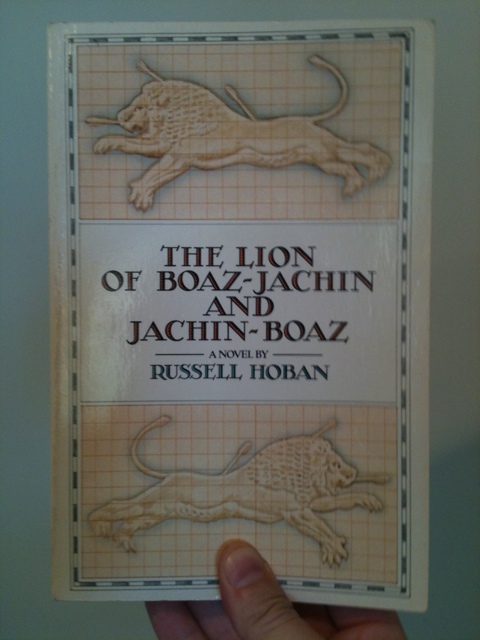
The Lion of Boaz-Jachin and Jachin-Boaz by Russell Hoban. It’s his first novel. Picked it up at the used bookshop today. Love the cover. I’m sure it’s as weird as the other stuff I’ve read by him (Riddley Walker, Pilgermann, Kleinzheit).

“Entering The Pale King Is Like Entering a Familiar Room, Now Stripped Bare”

At Seven Steps Back, there’s a marvelous series of posts—a long essay, really, broken down into digestible blog chunks—about David Foster Wallace’s The Pale King. The piece is easily one of the better analyses I’ve read about Wallace’s last book, well researched and well written through an intertextual lens. A taste, a riff on Wallace’s names—

Entering The Pale King is like entering a familiar room, now stripped bare, but with the footprints of its former occupant, your departed friend, still visible in the dust on the floor. For example, the good old names are back, strange and unharmonious, vaguely Germanic, Latinate, French, at root un-American; names like Lotwis and Glendenning and Bondurant and Henzke, not zany and humorous like Pynchon’s (it seems to me that the names and the scope of his books are the only reasons he has been called an epigone to Pynchon, nothing else), but rather like clothes one cannot find it in himself to feel at ease in, even though they aren’t tight or loose, but just right. They also seem like they were once normal, everyday names –names like George Smith and Janet Cooper– but at some point were taken apart and reconstructed by a neurotic tinkerer, in order to establish how long they can go on working before exploding.

Book Acquired, 9.29.2011

20110929-030604.jpg

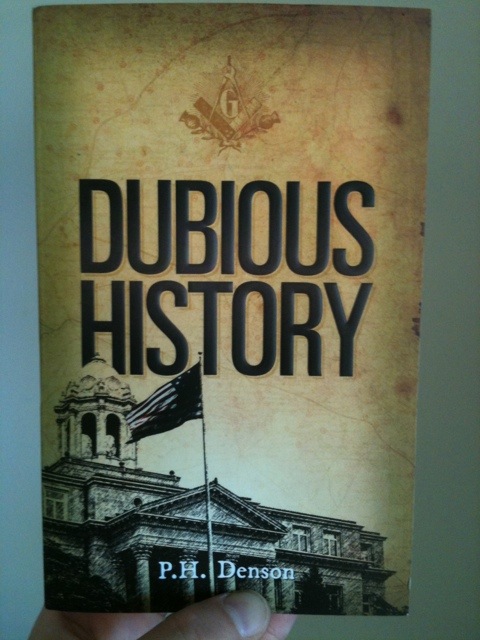
Dubious History by P.H. Denson. This sucker is thick; 550+ pages of conspiracy theory driven thriller. I read the first few pages this afternoon; the writing is much better than the swollen publisher’s description below—

Drawing on the secretive and intriguing mysteries of the Masonic brotherhood, the fast-paced, brilliantly layered storyline and its fascinating central characters have proved a big hit with readers who like to have their wits challenged and to be kept guessing right to the end. The story begins with what appears to be a hit-and-run ‘accident’ and moves rapidly to reveal a chilling web of serial murders and a deadly Masonic secret. George Fairfax, a Pulitzer nominee researching the history of a small American town, falls victim to a hit-and-run. When his nephew Zach steps in to complete writing the town’s history, he quickly becomes suspicious of his uncle’s ‘accidental’ death. Zach begins to unravel a spiderweb of clues that point to a dangerous Masonic secret which may also be responsible for the mysterious deaths of a number of other members of the Masonic lodge. Can Zach decode the clues to the two-hundred-year-old secret in time to find the serial killer before he claims his next victim? And what twists await at every turn as each clue uncovers more of the shocking truth behind the killer’s real end-game?

“We’re Made of Fragile Stuff” — Damien Hirst Rambles Incoherently on Francis Bacon

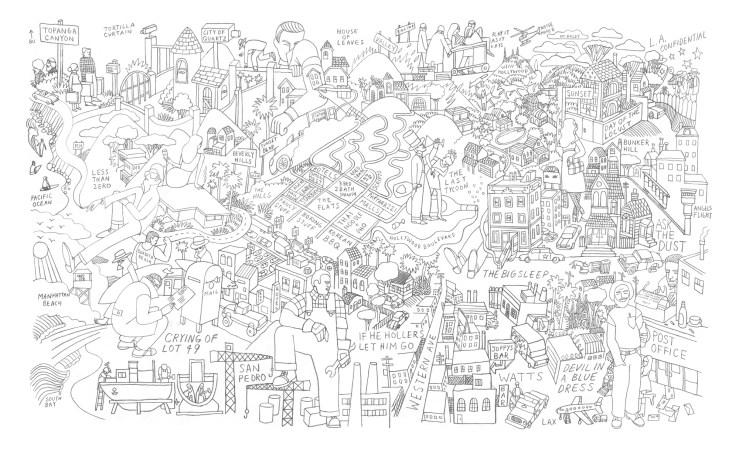
“Fictional Map of L.A.” — Geoff McFetridge


Geoff McFetridge’s fictional map of L.A., from GOOD magazine.

Hark! A Vagrant Does Wuthering Heights

At Hark! A Vagrant, satirist supreme Kate Beaton sends up Wuthering Heights. Beaton’s book is now available for preorder.

Harold Bloom Talks About Blood Meridian (Video)

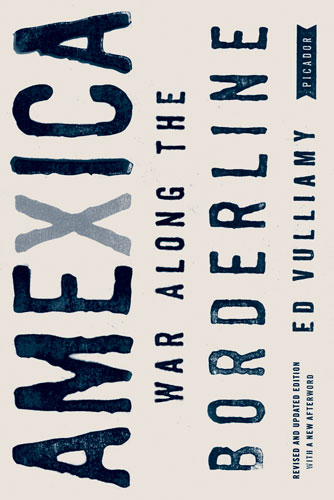
Amexica — Ed Vulliamy’s Violent Chronicle of the Border Wars

Like Cormac McCarthy’s Blood Meridian or Roberto Bolaño’s  2666, Ed Vulliamy’s Amexica explores violence and bloodshed along the porous border between Mexico and America. Unlike those blistering novels, Amexica belongs in the nonfiction section: it’s a sustained work of investigative journalism, part travelogue, part horror story, and all-too real. Blood Meridian and 2666 both have clear roots in the violent history of the borderland, but the membrane of literary fiction serves as a kind of psychological protection for the reader, an affective out, perhaps — “It’s just a book,” we might tell ourselves. Amexica, on the other hand, is unrelentingly true, real, and inescapably ugly. I have a predilection, I almost hate to admit, for literary violence, for bloody books—Blood Meridian and 2666 are two of my favorite books—although bloodshed is not the only reason I read. The violence in Amexica though can be stomach turning at times. Here’s a litmus test—the book’s first paragraph—

As dawn breaks over the vast desert, the body is hanging from a concrete overpass known as the Bridge of Dreams. It has been there for two hours—decapitated and dangling by a rope tied around the armpits. The sun begins to throw its rays across the busy intersection with its rush-hour traffic and former American school buses carrying workers to sweatshops. And it is still there an hour later, this grotesque, headless thing—swaying, hands cuffed behind its back—in the cold early morning wind that kicks up dust and cuts through the Mexican border town of Ciudad Juárez, the most dangerous city in the world.

From the outset, Vulliamy is unflinching in his portrayal of the borderland, the strange, amorphous world he calls “Amexica,” a place riddled with ambiguity, paradox, and uncertainty; indeed the only thing certain in Amexica is violence.

Vulliamy’s book is a west-to-east travelogue of Amexica, from the Pacific Coast (where he takes part in a surreal picnic on the beach where relatives pass food through a wire fence) to the Gulf Coast of Texas. What unites each stop along Vulliamy’s way is the relentless war between rivaling drug cartels and the federal, state, and local police. To clarify that last sentence, let me point out that the drug wars on the border are bellum omnium contra omnes, war of all against all—the drug cartels are at war with each other, but law enforcement are at war against each other as well, the various police forces backing various drug cartels.

Vulliamy’s difficult job is to suss out the whys and the hows of the drug war, but it’s an almost impossibly huge task. He tells us—

This book is not so much about a war as it is a view of a singular place in time of war. It is about the ways war impacts Amexica, but it is also about how the war is a consequence of other—mainly economic—degradations and exploitations, quite apart from drugs, from which the border’s people suffer. A suffering due not least to the fact that narco cartels are corporations like any other, applying the commercial logic and following the same globalized “business models” as the multiplicity of legal enterprises that have wreaked havoc along the borderline. Indeed, the drug violence is in many ways a direct result of this depredation caused by the legal globalized economy. The cartels are not pastiches of multinational capital—they are pioneers of it, integral to it, and apply its rules and logic (or, rather, lack of rules and logic) to their marketplace just as does any other commercial enterprise.

Vulliamy’s indictment of global capitalism as the root of the narco wars is plain—as is his righteous anger—but Amexica works better when it focuses on character and detail than when Vulliamy tries for targets that are simply too unwieldy. Amexica is at its best when Vulliamy plays tour guide, showing us the people of the border first hand, like the coroner in Tijuana who deciphers bodily mutilations as an Egyptologist might study hieroglyphs, or the bereaved mother of two notorious gangsters, or Julian Cardona, whose photographs of Juárez are charged with pathos, loss, and the traces of violence that plague that center of anarchy.

Indeed, Juárez is the grand, ugly center of both Vulliamy’s journey as well as his book; those who thrilled and suffered in Bolaño’s thinly-fictionalized version in 2666, “Santa Theresa,” will find a similar and equally disturbing beast. Anyone still searching for “the real killers” from Bolaño’s murder mystery are encouraged to read Vulliamy’s chapter on Juárez (short answer: we all did it).

Vulliamy’s journalism has a strong literary vein running through it, and like William T. Vollmann (who also chronicled a slice of the border in Imperial), he makes no pretense toward objectivity or neutrality. While Vulliamy puts his subjects and interviewees front and center, he never tries to hide or obscure his own involvement in the process; nor does he aggrandize his role, which surely must have been tempting given the extreme dangers of his project. And if at times his anger or indignation tips into furious verbosity (he could stand to slice a dependent clause or two), he’s surely earned it.

Amexica should be on the radar and reading list of anyone interested in the narco wars, or anyone who wants to learn more of the “real” story behind the murders explored in 2666. For all Amexica’s violence, there’s also dry, ironic humor, and a bristling current of justice, even optimism, at times. Amexica is not for everyone, to be sure, but those who wish to learn more about this massive war (which gets little or no coverage from major media outlets) will not be disappointed. Recommended.

Amexica is available now in an updated trade paperback edition from Picador.

Book Acquired, 9.27.2011

20110926-033724.jpg

I’m psyched about this one—Uncreative Writing by Kenneth Goldsmith, who you may know as UbuWeb.  Here’s the description from the publisher, Columbia UP

Can techniques traditionally thought to be outside the scope of literature, including word processing, databasing, identity ciphering, and intensive programming, inspire the reinvention of writing? The Internet and the digital environment present writers with new challenges and opportunities to reconceive creativity, authorship, and their relationship to language. Confronted with an unprecedented amount of texts and language, writers have the opportunity to move beyond the creation of new texts and manage, parse, appropriate, and reconstruct those that already exist.

In addition to explaining his concept of uncreative writing, which is also the name of his popular course at the University of Pennsylvania, Goldsmith reads the work of writers who have taken up this challenge. Examining a wide range of texts and techniques, including the use of Google searches to create poetry, the appropriation of courtroom testimony, and the possibility of robo-poetics, Goldsmith joins this recent work to practices that date back to the early twentieth century. Writers and artists such as Walter Benjamin, Gertrude Stein, James Joyce, and Andy Warhol embodied an ethos in which the construction or conception of a text was just as important as the resultant text itself. By extending this tradition into the digital realm, uncreative writing offers new ways of thinking about identity and the making of meaning.

Book Acquired, 9.26.2011

20110926-033621.jpg

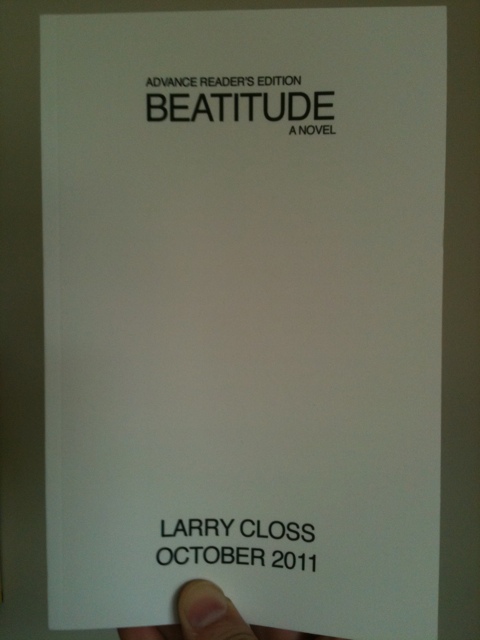
Beatitude by Larry Closs; ARC courtesy of the author. The book looks pretty cool—description from the author’s site

New York City, 1995: Harry Charity is a sensitive young loner haunted by a disastrous affair when he meets Jay Bishop, an outgoing poet and former Marine. Propelled by a shared fascination with the unfettered lives of Jack Kerouac and the Beat Generation, the two are irresistibly drawn together, even as Jay’s girlfriend, Zahra, senses something deeper developing.

Reveling in their discovery of the legendary scroll manuscript of Kerouac’s On the Road in the vaults of the New York Public Library, Harry and Jay embark on a nicotine-and-caffeine-fueled journey into New York’s thriving poetry scene of slams and open-mike nights.

An encounter with “Howl” poet Allen Ginsberg shatters their notions of what it means to be Beat but ultimately and unexpectedly leads them into their own hearts where they’re forced to confront the same questions that confounded their heroes: What do you do when you fall for someone who can’t fall for you? What do you do when you’re the object of affection? What must you each give up to keep the other in your life?

Beatitude features two previously unpublished poems by Allen Ginsberg.

The Origin of “Moby Dick”

Where did Herman Melville get the strange, marvelous name of the leviathan at the center of his strange, marvelous novel Moby-Dick? The name of the great white whale derives from  an 1839 article by Jeremiah Reynolds, “Mocha Dick: or The White Whale of the Pacific” (originally published in Knickerbocker Magazine). As the editors of Melville.org point out though (and thanks be unto them for all their hard, excellent work), how “Mocha Dick” morphed into “Moby Dick” remains “some strange piece of hermetic Melvillean arcana.” From Reynolds’s article

But to return to Mocha Dick — which, it may be observed, few were solicitous to do, who had once escaped from him. This renowned monster, who had come off victorious in a hundred fights with his pursuers, was an old bull whale, of prodigious size and strength. From the effect of age, or more probably from a freak of nature, as exhibited in the case of the Ethiopian Albino, a singular consequence had resulted — he was white as wool! Instead of projecting his spout obliquely forward, and puffing with a short, convulsive effort, accompanied by a snorting noise, as usual with his species, he flung the water from his nose in a lofty, perpendicular, expanded volume, at regular and somewhat distant intervals; its expulsion producing a continuous roar, like that of vapor struggling from the safety-valve of a powerful steam engine. Viewed from a distance, the practised eye of the sailor only could decide, that the moving mass, which constituted this enormous animal, was not a white cloud sailing along the horizon. On the spermaceti whale, barnacles are rarely discovered; but upon the head of this lusus naturae, they had clustered, until it became absolutely rugged with the shells. In short, regard him as you would, he was a most extraordinary fish; or, in the vernacular of Nantucket, “a genuine old sog”, of the first water.

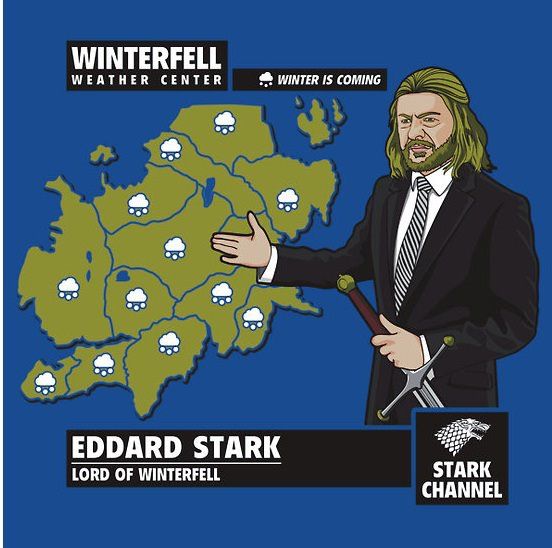
Winterfell Weather Report