The Road — Vasily Grossman

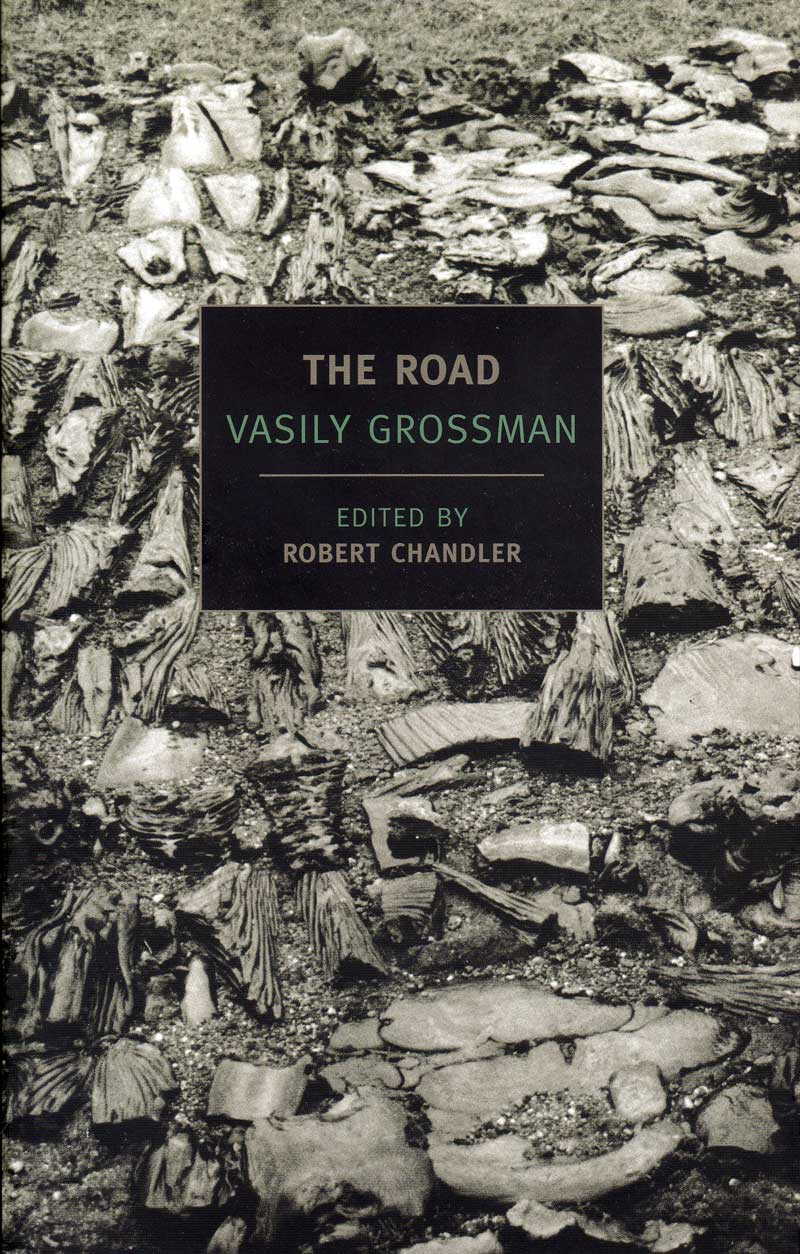
I’d never heard of Vasily Grossman until Timothy Snyder referred to him, briefly, as a Soviet journalist who published some of the first unflinching reports of atrocities committed by Nazi soldiers and Hitler’s secret police during their conquest of eastern Europe. In Bloodlands, Snyder lauded Grossman as a reporter guided by a clear moral vision and a keen understanding of the tenuousness of human life.  A Ukrainian Jew who rhapsodized the Red Army’s defense of Stalingrad and then followed it all the way to Berlin, he built a literary career under the Soviet system before passing away with little fanfare. Although his early novels sold in the millions, at the time of his death in 1964 his reputation in his homeland was shattered, his health had deteriorated, and his final novels were blacklisted.  He could count himself lucky to have lived through a number of purges of the U.S.S.R.’s literary elite.  Edited and compiled by Robert Chandler for the impressive New York Review Books imprint, The Road collects of a number of his short stories, essays, letters, and articles in one well-curated volume, an excellent introduction to an important but neglected voice.

Organized chronologically, Grossman’s stories are separated by brief biographical notes thoughtfully included by Chandler. Although the selections fall into early, middle, and later works, it becomes clear that Grossman’s life as a man and as a writer (at least how it is presented here) can be broken up into distinct periods marked by increasing dissatisfaction with life under Soviet rule. Chandler labels the periods, from earliest to latest: “The 1930s,” The War, The Shoah,” and “Late Stories.”  The works in this collection are sad—truly sad—but throughout he returns to remembrances of love and small gestures of tenderness.  He is marked by the excesses of the totalitarian regimes he waged war upon and lived under. As a result, his writing demonstrates an appreciation of kindness that could only arise from a true comprehension of both humanity’s potential for cruelty and the limitless power of an autonomous mind.

The first short section, “The 1930s,” collects three concise stories concerning the creation and dissolution of family bonds.  “A Small Life” describes a couple that decides to foster a child from their village orphanage who ultimately finds them weird and boring, while in “In the Town of Berdichev” a rough female commander in a military unit must take a forced leave when her pregnancy makes it impossible for her to fulfill her duties to her company. She fondly remembers the father who was shot down in battle, but struggles to balance her duty to protect her child against her duty to protect her county.  Perhaps the most striking of the three stories is the last, titled “A Young Woman and an Old Woman.” The title characters are both rewarded by their state employers with a free trip to a seaside resort and share a train cabin as they journey to the coast.   They talk.  The young woman, enjoying her rise through the Soviet system, befriends the older woman who has been saddened by the surprising detention of her daughter and her own stalled professional ambitions. These two subtly drawn characters never fully understand the hidden mechanisms behind their fleeting instances of happiness. Perhaps these mechanisms have been hidden by the totalitarian state or, maybe because they’re people, they will always be doomed to wonder.

As the book transitions to its second section, Grossman seems torn between his duty as a reporter to inspire his fellow citizens to sacrifice for the greater good and his need to rail against the injustices perpetrated by warring totalitarian regimes. Like “In the Town of Berdichev,” “The Old Man” finds Grossman adopting a tone that might almost be described as propagandistic. A quiet old man, a beekeeper whose livelihood requires patience and silence, overcomes a lifetime of reticence by braining a German soldier with a shovel.  Much better is “The Old Teacher,” a story about a village’s elderly teacher, a Jew.  Distraught by what he sees as Nazi soldiers advance on his town—long simmering feuds settled by prompt denunciations, families thrown out of houses, all sorts of groveling and obsequiousness—the old man reflects on his failings and his fleeting successes.  The teacher and the town’s other Jews are forcefully marched to a ravine.  There they are made to lie down and wait for the firing squad, positioned above them on a hill, to reload.  The victims, in their last moments, see brave assertions of individual dignity, dole out small kindnesses, and console each other with the hope that others will not suffer similar fates. “The Hell of Treblinka” and “The Sistene Madonna” close this section. The former is Grossman’s terrible and moving account of the discovery of the death camp at Treblinka, written while reporting the westward march of the Soviet Red Army. The latter is an attempt to explain the power of Raphael’s rendering of The Sistene Madonna. The Madonna and her child symbolize the universal mother’s struggle to  protect a child —  a child she must relinquish to the world. For Grossman,  the mother and son are recurring historical figures who reappear wherever human life is reduced to a simple mathematical calculation: at the death camps; in blackened cities throughout Europe; in the famine-ravaged Ukraine; at Hiroshima. Freedom requires individuals to confront existential fears — “Their human strength triumphed over the violence. The Madonna walked toward the gas chamber, treading lightly on small bare feet. She carried her son over the swaying earth of Treblinka.”

The final section contains a number of staggering stories, the type you shove into a stranger’s hand with a wild look in your eye. These are stories that remind you of the masters of the form, writers like Hemingway, Chekov, Eudora Welty, and Cortazar. “The Elk” is a fantastic rumination on illness, love, and political repression. “The Road” is written from the vantage point of an Italian mule conscripted into the war on the side of the Axis powers. As he is forcefully marched through northern Africa and then the Russian steppe strapped to heavy artillery he forgets the pleasure taken from green shoots and visions of young mares. His indifference permits his survival. In “Mama,” one of Stalin’s top advisers adopts the orphaned child of parents he may have had a hand in killing. Grossman gives his readers a glance of the luxurious and precarious lives of those residing at the very top of the Soviet system. Even Isaac Babel makes an appearance (read Red Calvary if you haven’t already).

The Road brings together a number of works by an artist who deserves greater recognition. Grossman witnessed some of worst atrocities of the twentieth century, and his writing demonstrates a need to speak out against a particular brand of cruelty.  His writing in The Road is brave not only because a number of these stories could probably have led to his imprisonment, exile, or condemnation, but also because he utilizes terrible situations to illustrate humanity’s best qualities. Without being obvious, he champions mercy, understanding, and unconditional love. Beautiful stuff. Pick it up if you can.

The History of Science Fiction — Ward Shelley

(Via, via).

“I Don’t Have a Religious Bone in My Body” — Philip Roth on Religion and God

A Few Thoughts on “Wiggle Room,” an Excerpt from David Foster Wallace’s Novel The Pale King

[Editorial note: Biblioklept originally published this post on March 3rd, 2009. We run it again today in anticipation of  the publication of David Foster Wallace’s posthumous novel, The Pale King, which is like, right around the corner].

The New Critics’ biggest contribution to literary criticism was the dictum that analysis was to be applied strictly to the text itself, without the muddying impurities of biography or any other outside knowledge influencing the reader. A context-free reading is pretty hard to come by, though, isn’t it? School syllabi are arranged around era or genre, or both; our teachers preface each novel or poem or story or essay with a nod to its relevance; a friend hands us a book because it’s “good.” We furtively flip through Tropic of Capricorn, knowing its rep; we look down our noses at abstinence vampire novels. In short, it’s hard to get to that pure reading the New Critics favor. Still, I’ve always thought it’s a pretty good strategy to put aside biographical/author psychology, and just stick to a good close reading of the text. Today, reading David Foster Wallace’s “Wiggle Room,” I was completely unable to do that.The context of Wallace’s recentish suicide hung over each page, each sentence. It was a distraction that led to a (necessary) rereading, a distraction that colored the reading–and then the rereading. A strange little voice popped into Wallace’s dense narration that kept whispering, “posthumous, unfinished novel.” But now that I’ve complicated and contextualized and complained, perhaps I should simply comment a bit on the story now.

In dense, thick sentences, Wallace relates a work morning for Lane Dean, an IRS rote examiner who detests his Sisyphean job. Like many cubicle-dwellers, Lane spends much of his day trying not to look at the clock. He also tries to use an inspirational photo of his son sparingly, so that the effect might be more intense. However, the boredom on this particular day overwhelms Lane and he “had the sensation of a great type of hole or emptiness falling through him and continuing to fall and never hitting the floor. Never before in his life up to now had he once thought of suicide.” Trying to truck through it is no good: “Lane Dean summoned all his will and bore down and did three returns in a row, and began imagining different high places to jump off of.” These thoughts of suicide are mixed with a strange humor. As Lane’s depression becomes frantic, Wallace writes, “Unbidden came ways to kill himself with Jell-O.” As Lane becomes more and more anxious, it becomes apparent that–paradoxically–his boredom literally excites him. He gets all worked up about it, about the thought of having to devote a whole lifetime to such meaningless, boring work. The scene culminates in an horrific image:

When he started to see the baby’s photo face melting and lengthening and growing a long cleft jaw and aging years in just seconds and finally caving in from old age and falling away from the grinning yellow skull underneath, he knew he was half asleep and dreaming but did not know his own face was in his hands until he heard a human voice and opened his eyes but couldn’t see who it went with and then smelled the pinkie’s rubber right under his nose.

The “human voice” that wakes up Lane is a strange cyclopean figure, an older man who delivers a weird lecture on the origins of the word “bore.” The scene is pure Wallacian, filled with plenty of erudite references and jostling with a love for etymology. It literally zaps life-force back into the text, and punctuates Lane’s boring day–which Wallace has so expertly made the reader suffer as well–with some strange, frightening fun. Wallace’s narration makes clear that the appearance of this strange man is not simply Lane going crazy from his boredom–Lane clearly cannot understand half of what the man refers to. Instead, we are given this nugget: “The phantom of the hallucination of repetitive concentration held for too long a time, like saying a word over and over until it kind of melted and got foreign.” After philosophical reflection on why the need for a word for a condition like boredom might have arisen, the episode ends with the phantom leaving and Lane looking up to see that “no time had passed at all, again.”

The emphasis on the ways a person’s soul might be bored into, how one might become bored, and what that might mean, proliferates the short text, and perhaps evokes some of the themes we’ll find in the whole of The Pale King. As the quotes I pulled suggest, the idea that boredom might feed a suicidal impulse resonates strongly in light of Wallace’s unfortunate death. But there I go again, letting context color my analysis. But if we’re only left fragments, isn’t it natural to want to pull them together, to frame them–to give them order–context? It’s hard to say and probably not worth guessing if Lane Dean and the phantom will be major parts of The Pale King or not, but as the text progressed, I found myself more and more interested. Apparently, The Pale King will be published with notes and outlines–some bits of context–perhaps giving readers a clue as to how the text was meant to progress. Who knows. A lot of readers felt thatInfinite Jest didn’t have a proper ending (not me, though). While I think that the “Wiggle Room” episode stands well on its own, I’d certainly be happy to read more about the phantom. Still, Infinite Jest was larded with lots of little vignettes that added to the whole, but it’s important to point out that there was a whole to be added to–not just a series of vignettes. I’m really hoping that, even unfinished, Wallace has left us something of substance and depth, something that narrativizes—contextualizes—its themes into a meaningful work of art.

“How Drunkly Sober Un-drunk” — A Passage from Malcolm Lowry’s Novel Under the Volcano

A passage from Malcolm Lowry’s novel Under the Volcano

The Consul dropped his eyes at last. How many bottles since then? In how many glasses, how many bottles had he hidden himself, since then alone? Suddenly he saw them, the bottles of aguardiente, of anís, of jerez, of Highland Queen, the glasses, a babel of glasses—towering, like the smoke from the train that day—built to the sky, then falling, the glasses toppling and crashing, falling downhill from the Generalife Gardens, the bottles breaking, bottles of Oporto, tinto, bianco, bottles of Pernod, Oxygénée, absinthe, bottles smashing, bottles cast aside, falling with a thud on the ground in parks, under benches, beds, cinema seats, hidden in drawers at Consulates, bottles of Calvados dropped and broken, or bursting into smithereens, tossed into garbage heaps, flung into the sea, the Mediterranean, the Caspian, the Caribbean, bottles floating in the ocean, dead Scotchmen on the Atlantic highlands—and now he saw them, smelt them, all, from the very beginning-bottles, bottles, bottles, and glasses, glasses, glasses, of bitter, of Dubonnet, of Falstaff, Rye, Johnny Walker, Vieux Whisky, blanc Canadien, the aperitifs, the digestifs, the demis, the dobles, the noch ein Herr Obers, the et glas Araks, the tusen taks, the bottles, the bottles, the beautiful bottles of tequila, and the gourds, gourds, gourds, the millions of gourds of beautiful mescal… The Consul sat very still. His conscience sounded muffled with the roar of water. It whacked and whined round the wooden frame-house with the spasmodic breeze, massed, with the thunderclouds over the trees, seen through the windows, its factions. How indeed could he hope to find himself to begin again when, somewhere, perhaps, in one of those lost or broken bottles, in one of those glasses, lay, for ever, the solitary clue to his identity? How could he go back and look now, scrabble among the broken glass, under the eternal bars, under the oceans?

Stop! Look! Listen! How drunk, or how drunkly sober un-drunk, can you calculate you are now, at any rate?

Don DeLillo Reads from Mao II

Dante’s Death Mask

“Twenty-nine Clouds” — A Passage on Aging from Malcolm Lowry’s Novel Under the Volcano

A passage about aging from Malcolm Lowry’s devastating novel Under the Volcano

Twenty-nine clouds. At twenty-nine a man was in his thirtieth year. And he was twenty-nine. And now at last, though the feeling had perhaps been growing on him all morning, he knew what it felt like, the intolerable impact of this knowledge that might have come at twenty-two, but had not, that ought at least to have come at twenty-five, but still somehow had not, this knowledge, hitherto associated only with people tottering on the brink of the grave and A. E. Housman, that one could not be young forever — that indeed, in the twinkling of an eye, one was not young any longer. For in less than four years, passing so swiftly to-day’s cigarette seemed smoked yesterday, one would be thirty-three, in seven more, forty; in forty-seven, eighty. Sixty-seven years seemed a comfortingly long time but then he would be a hundred. I am not a prodigy any longer. I have no excuse any longer to behave in this irresponsible fashion. I am not such a dashing fellow after all. On the other hand: I am a prodigy. I am young. I am a dashing fellow. Am I not? You are a liar, said the trees tossing in the garden. You are a traitor, rattled the plantain leaves. And a coward too, put in some fitful sounds of music that might have meant that in the zolaco the fair was beginning.

David Markson on Drinking with Malcolm Lowry and Dylan Thomas

Time for Bed — Eric Fischl

“We Never Saw the Shooters” — A Passage from Roberto Bolaño’s Novel The Savage Detectives

A late passage from our favorite section of Roberto Bolaño’s novel The Savage Detectives–

It was then, when there was nothing left to do, when we had already written and photographed everything imaginable, that someone proposed that a few of us take a trip to the interior. Most, of course, turned down the offer. A Frenchman from Paris Match accepted. So did an Italian from Reuters, and me. The trip was organized by one of the guys who worked in the kitchen at the Center and who, besides making a few bucks, wanted to have a look at his town, which he hadn’t been back to in six months, even though it was only fifteen or twenty miles from Monrovia. During the trip (we were in a dilapidated Chevy driven by a friend of the cook, armed with an assault rifle and two grenades) the cook told us that he was ethnic Mano and his wife was ethnic Gio, friends of the Mandingo (the driver was Mandingo) and enemies of the Krahn, whom he accused of being cannibals, and that he didn’t know whether his family was dead or alive. Shit, said the Frenchman, we should go back. But we were already halfway there and the Italian and I were happy, using up the last of our film.
And so, without crossing a single checkpoint, we passed through the town of Summers and the hamlet of Thomas Creek, the Saint Paul River occasionally appearing to our left and other times lost from sight. The road was bad. At times it ran through the forest, what may have been old rubber plantations, and at times along the plain. From the plain one could guess at more than see the gently sloping hills rising in the south. Only once did we cross a river, a tributary of the Saint Paul, over a wooden bridge in perfect condition, and the only thing presenting itself to the camera’s eye was nature, nothing I would call lush, or even exotic, so I don’t know why it reminded me of a trip I made as a boy to Corrientes, but I even said as much, I said to Luigi: this looks like Argentina, saying it in French, which was the language in which the three of us communicated, and the guy from Paris Match looked at me and said that he hoped it only looked like Argentina, which frankly disconcerted me, because I wasn’t even talking to him, was I? and what did he mean? that Argentina was even wilder and more dangerous than Liberia? that if the Liberians were Argentinians we would’ve been dead by now? I don’t know. In any case his remark completely broke the spell for me and I would have liked to have it out with him then and there, but I know from experience that kind of argument gets you nowhere, and anyway the Frenchman was already annoyed by our majority decision not to go back and he had to let off steam somehow, not being satisfied by his constant grumbling about the poor black guys who just wanted to make a few dollars and see their families again. So I pretended not to have heard him, although mentally I wished him a monkey fucking, and I kept talking to Luigi, explaining things that until that moment I thought I’d forgotten, I don’t know, the names of the trees, for example, which to me looked like the old Corrientes trees and had the same names as the Corrientes trees, although they obviously weren’t the Corrientes trees. And I guess my enthusiasm made me seem brilliant, or in any case much more brilliant than I am, and even funny, to judge by Luigi’s laughter and the occasional laughter of our companions, and it was in an atmosphere of relaxed camaraderie, excluding the Frenchman Jean-Pierre, of course, who was increasingly sulky, that we left behind those ever so Corrienteslike trees and entered a treeless stretch, only brush, bushes that were somehow sickly, and a silence split from time to time by the call of a solitary bird, a bird that called and called and received no answer, and then we started to get nervous, Luigi and I, but by then we were too close to our goal to turn back, and we kept going.
The shots began soon after the village came into sight. It all happened very fast. We never saw the shooters and the firing didn’t last longer than a minute, but by the time we came around the bend and were in Black Creek proper, my friend Luigi was dead and the arm of the guy who worked at the center was bleeding and he was whimpering quietly, crouched under the passenger seat.
We too had automatically dropped to the floor of the Chevy.
Continue reading ““We Never Saw the Shooters” — A Passage from Roberto Bolaño’s Novel The Savage Detectives”

Read Gordon Lish’s Edit of Raymond Carver’s “What We Talk About When We Talk About Love”

Boy oh boy this is great (yes, I am that kind of nerd). A few years ago The New Yorker published an early draft of Raymond Carver’s short story “What We Talk About When We Talk About Love,” which was originally titled “Beginners.” The New Yorker simultaneously published a version of the story showing Gordon Lish’s edits. It’s a fascinating look at the Carver-Lish writing experience. In the sample that follows, strike-throughs are deletions and boldfaced words are Lish’s additions—

My friend Mel Herb McGinnis, a cardiologist, was talking. Mel McGinnis is a cardiologist, and sometimes that gives him the right. The four of us were sitting around his kitchen table drinking gin. It was Saturday afternoon. Sunlight filled the kitchen from the big window behind the sink. There were Mel Herb and me I and his second wife, Teresa—Terri, we called her—and my wife, Laura. We lived in Albuquerque, then. But but we were all from somewhere else. There was an ice bucket on the table. The gin and the tonic water kept going around, and we somehow got on the subject of love. Mel Herb thought real love was nothing less than spiritual love. He said When he was young he’d spent five years in a seminary before quitting to go to medical school. He He’d left the Church at the same time, but he said he still looked back on to those years in the seminary as the most important in his life.

Terri said the man she lived with before she lived with Mel Herb loved her so much he tried to kill her. Herb laughed after she said this. He made a face. Terri looked at him. Then Terri she said, “He beat me up one night, the last night we lived together. He dragged me around the living room by my ankles. He kept saying, , all the while saying, ‘I love you, don’t you see? I love you, you bitch.’ He went on dragging me around the living room. My , my head kept knocking on things.” TerriShe looked around the table at us and then looked at her hands on her glass. “What do you do with love like that?” she said. She was a bone-thin woman with a pretty face, dark eyes, and brown hair that hung down her back. She liked necklaces made of turquoise, and long pendant earrings. She was fifteen years younger than Herb, had suffered periods of anorexia, and during the late sixties, before she’d gone to nursing school, had been a dropout, a “street person” as she put it. Herb sometimes called her, affectionately, his hippie.

“My God, don’t be silly. That’s not love, and you know it,” Mel Herb said. “I don’t know what you’d call it, —madness is what I’d call it—but I sure know you wouldn’t call it it’s sure as hell not love.”

The Collected Fictions of Gordon Lish (as Read by Gordon Lish)

Listening to Gordon Lish read selections from Iambik Audio’s compendium of his Collected Fictions for the fourth time today, it occurred to me that I should just go ahead and review the damn thing. Quit stalling. Get to it. I hope that pointing out that I’ve listened to Lish narrate ten of his odd, funny, gut-wrenching tales four times now (and will surely listen again) is enough to motivate thee, gentle reader, to follow my example—but that’s lazy, wishful thinking, right? There needs to be a proper review. Here goes—
Lish is perhaps more famous as an editor than a writer of short fiction. He worked for years at Vanity Fair and later for Knopf, and the list of writers that he championed reads like a who’s-who of contemporary greats: Don DeLillo, Cynthia Ozick, Amy Hempel, Barry Hannah, David Leavitt, and Harold Brodkey, just to name a few. The writer he is perhaps most associated with though is Raymond Carver. By paring down sentence after sentence, Lish helped Carver develop his spare, minimalist style.

It’s that attention to sentences, to the truth of each sentence, to their individual force, that shines through in the collection. Consider this beauty, from “The Death of Me,” a story about a boy (surely Gordon Lish, hero of all Gordon Lish stories) who peaks too early, winning first place in all five field events at his summer camp one fine day in 1944, and then succumbing to the realization that this apex is, frankly, the end of it all–

I felt like going to sleep and staying asleep until someone came and told me that my parents were dead and that I was all grown up and that there was a new God in heaven and that he liked me better even than the old God had.

This sentence seems to me to be the expression of an emotion that I’ve felt for which I have no name. Lish’s sentences can move through tragedy and pathos to devastating comedy, a kind of comedy that collapses the auditor. Check out a line from “Mr. Goldbaum”–

What if your father was the kind of father who was dying and he called you to him and you were his son and he said for you to come lie down on the bed with him so that he could hold you and so that you could hold him so that you both could be like that hugging with each other like that to say goodbye before you had to actually go leave each other and did it, you did it, you god down on the bed with your father and you got up close to your father and you got your arms around your father and your father was hugging you and you were hugging your father and there was one of you who could not stop it, who could not help it, but who just got a hard-on?

Lish advised, “Don’t have stories — have sentences,” but “The Death of Me” and “Mr. Goldbaum” are more than the sum of their parts, more than just a collection of sculpted, scalpeled syntax. From the 1988 collection Mourner at the Door (the only Lish book I’d read before Collected Fictions), both stories announce Lish’s major theme of death, the absurdity of death, or the absurdity of life against the inevitability of death—but also the heavy truth of death, the ugly truth of death, the powerlessness of language against the finality of death. “Spell Bereavement,” also from Mourner, is essentially a prequel to “Mr. Goldbaum”: Gordon gets the news of his father’s death from his sister and mother. The story takes place over the phone as a sort of switch-hit interrogation, as mom and sis caustically berate the speechless man, who tells us, at the end, “There are not people in my heart of hears. There are just sentences in my heart of hearts.” Why does Gordon the narrator of “Spell Bereavement” fail to respond to the news of his father’s death? He is “too disabled to talk . . . going crazy with pencil and paper so as not to miss one word.”

Lish means to capture the ecstatic truth in death, and truth is at the core of all these stories, even when they are fables of a sort, like “After the Beanstalk,” which features a bewitched princess who has been transmogrified into a dog. The tale is hilarious and cutting and sad. There’s also “Squeak in the Sycamore,” which begins as a child’s list of fears and enumerations of death and longing and nature and ends in a joke and then an insult to the reader for laughing at the joke. (Best line: “Six is: the gardener died from digging up a basilisk”). “How to Write a Poem” is a caustic rant that argues that literary theft is really a matter of stern guts, of facing truth, and “Everything I Know” problematizes the very act of storytelling — it’s a story about how we tell stories, or our versions of stories. By far the most affecting piece that Lish reads though is “Eats with Ozick and Lentricchia,” about which he tells us, before reading it, “there is not a word of it that is not true.” It is a story that hovers around the death, or the dying of, more accurately, Lish’s wife Barbara; its details are almost too cruel, too true to bear.

Lish reads his tales in a bold voice that seems to challenge the auditor at all angles, as if his sentences were prodding you, poking you, pinching you even. He claims, in one of the many asides that precede these tales, to have never really read his work aloud before, and not to have really read the work in years, but his confidence seems to belie this notion; maybe, more accurately, it conveys the intense concentration of his intellect. His tone fascinates, and then he cracks out something like: “It always astonishes me I could have written such a thing” in such a dry honest voice that, while his quip hangs ambiguous, it remains utterly sincere. There’s a wonderful moment in the recording when he moves from reading “Mr. Goldbaum” to “Spell Bereavement” and seems to notice, as if for the first time, their close connection. He then remarks–

It shames me in one kind of way to see that my writing gathers itself into such a rut, but on the other hand it does please me to have spoken again and again and again about that which occurred to me at the time to be of consequence. I haven’t written fiction or anything else really for a great number of years and this occasion, reading these pieces, is an education for me and alien, foreign, in one kind of way, because the sentences are complex, but in another kind of way, I’m reminded of who I am.

Lish’s influence cannot be underestimated, from writers like David Foster Wallace to Denis Johnson to Sam Lipsyte, and all of those who will follow in turn. Readers have a fantastic (and incredibly inexpensive, I must add) starting place in Iambik’s wonderful collection. Do yourself a favor and check this out. Very highly recommended.

Wells Tower on Barry Hannah

Wells Tower profiles Barry Hannah in a 2008 issue of Garden and Gun. A taste

Barry Hannah’s fame is of a peculiar kind. Ask people about him, and either they’ll say they’ve never heard the name (despite his nominations for both the National Book Award and the Pulitzer Prize) or they’ll get a feverish, ecstatic look before they seize you by the lapels and start reeling off cherished passages of his work. Echoes of familiar Southern tropes appear in Hannah’s novels and short stories: outlandish violence, catfish, desperate souls driven half mad by lust and drink. But in Hannah’s fiction the South becomes an alien place, narrated in a dark comic poetry you’ve never heard before, peopled with characters that outflank and outwit the flyspecked conventions of Southern lit. A Civil War scribe whose limbs—save his writing arm—are shot off. A serial killer who looks like Conway Twitty and makes his victim suck a football (“moan around on it some”) before beheading him. A Wild West widow who lashes a personal ad to a buzzard in hopes of finding a man. In Hannah’s panoramas, you’ll find hints of William Faulkner, rumbles of Charles Bukowski, and the tongue-in-cheek grotesquerie of David Lynch. But the fierce inventiveness of Hannah’s prose makes him something sui generis entirely, a writer who renders the project of comparison a farce.

Lightplay White, Black, Grey — Lászlô Moholy-Nagy

“Backbone” — David Foster Wallace

The New Yorker has published an excerpt from David Foster Wallace’s The Pale King under the title “Backbone.” Many fans might have already heard the piece — and in Wallace’s own voice even — as it was part of the Lannan recordings and has been transcribed at least twice (although it appears one of those transcriptions has been taken down). (There’s also this fragment, by the way). Anyway, a taste–

Every whole person has ambitions, objectives, initiatives, goals. This one particular boy’s goal was to be able to press his lips to every square inch of his own body.

His arms to the shoulders and most of his legs beneath the knee were child’s play. After these areas of his body, however, the difficulty increased with the abruptness of a coastal shelf. The boy came to understand that unimaginable challenges lay ahead of him. He was six.

There is little to say about the original animus or “motive cause” of the boy’s desire to press his lips to every square inch of his own body. He had been housebound one day with asthma, on a rainy and distended morning, apparently looking through some of his father’s promotional materials. Some of these survived the eventual fire. The boy’s asthma was thought to be congenital.

A Dwarf — Goya (After Velazquez)