“Nobody can be more clownish, more clumsy and sententiously in bad taste, than Herman Melville” — D.H. Lawrence on Moby-Dick

From D.H. Lawrence’s Studies in Classic American Literature, Chapter XI, “Herman Melville’s Moby-Dick“–

A hunt. The last great hunt.

For what ?

For Moby Dick, the huge white sperm whale: who is old, hoary, monstrous, and swims alone; who is unspeakably terrible in his wrath, having so often been attacked; and snow- white.

Of course he is a symbol.

Of what ?

I doubt if even Melville knew exactly. That’s the best of it.

He is warm-blooded, he is lovable. He is lonely Leviathan, not a Hobbes sort. Or is he ?

But he is warm-blooded and lovable. The South Sea Islanders, and Polynesians, and Malays, who worship shark, or crocodile, or weave endless frigate-bird distortions, why did they never worship the whale? So big!

Because the whale is not wicked. He doesn’t bite. And their gods had to bite.

He’s not a dragon. He is Leviathan. He never coils like the Chinese dragon of the sun. He’s not a serpent of the waters. He is warm-blooded, a mammal. And hunted, hunted down.

It is a great book.

At first you are put off by the style. It reads like journalism. It seems spurious. You feel Melville is trying to put something over you. It won’t do.

And Melville really is a bit sententious: aware of himself, self-conscious, putting something over even himself. But then it’s not easy to get into the swing of a piece of deep mysticism when you just set out with a story.

Nobody can be more clownish, more clumsy and sententiously in bad taste, than Herman Melville, even in a great book like Moby Dick. He preaches and holds forth because he’s not sure of himself And he holds forth, often, so amateurishly.

The artist was so much greater than the man. The man is rather a tiresome New Englander of the ethical mystical- transcendentalist sort: Emerson, Longfellow, Hawthorne, etc. So unrelieved, the solemn ass even in humour. So hopelessly au grand serieux, you feel like saying: Good God, what does it matter? If life is a tragedy, or a farce, or a disaster, or any- thing else, what do I care! Let life be what it likes. Give me a drink, that’s what I want just now.

For my part, life is so many things I don’t care what it is. It’s not my affair to sum it up. Just now it’s a cup of tea. This morning it was wormwood and gall. Hand me the sugar.

One wearies of the grand serieux. There’s something false about it. And that’s Melville. Oh dear, when the solemn ass brays! brays! brays!

But he was a deep, great artist, even if he was rather a sententious man. He was a real American in that he always felt his audience in front of him. But when he ceases to be American, when he forgets all audience, and gives us his sheer apprehension of the world, then he is wonderful, his book commands a stillness in the soul, an awe.


New in Paperback: Ali Shaw Does Creepy Fables, Cathleen Schine Channels Jane Austen, and Joan Schenkar Plumbs Patricia Highsmith

The Girl with Glass Feet is the début novel from British author Ali Shaw. Set in the remote archipelago of St. Hauda’s Land and steeped in the traditions of English folklore, Shaw’s novel works in the idiom of magical realism. His titular girl Ida Maclaird suffers from a strange affliction: she’s slowly turning into glass. She returns to St. Hauda’s land in the winter (after a previous summer holiday there) in the hopes of finding a cure. There she meets Midas Crook (whose symbolically overdetermined name seems part and parcel of Shaw’s program), a photographer fascinated by his father’s ghost stories about the isolated archipelago who is trying to capture something of its haunted spirit in his pictures. Together (and with the help of some strange locals) the pair tries to find answers against a melancholy and magical backdrop of tiny winged cows, albino crows, and other grotesques. A sample ghost story, one of many in Glass Feet

His father had once told him a legend: lone travelers on overgrown paths would glimpse a humanoid glow that ghosted between trees or swam in a still lake. And something, some impulse from the guts, would make the traveler lurch off the path in pursuit, into the mazy trees or deep water. When they pinned it down it would take shape. Sometimes it would form a flower of phosphorescent petals. Sometimes it drew a bird of sparks whose tail feathers fizzled embers. Sometimes it became like a person and they’d think they saw, under a nimbus like a veil, the features of a loved one long lost. Always the light grew steadily brighter until–in a flash–they’d be blinded. Midas’s father hadn’t needed to elaborate on what happened to them after that. Lost and alone in the cold of the woods.

In The Three Weissmanns of Westport, Cathleen Schine transposes the Dashwoods of Jane Austen’s Sense and Sensibility to a dilapidated beach cottage in Westport, Connecticut. When 78 year old Joseph divorces his 75 year old wife Betty, and his mistress essentially forces her from their high-end NYC apartment, Betty rallies by moving to the beach cottage with her daughters, impulsive Miranda, a literary agent, and practical Annie, a library director. The premise may sound like the domain of that most maligned of genres, “chick lit,” a fact that many reviewers tackled when it debuted in hardback last year. Here’s Dominique Browning in The New York Times

Schine sets her novel squarely in the most appealing part of chick-lit territory — its light-hearted readability — and then thumbs her nose as she starts kicking up the dust. The strange thing about the Jane brigade is that most of its practitioners have raided only her plots, apparently not quite up to the task of honoring the essence of Austen. But Schine’s homage has it all: stinging social satire, mordant wit, delicate charm, lilting language and cosseting materialistic detail.

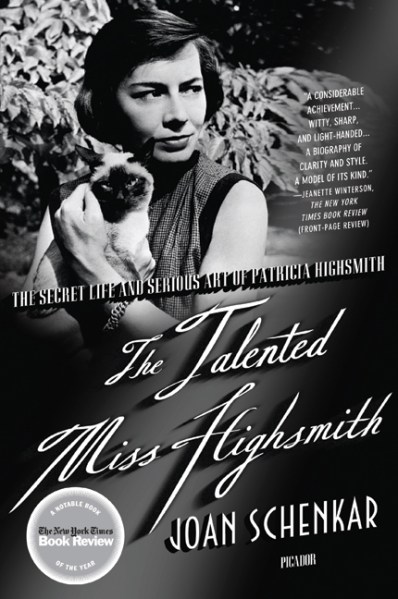
Before looking over Joan Schenkar’s exhaustive biography of Patricia Highsmith, The Talented Miss Highsmith: The Secret Life and Serious Art of Patricia Highsmith, I have to admit that I thought of the writer primarily as a practitioner of pulp fiction, the kind of lurid crime tales at home in airport bookshops. In recent years, I’ve come to reevaluate my stance on crime noir in particular (which I wrote about here), a genre whose conventions I find increasingly more apparent in the “literary fiction” that I enjoy. Anyway, Schenkar’s book places much stress on the Serious Art section of Highsmith’s biography. I knew Highsmith mainly from her Ripley novels, which I’ve never read, but gather to be smart and psychologically complex. I didn’t know that Highsmith wrote Strangers on a Train, adapted by Hitchcock into a noir classic. I didn’t know that she wrote comic books for years — the weird crime ones that stirred up so much commotion in the fifties. I didn’t know that she worked homoerotic themes into her novels, and wrote one very openly lesbian novel that was published during her lifetime (albeit under a pseudonym), The Price of Salt. Schenkar makes a case for a Highsmith as an underappreciated novelist, a contemporary of Mailer and Capote who never got her due (even if her novels were bestsellers), a writer in the tradition of Kafka and Freud. Rounding out the biography is a complex investigation of Highsmith’s strange relationship with her mother, a look at her long list of lovers, and plenty of charts, diagrams, and photos (Schenkar even sneaks a topless pic in, if that piques your interest).

All three titles are new in trade paperback from Picador.

Books I Am Always (Re-)Reading

Trudging through a very long book the other night–never mind the title, at least now anyway–it occurred to me that I’d rather be reading from 2666; that, at that particular moment, I’d rather re-read from “The Part About the Crimes.” I don’t know if it was the effete dullness of the first volume that made me want to pick up Bolaño’s epic, perhaps trying to zap some life into my waning eyeballs; perhaps it was just the sense that I was wasting my time with the merely good, which, after all, is mediocrity when set against genius (yes, these are subjective terms).

Anyway, I didn’t have to go looking for 2666 — I have a copy (yes, I have two) right there jammed into my nightstand, along with a few other books that I realize that I’m always reading. Furthermore, I’m always reading these books in the most discontinuous, stochastic fashion, often picking them up at random and thumbing through them. I think I use these books to clear my literary palate, to get a bad (or worse, boring) taste out of my brain, to inspire me, to suggest another book. Some of these books, like 2666 are big, fat volumes, volumes that I set close at hand in the hopes of rereading in full. Sometimes I’ve met this goal; in the case of Moby-Dick, I’ve read the book through at least three times now, and yet never tire of it. I’m always picking it up again and again, sometimes to find Elijah’s rant or to dip into Ahab’s mad monologue or perhaps just to hear Stubb comment on the proper preparation of shark steaks. Of a piece with those big novels is David Foster Wallace’s Infinite Jest, which I turn to repeatedly, reading over a riff or two at a time, perhaps still trying to figure out the ending, or some clue of the ending, perhaps trying to figure out why Hal can’t speak (you know, beyond like, a a metaphorical level).

There’s also Blood Meridian.

A book I always keep proximal is D.H. Lawrence’s Studies in Classic American Literature, which, if this were a dictatorship under Biblioklept might replace the Constitution (jaykay, Tea Partiers!). Tellingly, I’ve never managed to finish one of Lawrence’s novels (I even struggle through his much-anthologized piece, “The Rocking Horse Winner”), but I consider his dissertations on Hawthorne, Poe, and Melville indispensable (and creative in their own right). I guess I just like lit crit; Harold Bloom’s too-huge volume The Western Canon is a book I return to again and again. Sometimes I find myself throwing it to the ground, quite literally (if I’ve enjoyed a drink or two, that is), in disgust. Bloom’s battle with “The School of Resentment” can be maddening, especially when he’s so up front about essentially making Shakespeare God. Still, Shakespeare doesn’t seem like a bad God to have.

I should point out that I’ve made no attempt to read The Western Canon the whole way through; in fact, I’ve never made a single attempt to read it systematically. I just sort of pick it up, thumb through it, occasionally plumb the index. There are several books that I am always rereading in this category: Books That I Am Always Reading and Yet Have Never Finished. Foremost among these is Nietzsche’s Human, All Too Human, a book that I probably, at this point, have read in full, but never fully through. Its aphorisms beg to be read discontinuously; I think Nietzsche wet-dreamed about his fragmentary works being literally fragmented and then later found, read piecemeal against some newer, more garish culture. Or perhaps that’s just my metaphorical wet dream.

Other Books That I Am Always Reading and Yet Have Never Finished — The Life and Opinions of Tristram Shandy, Gentleman stands out, as does Finnegans Wake. Sterne’s book is such an oddity: I remember picking it up in a stack of books to be shelved at my college library, thumbing through it, bewildered, thinking that it must be contemporary with John Barth. A bit of research left me even more perplexed. Like Tristram, who can’t seem to finish his story, I can’t seem to actually finish it, but I’m okay with picking it up again and again. Similarly, Finnegans Wake strikes me as an unfinished-unfinishable volume (I do not mean this literally; I know that Joyce “finished” the book as an infinite strange loop, just as I know that the book can be read). I have an audio recording of Finnegans Wake that I like to listen to occasionally (especially while driving), as well as William York Tindall’s  guide (which is fun), but I’d rather just sort of grab the thing at random and read a page or two. I know, in an intellectual sense, that is, that I could easily read the book in a calendar year by committing to three pages a day (plus a few pages of Tindall), but I don’t think that I can read books in an intellectual sense. I think, at the risk of sounding unbearably corny, that books have to call to their readers in an emotional and perhaps even spiritual sense. Otherwise, what’s the point?

The Novelist’s Lexicon

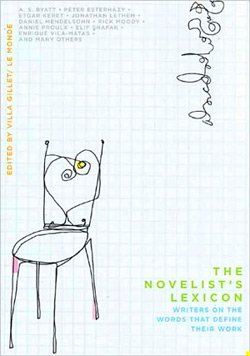
The Novelist’s Lexicon, new in hardback from Columbia University Press, is an auspicious and at times bewildering project originating from an international literary conference hosted by Le Monde a few years ago. Over seventy authors from more than a dozen countries were asked to write about a “key word that opens the door to his work.” A list of just a few of the authors here is probably more than enough to pique interest: Rick Moody, Helene Cixous, Colum McCann, Jonathan Lethem, Adam Thirlwell, A.S. Byatt, David Peace, Dennis Cooper, and Annie Proulx all contribute pieces, mostly short, somewhere between 100 and 500 words. By nature, The Novelist’s Lexicon is a fragmentary affair, discontinuous, open to multiplicity, and unified only by its authors’ sense of craft, as well as an abiding intelligence.

Some authors take the project in earnest, like Lethem, whose piece “Furniture,” (which we excerpted late last year) pinpoints a fundamental yet largely unremarked upon element of novel-writing. French author Nicholas Fargues taps into etymology, offering a bit of advice in his piece “Novice”–

Don’t ‘make’ literature. Don’t write because that’s what people expect of you now that you’re a ‘writer.’ Don’t write for the beauty of the gesture or the love of art. Beware of fine phrases and well-turned maxims; that’s not your thing. Watch out for words that strike a pose. But do let your memory and your instincts flow; let the aptest words, the words that resemble you most closely, come of their own accord.

Anne Weber’s piece “Waiting/Attention” suggests that a key word — or any key, really — is an impossible dream–

It would be a word that encapsulated my aspirations and expectations, my sadness and my joy, my amazement at the quince’s hairy skin, the wash of the sky, and the delicate pattern of the cyclamen’s leaves. And since everything would be contained in this single, essential word, since it would express everything, I wouldn’t need to write anymore. And good riddance, too!

Swedish author Jonas Hassen Khemiri, who goes with “Un-” also points to language’s simultaneous limitations and possibilities–

Un- as in never being satisfied with the language we have. Un- as in the realization of how difficult it is to communicate with people in a language you have invented yourself. Un- as in doubting whether you will ever succeed. Un- as in continuing to try even so. Un- as in suddenly launching yourself over a coffee table and transforming a dictionary into confetti.

Khemiri’s frustration with language (and paradoxical love) is thematic throughout Lexicon; we see it, for instance in David Peace’s “Plague.” Peace comes off like the crotchety old man in the group–

To be honest or stupid or both, but not churlish or contrary (I hope), I am uncertain I understand the premise of this lexicon. However, I am against the presumption of all premises and, equally, I am against all definitions and dictionaries, lexicons and lists, which, in their commodification and exclusivity, are the preserve and the territory of fascists and shoppers.

After this radical caveat, including the claim that he is under “duress” (did the folks at Le Monde put guns to these authors’ heads?), Peace goes on to discuss the word “plague,” tracing it through Western lit and showing how it evinces in his novel Occupied City (which we reviewed here, by the way).

Perhaps Peace should’ve just ignored the assignment, like Dennis Cooper, whose piece is “Signed D.C.” is simply a work of microfiction, imagining what would happen if Olive Oyl and Popeye who “peel like decals from the TV and live in the world.” The story is a clever, short five paragraphs, and ends with at least a trace of insight into Cooper’s writing process: “I am heavier than my constructions understand.” Maybe he didn’t ignore the assignment.

Cooper is not the only writer to let fiction reign — there are poems and meditations and strange riffs here, largely divorced of discussion from technique or craft. In any case, those interested in getting into the heads of some of the 21st century’s most prominent (and skillful) writers will wish to take notice of The Novelist’s Lexicon, a fun and repeatedly rewarding book. Recommended.

The Lost Books of the Odyssey — Zachary Mason

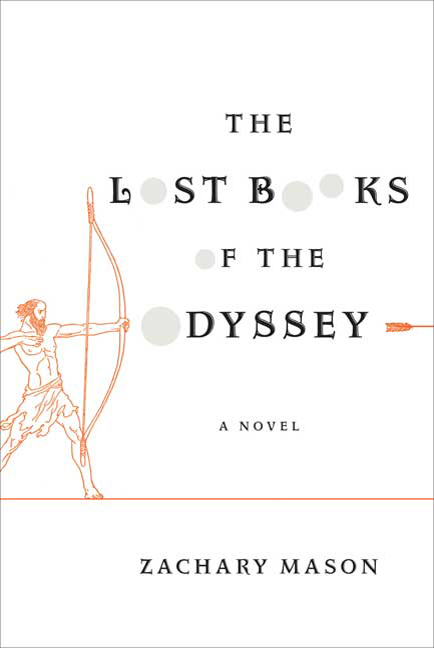
In his preface to The Lost Books of the Odyssey, author Zachary Mason tells us that before the story we now know as the Odyssey was organized by the poet Homer, the “material was formless, fluid, its elements shuffled into new narratives like cards in a deck.” Mason’s goal in The Lost Books is to echo these older versions of the story of Odysseus, omitting “stock epic formulae in favor of honing a single trope or image down to extreme clarity.” He succeeds admirably — Lost Books is an engaging and perplexing work that challenges our assumptions about one of the most foundational stories of Western literature. Mason’s “novel” (it is not really a novel, of course) strikes a wonderfully resonant and deeply upsetting chord, disrupting our sense of narrative satisfaction, breaking us away from the outcomes we thought we knew. I’ll share an example. Here’s chapter 14, “Fragment,” in its entirety–

A single fragment is all that survives of the forty-fifth book of the Odyssey:

Odysseus, finding that his reputation for trickery preceded, started inventing histories for himself and disseminating them wherever he went. This had the intended effect of clouding perception and distorting expectation, making it easier for him to work as he was wont, and the unexpected effect that one of his lies became, with minor variations, the Odyssey of Homer.

Lies with minor variations is a pretty good definition for storytelling. As the fragment above may skew a bit too academic for some readers, a bit too meta-textual, I’ll hasten to point out that Mason’s primary concern is storytelling. We get all the old characters: Penelope and Telemachus, Agamemnon and Achilles, Circe and Cassandra, and so on. Mason’s take is programmatic from the example above though — he works by “clouding perception and distorting expectation.” The opening chapter, “Sad Revelation,” begins with Odysseus returning home to find that Penelope is an old woman, and remarried at that. This revelation turns false, a “vengeful illusion, the deception of some malevolent god. The real Ithaca is elsewhere, somewhere on the sea-roads, hidden. Giddy, Odysseus turns and flees the tormenting shadows.” Hence, the real joy here is in movement and adventure. The journey is the telos, not Ithaca itself. Homecoming is always a deferral.

The opening chapter’s theme of an illusory home and wife repeats throughout the text, as Mason suggests again and again that notions of a stable, fixed identity will always prove untrue. Odysseus, through a clerical error, is ordered to carry out his own assassination. Later, he seems to swap souls with a Trojan enemy, living out another person’s life entirely. In another episode, we see that Odysseus never really escapes Hades, that he is simply always travelling through it, catching glimpses of another, older life.

While many of Mason’s pieces are short — one to three pages — there is a richness here that taps into the history of Western literature. What’s striking is how alienating it can all be: how dark, how cold, how scary. We are reminded that Odysseus can trace his lineage to lycanthropes, an odd call to Scandinavian myth, one reinforced later on a beach with three witches, a tale that echoes (or prefigures) the horror of Macbeth. Mason shows us (or, perhaps more accurately reminds us) that the Odyssey uncannily permeates more of our literature than we might readily recall.

The Lost Books of the Odyssey is post-modern through and through, fragmentary and elliptical, meta-textual and highly ironized. There’s of course a rich tradition of reinterpreting the Odyssey, from Tennyson’s poem to Joyce’s classic, from the Coen brothers’ film O Brother, Where Art Thou? to Margaret Atwood’s The Penelopiad, and Mason’s book will not disappoint those who are interested int the subject (although admittedly, some readers may find too much academic commentary in his work — not me though). In his brevity and frank humor, but most of all in the seemingly unclassifiableness of his work, Mason’s writing reminds me of Lydia Davis or Amy Hempel, but also Borges and Calvino. These are stories that might not be stories in a novel that might not be a novel. Highly recommended.

The Lost Books of the Odyssey is new in trade paperback from Picador.

“The Thirty-Six Dramatic Situations” — Georges Polti

“The Thirty-Six Dramatic Situations” is a list compiled by nineteenth-century French writer George Polti intended as a literary criticism device; in 2011 it reads almost like some kind of story or prose poem in itself–
  1. Supplication (in which the Supplicant must beg something from Power in authority)
  2. Deliverance
  3. Crime Pursued by Vengeance
  4. Vengeance taken for kindred upon kindred
  5. Pursuit
  6. Disaster
  7. Falling Prey to Cruelty of Misfortune
  8. Revolt
  9. Daring Enterprise
  10. Abduction
  11. The Enigma (temptation or a riddle)
  12. Obtaining
  13. Enmity of Kinsmen
  14. Rivalry of Kinsmen
  15. Murderous Adultery
  16. Madness
  17. Fatal Imprudence
  18. Involuntary Crimes of Love (example: discovery that one has married one’s mother, sister, etc.)
  19. Slaying of a Kinsman Unrecognized
  20. Self-Sacrificing for an Ideal
  21. Self-Sacrifice for Kindred
  22. All Sacrificed for Passion
  23. Necessity of Sacrificing Loved Ones
  24. Rivalry of Superior and Inferior
  25. Adultery
  26. Crimes of Love
  27. Discovery of the Dishonor of a Loved One
  28. Obstacles to Love
  29. An Enemy Loved
  30. Ambition
  31. Conflict with a God
  32. Mistaken Jealousy
  33. Erroneous Judgment
  34. Remorse
  35. Recovery of a Lost One
  36. Loss of Loved Ones.

“Twain Is the Day, Melville the Night” — Roberto Bolaño on U.S. Writers

The following excerpt comes from Raul Schenardi’s 2003 interview with Roberto Bolaño, conducted at the Turin Book Fair just months before the author’s death. The interview is written in Italian (although I’m not sure if it was conducted in Italian). The translation work is the result of two programs (Google Translate and Babel Fish) and a few dictionaries; I also used this Spanish translation as a second source for comparison.

. . .  in all Latin American writers is an influence that comes from two main lines of the American novel, Melville and Twain. [The Savage] Detectives no doubt owes much to Mark Twain. Belano and Lima are a transposition of Huckleberry Finn and Tom Sawyer. It’s a novel that follows the constant movement of the Mississippi. . . . I also read a lot of Melville, which fascinates me. Indeed, I flirt with the belief that I have a greater debt to Melville than Twain, but unfortunately I owe more to Mark Twain. Melville is an apocalyptic author. Twain is the day, Melville  the night — and always much more impressive at night. In regard to modern American literature, I know it poorly. I know just up to the generation previous to Bellow. I have read enough of Updike, but do not know why; surely it was a masochistic act, as each page Updike brings me to the edge of hysteria. Mailer I like better than Updike, but I think as a writer, a prose writer, Updike is more solid. The last American writers I’ve read thoroughly and I know well are those of the “Lost Generation,” Hemingway, Faulkner, Scott Fitzgerald, Thomas Wolff.

Oh Pure and Radiant Heart — Lydia Millet

The nice people at Iambik Audiobooks were kind enough to give me a few books from their catalog recently, one of which is Lydia Millet’s Oh Pure and Radiant Heart, which I will review momentarily, but first I’m compelled to comment on Iambik itself. The company is a true indie, run by people who care very much about literature; they release audiobooks on mp3 from independent publishers in the U.S. and Canada. Their prices are more than reasonable — around five bucks a book, cheaper than iTunes or Audible. And, unlike many audiobook vendors, there’s no weird third-party software you have to download, no DRM, no password protected files. Just nice, high quality mp3s, tagged and ready to go. I was able to download the books in a few minutes, put them on my iPod, and begin listening. Good stuff.

The premise of Oh Pure and Radiant Heart is this: three of the lead scientists of the Manhattan Project, Robert Oppenheimer, Leo Szilard, and Enrico Fermi — those nice men who brought us the atom bomb — are somehow transported from 1945 (during the Trinity test) to the early 2000s, during the first term of George W. Bush. Their arrival coincides with a strange dream (or mystical vision) on the part of the book’s protagonist, a quiet, thoughtful librarian named Ann, who lives with her husband Ben, a gardener, in Santa Fe, New Mexico. After a violent tragedy at Ann’s library, circumstance brings her together with the three scientists, whom she recognizes. Ann quickly comes to believe in the scientists in an almost spiritual sense. They give her life the meaning it has thus far lacked. Ben is far more skeptical, and one of the novel’s strengths, particularly in its first half, is watching the strain on the young couple’s marriage as Ann increasingly finds her identity wrapped up in the scientists’ mission. Even more problematic is her platonic relationship with Oppenheimer, who becomes both a father-figure to her as well as the object of her motherly protection. Ann, Ben, and Oppenheimer form the novel’s intellectual and philosophical core; Millet grants us repeated access into their first-person thoughts and feelings, which comprise many of the book’s most interesting obsessions — Ann mulls over the tension between the concrete world and the hopes of a metaphysical reality; Ben ponders how one might come to possess (or perhaps earn) a soul; Oppenheimer, through a somewhat guilty lens, observes a materialistic and intellectually degraded 21st century.

It’s this degradation that the scientists seek to redress, perhaps in part to atone for their own complicity in creating the future (or rather, this future). First, however, there’s a trip to Japan to see what their bombs did firsthand. In Tokyo the scientists are doubly alienated, not only by Japanese culture, but also by the intensity and futurity of hyperkinetic Tokyo. It’s here that they meet Larry, a 40-something surfer-bum/stoner/rich kid/lazy plot device, whose father has “more money than God.” It’s this money that funds the scientists throughout the rest of the novel. Larry comes to believe in them almost immediately, and becomes their chief financier (and manager of sorts) as they move on to the next episode, an overlong final-third back in America.

Despite Ben’s protests, the scientists, led by pushy, media-savvy Szilard, set out on a rambling tour of America, leading a campaign for world peace via nuclear disarmament. The conflict heightens between Szilard and Ben, natural foils, as Oppenheimer becomes increasingly abstracted from the physical world, and Fermi enters a mystical depression. As the scientists tour about on luxury RVs, meeting with media organizations and staging rallies, they begin to attract a strange cavalcade of hippies and dropouts, runaways and weirdos –and, significantly, a burgeoning group of End Times obsessed evangelical Christians. Szilard initially thinks he can control the swelling circus, but leadership soon falls into disarray. Complicating the matter are the private security forces the different contingents utilize. The irony that the peace movement is littered with men bearing guns is not lost on Oppenheimer. In the meantime, Ann feels increasingly marginalized and Ben continues to see their marriage dissolve (Ann seems abstractedly unaware). Ben does, however, make a meaningful and somewhat paternal relationship with sensitive Fermi, taking the man on hiking trips and otherwise shielding him from the craziness that Szilard openly embraces.

This final section of the novel is easily its weakest–Millet’s strength in the early parts of the book comes in her handling of the interior spaces of Oppenheimer, Ben, and Ann, as well as the mystical absurdity of the scientists’ transportation to the future. These concerns get muddied by too many characters and too many plots as the book reaches its climax; what should be a build to a thrilling end is instead something of a slog. Nevertheless, Millet (thankfully) pulls off that end in a dazzling, disturbing rally in Washington D.C. complete with riots and spiritual revelations of a sort.

While Millet’s conclusion is not my metaphysical cup of tea, it is an appropriate and organic resolution for the novel. Far more interesting, to me anyway, is Millet’s keen research about the development of the atom bomb and the (continued) proliferation of nuclear weapons. The novel is larded with frank, concise facts about America’s military-industrial complex that, when set against the narrative proper, create a highly ironic and coldly searing satire. The closest point of comparison I can think of here is J.G. Ballard, whose 1994 novel Rushing to Paradise Oh Pure and Radiant Heart often echoes. And while Millet’s satire is often funny, it’s the kind of funny that is cold and black when honestly reflected on — which her thoughtful characters often do. Ultimately, Oh Pure and Radiant Heart is a deeply sad comedy, especially if we identify strongly with Ben and Ann, who in a wistful coda, continue to search for meaningful lives against the existential backdrop of a word that is, to use the novel’s language, “post-history.”
“We’ve Gotten Used to Death” — A Passage from Roberto Bolaño’s 2666

From Roberto Bolaño’s 2666, “The Part About Fate, pages 266-267:

“We’ve gotten used to death,” he heard the young man say.

“It’s always been that way,” said the white-haired man, “always.”

In the nineteenth century, toward the middle or the end of the nineteenth century, said the white-haired man, society tended to filter death through the fabric of words. Reading news stories from back then you might get the idea that there was hardly any crime, or that a single murder could throw a whole country into tumult. We didn’t want death in the home, or in our dreams and fantasies, and yet it was a fact that terrible crimes were committed, mutilations, all kinds of rape, even serial killings. Of course, most of the serial killers were never caught. Take the most famous case of the day. No one knew who Jack the Ripper was. Everything was passed through the filter of words, everything trimmed to fit our fear. What does a child do when he’s afraid? He closes his eyes. What does a child do when he’s about to be raped and murdered? He closes his eyes. And he screams, too, but first he closes his eyes. Words served that purpose. And the funny thing is, the archetypes of human madness and cruelty weren’t invented by the men of our day but by our forebears. The Greeks, you might say, invented evil, the Greeks saw the evil inside us all, but testimonies or proofs of this evil no longer move us. They strike us as futile, senseless. You could say the same about madness. It was the Greeks who showed us the range of possibilities and yet now they mean nothing to us. Everything changes, you say. Of course everything changes, but not the archetypes of crime, not any more than human nature changes. Maybe it’s because polite society was so small back then. I’m talking about the nineteenth century, eighteenth century, seventeenth century. No doubt about it, society was small. Most human beings existed on the outer fringes of society. In the seventeenth century, for example, at least twenty percent of the merchandise on every slave ship died. By that I mean the dark-skinned people who were being transported for sale, to Virginia, say. And that didn’t get anyone upset or make headlines in the Virginia papers or make anyone go out and call for the ship captain to be hanged. But if a plantation owner went crazy and killed his neighbor and then went galloping back home, dismounted, and promptly killed his wife, two deaths in total, Virginia society spent the next six months in fear, and the legend of the murderer on horseback might linger for generations. Or look at the French. During the Paris Commune of 1871, thousands of people were killed and no one batted an eye. Around the same time a knife sharpener killed his wife and his elderly mother and then he was shot and killed by the police. The story didn’t just make all the French newspapers, it was written up in papers across Europe, and even got a mention in the New York Examiner. How come? The ones killed in the Commune weren’t part of society, the dark-skinned people who died on the ship weren’t part of society, whereas the woman killed in a French provincial capital and the murderer on horseback in Virginia were. What happened to them could be written, you might say, it was legible. That said, words back then were mostly used in the art of avoidance, not of revelation. Maybe they revealed something all the same. I couldn’t tell you.

Pig Earth — John Berger

People exaggerate the changes in nature so as to make nature seem lighter. Nature resists change. If something changes, nature waits to see whether the change can continue, and it it can’t, it crushes it with all its weight!  Ten thousand years ago the trout in the stream would have been exactly the same as today.

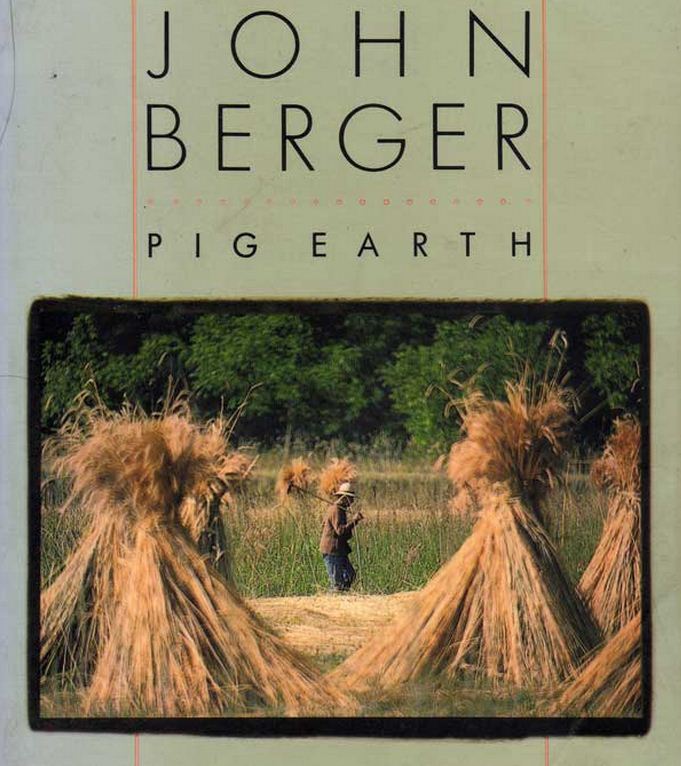
Stasis and disruption and the relation between people and their natural and urban surroundings are the themes John Berger writes about in his 1979 collection of essays, poems and short stories, Pig Earth.  Having moved from England, where he enjoyed considerable renown as an art critic and fiction writer, to the peasant villages of the French Alps, Berger settled into his role as an active participant in rural life, not only turning hay but observing and documenting the disappearance of a way of a once-pervasive mode of life.  Pig Earth was one result of his labors, the first book of a trilogy that took some fifteen-odd years to complete, a moving but not uncritical account of humanity’s struggle to conquer nature by symbiosis.

Maybe symbiosis isn’t the proper term if we agree that humanity is part of nature’s whole, but Berger juxtaposes the frailty of humanity with the earth’s uncaring and often violent strength.  Survival for the family of the subsistence farmer depends upon that family’s ability to tend to the needs of the plant and animal world (as well as more than a little bit of luck).  In the collection’s first true story, “A Calf Remembered,” a baby cow is delivered on a dark winter’s night. Here, Berger stresses the protections that nature and man have designed to ensure the survival of a young, vulnerable animal:  mucus, barn, salt, and sense.  The human spends his night in the barn protecting his property because it provides him not only with sustenance in the forms of milk and meat, but also companionship and a sense of duty.  When daily living requires acts that might mean life or death, the conscious and the instinct converge.

He sat on a milking stool in the dark.  With his head in his hands, his breathing was indistinguishable from that of the cows. The stable itself was like the inside of an animal.  Breath, water, cud were entering it:  wind, piss, shit were leaving.

Pig Earth is a book worth studying as people attempt to make sense of a world transitioning from one type of living to another and fuss over the sources of their own limited strength and vitality. Berger may not have been looking to pioneer a slow-living locavore lifestyle, but his subjects worry about their increasing isolation from the circles of power and industry.  They fret over the pointlessness of passing their knowledge to their children who need entirely different skills to survive in the rapidly encroaching urban wage economy.  In “The Value of Money” a father refuses a tractor, branded “The Liberator” by the manufacturer, that his son has purchased for him because it will render his faithful work-horse obsolete.  This same farmer kidnaps local tax officials because they want to confiscate the products of his labor without compensation for value that he exclusively created.  Unable to make them understand their wrongdoing, he sets them free because “you can only take revenge on those who are your own.”

The final story, “The Three Lives of Lucy Cabrol,” is the lengthiest and perhaps most poignant narrative in the book. It follows the life of a bright, tenacious, physically stunted woman as she grows from young girl to town outcast.  While Berger admired much of the life in the peasant village, he would fail in his duty as critic and chronicler if he ignored its darker sides. Berger often sets the title character’s pluck against the resignation and superstition endemic to village life. When life requires struggle, most people choose to hoard.  When poor choices may lead to death or family hardship, capitulation to those in power, whether those rulers be the town’s big man or Nazi collaborators, can often seem the only obvious choice.  Lucy shows us that cowardice, no matter the circumstances, only seems easy. Pig Earth is highly recommended.