Heroes of 2010 — David Mitchell

Vice Interviews Sam Lipsyte

Vice interviews Sam Lipsyte–good stuff. From the interview, here’s Lipsyte on writing comedy–

The page is very different than what a stand-up comic does. A comedian has a physical body—gestures, vocal intonations, double takes—whatever they’re going to do to bring across the comedy. They can make a phrase funny just by the way they say it. Authors don’t have any of those tools at our disposal, so we have to find lingual ways to do it. So much of it is how you build to something, how wide you make a loop of description before you veer off and land somewhere totally unrelated. You have to learn how that rhythm works in prose. It has to be something you feel.

I don’t want it to be too jokey, I don’t want it to be making claims for itself as funny, but then you must laugh because it is a funny moment. I pursue… something strange, usually, in every paragraph. It may be funny, or it may be something I don’t think is that funny. I’ve had people come up to me and say, “That was so funny!” and I think, “Dude, that’s the most devastating moment in the book.” I’ve realized that it’s both. In my work the funniest thing is usually the most devastating thing, and that’s where they play with each other.

“The Savior must have been a docile Gentleman” — Emily Dickinson

Emily Dickinson’s nativity poem, “The Savior must have been a docile Gentleman”–

The Savior must have been
A docile Gentleman—
To come so far so cold a Day
For little Fellowmen—

The Road to Bethlehem
Since He and I were Boys
Was leveled, but for that ‘twould be
A rugged Billion Miles—

James Joyce’s Death Mask

Charles Burns Talks to Vice; Discusses Subconscious Tintin Influences

At Vice, Sammy Markham (Crickets) interviews one of our heroes of Charles Burns. Read our review of Burns’s latest, X’ed Out. From the interview with Markham, Burns discusses subconscious influences–

There’s work that I grew up with and looked at and internalized. It is still in my subconscious, and I pay attention to that part of myself, and those images come through. For example, I looked at Tintin books when I was really, really young—before I could even read—and so there were elements of the stories that I didn’t understand the relevance of. In The Secret of the Unicorn there’s one scene where Tintin is down in this basement. He’s been kidnapped. He wakes up and there’s this intercom that’s stuck on the wall. And in my mind, I had no idea what an intercom was, but I could tell that there was a voice balloon coming from this little hole in the wall.

In a weird and felicitous coincidence, I happened to have read The Secret of the Unicorn just last week and then read a comic by Burns in the May or June 2010 issue of The Believer where he riffs on the very scene he’s described above, a comic I only understood after reading Unicorn. Here’s the comic–

“A Christmas Greeting” — Walt Whitman

“A Christmas Greeting” by Walt Whitman

Welcome, Brazilian brother–thy ample place is ready;
A loving hand–a smile from the north–a sunny instant hall!
(Let the future care for itself, where it reveals its troubles,
impedimentas,
Ours, ours the present throe, the democratic aim, the acceptance and
the faith;)
To thee to-day our reaching arm, our turning neck–to thee from us
the expectant eye,
Thou cluster free! thou brilliant lustrous one! thou, learning well,
The true lesson of a nation’s light in the sky,
(More shining than the Cross, more than the Crown,)
The height to be superb humanity.

A Gordon Lish Sentence That Cracked Me Up

Today, I listened to Iambik’s audiobook version of Collected Fictions, a selection of stories written and read by the inimitable Gordon Lish. Lish reads a few choice stories from four of his volumes in a wry, gruff tone; he’s got a wonderful rhythmic style, and he pauses to reflect on some of the selections before and after reading them. I’ll give the volume a proper review down the line, but I wanted to share a passage–a long sentence, really—that made me laugh out loud from the story “Mr. Goldbaum,” from the 1988 collection Mourner at the Door. I actually own Mourner at the Door, and had read “Mr. Goldbaum” sometime earlier this year or last year, but I don’t remember it being nearly as funny or touching. Must be Lish’s delivery. Anyway, the Lishness, which can be appreciated entirely out of context–

What if your father was the kind of father who was dying and he called you to him and you were his son and he said for you to come lie down on the bed with him so that he could hold you and so that you could hold him so that you both could be like that hugging with each other like that to say goodbye before you had to actually go leave each other and did it, you did it, you god down on the bed with your father and you got up close to your father and you got your arms around your father and your father was hugging you and you were hugging your father and there was one of you who could not stop it, who could not help it, but who just got a hard-on?

Or both did?

Picture that.

Not that I or my father ever hugged like that.

“Christmas at Sea” — Robert Louis Stevenson

“Christmas at Sea” by Robert Louis Stevenson

The sheets were frozen hard, and they cut the naked hand;
The decks were like a slide, where a seamen scarce could stand;
The wind was a nor’wester, blowing squally off the sea;
And cliffs and spouting breakers were the only things a-lee.

They heard the surf a-roaring before the break of day;
But ’twas only with the peep of light we saw how ill we lay.
We tumbled every hand on deck instanter, with a shout,
And we gave her the maintops’l, and stood by to go about.

All day we tacked and tacked between the South Head and the North;
All day we hauled the frozen sheets, and got no further forth;
All day as cold as charity, in bitter pain and dread,
For very life and nature we tacked from head to head.

We gave the South a wider berth, for there the tide-race roared;
But every tack we made we brought the North Head close aboard:
So’s we saw the cliffs and houses, and the breakers running high,
And the coastguard in his garden, with his glass against his eye.

The frost was on the village roofs as white as ocean foam;
The good red fires were burning bright in every ‘long-shore home;
The windows sparkled clear, and the chimneys volleyed out;
And I vow we sniffed the victuals as the vessel went about.

The bells upon the church were rung with a mighty jovial cheer;
For it’s just that I should tell you how (of all days in the year)
This day of our adversity was blessed Christmas morn,
And the house above the coastguard’s was the house where I was born.

O well I saw the pleasant room, the pleasant faces there,
My mother’s silver spectacles, my father’s silver hair;
And well I saw the firelight, like a flight of homely elves,
Go dancing round the china-plates that stand upon the shelves.

And well I knew the talk they had, the talk that was of me,
Of the shadow on the household and the son that went to sea;
And O the wicked fool I seemed, in every kind of way,
To be here and hauling frozen ropes on blessed Christmas Day.

They lit the high sea-light, and the dark began to fall.
“All hands to loose topgallant sails,” I heard the captain call.
“By the Lord, she’ll never stand it,” our first mate Jackson, cried.
…”It’s the one way or the other, Mr. Jackson,” he replied.

She staggered to her bearings, but the sails were new and good,
And the ship smelt up to windward just as though she understood.
As the winter’s day was ending, in the entry of the night,
We cleared the weary headland, and passed below the light.

And they heaved a mighty breath, every soul on board but me,
As they saw her nose again pointing handsome out to sea;
But all that I could think of, in the darkness and the cold,
Was just that I was leaving home and my folks were growing old.

The AV Club Interviews Lynda Barry

The AV Club’s Tasha Robinson interviews comix legend Lynda Barry. In the (rather lengthy) interview, Barry discusses teaching her craft–

It’s a really hard thing to teach students. The two things I always try to teach them is, one, you have to stay in motion. It doesn’t mean that you have to just write blah, blah, blah, blah, blah. Write the alphabet. You have to stay in motion. And the other thing is, when you get stuck, don’t read over what you just wrote. Especially if you have a computer. Maybe by hand is not so bad, but with a computer, what happens is… My experience has always been that there is a point when the story just stops. Always. You know, it’s just like when you’re dancing. There’s a time when you’re fake-dancing, because the groove has stopped. Then you’re back in the groove. So if people understood that that’s a natural part of making something, and they knew what to do during that time… But what people will do if they’re writing on a computer is, when that time comes and it’s quiet for a minute, they panic and go back and start fixing stuff above it that was not even broken. You can’t start to fix something until you know what it’s for, you know? So I always try to get my students to just sustain the state of mind for a certain amount of time. Even though I use 24 panels for my students, they’ll have seven minutes to just sustain this open state of mind while they’re writing, keep their hand in motion. But it’s really tough to get them to believe me, to just to even give it a try. And then once they do, it’s really fun.

A Blood Meridian Christmas

Cormac McCarthy’s seminal anti-Western Blood Meridian isn’t exactly known for visions of peace on earth and good will to man. Still, there’s a strange scene in the book’s final third that subtly recalls (and somehow inverts) the Christmas story. The scene takes place at the end of Chapter 15. The Kid, erstwhile protagonist of Blood Meridian, has just reunited with the rampaging Glanton gang after getting lost in the desert and, in a vision-quest of sorts, has witnessed “a lone tree burning on the desert” (a scene I argued earlier this year was the novel’s moral core).

Glanton’s marauders, tired and hungry, find temporary refuge from the winter cold in the town of Santa Cruz where they are fed by Mexicans and then permitted to stay the night in a barn. McCarthy offers a date at the beginning of the chapter — December 5th — and it’s reasonable to assume, based on the narrative action, that the night the gang spends in the manger is probably Christmas Eve. Here is the scene, which picks up as the gang — “they” — are led into the manger by a boy–

The shed held a mare with a suckling colt and the boy would would have put her out but they called to him to leave her. They carried straw from a stall and pitched it down and he held the lamp for them while they spread their bedding. The barn smelled of clay and straw and manure and in the soiled yellow light of the lamp their breath rolled smoking through the cold. When they had arranged their blankets the boy lowered the lamp and stepped into the yard and pulled the door shut behind, leaving them in profound and absolute darkness.

No one moved. In that cold stable the shutting of the door may have evoked in some hearts other hostels and not of their choosing. The mare sniffed uneasily and the young colt stepped about. Then one by one they began to divest themselves of their outer clothes, the hide slickers and raw wool serapes and vests, and one by one they propagated about themselves a great crackling of sparks and each man was seen to wear a shroud of palest fire. Their arms aloft pulling at their clothes were luminous and each obscure soul was enveloped in audible shapes of light as if it had always been so. The mare at the far end of the stable snorted and shied at this luminosity in beings so endarkened and the little horse turned and hid his face in the web of his dam’s flank.

The “shroud of palest fire” made of sparks is a strange image that seems almost supernatural upon first reading. The phenomena that McCarthy is describing is simply visible static electricity, which is not uncommon in a cold, dry atmosphere–particularly if one is removing wool clothing. Still, the imagery invests the men with a kind of profound, bizarre significance that is not easily explainable. It is almost as if these savage men, naked in the dark, are forced to wear something of their soul on the outside. Tellingly, this spectacle upsets both the mare and her colt, substitutions for Mary and Christ child, which makes sense. After all, these brutes are not wise men.

Santa Claus Rape in Ellison’s Invisible Man

I’m finishing up Ralph Ellison’s Invisible Man, and I came to this shocking, weird, gross, Christmasy reference near the end of the book. The context is that, in 1950s America, Sibyl, a white woman, wants the narrator, a black man, to fulfill her rape fantasy. Page 522 of my edition–

George Orwell’s Recipes for Plum Cake and Christmas Pudding

(Via).

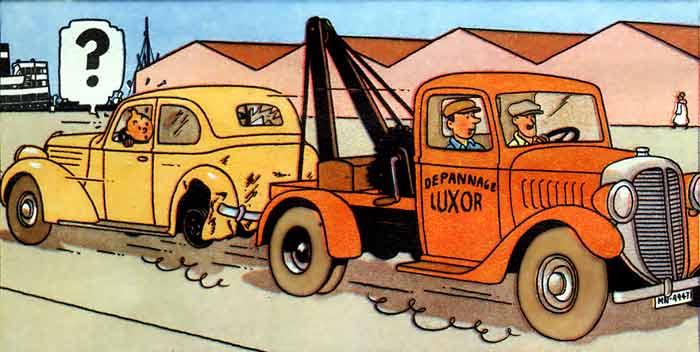
Every Car in Hergé’s Tintin Comics

Every car in Hergé’s Tintin comics.

(An Incomplete List of) Writers Who Died in 2010

J. D. Salinger, 91, American author

Howard Zinn, 87, American historian

Barry Hannah, 67, American novelist and short story writer

David Markson, 82, American writer

Harvey Pekar, 70, American comic book writer (American Splendor)

Tuli Kupferberg, 86, American poet, cartoonist and musician (The Fugs)

David Mills, 48, American author, journalist and television writer (NYPD BlueThe CornerKingpin)

Dick Giordano, 77, American comic book artist and editor (BatmanGreen Lantern)

José Saramago, 87, Portuguese novelist, playwright and journalist, Nobel Prize winner for literature

Lucille Clifton, 73, American poet (Blessing the Boats), Poet Laureate of Maryland

Robert Dana, 80, American poet, Iowa poet laureate

Rajendra Keshavlal Shah, 96, Indian poet

Tibet, 78, French comics artist

Mary Daly, 81, American radical feminist philosopher

Knox Burger, 87, American editor, writer, and literary agent

George Leonard, 86, American writer, editor and educator, pioneer of the Human Potential Movement

Robert B. Parker, 77, American detective writer

Laura Chapman Hruska, 74, American writer, co-founder and editor in chief of Soho Press

Stephen Morse, 65, American poet

P. K. Page, 93, Canadian poet

Bingo Gazingo, 85, American performance poet

Kage Baker, 57, American science fiction and fantasy author

Ralph McInerny, 80, American philosopher (University of Notre Dame) and mystery author

Erich Segal, 72, American professor, author (Love Story), and screenwriter (Yellow Submarine)

Carlos Montemayor, 62, Mexican writer

Violet Barclay, 87, American comic book artist

David Severn, 91, British author

Colin Ward, 85, British anarchist writer

William Tenn, 89, American science fiction writer

Liz Carpenter, 89, American feminist author, press secretary to Lady Bird Johnson (1963–1969)

John Eric Holmes, 80, American science fiction and fantasy author

Ai Ogawa, 62, American poet, breast cancer

Patricia Wrightson, 88, Australian children’s writer

Matilde Elena López, 91, Salvadoran poet, essayist and playwright

Elena Schwarz, 61, Russian poet

Ella Mae Johnson, 106, American social worker and author

Miguel Delibes, 89, Spanish author, journalist and scholar

Sid Fleischman, 90, American children’s writer

Bill DuBay, 62, American comic book editor, writer, and artist

Henry Scarpelli, 79, American comic book artist (Archie)

Alan Sillitoe, 82, British writer (Saturday Night and Sunday Morning)

Jan Balabán, 49, Czech writer, recipient of the Magnesia Litera award

William Neill, 88, British poet

Carolyn Rodgers, 69, American poet

Peter Orlovsky, 76, American poet

Leslie Scalapino, 65, American poet, publisher and playwright

Peter Seaton, 67, American poet

Judson Crews, 92, American poet

Hoàng Cầm, 88, Vietnamese poet and playwright

Donald Windham, 89, American novelist

Bree O’Mara, 42, South African novelist

Robert Tralins, 84, American author

Ruth Chew, 90, American children’s author

Randolph Stow, 74, Australian writer

Arthur Herzog, 83, American writer

Peter O’Donnell, 90, British writer

T. M. Aluko, 91, Nigerian writer

Kovilan, 86, Indian novelist

F. Gwynplaine MacIntyre, 62, Welsh science fiction author

Allen Hoey, 57, American poet

José Albi, 88, Spanish poet

Andrei Voznesensky, 77, Russian poet and writer

Vladimír Bystrov, 74, Czech writer and translator

Suso Cecchi d’Amico, 96, Italian screenwriter (Bicycle Thieves)

Tom Mankiewicz, 68, American screenwriter (James BondSuperman)

Iris Gower, 75, Welsh novelist

Jon Cleary, 92, Australian novelist (The SundownersHigh Road to China)

James P. Hogan, 69, British science fiction author

Michèle Causse, 74, French lesbian theorist, author and translator

Vance Bourjaily, 87, American novelist

Patrick Cauvin, 77, French novelist

Sir Frank Kermode, 90, British literary critic and writer

Ludvík Kundera, 90, Czech writer and translator

George Hitchcock, 96, American poet and publisher

Jennifer Rardin, 45, American author

Edwin Charles Tubb, 90, British science fiction author

Micky Burn, 97, British writer and poet

Belva Plain, 95, American novelist (Evergreen)

Bärbel Mohr, 46, German author

George Cain, 66, American author

Claire Rayner, 79, British author

Alí Chumacero, 92, Mexican writer and poet

Monica Johnson, 54, American novelist and screenwriter (Lost in America, Modern Romance)

Philip Carlo, 61, American crime author

Adrian Păunescu, 67, Romanian author, poet and politician

Dmitry Gorchev, 47, Russian writer

Richard Stanley “Dick” Francis, 79, a British jockey who later wrote crime novels about horse racing


Huxley vs. Orwell: The Webcomic

Stuart McMillen’s webcomic does a marvelous job of adapting (and updating!) Neil Postman’s famous book-length essay, Amusing Ourselves to Death, which argues that Aldous Huxley’s vision of the future in Brave New World was ultimately more accurate than the one proposed by George Orwell in 1984. (Via).

How Roberto Bolaño Handled Criticism

From Roberto Bolaño’s July, 2003 interview with Mexican Playboy, collected in The Last Interview and Other Conversations

Every time I read that someone has spoken badly of me I begin to cry, I drag myself across the floor, I scratch myself, I stop writing indefinitely, I lose my appetite, I smoke less, I engage in sport, I go for walks on the edge of the sea, which by the way is less than 30 meters from my house, and I ask the seagulls, whose ancestors ate the fish who ate Ulysses: Why me? Why? I’ve done you no harm.


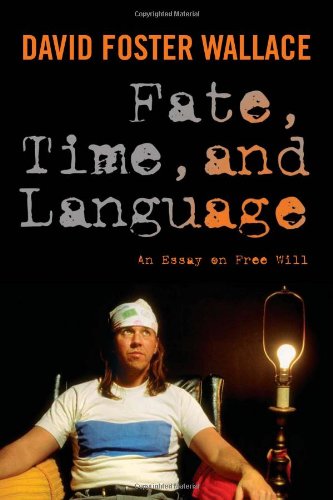
Fate, Time, and Language: An Essay on Free Will — David Foster Wallace

Sometime last year, during a rare visit to a big chain bookstore, I was disgusted to see what had happened to David Foster Wallace’s amazing Kenyon College commencement speech, “This Is Water.” Wallace’s speech, about 3,815 words, give or take (maybe twelve standard typed pages), was being sold as a 144 page hardback volume with only a sentence or two printed per page. The book was (and is) a nakedly commercial attempt to turn a text that is widely available on the web into the sort of thing that well-meaning uncles give to their nephews or nieces as graduation gifts. Of course, hardcore Wallace fans might want such a book — and I’d never begrudge them that — but it’s hard to imagine that Wallace would have been comfortable with how his book was marketed.

Which brings us to Fate, Time, and Language: An Essay on Free Will, new from Columbia University Press this week. The book publishes the 1985 honors thesis that Wallace submitted to the Amherst College’s Department of Philosophy, “Richard Taylor’s ‘Fatalism’ and the Semantics of Physical Modality.” The essay’s title alone signals a prohibitive level of academic specialization. In his introductory essay to the volume, “A Head That Throbbed Heartlike,” New York Times Magazine editor James Ryerson points out, “Its obscurity is easy to appreciate. A highly specialized, seventy-six page work of logic, semantics, and metaphysics, it is not for the philosophically faint of heart.” Ryerson then warns his reader to “Brace yourself for a sample sentence,” before offering a sample from Wallace’s essay that I do not have the patience or fortitude to type out (it would take me too long to locate all the diacritical marks and special logic symbols). Ryerson concludes the paragraph with this wry remark: “There are reasons that he’s better known for an essay about a cruise ship.”

Fortunately, the editors of Fate, Time, and Language make every effort to contextualize Wallace’s essay in a way that explains its aims, strengths, and even shortcomings. There’s Ryerson’s lengthy introduction, which provides an overview to Wallace’s life in philosophy. Then there’s Taylor’s “Fatalism” of course, a short, provocative argument combining six presuppositions that led Taylor to declare that humans have no control — none, whatsoever — over any future event. The volume collects four other essays by Taylor on fatalism, as well as eight other essays responding to his arguments, before delivering Wallace’s essay (the longest in the collection). Here’s Wallace—

So Taylor’s central claim, the Taylor problem, is that just a few basic logical and semantic presuppositions, regarded as uncontroversially true by most philosophers, lead directly to the metaphysical conclusion that human beings, agents, have no control over what is going to happen.

I ain’t even gonna front–pretty much everything that Wallace says after this was lost on me; if you want to read and comprehend the details of his argument you will need to have a grasp on the basics of Montague grammar and tensed modal logic. If you lack these skills, there will be skimming. Lots and lots of skimming. So, in short, I have no ideawhether Wallace’s logic is sound, although I find his conclusion (minus all the modal evidence) quite compelling—

This essay’s semantic analysis has shown that Taylor’s proof doesn’t “force” fatalism on us at all. We should now recall that Taylor was offering a very curious sort of argument: a semantic argument for ametaphysical conclusion. In light of what we’ve seen about the semantics of physical modality, I hold that Taylor’s semantic argument does not in fact yield his metaphysical conclusion.

After Wallace’s honors thesis, there’s a wonderful little memoir essay by his adviser on the project, Jay L. Garfield, who offers up this nugget—

I knew at the time, as I mention above, that David was also writing a novel as a thesis in English. But I never took that seriously. I though of David as a very talented young philosopher with a writing hobby, and did not realize that he was instead one of the most talented fiction writers of his generation who had a philosophy hobby.

These little pockets of insight appeal to me most in Fate, Time, and Language, and as such, Ryerson’s essay “A Head That Throbbed Heartlike” is the highpoint of the book. It weaves together Wallace’s personal life, writing career, and academic pursuits into a moving elegy of sorts, although one more rooted in ideas than feelings. He also spells out the book’s mission quite clearly—

For all its seeming inscrutability, though, the thesis is lucidly argued and–with some patience and industry on the part of the lay reader–ultimately accessible, which is welcome news for those looking to deepen their understanding of Wallace. The paper offers a point of entry into an overlooked aspect of his intellectual life: a serious early engagement with philosophy that would play a lasting role in his work and thought, including his ideas about the purpose and possibilities of fiction.

Many of us might shudder at the idea of our college essays being published posthumously. Of course, most of us aren’t Wallace, but there are undoubtedly critics out there who will cry foul at this publication. Fortunately, the team behind Fate, Time, and Language has produced a book of remarkable integrity, one that understands why it exists, readily acknowledges its obscurity without trying to gloss over that obscurity, and makes every effort to communicate with and engage its readers without sacrificing erudition. To return to my opening anecdote, this is not the naked commercialism that motivated a gimmicky edition This Is Water; rather, this is a book delivered by people who genuinely care about Wallace and his ideas. Make no mistake–it’s very dry and very specialized, but fanatics will no doubt want it.