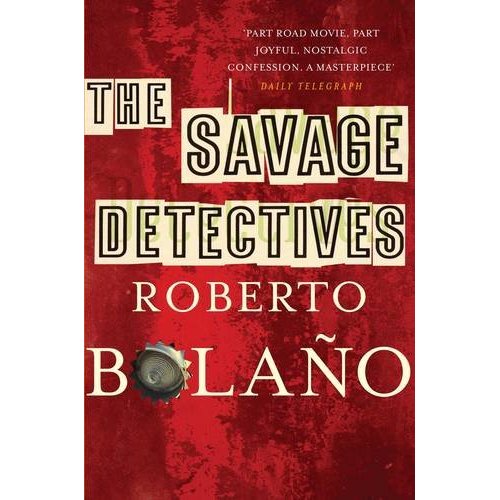
The Savage Detectives — Roberto Bolaño

Roberto Bolaño’s “other” masterwork The Savage Detectives has been previously reviewed on this website, but my view is that the previous writeup was unfair and premature.  Perhaps those of us who love this book are not “serious” readers.

The plot was accurately diagrammed in the earlier post. The Savage Detectives is made up of three sections. The first section consists of the diary of seventeen year-old Visceral Realist poet Juan Garcia Madero, his record of his literary ambition and dawning appreciation of beauty and words. The second, lengthy section is a series of interviews, seemingly conducted by a single, unknown interviewer in an attempt to uncover the history of the Visceral Realist movement, a group of iconoclastic poets that lived in Mexico City in the early part of the 1970s. The third section revisits Garcia Madero’s diary as he and Arturo Belano and Ulises Lima, the nominal leaders of the Visceral Realists, scour the unforgiving Sonora desert in search of their own lost heroes.

Bolaño revisits familiar themes in this novel by asking what drives people to create, and what happens to those people when the things they create are pushed, like themselves, to the margins of society.  Garcia Madero’s drive to write forces him to confront his everyday existence as he attempts to shed his innocence.  He loses friends, quits school, moves in with a waitress, falls in love, has his heart broken.  He writes when he eats, he writes when he should be doing something else, he writes about writing.  He assumes that he and his comrades are on the verge of fame and that others are aware that everything the Visceral Realists do is bold and profound.  Why then, Bolaño asks, is Garcia Madero satisfied with reading his poems to others when he dreams of placing his work in well-regarded anthologies?  What happens when we realize that immortality is ultimately an illusion?  Where does the spirit go when the ghost leaves only a sheet behind?

The answers to the questions posed in the first book are addressed in the second, but there is no sense that the unknown interviewer is close to mythologizing the Visceral Realists in the same manner as the scholars who made a hero of Hans Reiter in the first book of 2666.  At least at the time the interviews were conducted, the Visceral Realists’ body of work is unknown to most, but to those with knowledge of their oeuvre, the Visceral Realists are remembered as hacks or kids from the wrong side of the tracks who preferred the commission of petty misdemeanors to dedication to their craft.  The reality, as usual, is located somewhere in the middle. The Visceral Realists are shown to be like any other group of talented, excitable and intelligent young people because they’re bound to be disappointed.  Their failure of their movement can be blamed on their own choices as well as on barriers erected by those ensconced in the Mexican literary establishment whose notions of where ideas ought to come from are not easily refuted.  Especially by those demanding entry to their small but exclusive club.

Mr. Biblioklept’s first review was essentially right when he stated that The Savage Detectives “is an epic about the banal, ordinary things that fill our lives: jobs and eating and getting to places and having one’s friendships sour and being disappointed and so on.”  Yes, sadness pervades the book.  The Visceral Realists put down their pens, or they move to America, or they run and hide from the things that they cannot control at home.  The Visceral Realists succumb to disease, lose their minds, attempt to cope, and they die.  An early friend of Arturo Belano’s recounts–

I imagined him lost in a white space, a virgin space that kept getting dirtier and more soiled despite his best efforts, and even the face I remembered grew distorted, as if while I was talking to his sister his features melded into what she was describing, ridiculous feats of strength, terrifying, pointless rites of passage into adulthood so distant from what I thought would become of him.

Although the young poets suffer defeat, they enjoy small but significant triumphs, the most important of which is the existence of the book being argued about in this space.  For Bolaño, whose business is the veneration of creators and their creation, the perseverance of the questions raised by the mere existence of the Visceral Realists and their permanent embodiment in a physical object capable of transmission in perpetuity is the ultimate victory. If the author is right that “the search for a place to live and a place to work [is] the common fate of all humanity,” then the young poets transitioning to adulthood don’t fare so poorly.  Most of them, despite their backgrounds, become citizens with some stake in the places they live.  They find work, they have children, they find adventure.  Some, like Arturo Belano, continue to write at an immense personal cost.  A man without a country, he’s the shadow who forms the substance of the book and allows his alter ego to demonstrate his remarkable narrative powers.

But what makes The Savage Detectives a complete work is that, like the characters of Borges and Cortazar, who so many in this novel profess to admire, the poets realize, sometimes too late, that brief and startling connections between people are always possible and love may be found anywhere.  La Maga and Oliviera meet on strange bridges in Paris, condemned men revisit their lives in the moment between gunshot and blackness, and poor, unlettered poets will continue to read, and despite derision and hardship, will continue to express their own vision of hope and possibility.
Roberto Bolaño Explains the Good Thing About Stealing Books

From Roberto Bolaño’s July, 2003 interview with Mexican Playboy, collected in The Last Interview and Other Conversations

The good thing about stealing books–unlike safes–is that one can carefully examine their contents before perpetrating the crime.

Heroes of 2010 — Kenny Powers

As always, Kenny Powers is heroically NSFW —

And then there’s his seriously NSFW K-Swiss ad campaign —

Dr. Samuel Johnson, Origin of a Penis Euphemism

In his forthcoming cultural history of euphemisms, Euphemania, Ralph Keyes offers the following (seemingly apocryphal) origin of the euphemism “Johnson” (for “penis,” of course) —

Johnson is the last name most often used for the male sex organ. According to one theory, this slangy euphemism originated with the name of a large railroad brake lever. Lexicographer Eric Partridge thought it was more likely an abbreviated version of Dr. Johnson, a onetime synonym for “penis” that Partridge said might be based on the assumption that ‘there was no one Dr. [Samuel] Johnson was not prepared to stand up to.’ Working under the verbal restraints of his times, Partridge said this synonym was for the ‘membrum virile.’

Lie vs. Lay (with Help from Roy Peter Clark and Mad Men)

Roy Peter Clark, in his excellent guide to practical writing The Glamour of Grammar, offers the following advice on two of the trickiest homophones in the English language, lie and lay

Here’s the simplest way to remember the difference: lie means “to recline”; lay means “to place.” As in “I lay the cushions on the floor so I can recline in comfort.” (You can use the vowel sounds as a memory aid: lie/recline; lay/place.)

Confusion sweeps in when we move from the present tense to the past. Alas, the past tense of lie happens to by lay: “When I heard the news, I lay on the bed in disbelief.” And the past tense of lay is laid, as in “The bank robbers laid their weapons on the ground.”

Clark then gives us the following helpful examples that distinguish the principal parts of these tricky irregular verbs —

Lie: Today I lie on the bed. Yesterday I lay on the bed. I have lain on that bed so many times there are holes in the mattress.

Lay: Today I lay my cards on the table. Yesterday I laid my cards on the table. I have laid my cards on the table so many times that I was bound to win.

Significantly, Clark uses lie and lay as part of a larger discussion about how a writer can master irregular verbs. He suggests that learning the principal parts of these verbs and understanding the distinction between transitive and intransitive verbs will help writers to communicate more clearly. (The Glamour of Grammar is a fantastic book, by the way, and would make a vital addition to the libraries of experience and inexperienced writers alike).

So, ready for a quiz? One of our favorite blogs, Ironic Sans, compiled every use and misuse of lay and lie from the first three seasons of Mad Men. You’ll have a moment after hearing a character use or misuse lay or lie to decide if he or she has done so with grammatic fidelity. After that, a graphic (and sound) will let you know if the word has been used correctly. Good luck!

Why Cormac McCarthy Doesn’t Write Short Stories

I’m not interested in writing short stories. Anything that doesn’t take years of your life and drive you to suicide hardly seems worth doing.

(Via).

“Honoring the Subjunctive” — Lydia Davis

“Honoring the Subjunctive,” a very short story by Lydia Davis, from The Collected Stories of Lydia Davis

It invariably precedes, even if it do not altogether supersede, the determination of what is absolutely desirable and just.

Truman Capote’s Caviar-Smothered Baked Potatoes with 80-Proof Russian Vodka (and Other Literary Recipes)

Cool post over at Flavorwire on authors’ favorite foods — we like Truman Capote’s baked potato lunch the best:

Though Truman Capote’s writing was mostly occupied with social dealings, he managed to find time to write a forward to Myrna Davis’ The Potato Book, a cookbook penned to raise funds for a Long Island day school. In his brief contribution, Capote offers a recipe for what he describes as “my one and only most delicious ever potato lunch.” In a tribute to the then existing potato fields of Long Island, the recipe called for a baked potato smothered in sour cream and caviar, then paired with a chilled bottle of 80-proof Russian vodka.

Read our list of literary recipes here.

“Without Any Jiggery-Pokery” — David Mitchell on Writing His Novel Black Swan Green

David Mitchell talks about writing his novel Black Swan Green in his 2010 Paris Review interview

MITCHELL

I’d actually started Black Swan Green years earlier. In 2003, while I was finishing Cloud Atlas, Granta asked for an unpublished story, and all I had were a few sketches about the world I grew up in. I didn’t want to be overly distracted from the end of Cloud Atlas, so I decided to knock one of the sketches into a publishable story. In doing so, I began my next novel.

INTERVIEWER

Did you, like Jason, write poetry under a pseudonym for the parish newsletter?

MITCHELL

I did.

INTERVIEWER

Was your pseudonym the same as Jason’s: Eliot Bolivar?

MITCHELL

James Bolivar—after a character created by an American science-fiction writer, Harry Harrison. I’ve never told anyone that before. You can see why.

INTERVIEWER

And, like Jason, did you go see a speech therapist?

MITCHELL

Just the same, aged about thirteen. Like Jason, I would go, and my stammer would vanish in the presence of the therapist, but come the next day, I’d be stammering again. One very pleasing result of Black Swan Green is that the book now appears on course syllabi for speech therapists in the UK. I hope that the book is useful for anyone wanting to understand an insider’s account of disfluency. For most of my life, the subject was a source of paralyzing shame, scrupulously avoided by family and friends. They were being kind, but to do something about a problem it must be named, discussed, and thought about. After writing the second chapter of Black Swan Green I realized, This is true, real, and liberating. I felt a little like how I imagine a gay man feels when he comes out. Thank God—well, thank me actually—that I don’t have to pretend anymore. Now I’m more able to feel that if people have a problem with my stammer, that problem is theirs and not mine. Almost a militancy. If Jason comes back in a future book, he’ll be an adult speech therapist.

INTERVIEWER

When you were creating Jason Taylor, did you ask yourself, What was David Mitchell like at that age?

MITCHELL

It was largely that, yes. Arguably, the act of memory is an act of fiction—and much in the act of fiction draws on acts of memory. Despite the fact that Jason’s and my pubescent voices are close, his wasn’t the easiest to crack because it had to be both plausible and interesting for adult readers.

INTERVIEWER

It was perverse of you to write a first novel after having written three others.

MITCHELL

When I started out on this head-banging vocation, my own background simply didn’t attract me enough to write about it. An island boy looking for his father in Tokyo; sarin-gas attackers; decayed future civilizations in the middle of the Pacific—these were what attracted me. It took me three books to realize that any subject under the sun is interesting, so long as the writing is good. Chekhov makes muddy, disappointed tedium utterly beguiling.

INTERVIEWER

Black Swan Green is very carefully structured.

MITCHELL

Get the structure wrong and you blow up shortly after takeoff. Get it right and you save yourself an aborted manuscript and months and months of wasted writing. Make your structure original and you may end up with a novel that looks unlike any other. So yes, Black Swan Green is carefully structured—like all halfway decent books—but simply structured too, with one story per month for thirteen months. After Cloud Atlas I wanted a holiday from complexity. I was reading Raymond Carver, John Cheever, and Alice Munro—all three great No Tricks merchants. After doing a half Chinese-box, half Russian-doll sort of a novel, I wanted to see if I could write a compelling book about an outwardly unremarkable boy stuck in an outwardly unremarkable time and place without any jiggery-pokery, without fireworks—just old-school.

CableKlept: Wild Times in the Caucasus

WikiLeaks’ recent infodump (available on a DNS mirror here) of over 250,000 US diplomatic cables has raised myriad questions about media responsibility, notably just how open America’s information-drunk society needs to be when private (but not really) communications between members of the intelligence community and governments are open to the public.

And regardless of whether you think the leak is embarrassing (to the US), strategic (for the US making a case against Iran) or triumphant (Assange as Martyr 2.0), the cables themselves actually make for some pretty great stories. Alexis Madrigal at the Atlantic has rounded up some of the more finely crafted transmissions, revealing an intelligence corps that often eschews dry, fact-based tones for rich and, in the case below, humorous detail.

This excerpt of a cable from Moscow to DC recounts an oligarch’s wedding in the Caucasus but reads like the plot summary from an episode of Eastbound and Down:

Gadzhi was locked into his role as host. He greeted every guest personally as they entered the hall — failure to do so would cause great insult — and later moved constantly from table to table drinking toasts with everyone. The 120 toasts he estimated he drank would have killed anyone, hardened drinker or not, but Gadzhi had his Afghan waiter Khan following him around to pour his drinks from a special vodka bottle containing water. Still, he was much the worse for wear by evening’s end. At one point we caught up with him dancing with two scantily clad Russian women who looked far from home. One, it turned out was a Moscow poet (later she recited an incomprehensible poem in Gadzhi’s honor) who MOSCOW 00009533 004 OF 005 was in town with a film director to write the screenplay for a film immortalizing Gadzhi’s defense of Dagestan against Shamil Basayev. By 6 p.m. most of the houseguests had returned to Gadzhi’s seaside home for more swimming and more jet-skiing-under-the-influence. But by 8 the summer house’s restaurant was full once more, the food and drink were flowing, the name performers were giving acoustic renditions of the songs they had sung at the reception, and some stupendously fat guests were displaying their lezginkas for the benefit of the two visiting Russian women, who had wandered over from the reception.

While the excerpted cable is 5 pages of hilarity, others leaked are sad accounts of Gitmo detainees starting new lives and judges seeking protection from the US against terrorist assassins. In all of them, we’re reminded us that diplomacy and intelligence activities are driven not by abstract political ideals, but by humans with feelings, desires and perspectives of their own. Cheers to the Atlantic for finding life (and the humor) within the debate.

Read more of Madrigal’s picks.

Heroes of 2010 — Those Guys Who Stole Jonathan Franzen’s Glasses

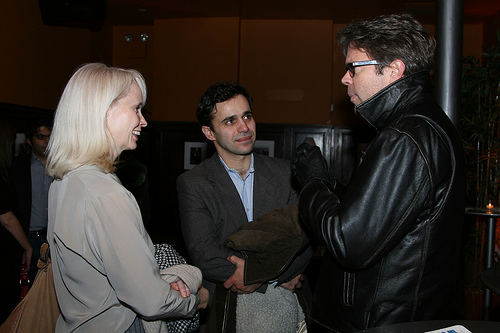
On October 4th of this year, right in the midst of Franzen-mania (and Franzenfreude), two ballsy Londoners jacked Jonathan Franzen’s signature spectacles during a Hyde Park bookstore launch party for Freedom. They left a ransom note asking for $100,000, but were eventually caught, and the glasses were returned. Now, if only someone could do him a favor and steal his silly leather jacket because, jeez, c’mon.

The Best Books We Read in 2010 That Were Published Before 2010

The best books that we read in 2010 that were published before 2010:

Nazi Literature in the Americas by Roberto Bolaño (2008, English translation) — Bolaño’s fake encyclopedia of right-wing writers is a tragicomic crash course in misanthropy, failure, and fated violence. Francisco Goldman’s blurb on the back of the book is spot on–the book is a “key cosmology to Bolaño’s literary universe.” Nazi Literature is like an index for the Bolañoverse–creepy, steeped in dread, deeply, caustically funny, and bitterly poignant.

Butterfly Stories by William T. Vollmann (1993) Adventures in the Southeast Asian sex trade. Bleakly funny, often depressing, and filled with erudite asides on Nobel prizewinners, transvestites, and the benefits of whiskey and benadryl. Plenty of grotesque sex. Not for everyone. In fact, not for most people.

The Friends of Eddie Coyle by George V. Higgins (1970) — Higgins throws his audience into the deep end of gritty urban Boston on the wrong side of the sixties in this crime noir classic. There’s little exposition to spell out Coyle’s intricate and fast-paced plot, but there is plenty of machine-gun dialogue, rendered very true and very raw. Higgins trusts the reader to sort out the complex relationships between hustlers and dupes, cops and finks from their conversations alone. The imagery is straight out of a Scorcese film, and like that director, Higgins has a wonderful gift for showing his audience action without getting in the way.

Home Land (2004) and Venus Drive (2000) by Sam Lipsyte — Is there a better stylist working today than Lipsyte? Does anyone write better sentences? Of course, sentences alone don’t matter much if you don’t have a story worth telling, and both Homeland and Venus Drive deliver. They are seething, funny, poignant books, with characters tipped toward some redemption, awful or otherwise, despite their myriad sins.

Steps by Jerzy Kosinski (1968) — One of the many small vignettes that comprise Steps begins with the narrator going to a zoo to see an octopus that is slowly killing itself by consuming its own tentacles. The piece ends with the same narrator discovering that a woman he’s picked up off the street is actually a man. In between, he experiences sexual frustration with a rich married woman. The piece is less than three pages long. You will either hate or love this book.

Cloud Atlas (2004) and Black Swan Green (2006) by David MitchellCloud Atlas is a postmodern puzzle piece of six nested narratives (each a smart take on some kind of genre fiction), informed by Nietzsche’s idea of eternal recurrence; Black Swan Green (which for some reason we forgot to review here) is a funny and heartwarming coming-of-age story of a boy who copes with his terrible stutter and his parents’ crumbling marriage in early 1980’s England. The books have little in common save their brilliance–which seems kinda sorta unfair. It also seems unfair that Mitchell put them out so quickly. Damn him.

Angels by Denis Johnson (1983) — Angels begins as a small book about not very much and ends as a small book about pretty much everything. Johnson has a keen eye and keener ear for the kinds of marginal characters many of us would rather overlook all together, people who live and sweat and suffer in the most wretched, unglamorous, and anti-heroic vistas of a decayed America. The great achievement of the novel (beyond Johnson’s artful sentences) is in staging redemption for a few–not all, but a few–of its hopeless anti-heroes.

Suttree by Cormac McCarthy (1979) — A beautiful, rambling riff on American literature — Suttree picks up on Emerson and Twain, Faulkner and Whitman, and flows into a new, wild territory that is pure McCarthy. Is it his best novel? Could be. Read it.

The Minimum Number of Books in Harvard’s Libraries That Are Bound in Human Flesh (and Other Fun Facts from Harper’s Index)

The following citations are culled from a search of Harper’s Index that used the term “literature.” (If it’s not obvious, the numbers before each datum are the month and year that Harper’s originally published the datum in its Index)–

5/84    Percentage of Americans who say they never read books: 45

Percentage of these who can’t read: 13

12/87  Number of direct-mail solicitations sent to Henry David Thoreau at Walden Pond this year: 90

4/87   Copies of Gabriel García Márquez’s new book burned by the Chilean government last November: 15,000

2/88   Exclamation points in Tom Wolfe’s The Bonfire of the Vanities: 2,343

10/90   Number of years George Bush has been citing Bonfire of the Vanities as an example of his pleasure reading: 2

11/90   Number of Georgia third-graders Representative Newt Gingrich paid $2 for every book they read last summer: 282

3/91   Percentage of American households in which no books were bought last year: 60

12/92   Chances that an attempt to ban or restrict access to school materials or books last’ year was successful: 2 in 5

6/94   Amount Random House lost on the 29 of its books included on the 1993 New York Times Notable Books list: $698,000

11/95   Estimated number of books banned since 1965 in Indonesia: 2,000

3/95   Amount for which a Mississippi man attempted to sue “the Bible” last year, citing it as “oppressive hearsay”: $45,000,000

5/95   Tons of remaindered books destroyed in the United States each year: 250,000

5/95   Number of Shakespeare’s thirty-seven plays quoted on the Senate floor last year by Robert Byrd: 37

9/95   Percentage of Americans who own at least five Bibles: 27

9/95   Number of California library books of modern American poetry from which pages have been reported stolen this year: 250

1/00   Estimated temperature of Hell, according to two Spanish physicists ‘ interpretation of the Bible: 832° F

Estimated temperature of Heaven: 448°F

3/00  Number of Playboy centerfold models since 1959 whose bios claimed their favorite book was by Ayn Rand: 12

9/00   Ratio of the number of copies of The Great Gatsby sold each month in the U.S. to the number sold in the author’s lifetime: 5:3

9/03   Estimated acres of forest Henry David Thoreau burned down in 1844 trying to cook fish he had caught for dinner: 300

6/04   Minimum number of the brand names mentioned in James Joyce’s Ulysses that are still extant: 28

Number of the brand holders that are sponsoring Dublin’s centennial Bloomsday celebration this month: 2

9/06   Minimum number of books in Harvard’s libraries that are bound in human flesh: 2

Books of 2010 — Noteworthy, Notorious, and Neglected

Biblioklept already busted out our Best Books of 2010 list, selecting ten of our favorite novels of the year. Such limitations help to generate lists, which internet folks love to circulate–you know the ritual–but those limitations can also prohibit a discussion of some of the other important books of 2010. So, without further ado–

Jonathan Franzen’s Freedom has, for some reason, topped all kinds of year-end lists already, and been hailed by writers, critics, and readers as book of the year, decade, and even century. We pretty much hated it, saying–

Franzen is deeply intelligent, even wise, and his analysis of the past decade is perhaps brilliant. It’s also incredibly easy to read, but this is mostly because it requires so little thought from the reader. Franzen has done all the thinking for you. The book has a clear vision, a mission even, but it lacks urgency and immediacy; it is flaccid, flabby, overlong. It moans where it should howl.

Still, we felt the need to defend Franzen when he caught flak for, gasp!, getting attention. Other writers had to work hard to get noticed, including Tao Lin, whose novel Richard Yates we found baffling. Lin smartly hijacked Franzen’s Time cover, parlaying it into the kind of media attention a young novelist needs in this decade to get noticed.

David Shields also garnered a lot of attention after publishing his ridiculous “manifesto” Reality Hunger, a book that cobbled together citations from superior writers to make a point that Henry Miller made over half a century ago and every novelist worth his salt has always known: great writers steal. Although Shields’s points about copyright laws and who can “own” stories are salient in world two point oh, his call for the death of the novel is absurd and offensive.

Lee Rourke’s brilliant début novel The Canal is as good an answer as any to Shields–The Canal is a thoroughly modern reconsideration of existentialism in the post-9/11 world, a new kind of novel in the nascent tradition of Tom McCarthy’s The Remainder (of course, as McCarthy–and David Shields–would point out, these novels are “plugging into” other novels). Similarly, Adam Langer’s witty novel The Thieves of Manhattan pointed to the ways that novels can still be meaningful; Thieves jauntily riffs on adventure and mystery genre fictions, squaring them against a parody of literary fiction and the hermetic world that produces it.

Langer’s novel tracks the quick rise and fall of more than one literary star; Yann Martel might have felt such a falling sensation in 2010–Beatrice and Virgil, his follow-up to the wildly successful book club classic Life of Pi, received mostly scathing reviews. He’ll have to console himself with the piles of money that Ang Lee’s film adaptation of Life of Pi will likely generate. In our review of Beatrice and Virgil we declared the book “a page turner, engaging, propulsive, and quite easy to read. It injects the philosophical and artistic concerns of literary fiction into the frame and pacing of a book designed for broader audiences.” We think too many folks mistook Martel’s aims for something higher.

Martel wasn’t the only big name writer whose 2010 novel found critical disfavor. Don DeLillo’s Point Omega was met with a mix of critical shrugs and outright dismissals, with very few champions. We seemed to like it better than most. In our review we said that “Point Omega takes an oblique, subtle, and unnerving tackle at themes of time, perception, family, and, ultimately, personal apocalypse. It’s not a particularly fun book nor does it yield any direct answers, but it’s also a rewarding, engaging, and often challenging read.”

DeLillo’s friend Paul Auster also received mixed reviews for his novel Sunset Park. We loved Auster’s winding syntax and his keen observations on high and middle culture, but found his take on twentysomethings in Brooklyn unrealistic and perhaps a bit pandering (Picador’s updated version of his Collected Prose that came out this year was a far more satisfying read).

The worst novel we read in 2010 though was quite easily Justin Cronin’s The Passage, a calculated attempt to make money, not literature. We have no problem with writers making money, of course–we don’t even mind writers ripping off other writers’ ideas to make money–but Cronin’s book is a shallow, sprawling laundry list of clichés and stolen-set pieces, a failed synthesis of post-apocalypse tropes, and a naked grab at commercial appeal. It seems to have been written expressly to be sold as a series of franchise movies. Because of Cronin’s earlier literary fictions, many critics mistook The Passage for a work of literature; indeed, many praised it. They were wrong.

Of course, our targeting of The Passage feels like backlash of some kind, common to both the internet and the book world. If we’re hating on Cronin for his overexposure, it might be because we feel that there are a host of neglected and overlooked books out there. We put two on our Best Books list: Imre Kertész’s The Union Jack and Nanni Balestrini’s Sandokan are both novellas in translation, not the sort of thing that usually tops critics’ year end lists (let alone get read by the public). We could add Yoko Ogawa’s bizarre, slim novel Hotel Iris to the list. Available for the first time in English this year, Ogawa’s novel is effectively a reverse-Lolita, a David Lynchian-riff on BDSM in a small Japanese coastal town. Not for everyone, but strange, disturbing stuff.

Critics also seemed to roundly ignore the full publication of Ralph Ellison’s second, unfinished novel, Three Days Before the Shooting . . . , which we wrote about twice (here and here) but never managed to finish, which doesn’t really matter because he didn’t finish it either. A much shortened version of the novel was published as Juneteenth in the ’90s to mixed reviews, but it seems strange that this version, collecting all of Ellison’s manuscripts and notes, should go so unremarked upon (still, it’s a big long sucker of a book; perhaps someone out there is still unpacking it all).

So what did we miss? What other books of 2010 remain thus-far neglected? What books did you love? Hate? Let us know.

Jonathan Franzen on Underappreciated Books

Vodpod videos no longer available.

Jonathan Franzen on Overrated Books

Vodpod videos no longer available.

Heroes of 2010 — Tom McCarthy

We loved Tom McCarthy’s novel C. We also loved how willing he was to do the author-junket thing, and how open he was about his novel’s literary sources.