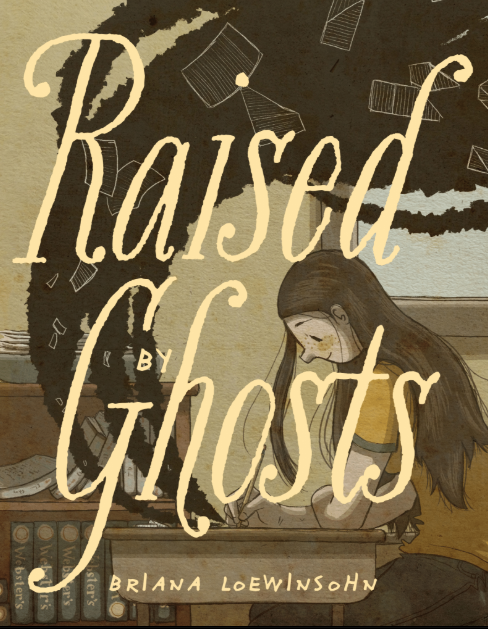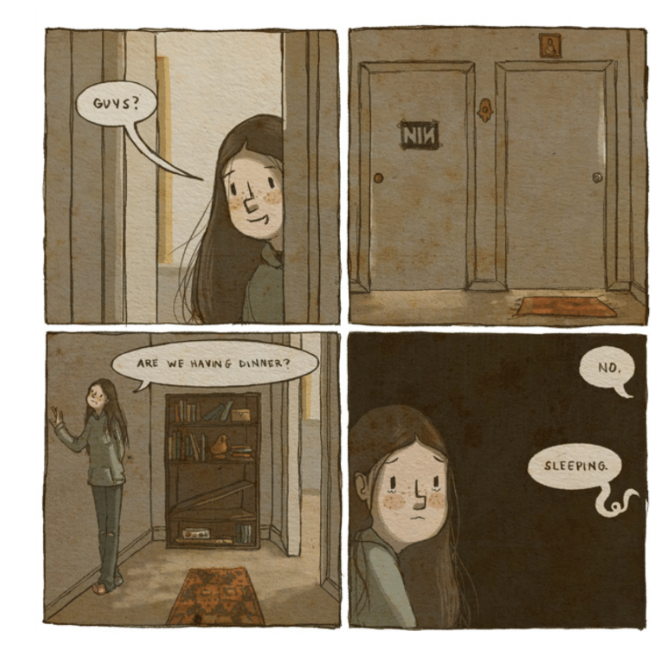
Briana Loewinsohn’s graphic novel Raised by Ghosts turns absence into haunting art

A decade ago I finally tossed out most of the contents of an old shoebox crammed with high-school nostalgia. Notes from ex-girlfriends, summer postcards, flyers from local shows, a handful of choice mixtapes. Some Polaroids. Our stupid band’s stupid lyrics, which we usually forgot or simply abandoned live. There was even a pair of fat shoelaces. The pain of return always hits me hard at such times, and I got dizzy. That box was crammed the scraps of an older life.

The preceding paragraph is an unfair opening to a review of Briana Loewinsohn’s excellent graphic memoir Raised by Ghosts. Reading Raised by Ghosts felt like opening that old shoebox: painful, dizzying, beautiful. Loewinsohn is one of usone of us to borrow a chant from Tod Browning’s Freaks. “Sometimes I feel like I am an alien at this school…But there are other aliens here,” protagonist Briana writes in her diary.

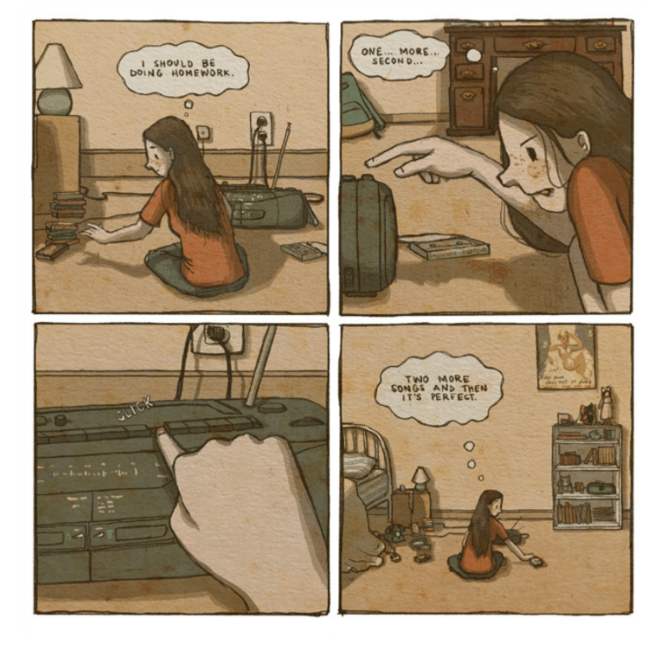
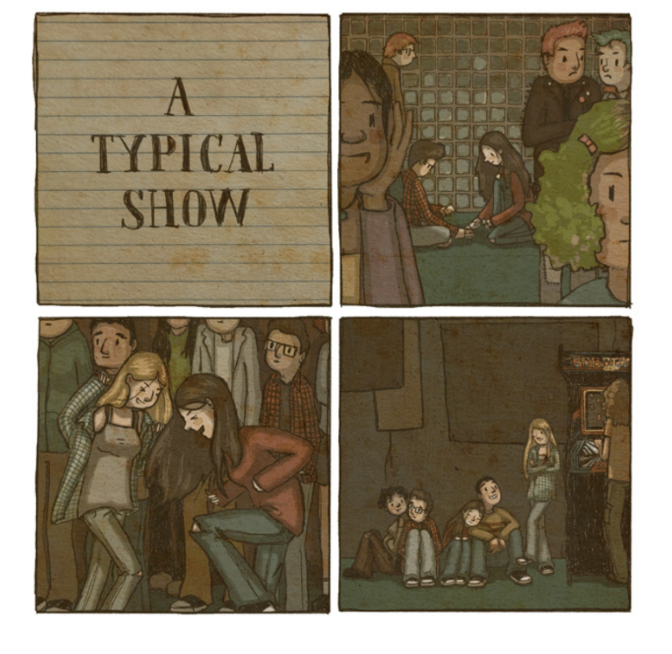
Raised by Ghosts covers Briana’s seven rough years through middle and high school. These are the gay nineties. The narrator, like Loewinsohn herself, is about my age, which makes reading Raised by Ghosts an eerie act of self-recognition. It’s not a conventional memoir—it doesn’t hold your hand or deliver a clean, linear narrative. Instead, it moves like memory does: in flashes, in vignettes, in small sensory moments that coalesce into something greater than the sum of their parts. Everything here feels true. We have here the relics of a teenage moondream, those little ghosts of the past that flicker through memory like frayed photos freed from the rubberbanded bundle in an old Converse box. Briana’s adolescence unfurls as an ebb and flow of loneliness and acceptance among fellow weirdos. She finds her people, but never quite makes the scene; she dances at the live show but finds as much fun in playing cards in the back.

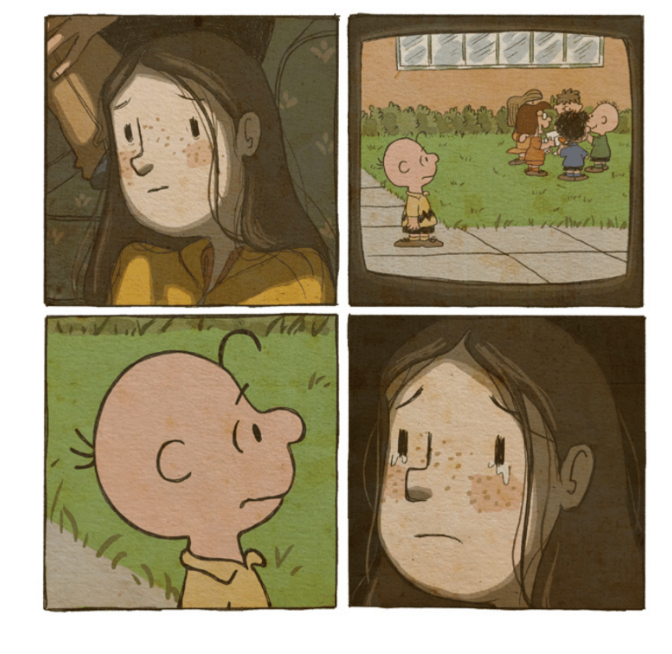
Loewinsohn’s art conveys Raised by Ghosts’ emotional weight. Soft, muted tones in drab olive and rust hues fill square panels that often resemble fading Polaroids. Candids and close-ups capture the messiness of high school. Briana is a sympathetic and endearing character, her sensitivity registering in ways she cannot understand herself, as when she skips out on a living-room VHS double feature. Oliver Stone’s Natural Born Killers would be way too much after the tragedy of You’re a Good Man, Charlie Brown.

Loewinsohn includes full handwritten pages to accompany the traditional comic strips in Raised by Ghosts. These handwritten pages serve as a kind of diary, but often take on subtle visual changes that suggest other media. Often, the handwritten pages mimic the form of the long notes bored Briana composes in class to pass to friends. A passage composed on graph paper praises the note-writing skills of a particular friend; the technique suggests this friend prefers squares to lines. A passage on a brown paper lunch bag reflects on how Briana’s father always takes the time to write her name in detailed, expressive lettering. The variations of handwritten pages enrich the narrative and subtly inform us of Briana’s artistic development.

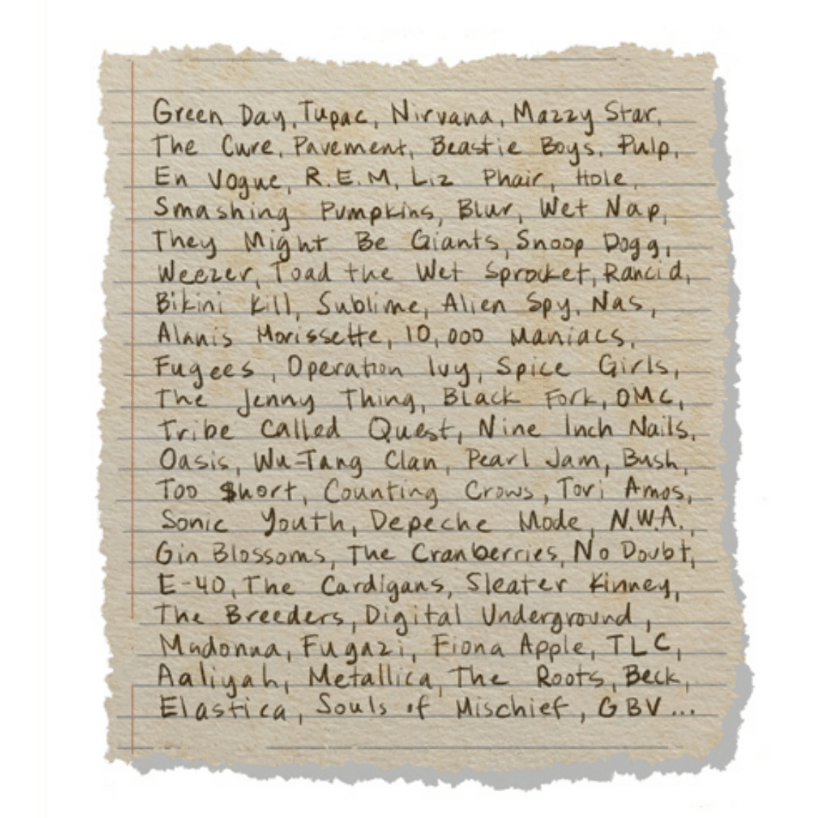
My favorite of the handwritten passages though is simply a list of bands scrawled on lined paper. When I got to that page, about a third of the way into Raised by Ghosts, I was already persuaded by the book–but the page of band names seemed so utterly true, so beautiful and banal. We used to do that, I thought, and: Why did we used to do that? knowing the answer has no good intellectual answer.

But let’s get to the ghosts. Loewinsohn never “shows” us Briana’s parents, yet the picture we get of them is hardly incomplete: a distant, detached mother and a father in arrested development. “I would say I was raised in an AA meeting,” Briana remarks of her mother, noting that it’s often hard for single mothers to find childcare. Of her father’s abode: “My pop’s house is a combination of Indiana Jones’ office, Pee Wee’s playhouse, and an opium den. I am kinda like a roommate here.”

Briana’s parents exist in Raised by Ghosts the way memories of the absent often do—fragmented, elusive, more felt than seen. Loewinsohn never lets them fully materialize, yet their presence, or lack thereof, shapes Briana’s interactions with her world. Neither parent offers Briana guidance. She’s a latchkey kid left to cobble her own sense of belonging among friends, music, and the small rituals of adolescence. In the absence of stability, she builds meaning from mixtapes, handwritten notes, and fleeting moments of connection.

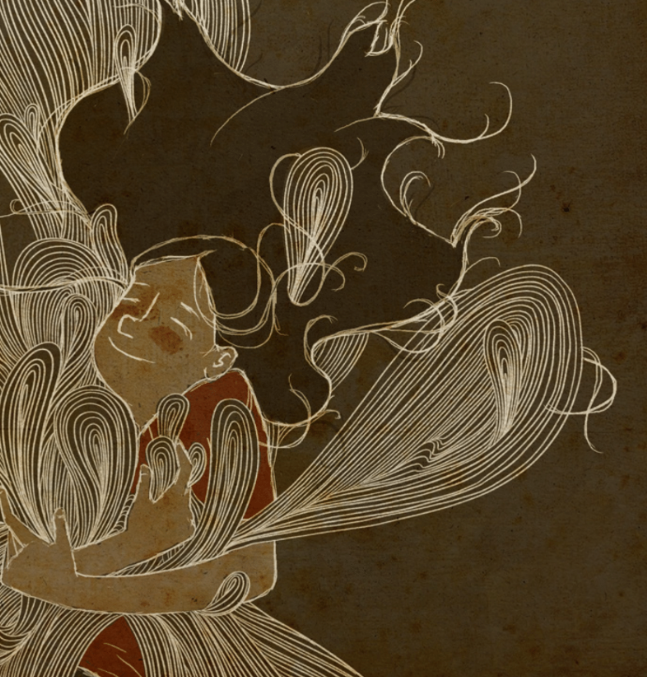
And art. The memoir climaxes in a moment of transformation—an act of self-possession and, ultimately, self-creation. Throughout Raised by Ghosts, Briana moves through a world shaped by absence, by the ghosts of parents who are physically present but emotionally distant. Yet, in the book’s remarkable penultimate sequence, she steps beyond that absence, beyond memory’s hazy grip, into a space that is entirely her own. The panels swirl into a dreamscape of shifting lines—formless and chaotic at first—until Briana gathers them together, lassoing meaning from the void. It is a moment of artistic alchemy, where creation becomes a form of agency, a way to shape her own narrative rather than just mimic one. When she carries those lines from dream to waking life, the transition is profound: she is no longer just a kid collecting relics of meaning from the world around her—she is an artist, making meaning herself.

Publisher Fantagraphics labels Raised by Ghosts as a “young adult graphic novel,” and teenagers will likely identify with Briana’s story—the loneliness, the search for belonging, the quiet acts of self-definition. They may also feel a strange twinge of envy for a world that no longer exists. Being a latchkey kid could be lonely, but it was not without its freedoms. Those of us who were teenage weirdos in the nineties will see in Loewinsohn’s memoir not a young adult novel, but rather a reflective elegy composed by a mature artist in control of her talent. Raised by Ghosts lingers like the echo of an old song in your dim memory — you know the one, right? It’s a memoir about growing up in the margins, about finding meaning in scraps and silence, about turning absence into something tangible. It haunts, in the very best way.

Mass-market Monday | Titus Burckhardt’s Alchemy

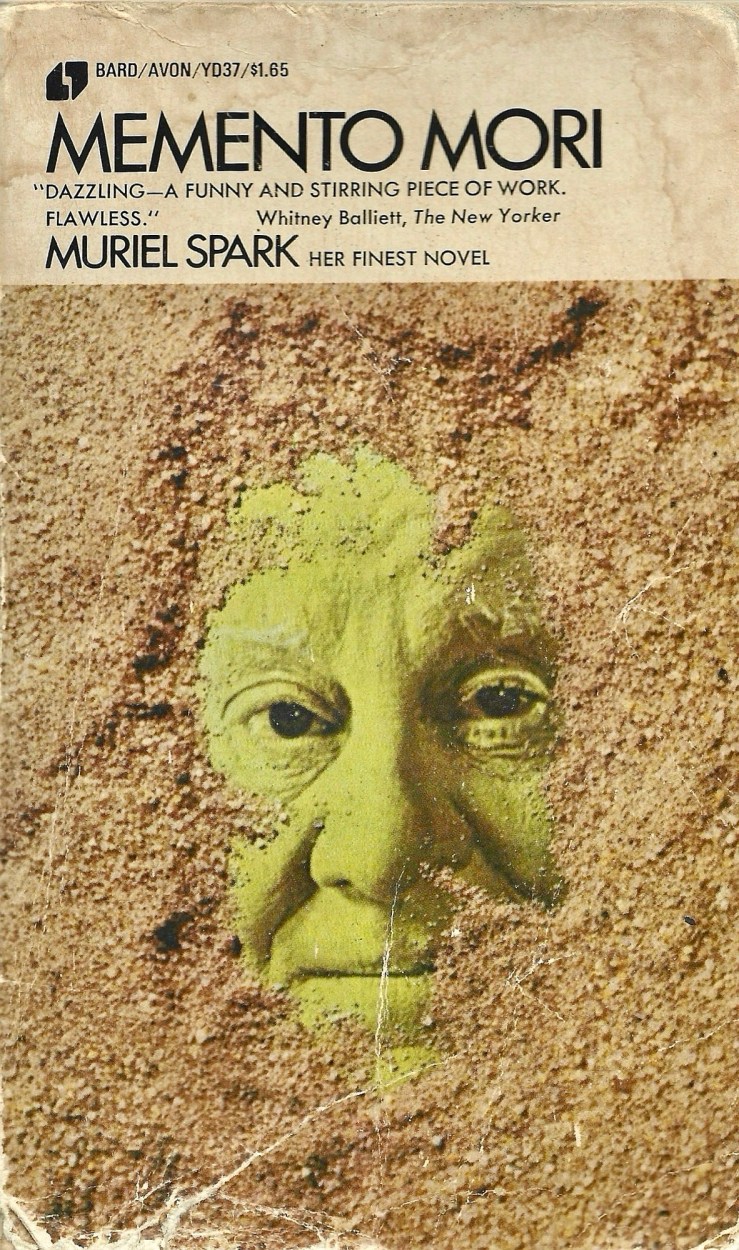
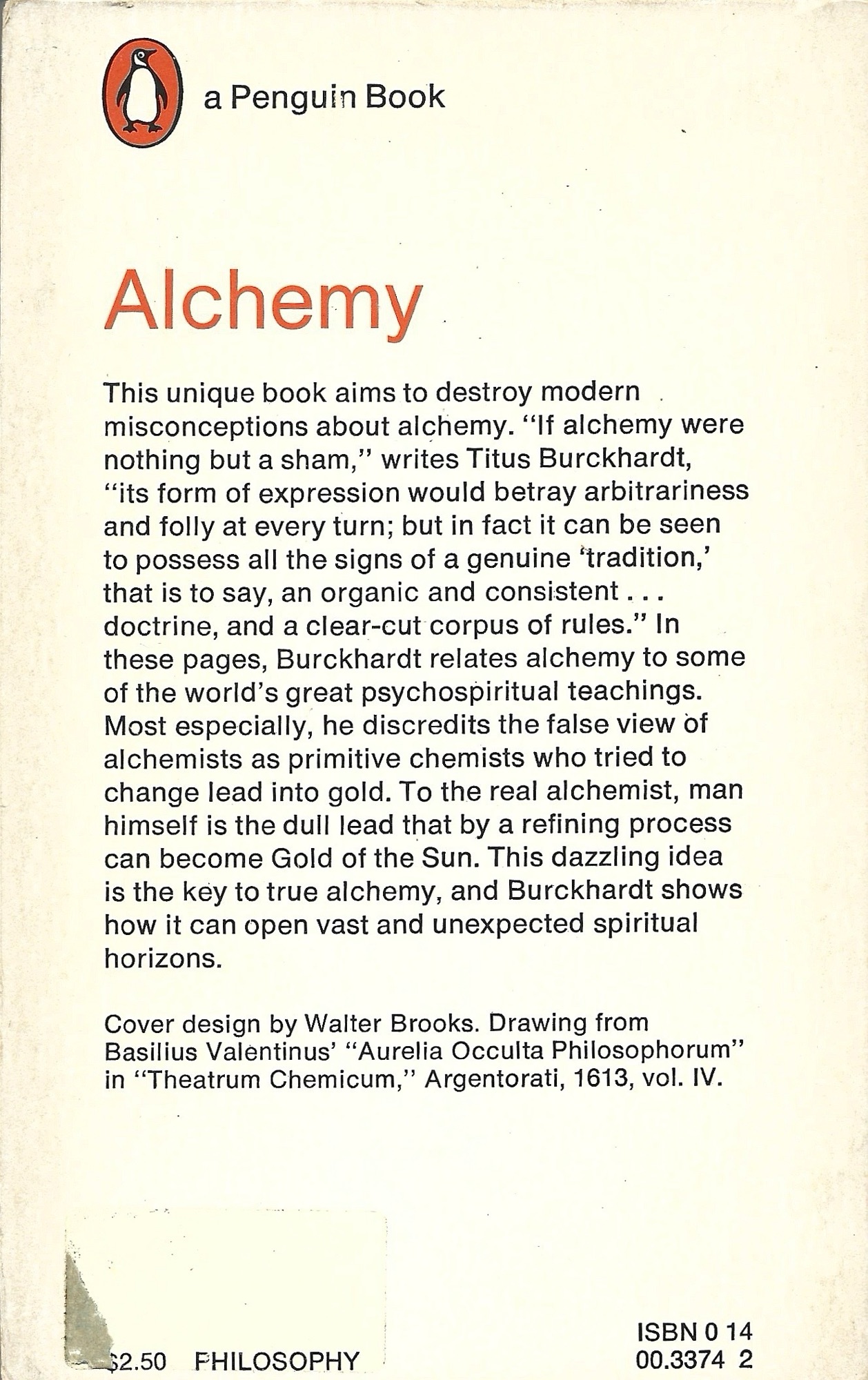
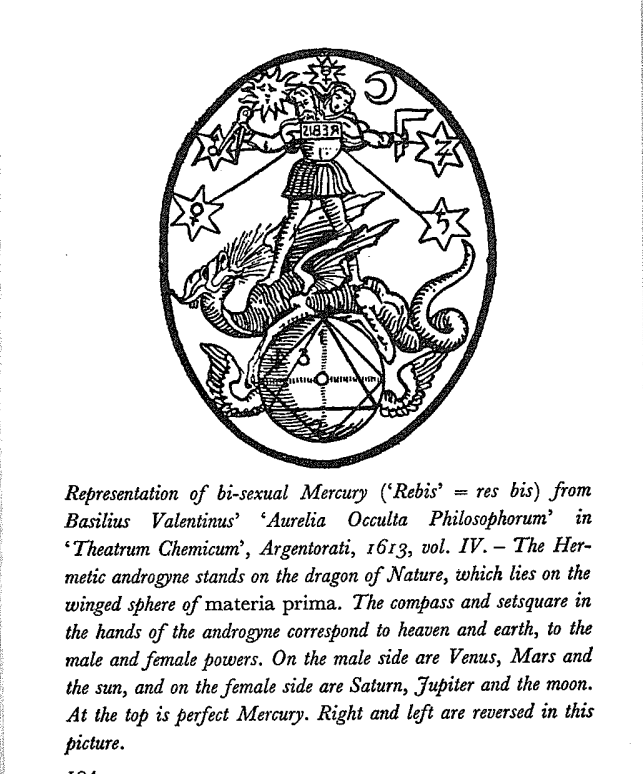
Alchemy, 1960, Titus Burckhardt. Translation by William Stoddart. Penguin Books (1971). Cover design by Walter Brooks employing an illustration from Basilius Valentinus’ Aurelia Occulta Philosophorum. 206 pages.

From Alchemy:

Mass-market Monday | Tadeusz Konwicki’s A Dreambook for Our Time

A Dreambook for Our Time, 1963, Tadeusz Konwicki. Translation by David Welsh. Penguin Books (1976). Cover illustration by Christopher Davis; cover design by Walter Brooks. 282 pages.

Blog about some recent reading, books acquired, a mini-review of The Hard Quartet live, etc.

I’ve been lucky over the last decade or so that my little college’s spring break almost always coincides with my children’s spring break. We aimed again this year at Georgia, spending a few days in a cabin outside the unfortunately named Whitesburg. Spring had not yet really sprung there yet. There was very little green about, but the hikes along and around Snake Creek through 20th century ruins were pleasant enough, and the kids enjoyed ziplining and aerial obstacle courses. In one of their sessions, I sneaked away to Harvey’s House of Books.

Harvey’s is, as far as I can tell, a Friends of the Library venture run by volunteers. I didn’t expect much, but the fiction section was surprisingly well populated. For around five bucks I picked up Charles Johnson’s Middle Passage, Mario Vargas Llosa’s The Feast of the Goat, and two by Cristina Peri Rossi — The Ship of Fools and Dostoevsky’s Last Night.

I was happy and surprised to find Rossi’s The Ship of Fools (in translation by Psiche Hughes); I’ve had it on a mental list for a few months now. I started it that night and it’s really odd–reminds me a bit of Ann Quin’s stuff, very odd but fun. More thoughts to come.

The Ship of Fools proved a nice antidote to the books I’d brought with me, Paul Valéry’s Monsieur Teste, (in translation by Charlotte Mandell) and a Dino Buzzati collection translated by Lawrence Venuti, called The Bewitched Bourgeois. I’ve enjoyed the Buzzati stories, but piled up there’s a sameness here that cries for interruption. I love Borgesian riffs on “Before the Law” as much as the next nerd, but too many in a row (six, in my case this week) feels, I dunno, like, I get it. But to be clear, I’ve really liked most of The Bewitched Bourgeois. I think it’s better parceled out though. Monsieur Teste on the other hand…look, I don’t know, maybe I misunderstood the book entirely, but I really kinda sorta hated it. Was I supposed to hate the central persona, Mister Teste, who aims for precision in language but comes off as a bore? At least it was short.

While I didn’t have the time in Atlanta to hit multiple bookstores (like in past trips), I made a point to hit up A Capella Books, a well stocked indie joint with a great used collection. I didn’t score anything there, although I was thrilled to see Anders Nilsen’s Tongues prominently featured in the graphic novel section. The book is great — I got a review copy right before we left. Some asshole named Edwin Turner landed a blurb on the back under his hero Charles Burns’s much shorter, pithier, better blurb:

Our spring break culminated Saturday night at the Variety Playhouse in Little Five Points, where we saw the so-called indie supergroup The Hard Quartet play all of their songs. I really dig The Hard Quartet’s self-titled debut, and dragged my wife and son along. (My daughter declined but played taxi driver.) Some interesting looking children were exiting the theater (really more of a club, let’s be honest) as we were entering, assuring the concerned security guard that they’d be right back, they just needed to get some Gatorade at a corner store. These were Sharp Pins, or The Sharp Pins, or Thee Sharp Pins, a Chicago power pop trio fronted by a kid named Kai Slater. They played a tight thirty minute set (including a Byrds cover); young Slater knows how to tuck away middle eight. The band’s youth invigorated the crowd of indie oldheads, and if Sharp Pins were occasionally a little out of tune or a step behind on the count, what came through was a true joy for the pop song. My son went bananas from them, saying something like, I know that they aren’t as good at playing their instruments as the Hard Quartet guys, but I liked their songs more. He bought their album and their t-shirt.

I liked The Hard Quartet’s live show very much — these are some old, or let’s just say older guys — look, pretty much everyone at the show was old, older, etc., except the Sharp Pins, my son, and some other teens there with their folks — these guys, the HQ, are veterans of disorder, coming up in club shows and theaters and big stages and big big stages and so on. They seemed very comfortable in the quasi-theater club. It was a joy to watch and listen to them.

They are, as I mentioned before, a so-called “supergroup.” Stephen Malkmus was the sideman for David Berman in The Silver Jews; Matt Sweeney, a popular YouTube influencer, was a member of another infamous supergroup — David Pajo’s short-lived side project Zwan; Emmett Kelly is a former gang member and circus performer; Jim White is the best drummer I’ve ever seen live (I have no stupid joke here; he is amazing and I listened to Ocean Songs every night for two years in a row when I was 22 and that’s not an exaggeration.)

The Hard Quartet are clearly a “real” band and not anyone’s side project. Sonics live were richer, fuller, more expansive than on disc. Emmett Kelly sang his new song, which, as far as I can tell, is the only update to their setlist in the past year — basically the record played straight through — but they seemed to never remember who was playing bass on which song when. No one used a pick, ever, as far as I could tell. Sweeney broke a string and then claimed he’d never broken a string on stage, ever. (Dubious.) Malkmus said he was thinking about “The Devil Went Down to Georgia,” but, what if it was, like, “The Devil Went Down on George.” Sweeney jokingly referred to Charlie Daniels as Chuck Daniels and at least two Atlanta audience members hissed foolish rejoinders. (Could’ve been those big beers, bald boys!) Jim White is both a gentle percussionist and a rawk gawd drummer. Malkmus’s, Kelly’s, and Sweeney’s singing in unison were some of the finest moments of the night, as in “Rio’s Song” and “Heel Highway.” The band’s weathered implementation of silence and space was also delicious and judicious in numbers like “Six Deaf Rats,” “Action for the Military Boys,” and “Hey.” Skronk and noodling were measured but never mannered. (Or the manners were there but they weren’t bad, unless they were meant to be bad.) Matt Sweeney’s left foot was the boss of the band, the bandleader, the clapper clopping down the count in a leopard print.

The Hard Quartet finished before eleven, having played all their songs. I think we all had a good time.

Jim White
Matt Sweeney
Stephen “SM” Malkmus
Emmett Kelly

Mass-market Mondays | Flann O’Brien’s Stories and Plays

Stories and Plays, collected 1974, Flann O’Brien. Penguin Books (1977). Cover design by Neil Stuart. 208 pages.

From “A Bash in the Tunnel”

James Joyce was an artist. He has said so himself. His was a case of Ars gratia Artist. He declared that he would pursue his artistic mission even if the penalty was as long as eternity itself. This seems to be an affirmation of belief in Hell, therefore of belief in Heaven and God.

An end to the infamy of mules terrified by the edges of precipices as on their backs they carried grand pianos for the masked balls | A sentence from Gabriel García Márquez’s The Autumn of the Patriarch

He was right, because during our time there was no one who doubted the legitimacy of his history, or anyone who could have disclosed or denied it because we couldn’t even establish the identity of his body, there was no other nation except the one that had been made by him in his own image and likeness where space was changed and time corrected by the designs of his absolute will, reconstituted by him ever since the most uncertain origins of his memory as he wandered at random through that house of infamy where no happy person had ever slept, as he tossed cracked corn to the hens who pecked around his hammock and exasperated the servants with orders he pulled out of the air to bring me a lemonade with chopped ice which he had left within reach of his hand, take that chair away from over there and put it over there, and they should put it back where it had been in order to satisfy in that minute way the warm embers of his enormous addiction to giving orders, distracting the everyday pastimes of his power with the patient raking up of ephemeral instants from his remote childhood as he nodded sleepily under the ceiba tree in the courtyard, he would wake up suddenly when he managed to grasp a memory like a piece in a limitless jigsaw puzzle of the nation that lay before him, the great, chimerical, shoreless nation, a realm of mangrove swamps with slow rafts and precipices that had been there before his time when men were so bold that they hunted crocodiles with their hands by placing a stake in their mouths, like that, he would explain to us holding his forefinger against his palate, he told us that on one Good Friday he had heard the hullabaloo of the wind and the scurf smell of the wind and he saw the heavy clouds of locusts that muddied the noonday sky and went along scissoring off everything that stood in their path and left the world all sheared and the light in tatters as on the eve of creation, because he had seen that disaster, he had seen a string of headless roosters hanging by their feet and bleeding drop by drop from the eaves of a house with a broad and crumbling sidewalk where a woman had just died, barefoot he had left his mother’s hand and followed the ragged corpse they were carrying off to bury without a coffin on a cargo litter that was lashed by the blizzard of locusts, because that was what the nation was like then, we didn’t even have coffins for the dead, nothing, he had seen a man who had tried to hang himself with a rope that had already been used by another hanged man from a tree in a village square and the rotted rope broke before it was time and the poor man lay in his death throes on the square to the horror of the ladies coming out of mass, but he didn’t die, they beat him awake with sticks without bothering to find out who he was because in those days no one knew who was who if he wasn’t known in the church, they stuck his ankles between the planks of the stocks and left him there exposed to the elements along with other comrades in suffering because that was what the times of the Goths were like when God ruled more than the government, the evil times of the nation before he gave the order to chop down all trees in village squares to prevent the terrible spectacle of a Sunday hanged man, he had prohibited the use of public stocks, burial without a coffin, everything that might awaken in one’s memory the ignominious laws that existed before his power, he had built the railroad to the upland plains to put an end to the infamy of mules terrified by the edges of precipices as on their backs they carried grand pianos for the masked balls at the coffee plantations, for he had also seen the disaster of the thirty grand pianos destroyed in an abyss and of which they had spoken and written so much even outside the country although only he could give truthful testimony, he had gone to the window by chance at the precise moment in which the rear mule had slipped and had dragged the rest into the abyss, so that no one but he had heard the shriek of terror from the cliff-flung mule train and the endless chords of the pianos that fell with it playing by themselves in the void, hurtling toward the depths of a nation which at that time was like everything that had existed before him, vast and uncertain, to such an extreme that it was impossible to know whether it was night or day in the kind of eternal twilight of the hot steamy mists in the deep canyons where the pianos imported from Austria had broken up into fragments, he had seen that and many other things in that remote world although not even he himself could have been sure with no room for doubt whether they were his own memories or whether he had heard about them on his bad nights of fever during the wars or whether he might have seen them in prints in travel books over which he would linger in ecstasy for long hours during the dead doldrums of power, but none of that mattered, God damn it, they’ll see that with time it will be the truth, he would say, conscious that his real childhood was not that crust of uncertain recollections that he only remembered when the smoke from the cow chips arose and he forgot it forever except that he really had lived it during the calm waters of my only and legitimate wife Leticia Nazareno who would sit him down every afternoon between two and four o’clock at a school desk under the pansy bower to teach him how to read and write, she had put her novice’s tenacity into that heroic enterprise and he matched it with his terrifying old man’s patience, with the terrifying will of his limitless power, with all my heart, so that he would chant with all his soul the tuna in the tin the loony in the bin the neat nightcap, he chanted without hearing himself or without anyone’s hearing him amidst the uproar of his dead mother’s aroused birds that the Indian packs the ointment in the can, papa places the tobacco in his pipe, Cecilia sells seals seeds seats seams scenes sequins seaweed and receivers, Cecilia sells everything, he would laugh, repeating amidst the clamor of the cicadas the reading lesson that Leticia Nazareno chanted to the time of her novice’s metronome, until the limits of the world became saturated with the creatures of your voice and in his vast realm of dreariness there was no other truth but the exemplary truths of the primer, there was nothing but the moon in the mist, the ball and the banana, the bull of Don Eloy, Otilia’s bordered bathrobe, the rote reading lessons which he repeated at every moment and everywhere just like his portraits even in the presence of the treasury minister from Holland who lost the thread of an official visit when the gloomy old man raised the hand with the velvet glove on it in the shadows of his unfathomable power and interrupted the audience to invite him to sing with me my mama’s a mummer, Ismael spent six months on the isle, the lady ate a tomato, imitating with his forefinger the beat of the metronome and repeating from memory Tuesday’s lesson with a perfect diction but with such a bad sense of the occasion that the interview ended as he had wanted it to with the postponement of payment of the Dutch debts for a more propitious moment, for when there would be time, he decided, to the surprise of the lepers, the blind men, the cripples who rose up at dawn among the rosebushes and saw the shadowy old man who gave a silent blessing and chanted three times with high-mass chords I am the king and the law is my thing, he chanted, the seer has fear of beer, a lighthouse is a very high tower with a bright beam which guides sailors at night, he chanted, conscious that in the shadows of his senile happiness there was no time but that of Leticia Nazareno of my life in the shrimp stew of the suffocating gambols of siesta time, there were no other anxieties but those of being naked with you on the sweat-soaked mattress under the captive bat of an electric fan, there was no light but that of your buttocks, Leticia, nothing but your totemic teats, your flat feet, your ramus of rue as a remedy, the oppressive Januaries of the remote island of Antigua where you came into the world one early dawn of solitude that was furrowed by the burning breeze of rotted swamps, they had shut themselves up in the quarters for distinguished guests with the personal order that no one is to come any closer than twenty feet to that door because I’m going to be very busy learning to read and write, so no one interrupted him not even with the news general sir that the black vomit was wreaking havoc among the rural population while the rhythms of my heart got ahead of the metronome because of that invisible force of your wild-animal smell, chanting that the midget is dancing on just one foot, the mule goes to the mill, Otilia washes the tub, kow is spelled with a jackass k, he chanted, while Leticia Nazareno moved aside the herniated testicle to clean him up from the last love-making’s dinky-poo, she submerged him in the lustral waters of the pewter bathtub with lion’s paws and lathered him with Reuter soap, scrubbed him with washcloths, and rinsed him off with the water of boiled herbs as they sang in duet ginger gibber and gentleman are all spelled with a gee, she would daub the joints of his legs with cocoa butter to alleviate the rash from his truss, she would put boric acid powder on the moldy star of his asshole and whack his behind like a tender mother for your bad manners with the minister from Holland, plap, plap, as a penance she asked him to permit the return to the country of the communities of poor nuns so they could go back to taking care of orphan asylums and hospitals and other houses of charity, but he wrapped her in the gloomy aura of his implacable rancor, never in a million years, he sighed, there wasn’t a single power in this world or the other that could make him go against a decision taken by himself alone and aloud, she asked him during the asthmas of love at two in the afternoon that you grant me one thing, my life, only one thing, that the mission territory communities who work on the fringes of the whims of power might return, but he answered her during the anxieties of his urgent husband snorts never in a million years my love, I’d rather be dead than humiliated by that pack of long skirts who saddle Indians instead of mules and pass out beads of colored glass in exchange for gold nose rings and earrings, never in a million years, he protested, insensitive to the pleas of Leticia Nazareno of my misfortune who had crossed her legs to ask him for the restitution of the confessional schools expropriated by the government, the disentailment of property held in mortmain, the sugar mills, the churches turned into barracks, but he turned his face to the wall ready to renounce the insatiable torture of your slow cavernous love-making before I would let my arm be twisted in favor of those bandits of God who for centuries have fed on the liver of the nation, never in a million years, he decided, and yet they did come back general sir, they returned to the country through the narrowest slits, the communities of poor nuns in accordance with his confidential order that they disembark silently in secret coves, they were paid enormous indemnities, their expropriated holdings were restored with interest and the recent laws concerning civil marriage, divorce, lay education were repealed, everything he had decreed aloud during his rage at the comic carnival of the process of the declaration of sainthood for his mother Bendición Alvarado may God keep her in His holy kingdom, God damn it, but Leticia Nazareno was not satisfied with all that but asked for more, she asked him to put your ear to the lower part of my stomach so that you can hear the singing of the creature growing inside, because she had awakened in the middle of the night startled by that deep voice that was describing the aquatic paradise of your insides furrowed by mallow-soft sundowns and winds of pitch, that interior voice that spoke to her of the polyps on your kidneys, the soft steel of your intestines, the warm amber of your urine sleeping in its springs, and to her stomach he put the ear that was buzzing less for him and he heard the secret bubbling of the living creature of his mortal sin, a child of our obscene bellies who would be named Emanuel, which is the name by which other gods know God, and on his forehead he will have the white star of his illustrious origins and he will inherit his mother’s spirit of sacrifice and his father’s greatness and his own destiny of an invisible conductor, but he was to be the shame of heaven and the stigma of the nation because of his illicit nature as long as he refused to consecrate at the altar what he had vilified in bed for so many years of sacrilegious concubinage, and then he opened a way through the foam of the ancient bridal mosquito netting with that snort of a ship’s boiler coming from the depths of his terrible repressed rage shouting never in a million years, better dead than wed, dragging his great feet of a secret bridegroom through the salons of an alien house whose splendor of a different age had been restored after the long period of the shadows of official mourning, the crumbling holy-week crepe had been pulled from the cornices, there was sea light in the bedrooms, flowers on the balconies, martial music, and all of it in fulfillment of an order that he had not given but which had been an order of his without the slightest doubt general sir because it had the tranquil decision of his voice and the unappealable style of his authority, and he approved, agreed, and the shuttered churches opened again, and the cloisters and cemeteries were returned to their former congregations by another order of his which he had not given either but he approved, agreed, the old holy days of obligation had been restored as well as the practices of lent and in through the open balconies came the crowd’s hymns of jubilation that had previously been sung to exalt his glory as they knelt under the burning sun to celebrate the good news that God had been brought in on a ship general sir, really, they had brought Him on your orders, Leticia, by means of a bedroom law which she had promulgated in secret without consulting anybody and which he approved in public so that it would not appear to anyone’s eyes that he had lost the oracles of his authority, for you were the hidden power behind those endless processions which he watched in amazement through the windows of his bedroom as they reached a distance beyond that of the fanatical hordes of his mother Bendición Alvarado whose memory had been erased from the time of men, the tatters of her bridal dress and the starch of her bones had been scattered to the winds and in the crypt the stone with the upside-down letters had been turned over so that even the mention of her name as a birdwoman painter of orioles in repose would not endure till the end of time, and all of that by your orders, because you were the one who had ordered it so that no other woman’s memory would cast a shadow on your memory, Leticia Nazareno of my misfortune, bitch-daughter.


From Gabriel García Márquez’s The Autumn of the Patriarch in translation by Gregory Rabassa.

Mass-market Monday | Aldous Huxley’s The Doors of Perception

The Doors of Perception, 1955, Aldous Huxley. Perennial Library (1970). Cover design by Pat Steir. 79 pages.

Here’s Huxley on mescaline, marveling at the folds of cloth in Botticelli’s Judith:

Civilized human beings wear clothes, therefore there can be no portraiture, no mythological or historical storytelling without representations of folded textiles. But though it may account for the origins, mere tailoring can never explain the luxuriant development of drapery as a major theme of all the plastic arts. Artists, it is obvious, have always loved drapery for its own sake – or, rather, for their own. When you paint or carve drapery, you are painting or carving forms which, for all practical purposes, are nonrepresentational-the kind of unconditioned forms on which artists even in the most naturalistic tradition like to let themselves go. In the average Madonna or Apostle the strictly human, fully representational element accounts for about ten per cent of the whole. All the rest consists of many colored variations on the inexhaustible theme of crumpled wool or linen. And these non-representational nine-tenths of a Madonna or an Apostle may be just as important qualitatively as they are in quantity. Very often they set the tone of the whole work of art, they state the key in which the theme is being rendered, they express the mood, the temperament, the attitude to life of the artist. Stoical serenity reveals itself in the smooth surfaces, the broad untortured folds of Piero’s draperies. Torn between fact and wish, between cynicism and idealism, Bernini tempers the all but caricatural verisimilitude of his faces with enormous sartorial abstractions, which are the embodiment, in stone or bronze, of the everlasting commonplaces of rhetoric – the heroism, the holiness, the sublimity to which mankind perpetually aspires, for the most part in vain. And here are El Greco’s disquietingly visceral skirts and mantles; here are the sharp, twisting, flame-like folds in which Cosimo Tura clothes his figures: in the first, traditional spirituality breaks down into a nameless physiological yearning; in the second, there writhes an agonized sense of the world’s essential strangeness and hostility. Or consider Watteau; his men and women play lutes, get ready for balls and harlequinades, embark, on velvet lawns and under noble trees, for the Cythera of every lover’s dream; their enormous melancholy and the flayed, excruciating sensibility of their creator find expression, not in the actions recorded, not in the gestures and the faces portrayed, but in the relief and texture of their taffeta skirts, their satin capes and doublets. Not an inch of smooth surface here, not a moment of peace or confidence, only a silken wilderness of countless tiny pleats and wrinkles, with an incessant modulation – inner uncertainty rendered with the perfect assurance of a master hand – of tone into tone, of one indeterminate color into another. In life, man proposes, God disposes. In the plastic arts the proposing is done by the subject matter; that which disposes is ultimately the artist’s temperament, proximately (at least in portraiture, history and genre) the carved or painted drapery. Between them, these two may decree that a fete galante shall move to tears, that a crucifixion shall be serene to the point of cheerfulness, that a stigmatization shall be almost intolerably sexy, that the likeness of a prodigy of female brainlessness (I am thinking now of Ingres’ incomparable Mme. Moitessier) shall express the austerest, the most uncompromising intellectuality.

Eight notes on Stephen Dixon’s novel Interstate

1,  It upset me deeply, reading Stephen Dixon’s 1995 novel Interstate. It fucked me up a little bit, and then a little bit more, addicted to reading it as I was over two weeks in a new year.

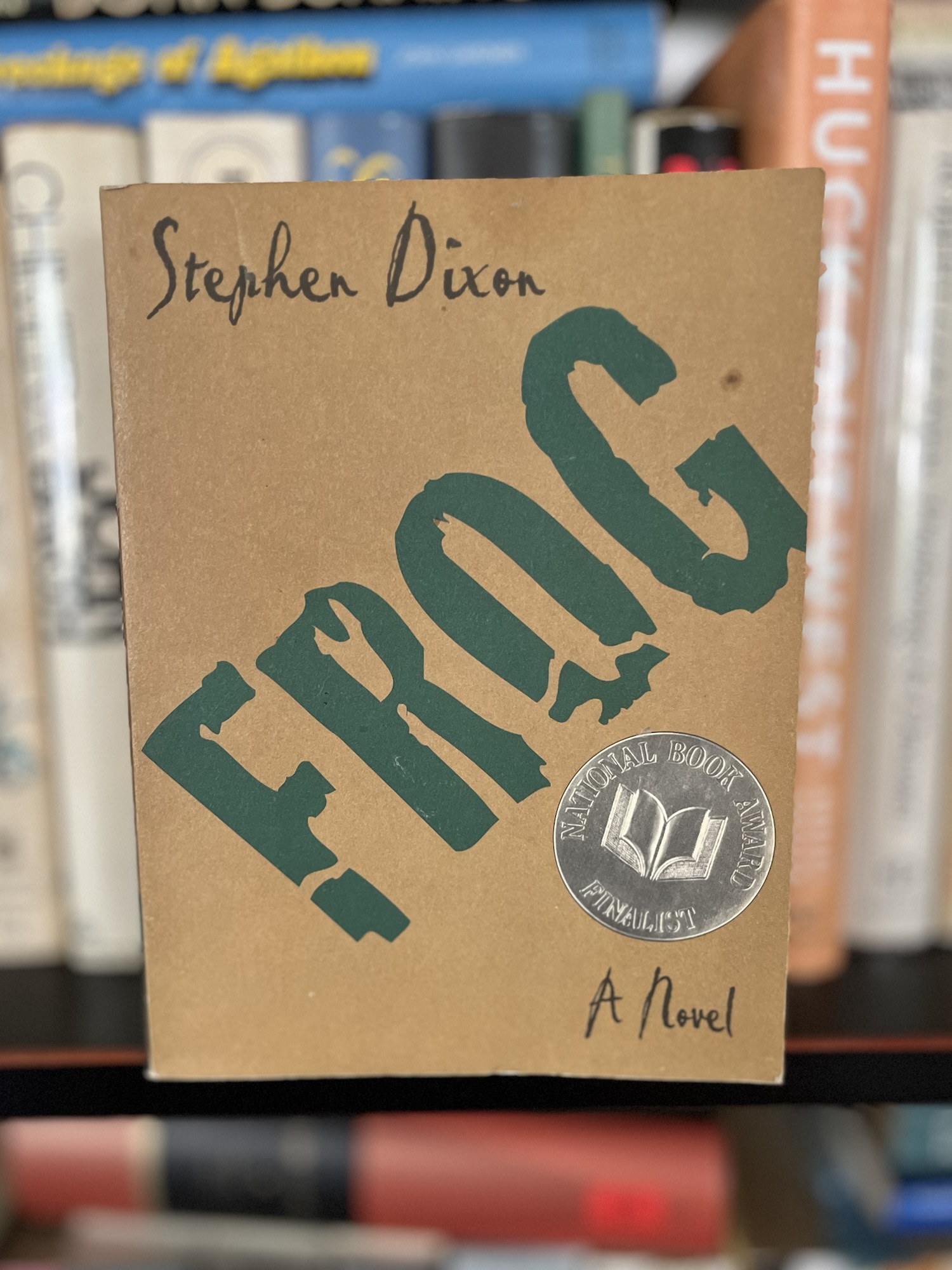
2,  What is it about, Stephen Dixon’s 1995 novel Interstate? I mean, you probably won’t like it, but that wasn’t the stupid rhetorical question that led this point. (And also but maybe like, you will like it.) Interstate was a finalist for the 1995 National Book Award. It didn’t win. The NBA’s website’s one-sentence summary fucks up: “In the author’s first novel since Frog, a Finalist for the National Book Award, a father mentally replays, in eight variations, the shooting of his daughters on an interstate highway.”

3,  There is (or is it are?) one too many esses in the NBA’s summary of Stephen Dixon’s 1995 novel Interstate—there are two daughters, plural, but only one is shot, and shot tragically, awfully, fatally—and really, as its variations play out, it’s not entirely clear if anyone was shot, if anyone was even on the highway, if anyone was even real. Are all the so-called events of the novel simply (there’s no simply about it) in the narrator’s imagination? “…but there I go again, the world’s easiest and most desirable copy out, the dream,” muses the narrator at one point. Not even a dream though, it’s all just words.

4,  It’s all “just” words, and if someone told me they read and hated Stephen Dixon’s 1995 novel Interstate, I’d shrug and ask if they made it all the way through all the words and still hated it. If someone told me that they made it all the way through Interstate and found it to be a strange and unappealing writing experiment, I’d mildly agree with them, and then tell them that I loved that particular flavor and if they didn’t like that particular flavor, well, cool.

5,  If someone read all the words in Stephen Dixon’s 1995 novel Interstate and concluded that it seemed like an ambitious and highly-achieved creative writing exercise — writing experiment, rather — I’d likely initially agree and then hedge a bit before mumbling something like, I don’t think it was an exercise or experiment on the author Stephen Dixon’s part. It might make for experimental reading, but I think he absolutely knew what he was doing; this wasn’t practice or exercise — it was the real thing.

6, I have, thus far, done a lousy job, not even really a job, of describing the force of language in Stephen Dixon’s 1995 novel Interstate. Normally I’d crib a few choice passages—and to be clear, Interstate s fat and juicy with choice passages—but we are talking about long, twisty, tangled passages, sentences that go on for pages, sentences that find the predicate verb sundered for a few paragraphs from its eventual object, sentences that move us through thought, how divergent thought can be how, how imprecise, indirect, yet still sharp and often painful. An easy, lazy comparison would be to liken Dixon’s paragraphs to Thomas Bernhard’s (although Dixon denied the influence, much like William Gaddis did in his final novel)—there’s a different flavor here but our guys are working in a similar mode. (Think too of László Krasznahorkai or Gabriel García Márquez or Faulkner or Mauro Javier Cárdenas or any number of practitioners of the long paragraph). John Domini, in his contemporary review in the Portland Oregonian (reprinted in his excellent collection The Sea-God’s Herb) does a better job of describing Dixon’s style than I can do:

Characters talk themselves through backwaters of memory (sometimes creating comic relief) or sail into dreamy what-ifs, all in order to put off some looming and drear inevitability. In conversation, one may mention an important insight that he or she has to share, then spiral away through a half-dozen distractions before revealing what matters. The format feels like a natural fit to the shuttered claustrophobia of worry and loss. So do the jam-packed paragraphs, sometimes running several pages without a break. Better still, these blocks of talky phrasing flicker with light, even (every now and again) with happier possibilities.”

(Maybe I just wanted to quote that lovely phrase of Domini’s, “blocks of talky phrasing flicker with light.”)

7,  “Better still, these blocks of talky phrasing flicker with light, even (every now and again) with happier possibilities,” Domini wrote of Stephen Dixon’s 1995 novel Interstate. The last of Dixon’s eight Interstates is an unexpected gift — a happy ending, or, rather a banal ending, a plain ending, an ending without tragedy or comedy or epic heroism. An ending where everyone gets to bed in time to fit in a little light reading before shuteye. It sounds hokey when I write it out, but there’s nothing trite about the conclusion. The reader purchases this moment of catharsis from all the terror (and horrifying comedy, which I’ve neglected in this riff and will continue to neglect) — the reader purchases the cathartic conclusion from the preceding horror.

8,  I wonder how I might have reacted to Stephen Dixon’s 1995 novel Interstate if I had read it, say, when it was first published, back when I was a junior in high school. Or how would I have reacted to it ten years after that, not yet a parent? (And writing these thoughts out now, I realize that, more than anything by Bernhard or Krasznahorkai or Faulkner or the other Dixon I’ve read, Interstate most reminds me of (at least at this moment that I write) of Frank Capra’s 1946 film It’s a Wonderful Life. I’ve watched It’s a Wonderful Life once a year for the past four decades, finding it strangely different every few years — first baffling and even a bit scary, then boring, then exasperating, infuriating even, then schmaltzy, sentimental, ludicrous, and then magical, endearing, heartbreaking, perfect–I’ve veered off course, where was I?) I wonder how being a parent has colored my psychic engagement with the novel Interstate? I was not so much manipulated by the tragedy of losing a child through violent, chaotic, meaningless death but rather the more banal tragedy the novel repeatedly engages — losing a child through half-neglect, through half-listening, through selfishness, through an inability to focus on now — not really so much losing a child but losing out on connections, memories, time you’ll never get back. It fucked me up, Interstate, and I don’t think I’d like to go down its road again — but I loved it. Very highly recommended.

Mass-market Monday | Gabriel García Márquez’s The Autumn of the Patriarch

The Autumn of the Patriarch, Gabriel García Márquez. Translation by Gregory Rabassa. Avon Bard (1977). No cover artist credited. 251 pages.

I started in on The Autumn of the Patriarch this afternoon, soaking into its initial pages, which seemed to me at first a grand revision of Faulkner’s “A Rose for Emily,” and then coasted on the sentences through its first section. Here are the first nine sentences:

Over the weekend the vultures got into the presidential palace by pecking through the screens on the balcony windows and the flapping of their wings stirred up the stagnant time inside, and at dawn on Monday the city awoke out of its lethargy of centuries with the warm, soft breeze of a great man dead and rotting grandeur. Only then did we dare go in without attacking the crumbling walls of reinforced stone, as the more resolute had wished, and without using oxbows to knock the main door off its hinges, as others had proposed, because all that was needed was for someone to give a push and the great armored doors that had resisted the lombards of William Dampier during the building’s heroic days gave way. It was like entering the atmosphere of another age, because the air was thinner in the rubble pits of the vast lair of power, and the silence was more ancient, and things were hard to see in the decrepit light. All across the first courtyard, where the paving stones had given way to the underground thrust of weeds, we saw the disorder of the post of the guard who had fled, the weapons abandoned in their racks, the big, long rough-planked tables with plates containing the leftovers of the Sunday lunch that had been interrupted by panic, in shadows we saw the annex where government house had been, colored fungi and pale irises among the unresolved briefs whose normal course had been slower than the pace of the dryest of lives, in the center of the courtyard we saw the baptismal font where more than five generations had been christened with martial sacraments, in the rear we saw the ancient viceregal stable which had been transformed into a coach house, and among the camellias and butterflies we saw the berlin from stirring days, the wagon from the time of the plague, the coach from the year of the comet, the hearse from progress in order, the sleep-walking limousine of the first century of peace, all in good shape under the dusty cobwebs and all painted with the colors of the flag. In the next courtyard, behind an iron grille, were the lunar-dust-covered rosebushes under which the lepers had slept during the great days of the house, and they had proliferated to such a degree in their abandonment that there was scarcely an odorless chink in that atmosphere of roses which mingled with the stench that came to us from the rear of the garden and the stink of the henhouse and the smell of dung and urine ferment of cows and soldiers from the colonial basilica that had been converted into a milking barn. Opening a way through the asphyxiating growth we saw the arches of the gallery with potted carnations and sprigs of astromelias and pansies where the concubines’ quarters had been, and from the variety of domestic leftovers and the quantity of sewing machines we thought it possible that more than a thousand women had lived there with their crews of seven-month runts, we saw the battlefield disorder of the kitchens, clothes rotting in the sun by the wash basins, the open slit trench shared by concubines and soldiers, and in back we saw the Babylonian willows that had been carried alive from Asia Minor in great seagoing hothouses, with their own soil, their sap, and their drizzle, and behind the willows we saw government house, immense and sad, where the vultures were still entering through the chipped blinds. We did not have to knock down the door, as we had thought, for the main door seemed to open by itself with just the push of a voice, so we went up to the main floor along a bare stone stairway where the opera-house carpeting had been torn by the hoofs of the cows, and from the first vestibule on down to the private bedrooms we saw the ruined offices and protocol salons through which the brazen cows wandered, eating the velvet curtains and nibbling at the trim on the chairs, we saw heroic portraits of saints and soldiers thrown to the floor among broken furniture and fresh cow flops, we saw a dining room that had been eaten up by the cows, the music room profaned by the cows’ breakage, the domino tables destroyed and the felt on the billiard tables cropped by the cows, abandoned in a corner we saw the wind machine, the one which counterfeited any phenomenon from the four points of the compass so that the people in the house could bear up under their nostalgia for the sea that had gone away, we saw birdcages hanging everywhere, still covered with the sleeping cloths put on some night the week before, and through the numerous windows we saw the broad and sleeping animal that was the city, still innocent of the historic Monday that was beginning to come to life, and beyond the city, up to the horizon, we saw the dead craters of harsh moon ash on the endless plain where the sea had been. In that forbidden corner which only a few people of privilege had ever come to know, we smelled the vultures’ carnage for the first time, we caught their age-old asthma, their premonitory instinct, and guiding ourselves by the putrefaction of their wing flaps in the reception room we found the wormy shells of the cows, their female animal hindquarters repeated many times in the full-length mirrors, and then we pushed open a side door that connected with an office hidden in the wall, and there we saw him, in his denim uniform without insignia, boots, the gold spur on his left heel, older than all old men and all old animals on land or sea, and he was stretched out on the floor, face down, his right arm bent under his head as a pillow, as he had slept night after night every night of his ever so long life of a solitary despot. Only when we turned him over to look at his face did we realize that it was impossible to recognize him, even though his face had not been pecked away by vultures, because none of us had ever seen him, and even though his profile was on both sides of all coins, on postage stamps, on condom labels, on trusses and scapulars, and even though his engraved picture with the flag across his chest and the dragon of the fatherland was displayed at all times in all places, we knew that they were copies of copies of portraits that had already been considered unfaithful during the time of the comet, when our own parents knew who he was because they had heard tell from theirs, as they had from theirs before them, and from childhood on we grew accustomed to believe that he was alive in the house of power because someone had seen him light the Chinese lanterns at some festival, someone had told about seeing his sad eyes, his pale lips, his pensive hand waving through the liturgical decorations of the presidential coach, because one Sunday many years ago they had brought him the blind man on the street who for five cents would recite the verses of the forgotten poet Ruben Dario and he had come away happy with the nice wad they had paid him for a recital that had been only for him, even though he had not seen him, of course, not because he was blind, but because no mortal had ever seen him since the days of the black vomit and yet we knew that he was there, we knew it because the world went on, life went on, the mail was delivered, the municipal band played its retreat of silly waltzes on Saturday under the dusty palm trees and the dim street lights of the main square, and other old musicians took the places of the dead musicians in the band.

Nonjoke | From Stephen Dixon’s Interstate

A passage from Stephen Dixon’s novel Interstate


So you go with the doctor to the room Julie’s in and the doctor says, right outside it—door closed, no little window in it, legs so weak while you walked that the doctor had to hold your arm, you said “I think I’m going to fall, grab me,” and he did, while you walked you thought “It’s like an execution I’m going to, mine, hanging, shooting, injection, gas; fear, weakness, feeling you want to heave,” sign on the door saying “Do Not Enter, Medical Staff Only, Permission Required”—“She’s in there on the bed. It’s not really a bed, we call it something else, but for our purposes we’ll call it that.” “What do you call it normally, meaning the technical calling—the word, you know?” and he says “‘Bed’ will do.” “But I’d like to know, if you don’t mind. I’m not sure why, peculiar reasons probably, but just, could you?” “An examination table, that’s all it is, but now it’s made up to look like a bed—sheets, a pillow.” “For under her head.” “Under her head, yes.” “You’re giving me a lot of your time, I’m sorry.” “It’s okay, what I do.” “I’ve been thinking of her head, only before, I think, on a pillow when she was alive. Everybody’s sure she’s dead?” He nods. “Then I’ll see her in there. I mean, I would, of course, if she were alive, but I’m saying for now.” You put your hand on the door. It has no knob or bar, only needs a push. Which side of the room will the bed be? The left, you guess. But it’s a table, so may be in the middle. “Yell for me, ‘Dr. Wilkie,’ if all of a sudden you need assistance. Or if you want, I’ll come in with you.” “You’ve seen her?” “Uh-huh.” “No, I want to see her alone.” “I can go in and leave when you want. Or with a flick of your finger, if you can’t speak, or point to the door.” “Nah, I want it to be now just me and her. ‘Me and she’ sounds better but it’s ‘me and her, me and her.’ Meaning, they go together, correctly, though in that case it could be ‘she and I’ for all I know. Why do I bring these things up? Delaying.” “No matter what, I won’t budge from here unless there’s an emergency I’m absolutely needed for. Chances of that are minimal, and I’ve asked another doctor to fill in for me. But you never know.” “You never know,” you say. “And I suppose I should go in now, get it over with. Somehow I imagine her in the middle of the room on that table-bed, head on the left side of it, so, perpendicular to us,” and you show with your hands in a T what you mean. “I believe that’s the way it is.” “So there. And all my life, you know, I’ve been getting things over with—no window in the room, probably.” “None.” “Lots of lights, some side tables with instruments and things on them, and so on. In fact, there’s a standard joke, a running one, rather, around my household—no, it’s no time for lines or jokes. This isn’t one, what I was about to say, but might sound like it. I haven’t told you it yet?” “If you mean now or before, not that I know of.” “I think I’ve told everyone else in the world. I have so few things to say. Of interest. Though it always had a serious degree to it. Side. It borders. Straddles.” “Go on, tell me if it’ll help relax and prepare you for going inside. Remember, here and now, anything you do or say is okay.” “Right, better I feel that way, relaxed, prepared, so I don’t crash first thing on seeing her, my dear kid, truly the dearest little girl-child-kid there ever was,” and you start crying and you cry and say “Everybody says ‘ever was,’ I bet, everybody, in a situation like this, and I should stop all this kind of talk. Just saying it, of course I know what it’ll do, so I have to wonder if I didn’t say it just to go to pieces and delay some more my going in. There,” patting yourself under the eyes, tears, “these goddamn these. Stop, stop, stop,” slapping your cheeks. “But my nonjoke. Nonintended for one, the something I was going to say and will probably say it that I said might sound like a joke, and other times it could be. Now it’s just a fact. An insight into me. So I’m telling it as an illustration of my always wanting to get things over with—trips, books, days, work, housecleaning, even sex sometimes. Cooking, quick, quick, quick. A joke to everyone I know, I can tell you, as if work to get rid of to clear yourself for the real or more important work, stuff that’s killing you for you to do and which turns out to be the same thing, get rid of it, clear yourself for something else, and so on. So say it. Or do it. My hand’s on the door again but I’m not pushing it even a quarter-inch. I can’t seem to get in there. Whyever why? The example’s this. That I want on my tombstone for it to read—Rather, that I want my epitaph to say on my tombstone, chiseled in—Rather, for ‘tombstone’ sounds so Western western—in other words, fake—that I want my head-or footstone—my gravestone epitaph to say, you know, under my name, birth and death dates—anywhere on the stone—‘So, I got it over with.’ Just that. You see the point; message is clear, isn’t it? It’s not funny now. Of course, nothing is, goes without saying, and long way I told the story, end of it was dead before I got there,” dropping your head, crying again, hand off the door. “This is too hard. Impossible. Why does it have to be? Her, I mean. I know, old question, but couldn’t this all somehow be a wake-up dream? All that’s done-before crap too, everybody must say it in a situation like this, and especially to you, true?” “But any other time your epitaph line would be humorous. I understand that. You got it over with—you’re a man who likes getting things over with, and the big thing, the biggest, life, you’re saying in this fictitious epitaph, you did.” “Maybe it was ‘Well, I finally got it over with’ what I told my wife and friends countless—endless amounts—countless times. Or no ‘well,’ but a ‘finally.’ So just ‘I finally’—and no ‘so’ either, so just i finally got it over with.’ I think that’s it. It is. Anyway, what’s the damn difference? One of those. And I should get it over with, finally. I know I have to see her, I want to.” “You’re right when you imply I know how difficult it is,” he says. “I’ve been through this with plenty of other people.” “Other fathers? But ones who adore their kids? Love them, adore them, worship them; if there was one word for those three, then that?” “Fathers, mothers, husbands, children for their sisters or brothers—everyone close.” “Okay. You close your eyes, you hold your breath, you push open the door and walk in. That’s all you have to do, just those.” You do them, push the door shut behind you without turning around, let your breath out and smell; nothing unusual, something medicinal; and open your eyes.

Mass-market Monday | Harlan Ellison’s The Glass Teat and The Other Glass Teat

The Glass Teat, Harlan Ellison. Ace Books (1983 reprint). Cover art by Barclay Shaw. 319 pages.

The Other Glass Teat, Harlan Ellison. Ace Books (1983). Cover art by Barclay Shaw. 397 pages.

Part of an ostensible review of the sitcom Happy Days; from Ellison’s column published on 3 July 1970 and reprinted in The Other Glass Teat:

One begins to realize that our national middle-class hunger to return to two decades of Depression, world war, Prohibition, Racism Unadmitted, Covert Fascination with Sex, Deadly Innocence, Isolationism, Provincialism, and Deprivation Remembered as Good Old Days has become a cultural sickness.

The past has always been a rich source for fun and profit. Nostalgia is a good thing. It keeps us from forgetting our roots. Readers of this column know I trip down Memory Lane myself frequently. But it is clearly evident that when an entire nation refuses to accept the responsibilities of its own future, when it seeks release in a morbid fascination with its past, and when it elevates the dusty dead days of the past to a pinnacle position of Olympian grandeur … we are in serious trouble.

Mass-market Monday | Ursula K. Le Guin’s The Compass Rose

The Compass Rose, Ursula K. Le Guin. Bantam Books (1983). Cover art by Yvonne Gilbert. 271 pages.

A strong collection, containing one of Le Guin’s classic stories, “Schrödinger’s Cat,” which I wrote about a few years ago. From that riff:

Ursula K. Le Guin’s 1982 short story “Schrödinger’s Cat” is a tale about living in radical uncertainty. The story is perhaps one of the finest examples of postmodern literature I’ve ever read. Playful, funny, surreal, philosophical, and a bit terrifying, the story is initially frustrating and ultimately rewarding.

While I think “Schrödinger’s Cat” has a thesis that will present itself to anyone who reads it more than just once or twice, the genius of the story is in Le Guin’s rhetorical construction of her central idea. She gives us a story about radical uncertainty by creating radical uncertainty in her reader, who will likely find the story’s trajectory baffling on first reading. Le Guin doesn’t so much eschew as utterly disrupt the traditional form of a short story in “Schrödinger’s Cat”: setting, characters, and plot are all presented in a terribly uncertain way.

Mass-market Monday | Charles Wright’s The Messenger

The Messenger, Charles Wright. Manor Books (1974). No cover artist or designer credited. 217 pages.

Charles Wright (not to be confused with Charles Wright or Charles Wright) published three novels between 1963 and 1973. His second novel, The Wig (1966) is an under-read, underappreciated gem—a tragicomic satire employing sharp distortions and cartoony edges. Wright’s first novel, The Messenger, is perhaps a bit too beholden to Richard Wright (to whom it is dedicated (along with Billie Holiday))—but many readers may prefer its raw realism to The Wig’s zany (and often crushing) zigs and zags. His last published novel, Absolutely Nothing to Get Alarmed About, is the most accomplished and singular of the trio—fragmentary, polyglossic, kaleidoscopic, messy. The trio remains in print as an omnibus with an introduction by Ishmael Reed. Read Reed on reading Wright.

Mass-market Monday | Henry Miller’s The Colossus of Maroussi

The Colossus of Maroussi, Henry Miller. Penguin Books (1964). Cover Osbert Lancaster. 248 pages.

From Miller’s The Colossus of Maroussi (1941):

At Arachova Ghika got out to vomit. I stood at the edge of a deep canyon and as I looked down into its depths I saw the shadow of a great eagle wheeling over the void. We were on the very ridge of the mountains, in the midst of a convulsed land which was seemingly still writhing and twisting. The village itself had the bleak, frostbitten look of a community cut off from the outside world by an avalanche. There was the continuous roar of an icy waterfall which, though hidden from the eye, seemed omnipresent. The proximity of the eagles, their shadows mysteriously darkening the ground, added to the chill, bleak sense of desolation. And yet from Arachova to the outer precincts of Delphi the earth presents one continuously sublime, dramatic spectacle. Imagine a bubbling cauldron into which a fearless band of men descend to spread a magic carpet. Imagine this carpet to be composed of the most ingenious patterns and the most variegated hues. Imagine that men have been at this task for several thousand years and that to relax for but a season is to destroy the work of centuries. Imagine that with every groan, sneeze or hiccough which the earth vents the carpet is grievously ripped and tattered. Imagine that the tints and hues which compose this dancing carpet of earth rival in splendor and subtlety the most beautiful stained glass windows of the mediaeval cathedrals. Imagine all this and you have only a glimmering comprehension of a spectacle which is changing hourly, monthly, yearly, millennially. Finally, in a state of dazed, drunken, battered stupefaction you come upon Delphi. It is four in the afternoon, say, and a mist blowing in from the sea has turned the world completely upside down. You are in Mongolia and the faint tinkle of bells from across the gully tells you that a caravan is approaching. The sea has become a mountain lake poised high above the mountaintops where the sun is sputtering out like a rum-soaked omelette. On the fierce glacial wall where the mist lifts for a moment someone has written with lightning speed in an unknown script. To the other side, as if borne along like a cataract, a sea of grass slips over the precipitous slope of a cliff. It has the brilliance of the vernal equinox, a green which grows between the stars in the twinkling of an eye.

Seeing it in this strange twilight mist Delphi seemed even more sublime and awe-inspiring than I had imagined it to be. I actually felt relieved, upon rolling up to the little bluff above the pavilion where we left the car, to find a group of idle village boys shooting dice: it gave a human touch to the scene. From the towering windows of the pavilion, which was built along the solid, generous lines of a mediaeval fortress, I could look across the gulch and, as the mist lifted, a pocket of the sea became visible—just beyond the hidden port of Itea. As soon as we had installed our things we looked for Katsimbalis whom we found at the Apollo Hotel—I believe he was the only guest since the departure of H. G. Wells under whose name I signed my own in the register though I was not stopping at the hotel. He, Wells, had a very fine, small hand, almost womanly, like that of a very modest, unobtrusive person, but then that is so characteristic of English handwriting that there is nothing unusual about it.

By dinnertime it was raining and we decided to eat in a little restaurant by the roadside. The place was as chill as the grave. We had a scanty meal supplemented by liberal portions of wine and cognac. I enjoyed that meal immensely, perhaps because I was in the mood to talk. As so oft en happens, when one has come at last to an impressive spot, the conversation had absolutely nothing to do with the scene. I remember vaguely the expression of astonishment on Ghika’s and Katsimbalis’ faces as I unlimbered at length upon the American scene. I believe it was a description of Kansas that I was giving them; at any rate it was a picture of emptiness and monotony such as to stagger them. When we got back to the bluff behind the pavilion, whence we had to pick our way in the dark, a gale was blowing and the rain was coming down in bucketfuls. It was only a short stretch we had to traverse but it was perilous. Being somewhat lit up I had supreme confidence in my ability to find my way unaided. Now and then a flash of lightning lit up the path which was swimming in mud. In these lurid moments the scene was so harrowingly desolate that I felt as if we were enacting a scene from Macbeth. “Blow wind and crack!” I shouted, gay as a mud-lark, and at that moment I slipped to my knees and would have rolled down a gully had not Katsimbalis caught me by the arm. When I saw the spot next morning I almost fainted.

Best Books of 1975?

Previously:

Best Books of 1972?

Best Books of 1973?

Best Books of 1974?

Not-really-the-rules recap:

I will focus primarily on novels here, or books of a novelistic/artistic scope.

I will include books published in English in 1975; I will not include books published in their original language in 1975 that did not appear in English translation until years later. So for example, Thomas Bernhard’s Korrektur will not appear on this list because although it was published in German in 1975, Sophie Wilkins’ English translation Correction didn’t come out until 1979.

I will not include English-language books published before 1975 that were published that year in the U.S.

I will fail to include titles that should be included, either through oversight or ignorance but never through malice. For example, I failed to include Dinah Brooke’s excellent 1973 novel Lord Jim at Home in my Best Books of 1973? post because I didn’t even know it existed until 2024. Please include titles that I missed in the comments.

So, what were some of the “Best Books of 1975?”

William Gaddis’s novel J R, one of the greatest 20th c. American novels, was published in 1975. I’ll make note of it first as an artistic ballast against the commercial list I’m about to offer up: The New York Times Best Seller list for 1975.

James Michener’s 1974 novel Centennial dominates the NYT list through winter and spring of 1975 (save for a brief one-week blip when Joseph Heller’s 1974 novel Something Happened published in paperback). By the summer, Arthur Hailey’s The Moneychangers rose to the top of the bestseller, the first novel of 1975 to do so. Judith Rossner’s Looking for Mr. Goodbar and E.L. Doctorow’s Ragtimcompeted for the top slot throughout the fall of ’75, with Agatha Christie’s final Poirot novel Curtain taking over in the winter.

My sense is that of these bestsellers, Ragtime‘s critical reputation has probably endured the strongest. The editors of the NYT Book Review included Ragtime in their 28 Dec. 1975 year-end round-up, along with Donald Barthelme’s The Dead Father, Saul Bellow’s Humboldt’s Gift, Peter Handke’s A Sorrow Beyond Dreams, Peter Matthiessen’s Far Tortuga and V. S. Naipaul’s Guerrillas

William Gaddis’s J R won the 1976 National Book Award for fiction; Paul Fussell’s The Great War and Modern Memory took the NBA for nonfiction; the NBA for poetry went to John Ashberry’s Self-Portrait in a Convex Mirror, and Walter D. Edmond’s Bert Breen’s Barn won the NBA for children’s literature. NBA finalists that year included Bellow’s Humboldt’s GiftVladimir Nabokov’s story collection Tyrants DestroyedJohnanna Kaplan’s Other People’s LivesLarry Woiwode’s Beyond the Bedroom Walland The Collected Stories of Hortense Calisher. (Robert Stone’s excellent 1974 novel Dog Soldiers won the 1975 NBA, if you’re keeping track).

If Bellow was sore about losing the NBA to Gaddis, he could console himself with the 1976 Pulitzer Prize for Literature (for Humboldt’s Gift). The 1975 Nobel Prize in Literature went to Eugenio Montale “for his distinctive poetry, which, with great artistic sensitivity, has interpreted human values under the sign of an outlook on life without illusions.” Montale did not publish a book in 1975.

The 1975 Booker Prize shortlisted only two of eighty-one novels (both published in 1975):  Ruth Prawer Jhabvala’s Heat and Dust and Thomas Keneally’s Gossip From the Forest. Heat and Dust took the prize.

The American Library Association’s Notable Books of 1975 list echoes many of the titles we’ve already seen, as well as some interesting outliers: Andre Brink’s self-translation of Looking on Darkness (banned by South Africa’s apartheid government), Alan Brody’s Coming ToBen Greer’s prison novel Slammer, Dagfinn Grønoset’s Anna (translated by Ingrid B. Josephson), Donald Harrington’s The Architecture of the Arkansas Ozarks, Anne Sexton’s The Awful Rowing toward God, and Mark Vonnegut’s memoir The Eden Express.

The National Book Critics Circle Awards for 1975 were Doctorow’s Ragtime, R.W.B. Lewis’s biography Edith Wharton, Ashbery’s Self-Portrait in a Convex Mirror, and Fussell’s The Great War and Modern Memory.

The 1975 Nebula Awards long list is particularly interesting. Along with sci-fi stalwarts like Poul Anderson, Alfred Bester, and Roger Zelzany, the Nebulas expanded their reach to include Doctorow’s Ragtime and Italo Calvino’s Invisible Cities. William Weaver’s translation of Invisible Cities was actually published in 1974 — as was the Nebula winner for 1975, Joe Haldeman’s The Forever War. Significant Nebula Awards shortlist titles published in 1975 include Joanna Russ’s The Female Man, Robert Silverberg’s The Stochastic Man, and Tanith Lee’s The Birthgrave. Most notable though is the inclusion of Samuel R. Delaney’s cult classic Dhalgren.

The 1976 Newberry Award went to Susan Cooper’s 1975 novel The Grey King; the Newberry Honor Titles were Sharon Bell Mathis’s The Hundred Penny Box (illustrated by Diane and Leo Dillon) and Laurence Yep’s DragonwingsOther notable books for children and adolescents published in 1975 include Natalie Babbitt’s Tuck EverlastingBeverly Cleary’s Ramona the Brave, and Roald Dahl’s Danny, the Champion of the World. 

Awards aside, commercial successes for 1975 included Stephen King’s Salem’s Lot, Joseph Wambaugh’s The Choirboys, Jack Higgins’s The Eagle Has Landed, James Clavell’s Shōgun, Michael Crichton’s The Great Train Robbery, Lawrence Sanders’s Deadly Sins, and Anthony Hope’s The Prisoner of Zenda.

Some critical/cult favorites (and genre exercises) from 1975 include: Martin Amis’s Dead Babies, J.G. Ballard’s High-Rise, Malcolm Bradbury’s The History Man, Charles Bukowski’s Factotum, Rumer Godden’s The Peacock Spring, Xavier Herbert’s insanely-long epic Poor Fellow My Country, Gayl Jones’s Corregidora, David Lodge’s Changing Places, Bharati Mukherjee’s Wife, Gary Myers’s weirdo fiction collection The House of the Worm, Tim O’Brien’s debut Northern Lights, James Purdy’s In a Shallow Grave, James Salter’s Light Years, Anya Seton’s Smouldering Fires, Gerald Seymour’s Harry’s Game, Robert Shea and Robert Anton Wilson’s The Illuminatus! Trilogy, Glendon Swarthout’s The Shootist, and Jack Vance’s Showboat World.

I’ve only read about fifteen books mentioned here (although I’ve abandoned several of them more than once (I’m looking at you Illuminatus! Trilogy and Dhalgren), so my own “best of 1975” list is uninformed and provisional, and frankly pretty obvious to anyone who checks in on this blog semi-regularly. My picks for ’75: J R, William Gaddis; The Dead Father, Donald Barthelme; High-Rise, J.G. Ballard.

A few sentences on every book I read or reread in 2024

☉ indicates a reread.

☆ indicates an outstanding read.

In some cases, I’ve self-plagiarized some descriptions and evaluations from my old tweets and blog posts.

I have not included books that I did not finish or abandoned.


Cake & Prostheses, Gerhard Rühm; trans. Alexander Booth

Sexy, surreal, silly, and profound. Lovely little thought experiments and longer meditations into the weird.

Abel Sanchez and Other Stories, Miguel de Unamuno; trans. Anthony Kerrigan

Both sad and funny, Abel Sanchez, the 1917 novella that makes up the bulk of this volume, feels contemporary with Kafka and points towards the existentialist novels of Albert Camus

After World, Debbie Urbanski

Debbie Urbanski’s debut novel After World reimagines the end of humanity—or perhaps the beginning of a new digital existence. The narrator, [storyworker] ad39-393a-7fbc, reconstructs the life of Sen Anon, the last human archived in the Digital Human Archive Project, using sources like drones, diaries, and other materials. Drawing on tropes from dystopian and post-apocalyptic literature, this metatextual novel references authors like Octavia Butler and Margaret Atwood while nodding to works such as House of Leaves and Station Eleven. Urbanski’s spare, post-postmodern approach also reminded me of David Markson’s Wittgenstein’s Mistress—good stuff.

Walking on Glass, Iain Banks

Walking on Glass weaves together three narrative threads: an art student’s infatuation, a paranoid-schizophrenic secret agent, and two ancient warriors trapped in a castle playing bizarre games. While the novel has some wonderful and funny moments, Banks’s debut The Wasp Factory is the stronger effort.

Red Pyramid, Vladimir Sorokin; trans. Max Lawton

If you’re interested in reading Sorokin but aren’t sure if you want to jump into the deep end with Blue Lard (or abject hell with Their Four Hearts), the collection Red Pyramid is a good starting place. In her blurb for the NYRB collection, Joy Williams describes Sorokin’s writing as “Extravagant, remarkable, politically and socially devastating, the tone and style without precedent, the parables merciless, the nightmares beyond outrance, the violence unparalleled.”

Ava, Carole Masso

The controlling intelligence of Carole Masso’s 1991 novel is the titular Ava, dying too young of cancer. Ava spools out in an elliptical assemblage of quips, quotes, observations, dream thoughts, and other lovely sad beautiful bits. Masso creates a feeling, not a story; or rather a story felt, intuited through fragmented language, experienced.

Dune, Frank Herbert☉

I have always remembered liking the first half of the first Dune novel and thinking that the book’s pacing, depth, and characterization falls apart in the second half. I thought the second of Villeneuve’s Dune films was so bad that I ended up listening to the audiobook to confirm if there was anything in the original material. The audit confirmed my suspicion that the first half of Dune is good—there’s a dinner scene that’s excellent—but the novel falls apart under its epic ambitions. Herbert is very good at writing about deceit, mind games, spycraft; he’s awful with action, legend, and myth.

Escape Velocity, Charles Portis

Charles Portis wrote five novels, all of which are excellent. He may have a perfect oeuvre. Escape Velocity collects some of his early journalism (he was on the Elvis beat for awhile, and then he covered the Civil Rights movement); there are also some short stories, a play, a few odds and ends. For completists only.

I Am Not Sidney Poitier, Percival Everett☆

A brilliant, picaresque satire that follows its absurdly named protagonist on a series of misadventures, washing the surreal in acid social commentary. A Candide for the cable teevee age.

The Einstein Intersection, Samuel R. Delaney

Shambolic and mythic, Delaney’s novel retells the story of Orpheus in a narrative style that mirrors the musician’s dismemberment and fragmentation.

Blue Lard, Vladimir Sorokin; trans. Max Lawton☉☆

I ended up writing seven riffs on this novel this spring. 

Telephone, Percival Everett

I don’t know which version I read, but it was sad.

How to Set a Fire and Why, Jesse Ball

I reviewed it here, writing, that the narrator “Lucia’s voice is the reason to read How to Start a Fire. It’s compelling and funny and persuasive and hurt. It seems authentic, and I admire the risk Ball has taken—it’s not easy to write a teenage girl who is also a maybe-genius-and-would-be-arsonist.”

The Pepsi-Cola Addict, June-Alison Gibbons☆

Loved this one. From my review:The Pepsi-Cola Addict is a strange and unsettling tale of teen angst that stands on its own as a small burning testament of adolescent creativity unspoiled by any intrusive ‘adult’ editorial hand.”

James, Percival Everett☆

James will likely end up on everyone’s year-end “best of”; to be clear it is mine. Everett’s novel joins a shortlist of strong responses to Adventures of Huckleberry Finn that includes Leslie Fiedler’s Love and Death in the American Novel, Cormac McCarthy’s Suttree, and Robert Coover’s Huck Out West.

Gravity’s Rainbow, Thomas Pynchon☉☆

The key to reading Gravity’s Rainbow is to read it once and then read it immediately again and post a series of silly annotations on your literary blog and then to read it again a year or two later and then a few years after that to listen to it on audiobook while you pressure wash your house and the shed you built a few years ago (with the help of your father-in-law and brother-in-law) and then repaint the house’s shutters and then invent a few other chores so you finish the audiobook. And then write two more annotation blogs about it, eight years after the first series.

Progress, Max Lawton

The Abode, Max Lawton

I’m the sliverest slightest bit wary to include Max Lawton’s novels here, as the versions I’ve read are not necessarily the ones that will publish—but they are big, bold, ambitious, and strange, and they left an incisor-sharp impression upon me this year. Progress is a “maybe-this-is-the-end-of-the-world?” catalog of horrors; The Abode is a self-deconstructing catalog of catalogs, bildungsroman, a (self-)love story.

Demian, Herman Hesse; trans. Michael Roloff and Michael Lebeck

We’ve all had a good great bad evil friend.

Strange Case of Dr Jekyll and Mr Hyde, Robert Louis Stevenson☉☆

I made my family listen to Ian Holm read RLS’s Jekyll and Hyde on a four-hire drive and learned that “Jekyll” is pronounced with a long e and not the accustomed schwa — it rhymes with “treacle” not “freckle.” The book is much better and weirder than I remembered.

One Hundred Years of Solitude, Gabriel García Márquez; trans. Gregory Rabassa☉☆

Much, much sadder than I’d remembered. I’d registered One Hundred Years of Solitude as rich and mythic, its robust humor tinged with melancholy spiked with sex and violence. That memory is only partially correct—García Márquez’s novel is darker and more pessimistic than my younger-reader-self could acknowledge.

On Homo rodans and Other Writings, Remedios Varo; trans. Margaret Carson☉

I enjoyed my discussion with Margaret Carson on her expanded translation of Remedios Varo’s fiction and letters.

The Son of Man, Jean-Baptiste Del Amo; trans. Frank Wynne

Enjoyed this one. From my review: “Del Amo gives us phenomena and response to that phenomena, but withholds the introspective logic of cause-and-effect or analysis that often dominates novels. Instead, he allows us to see what his characters see and to take from those sights our own interpretations.”

The Stars at Noon, Denis Johnson☉

A reread, but I honestly didn’t remember much about The Stars at Noon other than its premise and the fact that its narrator was an alcoholic journalist-cum-prostitute in Nicaragua. (That’s actually the premise.) It hadn’t made the same impression on me as other Johnson novels had when I went through a big Johnson jag in the late nineties and early 2000s, and I think that assessment was correct—it’s simply not as strong as AngelsFiskadoro, or Jesus’ Son.

Radiant Terminus, Antoine Volodine, trans. Jeffrey Zuckerman☆

Excellent stuff; a highlight read of the year. From my review:

“Antoine Volodine’s novel Radiant Terminus is a 500-page post-apocalyptic, post-modernist, post-exotic epic that destabilizes notions of life and death itself. Radiant Terminus is somehow simultaneously fat and bare, vibrant and etiolated, cunning and naive. The prose, in Jeffrey Zuckerman’s English translation, shifts from lucid, plain syntax to poetical flights of invention. Volodine’s novel is likely unlike anything you’ve read before—unless you’ve read Volodine.”

Gringos, Charles Portis☉☆

Portis wrote five novels and all of them are perfect—but I think Gringos, his last, might be my favorite.

Lord Jim at Home, Dinah Brooke☆

Loved it. From my review:

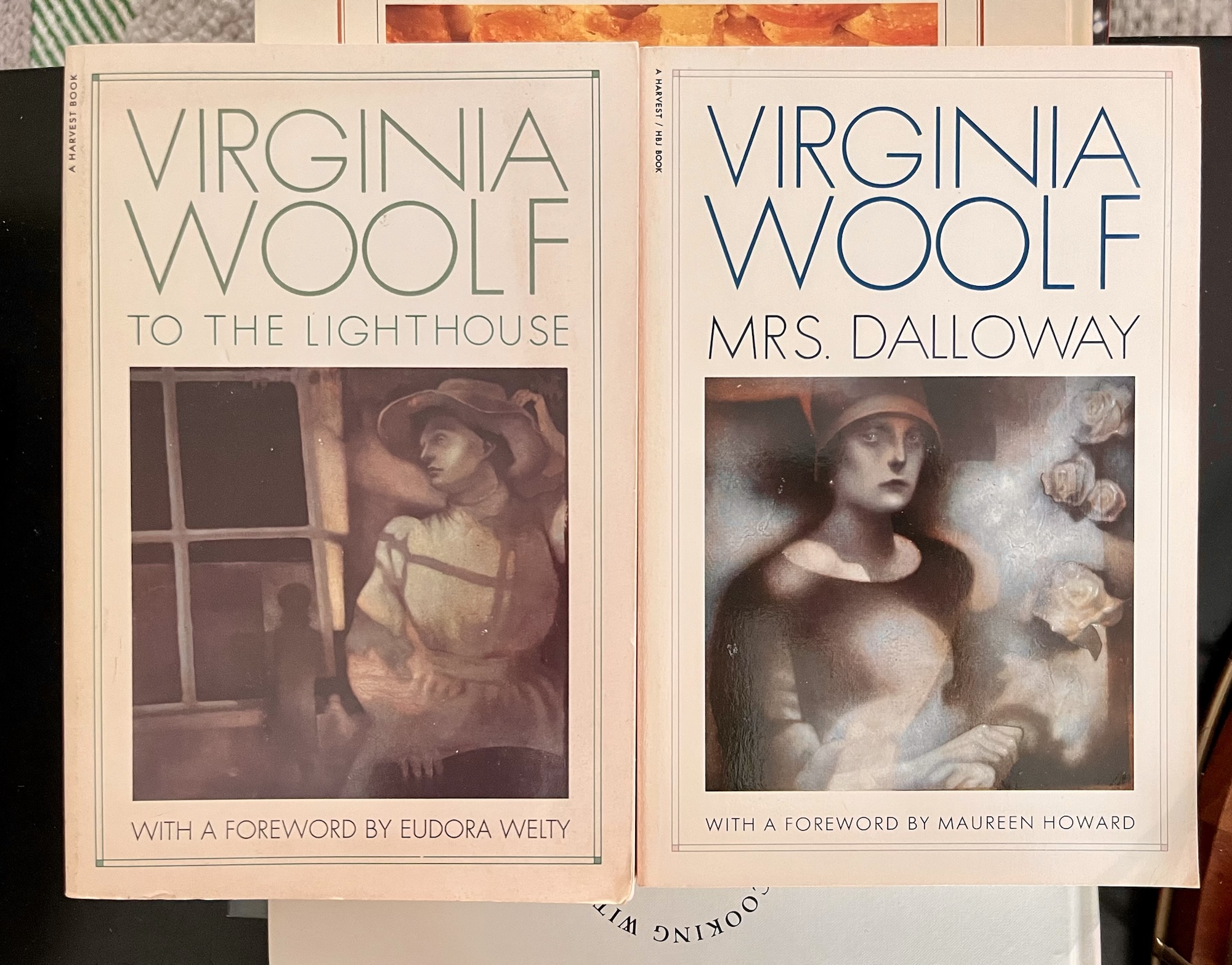
Lord Jim at Home is squalid and startling and nastily horrific. It is abject, lurid, violent, and dark. It is also sad, absurd, mythic, often very funny, and somehow very, very real for all its strangeness. The novels I would most liken Lord Jim at Home to, at least in terms of the aesthetic and emotional experience of reading it, are Ann Quin’s BergAnna Kavan’s Ice, Mervyn Peake’s Gormenghast novels, Virginia Woolf’s Mrs. Dalloway, and James Joyce’s Portrait (as well as bits of Ulysses). (I have not read Conrad’s Lord Jim, which Brooke has taken as something of a precursor text for Lord Jim at Home.)”

American Abductions, Mauro Javier Cárdenas☆

Another favorite novel this year. From a riff back in October:

“If I were to tell you that Mauro Javier Cárdenas’s third novel is about Latin American families being separated by racist, government-mandated (and wholly fascist, really) mass deportations, you might think American Abductions is a dour, solemn read. And yes, Cárdenas conjures a horrifying dystopian surveillance in this novel, and yes, things are grim, but his labyrinthine layering of consciousnesses adds up to something more than just the novel’s horrific premise on its own. Like Bernhard, Krasznahorkai, and Sebald, Cárdenas uses the long sentence to great effect. Each chapter of American Abductions is a wieldy comma splice that terminates only when his chapter concludes—only each chapter sails into the next, or layers on it, really. It’s fugue-like, dreamlike, sometimes nightmarish. It’s also very funny. But most of all, it’s a fascinating exercise in consciousness and language—an attempt, perhaps, to borrow a phrase from one of its many characters, to make a grand ‘statement of missingnessness.'”

Attic, Katherine Dunn☆

Truck, Katherine Dunn

Katherine Dunn’s first novel Attic is seriously fucked up—like William Burroughs-Kathy Acker fucked up—an abject rant from a woman in prison in the mode of Ginsberg’s Howl. The narrator seems to be an autofictional version of Dunn herself, which is perhaps why Eric Rosenblum, in his 2022 New Yorker review described it as “largely a realist work in which Dunn emphasizes the trauma of her protagonist’s childhood.” Rosenblum uses the term realism two other times to describe Attic and refers to it at one point as a work of magical realism. If Attic is realism then so is Blood and Guts in High School. Her second novel Truck is equally weird, but it was maybe too much for me by the end.

Soldier of Mist, Gene Wolfe

Great premise, poor execution.

Final Cut, Charles Burns☆

In my review, I wrote that Final Cut served up “all the sinister dread and awful beauty that anyone following Burns’ career would expect, synthesized into his most lucid exploration of the inherent problems of artistic expression.”

Wise Children, Angela Carter

An enjoyable and maybe old-fashioned effort from Carter. I breezed through it, and remember it fondly.

Garbage, Stephen Dixon☆

I think Stephen Dixon’s novel Garbage was my favorite read of the year. I don’t know if it’s the best novel I read this year, but it was the most compelling—by which I mean it compelled me to keep reading, way too late some nights. From a thing I wrote a few months ago:

“I don’t know if Dixon’s Garbage is the best novel I’ve read so far this year, but it’s certainly the one that has most wrapped itself up in my brain pan, in my ear, throbbed a little behind my temple. The novel’s opening line sounds like an uninspired set up for a joke: ‘Two men come in and sit at the bar.’ Everything that unfolds after is a brutal punchline, reminiscent of the Book of Job or pretty much any of Kafka’s major works. These two men come into Shaney’s bar—this is, or at least seems to be, NYC in the gritty seventies—and try to shake him down to switch up garbage collection services. A man of principle, Shaney rejects their ‘offer,’ setting off an escalating nightmare, a world of shit, or, really, a world of garbage. I don’t think typing this description out does any justice to how engrossing and strange (and, strangely normalGarbage is. Dixon’s control of Shaney’s voice is precise and so utterly real that the effect is frankly cinematic, even though there are no spectacular pyrotechnics going on; hell, at times Dixon’s Shaney gives us only the barest visual details to a scene, and yet the book still throbs with uncanny lifeforce. I could’ve kept reading and reading and reading this short novel; its final line serves as the real ecstatic punchline. Fantastic stuff.”

Graffiti on Low or No Dollars, Elberto Muller☆

A weirdo novel-in-riffs that I loved: bohemian hobo freight hopping, drug lore, art. Muller’s storytelling chops are excellent—he’s economical, dry, sometimes sour, and most of all a gifted imagist.

Galaxies, Barry N. Malzberg

Southern Comfort, Barry N. Malzberg (as “Gerold Watkins”)

A Satyr’s Romance, Barry N. Malzberg (as “Gerold Watkins”)

I really wanted to get into Galaxies, but I couldn’t. Malzberg’s faux-sci-fi metatextualist experiment carries his postmodernist anxiety of influence like a lance tilted against the would-be contemporaries who were more likely to get covered in The New York Times. His metamuscle is as strong as those folks, but you have to tell a story. I preferred the “erotic” novels I read that he wrote under the pseudonym Gerrold Watkins, 1969’s Southern Comfort and 1970’s A Satyr’s Romance.

The Singularity, Dino Buzzati; trans. Anne Milano Appel

From my review of The Singularity:

“Ultimately, The Singularity feels less like a novella than it does a short story stretched a bit too thin. Buzzati adroitly crafts an atmosphere of suspense and foreboding, but the characters are underdeveloped. Like a lot of pulp fiction, Buzzati’s book often reads as if it were written very quickly (and written expressly for money). Still, Buzzati’s intellect gives the book a philosophical heft, even if it sometimes comes through awkwardly in forced dialogue. Anne Milano Appel’s translation is smooth and nimble; it’s a page turner, for sure, and if it seems like I’ve been a bit rough on it in this paragraph in particular, I should be clear: I enjoyed The Singularity.”

Waiting for the Fear, Oğuz Atay; trans. Ralph Hubbell

A book of cramped, anxious stories. Atay, via Hubbell’s sticky translation, creates little worlds that seem a few reverberations off from reality. These are the kind of stories that one enjoys being allowed to leave, even if the protagonists are doomed to remain in the text (this is a compliment). Standouts include “Man in a White Overcoat,” “The Forgotten,” and “Letter to My Father.”

Making Pictures Is How I Talk to the World, Dmitry Samarov

Making Pictures spans four decades of Samarov’s career, showcasing his diverse styles—sketches, inks, oils, and more—through a thematically organized collection. His art, like his writing, emphasizes perspective over adornment, vividly depicting Chicago’s bars, coffee shops, and indie clubs.

Magnetic Field(s), Ron Loewinsohn☆

A hypnotic, fugue-like triptych exploring crime and art as overlapping intimacies. Through a burglar, a composer, and a novelist, it frames imagining another life as a taboo act of trespass.

Body High, Jon Lindsey

A breezy drug novel that’s funny, gross, and abject but tries to do too much too quickly. The narrator, a medical-experiment subject, dreams of writing pro-wrestling scripts, but spirals even further into mania when his underage aunt enters his life and stirs some disturbing desires. Body High is at its best when at its grimiest.

Sunday, Olivier Schrauwen☆

An achievement for slackers the world over. Sunday is a true graphic novel, by which I mean a real novel. Maybe I’ll get to a proper review of it; maybe The Comics Journal will ask me to come back to write reviews again. Anyway. Great stuff, a real achievement to those of us willing to drink a few beers before noon and fail to open the door when neighbors ring the bell.

Tinker Tailor Soldier Spy, John le Carré☉☆

Perfect book.

Breaking and Entering, Joy Williams☆

Joy Williams’ fourth novel, 1988’s Breaking and Entering zigs when you expect it to zag. It ends up in a place no reader would expect, and I don’t mean that there’s some weird twist. It twists weirdly like life. The sentences are excellent, but so are the paragraphs. Breaking and Entering is very, very Florida, crammed with weirdos and tragedies, farcical, ironic, and thickly sauced in the laugh-cry flavor. I’m not sure exactly where it’s set, but I do know that I do know the general area, the barrier islands, skinny shining strips of weird between the Gulf and the Tampa Bay.

Hyperion, Dan Simmons

The Fall of Hyperion, Dan Simmons

I listened to Simmons’ mass-cult favorites as audiobooks—Hyperion was good; Fall was pretty terrible! But seriously, the first one is a nice postmodernist sci-fi take on Canterbury Tales. 

Three Trapped Tigers, G. Cabrera Infante; trans. Donald Gardner and Suzanne Jill Levine with collaboration by Infante☆

Language! Language! Language! Bombastic, bullying, buzzing, braying, bristling— Infante’s dizzying mosaic of the fifties at night (and some hungover mornings) in Havana boxes you on your ear before kissing it, your ear, nipping the lobe even, showing off some neat tricks and other twisters of its fat vibrant tongue. A delight.

The Rest Is Silence, Augusto Monterroso; trans. Aaron Kerner

A quick clever slim novel that riffs on literary failure. A nugget from the so-called Latin Boom that surely (don’t call me Shirley!) influenced Roberto Bolaño.

The Obscene Bird of Night, José Donoso; trans. Hardie St. Martin, Leonard Mades, Megan McDowell☆

Heavy and gross, twisted and twisting, I loved Donoso’s The Obscene Bird of Night–reminded me of Goya’s Caprichos and William Faulkner and Anna Kavan soaked in Salò and Aleksei German’s adaptation of Hard to Be a God. About half way through I realized I needed to go back and put together some of the plot strands I’d missed; I think this novel is more coherent than its surreal and grotesque flourishes initially suggest.

Small dents, big books (tl;dr)

I usually finish reading a novel if I stick with it for, say thirty-to-fifty pages. However, as is the case with many readers, I suspect, very long novels foil me; or, rather, time foils me. Obligations intercede. Here are some long novels that I had to put aside for another time. From the top:

Lies and Sorcery, Elsa Morante (775 pages)

If the bookmark I left in Jenny McPhee’s translation Lies and Sorcery is not lying (or ensorcelled), I got seventy pages into it before getting sidetracked with something else. I remember liking what I was reading but also that the book seemed very heavy over my head at night.

The Strudlhof Steps, Heimito von Doderer (840 pages)

I’ve really enjoyed the first fifty pages of Heimito von Doderer’s The Strudlhof Steps (in translation by Vincent Kling). I’ve enjoyed them so much that I’ve read them at least four times over the past three years. The longest I’ve waded into the Steps was to page 99. Again, a slimmer model comes round and I lose my focus—but of the four novels I’ve listed here, von Doderer’s is the one that’s made the biggest impression on me. My bites may have been shallow but I keep going in for seconds.

A Bended Circuity, Robert S. Stickley (637 pages)

Although it’s the shortest novel on this list, my edition of RSS’s ABC feels cramped and constrained. I think the novel would like a bigger home. The pages are too bright, the font too small, the margins too narrow. It’s a cramped reading experience. I suppose I could break down and buy the Corona\Samizdat edition, which may be easier to ease into. Or an e-book? RSS, please agree to an e-book! Some of us have aging eyes. Oh, I got to page 48.

Miss MacIntosh, My Darling, Marguerite Young (1321 pages)

I cracked into Marguerite Young’s Miss MacIntosh, My Darling twice this year; once in the Spring and once in the Fall. Maybe I’ll try again in the Winter. I stalled out 78 pages in, at the end of chapter 3.